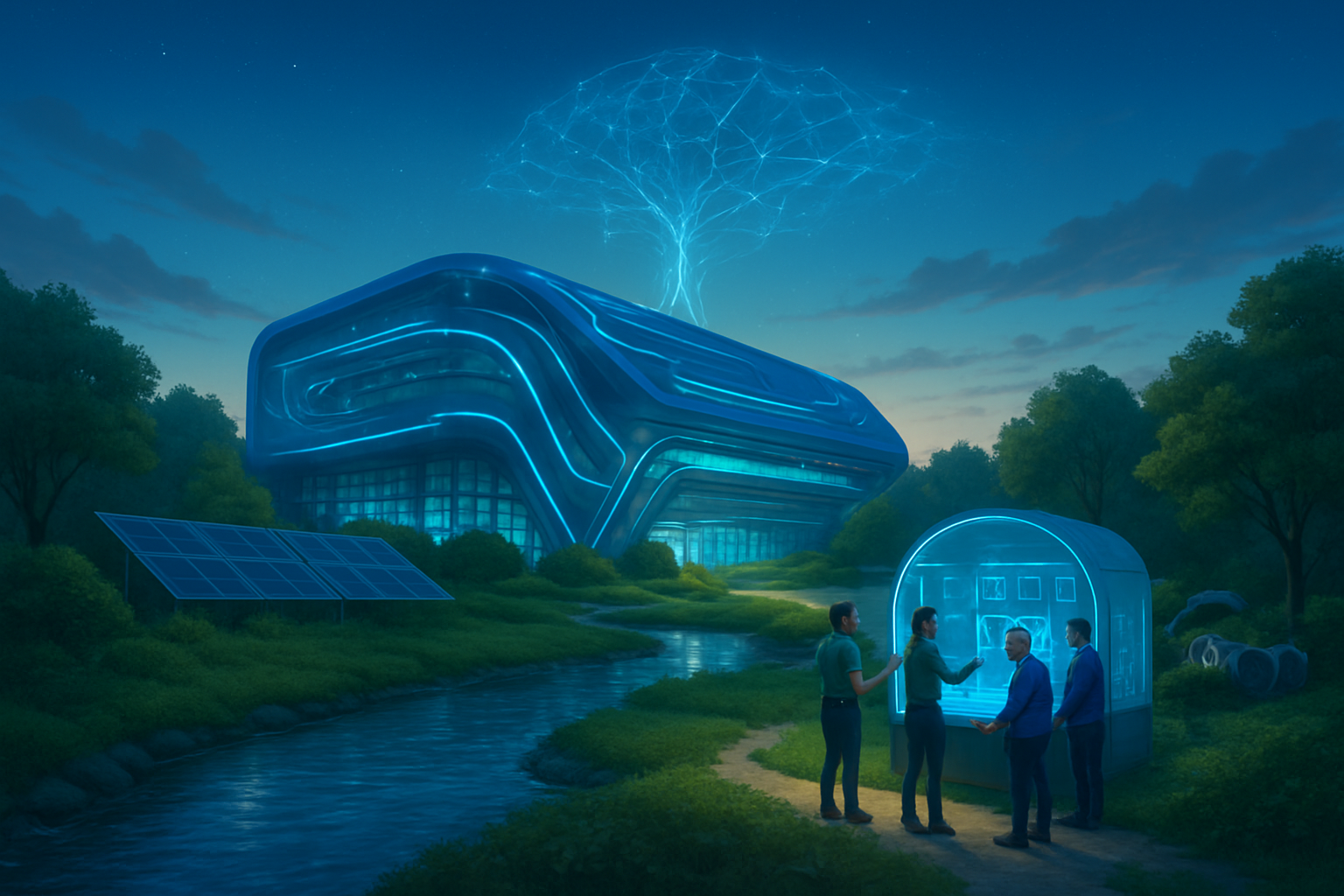
On January 13, 2026, Microsoft (NASDAQ: MSFT) unveiled its "Community-First AI Infrastructure" framework, a sweeping set of commitments designed to redefine the relationship between technology giants and the local communities that host their massive data centers. Announced by Microsoft Vice Chair and President Brad Smith during a public forum in Virginia, the initiative aims to quell growing public and political anxieties over the resource-intensive nature of the artificial intelligence boom. By prioritizing local economic health and resource sustainability, Microsoft is attempting to pivot from the traditional "growth-at-all-costs" model to one of "responsible stewardship."
The significance of this announcement cannot be overstated. As the demand for generative AI capabilities continues to surge, the physical infrastructure required to power these models—land, water, and electricity—has become a flashpoint for controversy. Microsoft’s new framework arrived just weeks after political pressure mounted from the incoming Trump administration, which emphasized that the rapid expansion of AI should not come at the expense of American households' utility bills. This move marks a strategic effort by the tech giant to self-regulate and set a voluntary industry standard before more stringent federal mandates are imposed.
Decoupling Growth from Grids: The Technical Framework
At the heart of the "Community-First" initiative is a sophisticated five-point plan that addresses the most persistent criticisms of data center expansion. The framework’s most technically significant component is its approach to Electricity Price Protection. Microsoft is advocating for a "user-pays" model, pioneered in states like Wisconsin and Wyoming. In Wisconsin, the company is pushing for a "Very Large Customers" rate structure that requires industrial AI users to pay the marginal cost of the energy they consume. By funding the full cost of new generation plants and high-voltage transmission lines upfront, Microsoft ensures that the localized spike in demand does not force residential rate increases. This differs from previous approaches where utility companies often spread the cost of grid upgrades across their entire customer base, effectively subsidizing tech giants with local residents' money.
The framework also introduces rigorous Water Stewardship standards, targeting a 40% reduction in data center water intensity by 2030. To achieve this, Microsoft is deploying advanced closed-loop cooling systems in its newest facilities. Unlike traditional evaporative cooling, which can consume millions of gallons of potable water daily, closed-loop systems recirculate water within a sealed environment, drastically reducing withdrawal from local aquifers. Furthermore, Microsoft has pledged to become "Water Positive," meaning it will replenish more water than it consumes within the same local water district through restoration projects and infrastructure grants, such as a $25 million investment in Southern Virginia’s sewer systems.
Reaction from the AI research and engineering communities has been largely positive regarding the technical feasibility, though experts noted the high capital expenditure required. "Microsoft is effectively building its own utility ecosystem to de-risk its expansion," noted one lead analyst. By committing to Local Job Creation and Tax Base Contributions, the company is also abandoning its history of seeking "sweetheart" tax abatements. Instead, it will pay full local property tax rates on its land and high-value equipment, ensuring that hundreds of millions of dollars flow directly into local schools, hospitals, and public services without the delay of negotiated exemptions.
The Hyperscaler Arms Race: Strategic Implications for Big Tech
This framework places significant pressure on other "hyperscalers" like Alphabet Inc. (NASDAQ: GOOGL), Amazon.com, Inc. (NASDAQ: AMZN), and Meta Platforms, Inc. (NASDAQ: META). For years, these companies have competed in a "race to the bottom," playing municipalities against one another to secure the most lucrative tax breaks and energy deals. Microsoft’s public pivot to "paying its own way" effectively ends this era of leverage, positioning the company as the "good neighbor" in the eyes of regulators. This is a clear strategic advantage as local opposition has begun to stall projects for competitors; for instance, xAI recently faced severe backlash for unauthorized generator use in Memphis, and OpenAI has dealt with grid-related friction in Michigan.
For startups and smaller AI labs, the implications are more complex. While Microsoft can afford the massive upfront costs of building grid infrastructure and paying full property taxes, smaller players may find it increasingly difficult to compete if these "good neighbor" policies become codified into law. If states begin requiring all data center operators to fund their own transmission lines, the barrier to entry for domestic AI infrastructure will skyrocket, potentially further consolidating power among the wealthiest tech incumbents.
Market analysts suggest that Microsoft’s partnership with utilities like Black Hills Energy (NYSE: BKH) to modernize grids upfront is a blueprint for the industry. By securing its own energy future through these community-friendly rate structures, Microsoft is insulating itself from the political volatility surrounding energy costs. This proactive stance is likely to be viewed favorably by long-term investors who prioritize regulatory stability and ESG (Environmental, Social, and Governance) compliance, even if the short-term capital expenditure remains staggering.
Scaling Responsibly in the Age of AI Dominance
The "Community-First" framework is a direct response to a broader shift in the AI landscape. In 2025 and early 2026, the narrative around AI transitioned from the magic of the models to the reality of the machines. The sheer scale of the infrastructure required to support next-generation models like GPT-5 and beyond has made data centers as visible and controversial as power plants or oil refineries. Microsoft’s move reflects a realization that social license is now a critical bottleneck for AI progress. Without community buy-in, the physical expansion required for AGI (Artificial General Intelligence) will simply not be allowed to happen.
However, the plan has not escaped criticism. Environmental advocacy groups have raised concerns about "greenwashing," pointing out that while closed-loop cooling and water replenishment are beneficial, the sheer volume of energy required—often still backed by natural gas in many regions—remains a massive carbon hurdle. Critics on platforms like Reddit and specialized tech forums have argued that "Water Positive" claims can be difficult to verify without independent, third-party monitoring. They suggest that replenish-and-consume metrics can be manipulated if the replenishment occurs in different parts of a watershed than the consumption.
Historically, this moment draws parallels to the early days of the industrial revolution or the expansion of the interstate highway system. In those eras, the initial unregulated boom eventually led to significant public harm, followed by a period of intense regulation. Microsoft is attempting to bypass that cycle by building the "guardrails" directly into its business model. Whether this framework can truly balance the "voracious demand" of AI with the finite resources of a local township remains the central question of the next decade.
The Road Ahead: 2026 and Beyond
In the near term, expect to see Microsoft roll out the Community AI Investment pillar of its plan with greater intensity. This includes the expansion of its Datacenter Academy, which aims to train thousands of local workers in specialized roles like "Critical Environment Technicians." In January 2026 alone, Microsoft announced a major partnership with Gateway Technical College in Wisconsin to train 1,000 students. We are also likely to see the conversion of local libraries into "AI Learning Hubs," providing the public with free access to high-tier AI tools and literacy training, a move intended to make the benefits of AI feel tangible rather than abstract to rural residents.
Looking further ahead, the "Community-First" model will likely face its toughest test as AI power demands continue to scale. Experts predict that by 2027, several "gigawatt-scale" data center clusters will be proposed. At that scale, even the most generous rate structures and water-saving technologies will be pushed to their limits. The challenge will be whether Microsoft—and the industry at large—can maintain these commitments when the trade-off is a delay in shipping the next breakthrough model.
A New Social Contract for the Digital Age
Microsoft’s "Community-First AI Infrastructure" framework represents a significant milestone in the history of technology development. It is an admission that the digital world can no longer be decoupled from the physical one, and that the success of the former is dependent on the health of the latter. By committing to electricity price protection, water stewardship, and local economic investment, Microsoft is attempting to draft a new social contract for the AI era.
The long-term impact of this framework will be measured not just in teraflops or revenue, but in the stability of the communities that power the cloud. If successful, Microsoft will have created a sustainable path for the infrastructure that the world’s future depends on. In the coming weeks and months, industry observers should watch for how competitors respond and whether local governments begin to mandate these "voluntary" commitments as the price of admission for the next generation of data centers.
This content is intended for informational purposes only and represents analysis of current AI developments.
TokenRing AI delivers enterprise-grade solutions for multi-agent AI workflow orchestration, AI-powered development tools, and seamless remote collaboration platforms.
For more information, visit https://www.tokenring.ai/.