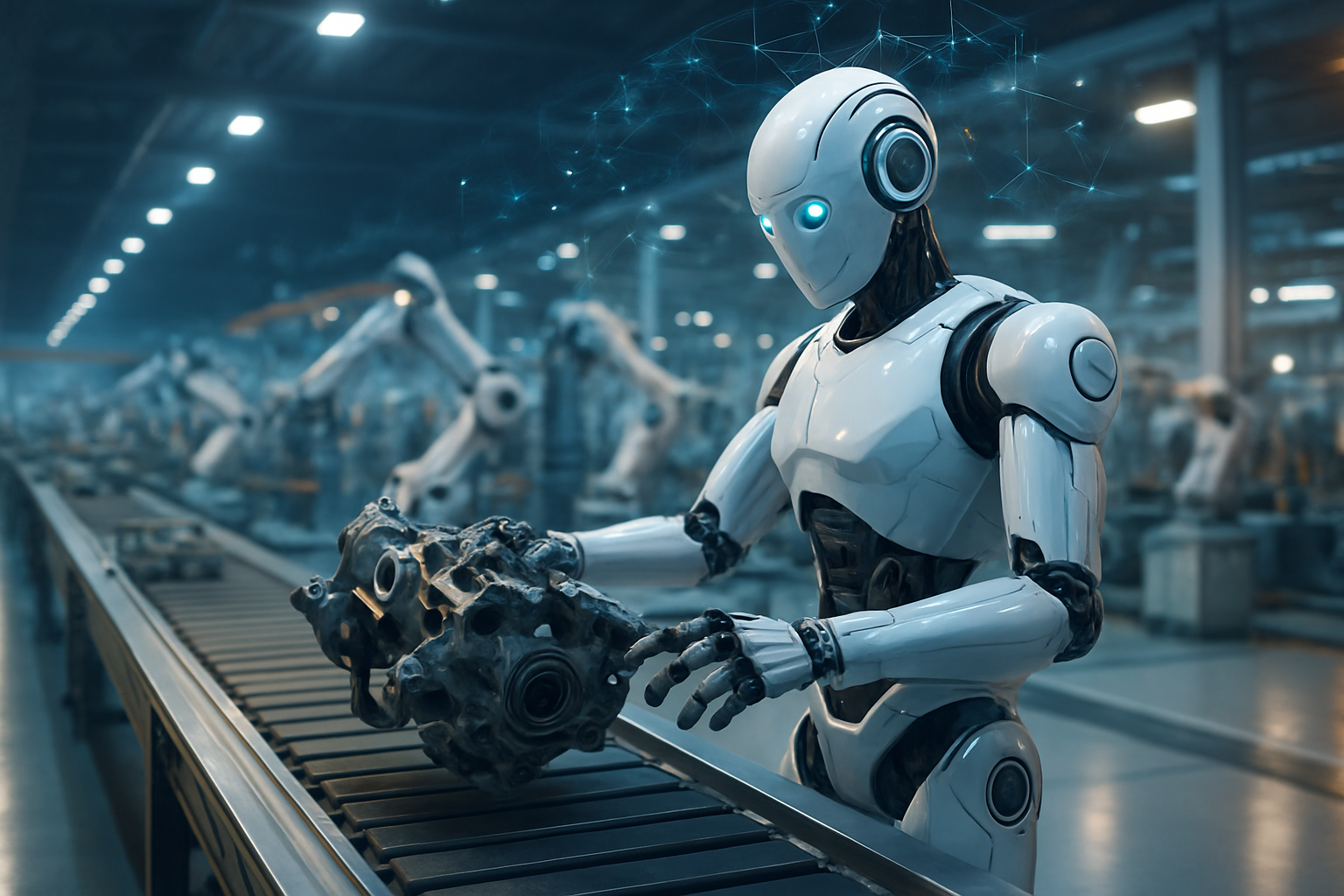
In a landmark shift for the robotics industry, Boston Dynamics has officially transitioned its iconic Atlas robot from a research prototype into a fully autonomous, production-ready workforce. Unveiled in its final commercial form at CES 2026, the all-electric Atlas has shed its hydraulic past and "viral stunt" reputation in favor of sophisticated reinforcement learning (RL) models. This evolution marks a pivotal moment where humanoid robots are no longer just following pre-programmed scripts but are instead making real-time decisions in complex industrial environments.
The significance of this development cannot be overstated. By moving beyond the rigid, hand-crafted algorithms that powered its predecessor, the new Atlas is now capable of navigating the "chaos" of a modern factory—responding to shifting bins, human interference, and unpredictable workflows with a level of fluidity that was once the stuff of science fiction. As the first fleet begins its deployment at Hyundai Motor Group (KRX: 005380) facilities, the robotics world is witnessing the birth of the "Large Behavior Model" (LBM) era.
The Technical Core: Reinforcement Learning and the 360-Degree Advantage
The technical architecture of the 2026 electric Atlas is a radical departure from its hydraulic ancestor. While the previous version relied on Model Predictive Control (MPC) and meticulously designed physics-based routines, the current model is powered by a 450-million-parameter Diffusion Transformer-based architecture. Developed in collaboration with Google DeepMind, a subsidiary of Alphabet Inc. (NASDAQ: GOOGL), this Large Behavior Model allows the robot to learn complex manipulation tasks through a combination of simulation and real-world demonstrations. Unlike traditional software, these RL policies enable Atlas to understand the physics of an object rather than just its coordinates, allowing it to adapt its grip or stance if a part is slightly out of place.
Physically, the robot has evolved to embrace a "superhuman" morphology. With 56 degrees of freedom—nearly double that of its predecessor—the electric Atlas utilizes custom-designed actuators that allow for 360-degree rotation of the torso and limbs. This "alien" flexibility means the robot does not need to turn its entire body to reach behind itself, a feat that drastically reduces cycle times in cramped factory cells. Furthermore, the integration of Vision-Language-Action (VLA) models enables the robot to process natural language commands. A supervisor can simply tell the robot to "prioritize the heavy struts," and the AI will use visual reasoning to identify and sort components without a single line of new code being written.
Initial reactions from the AI research community have been overwhelmingly positive, with many experts noting that Boston Dynamics has solved the "sim-to-real" gap more effectively than any competitor. By using an "Atlas Manual Task System" (MTS)—a stationary upper-body rig—the company has been able to harvest massive amounts of manipulation data, which is then fine-tuned into the full humanoid's RL policy. This data-driven approach has reduced the time to teach Atlas a new factory task from months of engineering to just 48 hours of autonomous training.
The Industrial Arms Race: Hyundai, Tesla, and the Battle for the Floor
The transition to a production-ready Atlas has immediate and far-reaching implications for the competitive landscape of industrial automation. Boston Dynamics, backed by the manufacturing might of Hyundai Motor Group, has successfully pivoted to a "factory-first" strategy. The entire 2026 production run of Atlas units has already been allocated to high-stakes pilot programs, most notably at the Hyundai Motor Group Metaplant America (HMGMA) in Georgia. Here, the robots are being tasked with high-risk, repetitive sequencing—moving engine covers and struts between supplier bins and sequencing dollies—tasks that are physically taxing for human workers.
This move places immense pressure on Tesla (NASDAQ: TSLA), whose Optimus robot has been a central pillar of Elon Musk’s vision for the future. While Tesla has emphasized the scalability and low target cost of Optimus, critics at CES 2026 pointed out that Atlas is already performing certified, enterprise-grade labor in external facilities, whereas Optimus remains largely confined to internal testing. Meanwhile, startups like Figure AI—which recently integrated its models into BMW production lines—are finding themselves in a fierce race for hardware reliability. Atlas’s new self-swappable battery system and 110-pound peak lift capacity give it a distinct "heavy-duty" edge over the more lightweight designs of its rivals.
For tech giants and AI labs, this development proves that the next frontier of AI is not in the cloud, but in the "embodied" world. The success of the Atlas RL stack validates the massive investments made by companies like NVIDIA (NASDAQ: NVDA) in robotics simulation platforms. As Atlas proves it can generate a return on investment through 24/7 autonomous operation, we expect to see a surge in demand for specialized AI chips capable of running high-frequency RL policies at the "edge"—directly on the robot’s hardware.
The Wider Significance: Beyond Human Mimicry
The emergence of a truly autonomous Atlas fits into a broader trend of "General Purpose Robotics," a field that has long been the "holy grail" of AI. For decades, robots were specialized tools—welding arms or vacuum cleaners that did one thing well. The electric Atlas represents a shift toward a singular machine that can do anything a human can do (and some things a human cannot) simply by loading a new model. This fits perfectly into the current "Foundation Model" trend, where a single large-scale AI is adapted for diverse tasks.
However, this breakthrough also raises significant societal and ethical concerns. As Atlas moves from being a research curiosity to a viable replacement for manual labor, the conversation around workforce displacement is becoming more urgent. Unlike previous waves of automation that replaced specific roles, the "embodied AI" seen in Atlas is designed to replace the human form's versatility itself. Analysts are already debating the long-term impact on global supply chains and the potential for a "reshoring" of manufacturing to high-cost regions where robots can offset labor costs.
Comparatively, the leap from the hydraulic Atlas to the electric, RL-driven Atlas is being likened to the "GPT-3 moment" for physical labor. It is the point where the technology stops being a parlor trick and starts being a tool of economic significance. The ability of a machine to "reason" through a physical task—realizing that a bin is stuck and adjusting its leverage to compensate—is a milestone that mirrors the breakthrough of large language models in the digital realm.
Looking Ahead: The Road to Universal Labor
In the near term, we expect Boston Dynamics to focus on refining the "fleet management" aspect of Atlas. This includes the Robotics Metaplant Application Center (RMAC), a "data factory" where dozens of Atlas units will work in a loop solely to generate training data for the rest of the fleet. This "self-improving" cycle could lead to exponential gains in robot dexterity and problem-solving capabilities over the next 18 to 24 months.
The long-term vision for Atlas extends far beyond the factory floor. While the current price point and hardware complexity keep it in the industrial sector, the advancements in RL and power efficiency are laying the groundwork for "humanoids-as-a-service" in logistics, construction, and eventually, healthcare. The biggest remaining challenge is not the AI, but the cost of the hardware; reducing the price of those 56 high-torque actuators will be the key to making Atlas a common sight in the broader world. Experts predict that by 2028, we may see the first "lite" versions of these robots entering the commercial service sector for tasks like janitorial work or complex delivery.
A New Era for Embodied AI
The 2026 electric Atlas is more than just a better robot; it is a manifestation of how far artificial intelligence has come in understanding the physical world. By ditching the pre-programmed routines of the past for the autonomous reasoning of reinforcement learning, Boston Dynamics has created a machine that can truly "see" and "think" its way through a workday.
The key takeaway for the industry is that the "brain" and the "body" have finally caught up with one another. The significance of this development in AI history will likely be viewed as the moment when robotics finally left the laboratory for good. In the coming months, all eyes will be on the Georgia Metaplant, as the first real-world performance data from the Atlas fleet begins to filter back, potentially triggering the largest shift in industrial production since the assembly line.
This content is intended for informational purposes only and represents analysis of current AI developments.
TokenRing AI delivers enterprise-grade solutions for multi-agent AI workflow orchestration, AI-powered development tools, and seamless remote collaboration platforms.
For more information, visit https://www.tokenring.ai/.