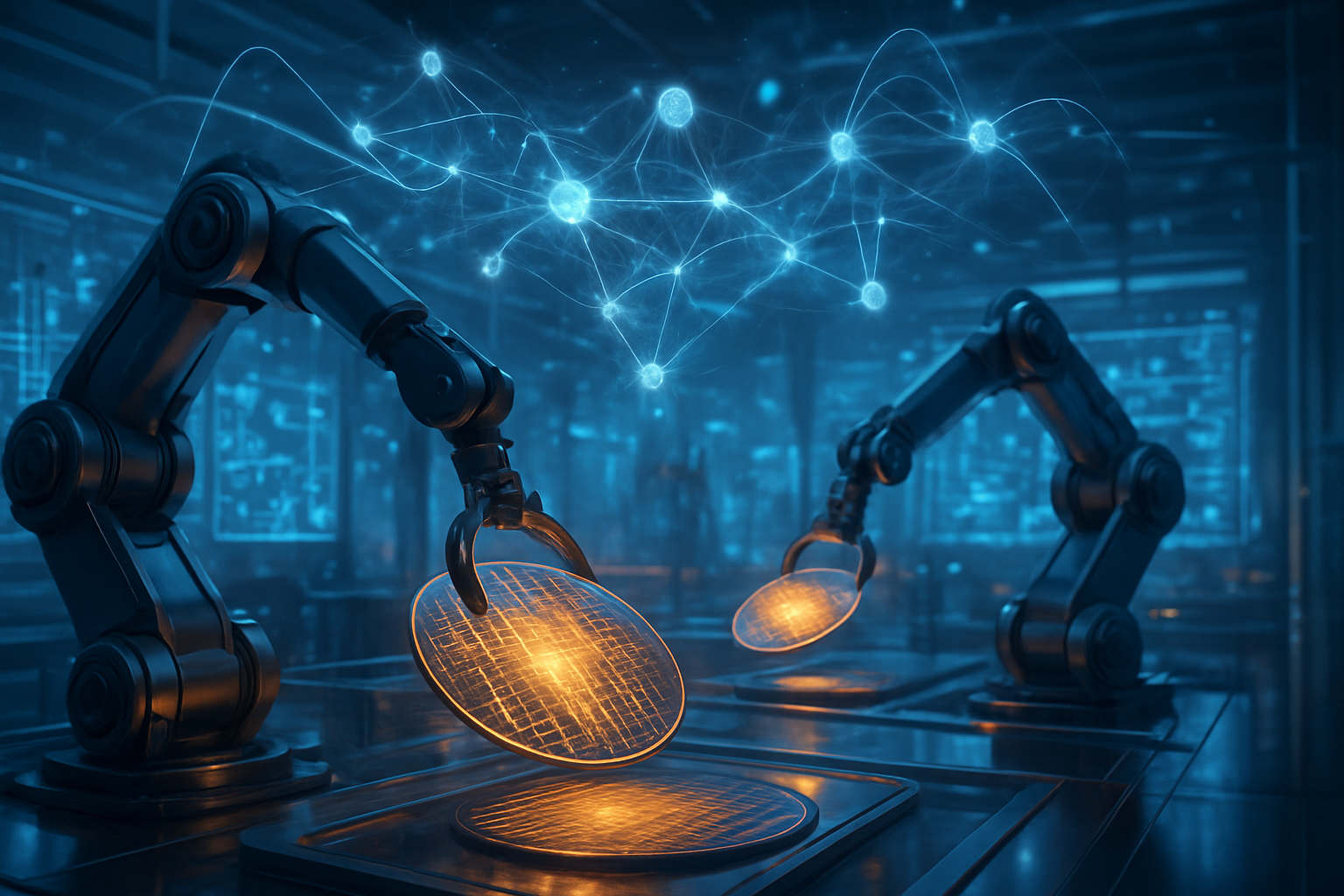
As of February 2026, the semiconductor industry has reached a pivotal inflection point, transitioning from the experimental use of artificial intelligence to the full-scale deployment of "Agentic AI." Unlike previous iterations of machine learning that acted as reactive assistants, these new autonomous agents are beginning to manage end-to-end logistics and production workflows. This evolution marks the birth of the "Silicon-based workforce," a paradigm shift where digital entities reason, plan, and execute complex manufacturing tasks with minimal human intervention.
The immediate significance of this development cannot be overstated. As the industry pushes toward 1.6nm and 2nm process nodes, the complexity of chip design and fabrication has exceeded the limits of unassisted human cognition. Leading manufacturers are now integrating multi-agent systems that coordinate everything from lithography scanner adjustments to global supply chain negotiations. This shift is not just an incremental improvement; it is a fundamental restructuring of how the world’s most complex hardware is built.
From Assisted ML to Autonomous Reasoning
Technically, Agentic AI represents a departure from the "Narrow AI" of the early 2020s. While traditional EDA (Electronic Design Automation) tools used pattern recognition to identify bugs or optimize layouts, Agentic AI employs "Chain-of-Thought" reasoning and tool-use capabilities to solve goal-oriented problems. In a modern verification environment, an agent doesn't just flag a timing violation; it analyzes the root cause, explores multiple architectural remedies, scripts a fix across different software tools, and runs a regression test to ensure stability before presenting the final result for human sign-off.
Industry leaders like Synopsys (NASDAQ: SNPS) have codified this transition through frameworks like the AgentEngineer™, which classifies AI autonomy on a scale from Level 1 (assistive) to Level 5 (fully autonomous). These systems are built on massive multi-modal models that have been trained not just on code, but on decades of proprietary "tribal knowledge" within chip firms. By orchestrating across various APIs and software environments, these agents function as a cohesive digital team, moving beyond simple automation into the realm of professional-grade task execution.
The research community has noted that the primary differentiator is the "proactive" nature of these agents. In a fab environment managed by TSMC (NYSE: TSM), a "Lithography Agent" can now detect a drift in overlay precision and autonomously coordinate with a "Metrology Agent" to recalibrate tools in real-time. This prevents the production of "scrap" wafers, potentially saving hundreds of millions of dollars in yield loss—a task that previously required hours of manual triaging by expert engineers.
A New Era for Industry Titans and Startups
This shift is creating a seismic ripple across the corporate landscape. NVIDIA (NASDAQ: NVDA), the vanguard of the AI revolution, is now one of the primary beneficiaries and users of agentic technology. At the start of 2026, NVIDIA announced it is utilizing agent-driven workflows to design its upcoming "Feynman" architecture, specifically to handle the extreme power-delivery constraints of 2,000-watt chips. By leveraging autonomous agents, NVIDIA can explore design spaces that would take human teams years to map out.
Meanwhile, EDA giants Cadence Design Systems (NASDAQ: CDNS) and Synopsys are transforming from software providers into "digital workforce" managers. Their business models are evolving from selling per-seat licenses to providing "Silicon Agents" that can be deployed to solve specific engineering bottlenecks. This disrupts the traditional consulting and staffing models that have historically supported the semiconductor industry. For major players like Intel (NASDAQ: INTC), which is marketing its 18A process as "AI-native," the integration of agentic workflows is essential to competing with the efficiency of established foundries.
The competitive landscape is also seeing a surge of startups focused on "Agentic Orchestration." These companies are building the "connective tissue" that allows different specialized agents to communicate across the design-to-fab pipeline. Market positioning is now dictated by how well a company can integrate these silicon workers into their existing infrastructure, with early adopters seeing a 30% reduction in time-to-market for complex SoCs (System-on-Chip).
Solving the Human Talent Crisis
Beyond the technical and corporate implications, the emergence of the Silicon-based workforce addresses a critical global challenge: the semiconductor talent shortage. By early 2026, estimates suggested a global deficit of over 146,000 engineers. As the geopolitical race for "chip supremacy" intensifies, the ability to supplement human labor with digital agents has become a matter of national security and economic survival.
Agentic AI allows a single engineer to act as an orchestrator for a team of digital workers, effectively tripling or quadrupling their productivity. This "productivity amplification" is the industry's answer to the aging workforce and the lack of new graduates entering the field. Furthermore, these agents serve as a permanent repository of institutional knowledge; when a senior designer retires, their expertise remains accessible within the "mental model" of the agents they helped train.
However, this transition is not without concern. The broader AI landscape is grappling with the ethics of autonomous decision-making in high-stakes manufacturing. Comparisons are being drawn to the early days of industrial automation, but with a key difference: these agents are making qualitative, reasoning-based decisions rather than just repeating physical motions. There are ongoing debates regarding the "hallucination" of chip logic and the potential for security vulnerabilities to be introduced by autonomous agents if not properly audited.
The Road to 2028: Autonomous Decisions at Scale
Looking toward the near future, the trajectory for Agentic AI is clear. Industry analysts predict that by 2028, AI agents will autonomously make 15% of all daily work decisions in semiconductor manufacturing and design. We are currently in the transition phase, moving from the 5-8% autonomy reported by early adopters like Samsung Electronics (KRX: 005930) and Intel in 2025 toward a future where "Human-on-the-loop" management is the standard.
Future developments are expected to focus on "Level 5 Autonomy," where a designer can provide high-level requirements—such as "Build a 4nm chip for autonomous driving with these specific power and latency targets"—and the agentic system will generate the entire design collateral, verify it, and send it to the fab without intermediate manual steps. The challenges remain significant, particularly in ensuring the interoperability of agents from different vendors and maintaining absolute data privacy in a multi-agent environment.
Experts predict the next breakthrough will come in the form of "Collaborative Agentic Design," where agents from different companies—such as an agent from an IP provider and an agent from a foundry—can securely negotiate technical specifications to optimize a chip's performance before a single transistor is printed.
A Defining Moment in Industrial AI
The rise of Agentic AI in the semiconductor sector represents more than just a new toolset; it is a defining chapter in the history of artificial intelligence. It marks the moment where AI moved from the digital realm of chat and image generation into the physical world of complex industrial production. The "Silicon-based workforce" is now an essential pillar of global technology, bridging the gap between human capability and the soaring demands of the next generation of computing.
Key takeaways for the coming months include the rollout of specialized "Agent Platforms" from the major EDA firms and the first reports of "fully autonomous design closures" in the mobile and automotive sectors. As we move deeper into 2026, the success of these agentic systems will likely determine the winners of the global chip race. For the technology industry, the message is clear: the future of silicon is being written by the silicon itself.
This content is intended for informational purposes only and represents analysis of current AI developments.
TokenRing AI delivers enterprise-grade solutions for multi-agent AI workflow orchestration, AI-powered development tools, and seamless remote collaboration platforms.
For more information, visit https://www.tokenring.ai/.