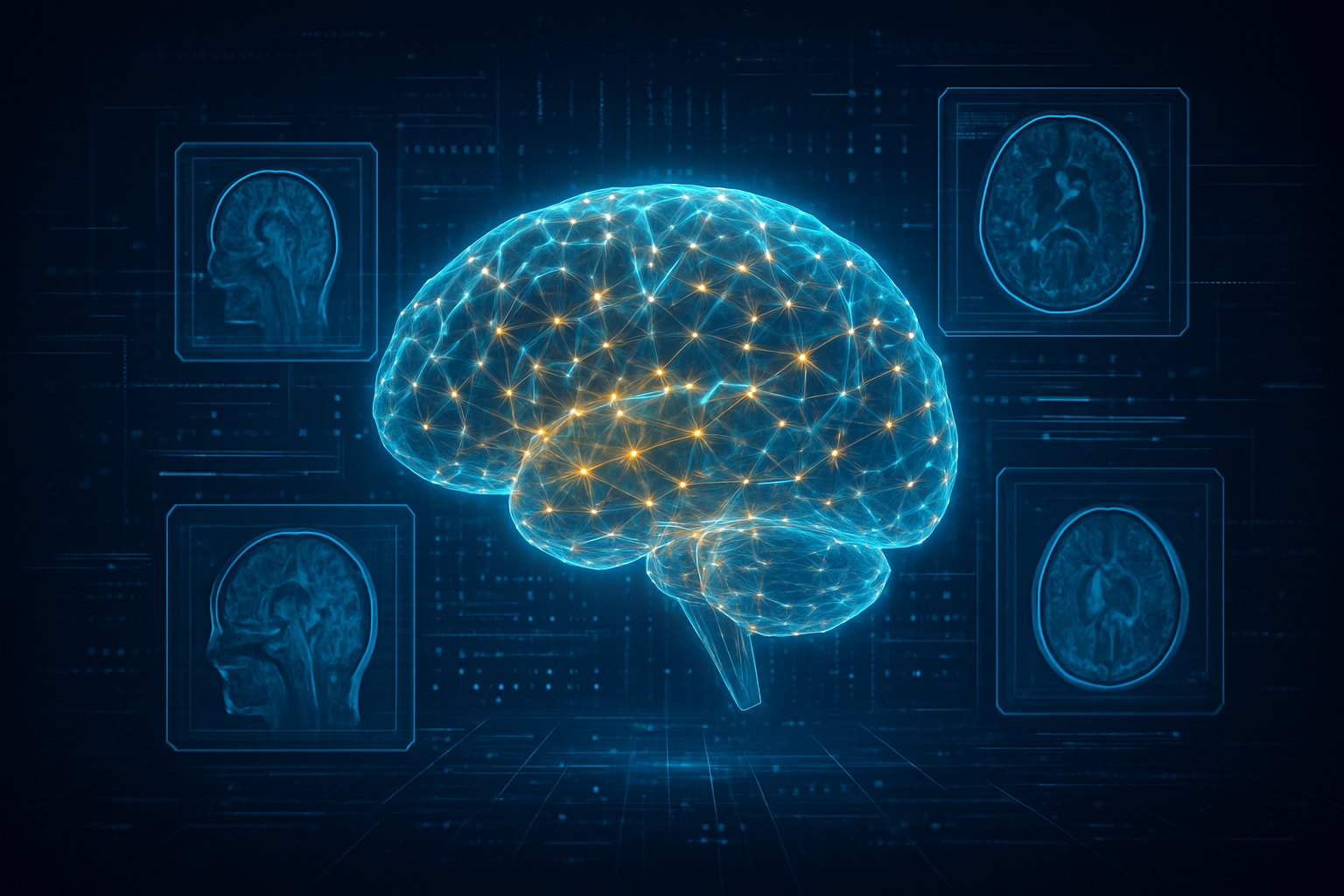
In a landmark development for computational medicine, Mass General Brigham (MGB) officially announced the launch of BrainIAC (Brain Imaging Adaptive Core) on February 5, 2026. This groundbreaking artificial intelligence foundation model represents a paradigm shift in how clinicians diagnose and treat neurological disorders. By utilizing a generalized architecture trained on tens of thousands of volumetric brain scans, BrainIAC has demonstrated an unprecedented ability to predict cognitive decline and identify genetic mutations in brain tumors directly from standard MRI imaging—tasks that previously required invasive biopsies or years of longitudinal observation.
The arrival of BrainIAC marks the transition of medical AI from "task-specific" tools—which were often limited to detecting a single type of lesion—to a sophisticated, multi-purpose "brain intelligence" engine. Integrated directly into the clinical workflow, the model provides radiologists and oncologists with a secondary layer of automated insight, effectively serving as an expert digital consultant that can see "hidden" biomarkers within the grain of a standard MRI.
The Architecture of Intelligence: Self-Supervision and 3D Vision
Technically, BrainIAC is built as a high-capacity 3D vision encoder, a departure from the 2D slice-based analysis that defined the previous decade of medical imaging AI. Developed using the SimCLR framework—a form of self-supervised contrastive learning—the model was not taught using traditional, human-labeled "ground truth" data. Instead, it learned the fundamental geometry and pathology of the human brain by analyzing relationships within a massive dataset of 48,519 MRI scans. This "foundation model" approach allows BrainIAC to understand the baseline of healthy brain anatomy so deeply that it can identify pathological deviations with minimal fine-tuning.
According to technical specifications published this week in Nature Neuroscience, the model specializes in two high-stakes areas: neurodegeneration and neuro-oncology. In the realm of dementia, BrainIAC calculates a patient’s "Brain Age"—a biomarker that compares biological brain volume and structure to chronological age to flag early-stage Alzheimer’s risk. In oncology, the model achieves a feat once thought impossible without surgery: the non-invasive prediction of IDH (Isocitrate Dehydrogenase) mutations in gliomas. By analyzing "radiomic signatures" across multi-parametric sequences (T1, T2, and FLAIR), the AI can tell surgeons whether a tumor is genetically predisposed to certain treatments before the first incision is ever made.
This generalized capability differs fundamentally from previous AI iterations, which were notoriously "brittle"—often failing when faced with scans from different MRI manufacturers or varying magnetic strengths. BrainIAC was trained on a heterogeneous pool of data from Siemens, GE Healthcare (NASDAQ: GEHC), and Philips (NYSE: PHG) hardware, ranging from 1.5T to 3T field strengths. This "hardware-agnostic" training ensures that the model maintains high accuracy regardless of the hospital environment, a major hurdle that had previously stalled the wide-scale adoption of medical AI.
Initial reactions from the AI research community have been overwhelmingly positive, though punctuated by calls for rigorous clinical validation. Dr. Aris Xanthos, a lead researcher at the MIT-IBM Watson AI Lab, noted that BrainIAC’s ability to perform across "seven distinct clinical tasks with a single backbone" is a breakthrough. Experts suggest that the efficiency of the model—requiring 90% less labeled data for new tasks than its predecessors—will accelerate the development of niche diagnostic tools for rare neurological diseases that previously lacked sufficient data for AI training.
Strategic Powerhouses: The Infrastructure Behind the Breakthrough
The launch of BrainIAC is not just a clinical victory but a significant milestone for the tech giants providing the underlying infrastructure. Mass General Brigham developed the model in close collaboration with NVIDIA (NASDAQ: NVDA), utilizing the MONAI (Medical Open Network for AI) framework and NVIDIA’s latest H200 GPU clusters to handle the immense computational load of training a volumetric 3D model. For NVIDIA, BrainIAC serves as a premier case study for their "AI Factory" vision, proving that high-performance computing can move beyond chatbots and into life-saving diagnostic applications.
On the delivery side, Microsoft (NASDAQ: MSFT) has secured a strategic advantage by hosting BrainIAC on its Azure AI platform. Through its subsidiary, Nuance, Microsoft is integrating BrainIAC’s outputs directly into the PowerScribe radiology reporting system. This allows the AI's findings—such as a predicted tumor mutation or an elevated Brain Age score—to be automatically drafted into the radiologist’s report for review. This "last-mile" integration is a significant blow to smaller AI startups that struggle to embed their tools into the high-friction environment of hospital IT systems.
The competitive implications for the broader AI market are profound. With MGB—one of the world's most prestigious academic medical centers—releasing a foundation model of this caliber, the "moat" for startups focusing on single-use diagnostic AI has effectively evaporated. Companies that spent years developing "dementia-only" or "tumor-only" detection tools now find themselves competing against a single, more robust model that does both. This is likely to trigger a wave of consolidation in the healthcare AI sector, as smaller players seek to pivot toward specialized applications that sit atop foundation models like BrainIAC.
A New Era of Predictive Medicine and Its Implications
The wider significance of BrainIAC lies in its role as a harbinger of "predictive" rather than "reactive" medicine. For decades, the AI community has chased the "ImageNet moment" for medicine—a point where a single model could understand medical imagery as broadly as humans understand the physical world. BrainIAC suggests we have arrived. By moving from simple detection (e.g., "there is a tumor") to complex prediction (e.g., "this tumor has an IDH mutation and the patient has a 70% chance of 5-year survival"), AI is beginning to provide information that even the most experienced human radiologists cannot discern from a visual inspection alone.
However, this breakthrough is not without its concerns. The use of foundation models in healthcare raises critical questions about "algorithmic "hallucination" in a 3D space. While a chatbot hallucinating a fact is problematic, an imaging model hallucinating a biomarker could lead to misdiagnosis. Mass General Brigham has addressed this by implementing a "Human-in-the-Loop" requirement, where BrainIAC serves as a decision-support tool rather than an autonomous diagnostic agent. Furthermore, the massive dataset used—nearly 50,000 scans—raises ongoing debates regarding patient data privacy and the ethics of using de-identified clinical data to build proprietary commercial tools.
Comparatively, BrainIAC is being hailed as the "AlphaFold of Neuroimaging." Just as DeepMind’s AlphaFold revolutionized biology by predicting protein structures, BrainIAC is expected to do the same for the "connectome" and the structural health of the human brain. It represents the successful application of the "Scaling Laws" of AI to the complex, high-dimensional world of medical physics, proving that more data and more compute, when applied to high-quality clinical records, yield exponential gains in diagnostic power.
The Horizon: Expanding the Foundation
In the near term, Mass General Brigham intends to expand the BrainIAC framework to include longitudinal data, allowing the model to analyze how a patient’s brain changes over multiple years of scans. This could unlock even more precise predictions for the progression of multiple sclerosis and the long-term effects of traumatic brain injury. There are also early discussions about expanding the model’s architecture to other organs, potentially creating a "BodyIAC" that could apply the same self-supervised principles to chest CTs and abdominal MRIs.
The challenges ahead are largely regulatory and cultural. While the technology is ready, the pathway for FDA approval of "evolving" foundation models remains complex. Unlike a static software-as-a-medical-device (SaMD), a foundation model that can be fine-tuned for dozens of tasks presents a moving target for regulators. Furthermore, the medical community must grapple with the "black box" nature of these models; understanding why BrainIAC thinks a tumor has a certain mutation is just as important to some doctors as the accuracy of the prediction itself.
Experts predict that by the end of 2026, the use of foundation models in large health systems will be the standard of care rather than the exception. As BrainIAC begins its rollout across the MGB network this month, the tech and medical worlds alike will be watching to see if it can deliver on its promise of reducing diagnostic errors and personalizing patient care on a global scale.
Summary: A Benchmark in Medical Evolution
The launch of BrainIAC stands as a defining moment in the history of artificial intelligence. By successfully distilling the complexities of human neuroanatomy into a 3D foundation model, Mass General Brigham has provided a blueprint for the future of clinical diagnostics. The model’s ability to non-invasively predict genetic mutations and early-stage dementia marks the beginning of an era where the MRI is no longer just a picture, but a deep reservoir of biological data waiting to be decoded.
As we look toward the coming months, the focus will shift from the model's technical brilliance to its real-world clinical outcomes. The integration of BrainIAC into hospital workflows via Microsoft and NVIDIA infrastructure will serve as a litmus test for the scalability of medical AI. For now, BrainIAC has set a new bar for what is possible when the frontiers of computer science and clinical medicine converge.
This content is intended for informational purposes only and represents analysis of current AI developments.
TokenRing AI delivers enterprise-grade solutions for multi-agent AI workflow orchestration, AI-powered development tools, and seamless remote collaboration platforms.
For more information, visit https://www.tokenring.ai/.