
Blog

  • NVIDIA Reports Record $51.2B Q3 Revenue as Blackwell Demand Hits ‘Insane’ Levels

    NVIDIA Reports Record $51.2B Q3 Revenue as Blackwell Demand Hits ‘Insane’ Levels

    In a financial performance that has effectively silenced skeptics of the "AI bubble," NVIDIA Corporation (NASDAQ: NVDA) has once again shattered industry expectations. The company reported record-breaking Q3 FY2026 revenue of $51.2 billion for its Data Center segment alone, contributing to a total quarterly revenue of $57.0 billion—a staggering 66% year-on-year increase. This explosive growth is being fueled by the rapid transition to the Blackwell architecture, which CEO Jensen Huang described during the earnings call as seeing demand that is "off the charts" and "insane."

    The implications of these results extend far beyond a single balance sheet; they signal a fundamental shift in the global computing landscape. As traditional data centers are being decommissioned in favor of "AI Factories," NVIDIA has positioned itself as the primary architect of this new industrial era. With a production ramp-up that is the fastest in semiconductor history, the company is now shipping approximately 1,000 GB200 NVL72 liquid-cooled racks every week. These systems are the backbone of massive-scale projects like xAI’s Colossus 2, marking a new era of compute density that was unthinkable just eighteen months ago.

    The Blackwell Breakthrough: Engineering the AI Factory

    At the heart of NVIDIA's dominance is the Blackwell B200 and GB200 series, a platform that represents a quantum leap over the previous Hopper generation. The flagship GB200 NVL72 is not merely a chip but a massive, unified system that acts as a single GPU. Each rack contains 72 Blackwell GPUs and 36 Grace CPUs, interconnected via NVIDIA’s fifth-generation NVLink. This architecture delivers up to a 30x increase in inference performance and a 25x increase in energy efficiency for trillion-parameter models compared to the H100. This efficiency is critical as the industry shifts from training static models to deploying real-time, autonomous AI agents.

    The technical complexity of these systems has necessitated a revolution in data center design. To manage the immense heat generated by Blackwell’s 1,200W TDP (Thermal Design Power), NVIDIA has moved toward a liquid-cooled standard. The 1,000 racks shipping weekly are complex machines comprising over 600,000 individual components, requiring a sophisticated global supply chain that competitors are struggling to replicate. Initial reactions from the AI research community have been overwhelmingly positive, with engineers noting that the Blackwell interconnect bandwidth allows for the training of models with context windows previously deemed computationally impossible.

    A Widening Moat: Industry Impact and Competitive Pressure

    The sheer scale of NVIDIA's Q3 results has sent ripples through the "Magnificent Seven" and the broader tech sector. While competitors like Advanced Micro Devices, Inc. (NASDAQ: AMD) have made strides with their MI325 and MI350 series, NVIDIA’s 73-76% gross margins suggest a level of pricing power that remains unchallenged. Major Cloud Service Providers (CSPs) including Microsoft Corporation (NASDAQ: MSFT), Alphabet Inc. (NASDAQ: GOOGL), and Amazon.com, Inc. (NASDAQ: AMZN) continue to be NVIDIA’s largest customers, even as they develop their own internal silicon like Google’s TPU and Amazon’s Trainium.

    The strategic advantage for these tech giants lies in the "CUDA Moat." NVIDIA’s software ecosystem, refined over two decades, remains the industry standard for AI development. For startups and enterprise giants alike, the cost of switching away from CUDA—which involves rewriting entire software stacks and optimizing for less mature hardware—often outweighs the potential savings of cheaper chips. Furthermore, the rise of "Physical AI" and robotics has given NVIDIA a new frontier; its Omniverse platform and Jetson Thor chips are becoming the foundational layers for the next generation of autonomous machines, a market where its competitors have yet to establish a significant foothold.

    Scaling Laws vs. Efficiency: The Broader AI Landscape

    Despite the record revenue, NVIDIA’s report comes at a time of intense debate regarding the "AI Bubble." Critics point to the massive capital expenditures of hyperscalers—estimated to exceed $250 billion collectively in 2025—and question the ultimate return on investment. The late 2025 "DeepSeek Shock," where a Chinese startup demonstrated high-performance model training at a fraction of the cost of U.S. counterparts, has raised questions about whether "brute force" scaling is reaching a point of diminishing returns.

    However, NVIDIA has countered these concerns by pivoting the narrative toward "Infrastructure Economics." Jensen Huang argues that the cost of not building AI infrastructure is higher than the cost of the hardware itself, as AI-driven productivity gains begin to manifest in software services. NVIDIA’s networking segment, which saw revenue hit $8.2 billion this quarter, underscores this trend. The shift from InfiniBand to Spectrum-X Ethernet is allowing more enterprises to build private AI clouds, democratizing access to high-end compute and moving the industry away from a total reliance on the largest hyperscalers.

    The Road to Rubin: Future Developments and the Next Frontier

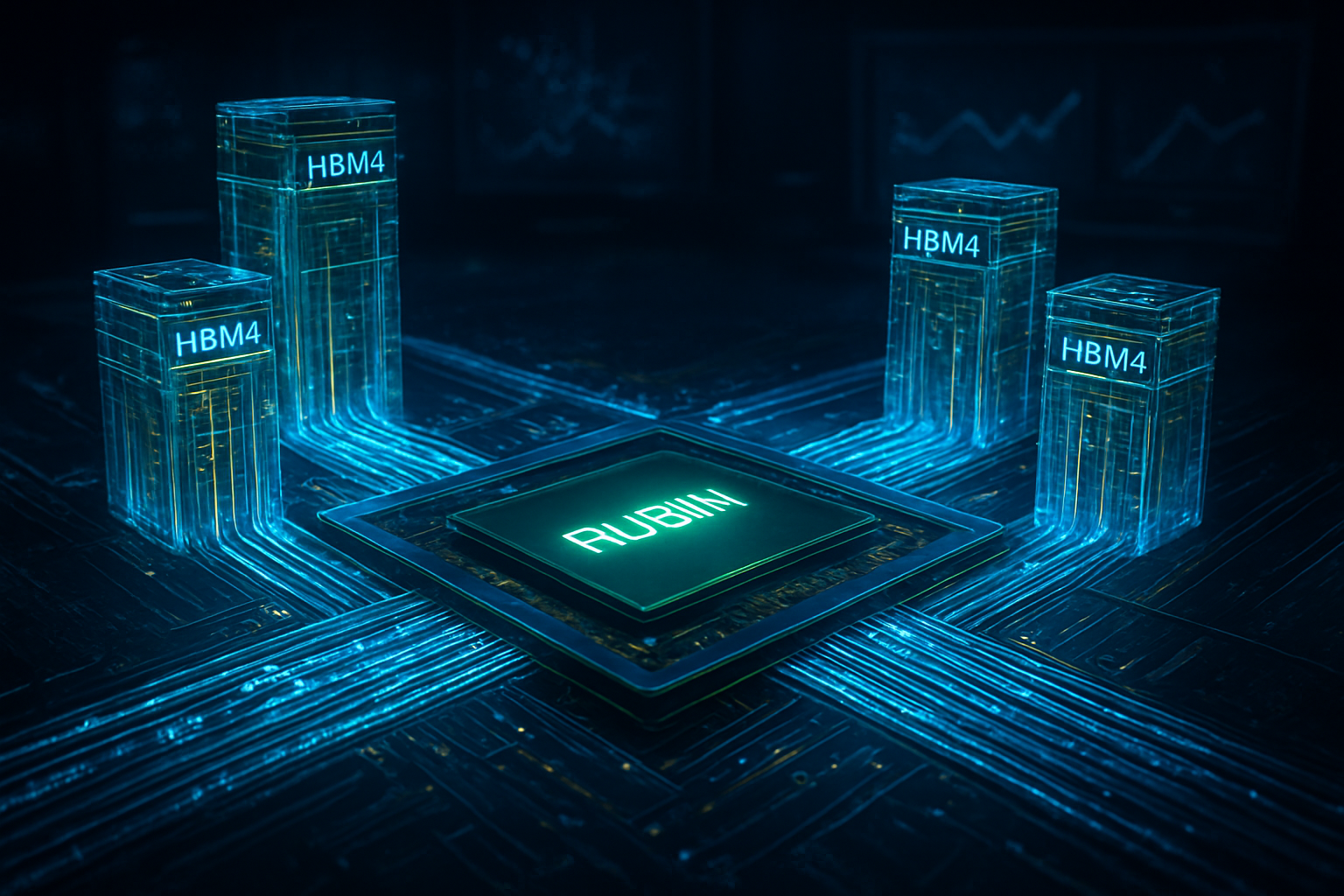
    Looking ahead, NVIDIA has already provided a glimpse into the post-Blackwell era. The company confirmed that its next-generation Rubin architecture (R100) has successfully "taped out" and is on track for a 2026 launch. Rubin will feature HBM4 memory and the new Vera CPU, specifically designed to handle "Agentic Inference"—the process of AI models making complex, multi-step decisions in real-time. This shift from simple chatbots to autonomous digital workers is expected to drive the next massive wave of demand.

    Challenges remain, particularly in the realm of power and logistics. The expansion of xAI’s Colossus 2 project in Memphis, which aims for a cluster of 1 million GPUs, has already faced hurdles related to local power grid stability and environmental impact. NVIDIA is addressing these issues by collaborating with energy providers on modular, nuclear-powered data centers and advanced liquid-cooling substations. Experts predict that the next twelve months will be defined by "Physical AI," where NVIDIA's hardware moves out of the data center and into the real world via humanoid robots and autonomous industrial systems.

    Conclusion: The Architect of the Intelligence Age

    NVIDIA’s Q3 FY2026 earnings report is more than a financial milestone; it is a confirmation that the AI revolution is accelerating rather than slowing down. By delivering record revenue and maintaining nearly 75% margins while shipping massive-scale liquid-cooled systems at a weekly cadence, NVIDIA has solidified its role as the indispensable provider of the world's most valuable resource: compute.

    As we move into 2026, the industry will be watching closely to see if the massive CapEx from hyperscalers translates into sustainable software revenue. While the "bubble" debate will undoubtedly continue, NVIDIA’s relentless innovation cycle—moving from Blackwell to Rubin at breakneck speed—ensures that it remains several steps ahead of any potential market correction. For now, the "AI Factory" is running at full capacity, and the world is only beginning to see the products it will create.


    This content is intended for informational purposes only and represents analysis of current AI developments.

    TokenRing AI delivers enterprise-grade solutions for multi-agent AI workflow orchestration, AI-powered development tools, and seamless remote collaboration platforms.
    For more information, visit https://www.tokenring.ai/.

  • Global Semiconductor Market Set to Hit $1 Trillion by 2026 Driven by AI Super-Cycle

    Global Semiconductor Market Set to Hit $1 Trillion by 2026 Driven by AI Super-Cycle

    As 2025 draws to a close, the technology sector is bracing for a historic milestone. Bank of America (NYSE: BAC) analyst Vivek Arya has issued a landmark projection stating that the global semiconductor market is on a collision course with the $1 trillion mark by 2026. Driven by what Arya describes as a "once-in-a-generation" AI super-cycle, the industry is expected to see a massive 30% year-on-year increase in sales, fueled by the aggressive infrastructure build-out of the world’s largest technology companies.

    This surge is not merely a continuation of current trends but represents a fundamental shift in the global computing landscape. As artificial intelligence moves from the experimental training phase into high-volume, real-time inference, the demand for specialized accelerators and next-generation memory has reached a fever pitch. With hyperscalers like Microsoft (NASDAQ: MSFT), Alphabet (NASDAQ: GOOGL), and Meta (NASDAQ: META) committing hundreds of billions in capital expenditure, the semiconductor industry is entering its most significant strategic transformation in over a decade.

    The Technical Engine: From Training to Inference and the Rise of HBM4

    The projected $1 trillion milestone is underpinned by a critical technical evolution: the transition from AI training to high-scale inference. While the last three years were dominated by the massive compute power required to train frontier models, 2026 is set to be the year of "inference at scale." This shift requires a different class of hardware—one that prioritizes memory bandwidth and energy efficiency over raw floating-point operations.

    Central to this transition is the arrival of High Bandwidth Memory 4 (HBM4). Unlike its predecessors, HBM4 features a 2,048-bit physical interface—double that of HBM3e—enabling bandwidth speeds of up to 2.0 TB/s per stack. This leap is essential for solving the "memory wall" that has long bottlenecked trillion-parameter models. By integrating custom logic dies directly into the memory stack, manufacturers like Micron (NASDAQ: MU) and SK Hynix are enabling "Thinking Models" to reason through complex queries in real-time, significantly reducing the "time-to-first-token" for end-users.

    Industry experts and the AI research community have noted that this shift is also driving a move toward "disaggregated prefill-decode" architectures. By separating the initial processing of a prompt from the iterative generation of a response, 2026-era accelerators can achieve up to a 40% improvement in power efficiency. This technical refinement is crucial as data centers begin to hit the physical limits of power grids, making performance-per-watt the most critical metric for the coming year.

    The Beneficiaries: NVIDIA and Broadcom Lead the "Brain and Nervous System"

    The primary beneficiaries of this $1 trillion expansion are NVIDIA (NASDAQ: NVDA) and Broadcom (NASDAQ: AVGO). Vivek Arya’s report characterizes NVIDIA as the "Brain" of the AI revolution, while Broadcom serves as its "Nervous System." NVIDIA’s upcoming Rubin (R100) architecture, slated for late 2026, is expected to leverage HBM4 and a 3nm manufacturing process to provide a 3x performance leap over the current Blackwell generation. With visibility into over $500 billion in demand, NVIDIA remains in a "different galaxy" compared to its competitors.

    Broadcom, meanwhile, has solidified its position as the cornerstone of custom AI infrastructure. As hyperscalers seek to reduce their total cost of ownership (TCO), they are increasingly turning to Broadcom for custom Application-Specific Integrated Circuits (ASICs). These chips, such as Google’s TPU v7 and Meta’s MTIA v3, are stripped of general-purpose legacy features, allowing them to run specific AI workloads at a fraction of the power cost of general GPUs. This strategic advantage has made Broadcom indispensable for the networking and custom silicon needs of the world’s largest data centers.

    The competitive implications are stark. While major AI labs like OpenAI and Anthropic continue to push the boundaries of model intelligence, the underlying "arms race" is being won by the companies providing the picks and shovels. Tech giants are now engaged in "offensive and defensive" spending; they must invest to capture new AI markets while simultaneously spending to protect their existing search, social media, and cloud empires from disruption.

    Wider Significance: A Decade-Long Structural Transformation

    This "AI Super-Cycle" is being compared to the internet boom of the 1990s and the mobile revolution of the 2000s, but with a significantly faster velocity. Arya argues that we are only three years into an 8-to-10-year journey, dismissing concerns of a short-term bubble. The "flywheel effect"—where massive CapEx creates intelligence, which is then monetized to fund further infrastructure—is now in full motion.

    However, the scale of this growth brings significant concerns regarding energy consumption and sovereign AI. As nations realize that AI compute is a matter of national security, we are seeing the rise of "Inference Factories" built within national borders to ensure data privacy and energy independence. This geopolitical dimension adds another layer of demand to the semiconductor market, as countries like Japan, France, and the UK look to build their own sovereign AI clusters using chips from NVIDIA and equipment from providers like Lam Research (NASDAQ: LRCX) and KLA Corp (NASDAQ: KLAC).

    Compared to previous milestones, the $1 trillion mark represents more than just a financial figure; it signifies the moment semiconductors became the primary driver of the global economy. The industry is no longer cyclical in the traditional sense, tied to consumer electronics or PC sales; it is now a foundational utility for the age of artificial intelligence.

    Future Outlook: The Path to $1.2 Trillion and Beyond

    Looking ahead, the momentum is expected to carry the market well past the $1 trillion mark. By 2030, the Total Addressable Market (TAM) for AI data center systems is projected to exceed $1.2 trillion, with AI accelerators alone representing a $900 billion opportunity. In the near term, we expect to see a surge in "Agentic AI," where HBM4-powered cloud servers handle complex reasoning while edge devices, powered by chips from Analog Devices (NASDAQ: ADI) and designed with software from Cadence Design Systems (NASDAQ: CDNS), handle local interactions.

    The primary challenges remaining are yield management and the physical limits of semiconductor fabrication. As the industry moves to 2nm and beyond, the cost of manufacturing equipment will continue to rise, potentially consolidating power among a handful of "mega-fabs." Experts predict that the next phase of the cycle will focus on "Test-Time Compute," where models use more processing power during the query phase to "think" through problems, further cementing the need for the massive infrastructure currently being deployed.

    Summary and Final Thoughts

    The projection of a $1 trillion semiconductor market by 2026 is a testament to the unprecedented scale of the AI revolution. Driven by a 30% YoY growth surge and the strategic shift toward inference, the industry is being reshaped by the massive CapEx of hyperscalers and the technical breakthroughs in HBM4 and custom silicon. NVIDIA and Broadcom stand at the apex of this transformation, providing the essential components for a new era of accelerated computing.

    As we move into 2026, the key metrics to watch will be the "cost-per-token" of AI models and the ability of power grids to keep pace with data center expansion. This development is not just a milestone for the tech industry; it is a defining moment in AI history that will dictate the economic and geopolitical landscape for the next decade.


    This content is intended for informational purposes only and represents analysis of current AI developments.

    TokenRing AI delivers enterprise-grade solutions for multi-agent AI workflow orchestration, AI-powered development tools, and seamless remote collaboration platforms.
    For more information, visit https://www.tokenring.ai/.
  • Intel’s 18A Node Hits Volume Production at Fab 52 as Yields Stabilize for Panther Lake Ramp

    Intel’s 18A Node Hits Volume Production at Fab 52 as Yields Stabilize for Panther Lake Ramp

    Intel Corporation (NASDAQ:INTC) has officially reached a historic milestone in the semiconductor race, announcing that its 18A (1.8nm-class) process node has entered high-volume manufacturing (HVM) at the newly operational Fab 52 in Arizona. This achievement marks the successful completion of CEO Pat Gelsinger’s ambitious "five nodes in four years" roadmap, positioning the American chipmaker as the first in the world to deploy 2nm-class technology at scale. As of late December 2025, the 18A node is powering the initial production ramp of the "Panther Lake" processor family, a critical product designed to cement Intel’s leadership in the burgeoning AI PC market.

    The transition to volume production at the $30 billion Fab 52 facility is a watershed moment for the U.S. semiconductor industry. While the journey to 18A was marked by skepticism from Wall Street and technical hurdles, internal reports now indicate that manufacturing yields have stabilized significantly. After trailing the mature yields of Taiwan Semiconductor Manufacturing Co. (NYSE:TSM) earlier in the year, Intel’s 18A process has shown a steady improvement of approximately 7% per month. Yields reached the 60-65% range in November, and the company is currently on track to hit its 70% target by the close of 2025, providing the necessary economic foundation for both internal products and external foundry customers.

    The Architecture of Leadership: RibbonFET and PowerVia

    The 18A node represents more than just a shrink in transistor size; it introduces the most significant architectural shifts in semiconductor manufacturing in over a decade. At the heart of 18A are two foundational technologies: RibbonFET and PowerVia. RibbonFET is Intel’s implementation of Gate-All-Around (GAA) transistors, which replaces the long-standing FinFET design. By wrapping the gate around all four sides of the transistor channel, RibbonFET provides superior electrostatic control, drastically reducing power leakage and allowing for higher drive currents. This results in a reported 25% performance-per-watt improvement over previous generations, a vital metric for AI-heavy workloads that demand extreme efficiency.

    Complementing RibbonFET is PowerVia, Intel’s industry-first commercialization of backside power delivery. Traditionally, power and signal lines are bundled together on the front of a chip, leading to "voltage droop" and routing congestion. PowerVia moves the power delivery network to the back of the silicon wafer, separating it from the signal lines. This decoupling allows for a 10% reduction in IR (voltage) droop and frees up significant space for signal routing, enabling a 0.72x area reduction compared to the Intel 3 node. This dual-innovation approach has allowed Intel to leapfrog competitors who are not expected to integrate backside power until their 2nm or sub-2nm nodes in 2026.

    Industry experts have noted that the stabilization of 18A yields is a testament to Intel’s aggressive use of ASML (NASDAQ:ASML) Twinscan NXE:3800E Low-NA EUV lithography systems. While the industry initially questioned Intel’s decision to skip High-NA EUV for the 18A node in favor of refined Low-NA techniques, the current volume ramp suggests the gamble has paid off. By perfecting the manufacturing process on existing equipment, Intel has managed to reach HVM ahead of TSMC’s N2 (2nm) schedule, which is not expected to see similar volume until mid-to-late 2026.

    Shifting the Competitive Landscape: Intel Foundry vs. The World

    The successful ramp of 18A at Fab 52 has immediate and profound implications for the global foundry market. For years, TSMC has held a near-monopoly on leading-edge manufacturing, serving giants like Apple (NASDAQ:AAPL) and NVIDIA (NASDAQ:NVDA). However, Intel’s progress is already drawing significant interest from "anchor" foundry customers. Microsoft (NASDAQ:MSFT) and Amazon (NASDAQ:AMZN) have already committed to using the 18A node for their custom AI silicon, seeking to diversify their supply chains and reduce their total reliance on Taiwanese fabrication.

    The competitive pressure is now squarely on Samsung (KRX:005930) and TSMC. While Samsung was the first to introduce GAA at 3nm, it struggled with yield issues that prevented widespread adoption. Intel’s ability to hit 60-65% yields on a more advanced 1.8nm-class node puts it in a prime position to capture market share from customers who are wary of Samsung’s consistency. For TSMC, the threat is more strategic; Intel is no longer just a designer of CPUs but a direct competitor in the high-margin foundry business. If Intel can maintain its 7% monthly yield improvement trajectory, it may offer a cost-competitive alternative to TSMC’s upcoming N2 node by the time the latter reaches volume.

    Furthermore, the "Panther Lake" ramp serves as a crucial internal proof of concept. By manufacturing 70% of the Panther Lake die area in-house on 18A, Intel is reducing its multi-billion dollar payments to external foundries. This vertical integration—the "IDM 2.0" strategy—is designed to improve Intel’s gross margins, which have been under pressure during this intensive capital expenditure phase. If Panther Lake meets its performance targets in the retail market this month, it will signal to the entire industry that Intel’s manufacturing engine is once again firing on all cylinders.

    Geopolitics and the AI Infrastructure Era

    The broader significance of 18A production at Fab 52 cannot be overstated in the context of global technopolitics. As the U.S. government seeks to "re-shore" critical technology through the CHIPS and Science Act, Intel’s Arizona facility stands as the premier example of domestic leading-edge manufacturing. The 18A node is already the designated process for the Department of Defense’s "Secure Enclave" program, ensuring that the next generation of American defense and intelligence hardware is built on home soil. This creates a "moat" for Intel that is as much about national security as it is about transistor density.

    In the AI landscape, the 18A node arrives at a pivotal moment. The current "AI PC" trend requires processors that can handle complex neural network tasks locally without sacrificing battery life. The efficiency gains from RibbonFET and PowerVia are specifically tailored for these use cases. By being the first to reach 2nm-class production, Intel is providing the hardware foundation for the next wave of generative AI applications, potentially shifting the balance of power in the laptop and workstation markets back in its favor after years of gains by ARM-based (NASDAQ:ARM) competitors.

    This milestone also marks the end of an era of uncertainty for Intel. The "five nodes in four years" promise was often viewed as a marketing slogan rather than a realistic engineering goal. By delivering 18A in volume by the end of 2025, Intel has restored its credibility with investors and partners alike. This achievement echoes the "Tick-Tock" era of Intel’s past dominance, suggesting that the company has finally overcome the 10nm and 7nm delays that plagued it for nearly a decade.

    The Road to 14A and High-NA EUV

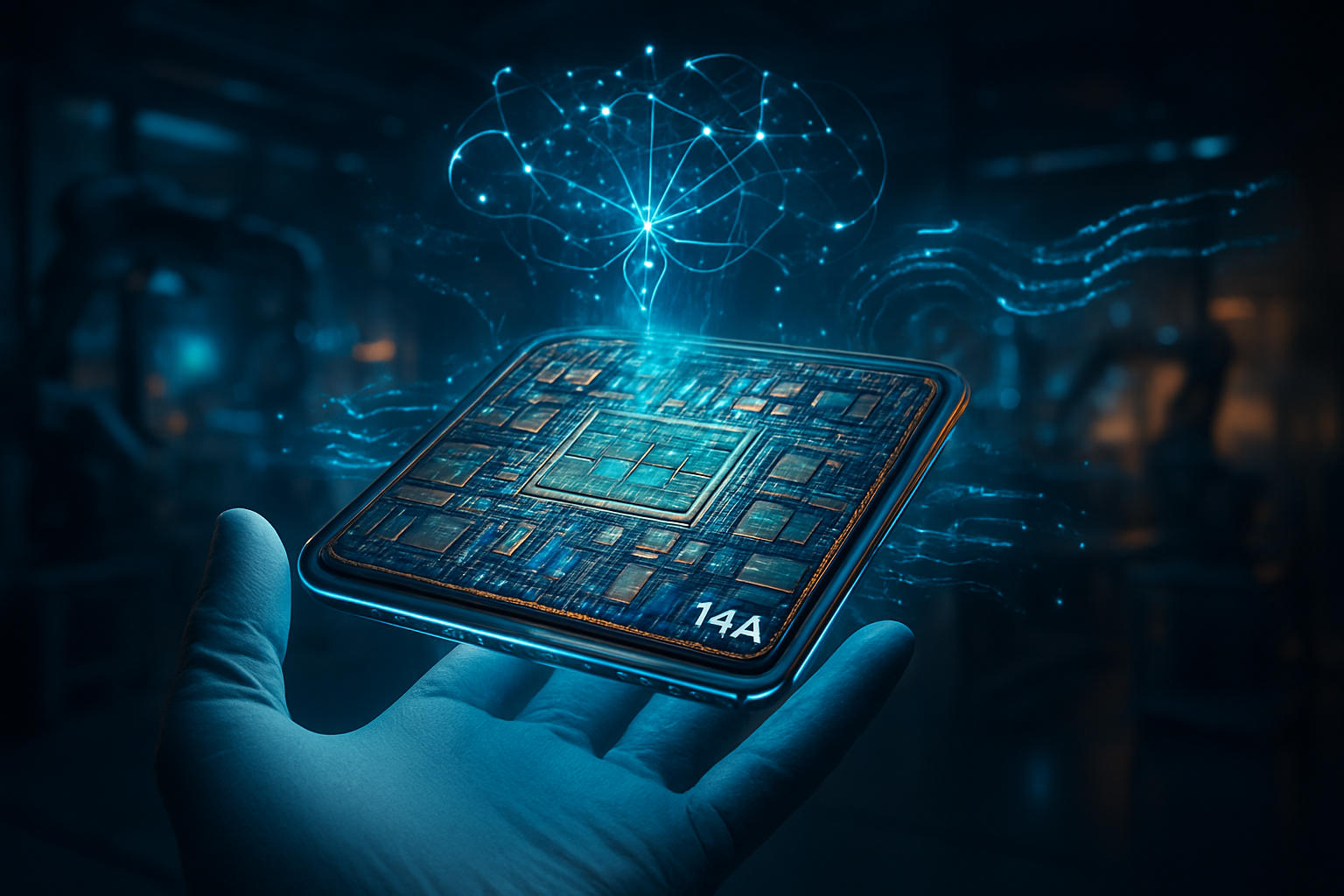
    Looking ahead, the success of 18A is the springboard for Intel’s next ambitious phase: the 14A (1.4nm) node. While 18A utilized refined Low-NA EUV, the 14A node will be the first to implement ASML’s High-NA EUV lithography at scale. Intel has already taken delivery of the first High-NA machines at its Oregon R&D site, and the lessons learned from the 18A ramp at Fab 52 will be instrumental in perfecting the next generation of patterning.

    In the near term, the industry will be watching the ramp of "Clearwater Forest," the 18A-based Xeon processor scheduled for early 2026. While Panther Lake addresses the consumer market, Clearwater Forest will be the true test of 18A’s viability in the high-stakes data center market. If Intel can deliver superior performance-per-watt in the server space, it could halt the market share erosion it has faced at the hands of AMD (NASDAQ:AMD).

    Challenges remain, particularly in scaling the 18A process to meet the diverse needs of dozens of foundry customers, each with unique design rules. However, the current trajectory suggests that Intel is well-positioned to reclaim the "manufacturing crown" by 2026. Analysts predict that if yields hit the 70% target by early 2026, Intel Foundry could become a profitable standalone entity sooner than originally anticipated, fundamentally altering the economics of the semiconductor industry.

    A New Chapter for Silicon

    The commencement of volume production at Fab 52 is more than just a corporate achievement; it is a signal that the semiconductor industry remains a field of rapid, disruptive innovation. Intel’s 18A node combines the most advanced transistor architecture with a revolutionary power delivery system, setting a new benchmark for what is possible in silicon. As Panther Lake chips begin to reach consumers this month, the world will get its first taste of the 1.8nm era.

    The key takeaways from this development are clear: Intel has successfully navigated its most difficult technical transition in history, the U.S. has regained a foothold in leading-edge manufacturing, and the race for AI hardware supremacy has entered a new, more competitive phase. The next few months will be critical as Intel moves from "stabilizing" yields to "optimizing" them for a global roster of clients.

    For the tech industry, the message is undeniable: the "Intel is back" narrative is no longer just a projection—it is being etched into silicon in the Arizona desert. As 2025 draws to a close, the focus shifts from whether Intel can build the future to how fast they can scale it.


    This content is intended for informational purposes only and represents analysis of current AI and semiconductor developments.

    TokenRing AI delivers enterprise-grade solutions for multi-agent AI workflow orchestration, AI-powered development tools, and seamless remote collaboration platforms.
    For more information, visit https://www.tokenring.ai/.

  • TSMC Boosts CoWoS Capacity as NVIDIA Dominates Advanced Packaging Orders through 2027

    TSMC Boosts CoWoS Capacity as NVIDIA Dominates Advanced Packaging Orders through 2027

    As the artificial intelligence revolution enters its next phase of industrialization, the battle for compute supremacy has shifted from the transistor to the package. Taiwan Semiconductor Manufacturing Company (NYSE: TSM) is aggressively expanding its Chip on Wafer on Substrate (CoWoS) advanced packaging capacity, aiming for a 33% increase by 2026 to satisfy an insatiable global appetite for AI silicon. This expansion is designed to break the primary bottleneck currently stifling the production of next-generation AI accelerators.

    NVIDIA Corporation (NASDAQ: NVDA) has emerged as the undisputed anchor tenant of this new infrastructure, reportedly booking over 50% of TSMC’s projected CoWoS capacity for 2026. With an estimated 800,000 to 850,000 wafers reserved, NVIDIA is clearing the path for its upcoming Blackwell Ultra and the highly anticipated Rubin architectures. This strategic move ensures that while competitors scramble for remaining slots, the AI market leader maintains a stranglehold on the hardware required to power the world’s largest large language models (LLMs) and autonomous systems.

    The Technical Frontier: CoWoS-L, SoIC, and the Rubin Shift

    The technical complexity of AI chips has reached a point where traditional monolithic designs are no longer viable. TSMC’s CoWoS technology, specifically the CoWoS-L (Local Silicon Interconnect) variant, has become the gold standard for integrating multiple logic and memory dies. As of late 2025, the industry is transitioning from the Blackwell architecture to Blackwell Ultra (GB300), which pushes the limits of interposer size. However, the real technical leap lies in the Rubin (R100) architecture, which utilizes a massive 4x reticle design. This means each chip occupies significantly more physical space on a wafer, necessitating the 33% capacity boost just to maintain current unit volume delivery.

    Rubin represents a paradigm shift by combining CoWoS-L with System on Integrated Chips (SoIC) technology. This "3D" stacking approach allows for shorter vertical interconnects, drastically reducing power consumption while increasing bandwidth. Furthermore, the Rubin platform will be the first to integrate High Bandwidth Memory 4 (HBM4) on TSMC’s N3P (3nm) process. Industry experts note that the integration of HBM4 requires unprecedented precision in bonding, a capability TSMC is currently perfecting at its specialized facilities.

    The initial reaction from the AI research community has been one of cautious optimism. While the technical specs of Rubin suggest a 3x to 5x performance-per-watt improvement over Blackwell, there are concerns regarding the "memory wall." As compute power scales, the ability of the packaging to move data between the processor and memory remains the ultimate governor of performance. TSMC’s ability to scale SoIC and CoWoS in tandem is seen as the only viable solution to this hardware constraint through 2027.

    Market Dominance and the Competitive Squeeze

    NVIDIA’s decision to lock down more than half of TSMC’s advanced packaging capacity through 2027 creates a challenging environment for other fabless chip designers. Companies like Advanced Micro Devices (NASDAQ: AMD) and specialized AI chip startups are finding themselves in a fierce bidding war for the remaining 40-50% of CoWoS supply. While AMD has successfully utilized TSMC’s packaging for its MI300 and MI350 series, the sheer scale of NVIDIA’s orders threatens to push competitors toward alternative Outsourced Semiconductor Assembly and Test (OSAT) providers like ASE Technology Holding (NYSE: ASX) or Amkor Technology (NASDAQ: AMKR).

    Hyperscalers such as Microsoft (NASDAQ: MSFT), Amazon (NASDAQ: AMZN), and Alphabet (NASDAQ: GOOGL) are also impacted by this capacity crunch. While these tech giants are increasingly designing their own custom AI silicon (like Azure’s Maia or Google’s TPU), they still rely heavily on TSMC for both wafer fabrication and advanced packaging. NVIDIA’s dominance in the packaging queue could potentially delay the rollout of internal silicon projects at these firms, forcing continued reliance on NVIDIA’s off-the-shelf H100, B200, and future Rubin systems.

    Strategic advantages are also shifting toward the memory manufacturers. SK Hynix, Micron Technology (NASDAQ: MU), and Samsung are now integral parts of the CoWoS ecosystem. Because HBM4 must be physically bonded to the logic die during the CoWoS process, these companies must coordinate their production cycles perfectly with TSMC’s expansion. The result is a more vertically integrated supply chain where NVIDIA and TSMC act as the central orchestrators, dictating the pace of innovation for the entire semiconductor industry.

    Geopolitics and the Global Infrastructure Landscape

    The expansion of TSMC’s capacity is not limited to Taiwan. The company’s Chiayi AP7 plant is central to this strategy, featuring multiple phases designed to scale through 2028. However, the geopolitical pressure to diversify the supply chain has led to significant developments in the United States. As of December 2025, TSMC has accelerated plans for an advanced packaging facility in Arizona. While Arizona’s Fab 21 is already producing 4nm and 5nm wafers with high yields, the lack of local packaging has historically required those wafers to be shipped back to Taiwan for final assembly—a process known as the "packaging gap."

    To address this, TSMC is repurposing land in Arizona for a dedicated Advanced Packaging (AP) plant, with tool move-in expected by late 2027. This move is seen as a critical step in de-risking the AI supply chain from potential cross-strait tensions. By providing "end-to-end" manufacturing on U.S. soil, TSMC is aligning itself with the strategic interests of the U.S. government while ensuring that its largest customer, NVIDIA, has a resilient path to market for its most sensitive government and enterprise contracts.

    This shift mirrors previous milestones in the semiconductor industry, such as the transition to EUV (Extreme Ultraviolet) lithography. Just as EUV became the gatekeeper for sub-7nm chips, advanced packaging is now the gatekeeper for the AI era. The massive capital expenditure required—estimated in the tens of billions of dollars—ensures that only a handful of players can compete at the leading edge, further consolidating power within the TSMC-NVIDIA-HBM triad.

    Future Horizons: Beyond 2027 and the Rise of Panel-Level Packaging

    Looking beyond 2027, the industry is already eyeing the next evolution: Chip-on-Panel-on-Substrate (CoPoS). As AI chips continue to grow in size, the circular 300mm silicon wafer becomes an inefficient medium for packaging. Panel-level packaging, which uses large rectangular glass or organic substrates, offers the potential to process significantly more chips at once, potentially lowering costs and increasing throughput. TSMC is reportedly experimenting with this technology at its later-phase AP7 facilities in Chiayi, with mass production targets set for the 2028-2029 timeframe.

    In the near term, we can expect a flurry of activity around HBM4 and HBM4e integration. The transition to 12-high and 16-high memory stacks will require even more sophisticated bonding techniques, such as hybrid bonding, which eliminates the need for traditional "bumps" between dies. This will allow for even thinner, more powerful AI modules that can fit into the increasingly cramped environments of edge servers and high-density data centers.

    The primary challenge remaining is the thermal envelope. As Rubin and its successors pack more transistors and memory into smaller volumes, the heat generated is becoming a physical limit. Future developments will likely include integrated liquid cooling or even "optical" interconnects that use light instead of electricity to move data between chips, further evolving the definition of what a "package" actually is.

    A New Era of Integrated Silicon

    TSMC’s aggressive expansion of CoWoS capacity and NVIDIA’s massive pre-orders mark a definitive turning point in the AI hardware race. We are no longer in an era where software alone defines AI progress; the physical constraints of how chips are assembled and cooled have become the primary variables in the equation of intelligence. By securing the lion's share of TSMC's capacity, NVIDIA has not just bought chips—it has bought time and market stability through 2027.

    The significance of this development cannot be overstated. It represents the maturation of the AI supply chain from a series of experimental bursts into a multi-year industrial roadmap. For the tech industry, the focus for the next 24 months will be on execution: can TSMC bring the AP7 and Arizona facilities online fast enough to meet the demand, and can the memory manufacturers keep up with the transition to HBM4?

    As we move into 2026, the industry should watch for the first risk production of the Rubin architecture and any signs of "over-ordering" that could lead to a future inventory correction. For now, however, the signal is clear: the AI boom is far from over, and the infrastructure to support it is being built at a scale and speed never before seen in the history of computing.


    This content is intended for informational purposes only and represents analysis of current AI developments.

    TokenRing AI delivers enterprise-grade solutions for multi-agent AI workflow orchestration, AI-powered development tools, and seamless remote collaboration platforms.
    For more information, visit https://www.tokenring.ai/.
  • The Great AI Pivot: Forbes Report Reveals 12 Million New Roles Amidst Targeted Job Losses

    The Great AI Pivot: Forbes Report Reveals 12 Million New Roles Amidst Targeted Job Losses

    The latest Forbes AI Workforce Report 2025 has sent ripples through the global economy, unveiling a paradoxical landscape of labor. While the report acknowledges a stark 48,414 job losses directly attributed to artificial intelligence in the United States this year, it counterbalances those figures with a staggering projection: the creation of 12 million new roles globally by the end of 2025. This data marks a definitive shift in the narrative from a "robot takeover" to a massive, systemic reorganization of human labor.

    The significance of these findings cannot be overstated. As of December 25, 2025, the global workforce is no longer merely "preparing" for AI; it is actively being restructured by it. The report highlights that while the displacement of nearly 50,000 workers is a localized tragedy for those affected, the broader trend is one of "augmentation" and "redesign." This suggests that the primary challenge of the mid-2020s is not a lack of work, but a profound mismatch between existing skills and the requirements of a new, AI-integrated economy.

    The Anatomy of the 12 Million: Beyond the 48k Baseline

    The report’s data, drawing from analysts at Challenger, Gray & Christmas and the World Economic Forum, provides a granular look at the current transition. The 48,414 job cuts in the U.S. represent roughly 4% of total layoffs for the year, indicating that while AI is a factor, it is not yet the primary driver of unemployment. These losses are largely concentrated in routine data processing, basic administrative support, and junior-level technical roles. In contrast, the 12 million new roles are emerging in "AI-adjacent" sectors where human judgment remains indispensable—such as AI-assisted healthcare diagnostics, ethical compliance, and complex supply chain orchestration.

    Technically, this shift is driven by the maturation of Agentic AI—systems capable of executing multi-step workflows rather than just answering prompts. Unlike the early generative AI of 2023, the 2025 models are integrated into enterprise resource planning (ERP) systems, allowing them to handle the "drudge work" of logistics and data entry. This leaves humans to focus on exception handling and strategic decision-making. Initial reactions from the AI research community have been cautiously optimistic, with many noting that the "productivity frontier" is moving faster than previously anticipated, necessitating a rethink of the standard 40-hour work week.

    Industry experts emphasize that the "new roles" are not just for Silicon Valley engineers. They include "Prompt Architects" in marketing firms, "AI Safety Auditors" in legal departments, and "Human-in-the-Loop" supervisors in manufacturing. The technical specification for the modern worker has shifted from "knowing the answer" to "knowing how to verify the machine's answer." This fundamental change in the human-machine interface is what is driving the massive demand for a new type of professional.

    Corporate Strategy: The Rise of the Internal AI Academy

    The Forbes report reveals a strategic pivot among tech giants and Fortune 500 companies. IBM (NYSE: IBM) and Amazon (NASDAQ: AMZN) have emerged as leaders in this transition, moving away from expensive external hiring toward "internal redeployment." IBM, in particular, has been vocal about its "AI First" internal training programs, which aim to transition thousands of back-office employees into AI-augmented roles. This strategy not only mitigates the social cost of layoffs but also retains institutional knowledge that is often lost during traditional downsizing.

    For major AI labs like Microsoft (NASDAQ: MSFT) and Alphabet Inc. (NASDAQ: GOOGL), the report suggests a competitive advantage for those who can provide the most "user-friendly" orchestration tools. As companies scramble to reskill their workforces, the platforms that require the least amount of technical "re-learning" are winning the market. This has led to a surge in specialized startups focusing on "No-Code AI" and "Natural Language Orchestration," threatening to disrupt traditional software-as-a-service (SaaS) models that rely on complex, manual user interfaces.

    The market positioning is clear: companies that view AI as a tool for "headcount reduction" are seeing short-term gains but long-term talent shortages. Conversely, those investing in the "Great Reskilling"—the report notes that 68% of C-suite leaders now prioritize human-AI collaboration—are building more resilient operations. This strategic advantage is becoming the primary differentiator in the 2025 fiscal landscape.

    The Societal Blueprint: Addressing the Entry-Level Crisis

    Beyond the corporate balance sheets, the Forbes report examines the wider societal implications of this shift. One of the most concerning trends identified is the "hollowing out" of entry-level positions. Historically, junior roles served as a training ground for future leaders. With AI now performing the tasks of junior coders, paralegals, and analysts, the "on-ramp" to professional careers is being dismantled. This creates a potential talent gap in the 2030s if the industry does not find new ways to apprentice young workers in an AI-dominated environment.

    The "massive reskilling shift" involves an estimated 120 million workers globally who will need retraining by 2027. This is a milestone that dwarfs previous industrial revolutions in both speed and scale. The report notes that the premium has shifted heavily toward "human-centric" skills: empathy, leadership, and complex problem-solving. In a world where a machine can write a perfect legal brief, the value of a lawyer who can navigate the emotional nuances of a courtroom or a negotiation has skyrocketed.

    However, concerns remain regarding the "digital divide." While 12 million new roles are being created, they are not necessarily appearing in the same geographic regions or socioeconomic brackets where the 48,000 jobs were lost. This geographic and skill-based mismatch is a primary concern for policymakers, who are now looking at "AI Transition Credits" and subsidized lifelong learning programs to ensure that the workforce is not left behind.

    The Horizon: Predictive Maintenance of the Human Workforce

    Looking ahead, the next 18 to 24 months will likely see the emergence of "Personalized AI Career Coaches"—AI systems designed to help workers identify their skill gaps and navigate their own reskilling journeys. Experts predict that the concept of a "static degree" is effectively dead; the future of work is a continuous cycle of micro-learning and adaptation. The report suggests that by 2026, "AI Fluency" will be as fundamental a requirement as literacy or basic numeracy.

    The challenges are significant. Educational institutions are currently struggling to keep pace with the 12-million-role demand, leading to a "skills vacuum" that private companies are having to fill themselves. We can expect to see more partnerships between tech companies and universities to create "fast-track" AI certifications. The long-term success of this transition depends on whether the 12 million roles can be filled quickly enough to offset the social friction caused by localized job losses.

    Final Reflections: A History in the Making

    The Forbes AI Workforce Report 2025 serves as a definitive marker in the history of the Fourth Industrial Revolution. It confirms that while the "AI apocalypse" for jobs hasn't materialized in the way doomsayers predicted, the "AI transformation" is deeper and more demanding than many optimists hoped. The net gain of 11.95 million roles is a cause for celebration, but it comes with the heavy responsibility of global reskilling.

    As we move into 2026, the key metric to watch will not be the number of jobs lost, but the speed of "time-to-retrain." The significance of this development lies in its confirmation that AI is not a replacement for human ingenuity, but a powerful new canvas for it. The coming months will be defined by how well society manages the transition of the 48,000 to the 12 million, ensuring that the AI-driven economy is as inclusive as it is productive.


    This content is intended for informational purposes only and represents analysis of current AI developments.

    TokenRing AI delivers enterprise-grade solutions for multi-agent AI workflow orchestration, AI-powered development tools, and seamless remote collaboration platforms.
    For more information, visit https://www.tokenring.ai/.
  • Beyond the Third Dimension: Roblox Redefines Metaverse Creation with ‘4D’ Generative AI and Open-Source Cube Model

    Beyond the Third Dimension: Roblox Redefines Metaverse Creation with ‘4D’ Generative AI and Open-Source Cube Model

    As of late 2025, the landscape of digital creation has undergone a seismic shift, led by a bold technological leap from one of the world's largest social platforms. Roblox (NYSE: RBLX) has officially rolled out its "4D" creation tools within the Roblox AI Studio, a suite of generative features that move beyond static 3D modeling to create fully functional, interactive environments and non-player characters (NPCs) in seconds. This development, powered by the company’s groundbreaking open-source "Cube" model, represents a transition from "generative art" to "generative systems," allowing users to manifest complex digital worlds that possess not just form, but behavior and physics.

    The significance of this announcement lies in its democratization of high-level game design. By integrating interaction as the "fourth dimension," Roblox is enabling a generation of creators—many of whom have no formal training in coding or 3D rigging—to build sophisticated, living ecosystems. This move positions Roblox not merely as a gaming platform, but as a primary laboratory for the future of spatial computing and functional artificial intelligence.

    The Architecture of Cube: Tokenizing the 3D World

    At the heart of this revolution is Cube (specifically Cube 3D), a multimodal transformer architecture that Roblox open-sourced earlier this year. Unlike previous generative 3D models that often relied on 2D image reconstruction—a process that frequently resulted in "hollow" or geometrically inconsistent models—Cube was trained on native 3D data from the millions of assets within the Roblox ecosystem. This native training allows the model to understand the internal structure of objects; for instance, when a user generates a car, the model understands that it requires an engine, a dashboard, and functional seats, rather than just a car-shaped shell.

    Technically, Cube operates through two primary components: ShapeGPT, which handles the generation of 3D geometry, and LayoutGPT, which manages spatial organization and how objects relate to one another in a scene. By tokenizing 3D space in a manner similar to how Large Language Models (LLMs) tokenize text, Cube can predict the "next shape token" to construct structurally sound environments. The model is optimized for high-performance hardware like the Nvidia (NASDAQ: NVDA) H100 and L40S, but it also supports local execution on Apple (NASDAQ: AAPL) Silicon, requiring between 16GB and 24GB of VRAM for real-time inference.

    The "4D" aspect of these tools refers to the automatic injection of functional code and physics into generated assets. When a creator prompts the AI to "build a rainy cyberpunk city," the system does not just place buildings; it applies wet-surface shaders, adjusts dynamic lighting, and generates the programmatic scripts necessary for the environment to react to the player. Initial reactions from the AI research community have been overwhelmingly positive, with experts noting that Roblox’s approach to "functional generation" solves the "static asset problem" that has long plagued generative AI in gaming.

    Disruption in the Engine Room: Market and Competitive Implications

    The release of these tools has sent ripples through the tech industry, placing immediate pressure on traditional game engine giants like Unity (NYSE: U) and the privately held Epic Games. While Unity and Unreal Engine have introduced their own AI assistants, Roblox’s strategic advantage lies in its closed-loop ecosystem. Because Roblox controls both the engine and the social platform, it can feed user interactions back into its models, creating a flywheel of data that specialized AI labs struggle to match.

    For the broader AI market, the open-sourcing of the Cube model is a strategic masterstroke. By making the model available on platforms like HuggingFace, Roblox has effectively set the standard for 3D tokenization, encouraging third-party developers to build tools that are natively compatible with the Roblox engine. This move challenges the dominance of proprietary 3D models from companies like OpenAI or Google, positioning Roblox as the "Linux of the Metaverse"—an open, foundational layer upon which others can build.

    Market analysts suggest that this technology is a cornerstone of Roblox’s stated goal to capture 10% of all global gaming revenue. Early data from the Q4 2025 rollout indicates a 31% increase in content publishing output from creators using the AI tools. For startups in the "AI-native gaming" space, the bar has been raised significantly; the value proposition now shifts from "generating a 3D model" to "generating a functional, scripted experience."

    The Societal Shift: Democratization and the "Flood" of Content

    The wider significance of 4D creation tools extends into the very philosophy of digital labor. We are witnessing a transition where the "creator" becomes more of a "director." This mirrors the breakthrough seen with LLMs in 2023, but applied to spatial and interactive media. The ability to generate NPCs with dynamic dialogue APIs and autonomous behaviors means that a single individual can now produce a level of content that previously required a mid-sized studio.

    However, this breakthrough is not without its concerns. Much like the "dead internet theory" sparked by text-generating bots, there are fears of a "dead metaverse" filled with low-quality, AI-generated "slop." Critics argue that while the quantity of content will explode, the "soul" of hand-crafted game design may be lost. Furthermore, the automation of rigging, skinning, and basic scripting poses an existential threat to entry-level roles in the 3D art and quality assurance sectors.

    Despite these concerns, the potential for education and accessibility is profound. A student can now "prompt" a historical simulation into existence, walking through a functional recreation of ancient Rome that responds to their questions in real-time. This fits into the broader trend of "world-building as a service," where the barrier between imagination and digital reality is almost entirely erased.

    The Horizon: Real-Time Voice-to-World and Beyond

    Looking ahead to 2026, the trajectory for Roblox AI Studio points toward even more seamless integration. Near-term developments are expected to focus on "Real-Time Voice-to-World" creation, where a developer can literally speak an environment into existence while standing inside it using a VR headset. This would turn the act of game development into a live, improvisational performance.

    The next major challenge for the Cube model will be "Physics-Aware AI"—the ability for the model to understand complex fluid dynamics or structural integrity without pre-baked scripts. Experts predict that as these models become more sophisticated, we will see the rise of "emergent gameplay," where the AI generates challenges and puzzles on the fly based on a player's specific skill level and past behavior. The ultimate goal is a truly infinite game, one that evolves and rewrites itself in response to the community.

    A New Dimension for the Digital Age

    The rollout of the 4D creation tools and the Cube model marks a definitive moment in AI history. It is the point where generative AI moved beyond the screen and into the "space," transforming from a tool that makes pictures and text into a tool that makes worlds. Roblox has successfully bridged the gap between complex engineering and creative intent, providing a glimpse into a future where the digital world is as malleable as thought itself.

    As we move into 2026, the industry will be watching closely to see how the Roblox community utilizes these tools. The key takeaways are clear: 3D data is the new frontier for foundational models, and "interaction" is the new benchmark for generative quality. For now, the "4D" era has begun, and the metaverse is no longer a static destination, but a living, breathing entity.


    This content is intended for informational purposes only and represents analysis of current AI developments.

    TokenRing AI delivers enterprise-grade solutions for multi-agent AI workflow orchestration, AI-powered development tools, and seamless remote collaboration platforms.
    For more information, visit https://www.tokenring.ai/.
  • Google’s $4.75B Power Play: Acquiring Intersect to Fuel the AI Revolution

    Google’s $4.75B Power Play: Acquiring Intersect to Fuel the AI Revolution

    In a move that underscores the desperate scramble for energy to fuel the generative AI revolution, Alphabet Inc. (NASDAQ: GOOGL) announced on December 22, 2025, that it has entered into a definitive agreement to acquire Intersect, the data center and power development division of Intersect Power. The $4.75 billion all-cash deal represents a paradigm shift for the tech giant, moving Google from a purchaser of renewable energy to a direct owner and developer of the massive infrastructure required to energize its next-generation AI data center clusters.

    The acquisition is a direct response to the "power crunch" that has become the primary bottleneck for AI scaling. As Google deploys increasingly dense clusters of high-performance GPUs—many of which now require upwards of 1,200 watts per chip—the traditional reliance on public utility grids has become a strategic liability. By bringing Intersect’s development pipeline and expertise in-house, Alphabet aims to bypass years of regulatory delays and ensure that its computing capacity is never throttled by a lack of electrons.

    The Technical Shift: Co-Location and Grid Independence

    At the heart of this acquisition is Intersect’s pioneering "co-location" model, which integrates data center facilities directly with dedicated renewable energy generation and massive battery storage. The crown jewel of the deal is a massive project currently under construction in Haskell County, Texas. This site features a 640 MW solar park paired with a 1.3 GW battery energy storage system (BESS), creating a self-sustaining ecosystem where the data center can draw power directly from the source without relying on the strained Texas ERCOT grid.

    This approach differs fundamentally from the traditional Power Purchase Agreement (PPA) model that tech companies have used for the last decade. Previously, companies would sign contracts to buy "green" energy from a distant wind farm to offset their carbon footprint, but the physical electricity still traveled through a congested public grid. By owning the generation assets and the data center on the same site, Google eliminates the "interconnection queue"—a multi-year backlog where new projects wait for permission to connect to the grid. This allows Google to build and activate AI clusters in "lockstep" with its energy supply.

    Furthermore, the acquisition provides Google with a testbed for advanced energy technologies that go beyond standard solar and wind. Intersect’s engineering team will now lead Alphabet’s efforts to integrate advanced geothermal systems, long-duration iron-air batteries, and carbon-capture-enabled natural gas into their power mix. This technical flexibility is essential for achieving "24/7 carbon-free energy," a goal that becomes exponentially harder as AI workloads demand constant, high-intensity power regardless of whether the sun is shining or the wind is blowing.

    Initial reactions from the AI research community suggest that this move is viewed as a "moat-building" exercise. Experts at the Frontier AI Institute noted that while software optimizations can reduce energy needs, the physical reality of training trillion-parameter models requires raw wattage that only a direct-ownership model can reliably provide. Industry analysts have praised the deal as a necessary evolution for a company that is transitioning from a software-first entity to a massive industrial power player.

    Competitive Implications: The New Arms Race for Electrons

    The acquisition of Intersect places Google in a direct "energy arms race" with other hyperscalers like Microsoft Corp. (NASDAQ: MSFT) and Amazon.com Inc. (NASDAQ: AMZN). While Microsoft has focused heavily on reviving nuclear power—most notably through its deal to restart the Three Mile Island reactor—Google’s strategy with Intersect emphasizes a more diversified, modular approach. By controlling the development arm, Google can rapidly deploy smaller, distributed energy-plus-compute nodes across various geographies, rather than relying on a few massive, centralized nuclear plants.

    This move potentially disrupts the traditional relationship between tech companies and utility providers. If the world’s largest companies begin building their own private microgrids, utilities may find themselves losing their most profitable customers while still being expected to maintain the infrastructure for the rest of the public. For startups and smaller AI labs, the barrier to entry just got significantly higher. Without the capital to spend billions on private energy infrastructure, smaller players may be forced to lease compute from Google or Microsoft at a premium, further consolidating power in the hands of the "Big Three" cloud providers.

    Strategically, the deal secures Google’s supply chain for the next decade. Intersect had a projected pipeline of over 10.8 gigawatts of power in development by 2028. By folding this pipeline into Alphabet, Google ensures that its competitors cannot swoop in and buy the same land or energy rights. In the high-stakes world of AI, where the first company to scale their model often wins the market, having a guaranteed power supply is now as important as having the best algorithms.

    The Broader AI Landscape and Societal Impact

    The Google-Intersect deal is a landmark moment in the transition of AI from a digital phenomenon to a physical one. It highlights a growing trend where "AI companies" are becoming indistinguishable from "infrastructure companies." This mirrors previous industrial revolutions; just as the early automotive giants had to invest in rubber plantations and steel mills to secure their future, AI leaders are now forced to become energy moguls.

    However, this development raises significant concerns regarding the environmental impact of AI. While Google remains committed to its 2030 carbon-neutral goals, the sheer scale of the energy required for AI is staggering. Critics argue that by sequestering vast amounts of renewable energy and storage capacity for private data centers, tech giants may be driving up the cost of clean energy for the general public and slowing down the broader decarbonization of the electrical grid.

    There is also the question of "energy sovereignty." As corporations begin to operate their own massive, private power plants, the boundary between public utility and private enterprise blurs. This could lead to new regulatory challenges as governments grapple with how to tax and oversee these "private utilities" that are powering the most influential technology in human history. Comparisons are already being drawn to the early 20th-century "company towns," but on a global, digital scale.

    Looking Ahead: SMRs and the Geothermal Frontier

    In the near term, expect Google to integrate Intersect’s development team into its existing partnerships with firms like Kairos Power and Fervo Energy. The goal will be to create a standardized "AI Power Template"—a blueprint for a data center that can be dropped anywhere in the world, complete with its own modular nuclear reactor or enhanced geothermal well. This would allow Google to expand into regions with poor grid infrastructure, further extending its global reach.

    The long-term vision includes the deployment of Small Modular Reactors (SMRs) alongside the solar and battery assets acquired from Intersect. Experts predict that by 2030, a significant portion of Google’s AI training will happen on "off-grid" campuses that are entirely self-sufficient. The challenge will be managing the immense heat generated by these facilities and finding ways to recycle that thermal energy, perhaps for local industrial use or municipal heating, to improve overall efficiency.

    As the transaction heads toward a mid-2026 closing, all eyes will be on how the Federal Energy Regulatory Commission (FERC) and other regulators view this level of vertical integration. If approved, it will likely trigger a wave of similar acquisitions as other tech giants seek to buy up the remaining independent power developers, forever changing the landscape of both the energy and technology sectors.

    Summary and Final Thoughts

    Google’s $4.75 billion acquisition of Intersect marks a definitive end to the era where AI was seen purely as a software challenge. It is now a race for land, water, and, most importantly, electricity. By taking direct control of its energy future, Alphabet is signaling that it views power generation as a core competency, just as vital as search algorithms or chip design.

    The significance of this development in AI history cannot be overstated. It represents the "industrialization" phase of artificial intelligence, where the physical constraints of the real world dictate the pace of digital innovation. For investors and industry watchers, the key metrics to watch in the coming months will not just be model performance or user growth, but gigawatts under management and interconnection timelines.

    As we move into 2026, the success of this acquisition will be measured by Google's ability to maintain its AI scaling trajectory without compromising its environmental commitments. The "power crunch" is real, and with the Intersect deal, Google has just placed a multi-billion dollar bet that it can engineer its way out of it.


    This content is intended for informational purposes only and represents analysis of current AI developments.

    TokenRing AI delivers enterprise-grade solutions for multi-agent AI workflow orchestration, AI-powered development tools, and seamless remote collaboration platforms.
    For more information, visit https://www.tokenring.ai/.

  • Samsung’s “Ghost in the Machine”: How the Galaxy S26 is Redefining Privacy with On-Device SLM Reasoning

    Samsung’s “Ghost in the Machine”: How the Galaxy S26 is Redefining Privacy with On-Device SLM Reasoning

    As the tech world approaches the dawn of 2026, the focus of the smartphone industry has shifted from raw megapixels and screen brightness to the "brain" inside the pocket. Samsung Electronics (KRX: 005930) is reportedly preparing to unveil its most ambitious hardware-software synergy to date with the Galaxy S26 series. Moving away from the cloud-dependent AI models that defined the previous two years, Samsung is betting its future on sophisticated on-device Small Language Model (SLM) reasoning. This development marks a pivotal moment in consumer technology, where the promise of a "continuous AI" companion—one that functions entirely without an internet connection—becomes a tangible reality.

    The immediate significance of this shift cannot be overstated. By migrating complex reasoning tasks from massive server farms to the palm of the hand, Samsung is addressing the two biggest hurdles of the AI era: latency and privacy. The rumored "Galaxy AI 2.0" stack, debuting with the S26, aims to provide a seamless, persistent intelligence that learns from user behavior in real-time without ever uploading sensitive personal data to the cloud. This move signals a departure from the "Hybrid AI" model favored by competitors, positioning Samsung as a leader in "Edge AI" and data sovereignty.

    The Architecture of Local Intelligence: SLMs and 2nm Silicon

    At the heart of the Galaxy S26’s technical breakthrough is a next-generation version of Samsung Gauss, the company’s proprietary AI suite. Unlike the massive Large Language Models (LLMs) that require gigawatts of power, Samsung is utilizing heavily quantized Small Language Models (SLMs) ranging from 3-billion to 7-billion parameters. These models are optimized for the device’s Neural Processing Unit (NPU) using LoRA (Low-Rank Adaptation) adapters. This allows the phone to "hot-swap" between specialized functions—such as real-time voice translation, complex document synthesis, or predictive text—without the overhead of a general-purpose model, ensuring that reasoning remains instantaneous.

    The hardware enabling this is equally revolutionary. Samsung is rumored to be utilizing its new 2nm Gate-All-Around (GAA) process for the Exynos 2600 chipset, which reportedly delivers a staggering 113% boost in NPU performance over its predecessor. In regions receiving the Qualcomm (NASDAQ: QCOM) Snapdragon 8 Gen 5, the "Elite 2" variant is expected to feature a Hexagon NPU capable of processing 200 tokens per second. These chips are supported by the new LPDDR6 RAM standard, which provides the massive memory throughput (up to 10.7 Gbps) required to hold "semantic embeddings" in active memory. This allows the AI to maintain context across different applications, effectively "remembering" a conversation in one app to provide relevant assistance in another.

    This approach differs fundamentally from previous generations. Where the Galaxy S24 and S25 relied on "Cloud-Based Processing" for complex tasks, the S26 is designed for "Continuous AI." A new AI Runtime Engine manages workloads across the CPU, GPU, and NPU to ensure that background reasoning—such as "Now Nudges" that predict user needs—doesn't drain the battery. Initial reactions from the AI research community have been overwhelmingly positive, with experts noting that Samsung's focus on "system-level priority" for AI tasks could finally solve the "jank" associated with background mobile processing.

    Shifting the Power Dynamics of the AI Market

    Samsung’s aggressive pivot to on-device reasoning creates a complex ripple effect across the tech industry. For years, Google, a subsidiary of Alphabet Inc. (NASDAQ: GOOGL), has been the primary provider of AI features for Android through its Gemini ecosystem. By developing a robust, independent SLM stack, Samsung is effectively reducing its reliance on Google’s cloud infrastructure. This strategic decoupling gives Samsung more control over its product roadmap and profit margins, as it no longer needs to pay the massive "compute tax" associated with third-party cloud AI services.

    The competitive implications for Apple Inc. (NASDAQ: AAPL) are equally significant. While Apple Intelligence has focused on privacy, Samsung’s rumored 2nm hardware gives it a potential "first-mover" advantage in raw local processing power. If the S26 can truly run 7B-parameter models with zero lag, it may force Apple to accelerate its own silicon development or increase the base RAM of its future iPhones to keep pace. Furthermore, the specialized "Heat Path Block" (HPB) technology in the Exynos 2600 addresses the thermal throttling issues that have plagued mobile AI, potentially setting a new industry standard for sustained performance.

    Startups and smaller AI labs may also find a new distribution channel through Samsung’s LoRA-based architecture. By allowing specialized adapters to be "plugged into" the core Gauss model, Samsung could create a marketplace for on-device AI tools, disrupting the current dominance of cloud-based AI subscription models. This positions Samsung not just as a hardware manufacturer, but as a gatekeeper for a new era of decentralized, local software.

    Privacy as a Premium: The End of the Data Trade-off

    The wider significance of the Galaxy S26 lies in its potential to redefine the relationship between consumers and their data. For the past decade, the industry standard has been a "data for services" trade-off. Samsung’s focus on on-device SLM reasoning challenges this paradigm. Features like "Flex Magic Pixel"—which uses AI to adjust screen viewing angles when it detects "shoulder surfing"—and local data redaction for images ensure that personal information never leaves the device. This is a direct response to growing global concerns over data breaches and the ethical use of AI training data.

    This trend fits into a broader movement toward "Data Sovereignty," where users maintain absolute control over their digital footprint. By providing "Scam Detection" that analyzes call patterns locally, Samsung is turning the smartphone into a proactive security shield. This marks a shift from AI as a "gimmick" to AI as an essential utility. However, this transition is not without concerns. Critics point out that "Continuous AI" that is always listening and learning could be seen as a double-edged sword; while the data stays local, the psychological impact of a device that "knows everything" about its owner remains a topic of intense debate among ethicists.

    Comparatively, this milestone is being likened to the transition from dial-up to broadband. Just as broadband enabled a new class of "always-on" internet services, on-device SLM reasoning enables "always-on" intelligence. It moves the needle from "Reactive AI" (where a user asks a question) to "Proactive AI" (where the device anticipates the user's needs), representing a fundamental evolution in human-computer interaction.

    The Road Ahead: Contextual Agents and Beyond

    Looking toward the near-term future, the success of the Galaxy S26 will likely trigger a "RAM war" in the smartphone industry. As on-device models grow in sophistication, the demand for 24GB or even 32GB of mobile RAM will become the new baseline for flagship devices. We can also expect to see these SLM capabilities trickle down into Samsung’s broader ecosystem, including tablets, laptops, and SmartThings-enabled home appliances, creating a unified "Local Intelligence" network that doesn't rely on a central server.

    The long-term potential for this technology involves the creation of truly "Personal AI Agents." These agents will be capable of performing complex multi-step tasks—such as planning a full travel itinerary or managing a professional calendar—entirely within the device's secure enclave. The challenge that remains is one of "Model Decay"; as local models are cut off from the vast, updating knowledge of the internet, Samsung will need to find a way to provide "Differential Privacy" updates that keep the SLMs current without compromising user anonymity.

    Experts predict that by the end of 2026, the ability to run a high-reasoning SLM locally will be the primary differentiator between "premium" and "budget" devices. Samsung's move with the S26 is the first major shot fired in this new battleground, setting the stage for a decade where the most powerful AI isn't in the cloud, but in your pocket.

    A New Chapter in Mobile Computing

    The rumored capabilities of the Samsung Galaxy S26 represent a landmark shift in the AI landscape. By prioritizing on-device SLM reasoning, Samsung is not just releasing a new phone; it is proposing a new philosophy for mobile computing—one where privacy, speed, and intelligence are inextricably linked. The combination of 2nm silicon, high-speed LPDDR6 memory, and the "Continuous AI" of One UI 8.5 suggests that the era of the "Cloud-First" smartphone is drawing to a close.

    As we look toward the official announcement in early 2026, the tech industry will be watching closely to see if Samsung can deliver on these lofty promises. If the S26 successfully bridges the gap between local hardware constraints and high-level AI reasoning, it will go down as one of the most significant milestones in the history of artificial intelligence. For consumers, the message is clear: the future of AI is private, it is local, and it is always on.


    This content is intended for informational purposes only and represents analysis of current AI developments.

    TokenRing AI delivers enterprise-grade solutions for multi-agent AI workflow orchestration, AI-powered development tools, and seamless remote collaboration platforms.
    For more information, visit https://www.tokenring.ai/.

  • Grasshopper Bank Becomes First Community Bank to Launch Conversational AI Financial Analysis via Anthropic’s MCP

    Grasshopper Bank Becomes First Community Bank to Launch Conversational AI Financial Analysis via Anthropic’s MCP

    In a significant leap for the democratization of high-end financial technology, Grasshopper Bank has officially become the first community bank in the United States to integrate Anthropic’s Model Context Protocol (MCP). This move allows the bank’s business clients to perform complex, natural language financial analysis directly through AI assistants like Claude. By bridging the gap between live banking data and large language models (LLMs), Grasshopper is transforming the traditional banking dashboard into a conversational partner capable of real-time cash flow analysis and predictive modeling.

    The announcement, which saw its initial rollout in August 2025 and has since expanded to include multi-model support, represents a pivotal shift in how small-to-medium businesses (SMBs) interact with their capital. Developed in partnership with the digital banking platform Narmi, the integration utilizes a secure, read-only data bridge that empowers founders and CFOs to ask nuanced questions about their finances without the need for manual data exports or complex spreadsheet formulas. This development marks a milestone in the "agentic" era of banking, where AI does not just display data but understands and interprets it in context.

    The Technical Architecture: Beyond RAG and Traditional APIs

    The core of this innovation lies in the Model Context Protocol (MCP), an open-source standard pioneered by Anthropic to solve the "integration tax" that has long plagued AI development. Historically, connecting an AI to a specific data source required bespoke, brittle API integrations. MCP replaces this with a universal client-server architecture, often described as the "USB-C port for AI." Grasshopper’s implementation utilizes a custom MCP server built by Narmi, which acts as a secure gateway. When a client asks a question, the AI "host" (such as Claude) communicates with the MCP server using JSON-RPC 2.0, discovering available "Tools" and "Resources" at runtime.

    Unlike traditional Retrieval-Augmented Generation (RAG), which often involves pre-indexing data into a vector database, the MCP approach is dynamic and "surgical." Instead of flooding the AI’s context window with potentially irrelevant chunks of transaction history, the AI uses specific MCP tools to query only the necessary data points—such as a specific month’s SaaS spend or a vendor's payment history—based on its own reasoning. This reduces latency and significantly improves the accuracy of the financial insights provided. The system is built on a "read-only" architecture, ensuring that while the AI can analyze data, it cannot initiate transactions or move funds, maintaining a strict security perimeter.

    Furthermore, the implementation utilizes OAuth 2.1 for permissioned access, meaning the AI assistant never sees or stores a user’s banking credentials. The technical achievement here is not just the connection itself, but the standardization of it. By adopting MCP, Grasshopper has avoided the "walled garden" approach of proprietary AI systems. This allows the bank to remain model-agnostic; while the service launched with Anthropic’s Claude, it has already expanded to support OpenAI’s ChatGPT and is slated to integrate Google’s Gemini, a product of Alphabet (NASDAQ: GOOGL), by early 2026.

    Leveling the Playing Field: Strategic Implications for the Banking Sector

    The adoption of MCP by a community bank with approximately $1.4 billion in assets sends a clear message to the "Too Big to Fail" institutions. Traditionally, advanced AI-driven financial insights were the exclusive domain of giants like JPMorgan Chase or Bank of America, who possess the multi-billion dollar R&D budgets required to build in-house proprietary models. By leveraging an open-source protocol and partnering with a nimble FinTech like Narmi, Grasshopper has bypassed years of development, effectively "leapfrogging" the traditional innovation cycle.

    This development poses a direct threat to the competitive advantage of larger banks' proprietary "digital assistants." As more community banks adopt open standards like MCP, the "sticky" nature of big-bank ecosystems may begin to erode. Startups and SMBs, who often prefer the personalized service of a community bank but require the high-tech tools of a global firm, no longer have to choose between the two. This shift could trigger a wave of consolidation in the FinTech space, as providers who do not support open AI protocols find themselves locked out of an increasingly interconnected financial web.

    Moreover, the strategic partnership between Anthropic and Amazon (NASDAQ: AMZN), which has seen billions in investment, provides a robust cloud infrastructure that ensures these MCP-driven services can scale rapidly. As Microsoft (NASDAQ: MSFT) continues to push its own AI "Copilots" into the enterprise space, the move by Grasshopper to support multiple models ensures they are not beholden to a single tech giant’s roadmap. This "Switzerland-style" neutrality in model support is likely to become a preferred strategy for regional banks looking to maintain autonomy while offering cutting-edge features.

    The Broader AI Landscape: From Chatbots to Financial Agents

    The significance of Grasshopper’s move extends far beyond the balance sheet of a single bank; it signals a transition in the broader AI landscape from "chatbots" to "agents." In the previous era of AI, users were responsible for bringing data to the model. In this new era, the model is securely brought to the data. This integration is a prime example of "Agentic Banking," where the AI is granted a persistent, contextual understanding of a user’s financial life. This mirrors trends seen in other sectors, such as AI-powered IDEs for software development or autonomous research agents in healthcare.

    However, the democratization of such powerful tools does not come without concerns. While the current read-only nature of the Grasshopper integration mitigates immediate risks of unauthorized fund transfers, the potential for "hallucinated" financial advice remains a hurdle. If an AI incorrectly categorizes a major expense or miscalculates a burn rate, the consequences for a small business could be severe. This highlights the ongoing need for "Human-in-the-Loop" systems, where the AI provides the analysis but the human CFO makes the final decision.

    Comparatively, this milestone is being viewed by industry experts as the "Open Banking 2.0" moment. Where the first wave of open banking focused on the portability of data via APIs (facilitated by companies like Plaid), this second wave is about the interpretability of that data. The ability for a business owner to ask, "Will I have enough cash to hire a new engineer in October?" and receive a data-backed response in seconds is a fundamental shift in the utility of financial services.

    The Road Ahead: Autonomous Banking and Write-Access

    Looking toward 2026, the roadmap for MCP in banking is expected to move from "read" to "write." While Grasshopper has started with read-only analysis to ensure safety, the next logical step is the integration of "Action Tools" within the MCP framework. This would allow an AI assistant to not only identify an upcoming bill but also draft the payment for the user to approve with a single click. Experts predict that "Autonomous Treasury Management" will become a standard offering for SMBs, where AI agents automatically move funds between high-yield savings and operating accounts to maximize interest while ensuring liquidity.

    The near-term developments will likely focus on expanding the "context" the AI can access. This could include integrating with accounting software like QuickBooks or tax filing services, allowing the AI to provide a truly holistic view of a company’s financial health. The challenge will remain the standardization of these connections; if every bank and software provider uses a different protocol, the vision of a seamless AI agent falls apart. Grasshopper’s early bet on MCP is a gamble that Anthropic’s standard will become the industry’s "lingua franca."

    Final Reflections: A New Era for Financial Intelligence

    Grasshopper Bank’s integration of the Model Context Protocol is more than just a new feature; it is a blueprint for the future of community banking. By proving that a smaller institution can deliver world-class AI capabilities through open standards, Grasshopper has set a precedent that will likely be followed by hundreds of other regional banks in the coming months. The era of the static bank statement is ending, replaced by a dynamic, conversational interface that puts the power of a full-time financial analyst into the pocket of every small business owner.

    In the history of AI development, 2025 may well be remembered as the year that protocols like MCP finally allowed LLMs to "touch" the real world in a secure and scalable way. As we move into 2026, the industry will be watching closely to see how users adopt these tools and how "Big Tech" responds to the encroachment of open-standard AI into their once-proprietary domains. For now, Grasshopper Bank stands at the forefront of a movement that is making financial intelligence more accessible, transparent, and actionable than ever before.


    This content is intended for informational purposes only and represents analysis of current AI developments.

    TokenRing AI delivers enterprise-grade solutions for multi-agent AI workflow orchestration, AI-powered development tools, and seamless remote collaboration platforms.
    For more information, visit https://www.tokenring.ai/.

  • Mistral AI Redefines the Developer Experience with Codestral: The 22B Powerhouse Setting New Benchmarks

    Mistral AI Redefines the Developer Experience with Codestral: The 22B Powerhouse Setting New Benchmarks

    The artificial intelligence landscape for software engineering shifted dramatically with the release of Codestral, the first specialized code-centric model from the French AI champion, Mistral AI. Designed as a 22-billion parameter open-weight model, Codestral was engineered specifically to master the complexities of modern programming, offering a potent combination of performance and efficiency that has challenged the dominance of much larger proprietary systems. By focusing exclusively on code, Mistral AI has delivered a tool that bridges the gap between lightweight autocomplete models and massive general-purpose LLMs.

    The immediate significance of Codestral lies in its impressive technical profile: a staggering 81.1% score on the HumanEval benchmark and a massive 256k token context window. These specifications represent a significant leap forward for open-weight models, providing developers with a high-reasoning engine capable of understanding entire codebases at once. As of late 2025, Codestral remains a cornerstone of the developer ecosystem, proving that specialized, medium-sized models can often outperform generalist giants in professional workflows.

    Technical Mastery: 22B Parameters and the 256k Context Frontier

    At the heart of Codestral is a dense 22B parameter architecture that has been meticulously trained on a dataset spanning over 80 programming languages. While many models excel in Python or JavaScript, Codestral demonstrates proficiency in everything from C++ and Java to more niche languages like Fortran and Swift. This breadth of knowledge is matched by its depth; the 81.1% HumanEval score places it in the top tier of coding models, outperforming many models twice its size. This performance is largely attributed to Mistral's sophisticated training pipeline, which prioritizes high-quality, diverse code samples over raw data volume.

    One of the most transformative features of Codestral is its 256k token context window. In the context of software development, this allows the model to "see" and reason across thousands of files simultaneously. Unlike previous generations of coding assistants that struggled with "forgetting" distant dependencies or requiring complex Retrieval-Augmented Generation (RAG) setups, Codestral can ingest a significant portion of a repository directly into its active memory. This capability is particularly crucial for complex refactoring tasks and bug hunting, where the root cause of an issue might be located in a configuration file far removed from the logic being edited.

    Furthermore, Codestral introduced advanced Fill-in-the-Middle (FIM) capabilities, which are essential for real-time IDE integration. By training the model to predict code not just at the end of a file but within existing blocks, Mistral AI achieved an industry-leading standard for autocomplete accuracy. This differs from previous approaches that often treated code generation as a simple linear completion task. The FIM architecture allows for more natural, context-aware suggestions that feel like a collaborative partner rather than a simple text predictor.

    Initial reactions from the AI research community were overwhelmingly positive, with many experts noting that Codestral effectively democratized high-end coding assistance. By releasing the model under the Mistral AI Non-Production License (MNPL), the company allowed researchers and individual developers to run a frontier-level coding model on consumer-grade hardware or private servers. This move was seen as a direct challenge to the "black box" nature of proprietary APIs, offering a level of transparency and customizability that was previously unavailable at this performance tier.

    Strategic Disruption: Challenging the Titans of Silicon Valley

    The arrival of Codestral sent ripples through the tech industry, forcing major players to re-evaluate their developer tool strategies. Microsoft (NASDAQ:MSFT), the owner of GitHub Copilot, found itself facing a formidable open-weight competitor that could be integrated into rival IDEs like Cursor or JetBrains with minimal friction. While Microsoft remains a key partner for Mistral AI—hosting Codestral on the Azure AI Foundry—the existence of a high-performance open-weight model reduces the "vendor lock-in" that proprietary services often rely on.

    For startups and smaller AI companies, Codestral has been a godsend. It provides a "gold standard" foundation upon which they can build specialized tools without the prohibitive costs of calling the most expensive APIs from OpenAI or Anthropic (backed by Amazon (NASDAQ:AMZN) and Alphabet (NASDAQ:GOOGL)). Companies specializing in automated code review, security auditing, and legacy code migration have pivoted to using Codestral as their primary engine, citing its superior cost-to-performance ratio and the ability to host it locally to satisfy strict enterprise data residency requirements.

    The competitive implications for Meta Platforms (NASDAQ:META) are also notable. While Meta's Llama series has been the standard-bearer for open-source AI, Codestral's hyper-specialization in code gave it a distinct edge in the developer market throughout 2024 and 2025. This forced Meta to refine its own code-specific variants, leading to a "specialization arms race" that has ultimately benefited the end-user. Mistral's strategic positioning as the "engineer's model" has allowed it to carve out a high-value niche that is resistant to the generalist trends of larger LLMs.

    In the enterprise sector, the shift toward Codestral has been driven by a desire for sovereignty. Large financial institutions and defense contractors, who are often wary of sending proprietary code to third-party clouds, have embraced Codestral's open-weight nature. By deploying the model on their own infrastructure, these organizations gain the benefits of frontier-level AI while maintaining total control over their intellectual property. This has disrupted the traditional SaaS model for AI, moving the market toward a hybrid approach where local, specialized models handle sensitive tasks.

    The Broader AI Landscape: Specialization Over Generalization

    Codestral's success marks a pivotal moment in the broader AI narrative: the move away from "one model to rule them all" toward highly specialized, efficient agents. In the early 2020s, the trend was toward ever-larger general-purpose models. However, as we move through 2025, it is clear that for professional applications like software engineering, a model that is "half the size but twice as focused" is often the superior choice. Codestral proved that 22 billion parameters, when correctly tuned and trained, are more than enough to handle the vast majority of professional coding tasks.

    This development also highlights the growing importance of the "context window" as a primary metric of AI utility. While raw benchmark scores like HumanEval are important, the ability of a model to maintain coherence across 256k tokens has changed how developers interact with AI. It has shifted the paradigm from "AI as a snippet generator" to "AI as a repository architect." This mirrors the evolution of other AI fields, such as legal tech or medical research, where the ability to process vast amounts of domain-specific data is becoming more valuable than general conversational ability.

    However, the rise of such powerful coding models is not without concerns. The AI community continues to debate the implications for junior developers, with some fearing that an over-reliance on high-performance assistants like Codestral could hinder the learning of fundamental skills. There are also ongoing discussions regarding the copyright of training data and the potential for AI to inadvertently generate insecure code if not properly guided. Despite these concerns, the consensus is that Codestral represents a net positive, significantly increasing developer productivity and lowering the barrier to entry for complex software projects.

    Comparatively, Codestral is often viewed as the "GPT-3.5 moment" for specialized coding models—a breakthrough that turned a promising technology into a reliable, daily-use tool. Just as earlier milestones proved that AI could write poetry or summarize text, Codestral proved that AI could understand the structural logic and interdependencies of massive software systems. This has set a new baseline for what developers expect from their tools, making high-context, high-reasoning code assistance a standard requirement rather than a luxury.

    The Horizon: Agentic Workflows and Beyond

    Looking toward the future, the foundation laid by Codestral is expected to lead to the rise of truly "agentic" software development. Instead of just suggesting the next line of code, future iterations of models like Codestral will likely act as autonomous agents capable of taking a high-level feature request and implementing it across an entire stack. With a 256k context window, the model already has the "memory" required for such tasks; the next step is refining the planning and execution capabilities to allow it to run tests, debug errors, and iterate without human intervention.

    We can also expect to see deeper integration of these models into the very fabric of the software development lifecycle (SDLC). Beyond the IDE, Codestral-like models will likely be embedded in CI/CD pipelines, automatically generating documentation, creating pull request summaries, and even predicting potential security vulnerabilities before a single line of code is merged. The challenge will be managing the "hallucination" rate in these autonomous workflows, ensuring that the AI's speed does not come at the cost of system stability or security.

    Experts predict that the next major milestone will be the move toward "real-time collaborative AI," where multiple specialized models work together on a single project. One model might focus on UI/UX, another on backend logic, and a third on database optimization, all coordinated by a central orchestrator. In this future, the 22B parameter size of Codestral makes it an ideal "team member"—small enough to be deployed flexibly, yet powerful enough to hold its own in a complex multi-agent system.

    A New Era for Software Engineering

    In summary, Mistral Codestral stands as a landmark achievement in the evolution of artificial intelligence. By combining a 22B parameter architecture with an 81.1% HumanEval score and a massive 256k context window, Mistral AI has provided the developer community with a tool that is both incredibly powerful and remarkably accessible. It has successfully challenged the dominance of proprietary models, offering a compelling alternative that prioritizes efficiency, transparency, and deep technical specialization.

    The long-term impact of Codestral will likely be measured by how it changed the "unit of work" for a software engineer. By automating the more mundane aspects of coding and providing a high-level reasoning partner for complex tasks, it has allowed developers to focus more on architecture, creative problem-solving, and user experience. As we look back from late 2025, Codestral's release is seen as the moment when AI-assisted coding moved from an experimental novelty to an indispensable part of the professional toolkit.

    In the coming weeks and months, the industry will be watching closely to see how Mistral AI continues to iterate on this foundation. With the rapid pace of development in the field, further expansions to the context window and even more refined "reasoning" versions of the model are almost certainly on the horizon. For now, Codestral remains the gold standard for open-weight coding AI, a testament to the power of focused, specialized training in the age of generative intelligence.


    This content is intended for informational purposes only and represents analysis of current AI developments.

    TokenRing AI delivers enterprise-grade solutions for multi-agent AI workflow orchestration, AI-powered development tools, and seamless remote collaboration platforms.
    For more information, visit https://www.tokenring.ai/.