Blog

  • The Great Recall: How Microsoft Navigated the Crisis to Define the AI PC Era

    The Great Recall: How Microsoft Navigated the Crisis to Define the AI PC Era

    As we reach the close of 2025, the personal computer landscape has undergone its most radical transformation since the introduction of the graphical user interface. At the heart of this shift is the Microsoft (NASDAQ: MSFT) Copilot+ PC initiative—a bold attempt to decentralize artificial intelligence by moving heavy processing from the cloud to the desk. What began as a controversial and hardware-constrained launch in 2024 has matured into a stable, high-performance ecosystem that has fundamentally redefined consumer expectations for privacy and local compute.

    The journey to this point was anything but smooth. Microsoft’s vision for the "AI PC" was nearly derailed by its own ambition, specifically the "Recall" feature—a photographic memory tool that promised to record everything a user sees and does. After a year of intense security scrutiny, a complete architectural overhaul, and a strategic delay that pushed the feature’s general release into 2025, Microsoft has finally managed to turn a potential privacy nightmare into the gold standard for secure, on-device AI.

    The 40 TOPS Threshold: Silicon’s New Minimum Wage

    The defining characteristic of a Copilot+ PC is not its software, but its silicon. Microsoft established a strict hardware baseline requiring a Neural Processing Unit (NPU) capable of at least 40 Trillions of Operations Per Second (TOPS). This requirement effectively drew a line in the sand, separating legacy hardware from the new generation of AI-native devices. In early 2024, Qualcomm (NASDAQ: QCOM) held a temporary monopoly on this standard with the Snapdragon X Elite, boasting a 45 TOPS Hexagon NPU. However, by late 2025, the market has expanded into a fierce three-way race.

    Intel (NASDAQ: INTC) responded aggressively with its Lunar Lake architecture (Core Ultra 200V), which hit the market in late 2024 and early 2025. By eliminating hyperthreading to prioritize efficiency and delivering 47–48 TOPS on the NPU alone, Intel managed to reclaim its dominance in the enterprise laptop segment. Not to be outdone, Advanced Micro Devices (NASDAQ: AMD) launched its Strix Point (Ryzen AI 300) series, pushing the envelope to 50–55 TOPS. This hardware arms race has made features like real-time "Live Captions" with translation, "Cocreator" image generation, and the revamped "Recall" possible without the latency or privacy risks associated with cloud-based AI.

    This shift represents a departure from the "Cloud-First" mantra that dominated the last decade. Unlike previous AI integrations that relied on massive data centers, Copilot+ PCs utilize Small Language Models (SLMs) like Phi-3, which are optimized to run entirely on the NPU. This ensures that even when a device is offline, its AI capabilities remain fully functional, providing a level of reliability that traditional web-based services cannot match.

    The Silicon Wars and the End of the x86 Hegemony

    The Copilot+ initiative has fundamentally altered the competitive dynamics of the semiconductor industry. For the first time in decades, the Windows ecosystem is no longer synonymous with x86 architecture. Qualcomm's successful entry into the high-end laptop space forced both Intel and AMD to prioritize power efficiency and AI performance over raw clock speeds. This "ARM-ification" of Windows has brought MacBook-like battery life—often exceeding 20 hours—to the PC side of the aisle, a feat previously thought impossible.

    For Microsoft, the strategic advantage lies in ecosystem lock-in. By tying advanced AI features to specific hardware requirements, they have created a powerful incentive for a massive hardware refresh cycle. This was perfectly timed with the October 2025 end-of-support for Windows 10, which acted as a catalyst for IT departments worldwide to migrate to Copilot+ hardware. While Apple (NASDAQ: AAPL) continues to lead the consumer segment with its "Apple Intelligence" across the M-series chips, Microsoft has solidified its grip on the corporate world by offering a more diverse range of hardware from partners like Dell, HP, and Lenovo.

    From "Privacy Nightmare" to Secure Enclave: The Redemption of Recall

    The most significant chapter in the Copilot+ saga was the near-death experience of the Recall feature. Originally slated for a June 2024 release, Recall was lambasted by security researchers for storing unencrypted screenshots in an easily accessible database. The fallout was immediate, forcing Microsoft to pull the feature and move it into a year-long "quarantine" within the Windows Insider Program.

    The version of Recall that finally reached general availability in April 2025 is a vastly different beast. Microsoft moved the entire operation into Virtualization-Based Security (VBS) Enclaves—isolated environments that are invisible even to the operating system's kernel. Furthermore, the feature is now strictly opt-in, requiring biometric authentication via Windows Hello for every interaction. Data is encrypted "just-in-time," meaning the "photographic memory" of the PC is only readable when the user is physically present and authenticated.

    This pivot was more than just a technical fix; it was a necessary cultural shift for Microsoft. By late 2025, the controversy has largely subsided, replaced by a cautious appreciation for the tool's utility. In a world where we are overwhelmed by digital information, the ability to search for "that blue graph I saw in a meeting three weeks ago" using natural language has become a "killer app" for productivity, provided the user trusts the underlying security.

    The Road to 2026: Agents and the 100 TOPS Frontier

    Looking ahead to 2026, the industry is already whispering about the next leap in hardware requirements. Rumors suggest that "Copilot+ Phase 2" may demand NPUs exceeding 100 TOPS to support "Autonomous Agents"—AI entities capable of navigating the OS and performing multi-step tasks on behalf of the user, such as "organizing a travel itinerary based on my recent emails and booking the flights."

    The challenge remains the "AI Tax." While premium laptops have embraced the 40+ TOPS standard, the budget segment still struggles with the high cost of the necessary RAM and NPU-integrated silicon. Experts predict that 2026 will see the democratization of these features, as second-generation AI chips become more affordable and the software ecosystem matures beyond simple image generation and search.

    A New Baseline for Personal Computing

    As we look back at the events of 2024 and 2025, the launch of Copilot+ PCs stands as a pivotal moment in AI history. It was the moment the industry realized that the future of AI isn't just in the cloud—it's in our pockets and on our laps. Microsoft's ability to navigate the Recall security crisis proved that privacy and utility can coexist, provided there is enough transparency and engineering rigor.

    For consumers and enterprises alike, the takeaway is clear: the "PC" is no longer just a tool for running applications; it is a proactive partner. As we move into 2026, the watchword will be "Agency." We have moved from AI that answers questions to AI that remembers our work, and we are rapidly approaching AI that can act on our behalf. The Copilot+ PC was the foundation for this transition, and despite its rocky start, it has successfully set the stage for the next decade of computing.


    This content is intended for informational purposes only and represents analysis of current AI developments.

    TokenRing AI delivers enterprise-grade solutions for multi-agent AI workflow orchestration, AI-powered development tools, and seamless remote collaboration platforms.
    For more information, visit https://www.tokenring.ai/.

  • Nvidia Blackwell Enters Full Production: Unlocking 25x Efficiency for Trillion-Parameter AI Models

    Nvidia Blackwell Enters Full Production: Unlocking 25x Efficiency for Trillion-Parameter AI Models

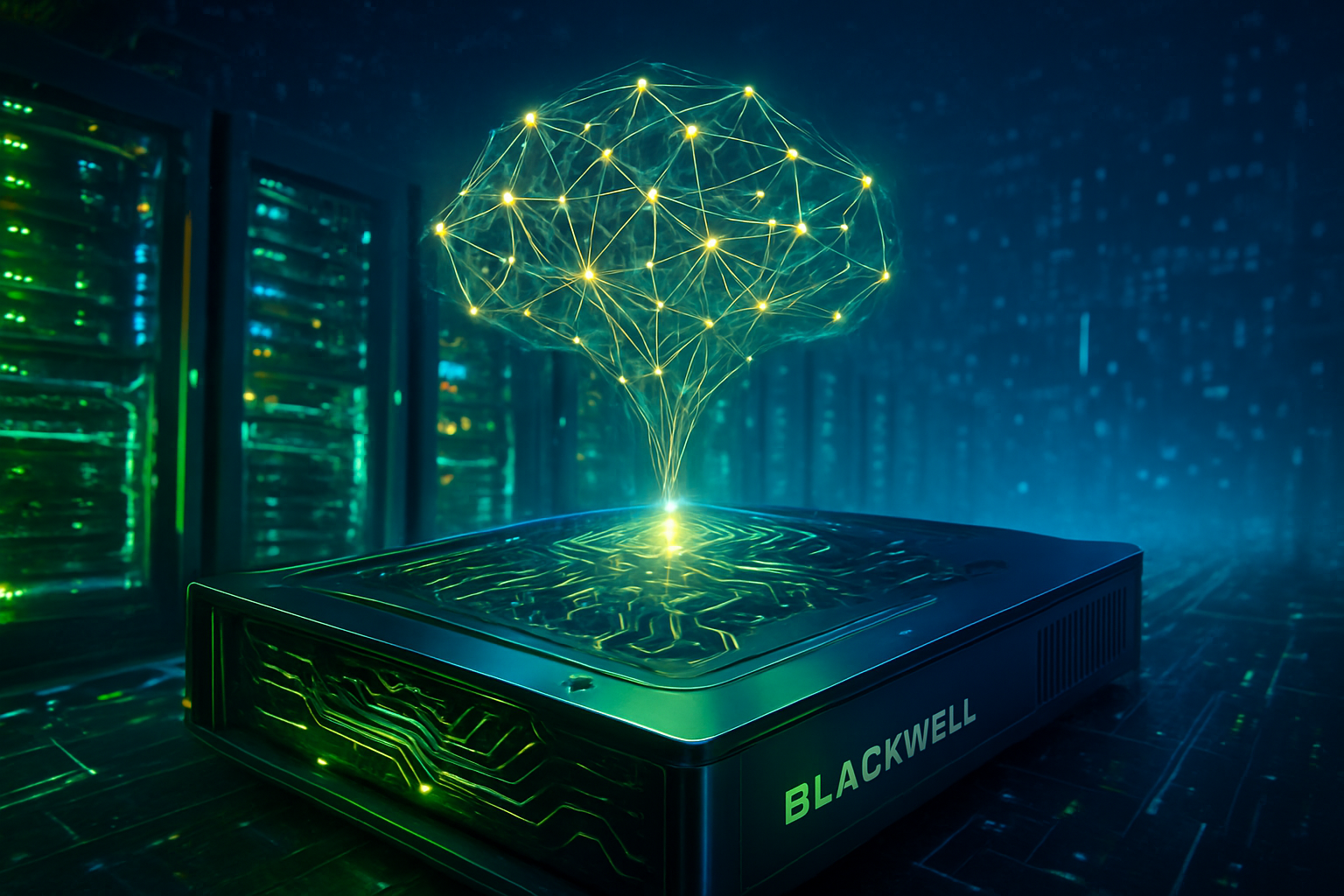
    In a move that cements its dominance over the artificial intelligence landscape, Nvidia (NASDAQ:NVDA) has officially moved its Blackwell GPU architecture into full-scale volume production. This milestone marks the beginning of a new chapter in computational history, as the company scales its most powerful hardware to meet the insatiable demand of hyperscalers and sovereign nations alike. With CEO Jensen Huang confirming that the company is now shipping approximately 1,000 Blackwell GB200 NVL72 racks per week, the "AI Factory" has transitioned from a conceptual vision to a physical reality, promising to redefine the economics of large-scale model deployment.

    The production ramp-up is accompanied by two significant breakthroughs that are already rippling through the industry: a staggering 25x increase in efficiency for trillion-parameter models and the launch of the RTX PRO 5000 72GB variant. These developments address the two most critical bottlenecks in the current AI era—energy consumption at the data center level and memory constraints at the developer workstation level. As the industry shifts its focus from training massive models to the high-volume inference required for agentic AI, Nvidia's latest hardware rollout appears perfectly timed to capture the next wave of the AI revolution.

    Technical Mastery: FP4 Precision and the 72GB Workstation Powerhouse

    The technical cornerstone of the Blackwell architecture's success is its revolutionary 4-bit floating point (FP4) precision. By introducing this new numerical format, Nvidia has effectively doubled the throughput of its previous H100 "Hopper" architecture while maintaining the high levels of accuracy required for trillion-parameter Mixture-of-Experts (MoE) models. This advancement, powered by 5th Generation Tensor Cores, allows the GB200 NVL72 systems to deliver up to 30x the inference performance of equivalent H100 clusters. The result is a hardware ecosystem that can process the world’s most complex AI tasks with significantly lower latency and a fraction of the power footprint previously required.

    Beyond the data center, Nvidia has addressed the needs of local developers with the October 21, 2025, launch of the RTX PRO 5000 72GB. This workstation-class GPU, built on the Blackwell GB202 architecture, features a massive 72GB of GDDR7 memory with Error Correction Code (ECC) support. With 14,080 CUDA cores and a staggering 2,142 TOPS of AI performance, the card is designed specifically for "Agentic AI" development and the local fine-tuning of large models. By offering a 50% increase in VRAM over its predecessor, the RTX PRO 5000 72GB allows engineers to keep massive datasets in local memory, ensuring data privacy and reducing the high costs associated with constant cloud prototyping.

    Initial reactions from the AI research community have been overwhelmingly positive, particularly regarding the efficiency gains. Early benchmarks from major labs suggest that the 25x reduction in energy consumption for trillion-parameter inference is not just a theoretical marketing claim but a practical reality in production environments. Industry experts note that the Blackwell architecture’s ability to run these massive models on fewer nodes significantly reduces the "communication tax"—the energy and time lost when data travels between different chips—making the GB200 the most cost-effective platform for the next generation of generative AI.

    Market Domination and the Competitive Fallout

    The full-scale production of Blackwell has profound implications for the world's largest tech companies. Hyperscalers such as Microsoft (NASDAQ:MSFT), Alphabet (NASDAQ:GOOGL), and Amazon (NASDAQ:AMZN) have already integrated Blackwell into their cloud offerings. Microsoft Azure’s ND GB200 V6 series and Google Cloud’s A4 VMs are now generally available, providing the infrastructure necessary for enterprises to deploy agentic workflows at scale. This rapid adoption has translated into a massive financial windfall for Nvidia, with Blackwell-related revenue reaching an estimated $11 billion in the final quarter of 2025 alone.

    For competitors like Advanced Micro Devices (NASDAQ:AMD) and Intel (NASDAQ:INTC), the Blackwell production ramp presents a daunting challenge. While AMD’s MI300 and MI325X series have found success in specific niches, Nvidia’s ability to ship 1,000 full-rack systems per week creates a "moat of scale" that is difficult to breach. The integration of hardware, software (CUDA), and networking (InfiniBand/Spectrum-X) into a single "AI Factory" platform makes it increasingly difficult for rivals to offer a comparable total cost of ownership (TCO), especially as the market shifts its spending from training to high-efficiency inference.

    Furthermore, the launch of the RTX PRO 5000 72GB disrupts the professional workstation market. By providing 72GB of high-speed GDDR7 memory, Nvidia is effectively cannibalizing some of its own lower-end data center sales in favor of empowering local development. This strategic move ensures that the next generation of AI applications is built on Nvidia hardware from the very first line of code, creating a long-term ecosystem lock-in that benefits startups and enterprise labs who prefer to keep their proprietary data off the public cloud during the early stages of development.

    A Paradigm Shift in the Global AI Landscape

    The transition to Blackwell signifies a broader shift in the global AI landscape: the move from "AI as a tool" to "AI as an infrastructure." Nvidia’s success in shipping millions of GPUs has catalyzed the rise of Sovereign AI, where nations are now investing in their own domestic AI factories to ensure data sovereignty and economic competitiveness. This trend has pushed Nvidia’s market capitalization to historic heights, as the company is no longer seen as a mere chipmaker but as the primary architect of the world's new "computational grid."

    Comparatively, the Blackwell milestone is being viewed by historians as significant as the transition from vacuum tubes to transistors. The 25x efficiency gain for trillion-parameter models effectively lowers the "entry fee" for true artificial general intelligence (AGI) research. What was once only possible for the most well-funded tech giants is now becoming accessible to a wider array of institutions. However, this rapid scaling also brings concerns regarding the environmental impact of massive data centers, even with Blackwell’s efficiency gains. The sheer volume of deployment means that while each calculation is 25x greener, the total energy demand of the AI sector continues to climb.

    The Blackwell era also marks the definitive end of the "GPU shortage" that defined 2023 and 2024. While demand still outpaces supply, the optimization of the TSMC (NYSE:TSM) 4NP process and the resolution of earlier packaging bottlenecks mean that the industry can finally move at the speed of software. This stability allows AI labs to plan multi-year roadmaps with the confidence that the necessary hardware will be available to support the next generation of multi-modal and agentic systems.

    The Horizon: From Blackwell to Rubin and Beyond

    Looking ahead, the road for Nvidia is already paved with its next architecture, codenamed "Rubin." Expected to debut in 2026, the Rubin R100 platform will likely build on the successes of Blackwell, potentially moving toward even more advanced packaging techniques and HBM4 memory. In the near term, the industry is expected to focus heavily on "Agentic AI"—autonomous systems that can reason, plan, and execute complex tasks. The 72GB capacity of the new RTX PRO 5000 is a direct response to this trend, providing the local "brain space" required for these agents to operate efficiently.

    The next challenge for the industry will be the integration of these massive hardware gains into seamless software workflows. While Blackwell provides the raw power, the development of standardized frameworks for multi-agent orchestration remains a work in progress. Experts predict that 2026 will be the year of "AI ROI," where companies will be under pressure to prove that their massive investments in Blackwell-powered infrastructure can translate into tangible productivity gains and new revenue streams.

    Final Assessment: The Foundation of the Intelligence Age

    Nvidia’s successful ramp-up of Blackwell production is more than just a corporate achievement; it is the foundational event of the late 2020s tech economy. By delivering 25x efficiency gains for the world’s most complex models and providing developers with high-capacity local hardware like the RTX PRO 5000 72GB, Nvidia has eliminated the primary physical barriers to AI scaling. The company has successfully navigated the transition from being a component supplier to the world's most vital infrastructure provider.

    As we move into 2026, the industry will be watching closely to see how the deployment of these 3.6 million+ Blackwell GPUs transforms the global economy. With a backlog of orders extending well into the next year and the Rubin architecture already on the horizon, Nvidia’s momentum shows no signs of slowing. For now, the message to the world is clear: the trillion-parameter era is here, and it is powered by Blackwell.


    This content is intended for informational purposes only and represents analysis of current AI developments.

    TokenRing AI delivers enterprise-grade solutions for multi-agent AI workflow orchestration, AI-powered development tools, and seamless remote collaboration platforms.
    For more information, visit https://www.tokenring.ai/.
  • The Rise of the Universal Agent: How Google’s Project Astra is Redefining the Human-AI Interface

    The Rise of the Universal Agent: How Google’s Project Astra is Redefining the Human-AI Interface

    As we close out 2025, the landscape of artificial intelligence has shifted from the era of static chatbots to the age of the "Universal Agent." At the forefront of this revolution is Project Astra, a massive multi-year initiative from Google, a subsidiary of Alphabet Inc. (NASDAQ:GOOGL), designed to create an ambient, proactive AI that doesn't just respond to prompts but perceives and interacts with the physical world in real-time.

    Originally unveiled as a research prototype at Google I/O in 2024, Project Astra has evolved into the operational backbone of the Gemini ecosystem. By integrating vision, sound, and persistent memory into a single low-latency framework, Google has moved closer to the "JARVIS-like" vision of AI—an assistant that lives in your glasses, controls your smartphone, and understands your environment as intuitively as a human companion.

    The Technical Foundation of Ambient Intelligence

    The technical foundation of Project Astra represents a departure from the "token-in, token-out" architecture of early large language models. To achieve the fluid, human-like responsiveness seen in late 2025, Google DeepMind engineers focused on three core pillars: multimodal synchronicity, sub-300ms latency, and persistent temporal memory. Unlike previous iterations of Gemini, which processed video as a series of discrete frames, Astra-powered models like Gemini 2.5 and the newly released Gemini 3.0 treat video and audio as a continuous, unified stream. This allows the agent to identify objects, read code, and interpret emotional nuances in a user’s voice simultaneously without the "thinking" delays that plagued earlier AI.

    One of the most significant breakthroughs of 2025 was the rollout of "Agentic Intuition." This capability allows Astra to navigate the Android operating system autonomously. In a landmark demonstration earlier this year, Google showed the agent taking a single voice command—"Help me fix my sink"—and proceeding to open the camera to identify the leak, search for a digital repair manual, find the necessary part on a local hardware store’s website, and draft an order for pickup. This level of "phone control" is made possible by the agent's ability to "see" the screen and interact with UI elements just as a human would, bypassing the need for specific app API integrations.

    Initial reactions from the AI research community have been a mix of awe and caution. Dr. Andrej Karpathy and other industry luminaries have noted that Google’s integration of Astra into the hardware level—specifically via the Tensor G5 chips in the latest Pixel devices—gives it a distinct advantage in power efficiency and speed. However, some researchers argue that the "black box" nature of Astra’s decision-making in autonomous tasks remains a challenge for safety, as the agent must now be trusted to handle sensitive digital actions like financial transactions and private communications.

    The Strategic Battle for the AI Operating System

    The success of Project Astra has ignited a fierce strategic battle for what analysts are calling the "AI OS." Alphabet Inc. (NASDAQ:GOOGL) is leveraging its control over Android to ensure that Astra is the default "brain" for billions of devices. This puts direct pressure on Apple Inc. (NASDAQ:AAPL), which has taken a more conservative approach with Apple Intelligence. While Apple remains the leader in user trust and privacy-centric "Private Cloud Compute," it has struggled to match the raw agentic capabilities and cross-app autonomy that Google has demonstrated with Astra.

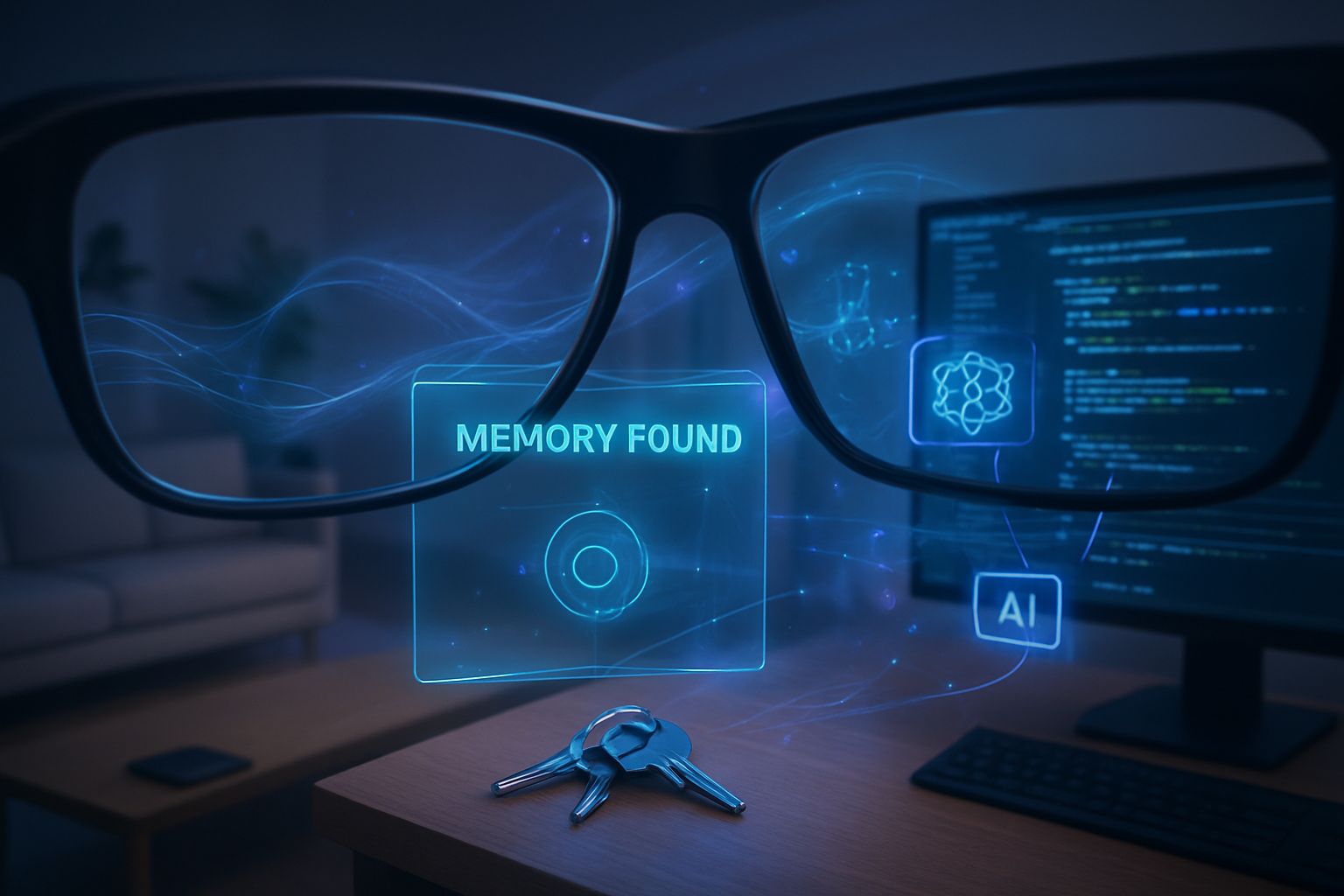
    In the wearable space, Google is positioning Astra as the intelligence behind the Android XR platform, a collaborative hardware effort with Samsung (KRX:005930) and Qualcomm (NASDAQ:QCOM). This is a direct challenge to Meta Platforms Inc. (NASDAQ:META), whose Ray-Ban Meta glasses have dominated the early "smart eyewear" market. While Meta’s Llama 4 models offer impressive "Look and Ask" features, Google’s Astra-powered glasses aim for a deeper level of integration, offering real-time world-overlay navigation and a "multimodal memory" that remembers where you left your keys or what a colleague said in a meeting three days ago.

    Startups are also feeling the ripples of Astra’s release. Companies that previously specialized in "wrapper" apps for specific AI tasks—such as automated scheduling or receipt tracking—are finding their value propositions absorbed into the native capabilities of the universal agent. To survive, the broader AI ecosystem is gravitating toward the Model Context Protocol (MCP), an open standard that allows agents from different companies to share data and tools, though Google’s "A2UI" (Agentic User Interface) standard is currently vying to become the dominant framework for how AI interacts with visual software.

    Societal Implications and the Privacy Paradox

    Beyond the corporate horse race, Project Astra signals a fundamental shift in the broader AI landscape: the transition from "Information Retrieval" to "Physical Agency." We are moving away from a world where we ask AI for information and toward a world where we delegate our intentions. This shift carries profound implications for human productivity, as "mundane admin"—the thousands of small digital tasks that consume our days—begins to vanish into the background of an ambient AI.

    However, this "always-on" vision has sparked significant ethical and privacy concerns. With Astra-powered glasses and phone-sharing features, the AI is effectively recording and processing a constant stream of visual and auditory data. Privacy advocates, including Signal President Meredith Whittaker, have warned that this creates a "narrative authority" over our lives, where a single corporation has a complete, searchable record of our physical and digital interactions. The EU AI Act, which saw its first major wave of enforcement in 2025, is currently scrutinizing these "autonomous systems" to determine if they violate bystander privacy or manipulate user behavior through proactive suggestions.

    Comparisons to previous milestones, like the release of GPT-4 or the original iPhone, are common, but Astra feels different. It represents the "eyes and ears" of the internet finally being connected to a "brain" that can act. If 2023 was the year AI learned to speak and 2024 was the year it learned to reason, 2025 is the year AI learned to inhabit our world.

    The Horizon: From Smartphones to Smart Worlds

    Looking ahead, the near-term roadmap for Project Astra involves a wider rollout of "Project Mariner," a desktop-focused version of the agent designed to handle complex professional workflows in Chrome and Workspace. Experts predict that by late 2026, we will see the first "Agentic-First" applications—software designed specifically to be navigated by AI rather than humans. These apps will likely have no traditional buttons or menus, consisting instead of data structures that an agent like Astra can parse and manipulate instantly.

    The ultimate challenge remains the "Reliability Gap." For a universal agent to be truly useful, it must achieve a near-perfect success rate in its actions. A 95% success rate is impressive for a chatbot, but a 5% failure rate is catastrophic when an AI is authorized to move money or delete files. Addressing "Agentic Hallucination"—where an AI confidently performs the wrong action—will be the primary focus of Google’s research as they move toward the eventual release of Gemini 4.0.

    A New Chapter in Human-Computer Interaction

    Project Astra is more than just a feature update; it is a blueprint for the future of computing. By bridging the gap between digital intelligence and physical reality, Google has established a new benchmark for what an AI assistant should be. The move from a reactive tool to a proactive agent marks a turning point in history, where the boundary between our devices and our environment begins to dissolve.

    The key takeaways from the Astra initiative are clear: multimodal understanding and low latency are the new prerequisites for AI, and the battle for the "AI OS" will be won by whoever can best integrate these agents into our daily hardware. In the coming months, watch for the public launch of the first consumer-grade Android XR glasses and the expansion of Astra’s "Computer Use" features into the enterprise sector. The era of the universal agent has arrived, and the way we interact with the world will never be the same.


    This content is intended for informational purposes only and represents analysis of current AI developments.

    TokenRing AI delivers enterprise-grade solutions for multi-agent AI workflow orchestration, AI-powered development tools, and seamless remote collaboration platforms.
    For more information, visit https://www.tokenring.ai/.
  • The Omni Shift: How GPT-4o Redefined Human-AI Interaction and Birthed the Agent Era

    The Omni Shift: How GPT-4o Redefined Human-AI Interaction and Birthed the Agent Era

    The Omni Shift: How GPT-4o Redefined Human-AI Interaction and Birthed the Agent Era

    As we look back from the close of 2025, few moments in the rapid evolution of artificial intelligence carry as much weight as the release of OpenAI’s GPT-4o, or "Omni." Launched in May 2024, the model represented a fundamental departure from the "chatbot" era, transitioning the industry toward a future where AI does not merely process text but perceives the world through a unified, native multimodal lens. By collapsing the barriers between sight, sound, and text, OpenAI set a new standard for what it means for an AI to be "present."

    The immediate significance of GPT-4o was its ability to operate at human-like speeds, effectively ending the awkward "AI lag" that had plagued previous voice assistants. With an average latency of 320 milliseconds—and a floor of 232 milliseconds—GPT-4o matched the response time of natural human conversation. This wasn't just a technical upgrade; it was a psychological breakthrough that allowed AI to move from being a digital encyclopedia to a real-time collaborator and emotional companion, laying the groundwork for the autonomous agents that now dominate our digital lives in late 2025.

    The Technical Leap: From Pipelines to Native Multimodality

    The technical brilliance of GPT-4o lay in its "native" architecture. Prior to its arrival, multimodal AI was essentially a "Frankenstein" pipeline of disparate models: one model (like Whisper) would transcribe audio to text, a second (GPT-4) would process that text, and a third would convert the response back into speech. This "pipeline" approach was inherently lossy; the AI could not "hear" the inflection in a user's voice or "see" the frustration on their face. GPT-4o changed the game by training a single neural network end-to-end across text, vision, and audio.

    Because every input and output was processed by the same model, GPT-4o could perceive raw audio waves directly. This allowed the model to detect subtle emotional cues, such as a user’s breathing patterns, background noises like a barking dog, or the specific cadence of a sarcastic remark. On the output side, the model gained the ability to generate speech with intentional emotional nuance—whispering, singing, or laughing—making it the first AI to truly cross the "uncanny valley" of vocal interaction.

    The vision capabilities were equally transformative. By processing video frames in real-time, GPT-4o could "watch" a user solve a math problem on paper or "see" a coding error on a screen, providing feedback as if it were standing right behind them. This leap from static image analysis to real-time video reasoning fundamentally differentiated OpenAI from its competitors at the time, who were still struggling with the latency issues inherent in multi-model architectures.

    A Competitive Earthquake: Reshaping the Big Tech Landscape

    The arrival of GPT-4o sent shockwaves through the tech industry, most notably affecting Microsoft (NASDAQ: MSFT), Alphabet (NASDAQ: GOOGL), and Apple (NASDAQ: AAPL). For Microsoft, OpenAI’s primary partner, GPT-4o provided the "brain" for a new generation of Copilot+ PCs, enabling features like Recall and real-time translation that required the low-latency processing the Omni model excelled at. However, the most surprising strategic shift came via Apple.

    At WWDC 2024, Apple announced that GPT-4o would be the foundational engine for its "Apple Intelligence" initiative, integrating ChatGPT directly into Siri. This partnership was a masterstroke for OpenAI, giving it access to over a billion high-value users and forcing Alphabet (NASDAQ: GOOGL) to accelerate its own Gemini Live roadmap. Google’s "Project Astra," which had been teased as a future vision, suddenly found itself in a race to match GPT-4o’s "Omni" capabilities, leading to a year of intense competition in the "AI-as-a-Companion" market.

    The release also disrupted the startup ecosystem. Companies that had built their value propositions around specialized speech-to-text or emotional AI found their moats evaporated overnight. GPT-4o proved that a general-purpose foundation model could outperform specialized tools in niche sensory tasks, signaling a consolidation of the AI market toward a few "super-models" capable of doing everything from vision to voice.

    The Cultural Milestone: The "Her" Moment and Ethical Friction

    The wider significance of GPT-4o was as much cultural as it was technical. The model’s launch was immediately compared to the 2013 film Her, which depicted a man falling in love with an emotionally intelligent AI. This comparison was not accidental; OpenAI’s leadership, including Sam Altman, leaned into the narrative of AI as a personal, empathetic companion. This shift sparked a global conversation about the psychological impact of forming emotional bonds with software, a topic that remains a central pillar of AI ethics in 2025.

    However, this transition was not without controversy. The "Sky" voice controversy, where actress Scarlett Johansson alleged the model’s voice was an unauthorized imitation of her own, highlighted the legal and ethical gray areas of vocal personality generation. It forced the industry to adopt stricter protocols regarding the "theft" of human likeness and vocal identity. Despite these hurdles, GPT-4o’s success proved that the public was ready—and even eager—for AI that felt more "human."

    Furthermore, GPT-4o served as the ultimate proof of concept for the "Agentic Era." By providing a model that could see and hear in real-time, OpenAI gave developers the tools to build agents that could navigate the physical and digital world autonomously. It was the bridge between the static LLMs of 2023 and the goal-oriented, multi-step autonomous systems we see today, which can manage entire workflows without human intervention.

    The Path Forward: From Companion to Autonomous Agent

    Looking ahead from our current 2025 vantage point, GPT-4o is seen as the precursor to the more advanced GPT-5 and o1 reasoning models. While GPT-4o focused on "presence" and "perception," the subsequent generations have focused on "reasoning" and "reliability." The near-term future of AI involves the further miniaturization of these Omni capabilities, allowing them to run locally on wearable devices like AI glasses and hearables without the need for a cloud connection.

    The next frontier, which experts predict will mature by 2026, is the integration of "long-term memory" into the Omni framework. While GPT-4o could perceive a single conversation with startling clarity, the next generation of agents will remember years of interactions, becoming truly personalized digital twins. The challenge remains in balancing this deep personalization with the massive privacy concerns that come with an AI that is "always listening" and "always watching."

    A Legacy of Presence: Wrapping Up the Omni Era

    In the grand timeline of artificial intelligence, GPT-4o will be remembered as the moment the "user interface" of AI changed forever. It moved the needle from a text box to a living, breathing (literally, in some cases) presence. The key takeaway from the GPT-4o era is that intelligence is not just about the ability to solve complex equations; it is about the ability to perceive and react to the world in a way that feels natural to humans.

    As we move deeper into 2026, the "Omni" philosophy has become the industry standard. No major AI lab would dream of releasing a text-only model today. GPT-4o’s legacy is the democratization of high-level multimodal intelligence, making it free for millions and setting the stage for the AI-integrated society we now inhabit. It wasn't just a better chatbot; it was the first step toward a world where AI is a constant, perceptive, and emotionally aware partner in the human experience.


    This content is intended for informational purposes only and represents analysis of current AI developments.

    TokenRing AI delivers enterprise-grade solutions for multi-agent AI workflow orchestration, AI-powered development tools, and seamless remote collaboration platforms.
    For more information, visit https://www.tokenring.ai/.
  • Trump Establishes “One Nation, One AI” Policy: New Executive Order Blocks State-Level Regulations

    Trump Establishes “One Nation, One AI” Policy: New Executive Order Blocks State-Level Regulations

    In a move that fundamentally reshapes the American technological landscape, President Donald Trump has signed a sweeping Executive Order aimed at establishing a singular national framework for artificial intelligence. Signed on December 11, 2025, the order—titled "Ensuring a National Policy Framework for Artificial Intelligence"—seeks to prevent a "patchwork" of conflicting state-level regulations from hindering the development and deployment of AI technologies. By asserting federal preemption, the administration is effectively sidelining state-led initiatives in California, Colorado, and New York that sought to impose strict safety and transparency requirements on AI developers.

    The immediate significance of this order cannot be overstated. It marks the final pivot of the administration’s "Make America First in AI" agenda, moving away from the safety-centric oversight of the previous administration toward a model of aggressive deregulation. The White House argues that for the United States to maintain its lead over global competitors, specifically China, American companies must be liberated from the "cumbersome and contradictory" rules of 50 different states. The order signals a new era where federal authority is used not to regulate, but to protect the industry from regulation.

    The Mechanics of Preemption: A New Legal Shield for AI

    The December Executive Order introduces several unprecedented mechanisms to enforce federal supremacy over AI policy. Central to this is the creation of an AI Litigation Task Force within the Department of Justice, which is scheduled to become fully operational by January 10, 2026. This task force is charged with challenging any state law that the administration deems "onerous" or an "unconstitutional burden" on interstate commerce. The legal strategy relies heavily on the Dormant Commerce Clause, arguing that because AI models are developed and deployed across state and national borders, they are inherently beyond the regulatory purview of individual states.

    Technically, the order targets specific categories of state regulation that the administration has labeled as "anti-innovation." These include mandatory algorithmic audits for "bias" and "discrimination," such as those found in Colorado’s SB 24-205, and California’s rigorous transparency requirements for large-scale foundation models. The administration has categorized these state-level mandates as "engineered social agendas" or "Woke AI" requirements, claiming they force developers to bake ideological biases into their software. By preempting these rules, the federal government aims to provide a "minimally burdensome" standard that focuses on performance and economic growth rather than social impact.

    Initial reactions from the AI research community are sharply divided. Proponents of the order, including many high-profile researchers at top labs, argue that a single federal standard will accelerate the pace of experimentation. They point out that the cost of compliance for a startup trying to navigate 50 different sets of rules is often prohibitive. Conversely, safety advocates and some academic researchers warn that by stripping states of their ability to regulate, the federal government is creating a "vacuum of accountability." They argue that the lack of local oversight could lead to a "race to the bottom" where safety protocols are sacrificed for speed.

    Big Tech and the Silicon Valley Victory

    The announcement has been met with quiet celebration across the headquarters of America’s largest technology firms. Major players such as Microsoft (NASDAQ:MSFT), Alphabet (NASDAQ:GOOGL), Meta Platforms (NASDAQ:META), and NVIDIA (NASDAQ:NVDA) have long lobbied for a unified federal approach to AI. For these giants, the order provides the "clarity and predictability" needed to deploy trillions of dollars in capital. By removing the threat of a fragmented regulatory environment, the administration has essentially lowered the long-term operational risk for companies building the next generation of Large Language Models (LLMs) and autonomous systems.

    Startups and venture capital firms are also positioned as major beneficiaries. Prominent investors, including Marc Andreessen of Andreessen Horowitz, have praised the move as a "lifeline" for the American startup ecosystem. Without the threat of state-level lawsuits or expensive compliance audits, smaller AI labs can focus their limited resources on technical breakthroughs rather than legal defense. This shift is expected to consolidate the U.S. market, making it more attractive for domestic investment while potentially disrupting the plans of international competitors who must still navigate the complex regulatory environment of the European Union’s AI Act.

    However, the competitive implications are not entirely one-sided. While the order protects incumbents and domestic startups, it also removes certain consumer protections that some smaller, safety-focused firms had hoped to use as a market differentiator. By standardizing a "minimally burdensome" framework, the administration may inadvertently reduce the incentive for companies to invest in the very safety and transparency features that European and Asian markets are increasingly demanding. This could create a strategic rift between U.S.-based AI services and the rest of the world.

    The Wider Significance: Innovation vs. Sovereignty

    This Executive Order represents a major milestone in the history of AI policy, signaling a complete reversal of the approach taken by the Biden administration. Whereas the previous Executive Order 14110 focused on managing risks and protecting civil rights, Trump’s EO 14179 and the subsequent December preemption order prioritize "global AI dominance" above all else. This shift reflects a broader trend in 2025: the framing of AI not just as a tool for productivity, but as a critical theater of national security and geopolitical competition.

    The move also touches on a deeper constitutional tension regarding state sovereignty. By threatening to withhold federal funding—specifically from the Broadband Equity Access and Deployment (BEAD) program—for states that refuse to align with federal AI policy, the administration is using significant financial leverage to enforce its will. This has sparked a bipartisan backlash among state Attorneys General, who argue that the federal government is overstepping its bounds and stripping states of their traditional role in consumer protection.

    Comparisons are already being drawn to the early days of the internet, when the federal government largely took a hands-off approach to regulation. Supporters of the preemption order argue that this "permissionless innovation" is exactly what allowed the U.S. to dominate the digital age. Critics, however, point out that AI is fundamentally different from the early web, with the potential to impact physical safety, democratic integrity, and the labor market in ways that static websites never could. The concern is that by the time the federal government decides to act, the "unregulated" development may have already caused irreversible societal shifts.

    Future Developments: A Supreme Court Showdown Looms

    The near-term future of this Executive Order will likely be decided in the courts. California Governor Gavin Newsom has already signaled that his state will not back down, calling the order an "illegal infringement on California’s rights." Legal experts predict a flurry of lawsuits in early 2026, as states seek to defend their right to protect their citizens from deepfakes, algorithmic bias, and job displacement. This is expected to culminate in a landmark Supreme Court case that will define the limits of federal power in the age of artificial intelligence.

    Beyond the legal battles, the industry is watching to see how the Department of Commerce defines the "onerous" laws that will be officially targeted for preemption. The list, expected in late January 2026, will serve as a roadmap for which state-level protections are most at risk. Meanwhile, we may see a push in Congress to codify this preemption into law, which would provide a more permanent legislative foundation for the administration's "One Nation, One AI" policy and make it harder for future administrations to reverse.

    Experts also predict a shift in how AI companies approach international markets. As the U.S. moves toward a deregulated model, the "Brussels Effect"—where EU regulations become the global standard—may strengthen. U.S. companies may find themselves building two versions of their products: a "high-performance" version for the domestic market and a "compliant" version for export to more regulated regions like Europe and parts of Asia.

    A New Chapter for American Technology

    The "Ensuring a National Policy Framework for Artificial Intelligence" Executive Order marks a definitive end to the era of cautious, safety-first AI policy in the United States. By centralizing authority and actively dismantling state-level oversight, the Trump administration has placed a massive bet on the idea that speed and scale are the most important metrics for AI success. The key takeaway for the industry is clear: the federal government is now the primary, and perhaps only, regulator that matters.

    In the history of AI development, this moment will likely be remembered as the "Great Preemption," a time when the federal government stepped in to ensure that the "engines of innovation" were not slowed by local concerns. Whether this leads to a new golden age of American technological dominance or a series of unforeseen societal crises remains to be seen. The long-term impact will depend on whether the federal government can effectively manage the risks of AI on its own, without the "laboratory of the states" to test different regulatory approaches.

    In the coming weeks, stakeholders should watch for the first filings from the AI Litigation Task Force and the reactions from the European Union, which may see this move as a direct challenge to its own regulatory ambitions. As 2026 begins, the battle for the soul of AI regulation has moved from the statehouses to the federal courts, and the stakes have never been higher.


    This content is intended for informational purposes only and represents analysis of current AI developments.

    TokenRing AI delivers enterprise-grade solutions for multi-agent AI workflow orchestration, AI-powered development tools, and seamless remote collaboration platforms.
    For more information, visit https://www.tokenring.ai/.
  • Trump Administration Launches ‘United States Tech Force’ to Recruit 1,000 Elite AI Engineers

    Trump Administration Launches ‘United States Tech Force’ to Recruit 1,000 Elite AI Engineers

    In a bold move to solidify American dominance in the global artificial intelligence race, the second Trump administration has officially launched the "United States Tech Force" (USTF). The initiative aims to recruit a specialized corps of 1,000 elite AI engineers and technologists to modernize the nation’s aging government infrastructure and spearhead the integration of advanced machine learning into federal operations. Announced on December 15, 2025, the program is a cornerstone of the administration’s broader "Winning the Race: America’s AI Action Plan," signaling a massive shift toward a tech-centric federal workforce.

    The USTF is designed to bridge the widening gap between the private sector's rapid innovation and the government’s legacy systems. By offering high-tier salaries and bypassing traditional bureaucratic hurdles, the administration hopes to lure top-tier talent from Silicon Valley to Washington, D.C. This development comes at a critical juncture as the United States intensifies its competition with China for AI supremacy, positioning the federal government not just as a regulator, but as a primary architect of the next generation of AI-driven public services and national defense.

    Technical Elite: 1,000 Engineers for the "Stargate" Era

    The United States Tech Force is not a standard federal hiring surge; it is a highly selective "skills-first" recruitment drive. The program targets 1,000 engineers, data scientists, and cybersecurity specialists for two-year service terms. Unlike traditional civil service roles, the USTF does not require a college degree if applicants can prove "elite" technical proficiency through rigorous assessments and portfolios. These recruits will be placed in high-impact roles at the Department of War—the recently rebranded Department of Defense—and the Treasury, as well as the newly established "Trump Accounts" portal at the IRS.

    Technically, the USTF is the human component of the "Stargate" project, a $500 billion public-private partnership focused on building massive AI data centers and energy infrastructure across states like Texas and Ohio. These engineers will be tasked with migrating fragmented federal data into secure, cloud-native AI environments. The technical specifications of the initiative emphasize "battle-hardened" software engineering and the deployment of autonomous systems. Initial reactions from the AI research community are mixed; while some praise the focus on technical merit over credentials, others worry that a two-year term is insufficient for the deep architectural overhauls required by the government’s complex, decade-old systems.

    Silicon Valley Goes to Washington: Industry Impact and Corporate Synergy

    The announcement has sent ripples through the tech industry, as major players move to align themselves with the federal surge. Companies like Microsoft (NASDAQ: MSFT), Nvidia (NASDAQ: NVDA), and Oracle (NYSE: ORCL) have already signed on as partners. These firms are not only providing the hardware and cloud infrastructure for the initiative but have also agreed to create a "revolving door" for talent, promising to prioritize USTF alumni for high-paying roles once their two-year government service concludes. This creates a powerful strategic advantage for these giants, essentially allowing them to help shape the very federal systems they may later bid to maintain.

    However, the initiative poses a competitive challenge for smaller AI startups. With the federal government offering salaries between $150,000 and $200,000—placing recruits at the GS-13 and GS-14 pay grades—the USTF is competing directly for the same pool of "early-career" talent that typically fuels the startup ecosystem. Furthermore, the administration’s decision to allow recruits to retain their private-sector stock options has sparked debate. While it makes the roles more attractive to employees of Amazon (NASDAQ: AMZN) or Meta (NASDAQ: META), critics argue it creates a massive conflict of interest, potentially leading to "regulatory capture" where government tech policy is influenced by the financial interests of Big Tech.

    A Post-DOGE Pivot: The Broader AI Landscape

    The launch of the Tech Force is being viewed by many as a strategic "re-staffing" following the massive workforce reductions led by the Department of Government Efficiency (DOGE) earlier in 2025. After cutting over 200,000 federal roles and dismantling units like the U.S. Digital Service (USDS), the administration is now selectively "surging" specialized talent back into the fold. This "fire-and-hire" strategy is unprecedented in federal history and reflects a belief that the government should be leaner in bureaucracy but more potent in technical capability.

    The broader significance lies in the "AI Arms Race." By embedding elite engineers directly into national security and infrastructure, the U.S. is signaling a shift toward an offensive AI posture. This mirrors previous milestones like the Manhattan Project or the Apollo program, but with a modern, decentralized twist. However, the focus on "coders" over "ethicists" has drawn fire from civil society groups. Organizations like Public Citizen have warned that sidelining AI safety and ethics experts in favor of pure engineering talent could lead to the deployment of biased or unaccountable algorithms in critical areas like law enforcement and financial oversight.

    The Road Ahead: 2026 and the Future of Federal AI

    As the first wave of recruitment begins in late December 2025, the tech world is watching to see how quickly these 1,000 engineers can be integrated. The first cohort is expected to be in place by March 2026. Near-term projects include the automation of federal procurement and the deployment of AI-driven predictive maintenance for the nation’s power grid. In the long term, the administration envisions the Tech Force as a permanent "surge capacity" that can be deployed to any agency facing a technical crisis or a major modernization hurdle.

    Challenges remain, particularly regarding security clearances and the inherent friction between fast-moving tech culture and slow-moving federal bureaucracy. Experts predict that the success of the USTF will hinge on whether these engineers are given the actual authority to bypass legacy protocols. If successful, the program could serve as a blueprint for other nations looking to modernize their civil services. If it fails, it may be remembered as an expensive experiment that further blurred the lines between private corporate interests and public governance.

    Conclusion: A New Era for the Federal Workforce

    The United States Tech Force represents a paradigm shift in how the federal government views its workforce. By prioritizing elite technical skills and offering competitive compensation, the Trump administration is attempting to build a "digital vanguard" capable of navigating the complexities of the 21st century. The initiative’s deep ties to industry leaders like Palantir (NYSE: PLTR) and Apple (NASDAQ: AAPL) suggest a future where the boundary between public service and private enterprise is increasingly porous.

    As we move into 2026, the USTF will be a primary indicator of the administration’s ability to execute its ambitious AI agenda. Whether this "Tech Force" can truly modernize the government or if it will simply become a high-tech extension of corporate Silicon Valley remains to be seen. For now, the recruitment drive is on, and the eyes of the global tech community are firmly fixed on Washington.


    This content is intended for informational purposes only and represents analysis of current AI developments.

    TokenRing AI delivers enterprise-grade solutions for multi-agent AI workflow orchestration, AI-powered development tools, and seamless remote collaboration platforms.
    For more information, visit https://www.tokenring.ai/.

  • Nvidia Secures AI Inference Dominance with Landmark $20 Billion Groq Licensing Deal

    Nvidia Secures AI Inference Dominance with Landmark $20 Billion Groq Licensing Deal

    In a move that has sent shockwaves through Silicon Valley and the global semiconductor industry, Nvidia (NASDAQ:NVDA) announced a historic $20 billion strategic licensing agreement with AI chip innovator Groq on December 24, 2025. The deal, structured as a non-exclusive technology license and a massive "acqui-hire," marks a pivotal shift in the AI hardware wars. As part of the agreement, Groq’s visionary founder and CEO, Jonathan Ross—a primary architect of Google’s original Tensor Processing Unit (TPU)—will join Nvidia’s executive leadership team to spearhead the company’s next-generation inference architecture.

    The announcement comes at a critical juncture as the AI industry pivots from the "training era" to the "inference era." While Nvidia has long dominated the market for training massive Large Language Models (LLMs), the rise of real-time reasoning agents and "System-2" thinking models in late 2025 has created an insatiable demand for ultra-low latency compute. By integrating Groq’s proprietary Language Processing Unit (LPU) technology into its ecosystem, Nvidia effectively neutralizes its most potent architectural rival while fortifying its "CUDA lock-in" against a rising tide of custom silicon from hyperscalers.

    The Architectural Rebellion: Understanding the LPU Advantage

    At the heart of this $20 billion deal is Groq’s radical departure from traditional chip design. Unlike the many-core GPU architectures perfected by Nvidia, which rely on dynamic scheduling and complex hardware-level management, Groq’s LPU is built on a Tensor Streaming Processor (TSP) architecture. This design utilizes "static scheduling," where the compiler orchestrates every instruction and data movement down to the individual clock cycle before the code even runs. This deterministic approach eliminates the need for branch predictors and global synchronization locks, allowing for a "conveyor belt" of data that processes language tokens with unprecedented speed.

    The technical specifications of the LPU are tailored specifically for the sequential nature of LLM inference. While Nvidia’s flagship Blackwell B200 GPUs rely on off-chip High Bandwidth Memory (HBM) to store model weights, Groq’s LPU utilizes 230MB of on-chip SRAM with a staggering bandwidth of approximately 80 TB/s—nearly ten times faster than the HBM3E found in current top-tier GPUs. This allows the LPU to bypass the "memory wall" that often bottlenecks GPUs during single-user, real-time interactions. Benchmarks from late 2025 show the LPU delivering over 800 tokens per second on Meta's (NASDAQ:META) Llama 3 (8B) model, compared to roughly 150 tokens per second on equivalent GPU-based cloud instances.

    The integration of Jonathan Ross into Nvidia is perhaps as significant as the technology itself. Ross, who famously initiated the TPU project as a "20% project" at Google (NASDAQ:GOOGL), is widely regarded as the father of modern AI accelerators. His philosophy of "software-defined hardware" has long been the antithesis of Nvidia’s hardware-first approach. Initial reactions from the AI research community suggest that this merger of philosophies could lead to a "unified compute fabric" that combines the massive parallel throughput of Nvidia’s CUDA cores with the lightning-fast sequential processing of Ross’s LPU designs.

    Market Consolidation and the "Inference War"

    The strategic implications for the broader tech landscape are profound. By licensing Groq’s IP, Nvidia has effectively built a defensive moat around the inference market, which analysts at Morgan Stanley now project will represent more than 50% of total AI compute demand by the end of 2026. This deal puts immense pressure on AMD (NASDAQ:AMD), whose Instinct MI355X chips had recently gained ground by offering superior HBM capacity. While AMD remains a strong contender for high-throughput training, Nvidia’s new "LPU-enhanced" roadmap targets the high-margin, real-time application market where latency is the primary metric of success.

    Cloud service providers like Microsoft (NASDAQ:MSFT) and Amazon (NASDAQ:AMZN), who have been aggressively developing their own custom silicon (Maia and Trainium, respectively), now face a more formidable Nvidia. The "Groq-inside" Nvidia chips will likely offer a Total Cost of Ownership (TCO) that makes it difficult for proprietary chips to compete on raw performance-per-watt for real-time agents. Furthermore, the deal allows Nvidia to offer a "best-of-both-worlds" solution: GPUs for the massive batch processing required for training, and LPU-derived blocks for the instantaneous "thinking" required by next-generation reasoning models.

    For startups and smaller AI labs, the deal is a double-edged sword. On one hand, the widespread availability of LPU-speed inference through Nvidia’s global distribution network will accelerate the deployment of real-time AI voice assistants and interactive agents. On the other hand, the consolidation of such a disruptive technology into the hands of the market leader raises concerns about long-term pricing power. Analysts suggest that Nvidia may eventually integrate LPU technology directly into its upcoming "Vera Rubin" architecture, potentially making high-speed inference a standard feature of the entire Nvidia stack.

    Shifting the Paradigm: From Training to Reasoning

    This deal reflects a broader trend in the AI landscape: the transition from "System-1" intuitive response models to "System-2" reasoning models. Models like the OpenAI o3 and DeepSeek R1 require "Test-Time Compute," where the model performs multiple internal reasoning steps before generating a final answer. This process is highly sensitive to latency; if each internal step takes a second, the final response could take minutes. Groq’s LPU technology is uniquely suited for these "thinking" models, as it can cycle through internal reasoning loops at a fraction of the time required by traditional architectures.

    The energy implications are equally significant. As data centers face increasing scrutiny over their power consumption, the efficiency of the LPU—which consumes significantly fewer joules per token than a high-end GPU for inference tasks—offers a path toward more sustainable AI scaling. By adopting this technology, Nvidia is positioning itself as a leader in "Green AI," addressing one of the most persistent criticisms of the generative AI boom.

    Comparisons are already being made to Intel’s (NASDAQ:INTC) historic "Intel Inside" campaign or Nvidia’s own acquisition of Mellanox. However, the Groq deal is unique because it represents the first time Nvidia has looked outside its own R&D labs to fundamentally alter its core compute architecture. It signals an admission that the GPU, while versatile, may not be the optimal tool for the specific task of sequential language generation. This "architectural humility" could be what ensures Nvidia’s dominance for the remainder of the decade.

    The Road Ahead: Real-Time Agents and "Rubin" Integration

    In the near term, industry experts expect Nvidia to launch a dedicated "Inference Accelerator" card based on Groq’s licensed designs as early as Q3 2026. This product will likely target the "Edge Cloud" and enterprise sectors, where companies are desperate to run private LLMs with human-like response times. Longer-term, the true potential lies in the integration of LPU logic into the Vera Rubin platform, Nvidia’s successor to Blackwell. A hybrid "GR-GPU" (Groq-Nvidia GPU) could theoretically handle the massive context windows of 2026-era models while maintaining the sub-100ms latency required for seamless human-AI collaboration.

    The primary challenge remaining is the software transition. While Groq’s compiler is world-class, it operates differently than the CUDA environment most developers are accustomed to. Jonathan Ross’s primary task at Nvidia will likely be the fusion of Groq’s software-defined scheduling with the CUDA ecosystem, creating a seamless experience where developers can deploy to either architecture without rewriting their underlying kernels. If successful, this "Unified Inference Architecture" will become the standard for the next generation of AI applications.

    A New Chapter in AI History

    The Nvidia-Groq deal will likely be remembered as the moment the "Inference War" was won. By spending $20 billion to secure the world's fastest inference technology and the talent behind the Google TPU, Nvidia has not only expanded its product line but has fundamentally evolved its identity from a graphics company to the undisputed architect of the global AI brain. The move effectively ends the era of the "GPU-only" data center and ushers in a new age of heterogeneous AI compute.

    As we move into 2026, the industry will be watching closely to see how quickly Ross and his team can integrate their "streaming" philosophy into Nvidia’s roadmap. For competitors, the window to offer a superior alternative for real-time AI has narrowed significantly. For the rest of the world, the result will be AI that is not only smarter but significantly faster, more efficient, and more integrated into the fabric of daily life than ever before.


    This content is intended for informational purposes only and represents analysis of current AI developments.

    TokenRing AI delivers enterprise-grade solutions for multi-agent AI workflow orchestration, AI-powered development tools, and seamless remote collaboration platforms.
    For more information, visit https://www.tokenring.ai/.
  • The Mouse and the Machine: Disney and OpenAI Ink Historic $1 Billion Deal to Revolutionize Storytelling

    The Mouse and the Machine: Disney and OpenAI Ink Historic $1 Billion Deal to Revolutionize Storytelling

    In a move that has sent shockwaves through both Silicon Valley and Hollywood, The Walt Disney Company (NYSE:DIS) and OpenAI announced a landmark $1 billion partnership on December 11, 2025. This unprecedented alliance grants OpenAI licensing rights to over 200 of Disney’s most iconic characters—spanning Disney Animation, Pixar, Marvel, and Star Wars—for use within the Sora video-generation platform. Beyond mere character licensing, the deal signals a deep integration of generative AI into Disney’s internal production pipelines, marking the most significant convergence of traditional media IP and advanced artificial intelligence to date.

    The $1 billion investment, structured as an equity stake in OpenAI with warrants for future purchases, positions Disney as a primary architect in the evolution of generative media. Under the terms of the three-year agreement, Disney will gain exclusive early access to next-generation agentic AI tools, while OpenAI gains a "gold standard" dataset of high-fidelity characters to refine its models. This partnership effectively creates a sanctioned ecosystem for AI-generated content, moving away from the "wild west" of unauthorized scraping toward a structured, licensed model of creative production.

    At the heart of the technical collaboration is the integration of Sora into Disney’s creative workflow. Unlike previous iterations of text-to-video technology that often struggled with temporal consistency and "hallucinations," the Disney-optimized version of Sora utilizes a specialized layer of "brand safety" filters and character-consistency weights. These technical guardrails ensure that characters like Elsa or Buzz Lightyear maintain their exact visual specifications and behavioral traits across generated frames. The deal specifically includes "masked" and animated characters but excludes the likenesses of live-action actors to comply with existing SAG-AFTRA protections, focusing instead on the digital assets that Disney owns outright.

    Internally, Disney is deploying two major AI systems: "DisneyGPT" and "JARVIS." DisneyGPT is a custom LLM interface for the company’s 225,000 employees, featuring a "Hey Mickey!" persona that draws from a verified database of Walt Disney’s own quotes and company history to assist with everything from financial analysis to guest services. More ambitious is "JARVIS" (Just Another Rather Very Intelligent System), an agentic AI designed for the production pipeline. Unlike standard chatbots, JARVIS can autonomously execute complex post-production tasks, such as automating animation rigging, color grading, and initial "in-betweening" for 2D and 3D animation, significantly reducing the manual labor required for high-fidelity rendering.

    This approach differs fundamentally from existing technology by moving AI from a generic "prompt-to-video" tool to a precise "production-integrated" assistant. Initial reactions from the AI research community have been largely positive regarding the technical rigor of the partnership. Experts note that Disney’s high-quality training data could solve the "uncanny valley" issues that have long plagued AI video, as the model is being trained on the world's most precisely engineered character movements.

    The strategic implications of this deal are far-reaching, particularly for tech giants like Alphabet Inc. (NASDAQ:GOOGL) and Meta Platforms, Inc. (NASDAQ:META). Just one day prior to the OpenAI announcement, Disney issued a massive cease-and-desist to Google, alleging that its AI models were trained on copyrighted Disney content without authorization. This "partner or sue" strategy suggests that Disney is attempting to consolidate the AI market around a single, licensed partner—OpenAI—while using litigation to starve competitors of the high-quality data they need to compete in the entertainment space.

    Microsoft Corporation (NASDAQ:MSFT), as OpenAI’s primary backer, stands to benefit immensely from this deal, as the infrastructure required to run Disney’s new AI-driven production pipeline will likely reside on the Azure cloud. For startups in the AI video space, the Disney-OpenAI alliance creates a formidable barrier to entry. It is no longer enough to have a good video model; companies now need the IP to make that model commercially viable in the mainstream. This could lead to a "land grab" where other major studios, such as Warner Bros. Discovery (NASDAQ:WBD) or Paramount Global (NASDAQ:PARA), feel pressured to sign similar exclusive deals with other AI labs like Anthropic or Mistral.

    However, the disruption to existing services is not without friction. Traditional animation houses and VFX studios may find their business models threatened as Disney brings more of these capabilities in-house via JARVIS. By automating the more rote aspects of animation, Disney can potentially produce content at a fraction of current costs, fundamentally altering the competitive landscape of the global animation industry.

    This partnership fits into a broader trend of "IP-gated AI," where the value of a model is increasingly defined by the legal rights to the data it processes. It represents a pivot from the era of "open" web scraping to a "closed" ecosystem of high-value, licensed data. In the broader AI landscape, this milestone is being compared to Disney’s acquisition of Pixar in 2006—a moment where the company recognized a technological shift and moved to lead it rather than fight it.

    The social and ethical impacts, however, remain a point of intense debate. Creative unions, including the Writers Guild of America (WGA) and The Animation Guild (TAG), have expressed strong opposition, labeling the deal "sanctioned theft." They argue that even if the AI is "licensed," it is still built on the collective work of thousands of human creators who will not see a share of the $1 billion investment. There are also concerns about the "homogenization" of content, as AI models tend to gravitate toward the statistical average of their training data, potentially stifling the very creative risks that made Disney’s IP valuable in the first place.

    Comparisons to previous AI milestones and breakthroughs, such as the release of GPT-4, highlight a shift in focus. While earlier milestones were about raw capability, the Disney-OpenAI deal is about application and legitimacy. It marks the moment AI moved from a tech curiosity to a foundational pillar of the world’s largest media empire.

    Looking ahead, the near-term focus will be the rollout of "fan-inspired" Sora tools for Disney+ subscribers in early 2026. This will allow users to generate their own short stories within the Disney universe, potentially creating a new category of "prosumer" content. In the long term, experts predict that Disney may move toward "personalized storytelling," where a movie’s ending or subplots could be dynamically generated based on an individual viewer's preferences, all while staying within the character guardrails established by the AI.

    The primary challenge remains the legal and labor-related hurdles. As JARVIS becomes more integrated into the production pipeline, the tension between Disney and its creative workforce is likely to reach a breaking point. Experts predict that the next round of union contract negotiations will be centered almost entirely on the "human-in-the-loop" requirements for AI-generated content. Furthermore, the outcome of Disney’s litigation against Google will set a legal precedent for whether "fair use" applies to AI training, a decision that will define the economics of the AI industry for decades.

    The Disney-OpenAI partnership is more than a business deal; it is a declaration of the future of entertainment. By combining the world's most valuable character library with the world's most advanced video AI, the two companies are attempting to define the standards for the next century of storytelling. The key takeaways are clear: IP is the new oil in the AI economy, and the line between "creator" and "consumer" is beginning to blur in ways that were once the stuff of science fiction.

    As we move into 2026, the industry will be watching the first Sora-generated Disney shorts with intense scrutiny. Will they capture the "magic" that has defined the brand for over a century, or will they feel like a calculated, algorithmic imitation? The answer to that question will determine whether this $1 billion gamble was a masterstroke of corporate strategy or a turning point where the art of storytelling lost its soul to the machine.


    This content is intended for informational purposes only and represents analysis of current AI developments.

    TokenRing AI delivers enterprise-grade solutions for multi-agent AI workflow orchestration, AI-powered development tools, and seamless remote collaboration platforms.
    For more information, visit https://www.tokenring.ai/.
  • The Dawn of the Autonomous Investigator: Google Unveils Gemini Deep Research and Gemini 3 Pro

    The Dawn of the Autonomous Investigator: Google Unveils Gemini Deep Research and Gemini 3 Pro

    In a move that marks the definitive transition from conversational AI to autonomous agentic systems, Google (NASDAQ:GOOGL) has officially launched Gemini Deep Research, a groundbreaking investigative agent powered by the newly minted Gemini 3 Pro model. Announced in late 2025, this development represents a fundamental shift in how information is synthesized, moving beyond simple query-and-response interactions to a system capable of executing multi-hour research projects without human intervention.

    The immediate significance of Gemini Deep Research lies in its ability to navigate the open web with the precision of a human analyst. By browsing hundreds of disparate sources, cross-referencing data points, and identifying knowledge gaps in real-time, the agent can produce exhaustive, structured reports that were previously the domain of specialized research teams. As of late December 2025, this technology is already being integrated across the Google Workspace ecosystem, signaling a new era where "searching" for information is replaced by "delegating" complex objectives to an autonomous digital workforce.

    The technical backbone of this advancement is Gemini 3 Pro, a model built on a sophisticated Sparse Mixture-of-Experts (MoE) architecture. While the model boasts a total parameter count exceeding 1 trillion, its efficiency is maintained by activating only 15 to 20 billion parameters per query, allowing for high-speed reasoning and lower latency. One of the most significant technical leaps is the introduction of a "Thinking" mode, which allows users to toggle between standard responses and extended internal reasoning. In "High" thinking mode, the model engages in deep chain-of-thought processing, making it ideal for the complex causal chains required for investigative research.

    Gemini Deep Research differentiates itself from previous "browsing" features by its level of autonomy. Rather than just summarizing a few search results, the agent operates in a continuous loop: it creates a research plan, browses hundreds of sites, reads PDFs, analyzes data tables, and even accesses a user’s private Google Drive or Gmail if permitted. If it encounters conflicting information, it autonomously seeks out a third source to resolve the discrepancy. The final output is not a chat bubble, but a multi-page structured report exported to Google Canvas, PDF, or even an interactive "Audio Overview" that summarizes the findings in a podcast-like format.

    Initial reactions from the AI research community have been focused on the new "DeepSearchQA" benchmark released alongside the tool. This benchmark, consisting of 900 complex "causal chain" tasks, suggests that Gemini 3 Pro is the first model to consistently solve research problems that require more than 20 independent steps of logic. Industry experts have noted that the model’s 10 million-token context window—specifically optimized for the "Code Assist" and "Research" variants—allows it to maintain perfect "needle-in-a-haystack" recall over massive datasets, a feat that previous generations of LLMs struggled to achieve consistently.

    The release of Gemini Deep Research has sent shockwaves through the competitive landscape, placing immense pressure on rivals like OpenAI and Anthropic. Following the initial November launch of Gemini 3 Pro, reports surfaced that OpenAI—heavily backed by Microsoft (NASDAQ:MSFT)—declared an internal "Code Red," leading to the accelerated release of GPT-5.2. While OpenAI's models remain highly competitive in creative reasoning, Google’s deep integration with Chrome and Workspace gives Gemini a strategic advantage in "grounding" its research in real-world, real-time data that other labs struggle to access as seamlessly.

    For startups and specialized research firms, the implications are disruptive. Services that previously charged thousands of dollars for market intelligence or due diligence reports are now facing a reality where a $20-a-month subscription can generate comparable results in minutes. This shift is likely to benefit enterprise-scale companies that can now deploy thousands of these agents to monitor global supply chains or legal filings. Meanwhile, Amazon (NASDAQ:AMZN)-backed Anthropic has responded with Claude Opus 4.5, positioning it as the "safer" and more "human-aligned" alternative for sensitive corporate research, though it currently lacks the sheer breadth of Google’s autonomous browsing capabilities.

    Market analysts suggest that Google’s strategic positioning is now focused on "Duration of Autonomy"—a new metric measuring how long an agent can work without human correction. By winning the "agent wars" of 2025, Google has effectively pivoted from being a search engine company to an "action engine" company. This transition is expected to bolster Google’s cloud revenue as enterprises move their data into the Google Cloud (NASDAQ:GOOGL) environment to take full advantage of the Gemini 3 Pro reasoning core.

    The broader significance of Gemini Deep Research lies in its potential to solve the "information overload" problem that has plagued the internet for decades. We are moving into a landscape where the primary value of AI is no longer its ability to write text, but its ability to filter and synthesize the vast, messy sea of human knowledge into actionable insights. However, this breakthrough is not without its concerns. The "death of search" as we know it could lead to a significant decline in traffic for independent publishers and journalists, as AI agents scrape content and present it in summarized reports, bypassing the original source's advertising or subscription models.

    Furthermore, the rise of autonomous investigative agents raises critical questions about academic integrity and misinformation. If an agent can browse hundreds of sites to support a specific (and potentially biased) hypothesis, the risk of "automated confirmation bias" becomes a reality. Critics point out that while Gemini 3 Pro is highly capable, its ability to distinguish between high-quality evidence and sophisticated "AI-slop" on the web will be the ultimate test of its utility. This marks a milestone in AI history comparable to the release of the first web browser; it is not just a tool for viewing the internet, but a tool for reconstructing it.

    Comparisons are already being drawn to the "AlphaGo moment" for general intelligence. While AlphaGo proved AI could master a closed system with fixed rules, Gemini Deep Research is proving that AI can master the open, chaotic system of human information. This transition from "Generative AI" to "Agentic AI" signifies the end of the first chapter of the LLM era and the beginning of a period where AI is defined by its agency and its ability to impact the physical and digital worlds through independent action.

    Looking ahead, the next 12 to 18 months are expected to see the expansion of these agents into "multimodal action." While Gemini Deep Research currently focuses on information gathering and reporting, the next logical step is for the agent to execute tasks based on its findings—such as booking travel, filing legal paperwork, or even initiating software patches in response to a discovered security vulnerability. Experts predict that the "Thinking" parameters of Gemini 3 will continue to scale, eventually allowing for "overnight" research tasks that involve thousands of steps and complex simulations.

    One of the primary challenges that remains is the cost of compute. While the MoE architecture makes Gemini 3 Pro efficient, running a "Deep Research" query that hits hundreds of sites is still significantly more expensive than a standard search. We can expect to see a tiered economy of agents, where "Flash" agents handle quick lookups and "Pro" agents are reserved for high-stakes strategic decisions. Additionally, the industry must address the "robot exclusion" protocols of the web; as more sites block AI crawlers, the "open" web that these agents rely on may begin to shrink, leading to a new era of gated data and private knowledge silos.

    Google’s announcement of Gemini Deep Research and the Gemini 3 Pro model marks a watershed moment in the evolution of artificial intelligence. By successfully bridging the gap between a chatbot and a fully autonomous investigative agent, Google has redefined the boundaries of what a digital assistant can achieve. The ability to browse, synthesize, and report on hundreds of sources in a matter of minutes represents a massive leap in productivity for researchers, analysts, and students alike.

    As we move into 2026, the key takeaway is that the "agentic era" has arrived. The significance of this development in AI history cannot be overstated; it is the moment AI moved from being a participant in human conversation to a partner in human labor. In the coming weeks and months, the tech world will be watching closely to see how OpenAI and Anthropic respond, and how the broader internet ecosystem adapts to a world where the most frequent "visitors" to a website are no longer humans, but autonomous agents searching for the truth.


    This content is intended for informational purposes only and represents analysis of current AI developments.

    TokenRing AI delivers enterprise-grade solutions for multi-agent AI workflow orchestration, AI-powered development tools, and seamless remote collaboration platforms.
    For more information, visit https://www.tokenring.ai/.

  • The $800 Billion AI Moonshot: OpenAI and Nvidia Forge a $100 Billion Alliance to Power the AGI Era

    The $800 Billion AI Moonshot: OpenAI and Nvidia Forge a $100 Billion Alliance to Power the AGI Era

    In a move that signals the dawn of a new era in industrial-scale artificial intelligence, OpenAI is reportedly in the final stages of a historic $100 billion fundraising round. This capital infusion, aimed at a staggering valuation between $750 billion and $830 billion, positions the San Francisco-based lab as the most valuable private startup in history. The news, emerging as the tech world closes out 2025, underscores a fundamental shift in the AI landscape: the transition from software development to the massive, physical infrastructure required to achieve Artificial General Intelligence (AGI).

    Central to this expansion is a landmark $100 billion strategic partnership with NVIDIA Corporation (NASDAQ: NVDA), designed to build out a colossal 10-gigawatt (GW) compute network. This unprecedented collaboration, characterized by industry insiders as the "Sovereign Compute Pact," aims to provide OpenAI with the raw processing power necessary to deploy its next-generation reasoning models. By securing its own dedicated hardware and energy supply, OpenAI is effectively evolving into a "self-hosted hyperscaler," rivaling the infrastructure of traditional cloud titans.

    The technical specifications of the OpenAI-Nvidia partnership are as ambitious as they are resource-intensive. At the heart of the 10GW initiative is Nvidia’s next-generation "Vera Rubin" platform, the successor to the Blackwell architecture. Under the terms of the deal, Nvidia will invest up to $100 billion in OpenAI, with capital released in $10 billion increments for every gigawatt of compute that successfully comes online. This massive fleet of GPUs will be housed in a series of specialized data centers, including the flagship "Project Ludicrous" in Abilene, Texas, which is slated to become a 1.2GW hub of AI activity by late 2026.

    Unlike previous generations of AI clusters that relied on existing cloud frameworks, this 10GW network will utilize millions of Vera Rubin GPUs and specialized networking gear sold directly by Nvidia to OpenAI. This bypasses the traditional intermediate layers of cloud providers, allowing for a hyper-optimized hardware-software stack. To meet the immense energy demands of these facilities—10GW is enough to power approximately 7.5 million homes—OpenAI is pursuing a "nuclear-first" strategy. The company is actively partnering with developers of Small Modular Reactors (SMRs) to provide carbon-free, baseload power that can operate independently of the traditional electrical grid.

    Initial reactions from the AI research community have been a mix of awe and trepidation. While many experts believe this level of compute is necessary to overcome the current "scaling plateaus" of large language models, others worry about the environmental and logistical challenges. The sheer scale of the project, which involves deploying millions of chips and securing gigawatts of power in record time, is being compared to the Manhattan Project or the Apollo program in its complexity and national significance.

    This development has profound implications for the competitive dynamics of the technology sector. By selling directly to OpenAI, NVIDIA Corporation (NASDAQ: NVDA) is redefining its relationship with its traditional "Big Tech" customers. While Microsoft Corporation (NASDAQ: MSFT) remains a critical partner and major shareholder in OpenAI, the new infrastructure deal suggests a more autonomous path for Sam Altman’s firm. This shift could potentially strain the "coopetition" between OpenAI and Microsoft, as OpenAI increasingly manages its own physical assets through "Stargate LLC," a joint venture involving SoftBank Group Corp. (OTC: SFTBY), Oracle Corporation (NYSE: ORCL), and the UAE’s MGX.

    Other tech giants, such as Alphabet Inc. (NASDAQ: GOOGL) and Amazon.com, Inc. (NASDAQ: AMZN), are now under immense pressure to match this level of vertical integration. Amazon has already responded by deepening its own chip-making efforts, while Google continues to leverage its proprietary TPU (Tensor Processing Unit) infrastructure. However, the $100 billion Nvidia deal gives OpenAI a significant "first-mover" advantage in the Vera Rubin era, potentially locking in the best hardware for years to come. Startups and smaller AI labs may find themselves at a severe disadvantage, as the "compute divide" widens between those who can afford gigawatt-scale infrastructure and those who cannot.

    Furthermore, the strategic advantage of this partnership extends to cost efficiency. By co-developing custom ASICs (Application-Specific Integrated Circuits) with Broadcom Inc. (NASDAQ: AVGO) alongside the Nvidia deal, OpenAI is aiming to reduce the "power-per-token" cost of inference by 30%. This would allow OpenAI to offer more advanced reasoning models at lower prices, potentially disrupting the business models of competitors who are still scaling on general-purpose cloud infrastructure.

    The wider significance of a $100 billion funding round and 10GW of compute cannot be overstated. It represents the "industrialization" of AI, where the success of a company is measured not just by the elegance of its code, but by its ability to secure land, power, and silicon. This trend is part of a broader global movement toward "Sovereign AI," where nations and massive corporations seek to control their own AI destiny rather than relying on shared public clouds. The regional expansions of the Stargate project into the UK, UAE, and Norway highlight the geopolitical weight of these AI hubs.

    However, this massive expansion brings significant concerns. The energy consumption of 10GW of compute has sparked intense debate over the sustainability of the AI boom. While the focus on nuclear SMRs is a proactive step, the timeline for deploying such reactors often lags behind the immediate needs of data center construction. There are also fears regarding the concentration of power; if a single private entity controls the most powerful compute cluster on Earth, the societal implications for data privacy, bias, and economic influence are vast.

    Comparatively, this milestone dwarfs previous breakthroughs. When GPT-4 was released, the focus was on the model's parameters. In late 2025, the focus has shifted to the "grid." The transition from the "era of models" to the "era of infrastructure" mirrors the early days of the oil industry or the expansion of the railroad, where the infrastructure itself became the ultimate source of power.

    Looking ahead, the next 12 to 24 months will be a period of intense construction and deployment. The first gigawatt of the Vera Rubin-powered network is expected to be operational by the second half of 2026. In the near term, we can expect OpenAI to use this massive compute pool to train and run "o2" and "o3" reasoning models, which are rumored to possess advanced scientific and mathematical problem-solving capabilities far beyond current systems.

    The long-term goal remains AGI. Experts predict that the 10GW threshold is the minimum requirement for a system that can autonomously conduct research and improve its own algorithms. However, significant challenges remain, particularly in cooling technologies and the stability of the power grid. If OpenAI and Nvidia can successfully navigate these hurdles, the potential applications—from personalized medicine to solving complex climate modeling—are limitless. The industry will be watching closely to see if the "Stargate" vision can truly unlock the next level of human intelligence.

    The rumored $100 billion fundraising round and the 10GW partnership with Nvidia represent a watershed moment in the history of technology. By aiming for a near-trillion-dollar valuation and building a sovereign infrastructure, OpenAI is betting that the path to AGI is paved with unprecedented amounts of capital and electricity. The collaboration between Sam Altman and Jensen Huang has effectively created a new category of enterprise: the AI Hyperscaler.

    As we move into 2026, the key metrics to watch will be the progress of the Abilene and Lordstown data center sites and the successful integration of the Vera Rubin GPUs. This development is more than just a financial story; it is a testament to the belief that AI is the defining technology of the 21st century. Whether this $100 billion gamble pays off will determine the trajectory of the global economy for decades to come.


    This content is intended for informational purposes only and represents analysis of current AI developments.

    TokenRing AI delivers enterprise-grade solutions for multi-agent AI workflow orchestration, AI-powered development tools, and seamless remote collaboration platforms.
    For more information, visit https://www.tokenring.ai/.