Blog

  • Trump Issues Landmark Executive Order to Nationalize AI Policy, Preempting State “Guardrails”

    Trump Issues Landmark Executive Order to Nationalize AI Policy, Preempting State “Guardrails”

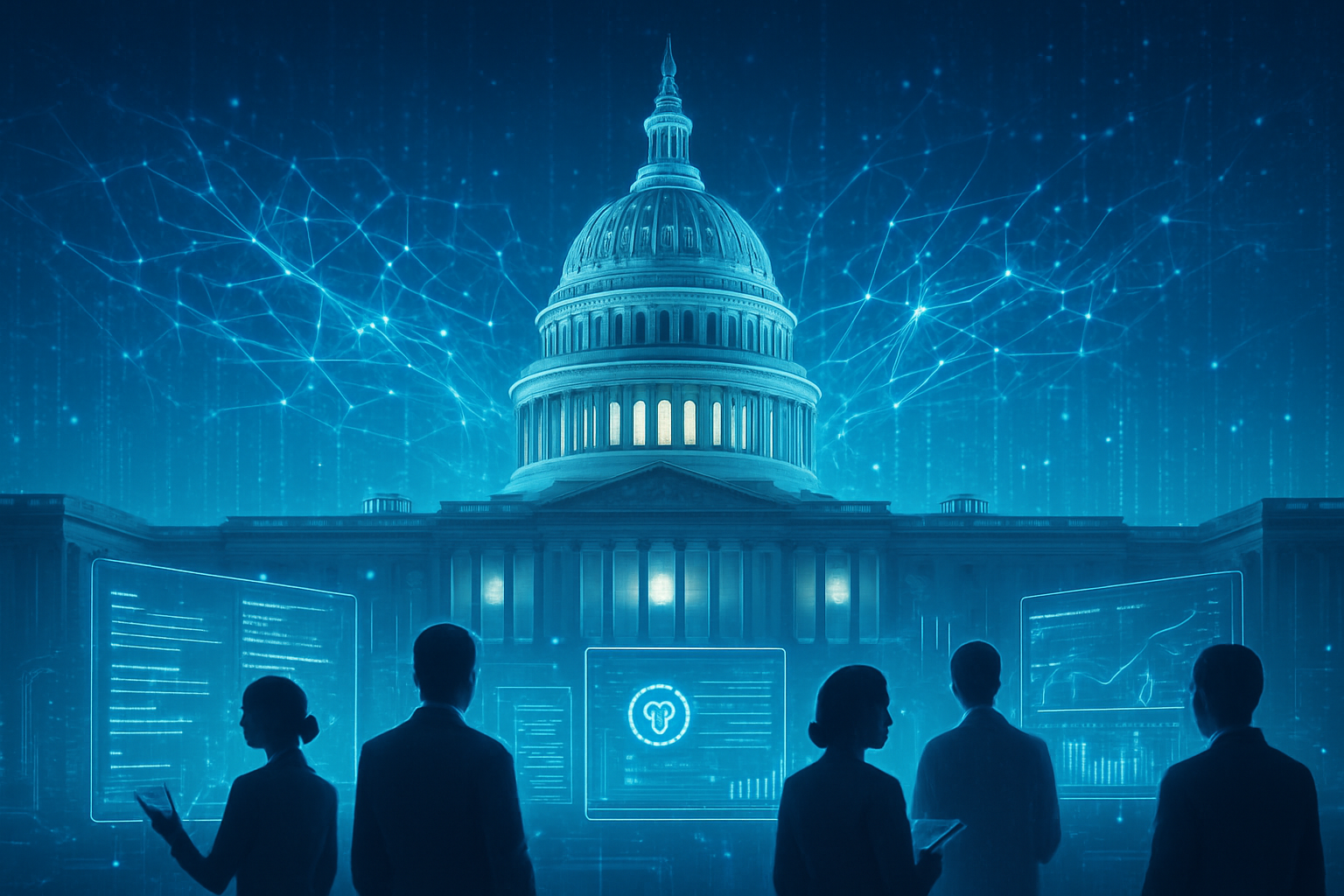
    On December 11, 2025, President Donald Trump signed Executive Order 14365, titled "Ensuring a National Policy Framework for Artificial Intelligence." This sweeping directive marks a pivotal moment in the governance of emerging technologies, aiming to dismantle what the administration describes as an "onerous patchwork" of state-level AI regulations. By centralizing authority at the federal level, the order seeks to establish a uniform, minimally burdensome standard designed to accelerate innovation and secure American dominance in the global AI race.

    The immediate significance of the order lies in its aggressive stance against state sovereignty over technology regulation. For months, states like California and Colorado have moved to fill a federal legislative vacuum, passing laws aimed at mitigating algorithmic bias, ensuring model transparency, and preventing "frontier" AI risks. Executive Order 14365 effectively declares war on these initiatives, arguing that a fragmented regulatory landscape creates prohibitive compliance costs that disadvantage American companies against international rivals, particularly those in China.

    The "National Policy Framework": Centralizing AI Governance

    Executive Order 14365 is built upon the principle of federal preemption, a legal doctrine that allows federal law to override conflicting state statutes. The order specifically targets state laws that require AI models to perform "bias audits" or "alter truthful outputs," which the administration characterizes as attempts to embed "ideological dogmas" into machine learning systems. A central pillar of the order is the "Truthful Output" standard, which asserts that AI systems should be free from state-mandated restrictions that might infringe upon First Amendment protections or force "deceptive" content moderation.

    To enforce this new framework, the order directs the Attorney General to establish an AI Litigation Task Force within 30 days. This unit is tasked with challenging state AI laws in court, arguing they unconstitutionally regulate interstate commerce. Furthermore, the administration is leveraging the "power of the purse" by conditioning federal grants—specifically the Broadband Equity Access and Deployment (BEAD) funds—on a state’s willingness to align its AI policies with the federal framework. This move places significant financial pressure on states to repeal or scale back their independent regulations.

    The order also instructs the Federal Trade Commission (FTC) and the Federal Communications Commission (FCC) to explore how existing federal statutes can be used to preempt state mandates. The FCC, in particular, is looking into creating a national reporting and disclosure standard for AI models that would supersede state-level requirements. This top-down approach differs fundamentally from the previous administration’s focus on risk management and safety "guardrails," shifting the priority entirely toward speed, deregulation, and ideological neutrality.

    Silicon Valley's Sigh of Relief: Tech Giants and Startups React

    The reaction from the technology sector has been overwhelmingly positive, as major players have long complained about the complexity of navigating diverse state rules. NVIDIA (NASDAQ: NVDA) CEO Jensen Huang has been a prominent supporter, stating that requiring "50 different approvals from 50 different states" would stifle the industry in its infancy. Similarly, Microsoft (NASDAQ: MSFT) and Alphabet (NASDAQ: GOOGL) have lobbied for a single national "rulebook" to provide the legal certainty needed for massive infrastructure investments in data centers and energy projects.

    Meta Platforms (NASDAQ: META) has also aligned itself with the administration’s goal, arguing that a unified federal framework is essential for competing with state-driven AI initiatives in China. For these tech giants, the order represents a significant strategic advantage, as it removes the threat of "frontier" safety regulations that could have forced them to undergo rigorous third-party testing before releasing new models. Startups like OpenAI and Anthropic, while occasionally more cautious in their rhetoric, have also sought relief from the hundreds of pending state AI bills that threaten to bog down their development cycles.

    However, the competitive implications are complex. While established giants benefit from the removal of state hurdles, some critics argue that a "minimally burdensome" federal standard might favor incumbents who can more easily influence federal agencies. By preempting state laws that might have encouraged competition or protected smaller players from algorithmic discrimination, the order could inadvertently solidify the dominance of the current "Magnificent Seven" tech companies.

    A Clash of Sovereignty: The States Fight Back

    The executive order has ignited a fierce political and legal battle, drawing a rare bipartisan backlash from state leaders. Democratic governors, including California’s Gavin Newsom and New York’s Kathy Hochul, have condemned the move as an overreach that leaves citizens vulnerable to deepfakes, privacy intrusions, and algorithmic bias. New York recently signaled its defiance by passing the RAISE Act (Responsible AI Safety and Education Act), asserting the state’s right to protect its residents from the risks posed by large-scale AI deployment.

    Surprisingly, the opposition is not limited to one side of the aisle. Republican governors such as Florida’s Ron DeSantis and Utah’s Spencer Cox have also voiced concerns, viewing the order as a violation of state sovereignty and a "subsidy to Big Tech." These leaders argue that states must retain the power to protect their citizens from censorship and intellectual property violations, regardless of federal policy. A coalition of over 40 state Attorneys General has already cautioned that federal agencies lack the authority to preempt state consumer protection laws via executive order alone.

    This development fits into a broader trend of "technological federalism," where the battle for control over the digital economy is increasingly fought between state capitals and Washington D.C. It echoes previous milestones in tech regulation, such as the fight over net neutrality and data privacy (CCPA), but with much higher stakes. The administration’s focus on "ideological neutrality" adds a new layer of complexity, framing AI regulation not just as a matter of safety, but as a cultural and constitutional conflict.

    The Legal Battlefield and the "AI Preemption Act"

    Looking ahead, the primary challenge for Executive Order 14365 will be its legal durability. Legal experts note that the President cannot unilaterally preempt state law without a clear mandate from Congress. Because there is currently no comprehensive federal AI statute, the "AI Litigation Task Force" may find it difficult to convince courts that state laws are preempted by mere executive fiat. This sets the stage for a series of high-profile court cases that could eventually reach the Supreme Court.

    To address this legal vulnerability, the administration is already preparing a legislative follow-up. The "AI and Crypto Czar," David Sacks, is reportedly drafting a proposal for a federal AI Preemption Act. This act would seek to codify the principles of the executive order into law, explicitly forbidding states from enacting conflicting AI regulations. While the bill faces an uphill battle in a divided Congress, its introduction will be a major focus of the 2026 legislative session, with tech lobbyists expected to spend record amounts to ensure its passage.

    In the near term, we can expect a "regulatory freeze" as companies wait to see how the courts rule on the validity of the executive order. Some states may choose to pause their enforcement of AI laws to avoid litigation, while others, like California, appear ready to double down. The result could be a period of intense uncertainty for the AI industry, ironically the very thing the executive order was intended to prevent.

    A Comprehensive Wrap-Up

    President Trump’s Executive Order 14365 represents a bold attempt to nationalize AI policy and prioritize innovation over state-level safety concerns. By targeting "onerous" state laws and creating a federal litigation task force, the administration has signaled its intent to be the sole arbiter of the AI landscape. For the tech industry, the order offers a vision of a streamlined, deregulated future; for state leaders and safety advocates, it represents a dangerous erosion of consumer protections and local sovereignty.

    The significance of this development in AI history cannot be overstated. It marks the moment when AI regulation moved from a technical debate about safety to a high-stakes constitutional and political struggle. The long-term impact will depend on the success of the administration's legal challenges and its ability to push a preemption act through Congress.

    In the coming weeks and months, the tech world will be watching for the first lawsuits filed by the AI Litigation Task Force and the specific policy statements issued by the FTC and FCC. As the federal government and the states lock horns, the future of American AI hangs in the balance, caught between the drive for rapid innovation and the demand for local accountability.


    This content is intended for informational purposes only and represents analysis of current AI developments.

    TokenRing AI delivers enterprise-grade solutions for multi-agent AI workflow orchestration, AI-powered development tools, and seamless remote collaboration platforms.
    For more information, visit https://www.tokenring.ai/.
  • The DeepSeek Shockwave: How a $6M Chinese Startup Upended the Global AI Arms Race in 2025

    The DeepSeek Shockwave: How a $6M Chinese Startup Upended the Global AI Arms Race in 2025

    As 2025 draws to a close, the landscape of artificial intelligence looks fundamentally different than it did just twelve months ago. The primary catalyst for this shift was not a trillion-dollar announcement from Silicon Valley, but the meteoric rise of DeepSeek, a Chinese startup that shattered the "compute moat" long thought to protect the dominance of Western tech giants. By releasing models that matched or exceeded the performance of the world’s most advanced systems for a fraction of the cost, DeepSeek forced a global reckoning over the economics of AI development.

    The "DeepSeek Shockwave" reached its zenith in early 2025 with the release of DeepSeek-V3 and DeepSeek-R1, which proved that frontier-level reasoning could be achieved with training budgets under $6 million—a figure that stands in stark contrast to the multi-billion-dollar capital expenditure cycles of US rivals. This disruption culminated in the historic "DeepSeek Monday" market crash in January and the unprecedented sight of a Chinese AI application sitting at the top of the US iOS App Store, signaling a new era of decentralized, hyper-efficient AI progress.

    The $5.6 Million Miracle: Technical Mastery Over Brute Force

    The technical foundation of DeepSeek’s 2025 dominance rests on the release of DeepSeek-V3 and its reasoning-focused successor, DeepSeek-R1. While the industry had become accustomed to "scaling laws" that demanded exponentially more GPUs and electricity, DeepSeek-V3 utilized a Mixture-of-Experts (MoE) architecture with 671 billion total parameters, of which only 37 billion are activated per token. This sparse activation allows the model to maintain the "intelligence" of a massive system while operating with the speed and cost-efficiency of a much smaller one.

    At the heart of their efficiency is a breakthrough known as Multi-head Latent Attention (MLA). Traditional transformer models are often bottlenecked by "KV cache" memory requirements, which balloon during long-context processing. DeepSeek’s MLA uses low-rank compression to reduce this memory footprint by a staggering 93.3%, enabling the models to handle massive 128k-token contexts with minimal hardware overhead. Furthermore, the company pioneered the use of FP8 (8-bit floating point) precision throughout the training process, significantly accelerating compute on older hardware like the NVIDIA (NASDAQ: NVDA) H800—chips that were previously thought to be insufficient for frontier-level training due to US export restrictions.

    The results were undeniable. In benchmark after benchmark, DeepSeek-R1 demonstrated reasoning capabilities on par with OpenAI’s o1 series, particularly in mathematics and coding. On the MATH-500 benchmark, R1 scored 91.6%, surpassing the 85.5% mark set by its primary Western competitors. The AI research community was initially skeptical of the $5.57 million training cost claim, but as the company released its open-weights and detailed technical reports, the industry realized that software optimization had effectively bypassed the need for massive hardware clusters.

    Market Disruption and the "DeepSeek Monday" Crash

    The economic implications of DeepSeek’s efficiency hit Wall Street with the force of a sledgehammer on Monday, January 27, 2025. Now known as "DeepSeek Monday," the day saw NVIDIA (NASDAQ: NVDA) experience the largest single-day loss in stock market history, with its shares plummeting nearly 18% and erasing roughly $600 billion in market capitalization. Investors, who had bet on the "hardware moat" as a permanent barrier to entry, were spooked by the realization that world-class AI could be built using fewer, less-expensive chips.

    The ripple effects extended across the entire "Magnificent Seven." Microsoft (NASDAQ: MSFT), Alphabet (NASDAQ: GOOGL), and Meta (NASDAQ: META) all saw significant declines as the narrative shifted from "who has the most GPUs" to "who can innovate on architecture." The success of DeepSeek suggested that the trillion-dollar capital expenditure plans for massive data centers might be over-leveraged if frontier models could be commoditized so cheaply. This forced a strategic pivot among US tech giants, who began emphasizing "inference scaling" and architectural efficiency over raw cluster size.

    DeepSeek’s impact was not limited to the stock market; it also disrupted the consumer software space. In late January, the DeepSeek app surged to the #1 spot on the US iOS App Store, surpassing ChatGPT and Google’s Gemini. This marked the first time a Chinese AI model achieved widespread viral adoption in the United States, amassing over 23 million downloads in less than three weeks. The app's success proved that users were less concerned with the "geopolitical origin" of their AI and more interested in the raw reasoning power and speed that the R1 model provided.

    A Geopolitical Shift in the AI Landscape

    The rise of DeepSeek has fundamentally altered the broader AI landscape, moving the industry toward an "open-weights" standard. By releasing their models under the MIT License, DeepSeek democratized access to frontier-level AI, allowing developers and startups worldwide to build on top of their architecture without the high costs associated with proprietary APIs. This move put significant pressure on closed-source labs like OpenAI and Anthropic, who found their "paywall" models competing against a free, high-performance alternative.

    This development has also sparked intense debate regarding the US-China AI rivalry. For years, US export controls on high-end semiconductors were designed to slow China's AI progress. DeepSeek’s ability to innovate around these restrictions using H800 GPUs and clever architectural optimizations has been described as a "Sputnik Moment" for the US government. It suggests that while hardware access remains a factor, the "intelligence gap" can be closed through algorithmic ingenuity.

    However, the rise of a Chinese-led model has not been without concerns. Issues regarding data privacy, government censorship within the model's outputs, and the long-term implications of relying on foreign-developed infrastructure have become central themes in tech policy discussions throughout 2025. Despite these concerns, the "DeepSeek effect" has accelerated the global trend toward transparency and efficiency, ending the era where only a handful of multi-billion-dollar companies could define the state of the art.

    The Road to 2026: Agentic Workflows and V4

    Looking ahead, the momentum established by DeepSeek shows no signs of slowing. Following the release of DeepSeek-V3.2 in December 2025, which introduced "Sparse Attention" to cut inference costs by another 70%, the company is reportedly working on DeepSeek-V4. This next-generation model is expected to focus heavily on "agentic workflows"—the ability for AI to not just reason, but to autonomously execute complex, multi-step tasks across different software environments.

    Experts predict that the next major challenge for DeepSeek and its followers will be the integration of real-time multimodal capabilities and the refinement of "Reinforcement Learning from Human Feedback" (RLHF) to minimize hallucinations in high-stakes environments. As the cost of intelligence continues to drop, we expect to see a surge in "Edge AI" applications, where DeepSeek-level reasoning is embedded directly into consumer hardware, from smartphones to robotics, without the need for constant cloud connectivity.

    The primary hurdle remains the evolving geopolitical landscape. As US regulators consider tighter restrictions on AI model sharing and "open-weights" exports, DeepSeek’s ability to maintain its global user base will depend on its ability to navigate a fractured regulatory environment. Nevertheless, the precedent has been set: the "scaling laws" of the past are being rewritten by the efficiency laws of the present.

    Conclusion: A Turning Point in AI History

    The year 2025 will be remembered as the year the "compute moat" evaporated. DeepSeek’s rise from a relatively niche player to a global powerhouse has proven that the future of AI belongs to the efficient, not just the wealthy. By delivering frontier-level performance for under $6 million, they have forced the entire industry to rethink its strategy, moving away from brute-force scaling and toward architectural innovation.

    The key takeaways from this year are clear: software optimization can overcome hardware limitations, open-weights models are a formidable force in the market, and the geography of AI leadership is more fluid than ever. As we move into 2026, the focus will shift from "how big" a model is to "how smart" it can be with the resources available.

    For the coming months, the industry will be watching the adoption rates of DeepSeek-V3.2 and the response from US labs, who are now under immense pressure to prove their value proposition in a world where "frontier AI" is increasingly accessible to everyone. The "DeepSeek Moment" wasn't just a flash in the pan; it was the start of a new chapter in the history of artificial intelligence.


    This content is intended for informational purposes only and represents analysis of current AI developments.

    TokenRing AI delivers enterprise-grade solutions for multi-agent AI workflow orchestration, AI-powered development tools, and seamless remote collaboration platforms.
    For more information, visit https://www.tokenring.ai/.

  • Google Unveils Interactions API: A New Era of Stateful, Autonomous AI Agents

    Google Unveils Interactions API: A New Era of Stateful, Autonomous AI Agents

    In a move that fundamentally reshapes the architecture of artificial intelligence applications, Google (NASDAQ: GOOGL) has officially launched its Interactions API in public beta. Released in mid-December 2025, this new infrastructure marks a decisive departure from the traditional "stateless" nature of large language models. By providing developers with a unified gateway to the Gemini 3 Pro model and the specialized Deep Research agent, Google is attempting to standardize how autonomous agents maintain context, reason through complex problems, and execute long-running tasks without constant client-side supervision.

    The immediate significance of the Interactions API lies in its ability to handle the "heavy lifting" of agentic workflows on the server side. Historically, developers were forced to manually manage conversation histories and tool-call states, often leading to "context bloat" and fragile implementations. With this launch, Google is positioning its AI infrastructure as a "Remote Operating System," where the state of an agent is preserved in the cloud, allowing for background execution that can span hours—or even days—of autonomous research and problem-solving.

    Technical Foundations: From Completion to Interaction

    At the heart of this announcement is the new /interactions endpoint, which is designed to replace the aging generateContent paradigm. Unlike its predecessors, the Interactions API is inherently stateful. When a developer initiates a session, Google’s servers assign a previous_interaction_id, effectively creating a persistent memory for the agent. This allows the model to "remember" previous tool outputs, reasoning chains, and user preferences without the developer having to re-upload the entire conversation history with every new prompt. This technical shift significantly reduces latency and token costs for complex, multi-turn dialogues.

    One of the most talked-about features is the Background Execution capability. By passing a background=true parameter, developers can trigger agents to perform "long-horizon" tasks. For instance, the integrated Deep Research agent—specifically the deep-research-pro-preview-12-2025 model—can be tasked with synthesizing a 50-page market analysis. The API immediately returns a session ID, allowing the client to disconnect while the agent autonomously browses the web, queries databases via the Model Context Protocol (MCP), and refines its findings. This mirrors how human employees work: you give them a task, they go away to perform it, and they report back when finished.

    Initial reactions from the AI research community have been largely positive, particularly regarding Google’s commitment to transparency. Unlike OpenAI’s Responses API, which uses "compaction" to hide reasoning steps for the sake of efficiency, Google’s Interactions API keeps the full reasoning chain—the model’s "thoughts"—available for developer inspection. This "glass-box" approach is seen as a critical tool for debugging the non-deterministic behavior of autonomous agents.

    Reshaping the Competitive Landscape

    The launch of the Interactions API is a direct shot across the bow of competitors like OpenAI and Anthropic. By integrating the Deep Research agent directly into the API, Google is commoditizing high-level cognitive labor. Startups that previously spent months building custom "wrapper" logic to handle research tasks now find that functionality available as a single API call. This move likely puts pressure on specialized AI research startups, forcing them to pivot toward niche vertical expertise rather than general-purpose research capabilities.

    For enterprise tech giants, the strategic advantage lies in the Agent2Agent (A2A) protocol integration. Google is positioning the Interactions API as the foundational layer for a multi-agent ecosystem where different specialized agents—some built by Google, some by third parties—can seamlessly hand off tasks to one another. This ecosystem play leverages Google’s massive Cloud infrastructure, making it difficult for smaller players to compete on the sheer scale of background processing and data persistence.

    However, the shift to server-side state management is not without its detractors. Some industry analysts at firms like Novalogiq have pointed out that Google’s 55-day data retention policy for paid tiers could create hurdles for industries with strict data residency requirements, such as healthcare and defense. While Google offers a "no-store" option, using it strips away the very stateful benefits that make the Interactions API compelling, creating a strategic tension between functionality and privacy.

    The Wider Significance: The Agentic Revolution

    The Interactions API is more than just a new set of tools; it is a milestone in the "agentic revolution" of 2025. We are moving away from AI as a chatbot and toward AI as a teammate. The release of the DeepSearchQA benchmark alongside the API underscores this shift. By scoring 66.1% on tasks that require "causal chain" reasoning—where each step depends on the successful completion of the last—Google has demonstrated that its agents are moving past simple pattern matching toward genuine multi-step problem solving.

    This development also highlights the growing importance of standardized protocols like the Model Context Protocol (MCP). By building native support for MCP into the Interactions API, Google is acknowledging that an agent is only as good as the tools it can access. This move toward interoperability suggests a future where AI agents aren't siloed within single platforms but can navigate a web of interconnected databases and services to fulfill their objectives.

    Comparatively, this milestone feels similar to the transition from static web pages to the dynamic, stateful web of the early 2000s. Just as AJAX and server-side sessions enabled the modern social media and e-commerce era, stateful AI APIs are likely to enable a new class of "autonomous-first" applications that we are only beginning to imagine.

    Future Horizons and Challenges

    Looking ahead, the next logical step for the Interactions API is the expansion of its "memory" capabilities. While 55 days of retention is a start, true personal or corporate AI assistants will eventually require "infinite" or "long-term" memory that can span years of interaction. Experts predict that Google will soon introduce a "Vectorized State" feature, allowing agents to query an indexed history of all past interactions to provide even deeper personalization.

    Another area of rapid development will be the refinement of the A2A protocol. As more developers adopt the Interactions API, we will likely see the emergence of "Agent Marketplaces" where specialized agents can be "hired" via API to perform specific sub-tasks within a larger workflow. The challenge, however, remains reliability. As the DeepSearchQA scores show, even the best models still fail nearly a third of the time on complex tasks. Reducing this "hallucination gap" in multi-step reasoning remains the "Holy Grail" for Google’s engineering teams.

    Conclusion: A New Standard for AI Development

    Google’s launch of the Interactions API in December 2025 represents a significant leap forward in AI infrastructure. By centralizing state management, enabling background execution, and providing unified access to the Gemini 3 Pro and Deep Research models, Google has set a new standard for what an AI development platform should look like. The shift from stateless prompts to stateful, autonomous "interactions" is not merely a technical upgrade; it is a fundamental change in how we interact with and build upon artificial intelligence.

    In the coming months, the industry will be watching closely to see how developers leverage these new background execution capabilities. Will we see the birth of the first truly autonomous "AI companies" run by a skeleton crew of humans and a fleet of stateful agents? Only time will tell, but with the Interactions API, the tools to build that future are now in the hands of the public.


    This content is intended for informational purposes only and represents analysis of current AI developments.

    TokenRing AI delivers enterprise-grade solutions for multi-agent AI workflow orchestration, AI-powered development tools, and seamless remote collaboration platforms.
    For more information, visit https://www.tokenring.ai/.
  • Google Unveils Gemini Deep Research: The Era of the 60-Minute Autonomous AI Colleague Begins

    Google Unveils Gemini Deep Research: The Era of the 60-Minute Autonomous AI Colleague Begins

    On December 11, 2025, Google, a subsidiary of Alphabet Inc. (NASDAQ: GOOGL), fundamentally shifted the landscape of artificial intelligence with the launch of its Gemini Deep Research agent. Unlike the conversational chatbots that defined the early 2020s, this new agent is a specialized, autonomous engine designed to undertake complex, long-horizon research tasks that previously required days of human effort. Powered by the cutting-edge Gemini 3 Pro model, the agent can operate independently for up to 60 minutes, navigating the open web and private data repositories to synthesize high-level intelligence reports.

    The release marks a pivotal moment in the transition from generative AI to "agentic AI." By moving beyond simple prompt-and-response interactions, Google has introduced a system capable of self-correction, multi-step planning, and deep-dive verification. The immediate significance of this launch is clear: Gemini Deep Research is not just a tool for writing emails or summarizing articles; it is a professional-grade research colleague capable of handling the heavy lifting of corporate due diligence, scientific literature reviews, and complex market analysis.

    The Architecture of Autonomy: Gemini 3 Pro and the 60-Minute Loop

    At the heart of this advancement is Gemini 3 Pro, a model built on a sophisticated Mixture-of-Experts (MoE) architecture. While the model boasts a total parameter count exceeding one trillion, it maintains operational efficiency by activating only 15 to 20 billion parameters per query. Most notably, Gemini 3 Pro introduces a "High-Thinking" mode, which allows the model to perform internal reasoning and chain-of-thought processing before generating an output. This technical leap is supported by a massive 1-million-token context window, enabling the agent to ingest and analyze vast amounts of data—from entire codebases to multi-hour video files—without losing the "thread" of the research.

    The Deep Research agent operates through a modular pipeline that distinguishes it from previous iterations of Gemini. When assigned a task via the new Interactions API, the agent enters an autonomous reasoning loop consisting of three primary stages:

    • The Planner: Decomposes a broad query into logical, sequential sub-goals.
    • The Browser: Executes Google Search calls and navigates deep into individual websites to extract granular data, identifying and filling knowledge gaps as it goes.
    • The Synthesizer: Compiles the findings into a structured, fully cited report that often exceeds 15 pages of dense analysis.

    This process can run for a maximum of 60 minutes, allowing the AI to iterate on its findings and verify facts across multiple sources. This is a significant departure from the near-instantaneous but often superficial responses of earlier models. Initial reactions from the AI research community have been overwhelmingly positive, with experts noting that Google has successfully solved the "context drift" problem that plagued earlier attempts at long-duration AI tasks.

    Market Shakedown: Alphabet Reclaims the AI Throne

    The timing of the launch was no coincidence, occurring on the same day that OpenAI released its GPT-5.2 model. This "clash of the titans" saw Alphabet (NASDAQ: GOOGL) shares surge by 4.5% to an all-time high, as investors reacted to the realization that Google had not only closed the performance gap with its rivals but had potentially surpassed them in agentic capabilities. Market analysts from major firms like Bank of America and TD Cowen have highlighted that the Deep Research agent positions Google as the leader in the enterprise AI space, particularly for industries that rely on high-stakes factual accuracy.

    The competitive implications are profound. While OpenAI’s latest models continue to show strength in novel problem-solving, Gemini 3 Pro’s dominance in long-term planning and multimodal depth gives it a strategic advantage in the corporate sector. Companies like Box, Inc. (NYSE: BOX) have already integrated Gemini 3 Pro into their platforms to handle "context dumps"—unstructured data that the agent can now organize and analyze with unprecedented precision. This development poses a direct challenge to specialized AI startups that had previously carved out niches in automated research, as Google’s native integration with its search index provides a data moat that is difficult to replicate.

    A New Benchmark for Intelligence: "Humanity's Last Exam"

    The true measure of the Deep Research agent’s power was demonstrated through its performance on "Humanity's Last Exam" (HLE). Developed by nearly 1,000 global experts, HLE is designed to be the final barrier for AI reasoning, featuring PhD-level questions across a vast array of academic subjects. While the base Gemini 3 Pro model scored a respectable 37.5% on the exam, the Deep Research agent—when allowed to use its autonomous tools and 60-minute reasoning window—shattered records with a score of 46.4%.

    This performance is a landmark in the AI landscape. For comparison, previous-generation models struggled to cross the 22% threshold. The jump to 46.4% signifies a move toward "System 2" thinking in AI—deliberative, analytical, and logical reasoning. However, this breakthrough also brings potential concerns regarding the "black box" nature of autonomous research. As these agents begin to handle more sensitive data, the industry is calling for increased transparency in how the "Synthesizer" module weighs conflicting information and how it avoids the echo chambers of the open web.

    The Road to General Purpose Agents

    Looking ahead, the launch of Gemini Deep Research is expected to trigger a wave of near-term developments in "vibe coding" and interactive application generation. Because Gemini 3 Pro can generate fully functional UIs from a simple prompt, the next logical step is an agent that not only researches a problem but also builds the software solution to address it. Experts predict that within the next 12 to 18 months, we will see these agents integrated into real-time collaborative environments, acting as "third-party participants" in boardrooms and research labs.

    The challenges remaining are significant, particularly regarding the ethical implications of autonomous web navigation and the potential for "hallucination loops" during the 60-minute execution window. However, the trajectory is clear: the industry is moving away from AI as a reactive tool and toward AI as a proactive partner. The next phase of development will likely focus on "multi-agent orchestration," where different specialized Gemini agents—one for research, one for coding, and one for legal compliance—work in tandem to complete massive projects.

    Conclusion: A Turning Point in AI History

    Google’s Gemini Deep Research launch on December 11, 2025, will likely be remembered as the moment the "AI winter" fears were permanently put to rest. By delivering a system that can think, plan, and research for an hour at a time, Alphabet has moved the goalposts for what is possible in the field of artificial general intelligence (AGI). The record-breaking performance on "Humanity's Last Exam" serves as a stark reminder that the gap between human and machine reasoning is closing faster than many anticipated.

    In the coming weeks and months, the tech world will be watching closely to see how enterprise adoption scales and how competitors respond to Google's "agentic" lead. For now, the message is clear: the era of the autonomous AI colleague has arrived, and the way we gather, synthesize, and act on information will never be the same.


    This content is intended for informational purposes only and represents analysis of current AI developments.

    TokenRing AI delivers enterprise-grade solutions for multi-agent AI workflow orchestration, AI-powered development tools, and seamless remote collaboration platforms.
    For more information, visit https://www.tokenring.ai/.
  • Anthropic’s $13 Billion Series F: The $183 Billion Valuation That Redefined the AI Race

    Anthropic’s $13 Billion Series F: The $183 Billion Valuation That Redefined the AI Race

    In a move that has sent shockwaves through Silicon Valley and global financial markets, Anthropic announced in September 2025 that it has closed a staggering $13 billion Series F funding round. The investment, led by ICONIQ Capital, values the artificial intelligence safety and research company at a breathtaking $183 billion. This milestone marks a nearly threefold increase in valuation since early 2025, signaling a decisive shift in investor sentiment toward Anthropic’s "safety-first" philosophy and its aggressive push into enterprise-grade agentic AI.

    The funding comes on the heels of what analysts are calling "the greatest hyper-growth phase in software history." Anthropic’s annualized run-rate revenue reportedly jumped from $1 billion in January 2025 to over $5 billion by August 2025. This 400% increase in just eight months has been fueled by a massive surge in enterprise adoption and the runaway success of its specialized developer tools, positioning Anthropic as the primary challenger to the dominance of OpenAI and Alphabet Inc. (NASDAQ:GOOGL).

    Technical Dominance: From Reasoning to Autonomous Action

    The technical foundation of Anthropic’s $183 billion valuation rests on the rapid evolution of its Claude model family. In May 2025, the company launched the Claude 4 series, which introduced a paradigm shift in AI capabilities. Unlike previous iterations that focused primarily on text generation, Claude 4 was built for "frontier coding" and native autonomous workflows. By the time the Series F closed in September, Anthropic had already begun rolling out the Claude 4.5 series, with the Sonnet 4.5 model achieving a record-breaking 77.2% score on the SWE-bench Verified benchmark—a feat that has made it the gold standard for automated software engineering.

    Perhaps the most significant technical breakthrough of the year was the introduction of advanced "computer use" capabilities. This feature allows Claude to navigate entire operating systems, interact with complex software interfaces, and perform multi-step research tasks autonomously for up to 30 hours without human intervention. This move into "agentic" AI differs from the chatbot-centric approach of 2023 and 2024, as the models are now capable of executing work rather than just describing it. Furthermore, Claude Opus 4 became the first model to be officially classified under AI Safety Level 3 (ASL-3), a rigorous standard that ensures the model's high intelligence is matched by robust safeguards against misuse.

    The Great Enterprise Re-Alignment

    Anthropic’s financial windfall is a direct reflection of its growing dominance in the corporate sector. According to industry reports from late 2025, Anthropic has officially unseated OpenAI as the leader in enterprise LLM spending, capturing approximately 40% of the market share compared to OpenAI’s 27%. This shift is largely attributed to Anthropic’s relentless focus on "Constitutional AI" and interpretability, which provides the level of security and predictability that Fortune 500 companies demand.

    The competitive implications for major tech giants are profound. While Microsoft Corporation (NASDAQ:MSFT) remains heavily integrated with OpenAI, Anthropic’s close partnerships with Amazon.com, Inc. (NASDAQ:AMZN) and Google have created a formidable counter-axis. Amazon, in particular, has seen its AWS Bedrock platform flourish as the primary hosting environment for Anthropic’s models. Meanwhile, startups that once relied on GPT-4 have migrated in droves to Claude Sonnet 4.5, citing its superior performance in coding and complex data analysis. This migration has forced competitors to accelerate their own release cycles, leading to a "three-way war" between Anthropic, OpenAI, and Google’s Gemini 3 Pro.

    A New Era for the AI Landscape

    The scale of this funding round reflects a broader trend in the AI landscape: the transition from experimental "toy" models to mission-critical infrastructure. Anthropic’s success proves that the market is willing to pay a premium for safety and reliability. By prioritizing "ASL-3" safety standards, Anthropic has mitigated the reputational risks that have previously made some enterprises hesitant to deploy AI at scale. This focus on "Responsible Scaling" has become a blueprint for the industry, moving the conversation away from raw parameter counts toward verifiable safety and utility.

    However, the sheer size of the $13 billion round also raises concerns about the concentration of power in the AI sector. With a valuation of $183 billion, Anthropic is now larger than many established legacy tech companies, creating a high barrier to entry for new startups. The massive capital requirements for training next-generation models—estimated to reach tens of billions of dollars per cluster by 2026—suggest that the "frontier" AI market is consolidating into a handful of hyper-capitalized players. This mirrors previous milestones like the birth of the cloud computing era, where only a few giants had the resources to build the necessary infrastructure.

    Looking Toward the Horizon: The Path to AGI

    As we head into 2026, the industry is closely watching Anthropic’s next moves. The company has hinted at the development of Claude 5, which is expected to leverage even more massive compute clusters provided by its strategic partners. Experts predict that the next frontier will be "continuous learning," where models can update their knowledge bases in real-time without requiring expensive retraining cycles. There is also significant anticipation around "multi-modal agency," where AI can seamlessly transition between visual, auditory, and digital environments to solve physical-world problems.

    The primary challenge for Anthropic will be maintaining its hyper-growth while navigating the increasing regulatory scrutiny surrounding AI safety. As the models become more autonomous, the "alignment problem"—ensuring AI goals remain subservient to human intent—will become more critical. Anthropic’s leadership has stated that a significant portion of the Series F funds will be dedicated to safety research, aiming to solve these challenges before the arrival of even more powerful systems.

    Conclusion: A Historic Milestone in AI Evolution

    Anthropic’s $13 billion Series F round and its meteoric rise to a $183 billion valuation represent a watershed moment in the history of technology. In less than a year, the company has transformed from a well-respected research lab into a commercial juggernaut that is effectively setting the pace for the entire AI industry. Its ability to scale revenue from $1 billion to $5 billion in eight months is a testament to the immense value that enterprise-grade, safe AI can unlock.

    As 2025 draws to a close, the narrative of the AI race has changed. It is no longer just about who has the most users or the fastest chatbot; it is about who can provide the most reliable, autonomous, and secure intelligence for the global economy. Anthropic has placed a massive bet on being that provider, and with $13 billion in new capital, it is better positioned than ever to lead the world into the age of agentic AI.


    This content is intended for informational purposes only and represents analysis of current AI developments.

    TokenRing AI delivers enterprise-grade solutions for multi-agent AI workflow orchestration, AI-powered development tools, and seamless remote collaboration platforms.
    For more information, visit https://www.tokenring.ai/.
  • The New Sovereign of Silicon: Anthropic’s Claude Opus 4.5 Redefines the Limits of Autonomous Engineering

    The New Sovereign of Silicon: Anthropic’s Claude Opus 4.5 Redefines the Limits of Autonomous Engineering

    On November 24, 2025, Anthropic marked a historic milestone in the evolution of artificial intelligence with the official release of Claude Opus 4.5. This flagship model, the final piece of the Claude 4.5 family, has sent shockwaves through the technology sector by achieving what was long considered a "holy grail" in software development: a score of 80.9% on the SWE-bench Verified benchmark. By crossing the 80% threshold, Opus 4.5 has effectively demonstrated that AI can now resolve complex, real-world software issues with a level of reliability that rivals—and in some cases, exceeds—senior human engineers.

    The significance of this launch extends far beyond a single benchmark. In a move that redefined the standard for performance evaluation, Anthropic revealed that Opus 4.5 successfully completed the company's own internal two-hour performance engineering exam, outperforming every human candidate who has ever taken the test. This announcement has fundamentally altered the conversation around AI’s role in the workforce, transitioning from "AI as an assistant" to "AI as a primary engineer."

    A Technical Masterclass: The "Effort" Parameter and Efficiency Gains

    The technical architecture of Claude Opus 4.5 introduces a paradigm shift in how developers interact with large language models. The most notable addition is the new "effort" parameter, a public beta API feature that allows users to modulate the model's reasoning depth. By adjusting this "knob," developers can choose between rapid, cost-effective responses and deep-thinking, multi-step reasoning. At "medium" effort, Opus 4.5 matches the state-of-the-art performance of its predecessor, Sonnet 4.5, while utilizing a staggering 76% fewer output tokens. Even at "high" effort, where the model significantly outperforms previous benchmarks, it remains 48% more token-efficient than the 4.1 generation.

    This efficiency is paired with a aggressive new pricing strategy. Anthropic, heavily backed by Amazon.com Inc. (NASDAQ:AMZN) and Alphabet Inc. (NASDAQ:GOOGL), has priced Opus 4.5 at $5 per million input tokens and $25 per million output tokens. This represents a 66% reduction in cost compared to earlier flagship models, making high-tier reasoning accessible to a much broader range of enterprise applications. The model also boasts a 200,000-token context window and a knowledge cutoff of March 2025, ensuring it is well-versed in the latest software frameworks and libraries.

    The Competitive Landscape: OpenAI’s "Code Red" and the Meta Exodus

    The arrival of Opus 4.5 has triggered a seismic shift among the "Big Three" AI labs. Just one week prior to Anthropic's announcement, Google (NASDAQ:GOOGL) had briefly claimed the performance crown with Gemini 3 Pro. However, the specialized reasoning and coding prowess of Opus 4.5 quickly reclaimed the top spot for Anthropic. According to industry insiders, the release prompted a "code red" at OpenAI. CEO Sam Altman reportedly convened emergency meetings to accelerate "Project Garlic" (GPT-5.2), as the company faces increasing pressure to maintain its lead in the reasoning-heavy coding sector.

    The impact has been perhaps most visible at Meta Platforms Inc. (NASDAQ:META). Following the lukewarm reception of Llama 4 Maverick earlier in 2025, which struggled to match the efficiency gains of the Claude 4.5 series, Meta’s Chief AI Scientist Yann LeCun announced his departure from the company in late 2025. LeCun has since launched Advanced Machine Intelligence (AMI), a new venture focused on non-LLM architectures, signaling a potential fracture in the industry’s consensus on the future of generative AI. Meanwhile, Microsoft Corp. (NASDAQ:MSFT) has moved quickly to integrate Opus 4.5 into its Azure AI Foundry, ensuring its enterprise customers have access to the most potent coding model currently available.

    Beyond the Benchmarks: The Rise of Autonomous Performance Engineering

    The broader significance of Claude Opus 4.5 lies in its mastery of performance engineering—a discipline that requires not just writing code, but optimizing it for speed, memory, and hardware constraints. By outperforming human candidates on a high-pressure, two-hour exam, Opus 4.5 has proven that AI can handle the "meta" aspects of programming. This development suggests a future where human engineers shift their focus from implementation to architecture and oversight, while AI handles the grueling tasks of optimization and debugging.

    However, this breakthrough also brings a wave of concerns regarding the "automation of the elite." While previous AI waves threatened entry-level roles, Opus 4.5 targets the high-end skills of senior performance engineers. AI researchers are now debating whether we have reached a "plateau of human parity" in software development. Comparisons are already being drawn to DeepBlue’s victory over Kasparov or AlphaGo’s triumph over Lee Sedol; however, unlike chess or Go, the "game" here is the foundational infrastructure of the modern economy: software.

    The Horizon: Multi-Agent Orchestration and the Path to Claude 5

    Looking ahead, the "effort" parameter is expected to evolve into a fully autonomous resource management system. Experts predict that the next iteration of the Claude family will be able to dynamically allocate its own "effort" based on the perceived complexity of a task, further reducing costs for developers. We are also seeing the early stages of multi-agent AI workflow orchestration, where multiple instances of Opus 4.5 work in tandem—one as an architect, one as a coder, and one as a performance tester—to build entire software systems from scratch with minimal human intervention.

    The industry is now looking toward the spring of 2026 for the first whispers of Claude 5. Until then, the focus remains on how businesses will integrate these newfound reasoning capabilities. The challenge for the coming year will not be the raw power of the models, but the "integration bottleneck"—the ability of human organizations to restructure their workflows to keep pace with an AI that can pass a senior engineering exam in the time it takes to have a long lunch.

    A New Chapter in AI History

    One month after its launch, Claude Opus 4.5 has solidified its place as a definitive milestone in the history of artificial intelligence. It is the model that moved AI from a "copilot" to a "lead engineer," backed by empirical data and real-world performance. The 80.9% SWE-bench score is more than just a number; it is a signal that the era of autonomous software creation has arrived.

    As we move into 2026, the industry will be watching closely to see how OpenAI and Google respond to Anthropic’s dominance in the reasoning space. For now, the "coding crown" resides in San Francisco with the Anthropic team. The long-term impact of this development will likely be felt for decades, as the barrier between human intent and functional, optimized code continues to dissolve.


    This content is intended for informational purposes only and represents analysis of current AI developments.

    TokenRing AI delivers enterprise-grade solutions for multi-agent AI workflow orchestration, AI-powered development tools, and seamless remote collaboration platforms.
    For more information, visit https://www.tokenring.ai/.

  • The Magic Kingdom Meets the Neural Network: Disney and OpenAI’s $1 Billion Content Revolution

    The Magic Kingdom Meets the Neural Network: Disney and OpenAI’s $1 Billion Content Revolution

    In a move that signals a seismic shift in how Hollywood manages intellectual property in the age of artificial intelligence, The Walt Disney Company (NYSE: DIS) and OpenAI announced a landmark $1 billion licensing and equity agreement on December 11, 2025. This historic partnership, the largest of its kind to date, transforms Disney from a cautious observer of generative AI into a primary architect of its consumer-facing future. By integrating Disney’s vast library of characters directly into OpenAI’s creative tools, the deal aims to legitimize the use of iconic IP while establishing a new gold standard for corporate control over AI-generated content.

    The immediate significance of this announcement cannot be overstated. For years, the relationship between major studios and AI developers has been defined by litigation and copyright disputes. This agreement effectively ends that era for Disney, replacing "cease and desist" letters with a lucrative "pay-to-play" model. As part of the deal, Disney has taken a $1 billion equity stake in OpenAI, signaling a deep strategic alignment that goes beyond simple content licensing. For OpenAI, the partnership provides the high-quality, legally cleared training data and brand recognition necessary to maintain its lead in an increasingly competitive market.

    A New Creative Sandbox: Sora and ChatGPT Integration

    Starting in early 2026, users of OpenAI’s Sora video generation platform and ChatGPT’s image generation tools will gain the ability to create original content featuring over 200 of Disney’s most iconic characters. The technical implementation involves a specialized "Disney Layer" within OpenAI’s models, trained on high-fidelity assets from Disney’s own archives. This ensures that a user-generated video of Mickey Mouse or a Star Wars X-Wing maintains the exact visual specifications, color palettes, and movement physics defined by Disney’s animators. The initial rollout will include legendary figures from the classic Disney vault, Pixar favorites, Marvel superheroes like Iron Man and Black Panther, and Star Wars staples such as Yoda and Darth Vader.

    However, the agreement comes with strict technical and legal guardrails designed to protect human talent. A critical exclusion in the deal is the use of talent likenesses and voices. To avoid the ethical and legal quagmires associated with "deepfakes" and to maintain compliance with labor agreements, users will be unable to generate content featuring the faces or voices of real-life actors. For instance, while a user can generate a cinematic shot of Iron Man in full armor, the model is hard-coded to prevent the generation of Robert Downey Jr.’s face or voice. This "mask-and-suit" policy ensures that the characters remain distinct from the human performers who portray them in live-action.

    The AI research community has viewed this development as a masterclass in "constrained creativity." Experts note that by providing OpenAI with a closed-loop dataset of 3D models and animation cycles, Disney is effectively teaching the AI the "rules" of its universe. This differs from previous approaches where AI models were trained on scraped internet data of varying quality. The result is expected to be a dramatic increase in the consistency and "on-model" accuracy of AI-generated characters, a feat that has historically been difficult for general-purpose generative models to achieve.

    Market Positioning and the "Carrot-and-Stick" Strategy

    The financial and strategic implications of this deal extend far beyond the $1 billion price tag. For Disney, the move is a brilliant "carrot-and-stick" maneuver. Simultaneously with the OpenAI announcement, Disney reportedly issued a massive cease-and-desist order against Alphabet Inc. (NASDAQ: GOOGL), demanding that the tech giant stop using Disney-owned IP to train its Gemini models without compensation. By rewarding OpenAI with a license while threatening Google with litigation, Disney is forcing the hand of every major AI developer: pay for the right to use the Magic Kingdom, or face the full weight of its legal department.

    Microsoft (NASDAQ: MSFT), as OpenAI’s primary partner, stands to benefit significantly from this arrangement. The integration of Disney IP into the OpenAI ecosystem makes the Microsoft-backed platform the exclusive home for "official" fan-generated Disney content, potentially drawing millions of users away from competitors like Meta (NASDAQ: META) or Midjourney. For startups in the AI space, the deal sets a high barrier to entry; the "Disney tax" for premium training data may become a standard cost of doing business, potentially squeezing out smaller players who cannot afford billion-dollar licensing fees.

    Market analysts have reacted positively to the news, with Disney’s stock seeing a notable uptick in the days following the announcement. Investors view the equity stake in OpenAI as a hedge against the disruption of traditional media. If AI is going to change how movies are made, Disney now owns a piece of the engine driving that change. Furthermore, Disney plans to use OpenAI’s enterprise tools to enhance its own internal productions and the Disney+ streaming experience, creating a more personalized and interactive interface for its global audience.

    The Wider Significance: A Paradigm Shift in IP Management

    This partnership marks a turning point in the broader AI landscape, signaling the end of the "Wild West" era of generative AI. By creating a legal framework for fan-generated content, Disney is acknowledging that the "genie is out of the bottle." Rather than trying to ban AI-generated fan art and videos, Disney is choosing to monetize and curate them. This mirrors the music industry’s eventual embrace of streaming after years of fighting digital piracy, but on a much more complex and technologically advanced scale.

    However, the deal has not been without its detractors. The Writers Guild of America (WGA) and other creative unions have expressed concern that this deal effectively "sanctions the theft of creative work" by allowing AI to mimic the styles and worlds built by human writers and artists. There are also significant concerns regarding child safety and brand integrity. Advocacy groups like Fairplay have criticized the move, arguing that inviting children to interact with AI-generated versions of their favorite characters could lead to unpredictable and potentially harmful interactions.

    Despite these concerns, the Disney-OpenAI deal is being compared to the 2006 acquisition of Pixar in terms of its long-term impact on the company’s DNA. It represents a move toward "participatory storytelling," where the boundary between the creator and the audience begins to blur. For the first time, a fan won't just watch a Star Wars movie; they will have the tools to create a high-quality, "official" scene within that universe, provided they stay within the established guardrails.

    The Horizon: Interactive Storytelling and the 2026 Rollout

    Looking ahead, the near-term focus will be the "Early 2026" rollout of Disney assets within Sora and ChatGPT. OpenAI is expected to release a series of "Creative Kits" tailored to different Disney franchises, allowing users to experiment with specific art styles—ranging from the hand-drawn aesthetic of the 1940s to the hyper-realistic CGI of modern Marvel films. Beyond simple video generation, experts predict that this technology will eventually power interactive Disney+ experiences where viewers can influence the direction of a story in real-time.

    The long-term challenges remain technical and ethical. Ensuring that the AI does not generate "off-brand" or inappropriate content featuring Mickey Mouse will require a massive investment in safety filters and human-in-the-loop moderation. Furthermore, as the technology evolves, the pressure to include talent likenesses and voices will only grow, potentially leading to a new round of negotiations with SAG-AFTRA and other talent guilds. The industry will be watching closely to see if Disney can maintain its "family-friendly" image in a world where anyone can be a director.

    A New Chapter for the Digital Age

    The $1 billion agreement between Disney and OpenAI is more than just a business deal; it is a declaration of the future of entertainment. By bridging the gap between one of the world’s oldest storytelling powerhouses and the vanguard of artificial intelligence, both companies are betting that the future of creativity is collaborative, digital, and deeply integrated with AI. The key takeaways from this announcement are clear: IP is the new currency of the AI age, and those who own the most iconic stories will hold the most power.

    As we move into 2026, the significance of this development in AI history will become even more apparent. It serves as a blueprint for how legacy media companies can survive and thrive in an era of technological disruption. While the risks are substantial, the potential for a new era of "democratized" high-end storytelling is unprecedented. In the coming weeks and months, the tech world will be watching for the first beta tests of the Disney-Sora integration, which will likely set the tone for the next decade of digital media.


    This content is intended for informational purposes only and represents analysis of current AI developments.

    TokenRing AI delivers enterprise-grade solutions for multi-agent AI workflow orchestration, AI-powered development tools, and seamless remote collaboration platforms.
    For more information, visit https://www.tokenring.ai/.

  • OpenAI Unveils GPT-5.2-Codex: A New Frontier in Autonomous Engineering and Defensive Cyber-Security

    OpenAI Unveils GPT-5.2-Codex: A New Frontier in Autonomous Engineering and Defensive Cyber-Security

    On December 18, 2025, OpenAI shattered the ceiling of automated software development with the release of GPT-5.2-Codex. This specialized variant of the GPT-5.2 model family marks a definitive shift from passive coding assistants to truly autonomous agents capable of managing complex, multi-step engineering workflows. By integrating high-level reasoning with a deep understanding of live system environments, OpenAI aims to redefine the role of the software engineer from a manual coder to a high-level orchestrator of AI-driven development.

    The immediate significance of this release lies in its "agentic" nature. Unlike its predecessors, GPT-5.2-Codex does not just suggest snippets of code; it can independently plan, execute, and verify entire project migrations and system refactors. This capability has profound implications for the speed of digital transformation across global industries, promising to reduce technical debt at a scale previously thought impossible. However, the release also signals a heightened focus on the dual-use nature of AI, as OpenAI simultaneously launched a restricted pilot program specifically for defensive cybersecurity professionals to manage the model’s unprecedented offensive and defensive potential.

    Breaking the Benchmarks: The Technical Edge of GPT-5.2-Codex

    Technically, GPT-5.2-Codex is built on a specialized architecture that prioritizes "long-horizon" tasks—engineering problems that require hours or even days of sustained reasoning. A cornerstone of this advancement is a new feature called Context Compaction. This technology allows the model to automatically summarize and compress older parts of a project’s context into token-efficient snapshots, enabling it to maintain a coherent "mental map" of massive codebases without the performance degradation typically seen in large-context models. Furthermore, the model has been optimized for Windows-native environments, addressing a long-standing gap where previous versions were predominantly Linux-centric.

    The performance metrics released by OpenAI confirm its dominance in autonomous tasks. GPT-5.2-Codex achieved a staggering 56.4% on SWE-bench Pro, a benchmark that requires models to resolve real-world GitHub issues by navigating complex repositories and generating functional patches. This outperformed the base GPT-5.2 (55.6%) and significantly gapped the previous generation’s GPT-5.1 (50.8%). Even more impressive was its performance on Terminal-Bench 2.0, where it scored 64.0%. This benchmark measures a model's ability to operate in live terminal environments—compiling code, configuring servers, and managing dependencies—proving that the AI can now handle the "ops" in DevOps with high reliability.

    Initial reactions from the AI research community have been largely positive, though some experts noted that the jump from the base GPT-5.2 model was incremental. However, the specialized "Codex-Max" tuning appears to have solved specific edge cases in multimodal engineering. The model can now interpret technical diagrams, UI mockups, and even screenshots of legacy systems, translating them directly into functional prototypes. This bridge between visual design and functional code represents a major leap toward the "no-code" future for enterprise-grade software.

    The Battle for the Enterprise: Microsoft, Google, and the Competitive Landscape

    The release of GPT-5.2-Codex has sent shockwaves through the tech industry, forcing major players to recalibrate their AI strategies. Microsoft (NASDAQ: MSFT), OpenAI’s primary partner, has moved quickly to integrate these capabilities into its GitHub Copilot ecosystem. However, Microsoft executives, including CEO Satya Nadella, have been careful to frame the update as a tool for human empowerment rather than replacement. Mustafa Suleyman, CEO of Microsoft AI, emphasized a cautious approach, suggesting that while the productivity gains are immense, the industry must remain vigilant about the existential risks posed by increasingly autonomous systems.

    The competition is fiercer than ever. On the same day as the Codex announcement, Alphabet Inc. (NASDAQ: GOOGL) released Gemini 3 Flash, a direct competitor designed for speed and efficiency in code reviews. Early independent testing suggests that Gemini 3 Flash may actually outperform GPT-5.2-Codex in specific vulnerability detection tasks, finding more bugs in a controlled 50-file test set. This rivalry was further highlighted when Marc Benioff, CEO of Salesforce (NYSE: CRM), publicly announced a shift from OpenAI’s tools to Google’s Gemini 3, citing superior reasoning speed and enterprise integration.

    This competitive pressure is driving a "race to the bottom" on latency and a "race to the top" on reasoning capabilities. For startups and smaller AI labs, the high barrier to entry for training models of this scale means many are pivoting toward building specialized "agent wrappers" around these foundation models. The market positioning of GPT-5.2-Codex as a "dependable partner" suggests that OpenAI is looking to capture the high-end professional market, where reliability and complex problem-solving are more valuable than raw generation speed.

    The Cybersecurity Frontier and the "Dual-Use" Dilemma

    Perhaps the most controversial aspect of the GPT-5.2-Codex release is its role in cybersecurity. OpenAI introduced the "Cyber Trusted Access" pilot program, an invite-only initiative for vetted security professionals. This program provides access to a more "permissive" version of the model, specifically tuned for defensive tasks like malware analysis and authorized red-teaming. OpenAI showcased a case study where a security engineer used a precursor of the model to identify critical vulnerabilities in React Server Components just a week before the official release, demonstrating a level of proficiency that rivals senior human researchers.

    However, the wider significance of this development is clouded by concerns over "dual-use risk." The same agentic reasoning that allows GPT-5.2-Codex to patch a system could, in the wrong hands, be used to automate the discovery and exploitation of zero-day vulnerabilities. In specialized Capture-the-Flag (CTF) challenges, the model’s proficiency jumped from 27% in the base GPT-5 to over 76% in the Codex-Max variant. This leap has sparked a heated debate within the cybersecurity community about whether releasing such powerful tools—even under a pilot program—lowers the barrier for entry for state-sponsored and criminal cyber-actors.

    Comparatively, this milestone is being viewed as the "GPT-3 moment" for cybersecurity. Just as GPT-3 changed the world’s understanding of natural language, GPT-5.2-Codex is changing the understanding of autonomous digital defense. The impact on the labor market for junior security analysts could be immediate, as the AI takes over the "grunt work" of log analysis and basic bug hunting, leaving only the most complex strategic decisions to human experts.

    The Road Ahead: Long-Horizon Tasks and the Future of Work

    Looking forward, the trajectory for GPT-5.2-Codex points toward even greater autonomy. Experts predict that the next iteration will focus on "cross-repo reasoning," where the AI can manage dependencies across dozens of interconnected microservices simultaneously. The near-term development of "self-healing" infrastructure—where the AI detects a server failure, identifies the bug in the code, writes a patch, and deploys it without human intervention—is no longer a matter of "if" but "when."

    However, significant challenges remain. The "black box" nature of AI reasoning makes it difficult for human developers to trust the model with mission-critical systems. Addressing the "explainability" of AI-generated patches will be a major focus for OpenAI in 2026. Furthermore, as AI models begin to write the majority of the world's code, the risk of "model collapse"—where future AIs are trained on the output of previous AIs, leading to a loss of creative problem-solving—remains a theoretical but persistent concern for the research community.

    A New Chapter in the AI Revolution

    The release of GPT-5.2-Codex on December 18, 2025, will likely be remembered as the point when AI moved from a tool that helps us work to an agent that works with us. By setting new records on SWE-bench Pro and Terminal-Bench 2.0, OpenAI has proven that the era of autonomous engineering is here. The dual-pronged approach of high-end engineering capabilities and a restricted cybersecurity pilot program shows a company trying to balance rapid innovation with the heavy responsibility of safety.

    As we move into 2026, the industry will be watching closely to see how the "Cyber Trusted Access" program evolves and whether the competitive pressure from Google and others will lead to a broader release of these powerful capabilities. For now, GPT-5.2-Codex stands as a testament to the incredible pace of AI development, offering a glimpse into a future where the only limit to software creation is the human imagination, not the manual labor of coding.


    This content is intended for informational purposes only and represents analysis of current AI developments.

    TokenRing AI delivers enterprise-grade solutions for multi-agent AI workflow orchestration, AI-powered development tools, and seamless remote collaboration platforms.
    For more information, visit https://www.tokenring.ai/.
  • The ‘Garlic’ Offensive: OpenAI Launches GPT-5.2 Series to Reclaim AI Dominance

    The ‘Garlic’ Offensive: OpenAI Launches GPT-5.2 Series to Reclaim AI Dominance

    On December 11, 2025, OpenAI shattered the growing industry narrative of a "plateau" in large language models with the surprise release of the GPT-5.2 series, internally codenamed "Garlic." This launch represents the most significant architectural pivot in the company's history, moving away from a single monolithic model toward a tiered ecosystem designed specifically for the high-stakes world of professional knowledge work. The release comes at a critical juncture for the San Francisco-based lab, arriving just weeks after internal reports of a "Code Red" crisis triggered by surging competition from rival labs.

    The GPT-5.2 lineup is divided into three distinct iterations: Instant, Thinking, and Pro. While the Instant model focuses on the low-latency needs of daily interactions, it is the Thinking and Pro models that have sent shockwaves through the research community. By integrating advanced reasoning-effort settings that allow the model to "deliberate" before responding, OpenAI has achieved what many thought was years away: a perfect 100% score on the American Invitational Mathematics Examination (AIME) 2025 benchmark. This development signals a shift from AI as a conversational assistant to AI as a verifiable reasoning engine capable of tackling the world's most complex intellectual challenges.

    Technical Breakthroughs: The Architecture of Deliberation

    The GPT-5.2 series marks a departure from the traditional "next-token prediction" paradigm, leaning heavily into reinforcement learning and "Chain-of-Thought" processing. The Thinking model is specifically engineered to handle "Artifacts"—complex, multi-layered digital objects such as dynamic financial models, interactive software prototypes, and 100-page legal briefs. Unlike its predecessors, GPT-5.2 Thinking can pause its output for several minutes to verify its internal logic, effectively debugging its own reasoning before the user ever sees a result. This "system 2" thinking approach has allowed the model to achieve a 55.6% success rate on the SWE-bench Pro, a benchmark for real-world software engineering that had previously stymied even the most advanced coding assistants.

    For those requiring the absolute ceiling of machine intelligence, the GPT-5.2 Pro model offers a "research-grade" experience. Available via a new $200-per-month subscription tier, the Pro version can engage in reasoning tasks for over an hour, processing vast amounts of data to solve high-stakes problems where the margin for error is zero. In technical evaluations, the Pro model reached a historic 54.2% on the ARC-AGI-2 benchmark, crossing the 50% threshold for the first time in history and moving the industry significantly closer to the elusive goal of Artificial General Intelligence (AGI).

    This technical leap is further supported by a massive 400,000-token context window, allowing professional users to upload entire codebases or multi-year financial histories for analysis. Initial reactions from the AI research community have been a mix of awe and scrutiny. While many praise the unprecedented reasoning capabilities, some experts have noted that the model's tone has become significantly more formal and "colder" than the GPT-5.1 release, a deliberate choice by OpenAI to prioritize professional utility over social charm.

    The 'Code Red' Response: A Shifting Competitive Landscape

    The launch of "Garlic" was not merely a scheduled update but a strategic counter-strike. In late 2024 and early 2025, OpenAI faced an existential threat as Alphabet Inc. (NASDAQ: GOOGL) released Gemini 3 Pro and Anthropic (Private) debuted Claude Opus 4.5. Both models had begun to outperform GPT-5.1 in key areas of creative writing and coding, leading to a reported dip in ChatGPT's market share. In response, OpenAI CEO Sam Altman reportedly declared a "Code Red," pausing non-essential projects—including a personal assistant codenamed "Pulse"—to focus the company's entire engineering might on GPT-5.2.

    The strategic importance of this release was underscored by the simultaneous announcement of a $1 billion equity investment from The Walt Disney Company (NYSE: DIS). This landmark partnership positions Disney as a primary customer, utilizing GPT-5.2 to orchestrate complex creative workflows and becoming the first major content partner for Sora, OpenAI's video generation tool. This move provides OpenAI with a massive influx of capital and a prestigious enterprise sandbox, while giving Disney a significant technological lead in the entertainment industry.

    Other major tech players are already pivoting to integrate the new models. Shopify Inc. (NYSE: SHOP) and Zoom Video Communications, Inc. (NASDAQ: ZM) were announced as early enterprise testers, reporting that the agentic reasoning of GPT-5.2 allows for the automation of multi-step projects that previously required human oversight. For Microsoft Corp. (NASDAQ: MSFT), OpenAI’s primary partner, the success of GPT-5.2 reinforces the value of their multi-billion dollar investment, as these capabilities are expected to be integrated into the next generation of Copilot Pro tools.

    Redefining Knowledge Work and the Broader AI Landscape

    The most profound impact of GPT-5.2 may be its focus on the "professional knowledge worker." OpenAI introduced a new evaluation metric alongside the launch called GDPval, which measures AI performance across 44 occupations that contribute significantly to the global economy. GPT-5.2 achieved a staggering 70.9% win rate against human experts in these fields, compared to just 38.8% for the original GPT-5. This suggests that the era of AI as a simple "copilot" is evolving into an era of AI as an autonomous "agent" capable of executing end-to-end projects with minimal intervention.

    However, this leap in capability brings a new set of concerns. The cost of the Pro tier and the increased API pricing ($1.75 per 1 million input tokens) have raised questions about a growing "intelligence divide," where only the largest corporations and wealthiest individuals can afford the most capable reasoning engines. Furthermore, the model's ability to solve complex mathematical and engineering problems with 100% accuracy raises significant questions about the future of STEM education and the long-term value of human-led technical expertise.

    Compared to previous milestones like the launch of GPT-4 in 2023, the GPT-5.2 release feels less like a magic trick and more like a professional tool. It marks the transition of LLMs from being "good at everything" to being "expert at the difficult." The industry is now watching closely to see if the "Garlic" offensive will be enough to maintain OpenAI's lead as Google and Anthropic prepare their own responses for the 2026 cycle.

    The Road Ahead: Agentic Workflows and the AGI Horizon

    Looking forward, the success of the GPT-5.2 series sets the stage for a 2026 dominated by "agentic workflows." Experts predict that the next 12 months will see a surge in specialized AI agents that use the Thinking and Pro models as their "brains" to navigate the real world—managing supply chains, conducting scientific research, and perhaps even drafting legislation. The ability of GPT-5.2 to use tools independently and verify its own work is the foundational layer for these autonomous systems.

    Challenges remain, however, particularly in the realm of energy consumption and the "hallucination of logic." While GPT-5.2 has largely solved fact-based hallucinations, researchers warn that "reasoning hallucinations"—where a model follows a flawed but internally consistent logic path—could still occur in highly novel scenarios. Addressing these edge cases will be the primary focus of the rumored GPT-6 development, which is expected to begin in earnest now that the "Code Red" has subsided.

    Conclusion: A New Benchmark for Intelligence

    The launch of GPT-5.2 "Garlic" on December 11, 2025, will likely be remembered as the moment OpenAI successfully pivoted from a consumer-facing AI company to an enterprise-grade reasoning powerhouse. By delivering a model that can solve AIME-level math with perfect accuracy and provide deep, deliberative reasoning, they have raised the bar for what is expected of artificial intelligence. The introduction of the Instant, Thinking, and Pro tiers provides a clear roadmap for how AI will be consumed in the future: as a scalable resource tailored to the complexity of the task at hand.

    As we move into 2026, the tech industry will be defined by how well companies can integrate these "reasoning engines" into their daily operations. With the backing of giants like Disney and Microsoft, and a clear lead in the reasoning benchmarks, OpenAI has once again claimed the center of the AI stage. Whether this lead is sustainable in the face of rapid innovation from Google and Anthropic remains to be seen, but for now, the "Garlic" offensive has successfully changed the conversation from "Can AI think?" to "How much are you willing to pay for it to think for you?"


    This content is intended for informational purposes only and represents analysis of current AI developments.

    TokenRing AI delivers enterprise-grade solutions for multi-agent AI workflow orchestration, AI-powered development tools, and seamless remote collaboration platforms.
    For more information, visit https://www.tokenring.ai/.

  • The Green Silicon Revolution: How AI-Driven Mega-Fabs are Achieving 90% Water Circularity in the Race for Net Zero

    The Green Silicon Revolution: How AI-Driven Mega-Fabs are Achieving 90% Water Circularity in the Race for Net Zero

    As the global demand for high-performance artificial intelligence reaches a fever pitch in late 2025, the semiconductor industry is undergoing a radical transformation. Long criticized for its massive environmental footprint, the sector has pivoted toward "Sustainable Fabrication," a movement that has moved from corporate social responsibility reports to the very core of chip-making engineering. Today, the world’s leading "Mega-Fabs" are no longer just cathedrals of computation; they are marvels of resource efficiency, successfully decoupling the exponential growth of AI from the depletion of local ecosystems.

    The immediate significance of this shift cannot be overstated. With the deployment of the next generation of 2nm and 1.8A (18 Angstrom) nodes, water and energy requirements have historically threatened to outpace local infrastructure. However, a breakthrough in circular water systems—now capable of recycling up to 90% of the ultrapure water (UPW) used in manufacturing—has provided a lifeline. This transition to "Water Positive" and "Net Zero" status is not merely an environmental win; it has become a strategic necessity for securing government subsidies and maintaining a "license to operate" in drought-prone regions like Arizona, Taiwan, and South Korea.

    Engineering the Closed-Loop: The 90% Water Recovery Milestone

    The technical cornerstone of the 2025 sustainability push is the widespread implementation of advanced circular water systems. Modern semiconductor manufacturing requires billions of gallons of ultrapure water to rinse silicon wafers between hundreds of chemical processing steps. Historically, much of this water was treated and discharged. In 2025, however, Mega-Fabs operated by industry leaders have integrated Counterflow Reverse Osmosis (CFRO) and sophisticated drain segregation. Unlike previous generations of water treatment, CFRO utilizes specialized membranes—such as those developed by Toray—to remove trace ions and organic contaminants at parts-per-quadrillion levels, allowing "grey water" to be polished back into UPW for immediate reuse.

    This technical achievement is managed by a new layer of "Industrial AI Agents." These AI systems, integrated into the fab’s infrastructure, monitor over 20 different segregated chemical waste streams in real-time. By using predictive algorithms, these agents can adjust filtration pressures and chemical dosing dynamically, preventing the microscopic contamination that previously made 90% recycling rates a pipe dream. Initial reactions from the research community, including experts at the SMART USA Institute, suggest that these AI-managed systems have improved overall process yield by 40%, as they catch minute fluctuations in water quality before they can affect wafer integrity.

    The Competitive Edge: Sustainability as a Market Differentiator

    The push for green fabrication has created a new competitive landscape for the industry's giants. Intel (NASDAQ: INTC) has emerged as a frontrunner, announcing in December 2025 that its Fab 52 in Arizona has achieved "Net Positive Water" status—restoring more water to the local community than it consumes. This achievement, bolstered by their "WATR" (Water Conservation and Treatment) facilities, has positioned Intel as the preferred partner for government-backed projects under the U.S. CHIPS Act, which now mandates strict environmental benchmarks for funding.

    Similarly, Samsung (KRX: 005930) has leveraged its "Green GAA" (Gate-All-Around) architecture to secure high-profile 2nm orders from Tesla (NASDAQ: TSLA), Google (NASDAQ: GOOGL), and AMD (NASDAQ: AMD). These tech giants are increasingly under pressure to report "cradle-to-gate" carbon footprints, and Samsung’s Taylor, Texas fab—which utilizes a massive digital twin powered by Nvidia (NASDAQ: NVDA) GPUs to optimize energy loads—offers a measurable marketing advantage. TSMC (NYSE: TSM) has countered by accelerating its U.S. 2nm timeline, citing the successful validation of its on-site closed-loop water systems in Phoenix as a key reason for the move. For these companies, sustainability is no longer a cost center; it is a strategic asset that secures tier-one clients.

    The Wider Significance: Solving the Green Paradox of AI

    The broader significance of sustainable fabrication lies in its resolution of the "Green Paradox." While AI is a critical tool for solving climate change—optimizing power grids and discovering new battery chemistries—the hardware required to run these models has traditionally been an environmental liability. By 2025, the industry has demonstrated that the "virtuous cycle of silicon" can be self-sustaining. The use of AI to optimize the very factories that produce AI chips represents a major milestone in industrial evolution, mirroring the transition from the steam age to the electrical age.

    However, this transition has not been without concerns. Some environmental advocates argue that "Water Positive" status can be achieved through creative accounting, such as funding off-site conservation projects rather than reducing on-site consumption. To address this, the European Union has made the Digital Product Passport (DPP) mandatory as of 2025. This regulation requires a transparent, blockchain-verified account of every chip’s water and carbon footprint. This level of transparency is unprecedented and has set a global standard that effectively forces all manufacturers, including those in emerging markets, to adopt circular practices if they wish to access the lucrative European market.

    The Path to Total Water Independence

    Looking ahead, the next frontier for sustainable fabrication is the "Zero-Liquid Discharge" (ZLD) fab. While 90% circularity is the current gold standard, experts predict that by 2030, Mega-Fabs will reach 98% or higher, effectively operating as closed ecosystems that only require water to replace what is lost to evaporation. Near-term developments are expected to focus on "Atmospheric Water Generation" (AWG) at scale, where fabs could potentially pull their remaining water needs directly from the air using waste heat from their own cooling towers.

    Challenges remain, particularly regarding the energy intensity of these high-tech recycling systems. While water circularity is improving, the power required to run reverse osmosis and AI-driven monitoring systems adds to the fab's total energy load. The industry is now turning its attention to "on-site fusion" and advanced modular reactors (SMRs) to provide the carbon-free baseload power needed to keep these circular systems running 24/7. Experts predict that the next three years will see a flurry of partnerships between semiconductor firms and clean-energy startups to solve this final piece of the Net Zero puzzle.

    A New Standard for the Silicon Age

    As 2025 draws to a close, the semiconductor industry has successfully proven that high-tech manufacturing does not have to come at the expense of the planet's most precious resources. The achievement of 90% water recycling in Mega-Fabs is more than a technical win; it is a foundational shift in how we approach industrial growth in an era of climate volatility. The integration of AI as both a product and a tool for sustainability has created a blueprint that other heavy industries, from steel to chemicals, are now beginning to follow.

    The key takeaway from this year’s developments is that the "Green Silicon" era is officially here. The significance of this transition will likely be remembered as a turning point in AI history—the moment when the digital world finally learned to live in harmony with the physical one. In the coming months, watch for the first "DPP-certified" consumer devices to hit the shelves, as the environmental cost of a chip becomes as important to consumers as its clock speed.


    This content is intended for informational purposes only and represents analysis of current AI developments.

    TokenRing AI delivers enterprise-grade solutions for multi-agent AI workflow orchestration, AI-powered development tools, and seamless remote collaboration platforms.
    For more information, visit https://www.tokenring.ai/.