Blog

  • Beyond the Lab: Boston Dynamics’ Electric Atlas Begins Autonomous Shift at Hyundai’s Georgia Metaplant

    Beyond the Lab: Boston Dynamics’ Electric Atlas Begins Autonomous Shift at Hyundai’s Georgia Metaplant

    In a move that signals the definitive end of the "viral video" era and the beginning of the industrial humanoid age, Boston Dynamics has officially transitioned its all-electric Atlas robot from the laboratory to the factory floor. As of January 2026, a fleet of the newly unveiled "product-ready" Atlas units has commenced rigorous field tests at the Hyundai Motor Group Metaplant America (HMGMA) (KRX: 005380) in Ellabell, Georgia. This deployment represents one of the first instances of a humanoid robot performing fully autonomous parts sequencing and heavy-lifting tasks in a live automotive manufacturing environment.

    The transition to the Georgia Metaplant is not merely a pilot program; it is the cornerstone of Hyundai’s vision for a "software-defined factory." By integrating Atlas into the $7.6 billion EV and battery facility, Hyundai and Boston Dynamics are attempting to prove that humanoid robots can move beyond scripted acrobatics to handle the unpredictable, high-stakes labor of modern manufacturing. The immediate significance lies in the robot's ability to operate in "fenceless" environments, working alongside human technicians and traditional automation to bridge the gap between fixed-station robotics and manual labor.

    The Technical Evolution: From Hydraulics to High-Torque Electric Precision

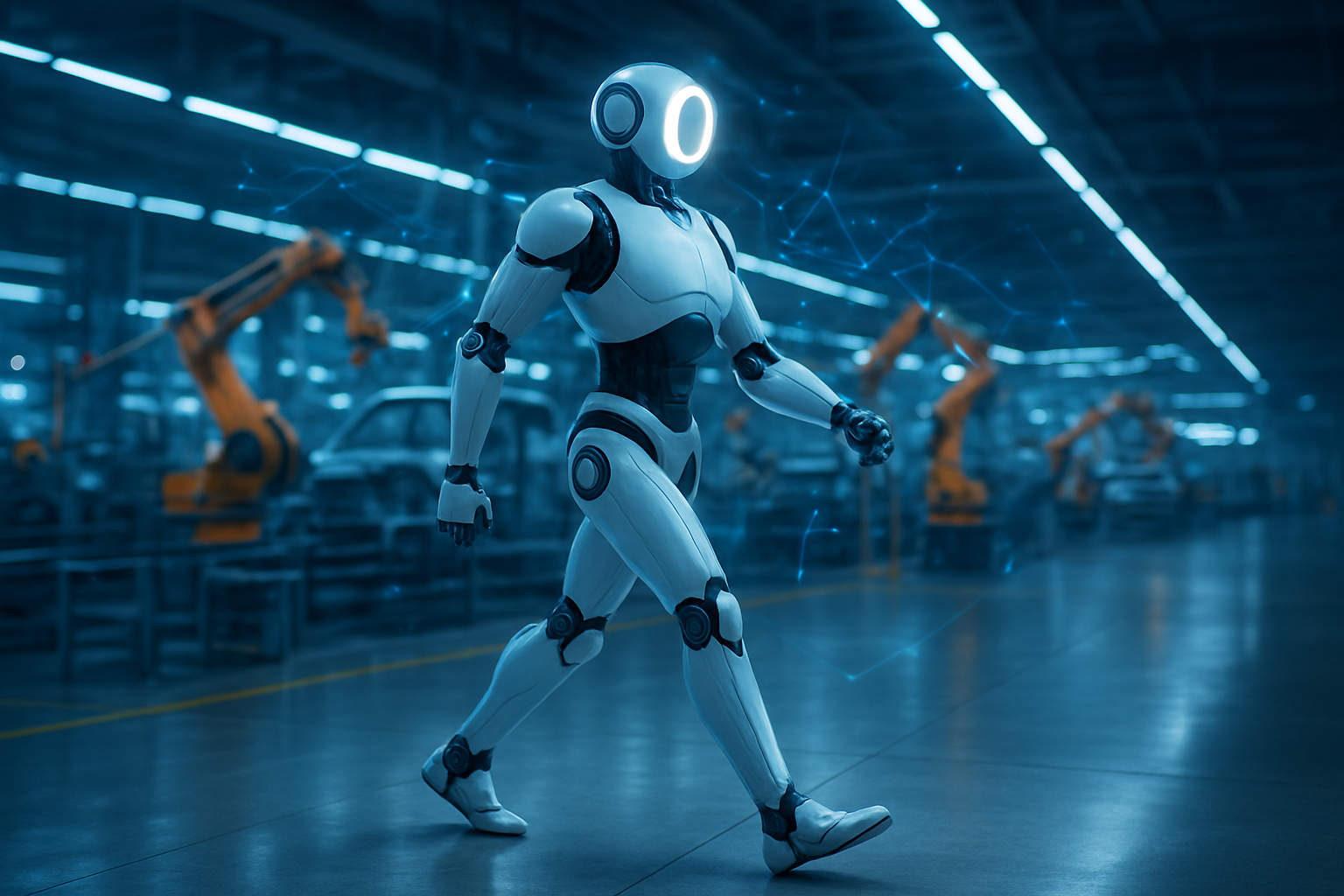
    The 2026 iteration of the electric Atlas, colloquially known within the industry as the "Product Version," is a radical departure from its hydraulic predecessor. Standing at 1.9 meters and weighing 90 kilograms, the robot features a distinctive "baby blue" protective chassis and a ring-lit sensor head designed for 360-degree perception. Unlike human-constrained designs, this Atlas utilizes specialized high-torque actuators and 56 degrees of freedom, including limbs and a torso capable of rotating a full 360 degrees. This "superhuman" range of motion allows the robot to orient its body toward a task without moving its feet, significantly reducing its floor footprint and increasing efficiency in the tight corridors of the Metaplant’s warehouse.

    Technical specifications of the deployed units include the integration of the NVIDIA (NASDAQ: NVDA) Jetson Thor compute platform, based on the Blackwell architecture, which provides the massive localized processing power required for real-time spatial AI. For energy management, the electric Atlas has solved the "runtime hurdle" that plagued earlier prototypes. It now features an autonomous dual-battery swapping system, allowing the robot to navigate to a charging station, swap its own depleted battery for a fresh one in under three minutes, and return to work—achieving a near-continuous operational cycle. Initial reactions from the AI research community have been overwhelmingly positive, with experts noting that the robot’s "fenceless" safety rating (IP67 water and dust resistance) and its use of Google DeepMind’s Gemini Robotics models for semantic reasoning represent a massive leap in multi-modal AI integration.

    Market Implications: The Humanoid Arms Race

    The deployment at HMGMA places Hyundai and Boston Dynamics in a direct technological arms race with other tech titans. Tesla (NASDAQ: TSLA) has been aggressively testing its Optimus Gen 3 robots within its own Gigafactories, focusing on high-volume production and fine-motor tasks like battery cell manipulation. Meanwhile, startups like Figure AI—backed by Microsoft (NASDAQ: MSFT) and OpenAI—have demonstrated significant staying power with their recent long-term deployment at BMW (OTC: BMWYY) facilities. While Tesla’s Optimus aims for a lower price point and mass consumer availability, the Boston Dynamics-Hyundai partnership is positioning Atlas as the "premium" industrial workhorse, capable of handling heavier payloads and more rugged environmental conditions.

    For the broader robotics industry, this milestone validates the "Data Factory" business model. To support the Georgia deployment, Hyundai has opened the Robot Metaplant Application Center (RMAC), a facility dedicated to "digital twin" simulations where Atlas robots are trained on virtual versions of the Metaplant floor before ever taking a physical step. This strategic advantage allows for rapid software updates and edge-case troubleshooting without interrupting actual vehicle production. This move essentially disrupts the traditional industrial robotics market, which has historically relied on stationary, single-purpose arms, by offering a versatile asset that can be repurposed across different plant sections as manufacturing needs evolve.

    Societal and Global Significance: The End of Labor as We Know It?

    The wider significance of the Atlas field tests extends into the global labor landscape and the future of human-robot collaboration. As industrialized nations face worsening labor shortages in manufacturing and logistics, the successful integration of humanoid labor at HMGMA serves as a proof-of-concept for the entire industrial sector. This isn't just about replacing human workers; it's about shifting the human role from "manual mover" to "robot fleet manager." However, this shift does not come without concerns. Labor unions and economic analysts are closely watching the Georgia tests, raising questions about the long-term displacement of entry-level manufacturing roles and the necessity of new regulatory frameworks for autonomous heavy machinery.

    In terms of the broader AI landscape, this deployment mirrors the "ChatGPT moment" for physical AI. Just as large language models moved from research papers to everyday tools, the electric Atlas represents the moment humanoid robotics moved from controlled laboratory demos to the messy, unpredictable reality of a 24/7 production line. Compared to previous breakthroughs like the first backflip of the hydraulic Atlas in 2017, the current field tests are less "spectacular" to the casual observer but far more consequential for the global economy, as they demonstrate reliability, durability, and ROI—the three pillars of industrial technology.

    The Future Roadmap: Scaling to 30,000 Units

    Looking ahead, the road for Atlas at the Georgia Metaplant is structured in multi-year phases. Near-term developments in 2026 will focus on "robot-only" shifts in high-hazard areas, such as areas with high temperatures or volatile chemical exposure, where human presence is currently limited. By 2028, Hyundai plans to transition from "sequencing" (moving parts) to "assembly," where Atlas units will use more advanced end-effectors to install components like trim pieces or weather stripping. Experts predict that the next major challenge will be "fleet-wide emergent behavior"—the ability for dozens of Atlas units to coordinate their movements and share environmental data in real-time without centralized control.

    Furthermore, the long-term applications of the Atlas platform are expected to leak into other sectors. Once the "ruggedized" industrial version is perfected, a "service" variant of Atlas could likely emerge for disaster response, nuclear decommissioning, or even large-scale construction. The primary hurdle remains the cost-benefit ratio; while the technical capabilities are proven, the industry is now waiting to see if the cost of maintaining a humanoid fleet can fall below the cost of traditional automation or human labor. Predicative maintenance AI will be the next major software update, allowing Atlas to self-diagnose mechanical wear before a failure occurs on the production line.

    A New Chapter in Industrial Robotics

    In summary, the arrival of the electric Atlas at the Hyundai Metaplant in Georgia marks a watershed moment for the 21st century. It represents the culmination of decades of research into balance, perception, and power density, finally manifesting as a viable tool for global commerce. The key takeaways from this deployment are clear: the hardware is finally robust enough for the "real world," the AI is finally smart enough to handle "fenceless" environments, and the economic incentive for humanoid labor is no longer a futuristic theory.

    As we move through 2026, the industry will be watching the HMGMA's throughput metrics and safety logs with intense scrutiny. The success of these field tests will likely determine the speed at which other automotive giants and logistics firms adopt humanoid solutions. For now, the sight of a faceless, 360-degree rotating robot autonomously sorting car parts in the Georgia heat is no longer science fiction—it is the new standard of the American factory floor.


    This content is intended for informational purposes only and represents analysis of current AI developments.

    TokenRing AI delivers enterprise-grade solutions for multi-agent AI workflow orchestration, AI-powered development tools, and seamless remote collaboration platforms.
    For more information, visit https://www.tokenring.ai/.
  • The “Thinking” Car: NVIDIA Launches Alpamayo Platform with 10-Billion Parameter ‘Chain-of-Thought’ AI

    The “Thinking” Car: NVIDIA Launches Alpamayo Platform with 10-Billion Parameter ‘Chain-of-Thought’ AI

    In a landmark announcement at the 2026 Consumer Electronics Show, NVIDIA (NASDAQ: NVDA) has officially unveiled the Alpamayo platform, a revolutionary leap in autonomous vehicle technology that shifts the focus from simple object detection to complex cognitive reasoning. Described by NVIDIA leadership as the "GPT-4 moment for mobility," Alpamayo marks the industry’s first comprehensive transition to "Physical AI"—systems that don't just see the world but understand the causal relationships within it.

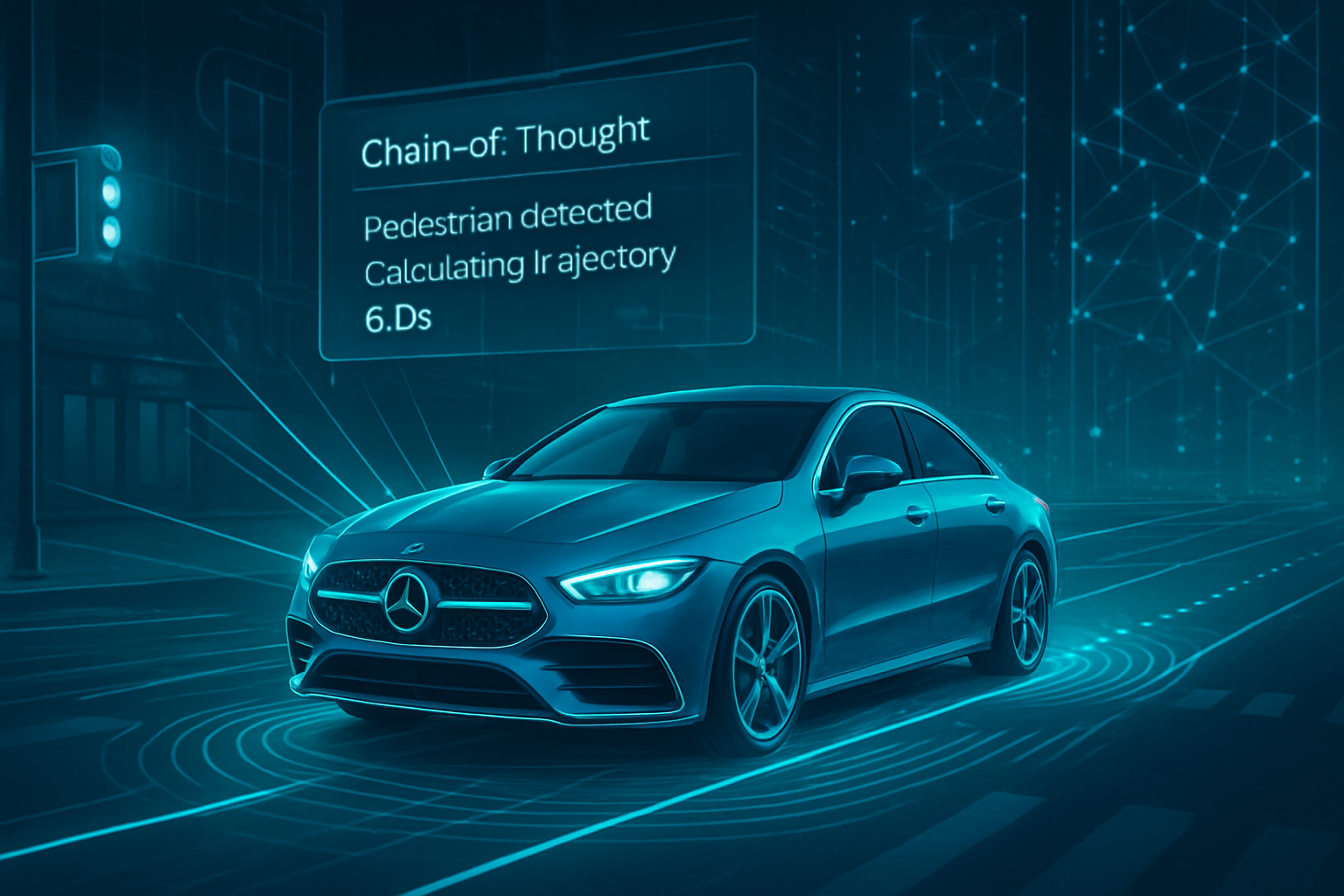
    The platform's debut coincides with its first commercial integration in the 2026 Mercedes-Benz (ETR: MBG) CLA, which will hit U.S. roads this quarter. By moving beyond traditional "black box" neural networks and into the realm of Vision-Language-Action (VLA) models, NVIDIA and Mercedes-Benz are attempting to bridge the gap between Level 2 driver assistance and the long-coveted goal of widespread, safe Level 4 autonomy.

    From Perception to Reasoning: The 10B VLA Breakthrough

    At the heart of the Alpamayo platform lies Alpamayo 1, a flagship 10-billion-parameter Vision-Language-Action model. Unlike previous generations of autonomous software that relied on discrete modules for perception, planning, and control, Alpamayo 1 is an end-to-end transformer-based architecture. It is divided into two specialized components: an 8.2-billion-parameter "Cosmos-Reason" backbone that handles semantic understanding of the environment, and a 2.3-billion-parameter "Action Expert" that translates those insights into a 6-second future trajectory at 10Hz.

    The most significant technical advancement is the introduction of "Chain-of-Thought" (CoT) reasoning, or what NVIDIA calls "Chain-of-Causation." Traditional AI driving systems often fail in "long-tail" scenarios—rare events like a child chasing a ball into the street or a construction worker using non-standard hand signals—because they cannot reason through the why of a situation. Alpamayo solves this by generating internal reasoning traces. For example, if the car slows down unexpectedly, the system doesn't just execute a braking command; it processes the logic: "Observing a ball roll into the street; inferring a child may follow; slowing to 15 mph and covering the brake to mitigate collision risk."

    This shift is powered by the NVIDIA DRIVE AGX Thor system-on-a-chip, built on the Blackwell architecture. Delivering 508 TOPS (Trillions of Operations Per Second), Thor provides the immense computational headroom required to run these massive VLA models in real-time with less than 100ms of latency. This differentiates Alpamayo from legacy approaches by Mobileye (NASDAQ: MBLY) or older Tesla (NASDAQ: TSLA) FSD versions, which traditionally lacked the on-board compute to run high-parameter language-based reasoning alongside vision processing.

    Shaking Up the Autonomous Arms Race

    NVIDIA's decision to launch Alpamayo as an open-source ecosystem is a strategic masterstroke intended to position the company as the "Android of Autonomy." By providing not just the model, but also the AlpaSim simulation framework and over 100 terabytes of curated "Physical AI" datasets, NVIDIA is lowering the barrier to entry for other automakers. This puts significant pressure on vertical competitors like Tesla, whose FSD (Full Self-Driving) stack remains a proprietary "walled garden."

    For Mercedes-Benz, the early adoption of Alpamayo in the CLA provides a massive market advantage in the luxury segment. While the initial release is categorized as a "Level 2++" system—requiring driver supervision—the hardware is fully L4-ready. This allows Mercedes to collect vast amounts of "reasoning data" from real-world fleets, which can then be distilled into smaller, more efficient models. Other major players, including Jaguar Land Rover and Lucid (NASDAQ: LCID), have already signaled their intent to adopt parts of the Alpamayo stack, potentially creating a unified standard for how AI cars "think."

    The Wider Significance: Explainability and the Safety Gap

    The launch of Alpamayo addresses the single biggest hurdle to autonomous vehicle adoption: trust. By making the AI's "thought process" transparent through Chain-of-Thought reasoning, NVIDIA is providing regulators and insurance companies with an audit trail that was previously impossible. In the event of a near-miss or accident, engineers can now look at the model's reasoning trace to understand the logic behind a specific maneuver, moving AI from a "black box" to an "open book."

    This move fits into a broader trend of "Explainable AI" (XAI) that is sweeping the tech industry. As AI agents begin to handle physical tasks—from warehouse robotics to driving—the ability to justify actions in human-readable terms becomes a safety requirement rather than a feature. However, this also raises new concerns. Critics argue that relying on large-scale models could introduce "hallucinations" into driving behavior, where a car might "reason" its way into a dangerous action based on a misunderstood visual cue. NVIDIA has countered this by implementing a "dual-stack" architecture, where a classical safety monitor (NVIDIA Halos) runs in parallel to the AI to veto any kinematically unsafe commands.

    The Horizon: Scaling Physical AI

    In the near term, expect the Alpamayo platform to expand rapidly beyond the Mercedes-Benz CLA. NVIDIA has already hinted at "Alpamayo Mini" models—highly distilled versions of the 10B VLA designed to run on lower-power chips for mid-range and budget vehicles. As more OEMs join the ecosystem, the "Physical AI Open Datasets" will grow exponentially, potentially solving the autonomous driving puzzle through sheer scale of shared data.

    Long-term, the implications of Alpamayo reach far beyond the automotive industry. The "Cosmos-Reason" backbone is fundamentally a physical-world simulator. The same logic used to navigate a busy intersection in a CLA could be adapted for humanoid robots in manufacturing or delivery drones. Experts predict that within the next 24 months, we will see the first "zero-shot" autonomous deployments, where vehicles can navigate entirely new cities they have never been mapped in, simply by reasoning through the environment the same way a human driver would.

    A New Era for the Road

    The launch of NVIDIA Alpamayo and its debut in the Mercedes-Benz CLA represents a pivot point in the history of artificial intelligence. We are moving away from an era where cars were programmed with rules, and into an era where they are taught to think. By combining 10-billion-parameter scale with explainable reasoning, NVIDIA is addressing the complexity of the real world with the nuance it requires.

    The significance of this development cannot be overstated; it is a fundamental redesign of the relationship between machine perception and action. In the coming weeks and months, the industry will be watching the Mercedes-Benz CLA's real-world performance closely. If Alpamayo lives up to its promise of solving the "long-tail" of driving through human-like logic, the path to a truly driverless future may finally be clear.


    This content is intended for informational purposes only and represents analysis of current AI developments.

    TokenRing AI delivers enterprise-grade solutions for multi-agent AI workflow orchestration, AI-powered development tools, and seamless remote collaboration platforms.
    For more information, visit https://www.tokenring.ai/.
  • The Reasoning Revolution: How OpenAI’s o3 Shattered the ARC-AGI Barrier and Redefined General Intelligence

    The Reasoning Revolution: How OpenAI’s o3 Shattered the ARC-AGI Barrier and Redefined General Intelligence

    When OpenAI (partnered with Microsoft (NASDAQ: MSFT)) unveiled its o3 model in late 2024, the artificial intelligence landscape experienced a paradigm shift. For years, the industry had focused on "System 1" thinking—the fast, intuitive, but often hallucination-prone pattern matching found in traditional Large Language Models (LLMs). The arrival of o3, however, signaled the dawn of "System 2" AI: a model capable of slow, deliberate reasoning and self-correction. By achieving a historic score on the Abstraction and Reasoning Corpus (ARC-AGI), o3 did what many critics, including ARC creator François Chollet, thought was years away: it matched human-level fluid intelligence on a benchmark specifically designed to resist memorization.

    As we stand in early 2026, the legacy of the o3 breakthrough is clear. It wasn't just another incremental update; it was a fundamental change in how we define AI progress. Rather than simply scaling the size of training datasets, OpenAI proved that scaling "test-time compute"—giving a model more time and resources to "think" during the inference process—could unlock capabilities that pre-training alone never could. This transition has moved the industry away from "stochastic parrots" toward agents that can truly solve novel problems they have never encountered before.

    Mastering the Unseen: The Technical Architecture of o3

    The technical achievement of o3 centered on its performance on the ARC-AGI-1 benchmark. While its predecessor, GPT-4o, struggled with a dismal 5% score, the high-compute version of o3 reached a staggering 87.5%, surpassing the established human baseline of 85%. This was achieved through a massive investment in test-time compute; reports indicate that running the model across the entire benchmark required approximately 172 times more compute than standard versions, with some estimates placing the cost of the benchmark run at over $1 million in GPU time. This "brute-force" approach to reasoning allowed the model to explore thousands of potential logic paths, backtracking when it hit a dead end and refining its strategy until a solution was found.

    Unlike previous models that relied on predicting the next most likely token, o3 utilized LLM-guided program search. Instead of guessing the answer to a visual puzzle, the model generated an internal "program"—a set of logical instructions—to solve the challenge and then executed that logic to produce the result. This process was refined through massive-scale Reinforcement Learning (RL), which taught the model how to effectively use its "thinking tokens" to navigate complex, multi-step puzzles. This shift from "intuitive guessing" to "programmatic reasoning" is what allowed o3 to handle the novel, abstract tasks that define the ARC benchmark.

    The AI research community's reaction was immediate and polarized. François Chollet, the Google researcher who created ARC-AGI, called the result a "genuine breakthrough in adaptability." However, he also cautioned that the high compute cost suggested a "brute-force" search rather than the efficient learning seen in biological brains. Despite these caveats, the consensus was clear: the ceiling for what LLM-based architectures could achieve had been raised significantly, effectively ending the era where ARC was considered "unsolvable" by generative AI.

    Market Disruption and the Race for Inference Scaling

    The success of o3 fundamentally altered the competitive strategies of major tech players. Microsoft (NASDAQ: MSFT), as OpenAI's primary partner, immediately integrated these reasoning capabilities into its Azure AI and Copilot ecosystems, providing enterprise clients with tools capable of complex coding and scientific synthesis. This put immense pressure on Alphabet Inc. (NASDAQ: GOOGL) and its Google DeepMind division, which responded by accelerating the development of its own reasoning-focused models, such as the Gemini 2.0 and 3.0 series, which sought to match o3’s logic while reducing the extreme compute overhead.

    Beyond the "Big Two," the o3 breakthrough created a ripple effect across the semiconductor and cloud industries. Nvidia (NASDAQ: NVDA) saw a surge in demand for chips optimized not just for training, but for the massive inference demands of System 2 models. Startups like Anthropic (backed by Amazon (NASDAQ: AMZN) and Google) were forced to pivot, leading to the release of their own reasoning models that emphasized "compositional generalization"—the ability to combine known concepts in entirely new ways. The market quickly realized that the next frontier of AI value wasn't just in knowing everything, but in thinking through anything.

    A New Benchmark for the Human Mind

    The wider significance of o3’s ARC-AGI score lies in its challenge to our understanding of "intelligence." For years, the ARC-AGI benchmark was the "gold standard" for measuring fluid intelligence because it required the AI to solve puzzles it had never seen, using only a few examples. By cracking this, o3 moved AI closer to the "General" in AGI. It demonstrated that reasoning is not a mystical quality but a computational process that can be scaled. However, this has also raised concerns about the "opacity" of reasoning; as models spend more time "thinking" internally, understanding why they reached a specific conclusion becomes more difficult for human observers.

    This milestone is frequently compared to DeepBlue’s victory over Garry Kasparov or AlphaGo’s triumph over Lee Sedol. While those were specialized breakthroughs in games, o3’s success on ARC-AGI is seen as a victory in a "meta-game": the game of learning itself. Yet, the transition to 2026 has shown that this was only the first step. The "saturation" of ARC-AGI-1 led to the creation of ARC-AGI-2 and the recently announced ARC-AGI-3, which are designed to be even more resistant to the type of search-heavy strategies o3 employed, focusing instead on "agentic intelligence" where the AI must experiment within an environment to learn.

    The Road to 2027: From Reasoning to Agency

    Looking ahead, the "o-series" lineage is evolving from static reasoning to active agency. Experts predict that the next generation of models, potentially dubbed o5, will integrate the reasoning depth of o3 with the real-world interaction capabilities of robotics and web agents. We are already seeing the emergence of "o4-mini" variants that offer o3-level logic at a fraction of the cost, making advanced reasoning accessible to mobile devices and edge computing. The challenge remains "compositional generalization"—solving tasks that require multiple layers of novel logic—where current models still lag behind human experts on the most difficult ARC-AGI-2 sets.

    The near-term focus is on "efficiency scaling." If o3 proved that we could solve reasoning with $1 million in compute, the goal for 2026 is to solve the same problems for $1. This will require breakthroughs in how models manage their "internal monologue" and more efficient architectures that don't require hundreds of reasoning tokens for simple logical leaps. As ARC-AGI-3 rolls out this year, the world will watch to see if AI can move from "thinking" to "doing"—learning in real-time through trial and error.

    Conclusion: The Legacy of a Landmark

    The breakthrough of OpenAI’s o3 on the ARC-AGI benchmark remains a defining moment in the history of artificial intelligence. It bridged the gap between pattern-matching LLMs and reasoning-capable agents, proving that the path to AGI may lie in how a model uses its time during inference as much as how it was trained. While critics like François Chollet correctly point out that we have not yet reached "true" human-like flexibility, the 87.5% score shattered the illusion that LLMs were nearing a plateau.

    As we move further into 2026, the industry is no longer asking if AI can reason, but how deeply and efficiently it can do so. The "Shipmas" announcement of 2024 was the spark that ignited the current reasoning arms race. For businesses and developers, the takeaway is clear: we are moving into an era where AI is not just a repository of information, but a partner in problem-solving. The next few months, particularly with the launch of ARC-AGI-3, will determine if the next leap in intelligence comes from more compute, or a fundamental new way for machines to learn.


    This content is intended for informational purposes only and represents analysis of current AI developments.

    TokenRing AI delivers enterprise-grade solutions for multi-agent AI workflow orchestration, AI-powered development tools, and seamless remote collaboration platforms.
    For more information, visit https://www.tokenring.ai/.

  • The Switzerland of Silicon Valley: Apple’s Multi-Vendor AI Strategy Redefines the Smartphone Wars

    The Switzerland of Silicon Valley: Apple’s Multi-Vendor AI Strategy Redefines the Smartphone Wars

    As of January 16, 2026, the landscape of consumer artificial intelligence has undergone a fundamental shift, driven by Apple’s (NASDAQ:AAPL) sophisticated and pragmatic "multi-vendor" strategy. While early rumors suggested a singular alliance with OpenAI, Apple has instead positioned itself as the ultimate gatekeeper of the AI era, orchestrating a complex ecosystem where Google (NASDAQ:GOOGL), OpenAI, and even Anthropic play specialized roles. This "Switzerland" approach allows Apple to offer cutting-edge generative features without tethering its reputation—or its hardware—to a single external model provider.

    The strategy has culminated in the recent rollout of iOS 19 and macOS 16, which introduce a revolutionary "Primary Intelligence Partner" toggle. By diversifying its AI backend, Apple has mitigated the risks of model hallucinations and service outages while maintaining its staunch commitment to user privacy. The move signals a broader trend in the tech industry: the commoditization of Large Language Models (LLMs) and the rise of the platform as the primary value driver.

    The Technical Core: A Three-Tiered Routing Architecture

    At the heart of Apple’s AI offensive is a sophisticated three-tier routing architecture that determines where an AI request is processed. Roughly 60% of all user interactions—including text summarization, notification prioritization, and basic image editing—are handled by Apple’s proprietary 3-billion and 7-billion parameter foundation models running locally on the Apple Neural Engine. This ensures that the most personal data never leaves the device, a core pillar of the Apple Intelligence brand.

    When a task exceeds local capabilities, the request is escalated to Apple’s Private Cloud Compute (PCC). In a strategic technical achievement, Apple has managed to "white-label" custom instances of Google’s Gemini models to run directly on Apple Silicon within these secure server environments. For the most complex "World Knowledge" queries, such as troubleshooting a mechanical issue or deep research, the system utilizes a Query Scheduler. This gatekeeper asks for explicit user permission before handing the request to an external provider. As of early 2026, Google Gemini has become the default partner for these queries, replacing the initial dominance OpenAI held during the platform's 2024 launch.

    This multi-vendor approach differs significantly from the vertical integration seen at companies like Google or Microsoft (NASDAQ:MSFT). While those firms prioritize their own first-party models (Gemini and Copilot, respectively), Apple treats models as modular "plugs." Industry experts have lauded this modularity, noting that it allows Apple to swap providers based on performance metrics, cost-efficiency, or regional regulatory requirements without disrupting the user interface.

    Market Implications: Winners and the New Competitive Balance

    The biggest winner in this new paradigm appears to be Google. By securing the default "World Knowledge" spot in Siri 2.0, Alphabet has reclaimed a critical entry point for search-adjacent AI queries, reportedly paying an estimated $1 billion annually for the privilege. This partnership mirrors the historic Google-Apple search deal, effectively making Gemini the invisible engine behind the most used voice assistant in the world. Meanwhile, OpenAI has transitioned into a "specialist" role, serving as an opt-in extension for creative writing and high-level reasoning tasks where its GPT-4o and successor models still hold a slight edge in "creative flair."

    The competitive implications extend beyond the big three. Apple’s decision to integrate Anthropic’s Claude models directly into Xcode for developers has created a new niche for "vibe-coding," where specialized models are used for specific professional workflows. This move challenges the dominance of Microsoft’s GitHub Copilot. For smaller AI startups, the Apple Intelligence framework presents a double-edged sword: the potential for massive distribution as a "plug" is high, but the barrier to entry remains steep due to Apple’s rigorous privacy and latency requirements.

    In China, Apple has navigated complex regulatory waters by adopting a dual-vendor regional strategy. By partnering with Alibaba (NYSE:BABA) and Baidu (NASDAQ:BIDU), Apple has ensured that its AI features comply with local data laws while still providing a seamless user experience. This flexibility has allowed Apple to maintain its market share in the Greater China region, even as domestic competitors like Huawei and Xiaomi ramp up their own AI integrations.

    Privacy, Sovereignty, and the Global AI Landscape

    Apple’s strategy represents a broader shift toward "AI Sovereignty." By controlling the orchestration layer rather than the underlying model, Apple maintains ultimate authority over the user experience. This fits into the wider trend of "agentic" AI, where the value lies not in the model’s size, but in its ability to navigate a user's personal context safely. The use of Private Cloud Compute (PCC) sets a new industry standard, forcing competitors to rethink how they handle cloud-based AI requests.

    There are, however, potential concerns. Critics argue that by relying on external partners for the "brains" of Siri, Apple remains vulnerable to the biases and ethical lapses of its partners. If a Google model provides a controversial answer, the lines of accountability become blurred. Furthermore, the complexity of managing multiple vendors could lead to fragmented user experiences, where the "vibe" of an AI interaction changes depending on which model is currently active.

    Compared to previous milestones like the launch of the App Store, the Apple Intelligence rollout is more of a diplomatic feat than a purely technical one. It represents the realization that no single company can win the AI race alone. Instead, the winner will be the one who can best aggregate and secure the world’s most powerful models for the average consumer.

    The Horizon: Siri 2.0 and the Future of Intent

    Looking ahead, the industry is closely watching the full public release of "Siri 2.0" in March 2026. This version is expected to utilize the multi-vendor strategy to its fullest extent, providing what Apple calls "Intent-Based Orchestration." In this future, Siri will not just answer questions but execute complex actions across multiple apps by routing sub-tasks to different models—using Gemini for research, Claude for code snippets, and Apple’s on-device models for personal scheduling.

    We may also see further expansion of the vendor list. Rumors persist that Apple is in talks with Meta (NASDAQ:META) to integrate Llama models for social-media-focused generative tasks. The primary challenge remains the "cold start" problem—ensuring that switching between models is instantaneous and invisible to the user. Experts predict that as edge computing power increases, more of these third-party models will eventually run locally on the device, further tightening Apple's grip on the ecosystem.

    A New Era of Collaboration

    Apple’s multi-vendor AI strategy is a masterclass in strategic hedging. By refusing to bet on a single horse, the company has ensured that its devices remain the most versatile portals to the world of generative AI. This development marks a turning point in AI history: the transition from "model-centric" AI to "experience-centric" AI.

    In the coming months, the success of this strategy will be measured by user adoption of the "Primary Intelligence Partner" toggle and the performance of Siri 2.0 in real-world scenarios. For now, Apple has successfully navigated the most disruptive shift in technology in a generation, proving that in the AI wars, the most powerful weapon might just be a well-negotiated contract.


    This content is intended for informational purposes only and represents analysis of current AI developments.

    TokenRing AI delivers enterprise-grade solutions for multi-agent AI workflow orchestration, AI-powered development tools, and seamless remote collaboration platforms.
    For more information, visit https://www.tokenring.ai/.

  • Meta’s Strategic Acquisition of Manus AI: The Dawn of the ‘Agentic’ Social Web

    Meta’s Strategic Acquisition of Manus AI: The Dawn of the ‘Agentic’ Social Web

    In a move that signals the definitive end of the "chatbot era" and the beginning of the age of autonomous execution, Meta Platforms Inc. (NASDAQ: META) has finalized its acquisition of Manus AI. Announced in late December 2025 and closing in the first weeks of 2026, the deal—valued at an estimated $2 billion—marks Meta’s most significant strategic pivot since its rebranding in 2021. By absorbing the creators of the world’s first "general-purpose AI agent," Meta is positioning itself to own the "execution layer" of the internet, moving beyond mere content generation to a future where AI handles complex, multi-step tasks independently.

    The significance of this acquisition cannot be overstated. While the industry spent 2024 and 2025 obsessed with large language models (LLMs) that could talk, the integration of Manus AI into the Meta ecosystem provides the company with an AI that can act. This transition toward "Agentic AI" allows Meta to transform its massive user base on WhatsApp, Instagram, and Messenger from passive content consumers into directors of a digital workforce. Industry analysts suggest this move is the first step in CEO Mark Zuckerberg’s broader vision of "Personal Superintelligence," where every user has an autonomous agent capable of managing their digital life, from professional scheduling to automated commerce.

    The Technical Leap: From Conversation to Execution

    Manus AI represents a fundamental departure from previous AI architectures. While traditional models like those from OpenAI or Alphabet Inc. (NASDAQ: GOOGL) rely on predicting the next token in a sequence, Manus operates on a "virtualization-first" architecture. According to technical specifications released during the acquisition, Manus provisions an ephemeral, Linux-based cloud sandbox for every task. This allows the agent to execute real shell commands, manage file systems, and navigate the live web using integrated browser control tools. Unlike previous "wrapper" technologies that simply parsed text, Manus treats the entire computing environment as its playground, enabling it to install software, write and deploy code, and conduct deep research in parallel.

    One of the primary technical breakthroughs of Manus AI is its approach to "context engineering." In standard LLMs, long-running tasks often suffer from "context drift" or memory loss as the prompt window fills up. Manus solves this by treating the sandbox’s file system as its long-term memory. Instead of re-reading a massive chat history, the agent maintains a dynamic summary of its progress within the virtual machine’s state. On the GAIA (General AI Assistants) benchmark, Manus has reportedly achieved state-of-the-art results, significantly outperforming competitive systems like OpenAI’s "Deep Research" in multi-step reasoning and autonomous tool usage.

    The initial reaction from the AI research community has been a mix of awe and apprehension. Erik Brynjolfsson of the Stanford Digital Economy Lab noted that 2026 is becoming the year of "Productive AI," where the focus shifts from generative creativity to "agentic labor." However, the move has also faced criticism. Yann LeCun, who recently transitioned out of his role as Meta’s Chief AI Scientist, argued that while the Manus "engineering scaffold" is impressive, it does not yet solve the fundamental reasoning flaws inherent in current autoregressive models. Despite these debates, the technical capability to spawn hundreds of sub-agents to perform parallel "MapReduce" style research has set a new bar for what consumers expect from an AI assistant.

    A Competitive Shockwave Through Silicon Valley

    The acquisition of Manus AI has sent ripples through the tech industry, forcing competitors to accelerate their own agentic roadmaps. For Meta, the move is a defensive masterstroke against OpenAI and Microsoft Corp. (NASDAQ: MSFT), both of which have been racing to release their own autonomous "Operator" agents. By acquiring the most advanced independent agent startup, Meta has effectively "bought" an execution layer that would have taken years to build internally. The company has already begun consolidating its AI divisions into the newly formed Meta Superintelligence Labs (MSL), led by high-profile recruits like former Scale AI founder Alexandr Wang.

    The competitive landscape is now divided between those who provide the "brains" and those who provide the "hands." While NVIDIA (NASDAQ: NVDA) continues to dominate the hardware layer, Meta’s acquisition of Manus allows it to bypass the traditional app-store model. If a Manus-powered agent can navigate the web and execute tasks directly via a browser, Meta becomes the primary interface for the internet, potentially disrupting the search dominance of Google. Market analysts at Goldman Sachs have already raised their price targets for META to over $850, citing the massive monetization potential of integrating agentic workflows into WhatsApp for small-to-medium businesses (SMBs).

    Furthermore, the acquisition has sparked a talent war. Sam Altman of OpenAI has publicly criticized Meta’s aggressive hiring tactics, which reportedly included nine-figure signing bonuses to lure agentic researchers away from rival labs. This "mercenary" approach to talent acquisition underscores the high stakes of the agentic era; the first company to achieve a reliable, autonomous agent that users can trust with financial transactions will likely capture the lion’s share of the next decade's digital economy.

    The Broader Significance: The Shift to Actionable Intelligence

    Beyond the corporate rivalry, the Meta-Manus deal marks a milestone in the evolution of artificial intelligence. We are witnessing a shift from "Generative AI"—which focuses on synthesis and creativity—to "Agentic AI," which focuses on utility and agency. This shift necessitates a massive increase in continuous compute power. Unlike a chatbot that only uses energy when a user sends a prompt, an autonomous agent might run in the background for hours or days to complete a task. To address this, Meta recently signed a landmark 1.2-gigawatt power deal with Oklo Inc. (NYSE: OKLO) to build nuclear-powered data centers, ensuring the baseload energy required for billions of background agents.

    However, the broader significance also includes significant risks. Max Tegmark of the Future of Life Institute has warned that granting agents autonomous browser control and financial access could lead to a "safety crisis" if the industry doesn't develop an "Agentic Harness" to prevent runaway errors. There are also geopolitical implications; Manus AI's original roots in a Chinese startup required Meta to undergo rigorous regulatory scrutiny. To satisfy US regulators, Meta has committed to severing all remaining Chinese ownership interests and closing operations in that region to ensure data sovereignty.

    This milestone is often compared to the release of the first iPhone or the launch of the World Wide Web. Just as the web transformed from a static collection of pages to a dynamic platform for services, AI is transforming from a static responder into a dynamic actor. The "Great Consolidation" of 2026, led by Meta’s acquisition, suggests that the window for independent agent startups is closing, as hyperscalers move to vertically integrate the data, the models, and the execution environments.

    Future Developments: Toward Personal Superintelligence

    In the near term, users should expect Meta to roll out "Digital Workers" for WhatsApp and Messenger. These agents will be capable of autonomously managing inventory, rebooking travel, and handling customer service for millions of businesses without human intervention. By late 2026, Meta is expected to integrate Manus capabilities into its Llama 5 model, creating a seamless bridge between high-level reasoning and low-level task execution. This will likely extend to Meta’s wearable tech, such as the Ray-Ban Meta glasses, allowing the AI to "see" the world and act upon it in real-time.

    Longer-term challenges remain, particularly around the "trust layer." For agents to be truly useful, they must be allowed to handle sensitive personal data and financial credentials. Developing a secure, encrypted "Vault" for agentic identity will be a primary focus for Meta's engineering teams in the coming months. Experts predict that the next frontier will be "multi-agent orchestration," where a user's personal Meta agent communicates with a merchant's agent to negotiate prices and finalize transactions without either human ever needing to open a browser.

    The predictive consensus among industry leaders is that by 2027, the concept of "using an app" will feel as antiquated as "dialing a phone." Instead, users will simply state an intent, and their agent—powered by the technology acquired from Manus—will handle the digital legwork. The challenge for Meta will be balancing this immense power with privacy and safety standards that can withstand global regulatory pressure.

    A New Chapter in AI History

    Meta’s acquisition of Manus AI is more than just a business transaction; it is a declaration of intent. By moving aggressively into the agentic space, Meta is betting that the future of the social web is not just about connecting people, but about providing them with the autonomous tools to navigate an increasingly complex digital world. This development will likely be remembered as the moment when AI moved from a novelty to a necessity, shifting the paradigm of human-computer interaction forever.

    As we look toward the final quarters of 2026, the industry will be watching the "Action Accuracy" scores of Meta’s new systems. The success of the Manus integration will be measured not by how well the AI can talk, but by how much time it saves the average user. If Meta can successfully deploy "Personal Superintelligence" at scale, it may well secure its place as the dominant platform of the next computing era.


    This content is intended for informational purposes only and represents analysis of current AI developments.

    TokenRing AI delivers enterprise-grade solutions for multi-agent AI workflow orchestration, AI-powered development tools, and seamless remote collaboration platforms.
    For more information, visit https://www.tokenring.ai/.
  • Meta’s 6.6-Gigawatt Nuclear “Super-Deal” to Power the Dawn of Artificial Superintelligence

    Meta’s 6.6-Gigawatt Nuclear “Super-Deal” to Power the Dawn of Artificial Superintelligence

    In a move that fundamentally reshapes the relationship between Big Tech and the global energy grid, Meta Platforms, Inc. (NASDAQ: META) has announced a staggering 6.6-gigawatt (GW) nuclear energy portfolio to fuel its next generation of AI infrastructure. On January 9, 2026, the social media and AI titan unveiled a series of landmark agreements with Vistra Corp (NYSE: VST), Oklo Inc (NYSE: OKLO), and the Bill Gates-founded TerraPower. These multi-decade partnerships represent the single largest private procurement of nuclear power in history, marking a decisive shift toward permanent, carbon-free baseload energy for the massive compute clusters required to achieve artificial general intelligence (AGI).

    The announcement solidifies Meta’s transition from a software-centric company to a vertically integrated compute-and-power powerhouse. By securing nearly seven gigawatts of dedicated nuclear capacity, Meta is addressing the "energy wall" that has threatened to stall AI scaling. The deal specifically targets the development of "Gigawatt-scale" data center clusters—industrial-scale supercomputers that consume as much power as a mid-sized American city. This strategic pivot ensures that as Meta’s AI models grow in complexity, the physical infrastructure supporting them will remain resilient, sustainable, and independent of the fluctuating prices of the traditional energy market.

    The Architecture of Atomic Intelligence: SMRs and Legacy Uprates

    Meta’s nuclear strategy is a sophisticated three-pronged approach that blends the modernization of existing infrastructure with the pioneering of next-generation reactor technology. The cornerstone of the immediate energy supply comes from Vistra Corp, with Meta signing 20-year Power Purchase Agreements (PPAs) to source over 2.1 GW from the Perry, Davis-Besse, and Beaver Valley nuclear plants. Beyond simple procurement, Meta is funding "uprates"—technical modifications to existing reactors that increase their efficiency and output—adding an additional 433 MW of new, carbon-free capacity to the PJM grid. This "brownfield" strategy allows Meta to bring new power online faster than building from scratch.

    For its long-term needs, Meta is betting heavily on Small Modular Reactors (SMRs). The partnership with Oklo Inc involves the development of a 1.2 GW "nuclear campus" in Pike County, Ohio. Utilizing Oklo’s Aurora Powerhouse technology, this campus will feature a fleet of fast fission reactors that can operate on both fresh and recycled nuclear fuel. Unlike traditional massive light-water reactors, these SMRs are designed for rapid deployment and can be co-located with data centers to minimize transmission losses. Meta has opted for a "Power as a Service" model with Oklo, providing upfront capital to de-risk the development phase and ensure a dedicated pipeline of energy through the 2030s.

    The most technically advanced component of the deal is the partnership with TerraPower for its Natrium reactor technology. These units utilize a sodium-cooled fast reactor combined with a molten salt energy storage system. This unique design allows the reactors to provide a steady 345 MW of baseload power while possessing the ability to "flex" up to 500 MW for over five hours to meet the high-demand spikes inherent in AI training runs. Meta has secured rights to two initial units with options for six more, totaling a potential 2.8 GW. This flexibility is a radical departure from the "always-on" nature of traditional nuclear, providing a dynamic energy source that matches the variable workloads of modern AI.

    The Trillion-Dollar Power Play: Market and Competitive Implications

    This massive energy grab places Meta at the forefront of the "Compute-Energy Nexus," a term now widely used by industry analysts to describe the merging of the tech and utility sectors. While Microsoft Corp (NASDAQ: MSFT) and Amazon.com, Inc. (NASDAQ: AMZN) made early waves in 2024 and 2025 with their respective deals for the Three Mile Island and Talen Energy sites, Meta’s 6.6 GW portfolio is significantly larger in both scope and technological diversity. By locking in long-term, fixed-price energy contracts, Meta is insulating itself from the energy volatility that its competitors may face as the global grid struggles to keep up with AI-driven demand.

    The primary beneficiaries of this deal are the nuclear innovators themselves. Following the announcement, shares of Vistra Corp and Oklo Inc saw significant surges, with Oklo being viewed as the "Apple of Energy"—a design-led firm with a massive, guaranteed customer in Meta. For TerraPower, the deal provides the commercial validation and capital injection needed to move Natrium from the pilot stage to industrial-scale deployment. This creates a powerful signal to the market: nuclear is no longer a "last resort" for green energy, but the primary engine for the next industrial revolution.

    However, this aggressive procurement has also raised concerns among smaller AI startups and research labs. As tech giants like Meta, Google—owned by Alphabet Inc (NASDAQ: GOOGL)—and Microsoft consolidate the world's available carbon-free energy, the "energy barrier to entry" for new AI companies becomes nearly insurmountable. The strategic advantage here is clear: those who control the power, control the compute. Meta's ability to build "Gigawatt" clusters like the 1 GW Prometheus in Ohio and the planned 5 GW Hyperion in Louisiana effectively creates a "moat of electricity" that could marginalize any competitor without its own dedicated power source.

    Beyond the Grid: AI’s Environmental and Societal Nuclear Renaissance

    The broader significance of Meta's nuclear pivot cannot be overstated. It marks a historic reconciliation between the environmental goals of the tech industry and the high energy demands of AI. For years, critics argued that the "AI boom" would lead to a resurgence in coal and natural gas; instead, Meta is using AI as the primary catalyst for a nuclear renaissance. By funding the "uprating" of old plants and the construction of new SMRs, Meta is effectively modernizing the American energy grid, providing a massive influx of private capital into a sector that has been largely stagnant for three decades.

    This development also reflects a fundamental shift in the AI landscape. We are moving away from the era of "efficiency-first" AI and into the era of "brute-force scaling." The "Gigawatt" data center is a testament to the belief that the path to AGI requires an almost unfathomable amount of physical resources. Comparing this to previous milestones, such as the 2012 AlexNet breakthrough or the 2022 launch of ChatGPT, the current milestone is not a change in code, but a change in matter. We are now measuring AI progress in terms of hectares of land, tons of cooling water, and gigawatts of nuclear energy.

    Despite the optimism, the move has sparked intense debate over grid equity and safety. While Meta is funding new capacity, the sheer volume of power it requires could still strain regional grids, potentially driving up costs for residential consumers in the PJM and MISO regions. Furthermore, the reliance on SMRs—a technology that is still in its commercial infancy—carries inherent regulatory and construction risks. The industry is watching closely to see if the Nuclear Regulatory Commission (NRC) can keep pace with the "Silicon Valley speed" that Meta and its partners are demanding.

    The Road to Hyperion: What’s Next for Meta’s Infrastructure

    In the near term, the focus will shift from contracts to construction. The first major milestone is the 1 GW Prometheus cluster in New Albany, Ohio, expected to go fully operational by late 2026. This facility will serve as the "blueprint" for future sites, integrating the energy from Vistra's nuclear uprates directly into the high-voltage fabric of Meta's most advanced AI training facility. Success here will determine the feasibility of the even more ambitious Hyperion project in Louisiana, which aims to reach 5 GW by the end of the decade.

    The long-term challenge remains the delivery of the SMR fleet. Oklo and TerraPower must navigate a complex landscape of supply chain hurdles, specialized labor shortages, and stringent safety testing. If successful, the applications for this "boundless" compute are transformative. Experts predict that Meta will use this power to run "infinite-context" models and real-time physical world simulations that could accelerate breakthroughs in materials science, drug discovery, and climate modeling—ironically using the very AI that consumes the energy to find more efficient ways to produce and save it.

    Conclusion: A New Era of Atomic-Scale Computing

    Meta’s 6.6 GW nuclear commitment is more than just a series of power deals; it is a declaration of intent for the age of Artificial Superintelligence. By partnering with Vistra, Oklo, and TerraPower, Meta has secured the physical foundation necessary to sustain its vision of the future. The significance of this development in AI history lies in its scale—it is the moment when the digital world fully acknowledged its inescapable dependence on the physical world’s most potent energy source.

    As we move further into 2026, the key metrics to watch will not just be model parameters or FLOPs, but "time-to-power" and "grid-interconnect" dates. The race for AI supremacy has become a race for atomic energy, and for now, Meta has taken a commanding lead. Whether this gamble pays off depends on the successful deployment of SMR technology and the company's ability to maintain public and regulatory support for a nuclear-powered future. One thing is certain: the path to the next generation of AI will be paved in uranium.


    This content is intended for informational purposes only and represents analysis of current AI developments.

    TokenRing AI delivers enterprise-grade solutions for multi-agent AI workflow orchestration, AI-powered development tools, and seamless remote collaboration platforms.
    For more information, visit https://www.tokenring.ai/.
  • Silicon Sovereignty: Trump Administration Levies 25% Tariff on Foreign-Made AI Chips

    Silicon Sovereignty: Trump Administration Levies 25% Tariff on Foreign-Made AI Chips

    In a move that has sent shockwaves through the global technology sector, the Trump Administration has officially implemented a 25% tariff on high-end artificial intelligence (AI) chips manufactured outside the United States. Invoking Section 232 of the Trade Expansion Act of 1962, the White House has framed this "Silicon Surcharge" as a defensive measure necessary to protect national security and ensure what officials are calling "Silicon Sovereignty." The policy effectively transitions the U.S. strategy from mere export controls to an aggressive model of economic extraction and domestic protectionism.

    The immediate significance of this announcement cannot be overstated. By targeting the sophisticated silicon that powers the modern AI revolution, the administration is attempting to forcibly reshore the world’s most advanced manufacturing capabilities. For years, the U.S. has relied on a "fabless" model, designing chips domestically but outsourcing production to foundries in Asia. This new tariff structure aims to break that dependency, compelling industry giants to migrate their production lines to American soil or face a steep tax on the "oil of the 21st century."

    The technical scope of the tariff is surgical, focusing specifically on high-performance compute (HPC) benchmarks that define frontier AI models. The proclamation explicitly targets the latest iterations of hardware from industry leaders, including the H200 and the upcoming Blackwell series from NVIDIA (NASDAQ: NVDA), as well as the MI300 and MI325X accelerators from Advanced Micro Devices, Inc. (NASDAQ: AMD). Unlike broader trade duties, this 25% levy is triggered by specific performance metrics, such as total processing power (TFLOPS) and interconnect bandwidth speeds, ensuring that consumer-grade hardware for laptops and gaming remains largely unaffected while the "compute engines" of the AI era are heavily taxed.

    This approach marks a radical departure from the previous administration's "presumption of denial" strategy, which focused almost exclusively on preventing China from obtaining high-end chips. The 2026 policy instead prioritizes the physical location of the manufacturing process. Even chips destined for American data centers will be subject to the tariff if they are fabricated at offshore foundries like those operated by Taiwan Semiconductor Manufacturing Company (NYSE: TSM). This has led to a "policy whiplash" effect; for instance, certain NVIDIA chips previously banned for export to China may now be approved for sale there, but only after being routed through U.S. labs for "sovereignty testing," where the 25% tariff is collected upon entry.

    Initial reactions from the AI research community and industry experts have been a mix of alarm and strategic adaptation. While some researchers fear that the increased cost of hardware will slow the pace of AI development, others note that the administration has included narrow exemptions for U.S.-based startups and public sector defense applications to mitigate the domestic impact. "We are seeing the end of the globalized supply chain as we knew it," noted one senior analyst at a prominent Silicon Valley think tank. "The administration is betting that the U.S. market is too valuable to lose, forcing a total reconfiguration of how silicon is birthed."

    The market implications are profound, creating a clear set of winners and losers in the race for AI supremacy. Intel Corporation (NASDAQ: INTC) has emerged as the primary beneficiary, with its stock surging following the announcement. The administration has effectively designated Intel as a "National Champion," even reportedly taking a 9.9% equity stake in the company to ensure the success of its domestic foundry business. By making foreign-made chips 25% more expensive, the government has built a "competitive moat" around Intel’s 18A and future process nodes, positioning them as the more cost-effective choice for NVIDIA and AMD's next-generation designs.

    For major AI labs and tech giants like Microsoft (NASDAQ: MSFT), Google (NASDAQ: GOOGL), and Meta (NASDAQ: META), the tariffs introduce a new layer of capital expenditure complexity. These companies, which have spent billions on massive GPU clusters, must now weigh the costs of paying the "Silicon Surcharge" against the long-term project of transitioning their custom silicon—such as Google’s TPUs or Meta’s MTIA—to domestic foundries. This shift provides a strategic advantage to any firm that has already invested in U.S.-based manufacturing, while those heavily reliant on Taiwanese fabrication face a sudden and significant increase in training costs for their next-generation Large Language Models (LLMs).

    Smaller AI startups may find themselves in a precarious position despite the offered exemptions. While they might avoid the direct tariff cost, the broader supply chain disruption and the potential for a "bifurcated" hardware market could lead to longer lead times and reduced access to cutting-edge silicon. Meanwhile, NVIDIA’s Jensen Huang has already signaled a pragmatic shift, reportedly hedging against the policy by committing billions toward Intel’s domestic capacity. This move underscores a growing reality: for the world’s most valuable chipmaker, the path to market now runs through American factories.

    The broader significance of this move lies in the complete rejection of the "just-in-time" globalist philosophy that has dominated the tech industry for decades. The "Silicon Sovereignty" doctrine views the 90% concentration of advanced chip manufacturing in Taiwan as an unacceptable single point of failure. By leveraging tariffs, the U.S. is attempting to neutralize the geopolitical risk associated with the Taiwan Strait, essentially telling the world that American AI will no longer be built on a foundation that could be disrupted by a regional conflict.

    This policy also fundamentally alters the relationship between the U.S. and Taiwan. To mitigate the impact, the administration recently negotiated a "chips-for-protection" deal, where Taiwanese firms pledged $250 billion in U.S.-based investments in exchange for a tariff cap of 15% for compliant companies. However, this has created significant tension regarding the "Silicon Shield"—the theory that Taiwan’s vital role in the global economy protects it from invasion. As the most advanced 2nm and 1.4nm nodes are incentivized to move to Arizona and Ohio, some fear that Taiwan’s geopolitical leverage may be inadvertently weakened.

    Comparatively, this move is far more aggressive than the original CHIPS and Science Act. While that legislation used "carrots" in the form of subsidies to encourage domestic building, the 2026 tariffs are the "stick." It signals a pivot toward a more dirigiste economic policy where the state actively shapes the industrial landscape. The potential concern, however, remains a global trade war. China has already warned that these "protectionist barriers" will backfire, potentially leading to retaliatory measures against U.S. software and cloud services, or an acceleration of China’s own indigenous chip programs like the Huawei Ascend series.

    Looking ahead, the next 24 to 36 months will be a critical transition period for the semiconductor industry. Near-term developments will likely focus on the "Tariff Offset Program," which allows companies to earn credits against their tax bills by proving their chips were manufactured in the U.S. This will create a frantic rush to certify supply chains and may lead to a surge in demand for domestic assembly and testing facilities, not just the front-end wafer fabrication.

    In the long term, we can expect a "bifurcated" AI ecosystem. One side will be optimized for the U.S.-aligned "Sovereignty" market, utilizing domestic Intel and GlobalFoundries nodes, while the other side, centered in Asia, may rely on increasingly independent Chinese and regional supply chains. The challenge will be maintaining the pace of AI innovation during this fragmentation. Experts predict that if U.S. manufacturing can scale efficiently, the long-term result will be a more resilient, albeit more expensive, infrastructure for the American AI economy.

    The success of this gamble hinges on several factors: the ability of Intel and its peers to meet the rigorous yield and performance requirements of NVIDIA and AMD, and the government's ability to maintain these tariffs without causing a domestic inflationary spike in tech services. If the "Silicon Sovereignty" move succeeds, it will be viewed as the moment the U.S. reclaimed its industrial crown; if it fails, it could be remembered as the policy that handed the lead in AI cost-efficiency to the rest of the world.

    The implementation of the 25% tariff on high-end AI chips represents a watershed moment in the history of technology and trade. By prioritizing "Silicon Sovereignty" over global market efficiency, the Trump Administration has fundamentally reordered the priorities of the most powerful companies on earth. The message is clear: the United States will no longer tolerate a reality where its most critical future technology is manufactured in a geographically vulnerable region.

    Key takeaways include the emergence of Intel as a state-backed national champion, the forced transition of NVIDIA and AMD toward domestic foundries, and the use of trade policy as a primary tool for industrial reshoring. This development will likely be studied by future historians as the definitive end of the "fabless" era and the beginning of a new age of techno-nationalism.

    In the coming weeks, market watchers should keep a close eye on the implementation details of the Tariff Offset Program and the specific "sovereignty testing" protocols for exported chips. Furthermore, any retaliatory measures from China or further "chips-for-protection" negotiations with international partners will dictate the stability of the global tech economy in 2026 and beyond. The race for AI supremacy is no longer just about who has the best algorithms; it is now firmly about who controls the machines that build the machines.


    This content is intended for informational purposes only and represents analysis of current AI developments.

    TokenRing AI delivers enterprise-grade solutions for multi-agent AI workflow orchestration, AI-powered development tools, and seamless remote collaboration platforms.
    For more information, visit https://www.tokenring.ai/.
  • The Rubin Revolution: NVIDIA’s CES 2026 Unveiling Accelerates the AI Arms Race

    The Rubin Revolution: NVIDIA’s CES 2026 Unveiling Accelerates the AI Arms Race

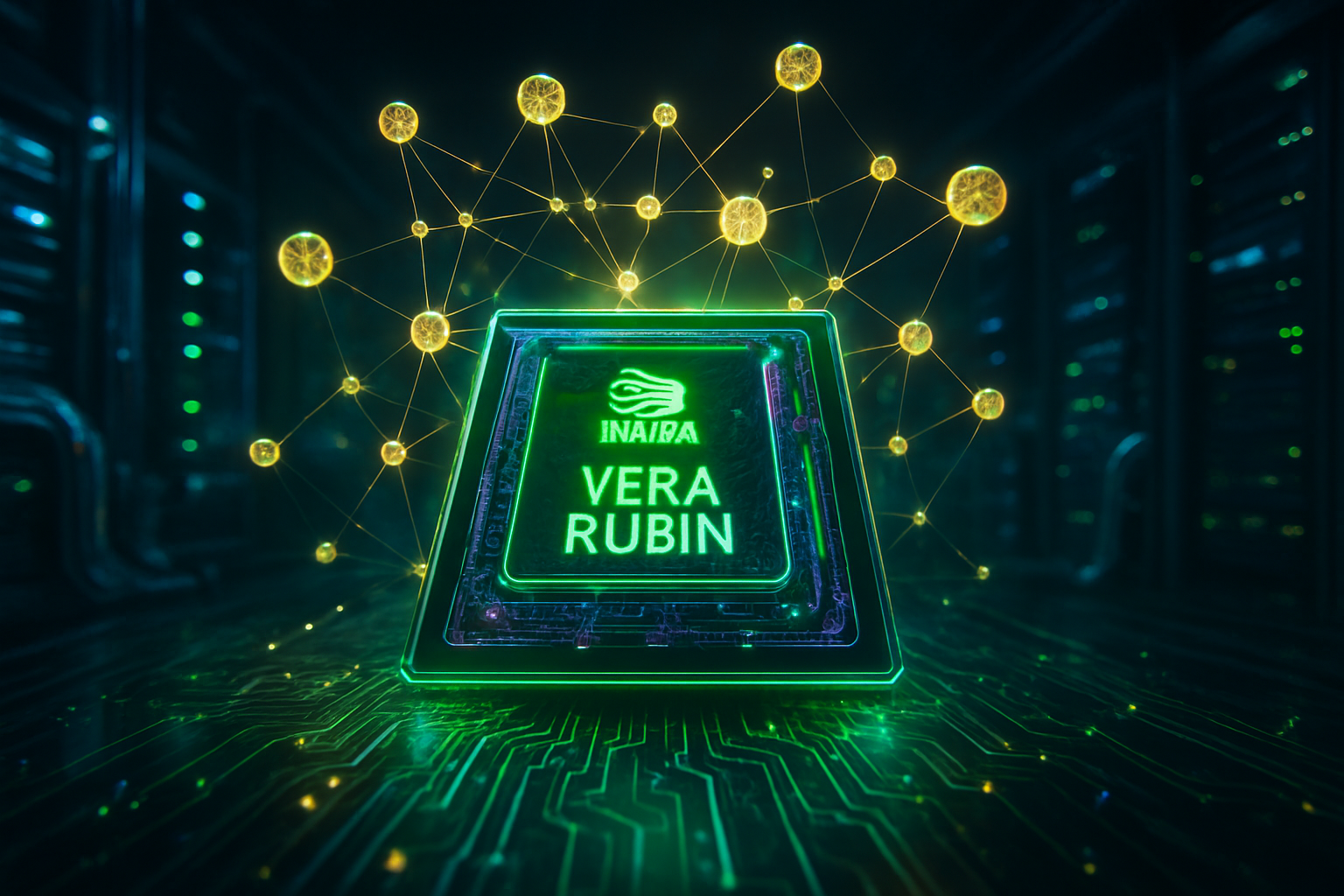
    In a landmark presentation at CES 2026 that has sent shockwaves through the global technology sector, NVIDIA (NASDAQ: NVDA) CEO Jensen Huang officially unveiled the "Vera Rubin" architecture. Named after the pioneering astronomer who provided the first evidence for dark matter, the Rubin platform represents more than just an incremental upgrade; it is a fundamental reconfiguration of the AI data center designed to power the next generation of autonomous "agentic" AI and trillion-parameter models.

    The announcement, delivered to a capacity crowd in Las Vegas, signals a definitive end to the traditional two-year silicon cycle. By committing to a yearly release cadence, NVIDIA is forcing a relentless pace of innovation that threatens to leave competitors scrambling. With a staggering 5x increase in raw performance over the previous Blackwell generation and a 10x reduction in inference costs, the Rubin architecture aims to make advanced artificial intelligence not just more capable, but economically ubiquitous across every major industry.

    Technical Mastery: 336 Billion Transistors and the Dawn of HBM4

    The Vera Rubin architecture is built on Taiwan Semiconductor Manufacturing Company’s (NYSE: TSM) cutting-edge 3nm process, allowing for an unprecedented 336 billion transistors on a single Rubin GPU—a 1.6x density increase over the Blackwell series. At its core, the platform introduces the Vera CPU, featuring 88 custom "Olympus" cores based on the Arm v9 architecture. This new CPU delivers three times the memory capacity of its predecessor, the Grace CPU, ensuring that data bottlenecks do not stifle the GPU’s massive computational potential.

    The most critical technical breakthrough, however, is the integration of HBM4 (High Bandwidth Memory 4). By partnering with the "HBM Troika" of SK Hynix, Samsung, and Micron (NASDAQ: MU), NVIDIA has outfitted each Rubin GPU with up to 288GB of HBM4, utilizing a 2048-bit interface. This nearly triples the memory bandwidth of early HBM3 devices, providing the massive throughput required for real-time reasoning in models with hundreds of billions of parameters. Furthermore, the new NVLink 6 interconnect offers 3.6 TB/s of bidirectional bandwidth, effectively doubling the scale-up capacity of previous systems and allowing thousands of GPUs to function as a single, cohesive supercomputer.

    Industry experts have expressed awe at the inference metrics released during the keynote. By leveraging a 3rd-Generation Transformer Engine and a specialized "Inference Context Memory Storage" platform, NVIDIA has achieved a 10x reduction in the cost per token. This optimization is specifically tuned for Mixture-of-Experts (MoE) models, which have become the industry standard for efficiency. Initial reactions from the AI research community suggest that Rubin will be the first architecture capable of running sophisticated, multi-step agentic reasoning without the prohibitive latency and cost barriers that have plagued the 2024-2025 era.

    A Competitive Chasm: Market Impact and Strategic Positioning

    The strategic implications for the "Magnificent Seven" and the broader tech ecosystem are profound. Major cloud service providers, including Microsoft (NASDAQ: MSFT), Alphabet (NASDAQ: GOOGL), and Amazon (NASDAQ: AMZN), have already announced plans to deploy Rubin-based "AI Factories" by the second half of 2026. For these giants, the 10x reduction in inference costs is a game-changer, potentially turning money-losing AI services into highly profitable core business units.

    For NVIDIA’s direct competitors, such as Advanced Micro Devices (NASDAQ: AMD) and Intel (NASDAQ: INTC), the move to a yearly release cycle creates an immense engineering and capital hurdle. While AMD’s MI series has made significant gains in memory capacity, NVIDIA’s "full-stack" approach—integrating custom CPUs, DPUs, and proprietary interconnects—solidifies its moat. Startups focused on specialized AI hardware may find it increasingly difficult to compete with a moving target that refreshes every twelve months, likely leading to a wave of consolidation in the AI chip space.

    Furthermore, server manufacturers like Dell Technologies (NYSE: DELL) and Super Micro Computer (NASDAQ: SMCI) are already pivoting to accommodate the Rubin architecture's requirements. The sheer power density of the Vera Rubin NVL72 racks means that liquid cooling is no longer an exotic option but an absolute enterprise standard. This shift is creating a secondary boom for industrial cooling and data center infrastructure companies as the world races to retrofit legacy facilities for the Rubin era.

    Beyond the Silicon: The Broader AI Landscape

    The unveiling of Vera Rubin marks a pivot from "Chatbot AI" to "Physical and Agentic AI." The architecture’s focus on power efficiency and long-context reasoning addresses the primary criticisms of the 2024 AI boom: energy consumption and "hallucination" in complex tasks. By providing dedicated hardware for "inference context," NVIDIA is enabling AI agents to maintain memory over long-duration tasks, a prerequisite for autonomous research assistants, complex coding agents, and advanced robotics.

    However, the rapid-fire release cycle raises significant concerns regarding the environmental footprint of the AI industry. Despite a 4x improvement in training efficiency for MoE models, the sheer volume of Rubin chips expected to hit the market in late 2026 will put unprecedented strain on global power grids. NVIDIA’s focus on "performance per watt" is a necessary defense against mounting regulatory scrutiny, yet the aggregate energy demand of the "AI Industrial Revolution" remains a contentious topic among climate advocates and policymakers.

    Comparing this milestone to previous breakthroughs, Vera Rubin feels less like the transition from the A100 to the H100 and more like the move from mainframe computers to distributed networking. It is the architectural realization of "AI as a Utility." By lowering the barrier to entry for high-end inference, NVIDIA is effectively democratizing the ability to run trillion-parameter models, potentially shifting the center of gravity from a few elite AI labs to a broader range of enterprise and mid-market players.

    The Road to 2027: Future Developments and Challenges

    Looking ahead, the shift to a yearly cadence means that the "Rubin Ultra" is likely already being finalized for a 2027 release. Experts predict that the next phase of development will focus even more heavily on "on-device" integration and the "edge," bringing Rubin-class reasoning to local workstations and autonomous vehicles. The integration of BlueField-4 DPUs in the Rubin platform suggests that NVIDIA is preparing for a world where the network itself is as intelligent as the compute nodes it connects.

    The primary challenges remaining are geopolitical and logistical. The reliance on TSMC’s 3nm nodes and the "HBM Troika" leaves NVIDIA vulnerable to supply chain disruptions and shifting trade policies. Moreover, as the complexity of these systems grows, the software stack—specifically CUDA and the new NIM (NVIDIA Inference Microservices)—must evolve to ensure that developers can actually harness the 5x performance gains without a corresponding 5x increase in development complexity.

    Closing the Chapter on the Old Guard

    The unveiling of the Vera Rubin architecture at CES 2026 will likely be remembered as the moment NVIDIA consolidated its status not just as a chipmaker, but as the primary architect of the world’s digital infrastructure. The metrics—5x performance, 10x cost reduction—are spectacular, but the true significance lies in the acceleration of the innovation cycle itself.

    As we move into the second half of 2026, the industry will be watching for the first volume shipments of Rubin GPUs. The question is no longer whether AI can scale, but how quickly society can adapt to the sudden surplus of cheap, high-performance intelligence. NVIDIA has set the pace; now, the rest of the world must figure out how to keep up.


    This content is intended for informational purposes only and represents analysis of current AI developments.

    TokenRing AI delivers enterprise-grade solutions for multi-agent AI workflow orchestration, AI-powered development tools, and seamless remote collaboration platforms.
    For more information, visit https://www.tokenring.ai/.

  • OpenAI Breaks Tradition: ChatGPT to Integrate Advertisements in Bold Revenue Pivot

    OpenAI Breaks Tradition: ChatGPT to Integrate Advertisements in Bold Revenue Pivot

    In a move that marks the end of the "ad-free" era for generative artificial intelligence, OpenAI officially announced on January 16, 2026, that it will begin integrating advertisements directly into ChatGPT responses. The decision, aimed at addressing the astronomical operational costs of maintaining its most advanced models, signals a fundamental shift in how the industry leader plans to monetize the hundreds of millions of users who rely on its platform daily.

    The rollout begins immediately for logged-in adult users in the United States, primarily within the free tier and a newly launched mid-range subscription. This strategic pivot highlights the increasing pressure on AI labs to transition from research-heavy "burn" phases to sustainable, high-growth revenue engines capable of satisfying investors and funding the next generation of "Frontier" models.

    The Engineering of Intent: How ChatGPT Ads Work

    Unlike the traditional banner ads or pre-roll videos that defined the early internet, OpenAI is debuting what it calls "Intent-Based Monetization." This technical framework does not rely on simple keywords; instead, it uses the deep contextual understanding of GPT-5.2 to surface sponsored content only when a user’s query indicates a specific commercial need. For example, a user asking for advice on "treating dry skin in winter" might see a response followed by a clearly labeled "Sponsored Recommendation" for a specific moisturizer brand.

    Technically, OpenAI has implemented a strict separation between the Large Language Model’s (LLM) generative output and the ad-serving layer. Company engineers state that the AI generates its primary response first, ensuring that the "core intelligence" remains unbiased by commercial interests. Once the response is generated, a secondary "Ad-Selector" model analyzes the text and the user’s intent to append relevant modules. These modules include "Bottom-of-Answer Boxes," which appear as distinct cards below the text, and "Sponsored Citations" within the ChatGPT Search interface, where a partner’s link may be prioritized as a verified source.

    To facilitate this, OpenAI has secured inaugural partnerships with retail giants like Walmart (NYSE: WMT) and Shopify (NYSE: SHOP), allowing for "Instant Checkout" features where users can purchase products mentioned in the chat without leaving the interface. This differs significantly from previous approaches like Google’s (NASDAQ: GOOGL) traditional Search ads, as it attempts to shorten the distance between a conversational epiphany and a commercial transaction. Initial reactions from the AI research community have been cautious, with some praising the technical transparency of the ad-boxes while others worry about the potential for "subtle steering," where the model might subconsciously favor topics that are more easily monetized.

    A High-Stakes Battle for the Future of Search

    The integration of ads is a direct challenge to the incumbents of the digital advertising world. Alphabet Inc. (NASDAQ: GOOGL), which has dominated search advertising for decades, has already begun defensive maneuvers by integrating AI Overviews and ads into its Gemini chatbot. However, OpenAI’s move to capture "intent" at the moment of reasoning could disrupt the traditional "blue link" economy. By providing a direct answer followed by a curated product, OpenAI is betting that users will prefer a streamlined experience over the traditional search-and-click journey.

    This development also places significant pressure on Microsoft (NASDAQ: MSFT), OpenAI’s primary partner. While Microsoft has already integrated ads into its Copilot service via the Bing network, OpenAI’s independent ad platform suggests a desire for greater autonomy and a larger slice of the multi-billion dollar search market. Meanwhile, startups like Perplexity AI, which pioneered "Sponsored Follow-up Questions" late in 2024, now find themselves competing with a titan that possesses a much larger user base and deeper technical integration with consumer hardware.

    Market analysts suggest that the real winners in this shift may be the advertisers themselves, who are desperate for new channels as traditional social media engagement plateaus. Meta Platforms (NASDAQ: META), which has relied heavily on Instagram and Facebook for ad revenue, is also reportedly accelerating its own AI-driven ad formats to keep pace. The competitive landscape is no longer just about who has the "smartest" AI, but who can most effectively turn that intelligence into a profitable marketplace.

    The End of the "Clean" AI Era

    The broader significance of this move cannot be overstated. For years, ChatGPT was viewed as a "clean" interface—a stark contrast to the cluttered, ad-heavy experience of the modern web. The introduction of ads marks a "loss of innocence" for the AI landscape, bringing it in line with the historical trajectory of Google, Facebook, and even early radio and television. It confirms the industry consensus that "intelligence" is simply too expensive to be provided for free without a commercial trade-off.

    However, this transition brings significant concerns regarding bias and the "AI Hallucination" of commercial preferences. While OpenAI maintains that ads do not influence the LLM’s output, critics argue that the pressure to generate revenue could eventually lead to "optimization for clicks" rather than "optimization for truth." This mirrors the early 2000s debates over whether Google’s search results were being skewed by its advertising business—a debate that continues to this day.

    Furthermore, the introduction of the "ChatGPT Go" tier at $8/month—which offers higher capacity but still includes ads—creates a new hierarchy of intelligence. In this new landscape, "Ad-Free Intelligence" is becoming a luxury good, reserved for those willing to pay $20 a month or more for Plus and Pro plans. This has sparked a debate about the "digital divide," where the most objective, unbiased AI might only be accessible to the wealthy, while the general public interacts with a version of "truth" that is partially subsidized by corporate interests.

    Looking Ahead: The Multimodal Ad Frontier

    In the near term, experts predict that OpenAI will expand these ad formats into its multimodal features. We may soon see "Sponsored Visuals" in DALL-E 3 generations or "Audio Placements" in the ChatGPT Advanced Voice Mode, where the AI might suggest a nearby coffee shop or a specific brand of headphones during a natural conversation. The company’s planned 60-second Super Bowl LX advertisement in February 2026 is expected to focus heavily on "ChatGPT as a Personal Shopping Assistant," framing the ad integration as a helpful feature rather than a necessary evil.

    The ultimate challenge for OpenAI will be maintaining the delicate balance between user experience and revenue generation. If the ads become too intrusive or begin to degrade the quality of the AI's reasoning, the company risks a mass exodus to open-source models or emerging competitors that promise an ad-free experience. However, if they succeed, they will have solved the "trillion-dollar problem" of AI: how to provide world-class intelligence at a scale that is financially sustainable for the long haul.

    A Pivotal Moment in AI History

    OpenAI’s decision to monetize ChatGPT through ads is a watershed moment that will likely define the "Second Act" of the AI revolution. It represents the transition from a period of awe-inspiring discovery to one of cold, hard commercial reality. Key takeaways from this announcement include the launch of the "intent-based" ad model, the introduction of the $8 "Go" tier, and a clear signal that the company is targeting a massive $125 billion revenue goal by 2029.

    As we look toward the coming weeks, the industry will be watching the US market's adoption rates and the performance of the "Instant Checkout" partnerships. This move is more than just a business update; it is an experiment in whether a machine can be both a trusted advisor and a high-efficiency salesperson. The success or failure of this integration will determine the business model for the entire AI industry for the next decade.


    This content is intended for informational purposes only and represents analysis of current AI developments.

    TokenRing AI delivers enterprise-grade solutions for multi-agent AI workflow orchestration, AI-powered development tools, and seamless remote collaboration platforms.
    For more information, visit https://www.tokenring.ai/.
  • From Months to Minutes: Anthropic’s Claude Code Stuns Industry by Matching Year-Long Google Project in One Hour

    From Months to Minutes: Anthropic’s Claude Code Stuns Industry by Matching Year-Long Google Project in One Hour

    In the first weeks of 2026, the software engineering landscape has been rocked by a viral demonstration of artificial intelligence that many are calling a "Sputnik moment" for the coding profession. The event centered on Anthropic’s recently updated Claude Code—a terminal-native AI agent—which managed to architect a complex distributed system in just sixty minutes. Remarkably, the same project had previously occupied a senior engineering team at Alphabet Inc. (NASDAQ: GOOGL) for an entire calendar year, highlighting a staggering shift in the velocity of technological development.

    The revelation came from Jaana Dogan, a Principal Engineer at Google, who documented the experiment on social media. After providing Claude Code with a high-level three-paragraph description of a "distributed agent orchestrator," the AI produced a functional architectural prototype that mirrored the core design patterns her team had spent 2024 and 2025 validating. This event has instantly reframed the conversation around AI in the workplace, moving from "assistants that help write functions" to "agents that can replace months of architectural deliberation."

    The technical prowess behind this feat is rooted in Anthropic’s latest flagship model, Claude 4.5 Opus. Released in late 2025, the model became the first to break the 80% barrier on the SWE-bench Verified benchmark, a rigorous test of an AI’s ability to resolve real-world software issues. Unlike traditional IDE plugins that offer autocomplete suggestions, Claude Code is a terminal-native agent with "computer use" capabilities. This allows it to interact directly with the file system, execute shell commands, run test suites, and self-correct based on compiler errors without human intervention.

    Key to this advancement is the implementation of the Model Context Protocol (MCP) and a new feature known as SKILL.md. While previous iterations of AI coding tools struggled with project-specific conventions, Claude Code can now "ingest" a company's entire workflow logic from a single markdown file, allowing it to adhere to complex architectural standards instantly. Furthermore, the tool utilizes a sub-agent orchestration layer, where a "Lead Agent" spawns specialized "Worker Agents" to handle parallel tasks like unit testing or documentation, effectively simulating a full engineering pod within a single terminal session.

    The implications for the "Big Tech" status quo are profound. For years, companies like Microsoft Corp. (NASDAQ: MSFT) have dominated the space with GitHub Copilot, but the viral success of Claude Code has forced a strategic pivot. While Microsoft has integrated Claude 4.5 into its Copilot Workspace, the industry is seeing a clear divergence between "Integrated Development Environment (IDE)" tools and "Terminal Agents." Anthropic’s terminal-first approach is perceived as more powerful for senior architects who need to execute large-scale refactors across hundreds of files simultaneously.

    Google’s response has been the rapid deployment of Google Antigravity, an agent-first development environment powered by their Gemini 3 model. Antigravity attempts to counter Anthropic by offering a "Mission Control" view that allows human managers to oversee dozens of AI agents at once. However, the "one hour vs. one year" story suggests that the competitive advantage is shifting toward companies that can minimize the "bureaucracy trap." As AI agents begin to bypass the need for endless alignment meetings and design docs, the organizational structures of traditional tech giants may find themselves at a disadvantage compared to lean, AI-native startups.

    Beyond the corporate rivalry, this event signals the rise of what the community is calling "Vibe Coding." This paradigm shift suggests that the primary skill of a software engineer is moving from implementation (writing the code) to articulation (defining the architectural "vibe" and constraints). When an AI can collapse a year of human architectural debate into an hour of computation, the bottleneck of progress is no longer how fast we can build, but how clearly we can think.

    However, this breakthrough is not without its critics. AI researchers have raised concerns regarding the "Context Chasm"—a future where no single human fully understands the sprawling, AI-generated codebases they are tasked with maintaining. There are also significant security questions; giving an AI agent full terminal access and the ability to execute code locally creates a massive attack surface. Comparing this to previous milestones like the release of GPT-4 in 2023, the current era of "Agentic Coding" feels less like a tool and more like a workforce expansion, bringing both unprecedented productivity and existential risks to the engineering career path.

    In the near term, we expect to see "Self-Healing Code" become a standard feature in enterprise CI/CD pipelines. Instead of a build failing and waiting for a human to wake up, agents like Claude Code will likely be tasked with diagnosing the failure, writing a fix, and re-running the tests before the human developer even arrives at their desk. We may also see the emergence of "Legacy Bridge Agents" designed specifically to migrate decades-old COBOL or Java systems to modern architectures in a fraction of the time currently required.

    The challenge ahead lies in verification and trust. As these systems become more autonomous, the industry will need to develop new frameworks for "Agentic Governance." Experts predict that the next major breakthrough will involve Multi-Modal Verification, where an AI agent not only writes the code but also generates a video walkthrough of its logic and a formal mathematical proof of its security. The race is now on to build the platforms that will host these autonomous developers.

    The "one hour vs. one year" viral event will likely be remembered as a pivotal moment in the history of artificial intelligence. It serves as a stark reminder that the traditional metrics of human productivity—years of experience, months of planning, and weeks of coding—are being fundamentally rewritten by agentic systems. Claude Code has demonstrated that the "bureaucracy trap" of modern corporate engineering can be bypassed, potentially unlocking a level of innovation that was previously unimaginable.

    As we move through 2026, the tech world will be watching closely to see if this level of performance can be sustained across even more complex, mission-critical systems. For now, the message is clear: the era of the "AI Assistant" is over, and the era of the "AI Engineer" has officially begun. Developers should look toward mastering articulation and orchestration, as the ability to "steer" these powerful agents becomes the most valuable skill in the industry.


    This content is intended for informational purposes only and represents analysis of current AI developments.

    TokenRing AI delivers enterprise-grade solutions for multi-agent AI workflow orchestration, AI-powered development tools, and seamless remote collaboration platforms.
    For more information, visit https://www.tokenring.ai/.