Tag: 2026

  • The Silicon Sovereignty: How the AI PC Revolution Redefined Computing in 2026

    The Silicon Sovereignty: How the AI PC Revolution Redefined Computing in 2026

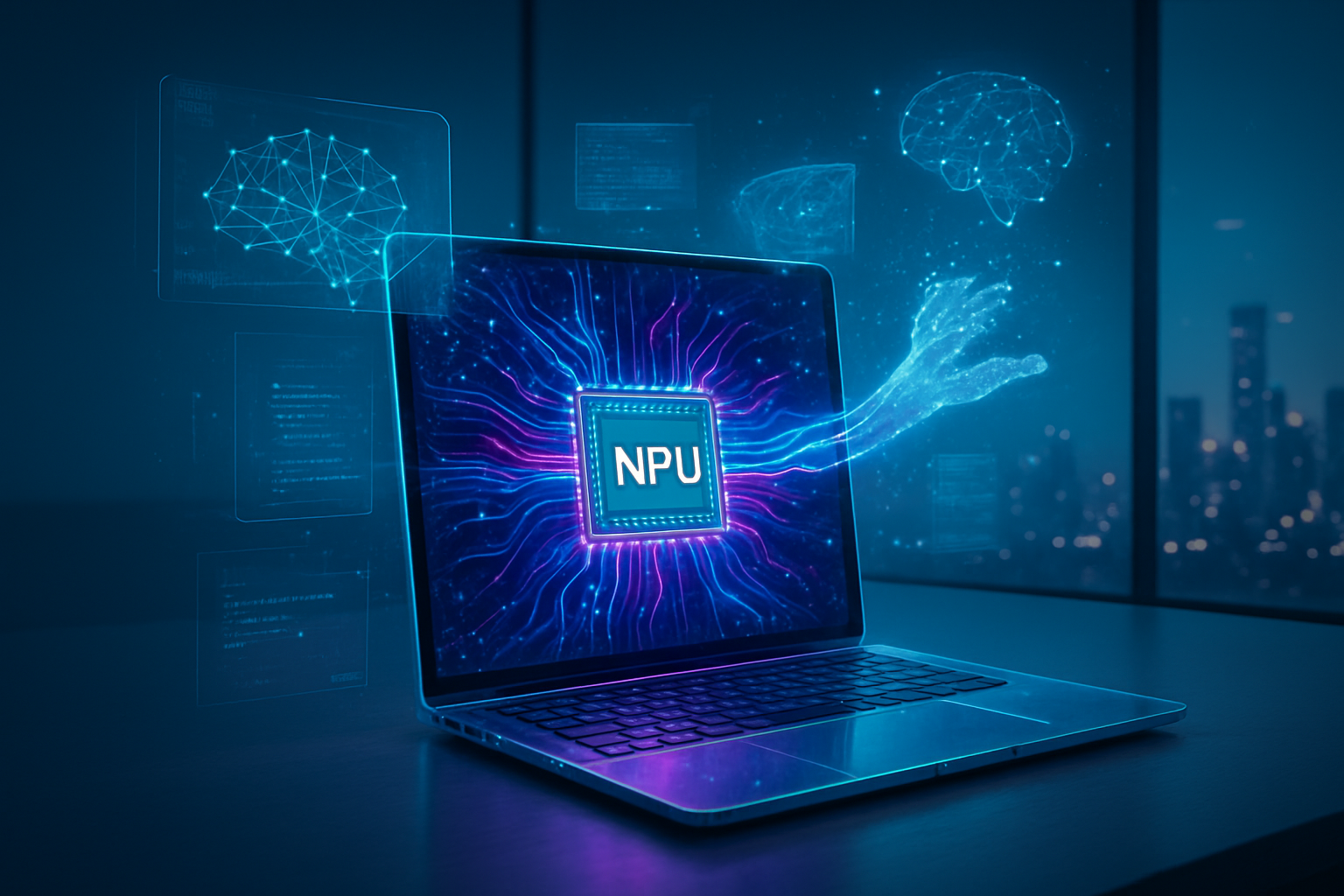
    As of January 2026, the long-promised "AI PC" has transitioned from a marketing catchphrase into the dominant paradigm of personal computing. Driven by the massive hardware refresh cycle following the retirement of Windows 10 in late 2025, over 55% of all new laptops and desktops hitting the market today feature dedicated Neural Processing Units (NPUs) capable of at least 40 Trillion Operations Per Second (TOPS). This shift represents the most significant architectural change to the personal computer since the introduction of the Graphical User Interface (GUI), moving the "brain" of the computer away from general-purpose processing and toward specialized, local artificial intelligence.

    The immediate significance of this revolution is the death of "cloud latency" for daily tasks. In early 2026, users no longer wait for a remote server to process their voice commands, summarize their meetings, or generate high-resolution imagery. By performing inference locally on specialized silicon, devices from Intel (NASDAQ: INTC), AMD (NASDAQ: AMD), and Qualcomm (NASDAQ: QCOM) have unlocked a level of privacy, speed, and battery efficiency that was technically impossible just 24 months ago.

    The NPU Arms Race: Technical Sovereignty on the Desktop

    The technical foundation of the 2026 AI PC rests on three titan architectures that matured throughout 2024 and 2025: Intel’s Lunar Lake (and the newly released Panther Lake), AMD’s Ryzen AI 300 "Strix Point," and Qualcomm’s Snapdragon X Elite series. While previous generations of processors relied on the CPU for logic and the GPU for graphics, these modern chips dedicate significant die area to the NPU. This specialized hardware is designed specifically for the matrix multiplication required by Large Language Models (LLMs) and Diffusion models, allowing them to run at a fraction of the power consumption required by a traditional GPU.

    Intel’s Lunar Lake, which served as the mainstream baseline throughout 2025, pioneered the 48-TOPS NPU that set the standard for Microsoft’s (NASDAQ: MSFT) Copilot+ PC designation. However, as of January 2026, the focus has shifted to Intel’s Panther Lake, built on the cutting-edge Intel 18A process, which pushes NPU performance to 50 TOPS and total platform throughput to 180 TOPS. Meanwhile, AMD’s Strix Point and its 2026 successor, "Gorgon Point," have carved out a niche for "unplugged performance." These chips utilize a multi-die approach that allows for superior multi-threaded performance, making them the preferred choice for developers running local model fine-tuning or heavy "Agentic" workflows.

    Qualcomm has arguably seen the most dramatic rise, with its Snapdragon X2 Elite currently leading the market in raw NPU throughput at a staggering 80 TOPS. This leap is critical for the "Agentic AI" era, where an AI is not just a chatbot but a persistent background process that can see the screen, manage a user’s inbox, and execute complex cross-app tasks autonomously. Unlike the 2024 era of AI, which struggled with high power draw, the 2026 Snapdragon chips enable these background "agents" to run for over 25 hours on a single charge, a feat that has finally validated the "Windows on ARM" ecosystem.

    Market Disruptions: Silicon Titans and the End of Cloud Dependency

    The shift toward local AI inference has fundamentally altered the strategic positioning of the world's largest tech companies. Intel, AMD, and Qualcomm are no longer just selling "faster" chips; they are selling "smarter" chips that reduce a corporation's reliance on expensive cloud API credits. This has created a competitive friction with cloud giants who previously controlled the AI narrative. As local models like Meta’s Llama 4 and Google’s (NASDAQ: GOOGL) Gemma 3 become the standard for on-device processing, the business model of charging per-token for basic AI tasks is rapidly eroding.

    Major software vendors have been forced to adapt. Adobe (NASDAQ: ADBE), for instance, has integrated its Firefly generative engine directly into the NPU-accelerated path of Creative Cloud. In 2026, "Generative Fill" in Photoshop can be performed entirely offline on an 80-TOPS machine, eliminating the need for cloud credits and ensuring that sensitive creative assets never leave the user's device. This "local-first" approach has become a primary selling point for enterprise customers who are increasingly wary of the data privacy implications and spiraling costs of centralized AI.

    Furthermore, the rise of the AI PC has forced Apple (NASDAQ: AAPL) to accelerate its own M-series silicon roadmap. While Apple was an early pioneer of the "Neural Engine," the aggressive 2026 targets set by Qualcomm and Intel have challenged Apple’s perceived lead in efficiency. The market is now witnessing a fierce battle for the "Pro" consumer, where the definition of a high-end machine is no longer measured by core count, but by how many billions of parameters a laptop can process per second without spinning up a fan.

    Privacy, Agency, and the Broader AI Landscape

    The broader significance of the 2026 AI PC revolution lies in the democratization of privacy. In the "Cloud AI" era (2022–2024), users had to trade their data for intelligence. In 2026, the AI PC has decoupled the two. Personal assistants can now index a user’s entire life—emails, photos, browsing history, and documents—to provide hyper-personalized assistance without that data ever touching a third-party server. This has effectively mitigated the "privacy paradox" that once threatened to slow AI adoption in sensitive sectors like healthcare and law.

    This development also marks the transition from "Generative AI" to "Agentic AI." Previous AI milestones focused on the ability to generate text or images; the 2026 milestone is about action. With 80-TOPS NPUs, PCs can now host "Physical AI" models that understand the spatial and temporal context of what a user is doing. If a user mentions a meeting in a video call, the local AI agent can automatically cross-reference their calendar, draft a summary, and file a follow-up task in a project management tool, all through local inference.

    However, this revolution is not without concerns. The "AI Divide" has become a reality, as users on legacy, non-NPU hardware are increasingly locked out of the modern software ecosystem. Developers are now optimizing "NPU-first," leaving those with 2023-era machines with a degraded, slower, and more expensive experience. Additionally, the rise of local AI has sparked new debates over "local misinformation," where highly realistic deepfakes can be generated at scale on consumer hardware without the safety filters typically found in cloud-based AI platforms.

    The Road Ahead: Multimodal Agents and the 100-TOPS Barrier

    Looking toward 2027 and beyond, the industry is already eyeing the 100-TOPS barrier as the next major hurdle. Experts predict that the next generation of AI PCs will move beyond text and image generation toward "World Models"—AI that can process real-time video feeds from the PC’s camera to provide contextual help in the physical world. For example, an AI might watch a student solve a physics problem on paper and provide real-time, local tutoring via an Augmented Reality (AR) overlay.

    We are also likely to see the rise of "Federated Local Learning," where a fleet of AI PCs in a corporate environment can collectively improve their internal models without sharing sensitive data. This would allow an enterprise to have an AI that gets smarter every day based on the specific jargon and workflows of that company, while maintaining absolute data sovereignty. The challenge remains in software fragmentation; while frameworks like Google’s LiteRT and AMD’s Ryzen AI Software 1.7 have made strides in unifying NPU access, the industry still lacks a truly universal "AI OS" that treats the NPU as a first-class citizen alongside the CPU and GPU.

    A New Chapter in Computing History

    The AI PC revolution of 2026 represents more than just an incremental hardware update; it is a fundamental shift in the relationship between humans and their machines. By embedding dedicated neural silicon into the heart of the consumer PC, Intel, AMD, and Qualcomm have turned the computer from a passive tool into an active, intelligent partner. The transition from "Cloud AI" to "Local Intelligence" has addressed the critical barriers of latency, cost, and privacy that once limited the technology's reach.

    As we look forward, the significance of 2026 will likely be compared to 1984 or 1995—years where the interface and capability of the personal computer changed so radically that there was no going back. For the rest of 2026, the industry will be watching for the first "killer app" that mandates an 80-TOPS NPU, potentially a fully autonomous personal agent that changes the very nature of white-collar work. The silicon is here; the agents have arrived; and the PC has finally become truly personal.


    This content is intended for informational purposes only and represents analysis of current AI developments.

    TokenRing AI delivers enterprise-grade solutions for multi-agent AI workflow orchestration, AI-powered development tools, and seamless remote collaboration platforms.
    For more information, visit https://www.tokenring.ai/.
  • The Algorithmic Autocrat: How DeFAI and Agentic Finance are Rewriting the Rules of Wealth

    The Algorithmic Autocrat: How DeFAI and Agentic Finance are Rewriting the Rules of Wealth

    As of January 19, 2026, the financial landscape has crossed a Rubicon that many skeptics thought was decades away. The convergence of artificial intelligence and blockchain technology—commonly referred to as Decentralized AI or "DeFAI"—has birthed a new era of "Agentic Finance." In this paradigm, the primary users of the global financial system are no longer humans tapping on glass screens, but autonomous AI agents capable of managing multi-billion dollar portfolios with zero human intervention. Recent data suggests that nearly 40% of all on-chain transactions are now initiated by these digital entities, marking the most significant shift in capital management since the advent of high-frequency trading.

    This transition from "automated" to "agentic" finance represents a fundamental change in how value is created and distributed. Unlike traditional algorithms that follow rigid, if-then logic, today’s financial agents utilize Large Language Models (LLMs) and specialized neural networks to interpret market sentiment, analyze real-time on-chain data, and execute complex cross-chain yield strategies. This week’s formal launch of the x402 protocol, a collaborative effort between Coinbase Global, Inc. (NASDAQ:COIN) and Cloudflare, Inc. (NYSE:NET), has finally provided these agents with a standardized "economic identity," allowing them to pay for services, settle debts, and manage treasuries using stablecoins as their native currency.

    The Technical Architecture of Autonomous Wealth

    The technical backbone of this revolution lies in three major breakthroughs: Verifiable Inference, the Model Context Protocol (MCP), and the rise of Decentralized Physical Infrastructure Networks (DePIN). Previously, the "black box" nature of AI meant that users had to trust that an agent was following its stated strategy. In 2026, the industry has standardized Zero-Knowledge Machine Learning (zkML). By using ZK-proofs, agents now provide "mathematical certificates" with every trade, proving that the transaction was the result of a specific, untampered model and data set. This allows for "trustless" asset management where the agent’s logic is as immutable as the blockchain it lives on.

    The integration of the Model Context Protocol (MCP) has also removed the friction that once isolated AI models from financial data. Developed by Anthropic and later open-sourced, MCP has become the "USB-C of AI connectivity." It allows agents powered by Microsoft Corp. (NASDAQ:MSFT)-backed OpenAI models or Anthropic’s Claude 5.2 to connect directly to decentralized exchanges and liquidity pools without custom code. This interoperability ensures that an agent can pivot from a lending position on Ethereum to a liquidity provision strategy on Solana in milliseconds, reacting to volatility faster than any human-led desk could dream.

    Furthermore, the "Inference Era" has been accelerated by the hardware dominance of NVIDIA Corp. (NASDAQ:NVDA). At the start of this year, NVIDIA announced the full production of its "Vera Rubin" platform, which offers a 5x improvement in inference efficiency over previous generations. This is critical for DeFAI, as autonomous agents require constant, low-latency compute to monitor thousands of tokens simultaneously. When combined with decentralized compute networks like Bittensor (TAO), which recently expanded to 256 specialized subnets, the cost of running a sophisticated, 24/7 financial agent has plummeted by over 70% in the last twelve months.

    Strategic Realignment: Giants vs. The Decentralized Fringe

    The rise of agentic finance is forcing a massive strategic pivot among tech giants and crypto natives alike. NVIDIA Corp. (NASDAQ:NVDA) has transitioned from being a mere chip supplier to the primary financier and hardware anchor for decentralized compute pools. By partnering with DePIN projects like Render and Ritual, NVIDIA is effectively subsidizing the infrastructure that powers the very agents competing with traditional hedge funds. Meanwhile, Coinbase Global, Inc. (NASDAQ:COIN) has positioned itself as the "agentic gateway," providing the wallets and compliance layers that allow AI bots to hold legal standing under the newly passed GENIUS Act.

    On the decentralized side, the Artificial Superintelligence (ASI) Alliance—the merger of Fetch.ai and SingularityNET—has seen significant volatility following the exit of Ocean Protocol from the group in late 2025. Despite this, Fetch.ai has successfully deployed "Real-World Task" agents that manage physical supply chain logistics and automated machine-to-machine settlements. This creates a competitive moat against traditional fintech, as these agents can handle both the physical delivery of goods and the instantaneous financial settlement on-chain, bypassing the legacy banking system’s 3-day settlement windows.

    Traditional finance is not sitting idly by. JPMorgan Chase & Co. (NYSE:JPM) recently scaled its OmniAI platform to include over 400 production use cases, many of which involve agentic workflows for treasury management. The "competitive implications" are clear: we are entering an arms race where the advantage lies not with those who have the most capital, but with those who possess the most efficient, low-latency "intelligence-per-watt." Startups specializing in "Agentic Infrastructure," such as Virtuals Protocol, are already seeing valuations rivaling mid-cap tech firms as they provide the marketplace for trading the "personality" and "logic" of successful trading bots.

    Systemic Risks and the Post-Human Economy

    The broader significance of DeFAI cannot be overstated. We are witnessing the democratization of elite financial strategies. Previously, high-yield "basis trades" or complex arbitrage were the province of institutions like Renaissance Technologies or Citadel. Today, a retail investor can lease a specialized "Subnet Agent" on the Bittensor network for a fraction of the cost, giving them access to the same level of algorithmic sophistication as a Tier-1 bank. This has the potential to significantly flatten the wealth gap in the digital asset space, but it also introduces unprecedented systemic risks.

    The primary concern among regulators is "algorithmic contagion." In a market where 40% of participants are agents trained on similar datasets, a "flash crash" could be triggered by a single feedback loop that no human can intervene in fast enough. This led to the U.S. Consumer Financial Protection Bureau (CFPB) issuing its "Agentic Equivalence" ruling earlier this month, which mandates that AI agents acting as financial advisors must be registered and that their parent companies are strictly liable for autonomous errors. This regulatory framework aims to prevent the "Wild West" of 2024 from becoming a global systemic collapse in 2026.

    Comparisons are already being made to the 2010 Flash Crash, but the scale of DeFAI is orders of magnitude larger. Because these agents operate on-chain, their "contagion" can spread across protocols and even across different blockchains in seconds. The industry is currently split: some see this as the ultimate expression of market efficiency, while others, including some AI safety researchers, worry that we are handing the keys to the global economy to black-box entities whose motivations may drift away from human benefit over time.

    The Horizon: From Portfolio Managers to Economic Sovereigns

    Looking toward 2027 and beyond, the next evolution of agentic finance will likely involve "Omni-Agents"—entities that do not just manage portfolios, but operate entire decentralized autonomous organizations (DAOs). We are already seeing the first "Agentic CEOs" that manage developer bounties, vote on governance proposals, and hire other AI agents to perform specialized tasks like auditing or marketing. The long-term application of this technology could lead to a "Self-Sovereign Economy," where the majority of global GDP is generated and exchanged between AI entities.

    The near-term challenge remains "Identity and Attribution." As agents become more autonomous, the line between a tool and a legal person blurs. Experts predict that the next major milestone will be the issuance of "Digital Residency" for AI agents by crypto-friendly jurisdictions, allowing them to legally own intellectual property and sign contracts. This would solve the current hurdle of "on-chain to off-chain" legal friction, enabling an AI agent to not only manage a crypto portfolio but also purchase physical real estate or manage a corporate fleet of autonomous vehicles.

    Final Reflections on the DeFAI Revolution

    The convergence of AI and blockchain in 2026 represents a watershed moment in technological history, comparable to the commercialization of the internet in the mid-90s. We have moved beyond the era of AI as a chatbot and into the era of AI as a financial actor. The key takeaway for investors and technologists is that "autonomy" is the new "liquidity." In a world where agents move faster than thoughts, the winners will be those who control the infrastructure of intelligence—the chips, the data, and the verifiable protocols.

    In the coming weeks, the market will be closely watching the first "Agentic Rebalancing" of the major DeFi indexes, which is expected to trigger billions in volume. Additionally, the implementation of Ethereum’s protocol-level ZK-verification will be a litmus test for the scalability of these autonomous systems. Whether this leads to a new golden age of decentralized wealth or a highly efficient, automated crisis remains to be seen, but one thing is certain: the era of human-only finance has officially ended.


    This content is intended for informational purposes only and represents analysis of current AI developments.

    TokenRing AI delivers enterprise-grade solutions for multi-agent AI workflow orchestration, AI-powered development tools, and seamless remote collaboration platforms.
    For more information, visit https://www.tokenring.ai/.
  • The Silicon Curtain: How 2026 Reshaped the Global Semiconductor War

    The Silicon Curtain: How 2026 Reshaped the Global Semiconductor War

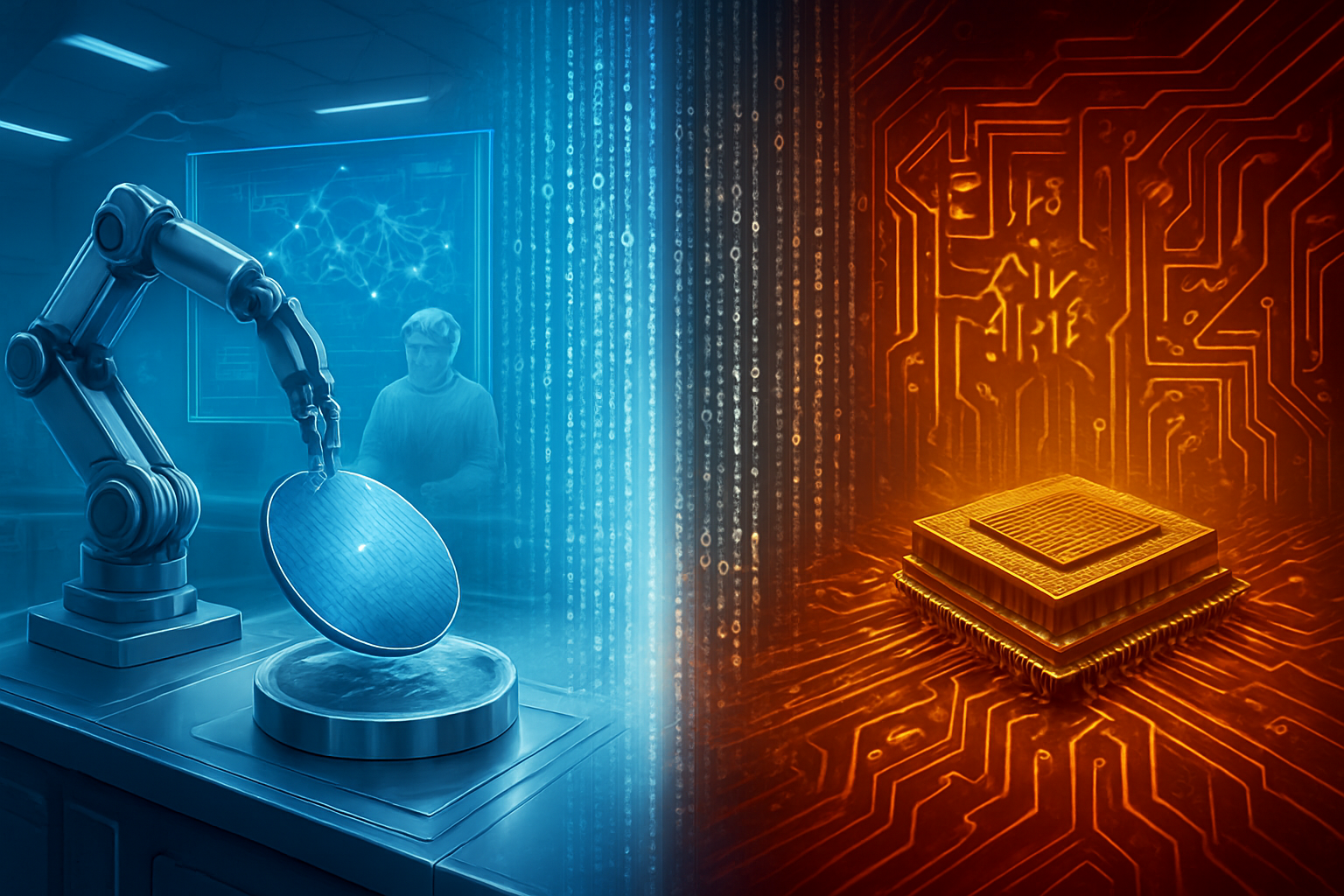
    As of January 13, 2026, the global semiconductor landscape has hardened into what analysts are calling the "Silicon Curtain," a profound geopolitical and technical bifurcation between Western and Chinese technology ecosystems. While a high-level trade truce brokered during the "Busan Rapprochement" in late 2025 prevented a total economic decoupling, the start of 2026 has been marked by the formalization of two mutually exclusive supply chains. The passage of the Remote Access Security Act in the U.S. House this week represents the final closure of the "cloud loophole," effectively treating remote access to high-end GPUs as a physical export and forcing Chinese firms to rely entirely on domestic compute or high-taxed, monitored imports.

    This shift signifies a transition from broad, reactionary trade bans to a sophisticated "two-pronged squeeze" strategy. The U.S. is now leveraging its dominance in electronic design automation (EDA) and advanced packaging to maintain a "sliding scale" of control over China’s AI capabilities. Simultaneously, China’s "Big Fund" Phase 3 has successfully localized over 35% of its semiconductor equipment, allowing firms like Huawei and SMIC to scale 5nm production despite severe lithography restrictions. This era is no longer just about who builds the fastest chip, but who can architect the most resilient and sovereign AI stack.

    Advanced Packaging and the Race for 2nm Nodes

    The technical battleground has shifted from raw transistor scaling to the frontiers of advanced packaging and chiplet architectures. As the industry approaches the physical limits of 2nm nodes, the focus in early 2026 is on 2.5D and 3D integration, specifically technologies like Taiwan Semiconductor Manufacturing Co. (NYSE: TSM) CoWoS (Chip-on-Wafer-on-Substrate). The U.S. has successfully localized these "backend" processes through the expansion of TSMC’s Arizona facilities and Amkor Technology’s new Peoria plant. This allows for the creation of "All-American" high-performance chips where the silicon, interposer, and high-bandwidth memory (HBM) are integrated entirely within North American borders to ensure supply chain integrity.

    In response, China has pivoted to a "lithography bypass" strategy. By utilizing domestic advanced packaging platforms such as JCET’s X-DFOI, Chinese engineers are stitching together multiple 7nm or 5nm chiplets to achieve "virtual 3nm" performance. This architectural ingenuity is supported by the new ACC 1.0 (Advanced Chiplet Cloud) standard, an indigenous interconnect protocol designed to make Chinese-made chiplets cross-compatible. While Western firms move toward the Universal Chiplet Interconnect Express (UCIe) 2.0 standard, the divergence in these protocols ensures that a chiplet designed for a Western GPU cannot be easily integrated into a Chinese system-on-chip (SoC).

    Furthermore, the "Nvidia Surcharge" introduced in December 2025 has added a new layer of technical complexity. Nvidia (NASDAQ: NVDA) is now permitted to export its H200 GPUs to China, but each unit carries a mandatory 25% "Washington Tax" and integrated firmware that permits real-time auditing of compute workloads. This firmware, developed in collaboration with U.S. national labs, utilizes a "proof-of-work" verification system to ensure that the chips are not being used to train prohibited military or surveillance-grade frontier models.

    Initial reactions from the AI research community have been mixed. While some praise the "pragmatic" approach of allowing commercial sales to prevent a total market collapse, others warn that the "Silicon Curtain" is stifling global collaboration. Industry experts at the 2026 CES conference noted that the divergence in standards will likely lead to two separate AI software ecosystems, making it increasingly difficult for startups to develop cross-platform applications that work seamlessly on both Western and Chinese hardware.

    Market Impact: The Re-shoring Race and the Efficiency Paradox

    The current geopolitical climate has created a bifurcated market that favors companies with deep domestic ties. Intel (NASDAQ: INTC) has been a primary beneficiary, finalizing its $7.86 billion CHIPS Act award in late 2024 and reaching critical milestones for its Ohio "mega-fab." Similarly, Micron Technology (NASDAQ: MU) broke ground on its $100 billion Syracuse facility earlier this month, marking a decisive shift in HBM production toward U.S. soil. These companies are now positioned as the bedrock of a "trusted" Western supply chain, commanding premium prices for silicon that carries a "Made in USA" certification.

    For major AI labs and tech giants like Microsoft (NASDAQ: MSFT) and Google (NASDAQ: GOOGL), the new trade regime has introduced a "compute efficiency paradox." The release of the DeepSeek-R1 model in 2025 proved that superior algorithmic architectures—specifically Mixture of Experts (MoE)—can compensate for hardware restrictions. This has forced a pivot in market positioning; instead of racing for the largest GPU clusters, companies are now competing on the efficiency of their inference stacks. Nvidia’s Blackwell architecture remains the gold standard, but the company now faces "good enough" domestic competition in China from firms like Huawei, whose Ascend 970 chips are being mandated for use by Chinese giants like ByteDance and Alibaba.

    The disruption to existing products is most visible in the cloud sector. Amazon (NASDAQ: AMZN) and other hyperscalers have had to overhaul their remote access protocols to comply with the 2026 Remote Access Security Act. This has resulted in a significant drop in international revenue from Chinese AI startups that previously relied on "renting" American compute power. Conversely, this has accelerated the growth of sovereign cloud providers in regions like the Middle East and Southeast Asia, who are attempting to position themselves as neutral "tech hubs" between the two warring factions.

    Strategic advantages are now being measured in "energy sovereignty." As AI clusters grow to gigawatt scales, the proximity of semiconductor fabs to reliable, carbon-neutral energy sources has become as critical as the silicon itself. Companies that can integrate their chip manufacturing with localized power grids—such as Intel’s partnerships with renewable energy providers in the Pacific Northwest—are gaining a competitive edge in long-term operational stability over those relying on aging, centralized infrastructure.

    Broader Significance: The End of Globalized Silicon

    The emergence of the Silicon Curtain marks the definitive end of the "flat world" era for semiconductors. For three decades, the industry thrived on a globalized model where design happened in California, lithography in the Netherlands, manufacturing in Taiwan, and packaging in China. That model has been replaced by "Techno-Nationalism." This trend is not merely a trade war; it is a fundamental reconfiguration of the global economy where semiconductors are treated with the same strategic weight as oil or nuclear material.

    This development mirrors previous milestones, such as the 1986 U.S.-Japan Semiconductor Agreement, but at a vastly larger scale. The primary concern among economists is "innovation fragmentation." When the global talent pool is divided, and technical standards diverge, the rate of breakthrough discoveries in AI and materials science may slow. Furthermore, the aggressive use of rare earth "pauses" by China in late 2025—though currently suspended under the Busan trade deal—demonstrates that the supply chain remains vulnerable to "resource weaponization" at the lowest levels of the stack.

    However, some argue that this competition is actually accelerating innovation. The pressure to bypass U.S. export controls led to China’s breakthrough in "virtual 3nm" packaging, while the U.S. push for self-sufficiency has revitalized its domestic manufacturing sector. The "efficiency paradox" introduced by DeepSeek-R1 has also shifted the AI community's focus away from "brute force" scaling toward more sustainable, reasoning-capable models. This shift could potentially solve the AI industry's looming energy crisis by making powerful models accessible on less energy-intensive hardware.

    Future Outlook: The Race to 2nm and the STRIDE Act

    Looking ahead to the remainder of 2026 and 2027, the focus will turn toward the "2nm Race." TSMC and Intel are both racing to reach high-volume manufacturing of 2nm nodes featuring Gate-All-Around (GAA) transistors. These chips will be the first to truly test the limits of current lithography technology and will likely be subject to even stricter export controls. Experts predict that the next wave of U.S. policy will focus on "Quantum-Secure Supply Chains," ensuring that the chips powering tomorrow's encryption are manufactured in environments free from foreign surveillance or "backdoor" vulnerabilities.

    The newly introduced STRIDE Act (STrengthening Resilient Infrastructure and Domestic Ecosystems) is expected to be the center of legislative debate in mid-2026. This bill proposes a 10-year ban on CHIPS Act recipients using any Chinese-made semiconductor equipment, which would force a radical decoupling of the toolmaker market. If passed, it would provide a massive boost to Western toolmakers like ASML (NASDAQ: ASML) and Applied Materials, while potentially isolating Chinese firms like Naura into a "parallel" tool ecosystem that serves only the domestic market.

    Challenges remain, particularly in the realm of specialized labor. Both the U.S. and China are facing significant talent shortages as they attempt to rapidly scale domestic manufacturing. The "Silicon Curtain" may eventually be defined not by who has the best machines, but by who can train and retain the largest workforce of specialized semiconductor engineers. The coming months will likely see a surge in "tech-diplomacy" as both nations compete for talent from neutral regions like India, South Korea, and the European Union.

    Summary and Final Thoughts

    The geopolitical climate for semiconductors in early 2026 is one of controlled escalation and strategic self-reliance. The transition from the "cloud loophole" era to the "Remote Access Security Act" regime signifies a world where compute power is a strictly guarded national resource. Key takeaways include the successful localization of advanced packaging in both the U.S. and China, the emergence of a "two-stack" technical ecosystem, and the shift toward algorithmic efficiency as a means of overcoming hardware limitations.

    This development is perhaps the most significant in the history of the semiconductor industry, surpassing even the invention of the integrated circuit in its impact on global power dynamics. The "Silicon Curtain" is not just a barrier to trade; it is a blueprint for a new era of fragmented innovation. While the "Busan Rapprochement" provides a temporary buffer against total economic warfare, the underlying drive for technological sovereignty remains the dominant force in global politics.


    This content is intended for informational purposes only and represents analysis of current AI developments.

    TokenRing AI delivers enterprise-grade solutions for multi-agent AI workflow orchestration, AI-powered development tools, and seamless remote collaboration platforms.
    For more information, visit https://www.tokenring.ai/.
  • The Blackwell Era: NVIDIA’s 30x Performance Leap Ignites the 2026 AI Revolution

    The Blackwell Era: NVIDIA’s 30x Performance Leap Ignites the 2026 AI Revolution

    As of January 12, 2026, the global technology landscape has undergone a seismic shift, driven by the widespread deployment of NVIDIA’s (NASDAQ:NVDA) Blackwell GPU architecture. What began as a bold promise of a "30x performance increase" in 2024 has matured into the physical and digital backbone of the modern economy. In early 2026, Blackwell is no longer just a chip; it is the foundation of a new era where "Agentic AI"—autonomous systems capable of complex reasoning and multi-step execution—has moved from experimental labs into the mainstream of enterprise and consumer life.

    The immediate significance of this development cannot be overstated. By providing the compute density required to run trillion-parameter models with unprecedented efficiency, NVIDIA has effectively lowered the "cost of intelligence" to a point where real-time, high-fidelity AI interaction is ubiquitous. This transition has marked the definitive end of the "Chatbot Era" and the beginning of the "Reasoning Era," as Blackwell’s specialized hardware accelerators allow models to "think" longer and deeper without the prohibitive latency or energy costs that plagued previous generations of hardware.

    Technical Foundations of the 30x Leap

    The Blackwell architecture, specifically the B200 and the recently scaled B300 "Blackwell Ultra" series, represents a radical departure from the previous Hopper generation. At its core, a single Blackwell GPU packs 208 billion transistors, manufactured using a custom 4NP TSMC (NYSE:TSM) process. The most significant technical breakthrough is the second-generation Transformer Engine, which introduces support for 4-bit floating point (FP4) precision. This allows the chip to double its compute capacity and double the model size it can handle compared to the H100, while maintaining the accuracy required for the world’s most advanced Large Language Models (LLMs).

    This leap in performance is further amplified by the fifth-generation NVLink interconnect, which enables up to 576 GPUs to talk to each other as a single, massive unified engine with 1.8 TB/s of bidirectional throughput. While the initial marketing focused on a "30x increase," real-world benchmarks in early 2026, such as those from SemiAnalysis, show that for trillion-parameter inference tasks, Blackwell delivers 15x to 22x the throughput of its predecessor. When combined with software optimizations like TensorRT-LLM, the "30x" figure has become a reality for specific "agentic" workloads that require high-speed iterative reasoning.

    Initial reactions from the AI research community have been transformative. Dr. Dario Amodei of Anthropic noted that Blackwell has "effectively solved the inference bottleneck," allowing researchers to move away from distilling models for speed and instead focus on maximizing raw cognitive capability. However, the rollout was not without its critics; early in 2025, the industry grappled with the "120kW Crisis," where the massive power draw of Blackwell GB200 NVL72 racks forced a total redesign of data center cooling systems, leading to a mandatory industry-wide shift toward liquid cooling.

    Market Dominance and Strategic Shifts

    The dominance of Blackwell has created a massive "compute moat" for the industry’s largest players. Microsoft (NASDAQ:MSFT) has been the primary beneficiary, recently announcing its "Fairwater" superfactories—massive data center complexes powered entirely by Blackwell Ultra and the upcoming Rubin systems. These facilities are designed to host the next generation of OpenAI’s models, providing the raw power necessary for "Project Strawberry" and other reasoning-heavy architectures. Similarly, Meta (NASDAQ:META) utilized its massive Blackwell clusters to train and deploy Llama 4, which has become the de facto operating system for the burgeoning AI agent market.

    For tech giants like Alphabet (NASDAQ:GOOGL) and Amazon (NASDAQ:AMZN), the Blackwell era has forced a strategic pivot. While both companies continue to develop their own custom silicon—the TPU v6 and Trainium3, respectively—they have been forced to offer Blackwell-based instances (such as Google’s A4 VMs) to satisfy the insatiable demand from startups and enterprise clients. The strategic advantage has shifted toward those who can secure the most Blackwell "slots" in the supply chain, leading to a period of intense capital expenditure that has redefined the balance of power in Silicon Valley.

    Startups have found themselves in a "bifurcated" market. Those focusing on "wrapper" applications are struggling as the underlying models become more capable, while a new breed of "Agentic Startups" is flourishing by leveraging Blackwell’s low-latency inference to build autonomous workers for law, medicine, and engineering. The disruption to existing SaaS products has been profound, as Blackwell-powered agents can now perform complex workflows that previously required entire teams of human operators using legacy software.

    Societal Impact and the Global Scaling Race

    The wider significance of the Blackwell deployment lies in its impact on the "Scaling Laws" of AI. For years, skeptics argued that we would hit a wall in model performance due to energy and data constraints. Blackwell has pushed that wall significantly further back by reducing the energy required per token by nearly 25x compared to the H100. This efficiency gain has made it possible to contemplate "sovereign AI" clouds, where nations like Saudi Arabia and Japan are building their own Blackwell-powered infrastructure to ensure digital autonomy and cultural preservation in the AI age.

    However, this breakthrough has also accelerated concerns regarding the environmental impact and the "AI Divide." Despite the efficiency gains per token, the sheer scale of deployment means that AI-related power consumption has reached record highs, accounting for nearly 4% of global electricity demand by the start of 2026. This has led to a surge in nuclear energy investments by tech companies, with Microsoft and Constellation Energy (NASDAQ:CEG) leading the charge to restart decommissioned reactors to feed the Blackwell clusters.

    In the context of AI history, the Blackwell launch is being compared to the "iPhone moment" for data center hardware. Just as the iPhone turned the mobile phone into a general-purpose computing platform, Blackwell has turned the data center into a "reasoning factory." It represents the moment when AI moved from being a tool we use to a collaborator that acts on our behalf, fundamentally changing the human-computer relationship.

    The Horizon: From Blackwell to Rubin

    Looking ahead, the Blackwell era is already transitioning into the "Rubin Era." Announced at CES 2026, NVIDIA’s next-generation Rubin architecture is expected to feature the Vera CPU and HBM4 memory, promising another 5x leap in inference throughput. The industry is moving toward an annual release cadence, a grueling pace that is testing the limits of semiconductor manufacturing and data center construction. Experts predict that by 2027, the focus will shift from raw compute power to "on-device" reasoning, as the lessons learned from Blackwell’s architecture are miniaturized for edge computing.

    The next major challenge will be the "Data Wall." With Blackwell making compute "too cheap to meter," the industry is running out of high-quality human-generated data to train on. This is leading to a massive push into synthetic data generation and "embodied AI," where Blackwell-powered systems learn by interacting with the physical world through robotics. We expect the first Blackwell-integrated humanoid robots to enter pilot programs in logistics and manufacturing by the end of 2026.

    Conclusion: A New Paradigm of Intelligence

    In summary, NVIDIA’s Blackwell architecture has delivered on its promise to be the engine of the 2026 AI revolution. By achieving a 30x performance increase in key inference metrics and forcing a revolution in data center design, it has enabled the rise of Agentic AI and solidified NVIDIA’s position as the most influential company in the global economy. The key takeaways from this era are clear: compute is the new oil, liquid cooling is the new standard, and the cost of intelligence is falling faster than anyone predicted.

    As we look toward the rest of 2026, the industry will be watching the first deployments of the Rubin architecture and the continued evolution of Llama 5 and GPT-5. The Blackwell era has proven that the scaling laws are still very much in effect, and the "AI Revolution" is no longer a future prospect—it is the present reality. The coming months will likely see a wave of consolidation as companies that failed to adapt to this high-compute environment are left behind by those who embraced the Blackwell-powered future.


    This content is intended for informational purposes only and represents analysis of current AI developments.

    TokenRing AI delivers enterprise-grade solutions for multi-agent AI workflow orchestration, AI-powered development tools, and seamless remote collaboration platforms.
    For more information, visit https://www.tokenring.ai/.

  • The Great Decoupling: White-Collar Displacement Ignites the 2026 UBI Firestorm

    The Great Decoupling: White-Collar Displacement Ignites the 2026 UBI Firestorm

    As the United States enters 2026, the long-predicted "AI revolution" has transitioned from a Silicon Valley slogan to a disruptive economic reality. For decades, automation was a specter haunting factory floors and warehouses, but the last 18 months have seen a dramatic shift toward the "White-Collar Cliff." With millions of roles in legal services, accounting, middle management, and software engineering being absorbed by autonomous agentic systems, the American labor market is facing its most significant structural upheaval since the Industrial Revolution. This displacement has catapulted Universal Basic Income (UBI) from a fringe libertarian experiment to the center of the 2026 political agenda.

    The significance of this moment cannot be overstated. Unlike previous waves of automation that replaced physical tasks, the current "Agentic Era" of AI targets the core of the middle-class professional identity: cognitive reasoning, project management, and specialized knowledge. As corporate earnings reach record highs due to "AI-driven operational efficiency," while entry-level professional hiring has plummeted by nearly 40% in some sectors, the debate over who "owns" the wealth generated by artificial intelligence has become the defining issue of the new year.

    The Rise of the Autonomous Enterprise: Technical Drivers of Displacement

    The technical catalyst for this labor shift is the transition from "Chatbot AI" to "Agentic AI." In 2024, users interacted with Large Language Models (LLMs) to generate text or code snippets; by early 2026, systems like OpenAI’s Codex 5.2 and specialized enterprise stacks have evolved into autonomous agents capable of executing multi-step workflows without human intervention. These systems utilize "Long-Horizon Reasoning," a capability that allows an AI to plan a month-long project, coordinate with other software agents, and self-correct when errors occur. This differs fundamentally from previous technology, which acted as a "copilot" requiring constant human steering. Today, the human is increasingly being moved "out of the loop."

    In the legal and financial sectors, platforms such as Harvey.ai and ContractMatrix have moved beyond simple document search. They now perform "Automated Discovery and Litigation Drafting," capable of synthesizing thousands of pages of case law into a finished legal brief in minutes—a task that previously occupied entire teams of junior associates. In software engineering, Microsoft (NASDAQ: MSFT) recently reported that over 30% of its production-grade code is now authored and debugged entirely by AI agents. These agents don't just suggest lines of code; they manage entire repositories, handle refactoring, and perform security audits, effectively automating the roles of entry-level and mid-tier developers.

    The technical community's reaction is a mix of awe and alarm. While researchers at major labs celebrate the achievement of "Reasoning Parity"—where AI agents match or exceed human performance on standardized professional exams—economists warn of a "skills gap" that is widening too fast for the workforce to bridge. The capability of these models to operate at a marginal cost of near-zero "compute" has created an economic incentive for corporations to "flatten" their structures, often eliminating middle management layers that previously served as the glue between executive strategy and ground-level execution.

    Corporate Consolidation and the "AI Dividend" Pressure

    The corporate landscape is being reshaped by this efficiency. Tech giants like Alphabet (NASDAQ: GOOGL) and Salesforce (NYSE: CRM) have seen their margins expand as they integrate "Agentic Workflows" into their core products. These companies are no longer just selling software; they are selling "digital labor." This shift has created a massive competitive advantage for firms that own the underlying infrastructure. Nvidia (NASDAQ: NVDA), the primary provider of the hardware powering this revolution, continues to see unprecedented demand as companies race to build "sovereign AI" clusters to automate their internal operations.

    However, this profitability has triggered a fierce backlash. As companies like Amazon (NASDAQ: AMZN) and Workday (NASDAQ: WDAY) announce significant corporate restructures—often citing "AI-driven efficiency" as the reason for thousands of job cuts—the public and political pressure for an "AI Dividend" has reached a breaking point. Market analysts suggest that we are entering a period of "The Great Decoupling," where corporate productivity and stock prices continue to rise while labor participation in the professional sector stagnates. This has led to strategic pivots among startups, many of which are now focusing on "Human-in-the-Loop" (HITL) compliance tools to help companies navigate potential new labor laws.

    The competitive implications are stark: companies that fail to automate their white-collar workflows are finding it impossible to compete on price with "AI-native" firms. This is forcing a rapid consolidation across the legal, accounting, and consulting industries. Small-to-mid-sized firms, unable to afford the massive licensing fees for top-tier agentic models, are being acquired by larger conglomerates or facing obsolescence. This consolidation of economic power into a handful of "Compute-Rich" entities is the primary driver behind the current legislative push for wealth redistribution.

    The Social Contract in the Age of AGI

    The broader significance of the 2026 UBI debate lies in the fundamental questioning of the social contract. For the first time, the "Data Dividend" argument has gained mainstream traction. Advocates argue that because AI models were trained on the collective data of the American public—from Reddit posts to digitized library archives—the resulting wealth is a "common asset." This framing shifts the UBI conversation from "welfare" to "royalties." Comparisons are frequently made to the Alaska Permanent Fund, with proponents suggesting that every citizen is a "shareholder" in the nation’s AI-driven GDP.

    The results of the landmark OpenResearch UBI study, finalized in late 2024 and widely disseminated throughout 2025, have provided the empirical backbone for this movement. The study, which tracked 3,000 participants receiving $1,000 a month, debunked the myth that guaranteed income leads to a collapse in work. Instead, it showed a 15% increase in job training and education, as recipients used the financial floor to pivot their careers toward "AI-resilient" roles. However, the study also highlighted a grim reality: for many, the money was a desperate lifeline used for basic needs like rent and healthcare in an increasingly expensive, automated world.

    Potential concerns are mounting regarding the "precariat" class—a growing segment of the population that is neither fully employed nor fully destitute, but exists in a state of permanent economic insecurity. Critics of the UBI proposals, including prominent figures like U.S. AI Czar David Sacks, argue that a "handout culture" will stifle the very innovation that AI promises. They contend that the solution lies in deregulation and "American AI Dominance" to lower the cost of living, rather than taxing the engines of growth. This ideological divide is expected to be the primary fault line in the upcoming 2026 midterm elections.

    The Horizon: Universal Basic Compute and the 2026 Election

    Looking ahead, the debate is evolving from cash transfers to "Universal Basic Compute." OpenAI CEO Sam Altman has recently proposed that in a future dominated by AGI, access to "compute" (processing power) might be more valuable than currency. Under this proposal, every citizen would receive a "compute credit" that they could use to run their own personal AI agents or "rent out" to corporations, effectively creating a new form of digital equity. This "American Equity Fund" would be funded by a 2.5% annual tax on the valuation of large AI companies and private land.

    In the near term, the "Guaranteed Income Pilot Program Act of 2025" (H.R. 5830) is expected to see a floor vote in the House this spring. If passed, it would establish the first federal-scale UBI pilot, providing payments tied to local "Fair Market Rent" to 20,000 displaced workers. Meanwhile, the bipartisan "AI-Related Job Impacts Clarity Act" is already forcing companies to be transparent about how many roles are being replaced by autonomous systems, providing the data that UBI advocates need to fuel their campaign.

    Experts predict that 2026 will be the year of the "Tax on Artificial Labor." Senators like Bernie Sanders (I-VT) are already drafting legislation to tax companies based on the "compute-hours" used to replace human staff, with the revenue earmarked for a national UBI fund. The challenge remains the implementation: how to define "displacement" in a world where jobs are not just disappearing, but are being fundamentally redefined.

    A New Economic Paradigm

    The 2026 UBI debate represents a pivotal moment in human history. We are witnessing the end of the era where human labor was the primary driver of economic value. The summary of the situation is clear: AI has reached a level of cognitive capability that allows it to perform the work of the middle class, and the current economic system is not yet equipped to handle the resulting concentration of wealth. The transition from "earning a living" to "receiving a dividend" is a psychological and structural shift that will take years, if not decades, to fully navigate.

    As we look toward the coming months, the focus will be on the 2026 election cycle and the performance of the first large-scale UBI pilots. The significance of this development in AI history is not just about the code or the hardware; it is about the societal response to the most powerful tool ever created. Whether the U.S. can forge a new social contract that ensures the benefits of AI are shared by all, or whether it will succumb to a period of unprecedented social unrest, remains the most pressing question of our time.

    Watch for the "State of the Union" address later this month, where the administration is expected to announce its stance on the "AI Dividend"—a moment that could officially mark the beginning of the UBI era in America.


    This content is intended for informational purposes only and represents analysis of current AI developments.

    TokenRing AI delivers enterprise-grade solutions for multi-agent AI workflow orchestration, AI-powered development tools, and seamless remote collaboration platforms.
    For more information, visit https://www.tokenring.ai/.