Tag: 2nm Node

  • Backside Power Delivery: A Radical Shift in Chip Architecture

    Backside Power Delivery: A Radical Shift in Chip Architecture

    The world of semiconductor manufacturing has reached a historic inflection point. As of January 2026, the industry has officially moved beyond the constraints of traditional transistor scaling and entered the "Angstrom Era," defined by a radical architectural shift known as Backside Power Delivery (BSPDN). This breakthrough, led by Intel’s "PowerVia" and TSMC’s "Super Power Rail," represents the most significant change to microchip design in over a decade, fundamentally rewriting how power and data move through silicon to fuel the next generation of generative AI.

    The immediate significance of BSPDN cannot be overstated. By moving power delivery lines from the front of the wafer to the back, chipmakers have finally broken the "interconnect bottleneck" that threatened to stall Moore’s Law. This transition is the primary engine behind the new 2nm and 1.8nm nodes, providing the massive efficiency gains required for the power-hungry AI accelerators that now dominate global data centers.

    Decoupling Power from Logic

    For decades, microchips were built like a house where the plumbing and the electrical wiring were forced to run through the same narrow hallways as the residents. In traditional Front-End-Of-Line (FEOL) manufacturing, both power lines and signal interconnects are built on the front side of the silicon wafer. As transistors shrank to the 3nm level, these wires became so densely packed that they began to interfere with one another, causing significant electrical resistance and "crosstalk" interference.

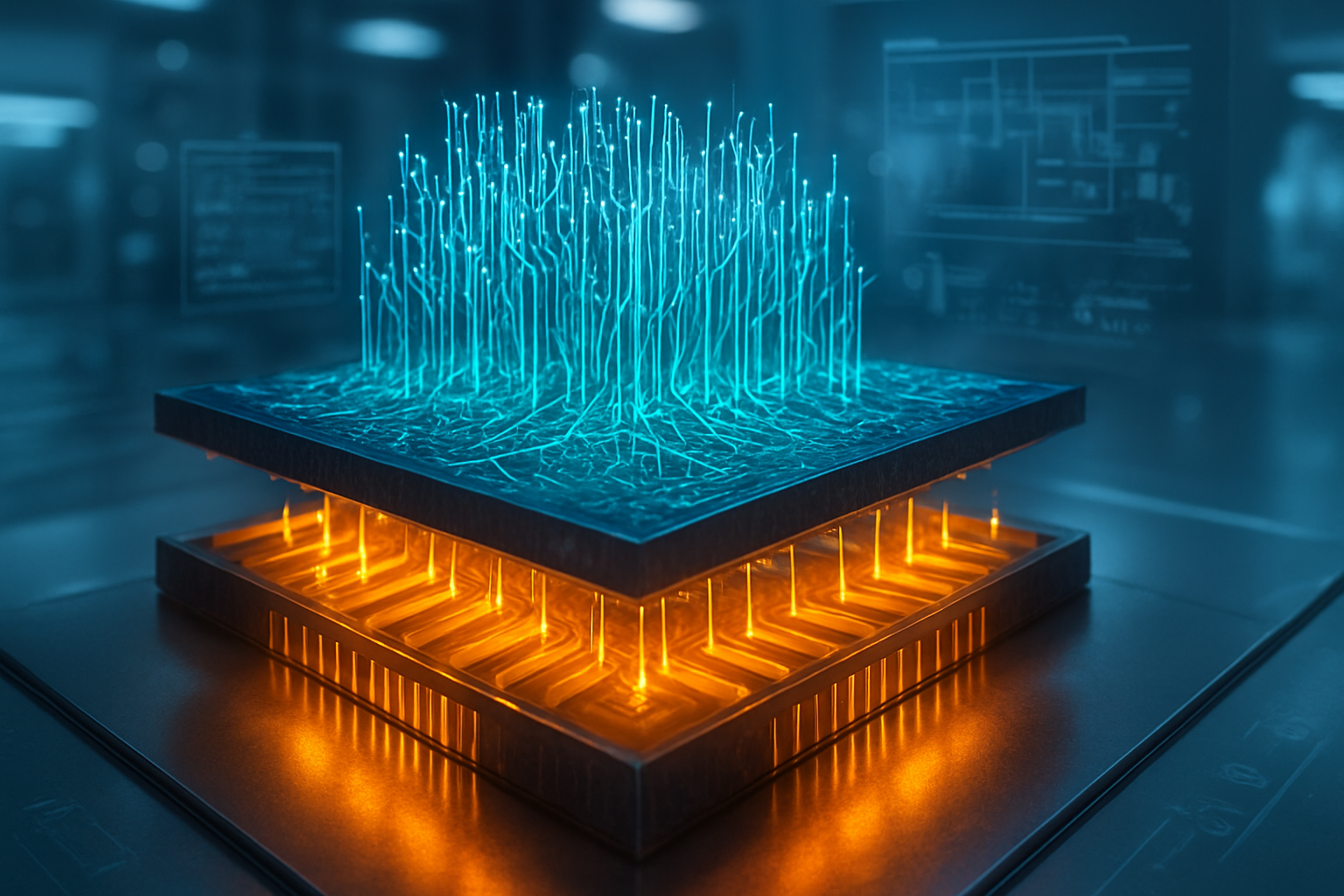
    BSPDN solves this by essentially flipping the house. In this new architecture, the silicon wafer is thinned down to a fraction of its original thickness, and an entirely separate network of power delivery lines is fabricated on the back. Intel Corporation (NASDAQ: INTC) was the first to commercialize this with its PowerVia technology, which utilizes "nano-Through Silicon Vias" (nTSVs) to carry power directly to the transistor layer. This separation allows for much thicker, less resistive power wires on the back and clearer, more efficient signal routing on the front.

    The technical specifications are staggering. Early reports from the 1.8nm (18A) production lines indicate that BSPDN reduces "IR drop"—a phenomenon where voltage decreases as it travels through a circuit—by nearly 30%. This allows transistors to switch faster while consuming less energy. Initial reactions from the research community have highlighted that this shift provides a 6% to 10% frequency boost and up to a 15% reduction in total power loss, a critical requirement for AI chips that are now pushing toward 1,000-watt power envelopes.

    The New Foundry War: Intel, TSMC, and the 2nm Gold Rush

    The successful rollout of BSPDN has reshaped the competitive landscape among the world’s leading foundries. Intel (NASDAQ: INTC) has used its first-mover advantage with PowerVia to reclaim a seat at the table of leading-edge manufacturing. Its 18A node is now in high-volume production, powering the new Panther Lake processors and securing major foundry customers like Microsoft Corporation (NASDAQ: MSFT) and Amazon (NASDAQ: AMZN), both of which are designing custom AI silicon to reduce their reliance on merchant hardware.

    However, Taiwan Semiconductor Manufacturing Company (NYSE: TSM) remains the titan to beat. While TSMC’s initial 2nm (N2) node did not include backside power, its upcoming A16 node—scheduled for mass production later this year—introduces the "Super Power Rail." This implementation is even more advanced than Intel's, connecting power directly to the transistor’s source and drain. This precision has led NVIDIA Corporation (NASDAQ: NVDA) to select TSMC’s A16 for its next-generation "Rubin" AI platform, which aims to deliver a 3x performance-per-watt improvement over the previous Blackwell architecture.

    Meanwhile, Samsung Electronics (OTC: SSNLF) is positioning itself as the "turnkey" alternative. Samsung is skipping the intermediate steps and moving directly to a highly optimized BSPDN on its 2nm (SF2Z) node. By offering a bundled package of 2nm logic, HBM4 memory, and advanced 2.5D packaging, Samsung has managed to peel away high-profile AI startups and even secure contracts from Advanced Micro Devices (NASDAQ: AMD) for specialized AI chiplets.

    AI Scaling and the "Joule-per-Token" Metric

    The broader significance of Backside Power Delivery lies in its impact on the economics of artificial intelligence. In 2026, the focus of the AI industry has shifted from raw FLOPS (Floating Point Operations Per Second) to "Joules-per-Token"—a measure of how much energy it takes to generate a single word of AI output. With the cost of 2nm wafers reportedly reaching $30,000 each, the energy efficiency provided by BSPDN is the only way for hyperscalers to keep the operational costs of LLMs (Large Language Models) sustainable.

    Furthermore, BSPDN is a prerequisite for the continued density of AI accelerators. By freeing up space on the front of the die, designers have been able to increase logic density by 10% to 20%, allowing for more Tensor cores and larger on-chip caches. This is vital for the 2026 crop of "Superchips" that integrate CPUs and GPUs on a single package. Without backside power, these chips would have simply melted under the thermal and electrical stress of modern AI workloads.

    However, this transition has not been without its challenges. One major concern is thermal management. Because the power delivery network is now on the back of the chip, it can trap heat between the silicon and the cooling solution. This has made liquid cooling a mandatory requirement for almost all high-performance AI hardware using these new nodes, leading to a massive infrastructure upgrade cycle in data centers across the globe.

    Looking Ahead: 1nm and the 3D Future

    The shift to BSPDN is not just a one-time upgrade; it is the foundation for the next decade of semiconductor evolution. Looking forward to 2027 and 2028, experts predict the arrival of the 1.4nm and 1nm nodes, where BSPDN will be combined with "Complementary FET" (CFET) architectures. In a CFET design, n-type and p-type transistors are stacked directly on top of each other, a move that would be physically impossible without the backside plumbing provided by BSPDN.

    We are also seeing the early stages of "Function-Side Power Delivery," where specific parts of the chip can be powered independently from the back to allow for ultra-fine-grained power gating. This would allow AI chips to "turn off" 90% of their circuits during idle periods, further driving down the carbon footprint of AI. The primary challenge remaining is yield; as of early 2026, Intel and TSMC are still working to push 2nm/1.8nm yields past the 70% mark, a task complicated by the extreme precision required to align the front and back of the wafer.

    A Fundamental Transformation of Silicon

    The arrival of Backside Power Delivery marks the end of the "Planar Era" and the beginning of a truly three-dimensional approach to computing. By separating the flow of energy from the flow of information, the semiconductor industry has successfully navigated the most dangerous bottleneck in its history.

    The key takeaways for the coming year are clear: Intel has proven its technical relevance with PowerVia, but TSMC’s A16 remains the preferred choice for the highest-end AI hardware. For the tech industry, the 2nm and 1.8nm nodes represent more than just a shrink; they are an architectural rebirth that will define the performance limits of artificial intelligence for years to come. In the coming months, watch for the first third-party benchmarks of Intel’s 18A and the official tape-outs of NVIDIA’s Rubin GPUs—these will be the ultimate tests of whether the "backside revolution" lives up to its immense promise.


    This content is intended for informational purposes only and represents analysis of current AI developments.

    TokenRing AI delivers enterprise-grade solutions for multi-agent AI workflow orchestration, AI-powered development tools, and seamless remote collaboration platforms.
    For more information, visit https://www.tokenring.ai/.

  • ASML Enters the “Angstrom Era”: How Intel and TSMC’s Record Capex is Fueling the High-NA EUV Revolution

    ASML Enters the “Angstrom Era”: How Intel and TSMC’s Record Capex is Fueling the High-NA EUV Revolution

    As the global technology industry crosses into 2026, ASML (NASDAQ:ASML) has officially cemented its role as the ultimate gatekeeper of the artificial intelligence revolution. Following a fiscal 2025 that saw unprecedented demand for AI-specific silicon, ASML’s 2026 outlook points to a historic revenue target of €36.5 billion. This growth is being propelled by a massive capital expenditure surge from industry titans Intel (NASDAQ:INTC) and TSMC (NYSE:TSM), who are locked in a high-stakes "Race to 2nm" and beyond. The centerpiece of this transformation is the transition of High-NA (Numerical Aperture) Extreme Ultraviolet (EUV) lithography from experimental pilot lines into high-volume manufacturing (HVM).

    The immediate significance of this development cannot be overstated. With Big Tech projected to invest over $400 billion in AI infrastructure in 2026 alone, the bottleneck has shifted from software algorithms to the physical limits of silicon. ASML’s delivery of the Twinscan EXE:5200 systems represents the first time the semiconductor industry can reliably print features at the angstrom scale in a commercial environment. This technological leap is the primary engine allowing chipmakers to keep pace with the exponential compute requirements of next-generation Large Language Models (LLMs) and autonomous AI agents.

    The Technical Edge: Twinscan EXE:5200 and the 8nm Resolution Frontier

    At the heart of the 2026 roadmap is the Twinscan EXE:5200, ASML’s flagship High-NA EUV system. Unlike the previous generation of standard (Low-NA) EUV tools that utilized a 0.33 numerical aperture, the High-NA systems utilize a 0.55 NA lens system. This allows for a resolution of 8nm, enabling the printing of features that are 1.7 times smaller than what was previously possible. For engineers, this means the ability to achieve a 2.9x increase in transistor density without the need for complex, yield-killing multi-patterning techniques.

    The EXE:5200 is a significant upgrade over the R&D-focused EXE:5000 models delivered in 2024 and 2025. It boasts a productivity throughput of over 200 wafers per hour (WPH), matching the efficiency of standard EUV tools while operating at a far tighter resolution. This throughput is critical for the commercial viability of 2nm and 1.4nm (14A) nodes. By moving to a single-exposure process for the most critical metal layers of a chip, manufacturers can reduce cycle times and minimize the cumulative defects that occur when a single layer must be passed through a scanner multiple times.

    Initial reactions from the industry have been polarized along strategic lines. Intel, which received the world’s first commercial-grade EXE:5200B in late 2025, has championed the tool as the "holy grail" of process leadership. Conversely, experts at TSMC initially expressed caution regarding the system's $400 million price tag, preferring to push standard EUV to its absolute limits. However, as of early 2026, the sheer complexity of 1.6nm (A16) and 1.4nm designs has forced a universal consensus: High-NA is no longer an optional luxury but a fundamental requirement for the "Angstrom Era."

    Strategic Warfare: Intel’s First-Mover Gamble vs. TSMC’s Efficiency Engine

    The competitive landscape of 2026 is defined by a sharp divergence in how the world’s two largest foundries are deploying ASML’s technology. Intel has adopted an aggressive "first-mover" strategy, utilizing High-NA EUV to accelerate its 14A (1.4nm) node. By integrating these tools earlier than its rivals, Intel aims to reclaim the process leadership it lost a decade ago. For Intel, 2026 is the "prove-it" year; if the EXE:5200 can deliver superior yields for its Panther Lake and Clearwater Forest processors, the company will have a strategic advantage in attracting external foundry customers like Microsoft (NASDAQ:MSFT) and Nvidia (NASDAQ:NVDA).

    TSMC, meanwhile, is operating with a massive 2026 capex budget of $52 billion to $56 billion, much of which is dedicated to the high-volume ramp of its N2 (2nm) and N2P nodes. While TSMC has been more conservative with High-NA adoption—relying on standard EUV with advanced multi-patterning for its A16 (1.6nm) process—the company has begun installing High-NA evaluation tools in early 2026 to de-risk its future A10 node. TSMC’s strategy focuses on maximizing the ROI of its existing EUV fleet while maintaining its dominant 90% market share in high-end AI accelerators.

    This shift has profound implications for chip designers. Nvidia’s "Rubin" R100 architecture and AMD’s (NASDAQ:AMD) MI400 series, both expected to dominate 2026 data center sales, are being optimized for these new nodes. While Nvidia is currently leveraging TSMC’s 3nm N3P process, rumors suggest a split-foundry strategy may emerge by the end of 2026, with some high-performance components being shifted to Intel’s 18A or 14A lines to ensure supply chain resiliency.

    The Triple Threat: 2nm, Advanced Packaging, and the Memory Supercycle

    The 2026 outlook is not merely about smaller transistors; it is about "System-on-Package" (SoP) innovation. Advanced packaging has become a third growth lever for ASML. Techniques like TSMC’s CoWoS-L (Chip-on-Wafer-on-Substrate with Local Silicon Interconnect) are now scaling to 5.5x the reticle limit, allowing for massive AI "Super-Chips" that combine logic, cache, and HBM4 (High Bandwidth Memory) in a single massive footprint. ASML has responded by launching specialized scanners like the Twinscan XT:260, designed specifically for the high-precision alignment required in 3D stacking and hybrid bonding.

    The memory sector is also becoming an "EUV-intensive" business. SK Hynix (KRX:000660) and Samsung (KRX:005930) are in the midst of an HBM-led supercycle, where the logic base dies for HBM4 are being manufactured on advanced logic nodes (5nm and 12nm). This has created a secondary surge in orders for ASML’s standard EUV systems. For the first time in history, the demand for lithography tools is being driven equally by memory density and logic performance, creating a diversified revenue stream that insulates ASML from downturns in the consumer smartphone or PC markets.

    However, this transition is not without concerns. The extreme cost of High-NA systems and the energy required to run them are putting pressure on the margins of smaller players. Industry analysts worry that the "Angstrom Era" may lead to further consolidation, as only a handful of companies can afford the $20+ billion price tag of a modern "Mega-Fab." Geopolitical tensions also remain a factor, as ASML continues to navigate strict export controls that have drastically reduced its revenue from China, forcing the company to rely even more heavily on the U.S., Taiwan, and South Korea.

    Future Horizons: The Path to 1nm and the Glass Substrate Pivot

    Looking beyond 2026, the trajectory for lithography points toward the sub-1nm frontier. ASML is already in the early R&D phases for "Hyper-NA" systems, which would push the numerical aperture to 0.75. Near-term, we expect to see the full stabilization of High-NA yields by the third quarter of 2026, followed by the first 1.4nm (14A) risk production runs. These developments will be essential for the next generation of AI hardware capable of on-device "reasoning" and real-time multimodal processing.

    Another development to watch is the shift toward glass substrates. Led by Intel, the industry is beginning to replace organic packaging materials with glass to provide the structural integrity needed for the increasingly heavy and hot AI chip stacks. ASML’s packaging-specific lithography tools will play a vital role here, ensuring that the interconnects on these glass substrates can meet the nanometer-perfect alignment required for copper-to-copper hybrid bonding. Experts predict that by 2028, the distinction between "front-end" wafer fabrication and "back-end" packaging will have blurred entirely into a single, continuous manufacturing flow.

    Conclusion: ASML’s Indispensable Decade

    As we move through 2026, ASML stands at the center of the most aggressive capital expansion in industrial history. The transition to High-NA EUV with the Twinscan EXE:5200 is more than just a technical milestone; it is the physical foundation upon which the next decade of artificial intelligence will be built. With a €33 billion order backlog and a dominant position in both logic and memory lithography, ASML is uniquely positioned to benefit from the "AI Infrastructure Supercycle."

    The key takeaway for 2026 is that the industry has successfully navigated the "air pocket" of the early 2020s and is now entering a period of normalized, high-volume growth. While the "Race to 2nm" will produce clear winners and losers among foundries, the collective surge in capex ensures that the compute bottleneck will continue to widen, making way for AI models of unprecedented scale. In the coming months, the industry will be watching Intel’s 18A yield reports and TSMC’s A16 progress as the definitive indicators of who will lead the angstrom-scale future.


    This content is intended for informational purposes only and represents analysis of current AI developments.

    TokenRing AI delivers enterprise-grade solutions for multi-agent AI workflow orchestration, AI-powered development tools, and seamless remote collaboration platforms.
    For more information, visit https://www.tokenring.ai/.

  • Silicon Sovereignty: The 2nm GAA Race and the Battle for the Future of AI Compute

    Silicon Sovereignty: The 2nm GAA Race and the Battle for the Future of AI Compute

    The semiconductor industry has officially entered the era of Gate-All-Around (GAA) transistor technology, marking the most significant architectural shift in chip manufacturing in over a decade. As of January 2, 2026, the race for 2-nanometer (2nm) supremacy has reached a fever pitch, with Taiwan Semiconductor Manufacturing Company (NYSE:TSM), Samsung Electronics (KRX:005930), and Intel (NASDAQ:INTC) all deploying their most advanced nodes to satisfy the insatiable demand for high-performance AI compute. This transition represents more than just a reduction in size; it is a fundamental redesign of the transistor that promises to unlock unprecedented levels of energy efficiency and processing power for the next generation of artificial intelligence.

    While the technical hurdles have been immense, the stakes could not be higher. The winner of this race will dictate the pace of AI innovation for years to come, providing the underlying hardware for everything from autonomous vehicles and generative AI models to the next wave of ultra-powerful consumer electronics. TSMC currently leads the pack in high-volume manufacturing, but the aggressive strategies of Samsung and Intel are creating a fragmented market where performance, yield, and geopolitical security are becoming as important as the nanometer designation itself.

    The Technical Leap: Nanosheets, RibbonFETs, and the End of FinFET

    The move to the 2nm node marks the retirement of the FinFET (Fin Field-Effect Transistor) architecture, which has dominated the industry since the 22nm era. At the heart of the 2nm revolution is Gate-All-Around (GAA) technology. Unlike FinFETs, where the gate contacts the channel on three sides, GAA transistors feature a gate that completely surrounds the channel on all four sides. This design provides superior electrostatic control, drastically reducing current leakage and allowing for further voltage scaling. TSMC’s N2 process utilizes a "Nanosheet" architecture, while Samsung has dubbed its version Multi-Bridge Channel FET (MBCFET), and Intel has introduced "RibbonFET."

    Intel’s 18A node, which has become its primary "comeback" vehicle in 2026, pairs RibbonFET with another breakthrough: PowerVia. This backside power delivery system moves the power routing to the back of the wafer, separating it from the signal lines on the front. This reduces voltage drop and allows for higher clock speeds, giving Intel a distinct performance-per-watt advantage in high-performance computing (HPC) tasks. Benchmarks from late 2025 suggest that while Intel's 18A trails TSMC in pure transistor density—238 million transistors per square millimeter (MTr/mm²) compared to TSMC’s 313 MTr/mm²—it excels in raw compute performance, making it a formidable contender for the AI data center market.

    Samsung, which was the first to implement GAA at the 3nm stage, has utilized its early experience to launch the SF2 node. Although Samsung has faced well-documented yield struggles in the past, its SF2 process is now in mass production, powering the latest Exynos 2600 processors. The SF2 node offers an 8% increase in power efficiency over its predecessor, though it remains under pressure to improve its 40–50% yield rates to compete with TSMC’s mature 70% yields. The industry’s initial reaction has been a mix of cautious optimism for Samsung’s persistence and awe at TSMC’s ability to maintain high yields even at such extreme technical complexities.

    Market Positioning and the New Foundry Hierarchy

    The 2nm race has reshaped the strategic landscape for tech giants and AI startups alike. TSMC remains the primary choice for external chip design firms, having secured over 50% of its initial N2 capacity for Apple (NASDAQ:AAPL). The upcoming A20 Pro and M6 chips are expected to set new benchmarks for mobile and desktop efficiency, further cementing Apple’s lead in consumer hardware. However, TSMC’s near-monopoly on high-volume 2nm production has led to capacity constraints, forcing other major players like Qualcomm (NASDAQ:QCOM) and Nvidia (NASDAQ:NVDA) to explore multi-sourcing strategies.

    Nvidia, in a landmark move in late 2025, finalized a $5 billion investment in Intel’s foundry services. While Nvidia continues to rely on TSMC for its flagship "Rubin Ultra" AI GPUs, the investment in Intel provides a strategic hedge and access to U.S.-based manufacturing and advanced packaging. This move significantly benefits Intel, providing the capital and credibility needed to establish its "IDM 2.0" vision. Meanwhile, Microsoft (NASDAQ:MSFT) and Amazon (NASDAQ:AMZN) have begun leveraging Intel’s 18A node for their custom AI accelerators, seeking to reduce their total cost of ownership by moving away from off-the-shelf components.

    Samsung has found its niche as a "relief valve" for the industry. While it may not match TSMC’s density, its lower wafer costs—estimated at $22,000 to $25,000 compared to TSMC’s $30,000—have attracted cost-sensitive or capacity-constrained customers. Tesla (NASDAQ:TSLA) has reportedly secured SF2 capacity for its next-generation AI5 autonomous driving chips, and Meta (NASDAQ:META) is utilizing Samsung for its MTIA ASICs. This diversification of the foundry market is disrupting the previous winner-take-all dynamic, allowing for a more resilient global supply chain.

    Geopolitics, Energy, and the Broader AI Landscape

    The 2nm transition is not occurring in a vacuum; it is deeply intertwined with the global push for "silicon sovereignty." The ability to manufacture 2nm chips domestically has become a matter of national security for the United States and the European Union. Intel’s progress with 18A is a cornerstone of the U.S. CHIPS Act goals, providing a domestic alternative to the Taiwan-centric supply chain. This geopolitical dimension adds a layer of complexity to the 2nm race, as government subsidies and export controls on advanced lithography equipment from ASML (NASDAQ:ASML) influence where and how these chips are built.

    From an environmental perspective, the shift to GAA is a critical milestone. As AI data centers consume an ever-increasing share of the world’s electricity, the 25–30% power reduction offered by nodes like TSMC’s N2 is essential for sustainable growth. The industry is reaching a point where traditional scaling is no longer enough; architectural innovations like backside power delivery and advanced 3D packaging are now the primary drivers of efficiency. This mirrors previous milestones like the introduction of High-K Metal Gate (HKMG) or EUV lithography, but at a scale that impacts the global energy grid.

    However, concerns remain regarding the "yield gap" between TSMC and its rivals. If Samsung and Intel cannot stabilize their production lines, the industry risks a bottleneck where only a handful of companies—those with the deepest pockets—can afford the most advanced silicon. This could lead to a two-tier AI landscape, where the most capable models are restricted to the few firms that can secure TSMC’s premium capacity, potentially stifling innovation among smaller startups and research labs.

    The Horizon: 1.4nm and the High-NA EUV Era

    Looking ahead, the 2nm node is merely a stepping stone toward the "Angstrom Era." TSMC has already announced its A16 (1.6nm) node, scheduled for mass production in late 2026, which will incorporate its own version of backside power delivery. Intel is similarly preparing its 18AP node, which promises further refinements to the RibbonFET architecture. These near-term developments suggest that the pace of innovation is actually accelerating, rather than slowing down, as the industry tackles the limits of physics.

    The next major hurdle will be the widespread adoption of High-NA (Numerical Aperture) EUV lithography. Intel has taken an early lead in this area, installing the world’s first High-NA machines to prepare for the 1.4nm (Intel 14A) node. Experts predict that the integration of High-NA EUV will be the defining challenge of 2027 and 2028, requiring entirely new photoresists and mask technologies. Challenges such as thermal management in 3D-stacked chips and the rising cost of design—now exceeding $1 billion for a complex 2nm SoC—will need to be addressed by the broader ecosystem.

    A New Chapter in Semiconductor History

    The 2nm GAA race of 2026 represents a pivotal moment in semiconductor history. It is the point where the industry successfully navigated the transition away from FinFETs, ensuring that Moore’s Law—or at least the spirit of it—continues to drive the AI revolution. TSMC’s operational excellence has kept it at the forefront, but the emergence of a viable three-way competition with Intel and Samsung is a healthy development for a world that is increasingly dependent on advanced silicon.

    In the coming months, the industry will be watching the first consumer reviews of 2nm-powered devices and the performance of Intel’s 18A in enterprise data centers. The key takeaways from this era are clear: architecture matters as much as size, and the ability to manufacture at scale remains the ultimate competitive advantage. As we look toward the end of 2026, the focus will inevitably shift toward the 1.4nm horizon, but the lessons learned during the 2nm GAA transition will provide the blueprint for the next decade of compute.


    This content is intended for informational purposes only and represents analysis of current AI developments.

    TokenRing AI delivers enterprise-grade solutions for multi-agent AI workflow orchestration, AI-powered development tools, and seamless remote collaboration platforms.
    For more information, visit https://www.tokenring.ai/.