Tag: Agentic AI

  • The Agentic Revolution: How NVIDIA and Microsoft are Turning AI from Chatbots into Autonomous Operators

    The Agentic Revolution: How NVIDIA and Microsoft are Turning AI from Chatbots into Autonomous Operators

    The dawn of 2026 has brought with it a fundamental shift in the artificial intelligence landscape, moving away from the era of conversational "copilots" toward a future defined by "Agentic AI." For years, AI was largely reactive—a user would provide a prompt, and the model would generate a response. Today, the industry is pivoting toward autonomous agents that don't just talk, but act. These systems are capable of planning complex, multi-step workflows, navigating software interfaces, and executing tasks with minimal human intervention, effectively transitioning from digital assistants to digital employees.

    This transition is being accelerated by a powerful "one-two punch" of hardware and software innovation. On the hardware front, NVIDIA (NASDAQ: NVDA) has officially detailed its Rubin platform, a successor to the Blackwell architecture specifically designed to handle the massive reasoning and memory requirements of autonomous agents. Simultaneously, Microsoft (NASDAQ: MSFT) has signaled its commitment to this new era through the strategic acquisition of Osmos, a startup specializing in autonomous agentic workflows for data engineering. Together, these developments represent a move from "thinking" models to "doing" models, setting the stage for a massive productivity leap across the global economy.

    The Silicon and Software of Autonomy: Inside Rubin and Osmos

    The technical backbone of this shift lies in NVIDIA’s new Rubin architecture, which debuted at the start of 2026. Unlike previous generations that focused primarily on raw throughput for training, the Rubin R100 GPU is architected for "test-time scaling"—a process where an AI agent spends more compute cycles "reasoning" through a problem before delivering an output. Built on TSMC’s 3nm process, the R100 boasts a staggering 336 billion transistors and is the first to utilize HBM4 memory. With a memory bandwidth of 22 TB/s, Rubin effectively breaks the "memory wall" that previously limited AI agents' ability to maintain long-term context and execute complex, multi-stage plans without losing their place.

    Complementing this hardware is the "Vera" CPU, which features 88 custom "Olympus" cores designed to manage the high-speed data movement required for agentic reasoning. This hardware stack allows for a 5x leap in inference performance over the previous Blackwell generation, specifically optimized for Mixture-of-Experts (MoE) models. These models are the preferred architecture for agents, as they allow a system to consult different "specialist" sub-networks for different parts of a complex task, such as writing code, analyzing market data, and then autonomously generating a financial report.

    On the software side, Microsoft’s acquisition of Osmos provides the "brain" for these autonomous workflows. Osmos has pioneered "Agentic AI for data engineering," creating agents that can navigate messy, unstructured data environments to build production-grade pipelines without human coding. By integrating Osmos into the Microsoft Fabric ecosystem, Microsoft is moving beyond simple text generation. The new "AI Data Wrangler" and "AI Data Engineer" agents can autonomously identify data discrepancies, normalize information across disparate sources, and manage entire infrastructure schemas. This differs from previous "Copilot" iterations by removing the human from the "inner loop" of the process; the user sets the goal, and the Osmos-powered agents execute the entire workflow.

    Initial reactions from the AI research community have been overwhelmingly positive, with experts noting that the Rubin-Osmos era marks the end of the "hallucination-heavy" chatbot phase. By providing models with the hardware to "think" longer and the software frameworks to interact with real-world data systems, the industry is finally delivering on the promise of Large Action Models (LAMs).

    A Seismic Shift in the Competitive Landscape

    The move toward Agentic AI is redrawing the competitive map for tech giants and startups alike. NVIDIA (NASDAQ: NVDA) continues to cement its position as the "arms dealer" of the AI revolution. By tailoring the Rubin architecture specifically for agents, NVIDIA is making it difficult for competitors like AMD (NASDAQ: AMD) or Intel (NASDAQ: INTC) to catch up in the high-end inference market, where low-latency reasoning is now the most valuable currency. The Rubin NVL72 racks are already becoming the gold standard for "AI Superfactories," ensuring that any company wanting to run high-performance agents must go through NVIDIA.

    For Microsoft (NASDAQ: MSFT), the Osmos acquisition is a direct shot across the bow of data heavyweights like Databricks and Snowflake (NYSE: SNOW). By embedding autonomous data agents directly into the Azure and Fabric core, Microsoft is attempting to make manual data engineering—a multi-billion dollar industry—obsolete. If an autonomous agent can handle the "grunt work" of data preparation and pipeline management, the value proposition of traditional data platforms shifts dramatically toward those who can offer the best agentic orchestration.

    Startups are also finding new niches in this ecosystem. While the giants provide the base models and hardware, a new wave of "Agentic Service Providers" is emerging. These companies focus on "fine-tuning for action," creating highly specialized agents for legal, medical, or engineering fields. However, the barrier to entry is rising; as hardware requirements for reasoning increase, startups must rely more heavily on cloud partnerships with the likes of Microsoft or Amazon (NASDAQ: AMZN) to access the Rubin-class compute needed to remain competitive.

    The Broader Significance: From Assistant to Operator

    The shift to Agentic AI represents more than just a technical upgrade; it is a fundamental change in how humans interact with technology. We are moving from the "Copilot" era—where AI suggests actions—to the "Operator" era, where AI takes them. This fits into the broader trend of "Universal AI Orchestration," where multiple agents work together in a hierarchy to solve business problems. For example, a "Manager Agent" might receive a high-level business objective, decompose it into sub-tasks, and delegate those tasks to "Worker Agents" specialized in research, coding, or communication.

    This evolution brings significant economic implications. The automation of multi-step workflows could lead to a massive productivity boom, particularly in white-collar sectors that involve heavy data processing and administrative coordination. However, it also raises concerns about job displacement and the "black box" nature of autonomous decision-making. Unlike a chatbot that provides a source for its text, an autonomous agent making changes to a production database or executing financial trades requires a much higher level of trust and robust safety guardrails.

    Comparatively, this milestone is being viewed as more significant than the release of GPT-4. While GPT-4 proved that AI could understand and generate human-like language, the Rubin and Osmos era proves that AI can reliably interact with the digital world. It is the transition from a "brain in a vat" to an "agent with hands," marking the true beginning of the autonomous digital economy.

    The Road Ahead: What to Expect in 2026 and Beyond

    As we look toward the second half of 2026, the industry is bracing for the first wave of "Agent-First" enterprise applications. We expect to see the rollout of "Self-Healing Infrastructure," where AI agents powered by the Rubin platform monitor global networks and autonomously deploy code fixes or re-route traffic before a human is even aware of an issue. In the consumer space, this will likely manifest as "Personal OS Agents" that can manage a user’s entire digital life—from booking complex travel itineraries across multiple platforms to managing personal finances and taxes.

    However, several challenges remain. The "Agentic Gap"—the difference between an agent planning a task and successfully executing it in a dynamic, unpredictable environment—is still being bridged. Reliability is paramount; an agent that fails 5% of the time is a novelty, but an agent that fails 5% of the time when managing a corporate supply chain is a liability. Developers are currently focusing on "verifiable reasoning" frameworks to ensure that agents can prove the logic behind their actions.

    Experts predict that by 2027, the focus will shift from building individual agents to "Agentic Swarms"—groups of hundreds or thousands of specialized agents working in concert to solve massive scientific or engineering challenges, such as drug discovery or climate modeling. The infrastructure being laid today by NVIDIA and Microsoft is the foundation for this decentralized, autonomous future.

    Conclusion: The New Foundation of Intelligence

    The convergence of NVIDIA’s Rubin platform and Microsoft’s Osmos acquisition marks a definitive turning point in the history of artificial intelligence. We have moved past the novelty of generative AI and into the era of functional, autonomous agency. By providing the massive memory bandwidth and reasoning-optimized silicon of the R100, and the sophisticated workflow orchestration of Osmos, these tech giants have solved the two biggest hurdles to AI autonomy: hardware bottlenecks and software complexity.

    The key takeaway for businesses and individuals alike is that AI is no longer just a tool for brainstorming or drafting emails; it is becoming a primary driver of operational execution. In the coming weeks and months, watch for the first "Rubin-powered" instances to go live on Azure, and keep an eye on how competitors like Google (NASDAQ: GOOGL) and OpenAI respond with their own agentic frameworks. The "Agentic AI" shift is not just a trend—it is the new operating model for the digital age.


    This content is intended for informational purposes only and represents analysis of current AI developments.

    TokenRing AI delivers enterprise-grade solutions for multi-agent AI workflow orchestration, AI-powered development tools, and seamless remote collaboration platforms.
    For more information, visit https://www.tokenring.ai/.
  • Microsoft Acquires Osmos to Revolutionize Data Engineering with Agentic AI Integration in Fabric

    Microsoft Acquires Osmos to Revolutionize Data Engineering with Agentic AI Integration in Fabric

    In a move that signals a paradigm shift for the enterprise data landscape, Microsoft (NASDAQ: MSFT) officially announced the acquisition of Seattle-based startup Osmos on January 5, 2026. The acquisition is poised to transform Microsoft Fabric from a passive data lakehouse into an autonomous, self-configuring intelligence engine by integrating Osmos’s cutting-edge agentic AI technology. By tackling the notorious "first-mile" bottlenecks of data preparation, Microsoft aims to drastically reduce the manual labor historically required for data cleaning and pipeline maintenance.

    The significance of this deal lies in its focus on "agentic" capabilities—AI that doesn't just suggest actions but autonomously reasons through complex data inconsistencies and executes engineering tasks. As enterprises struggle with an explosion of unstructured data and a chronic shortage of skilled data engineers, Microsoft is positioning this integration as a vital solution to accelerate time-to-value for AI-driven insights.

    The Rise of the Autonomous Data Engineer

    The technical core of the acquisition centers on Osmos’s suite of specialized AI agents, which are being folded directly into the Microsoft Fabric engineering organization. Unlike traditional ETL (Extract, Transform, Load) tools that rely on rigid, pre-defined rules, Osmos utilizes Program Synthesis to generate production-ready PySpark code and notebooks. This allows the system to handle "messy" data—such as nested JSON, irregular CSVs, and even unstructured PDFs—by deriving relationships between source and target schemas without manual mapping.

    One of the standout features is the AI Data Wrangler, an agent designed to manage "schema evolution." In traditional environments, if an external vendor changes a file format, downstream pipelines often break, requiring manual intervention. Osmos’s agents autonomously detect these changes and repair the pipelines in real-time. Furthermore, the AI AutoClean and Value Mapping features allow users to provide natural language instructions, such as "normalize all date formats and standardize address fields," which the agent then executes using LLM-driven semantic reasoning to ensure data quality before it ever reaches the data lake.

    Industry experts have compared this technological leap to the evolution of computer programming. Just as high-level languages moved from manual memory management to "automatic garbage collection," data engineering is now transitioning from manual pipeline management to autonomous agentic oversight. Initial reports from early adopters of the Osmos-Fabric integration suggest a greater than 50% reduction in development and maintenance efforts, effectively acting as an "autonomous airlock" for Microsoft’s OneLake.

    A Strategic "Walled Garden" for the AI Era

    The acquisition is a calculated strike against major competitors like Snowflake (NYSE: SNOW) and Databricks. In a notable strategic pivot, Microsoft has confirmed plans to sunset Osmos’s existing support for non-Azure platforms. By making this technology Fabric-exclusive, Microsoft is creating a proprietary advantage that forces a difficult choice for enterprises currently utilizing multi-cloud strategies. While Snowflake has expanded its Cortex AI capabilities and Databricks continues to promote its Lakeflow automation, Microsoft’s deep integration of agentic AI provides a seamless, end-to-end automation layer that is difficult to replicate.

    Market analysts suggest that this move strengthens Microsoft’s "one-stop solution" narrative. By reducing the reliance on third-party ETL tools and even Databricks-aligned formats, Microsoft is tightening its grip on the enterprise data stack. This "walled garden" approach is designed to ensure that the data feeding into Fabric IQ—Microsoft’s semantic reasoning layer—remains curated and stable, providing a competitive edge in the race to provide reliable generative AI outputs for business intelligence.

    However, this strategy is not without its risks. The decision to cut off support for rival platforms has raised concerns regarding vendor lock-in. CIOs who have spent years building flexible, multi-cloud architectures may find themselves pressured to migrate workloads to Azure to access these advanced automation features. Despite these concerns, the promise of a massive reduction in operational overhead is a powerful incentive for organizations looking to scale their AI initiatives quickly.

    Reshaping the Broader AI Landscape

    The Microsoft-Osmos deal reflects a broader trend in the AI industry: the shift from "Chatbot AI" to "Agentic AI." While the last two years were dominated by LLMs that could answer questions, 2026 is becoming the year of agents that do work. This acquisition marks a milestone in the maturity of agentic workflows, moving them out of experimental labs and into the mission-critical infrastructure of global enterprises. It follows the trajectory of previous breakthroughs like the introduction of Transformers, but with a focus on practical, industrial-scale application.

    There are also significant implications for the labor market within the tech sector. By automating tasks typically handled by junior data engineers, Microsoft is fundamentally changing the requirements for data roles. The focus is shifting from "how to build a pipeline" to "how to oversee an agent." While this democratizes data engineering—allowing business users to build complex flows via natural language through the Power Platform—it also necessitates a massive upskilling effort for existing technical staff to focus on higher-level architecture and AI governance.

    Potential concerns remain regarding the "black box" nature of autonomous agents. If an agent makes a semantic error during data normalization that goes unnoticed, it could lead to flawed business decisions. Microsoft is expected to counter this by implementing rigorous "human-in-the-loop" checkpoints within Fabric, but the tension between full autonomy and data integrity will likely be a central theme in AI research for the foreseeable future.

    The Future of Autonomous Data Management

    Looking ahead, the integration of Osmos into Microsoft Fabric is expected to pave the way for even more advanced "self-healing" data ecosystems. In the near term, we can expect to see these agents expand their capabilities to include autonomous cost optimization, where agents redirect data flows based on real-time compute pricing and performance metrics. Long-term, the goal is a "Zero-ETL" reality where data is instantly usable the moment it is generated, regardless of its original format or source.

    Experts predict that the next frontier will be the integration of these agents with edge computing and IoT. Imagine a scenario where data from millions of sensors is cleaned, normalized, and integrated into a global data lake by agents operating at the network's edge, providing real-time insights for autonomous manufacturing or smart city management. The challenge will be ensuring these agents can operate securely and ethically across disparate regulatory environments.

    As Microsoft rolls out these features to the general public in the coming months, the industry will be watching closely to see if the promised 50% efficiency gains hold up in diverse, real-world environments. The success of this acquisition will likely trigger a wave of similar M&A activity, as other tech giants scramble to acquire their own agentic AI capabilities to keep pace with the rapidly evolving "autonomous enterprise."

    A New Chapter for Enterprise Intelligence

    The acquisition of Osmos by Microsoft marks a definitive turning point in the history of data engineering. By embedding agentic AI into the very fabric of the data stack, Microsoft is addressing the most persistent hurdle in the AI lifecycle: the preparation of high-quality data. This move not only solidifies Microsoft's position as a leader in the AI-native data platform market but also sets a new standard for what enterprises expect from their cloud providers.

    The key takeaways from this development are clear: automation is moving from simple scripts to autonomous reasoning, vendor ecosystems are becoming more integrated (and more exclusive), and the role of the data professional is being permanently redefined. As we move further into 2026, the success of Microsoft Fabric will be a bellwether for the broader adoption of agentic AI across all sectors of the economy.

    For now, the tech world remains focused on the upcoming Microsoft Build conference, where more granular details of the Osmos integration are expected to be revealed. The era of the manual data pipeline is drawing to a close, replaced by a future where data flows as autonomously as the AI that consumes it.


    This content is intended for informational purposes only and represents analysis of current AI developments.

    TokenRing AI delivers enterprise-grade solutions for multi-agent AI workflow orchestration, AI-powered development tools, and seamless remote collaboration platforms.
    For more information, visit https://www.tokenring.ai/.
  • Nvidia Unveils Nemotron 3: The ‘Agentic’ Brain Powering a New Era of Physical AI at CES 2026

    Nvidia Unveils Nemotron 3: The ‘Agentic’ Brain Powering a New Era of Physical AI at CES 2026

    At the 2026 Consumer Electronics Show (CES), NVIDIA (NASDAQ: NVDA) redefined the boundaries of artificial intelligence by unveiling the Nemotron 3 family of open models. Moving beyond the text-and-image paradigms of previous years, the new suite is specifically engineered for "agentic AI"—autonomous systems capable of multi-step reasoning, tool use, and complex decision-making. This launch marks a pivotal shift for the tech giant as it transitions from a provider of general-purpose large language models (LLMs) to the architect of a comprehensive "Physical AI" ecosystem.

    The announcement signals Nvidia's ambition to move AI off the screen and into the physical world. By integrating the Nemotron 3 reasoning engine with its newly announced Cosmos world foundation models and Rubin hardware platform, Nvidia is providing the foundational software and hardware stack for the next generation of humanoid robots, autonomous vehicles, and industrial automation systems. The immediate significance is clear: Nvidia is no longer just selling the "shovels" for the AI gold rush; it is now providing the brains and the bodies for the autonomous workforce of the future.

    Technical Mastery: The Hybrid Mamba-Transformer Architecture

    The Nemotron 3 family represents a significant technical departure from the industry-standard Transformer-only models. Built on a sophisticated Hybrid Mamba-Transformer Mixture-of-Experts (MoE) architecture, these models combine the high-reasoning accuracy of Transformers with the low-latency and long-context efficiency of Mamba-2. The family is tiered into three primary sizes: the 30B Nemotron 3 Nano for local edge devices, the 100B Nemotron 3 Super for enterprise automation, and the massive 500B Nemotron 3 Ultra, which sets new benchmarks for complex scientific planning and coding.

    One of the most striking technical features is the massive 1-million-token context window, allowing agents to ingest and "remember" entire technical manuals or weeks of operational data in a single pass. Furthermore, Nvidia has introduced granular "Reasoning Controls," including a "Thinking Budget" that allows developers to toggle between high-speed responses and deep-reasoning modes. This flexibility is essential for agentic workflows where a robot might need to react instantly to a physical hazard but spend several seconds planning a complex assembly task. Initial reactions from the AI research community have been overwhelmingly positive, with experts noting that the 4x throughput increase over Nemotron 2, when paired with the new Rubin GPUs, effectively solves the latency bottleneck that previously plagued real-time agentic AI.

    Strategic Dominance: Reshaping the Competitive Landscape

    The release of Nemotron 3 as an open-model family places significant pressure on proprietary AI labs like OpenAI and Google (NASDAQ: GOOGL). By offering state-of-the-art (SOTA) reasoning capabilities that are optimized to run with maximum efficiency on Nvidia hardware, the company is incentivizing developers to build within its ecosystem rather than relying on closed APIs. This strategy directly benefits enterprise giants like Siemens (OTC: SIEGY), which has already announced plans to integrate Nemotron 3 into its industrial design software to create AI agents that assist in complex semiconductor and PCB layout.

    For startups and smaller AI labs, the availability of these high-performance open models lowers the barrier to entry for developing sophisticated agents. However, the true competitive advantage lies in Nvidia's vertical integration. Because Nemotron 3 is specifically tuned for the Rubin platform—utilizing the new Vera CPU and BlueField-4 DPU for optimized data movement—competitors who lack integrated hardware stacks may find it difficult to match the performance-to-cost ratio Nvidia is now offering. This positioning turns Nvidia into a "one-stop shop" for Physical AI, potentially disrupting the market for third-party orchestration layers and middleware.

    The Physical AI Vision: Bridging the Digital-Physical Divide

    The "Physical AI" strategy announced at CES 2026 is perhaps the most ambitious roadmap in Nvidia's history. It is built on a "three-computer" architecture: the DGX for training, Omniverse for simulation, and Jetson or DRIVE for real-time operation. Within this framework, Nemotron 3 serves as the "logic" or the brain, while the new NVIDIA Cosmos models act as the "intuition." Cosmos models are world foundation models designed to understand physics—predicting how objects fall, slide, or interact—which allows robots to navigate the real world with human-like common sense.

    This integration is a milestone in the broader AI landscape, moving beyond the "stochastic parrot" critique of early LLMs. By grounding reasoning in physical reality, Nvidia is addressing one of the most significant hurdles in robotics: the "sim-to-real" gap. Unlike previous breakthroughs that focused on digital intelligence, such as GPT-4, the combination of Nemotron and Cosmos allows for "Physical Common Sense," where an AI doesn't just know how to describe a hammer but understands the weight, trajectory, and force required to use one. This shift places Nvidia at the forefront of the "General Purpose Robotics" trend that many believe will define the late 2020s.

    The Road Ahead: Humanoids and Autonomous Realities

    Looking toward the near-term future, the most immediate applications of the Nemotron-Cosmos stack will be seen in humanoid robotics and autonomous transport. Nvidia’s Isaac GR00T N1.6—a Vision-Language-Action (VLA) model—is already utilizing Nemotron 3 to enable robots to perform bimanual manipulation and navigate dynamic, crowded workspaces. In the automotive sector, the new Alpamayo 1 model, developed in partnership with Mercedes-Benz (OTC: MBGYY), uses Nemotron's chain-of-thought reasoning to allow self-driving cars to explain their decisions to passengers, such as slowing down for a distracted pedestrian.

    Despite the excitement, significant challenges remain, particularly regarding the safety and reliability of autonomous agents in unconstrained environments. Experts predict that the next two years will be focused on "alignment for action," ensuring that agentic AI follows strict safety protocols when interacting with humans. As these models become more autonomous, the industry will likely see a surge in demand for "Inference Context Memory Storage" and other hardware-level solutions to manage the massive data flows required by multi-agent systems.

    A New Chapter in the AI Revolution

    Nvidia’s announcements at CES 2026 represent a definitive closing of the chapter on "Chatbot AI" and the opening of the era of "Agentic Physical AI." The Nemotron 3 family provides the necessary reasoning depth, while the Cosmos models provide the physical grounding, creating a holistic system that can finally interact with the world in a meaningful way. This development is likely to be remembered as the moment when AI moved from being a tool we talk to, to a partner that works alongside us.

    As we move into the coming months, the industry will be watching closely to see how quickly these models are adopted by the robotics and automotive sectors. With the Rubin platform entering full production and partnerships with global leaders already in place, Nvidia has set a high bar for the rest of the tech industry. The long-term impact of this development could be a fundamental shift in global productivity, as autonomous agents begin to take on roles in manufacturing, logistics, and even domestic care that were once thought to be decades away.


    This content is intended for informational purposes only and represents analysis of current AI developments.

    TokenRing AI delivers enterprise-grade solutions for multi-agent AI workflow orchestration, AI-powered development tools, and seamless remote collaboration platforms.
    For more information, visit https://www.tokenring.ai/.
  • Microsoft Acquires Osmos to Eliminate Data Engineering Bottlenecks in Fabric

    Microsoft Acquires Osmos to Eliminate Data Engineering Bottlenecks in Fabric

    In a strategic move aimed at solidifying its dominance in the enterprise analytics space, Microsoft (NASDAQ: MSFT) officially announced the acquisition of Osmos (osmos.io) on January 5, 2026. The acquisition is designed to integrate Osmos’s cutting-edge "agentic AI" capabilities directly into the Microsoft Fabric platform, addressing the "first-mile" challenge of data engineering—the arduous process of ingesting, cleaning, and transforming messy external data into actionable insights.

    The significance of this deal cannot be overstated for the Azure ecosystem. By bringing Osmos’s autonomous data agents under the Fabric umbrella, Microsoft is signaling an end to the era where data scientists and engineers spend the vast majority of their time on manual ETL (Extract, Transform, Load) tasks. This acquisition aims to transform Microsoft Fabric from a comprehensive data lakehouse into a self-configuring, autonomous intelligence engine that handles the heavy lifting of data preparation without human intervention.

    The Rise of the Agentic Data Engineer: Technical Breakthroughs

    The core of the Osmos acquisition lies in its departure from traditional, rule-based ETL tools. Unlike legacy systems that require rigid mapping and manual coding, Osmos utilizes Agentic AI—autonomous models capable of reasoning through data inconsistencies. At the heart of this integration is the "AI Data Wrangler," a tool specifically designed to handle "messy" data from external partners and suppliers. It automatically manages schema evolution and column mapping, ensuring that when a vendor changes their file format, the pipeline doesn't break; the AI simply adapts and repairs the mapping in real-time.

    Technically, the integration goes deep into the Fabric architecture. Osmos technology now serves as an "autonomous airlock" for OneLake, Microsoft’s unified data storage layer. Before data ever touches the lake, Osmos agents perform "AI AutoClean," interpreting natural language instructions—such as "standardize all currency to USD and flag outliers"—and converting them into production-grade PySpark notebooks. This differs from previous "black box" AI approaches by providing explainable, version-controlled code that engineers can audit and modify within Fabric’s native environment. This transparency ensures that while the AI does the work, the human engineer retains ultimate governance.

    Initial reactions from the AI research community have been overwhelmingly positive, particularly regarding Osmos’s use of Program Synthesis. By using LLMs to generate the specific Python and SQL code required for complex joins and aggregations, Microsoft is effectively automating the role of the junior data engineer. Industry experts note that this move leapfrogs traditional "Copilot" assistants, moving from a chat-based helper to an active "worker" that proactively identifies and fixes data quality issues before they can contaminate downstream analytics or machine learning models.

    Strategic Consolidation and the "Walled Garden" Shift

    The acquisition of Osmos is a clear shot across the bow for competitors like Snowflake (NYSE: SNOW) and Databricks. Historically, Osmos was a platform-agnostic tool that supported various data environments. However, following the acquisition, Microsoft has confirmed plans to sunset Osmos’s support for non-Azure platforms, effectively turning a premier data ingestion tool into a "walled garden" feature for Microsoft Fabric. This move forces enterprise customers to choose between a fragmented multi-cloud strategy or the seamless, AI-automated experience offered by the integrated Microsoft stack.

    For tech giants and AI startups alike, this acquisition underscores a trend toward vertical integration in the AI era. By owning the ingestion layer, Microsoft reduces the need for third-party ETL vendors like Informatica (NYSE: INFA) or Fivetran within its ecosystem. This consolidation provides Microsoft with a significant strategic advantage: it can offer a lower total cost of ownership (TCO) by eliminating the "tool sprawl" that plagues modern data departments. Startups that previously specialized in niche data cleaning tasks now find themselves competing against a native, AI-powered feature built directly into the world’s most widely used enterprise cloud.

    Market analysts suggest that this move will accelerate the "democratization" of data engineering. By allowing non-technical teams—such as finance or operations—to use natural language to ingest and prepare their own data, Microsoft is expanding the potential user base for Fabric. This shift not only benefits Microsoft’s bottom line but also creates a competitive pressure for other cloud providers to either build or acquire similar agentic AI capabilities to keep pace with the automation standards being set in Redmond.

    Redefining the Broader AI Landscape

    The integration of Osmos into Microsoft Fabric fits into a larger industry shift toward Agentic Workflows. We are moving past the era of "AI as a Chatbot" and into the era of "AI as an Operator." In the broader AI landscape, this acquisition mirrors previous milestones like the introduction of GitHub Copilot, but for data infrastructure. It addresses the "garbage in, garbage out" problem that has long hindered large-scale AI deployments. If the data feeding the models is clean, consistent, and automatically updated, the reliability of the resulting AI insights increases exponentially.

    However, this transition is not without its concerns. The primary apprehension among industry veterans is the potential for "automation bias" and the loss of granular control over data lineage. While Osmos provides explainable code, the sheer speed and volume of AI-generated pipelines may outpace the ability of human teams to effectively audit them. Furthermore, the move toward a Microsoft-only ecosystem for Osmos technology raises questions about vendor lock-in, as enterprises become increasingly dependent on Microsoft’s proprietary AI agents to maintain their data infrastructure.

    Despite these concerns, the move is a landmark in the evolution of data management. Comparisons are already being made to the shift from manual memory management to garbage collection in programming languages. Just as developers stopped worrying about allocating bits and started focusing on application logic, Microsoft is betting that data engineers will stop worrying about CSV formatting and start focusing on high-level data architecture and strategic business intelligence.

    Future Developments and the Path to Self-Healing Data

    Looking ahead, the near-term roadmap for Microsoft Fabric involves a total convergence of Osmos’s reasoning capabilities with the existing Fabric Copilot. We can expect to see "Self-Healing Data Pipelines" that not only ingest data but also predict when a source is likely to fail or provide anomalous data based on historical patterns. In the long term, these AI agents may evolve to the point where they can autonomously discover new data sources within an organization and suggest new analytical models to leadership without being prompted.

    The next challenge for Microsoft will be extending these capabilities to unstructured data—such as video, audio, and sensor logs—which remain a significant hurdle for most enterprises. Experts predict that the "Osmos-infused" Fabric will soon feature multi-modal ingestion agents capable of extracting structured insights from a company's entire digital footprint. As these agents become more sophisticated, the role of the data professional will continue to evolve, focusing more on data ethics, governance, and the strategic alignment of AI outputs with corporate goals.

    A New Chapter in Enterprise Intelligence

    The acquisition of Osmos marks a pivotal moment in the history of data engineering. By eliminating the manual bottlenecks that have hampered analytics for decades, Microsoft is positioning Fabric as the definitive operating system for the AI-driven enterprise. The key takeaway is clear: the future of data is not just about storage or processing power, but about the autonomy of the pipelines that connect the two.

    As we move further into 2026, the success of this acquisition will be measured by how quickly Microsoft can transition its massive user base to these new agentic workflows. For now, the tech industry should watch for the first "Agent-First" updates to Fabric in the coming weeks, which will likely showcase the true power of an AI that doesn't just talk about data, but actually does the work of managing it. This development isn't just a tool upgrade; it's a fundamental shift in how businesses will interact with their information for years to come.


    This content is intended for informational purposes only and represents analysis of current AI developments.

    TokenRing AI delivers enterprise-grade solutions for multi-agent AI workflow orchestration, AI-powered development tools, and seamless remote collaboration platforms.
    For more information, visit https://www.tokenring.ai/.
  • The End of the Chatbot: Why 2026 is the Year of the ‘AI Intern’

    The End of the Chatbot: Why 2026 is the Year of the ‘AI Intern’

    The era of the general-purpose chatbot is rapidly fading, replaced by a new paradigm of autonomous, task-specific "Agentic AI" that is fundamentally reshaping the corporate landscape. While 2023 and 2024 were defined by employees "chatting" with Large Language Models (LLMs) to draft emails or summarize meetings, 2026 has ushered in the age of the "AI Intern"—specialized agents that don't just talk about work, but execute it. Leading this charge is Nexos.ai, a startup that recently emerged from stealth with a €35 million Series A to provide the "connective tissue" for these digital colleagues.

    This shift marks a critical turning point for the enterprise. Instead of a single, monolithic interface, companies are now deploying fleets of named, assigned AI agents embedded directly into HR, Legal, and Sales workflows. These agents operate with a level of agency previously reserved for human employees, monitoring live data streams, triggering multi-step processes across different software platforms, and adhering to strict Standard Operating Procedures (SOPs). The significance is immediate: businesses are moving from "AI as an assistant" to "AI as infrastructure," where the value is measured not by words generated, but by tasks completed.

    From Reactive Chat to Proactive Agency

    The technical evolution from a standard chatbot to an "AI Intern" involves a shift from reactive text prediction to proactive reasoning and tool use. Unlike the early iterations of ChatGPT or Claude, which required a human prompt to initiate any action, the agents developed by Nexos.ai and others are built on "agentic loops." These loops allow the AI to perceive a trigger—such as a new candidate application in a recruitment portal or a red-line in a contract—and then plan a series of actions to resolve the task. This is powered by the latest generation of reasoning models, such as GPT-5 from OpenAI (NASDAQ:MSFT) and Claude 4 from Anthropic, which have transitioned from "predicting the next word" to "predicting the next logical action."

    Central to this transition are two major technical breakthroughs: the Model Context Protocol (MCP) and the Agent-to-Agent (A2A) protocol. MCP, championed by Anthropic, has become the "USB-C" of the AI world, allowing agents to safely discover and interact with enterprise tools like SharePoint, Jira, and various CRMs without custom coding for every integration. Meanwhile, the A2A protocol allows an HR agent to "talk" to a Legal agent to verify compliance before sending an offer letter. This interoperability allows for a "multi-agent orchestration" layer where the AI can navigate the complex web of enterprise software autonomously.

    This approach differs significantly from previous "Co-pilot" models. While a Co-pilot sits beside a human and waits for instructions, an AI Intern is "onboarded" with specific permissions and data access. For example, a Nexos.ai Sales Intern doesn't just suggest a follow-up email; it monitors a salesperson’s Gmail and Salesforce (NYSE:CRM) account, identifies a "buyer signal" in an incoming message, checks the inventory in an ERP system, and drafts a personalized quote—all before the human salesperson has even had their morning coffee. Initial reactions from the AI research community, including pioneers like Andrew Ng, suggest that this move toward agentic workflows is the most significant leap in productivity since the introduction of the cloud.

    The Great Agent War: MSFT, CRM, and NOW

    The transition to agentic AI has sparked a "Great Agent War" among the world’s largest software providers, as they vie to become the "Agentic Operating System" for the enterprise. Salesforce (NYSE:CRM) has pivoted its entire strategy around "Agentforce," utilizing its Atlas Reasoning Engine to allow agents to "think" through complex customer service and sales tasks. By moving from advice-giving to execution, Salesforce is aggressively encroaching on territory traditionally held by back-office specialists, aiming to replace manual data entry and lead qualification with autonomous loops.

    Microsoft (NASDAQ:MSFT) has taken a different approach, leveraging its dominance in productivity software to embed agents directly into the Windows and Office ecosystems. In early 2026, Microsoft launched its "Agentic Retail Suite," which allows store managers to delegate inventory management and supply chain logistics to autonomous agents. To maintain a competitive edge, Microsoft is also ramping up production of its custom Maia 200 AI accelerators, seeking to lower the "intelligence tax"—the high computational cost of running autonomous agents—and making it more affordable for enterprises to run hundreds of agents simultaneously.

    Meanwhile, ServiceNow (NYSE:NOW) is positioning itself as the "Control Tower" for this new era. With its "Zurich" update in early 2026, ServiceNow introduced a governance layer that allows Chief Information Officers (CIOs) to monitor every decision made by an autonomous agent across their organization. This includes "kill switches" and audit logs to ensure that as agents from different vendors (Microsoft, Salesforce, Nexos) begin to interact, they do so within the bounds of corporate policy. This strategic positioning as the "platform of platforms" aims to make ServiceNow indispensable for the secure management of a non-human workforce.

    The Societal Impact of the Digital Colleague

    The wider significance of the "AI Intern" goes beyond corporate efficiency; it represents a fundamental shift in the white-collar labor market. Gartner (NYSE:IT) predicts that by the end of 2026, 40% of enterprise applications will have embedded autonomous agents. This "White-Collar Shockwave" is already being felt in the entry-level job market. As AI interns take over the "junior" tasks—data cleaning, initial legal research, and candidate screening—the traditional pathway for recent college graduates is being disrupted. There is a growing concern that the "internship" phase of a human career is being automated away, leading to a potential "AI Talent Shortage" where there are no experienced seniors because there were no entry-level roles for them to learn in.

    Security and accountability also remain top-tier concerns. As agents are granted "Non-Human Identities" (NHI) and the permissions required to execute tasks—such as accessing sensitive financial records or HR files—they become high-value targets for cyberattacks. Security experts warn of the "Superuser Problem," where an over-empowered AI intern could be manipulated into leaking data or bypassing internal controls. Furthermore, the legal landscape is still catching up to the "The Model Did It" paradox: if an autonomous agent from Nexos.ai makes a multi-million dollar error in a contract, the industry is still debating whether the liability lies with the model provider, the software platform, or the enterprise that deployed it.

    Despite these concerns, the move to agentic AI is seen as an inevitable evolution of the digital transformation that began decades ago. Much like the transition from paper to spreadsheets, the transition from manual workflows to agentic ones is expected to create a massive productivity dividend. However, this dividend comes with a price: a widening "intelligence gap" between companies that can effectively orchestrate these agents and those that remain stuck in the "chatbot" era of 2024.

    Future Horizons: The Rise of Agentic Infrastructure

    Looking ahead to the remainder of 2026 and into 2027, experts predict the emergence of "Cross-Company Agents." These are agents that can negotiate and execute transactions between different organizations without any human intervention. For instance, a procurement agent at a manufacturing firm could autonomously negotiate pricing and delivery schedules with a logistics agent at a shipping company, effectively automating the entire B2B supply chain. This would require a level of trust and standardization in A2A protocols that is currently being debated in international standards bodies.

    Another frontier is the development of "Physical-Digital Hybrid Agents." As AI models gain better "world models"—a concept championed by Meta (NASDAQ:META) Chief AI Scientist Yann LeCun—agents will move beyond digital screens to interact with the physical world via IoT-connected sensors and robotics in warehouses and hospitals. The challenge will be ensuring these agents can handle the "edge cases" of the physical world as reliably as they handle the structured data of a CRM.

    Conclusion: A New Chapter in Human-AI Collaboration

    The transition from general-purpose chatbots to task-specific AI interns marks the end of the "Generative AI" hype cycle and the beginning of the "Agentic AI" utility era. The success of companies like Nexos.ai and the aggressive pivots by giants like Microsoft and Salesforce signal that the enterprise has moved past the novelty of AI-generated text. We are now in a period where AI is judged by its ability to act as a reliable, autonomous, and secure member of a professional team.

    As we move through 2026, the key takeaway is that the "AI Intern" is no longer a futuristic concept—it is a current reality. For businesses, the challenge is no longer just "using AI," but building the governance, security, and cultural frameworks to manage a hybrid workforce of humans and autonomous agents. The coming months will likely see a wave of consolidation as the "Great Agent War" intensifies, and the first major legal and security tests of these autonomous systems will set the precedents for the decade to come.


    This content is intended for informational purposes only and represents analysis of current AI developments.

    TokenRing AI delivers enterprise-grade solutions for multi-agent AI workflow orchestration, AI-powered development tools, and seamless remote collaboration platforms.
    For more information, visit https://www.tokenring.ai/.
  • Beyond the Chatbox: How Anthropic’s ‘Computer Use’ Ignited the Era of Autonomous AI Agents

    Beyond the Chatbox: How Anthropic’s ‘Computer Use’ Ignited the Era of Autonomous AI Agents

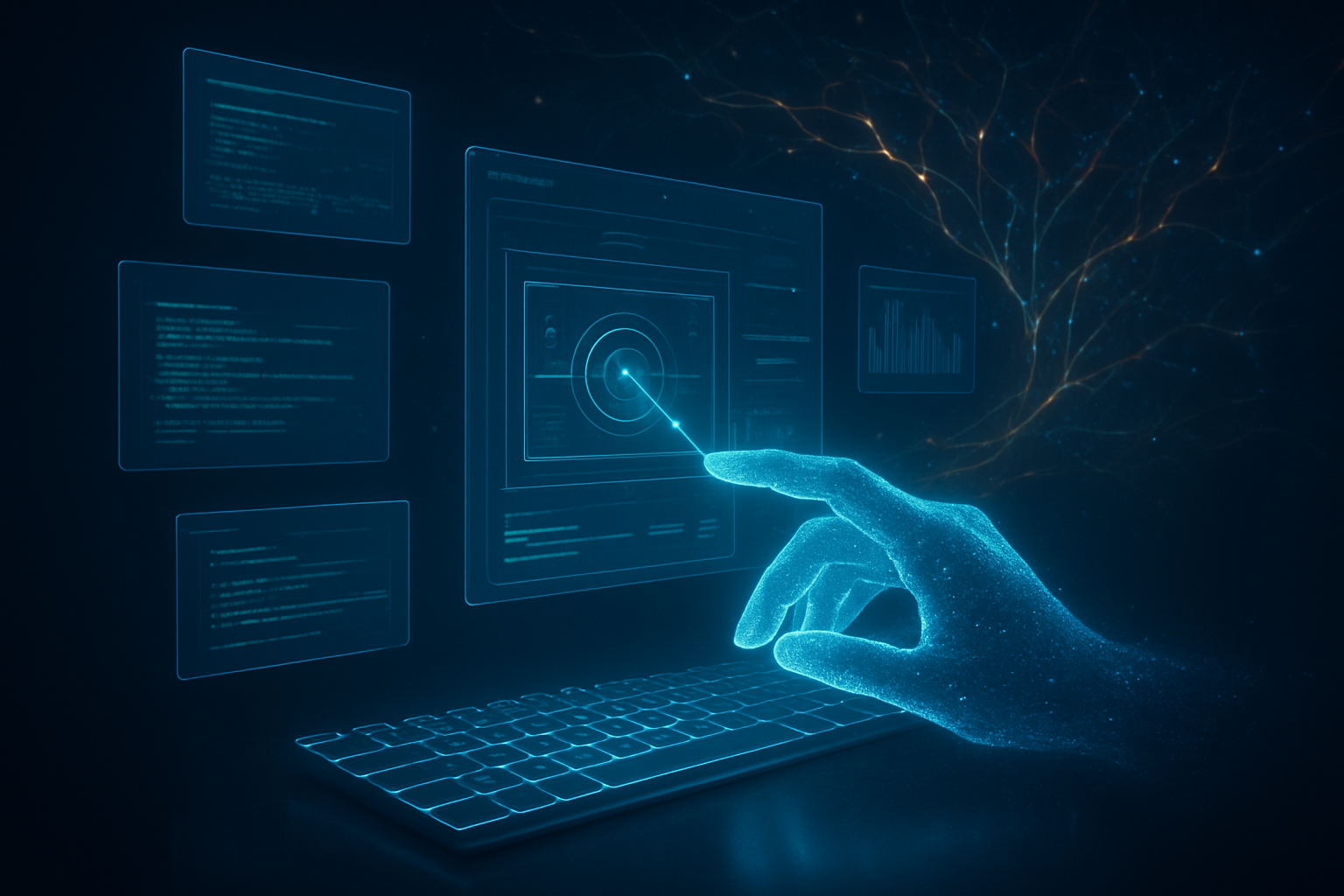
    In a definitive shift for the artificial intelligence industry, Anthropic has moved beyond the era of static text generation and into the realm of autonomous action. With the introduction and subsequent evolution of its "Computer Use" capability for the Claude 3.5 Sonnet model—and its recent integration into the powerhouse Claude 4 series—the company has fundamentally changed how humans interact with software. No longer confined to a chat interface, Claude can now "see" a digital desktop, move a cursor, click buttons, and type text, effectively operating a computer in the same manner as a human professional.

    This development marks the transition from Generative AI to "Agentic AI." By treating the computer screen as a visual environment to be navigated rather than a set of code-based APIs to be integrated, Anthropic has bypassed the traditional "walled gardens" of software. As of January 6, 2026, what began as an experimental public beta has matured into a cornerstone of enterprise automation, enabling multi-step workflows that span across disparate applications like spreadsheets, web browsers, and internal databases without requiring custom integrations for each tool.

    The Mechanics of Digital Agency: How Claude Navigates the Desktop

    The technical breakthrough behind "Computer Use" lies in its "General Skill" approach. Unlike previous automation attempts that relied on brittle scripts or specific back-end connectors, Anthropic trained Claude 3.5 Sonnet to interpret the Graphical User Interface (GUI) directly. The model functions through a high-frequency "vision-action loop": it captures a screenshot of the current screen, analyzes the pixel coordinates of UI elements, and generates precise commands for mouse movements and keystrokes. This allows the model to perform complex tasks—such as researching a lead on LinkedIn, cross-referencing their history in a CRM, and drafting a personalized outreach email—entirely through the front-end interface.

    Technical specifications for this capability have advanced rapidly. While the initial October 2024 release utilized the computer_20241022 tool version, the current Claude 4.5 architecture employs sophisticated spatial reasoning that supports high-resolution displays and complex gestures like "drag-and-drop" and "triple-click." To handle the latency and cost of processing constant visual data, Anthropic utilizes an optimized base64 encoding for screenshots, allowing the model to "glance" at the screen every few seconds to verify its progress. Industry experts have noted that this approach is significantly more robust than traditional Robotic Process Automation (RPA), as the AI can "reason" its way through unexpected pop-ups or UI changes that would typically break a standard script.

    The AI research community initially reacted with a mix of awe and caution. On the OSWorld benchmark—a rigorous test of an AI’s ability to perform human-like tasks on a computer—Claude 3.5 Sonnet originally scored 14.9%, a modest but groundbreaking figure compared to the sub-10% scores of its predecessors. However, as of early 2026, the latest iterations have surged past the 60% mark. This leap in reliability has silenced skeptics who argued that visual-based navigation would be too prone to "hallucinations in action," where an agent might click the wrong button and cause irreversible data errors.

    The Battle for the Desktop: Competitive Implications for Tech Giants

    Anthropic’s move has ignited a fierce "Agent War" among Silicon Valley’s elite. While Anthropic has positioned itself as the "Frontier B2B" choice, focusing on developer-centric tools and enterprise sovereignty, it faces stiff competition from OpenAI, Microsoft (NASDAQ: MSFT), and Alphabet (NASDAQ: GOOGL). OpenAI recently scaled its "Operator" agent to all ChatGPT Pro users, focusing on a reasoning-first approach that excels at consumer-facing tasks like travel booking. Meanwhile, Google has leveraged its dominance in the browser market by integrating "Project Jarvis" directly into Chrome, turning the world’s most popular browser into a native agentic environment.

    For Microsoft (NASDAQ: MSFT), the response has been to double down on operating system integration. With "Windows UFO" (UI-Focused Agent), Microsoft aims to make the entire Windows environment "agent-aware," allowing AI to control native legacy applications that lack modern APIs. However, Anthropic’s strategic partnership with Amazon (NASDAQ: AMZN) and its availability on the AWS Bedrock platform have given it a significant advantage in the enterprise sector. Companies are increasingly choosing Anthropic for its "sandbox-first" mentality, which allows developers to run these agents in isolated virtual machines to prevent unauthorized access to sensitive corporate data.

    Early partners have already demonstrated the transformative potential of this tech. Replit, the popular cloud coding platform, uses Claude’s computer use capabilities to allow its "Replit Agent" to autonomously test and debug user interfaces. Canva has integrated the technology to automate complex design workflows, such as batch-editing assets across multiple browser tabs. Even in the service sector, companies like DoorDash (NASDAQ: DASH) and Asana (NYSE: ASAN) have explored using these agents to bridge the gap between their proprietary platforms and the messy, un-integrated world of legacy vendor websites.

    Societal Shifts and the "Agentic" Economy

    The wider significance of "Computer Use" extends far beyond technical novelty; it represents a fundamental shift in the labor economy. As AI agents become capable of handling routine administrative tasks—filling out forms, managing calendars, and reconciling invoices—the definition of "knowledge work" is being rewritten. Analysts from Gartner and Forrester suggest that we are entering an era where the primary skill for office workers will shift from "execution" to "orchestration." Instead of performing a task, employees will supervise a fleet of agents that perform the tasks for them.

    However, this transition is not without significant concerns. The ability for an AI to control a computer raises profound security and safety questions. A model that can click buttons can also potentially click "Send" on a fraudulent wire transfer or "Delete" on a critical database. To mitigate these risks, Anthropic has implemented "Safety-by-Design" layers, including real-time classifiers that block the model from interacting with high-risk domains like social media or government portals. Furthermore, the industry is gravitating toward a "Human-in-the-Loop" (HITL) model, where high-stakes actions require a physical click from a human supervisor before the agent can proceed.

    Comparisons to previous AI milestones are frequent. Many experts view the release of "Computer Use" as the "GPT-3 moment" for robotics and automation. Just as GPT-3 proved that language could be modeled at scale, Claude 3.5 Sonnet proved that the human-computer interface itself could be modeled as a visual environment. This has paved the way for a more unified AI landscape, where the distinction between a "chatbot" and a "software user" is rapidly disappearing.

    The Roadmap to 2029: What Lies Ahead

    Looking toward the next 24 to 36 months, the trajectory of agentic AI suggests a "death of the app" for many use cases. Experts predict that by 2028, a significant portion of user interactions will move away from native application interfaces and toward "intent-based" commands. Instead of opening a complex ERP system, a user might simply tell their agent, "Adjust the Q3 budget based on the new tax law," and the agent will navigate the necessary software to execute the request. This "agentic front-end" could make software complexity invisible to the end-user.

    The next major challenge for Anthropic and its peers will be "long-horizon reliability." While current models can handle tasks lasting a few minutes, the goal is to create agents that can work autonomously for days or weeks—monitoring a project's progress, responding to emails, and making incremental adjustments to a workflow. This will require breakthroughs in "agentic memory," allowing the AI to remember its progress and context across long periods without getting lost in "context window" limitations.

    Furthermore, we can expect a push toward "on-device" agentic AI. As hardware manufacturers develop specialized NPU (Neural Processing Unit) chips, the vision-action loop that currently happens in the cloud may move directly onto laptops and smartphones. This would not only reduce latency but also enhance privacy, as the screenshots of a user's desktop would never need to leave their local device.

    Conclusion: A New Chapter in Human-AI Collaboration

    Anthropic’s "Computer Use" capability has effectively broken the "fourth wall" of artificial intelligence. By giving Claude the ability to interact with the world through the same interfaces humans use, Anthropic has created a tool that is as versatile as the software it controls. The transition from a beta experiment in late 2024 to a core enterprise utility in 2026 marks one of the fastest adoption curves in the history of computing.

    As we look forward, the significance of this development in AI history cannot be overstated. It is the moment AI stopped being a consultant and started being a collaborator. While the long-term impact on the workforce and digital security remains a subject of intense debate, the immediate utility of these agents is undeniable. In the coming weeks and months, the tech industry will be watching closely as Claude 4.5 and its competitors attempt to master increasingly complex environments, moving us closer to a future where the computer is no longer a tool we use, but a partner we direct.


    This content is intended for informational purposes only and represents analysis of current AI developments.

    TokenRing AI delivers enterprise-grade solutions for multi-agent AI workflow orchestration, AI-powered development tools, and seamless remote collaboration platforms.
    For more information, visit https://www.tokenring.ai/.

  • The Dawn of the Internet of Agents: Anthropic and Linux Foundation Launch the Agentic AI Foundation

    The Dawn of the Internet of Agents: Anthropic and Linux Foundation Launch the Agentic AI Foundation

    In a move that signals a seismic shift in the artificial intelligence landscape, Anthropic and the Linux Foundation have officially launched the Agentic AI Foundation (AAIF). Announced on December 9, 2025, this collaborative initiative marks a transition from the era of conversational chatbots to a future defined by autonomous, interoperable AI agents. By establishing a neutral, open-governance body, the partnership aims to prevent the "siloization" of agentic technology, ensuring that the next generation of AI can work across platforms, tools, and organizations without the friction of proprietary barriers.

    The significance of this partnership cannot be overstated. As AI agents begin to handle real-world tasks—from managing complex software deployments to orchestrating multi-step business workflows—the need for a standardized "plumbing" system has become critical. The AAIF brings together a powerhouse coalition, including the Linux Foundation, Anthropic, OpenAI, and Block (NYSE: SQ), to provide the open-source frameworks and safety protocols necessary for these agents to operate reliably and at scale.

    A Unified Architecture for Autonomous Intelligence

    The technical cornerstone of the Agentic AI Foundation is the contribution of several high-impact "seed" projects designed to standardize how AI agents interact with the world. Leading the charge is Anthropic’s Model Context Protocol (MCP), a universal open standard that allows AI models to connect seamlessly to external data sources and tools. Before this standardization, developers were forced to write custom integrations for every specific tool an agent needed to access. With MCP, an agent built on any model can "browse" and utilize a library of thousands of public servers, drastically reducing the complexity of building autonomous systems.

    In addition to MCP, the foundation has integrated OpenAI’s AGENTS.md specification. This is a markdown-based protocol that lives within a codebase, providing AI coding agents with clear, project-specific instructions on how to handle testing, builds, and repository-specific rules. Complementing these is Goose, an open-source framework contributed by Block (NYSE: SQ), which provides a local-first environment for building agentic workflows. Together, these technologies move the industry away from "prompt engineering" and toward a structured, programmatic way of defining agent behavior and environmental interaction.

    This approach differs fundamentally from previous AI development cycles, which were largely characterized by "walled gardens" where companies like Google (NASDAQ: GOOGL) and Microsoft (NASDAQ: MSFT) built internal, proprietary ecosystems. By moving these protocols to the Linux Foundation, the industry is betting on a community-led model similar to the one that powered the growth of the internet and cloud computing. Initial reactions from the research community have been overwhelmingly positive, with experts noting that these standards will likely do for AI agents what HTTP did for the World Wide Web.

    Reshaping the Competitive Landscape for Tech Giants and Startups

    The formation of the AAIF has immediate and profound implications for the competitive dynamics of the tech industry. For major AI labs like Anthropic and OpenAI, contributing their core protocols to an open foundation is a strategic play to establish their technology as the industry standard. By making MCP the "lingua franca" of agent communication, Anthropic ensures that its models remain at the center of the enterprise AI ecosystem, even as competitors emerge.

    Tech giants like Amazon (NASDAQ: AMZN), Google (NASDAQ: GOOGL), and Microsoft (NASDAQ: MSFT)—all of whom are founding or platinum members—stand to benefit from the reduced integration costs and increased stability that come with open standards. For enterprises, the AAIF offers a "get out of jail free" card regarding vendor lock-in. Companies like Salesforce (NYSE: CRM), SAP (NYSE: SAP), and Oracle (NYSE: ORCL) can now build agentic features into their software suites knowing they will be compatible with the leading AI models of the day.

    However, this development may disrupt startups that were previously attempting to build proprietary "agent orchestration" layers. With the foundation providing these layers for free as open-source projects, the value proposition for many AI middleware startups has shifted overnight. Success in the new "agentic" economy will likely depend on who can provide the best specialized agents and data services, rather than who owns the underlying communication protocols.

    The Broader Significance: From Chatbots to the "Internet of Agents"

    The launch of the Agentic AI Foundation represents a maturation of the AI field. We are moving beyond the "wow factor" of generative text and into the practical reality of autonomous systems that can execute tasks. This shift mirrors the early days of the Cloud Native Computing Foundation (CNCF), which standardized containerization and paved the way for modern cloud infrastructure. By creating the AAIF, the Linux Foundation is essentially building the "operating system" for the future of work.

    There are, however, significant concerns that the foundation must address. As agents gain more autonomy, issues of security, identity, and accountability become paramount. The AAIF is working on the SLIM protocol (Secure Low Latency Interactive Messaging) to ensure that agents can verify each other's identities and operate within secure boundaries. There is also the perennial concern regarding the influence of "Big Tech." While the foundation is open, the heavy involvement of trillion-dollar companies has led some critics to wonder if the standards will be steered in ways that favor large-scale compute providers over smaller, decentralized alternatives.

    Despite these concerns, the move is a clear acknowledgment that the future of AI is too big for any one company to control. The comparison to the early days of the Linux kernel is apt; just as Linux became the backbone of the enterprise server market, the AAIF aims to make its frameworks the backbone of the global AI economy.

    The Horizon: Multi-Agent Orchestration and Beyond

    Looking ahead, the near-term focus of the AAIF will be the expansion of the MCP ecosystem. We can expect a flood of new "MCP servers" that allow AI agents to interact with everything from specialized medical databases to industrial control systems. In the long term, the goal is "agent-to-agent" collaboration, where a travel agent AI might negotiate directly with a hotel's booking agent AI to finalize a complex itinerary without human intervention.

    The challenges remaining are not just technical, but also legal and ethical. How do we assign liability when an autonomous agent makes a financial error? How do we ensure that "agentic" workflows don't lead to unforeseen systemic risks in global markets? Experts predict that the next two years will be a period of intense experimentation, as the AAIF works to solve these "governance of autonomy" problems.

    A New Chapter in AI History

    The partnership between Anthropic and the Linux Foundation to create the Agentic AI Foundation is a landmark event that will likely be remembered as the moment the AI industry "grew up." By choosing collaboration over closed ecosystems, these organizations have laid the groundwork for a more transparent, interoperable, and powerful AI future.

    The key takeaway for businesses and developers is clear: the age of the isolated chatbot is ending, and the era of the interconnected agent has begun. In the coming weeks and months, the industry will be watching closely as the first wave of AAIF-certified agents hits the market. Whether this initiative can truly prevent the fragmentation of AI remains to be seen, but for now, the Agentic AI Foundation represents the most significant step toward a unified, autonomous digital world.


    This content is intended for informational purposes only and represents analysis of current AI developments.

    TokenRing AI delivers enterprise-grade solutions for multi-agent AI workflow orchestration, AI-powered development tools, and seamless remote collaboration platforms.
    For more information, visit https://www.tokenring.ai/.
  • The Trillion-Agent Engine: How 2026’s Hardware Revolution is Powering the Rise of Autonomous AI

    The Trillion-Agent Engine: How 2026’s Hardware Revolution is Powering the Rise of Autonomous AI

    As of early 2026, the artificial intelligence industry has undergone a seismic shift from "generative" models that merely produce content to "agentic" systems that plan, reason, and execute complex multi-step tasks. This transition has been catalyzed by a fundamental redesign of silicon architecture. We have moved past the era of the monolithic GPU; today, the tech world is witnessing the "Agentic AI" hardware revolution, where chipsets are no longer judged solely by raw FLOPS, but by their ability to orchestrate thousands of autonomous software agents simultaneously.

    This revolution is not just a software update—it is a total reimagining of the compute stack. With the mass production of NVIDIA’s Rubin architecture and Intel’s 18A process node reaching high-volume manufacturing, the hardware bottlenecks that once throttled AI agents—specifically CPU-to-GPU latency and memory bandwidth—are being systematically dismantled. The result is a new "Trillion-Agent Economy" where AI agents act as autonomous economic actors, requiring hardware that can handle the "bursty" and logic-heavy nature of real-time reasoning.

    The Architecture of Autonomy: Rubin, 18A, and the Death of the CPU Bottleneck

    At the heart of this hardware shift is the NVIDIA (NASDAQ: NVDA) Rubin architecture, which officially entered the market in early 2026. Unlike its predecessor, Blackwell, Rubin is built for the "managerial" logic of agentic AI. The platform features the Vera CPU—NVIDIA’s first fully custom Arm-compatible processor using "Olympus" cores—designed specifically to handle the "data shuffling" required by multi-agent workflows. In agentic AI, the CPU acts as the orchestrator, managing task planning and tool-calling logic while the GPU handles heavy inference. By utilizing a bidirectional NVLink-C2C (Chip-to-Chip) interconnect with 1.8 TB/s of bandwidth, NVIDIA has achieved total cache coherency, allowing the "thinking" and "doing" parts of the AI to share data without the latency penalties of previous generations.

    Simultaneously, Intel (NASDAQ: INTC) has successfully reached high-volume manufacturing on its 18A (1.8nm class) process node. This milestone is critical for agentic AI due to two key technologies: RibbonFET (Gate-All-Around transistors) and PowerVia (backside power delivery). Agentic workloads are notoriously "bursty"—they require sudden, intense power for a reasoning step followed by a pause during tool execution. Intel’s PowerVia reduces voltage drop by 30%, ensuring that these rapid transitions don't lead to "compute stalls." Intel’s Panther Lake (Core Ultra Series 3) chips are already leveraging 18A to deliver over 180 TOPS (Trillion Operations Per Second) of platform throughput, enabling "Physical AI" agents to run locally on devices with zero cloud latency.

    The third pillar of this revolution is the transition to HBM4 (High Bandwidth Memory 4). In early 2026, HBM4 has become the standard for AI accelerators, doubling the interface width to 2048-bit and reaching bandwidths exceeding 2.0 TB/s per stack. This is vital for managing the massive Key-Value (KV) caches required for long-context reasoning. For the first time, the "base die" of the HBM stack is manufactured using a 12nm logic process by TSMC (NYSE: TSM), allowing for "near-memory processing." This means certain agentic tasks, like data-routing or memory retrieval, can be offloaded to the memory stack itself, drastically reducing energy consumption and eliminating the "Memory Wall" that hindered 2024-era agents.

    The Battle for the Orchestration Layer: NVIDIA vs. AMD vs. Custom Silicon

    The shift to agentic AI has reshaped the competitive landscape. While NVIDIA remains the dominant force, AMD (NASDAQ: AMD) has mounted a significant challenge with its Instinct MI400 series and the "Helios" rack-scale strategy. AMD’s CDNA 5 architecture focuses on massive memory capacity—offering up to 432GB of HBM4—to appeal to hyperscalers like Meta (NASDAQ: META) and Microsoft (NASDAQ: MSFT). AMD is positioning itself as the "open" alternative, championing the Ultra Accelerator Link (UALink) to prevent the vendor lock-in associated with NVIDIA’s proprietary NVLink.

    Meanwhile, the major AI labs are moving toward vertical integration to lower the "Token-per-Dollar" cost of running agents. Google (NASDAQ: GOOGL) recently announced its TPU v7 (Ironwood), the first processor designed specifically for "test-time compute"—the ability for a chip to allocate more reasoning cycles to a single complex query. Google’s "SparseCore" technology in the TPU v7 is optimized for handling the ultra-large embeddings and reasoning steps common in multi-agent orchestration.

    OpenAI, in collaboration with Broadcom (NASDAQ: AVGO), has also begun deploying its own custom "XPU" in 2026. This internal silicon is designed to move OpenAI from a research lab to a vertically integrated platform, allowing them to run their most advanced agentic workflows—like those seen in the o1 model series—on proprietary hardware. This move is seen as a direct attempt to bypass the "NVIDIA tax" and secure the massive compute margins necessary for a trillion-agent ecosystem.

    Beyond Inference: State Management and the Energy Challenge

    The wider significance of this hardware revolution lies in the transition from "inference" to "state management." In 2024, the goal was simply to generate a fast response. In 2026, the goal is to maintain the "memory" and "state" of billions of active agent threads simultaneously. This requires hardware that can handle long-term memory retrieval from vector databases at scale. The introduction of HBM4 and low-latency interconnects has finally made it possible for agents to "remember" previous steps in a multi-day task without the system slowing to a crawl.

    However, this leap in capability brings significant concerns regarding energy consumption. While architectures like Intel 18A and NVIDIA Rubin are more efficient per-token, the sheer volume of "agentic thinking" is driving up total power demand. The industry is responding with "heterogeneous compute"—dynamically mapping tasks to the most efficient engine. For example, a "prefill" task (understanding a prompt) might run on an NPU, while the "reasoning" happens on the GPU, and the "tool-call" (executing code) is managed by the CPU. This zero-copy data sharing between "thinker" and "doer" is the only way to keep the energy costs of the Trillion-Agent Economy sustainable.

    Comparatively, this milestone is being viewed as the "Broadband Era" of AI. If the early 2020s were the "Dial-up" phase—characterized by slow, single-turn interactions—2026 is the year AI became "Always-On" and autonomous. The focus has moved from how large a model is to how effectively it can act within the world.

    The Horizon: Edge Agents and Physical AI

    Looking ahead to late 2026 and 2027, the next frontier is "Edge Agentic AI." With the success of Intel 18A and similar advancements from Apple (NASDAQ: AAPL), we expect to see autonomous agents move off the cloud and onto local devices. This will enable "Physical AI"—agents that can control robotics, manage smart cities, or act as high-fidelity personal assistants with total privacy and zero latency.

    The primary challenge remains the standardization of agent communication. While Anthropic has championed the Model Context Protocol (MCP) as the "USB-C of AI," the industry still lacks a universal hardware-level language for agent-to-agent negotiation. Experts predict that the next two years will see the emergence of "Orchestration Accelerators"—specialized silicon blocks dedicated entirely to the logic of agentic collaboration, further offloading these tasks from the general-purpose cores.

    A New Era of Computing

    The hardware revolution of 2026 marks the end of AI as a passive tool and its birth as an active partner. The combination of NVIDIA’s Rubin, Intel’s 18A, and the massive throughput of HBM4 has provided the physical foundation for agents that don't just talk, but act. Key takeaways from this development include the shift to heterogeneous compute, the elimination of CPU bottlenecks through custom orchestration cores, and the rise of custom silicon among AI labs.

    This development is perhaps the most significant in AI history since the introduction of the Transformer. It represents the move from "Artificial Intelligence" to "Artificial Agency." In the coming months, watch for the first wave of "Agent-Native" applications that leverage this hardware to perform tasks that were previously impossible, such as autonomous software engineering, real-time supply chain management, and complex scientific discovery.


    This content is intended for informational purposes only and represents analysis of current AI developments.

    TokenRing AI delivers enterprise-grade solutions for multi-agent AI workflow orchestration, AI-powered development tools, and seamless remote collaboration platforms.
    For more information, visit https://www.tokenring.ai/.
  • The Rubin Revolution: NVIDIA Unveils the 3nm Roadmap to Trillion-Parameter Agentic AI at CES 2026

    The Rubin Revolution: NVIDIA Unveils the 3nm Roadmap to Trillion-Parameter Agentic AI at CES 2026

    In a landmark keynote at CES 2026, NVIDIA (NASDAQ: NVDA) CEO Jensen Huang officially ushered in the "Rubin Era," unveiling a comprehensive hardware roadmap that marks the most significant architectural shift in the company’s history. While the previous Blackwell generation laid the groundwork for generative AI, the newly announced Rubin (R100) platform is engineered for a world of "Agentic AI"—autonomous systems capable of reasoning, planning, and executing complex multi-step workflows without constant human intervention.

    The announcement signals a rapid transition from the Blackwell Ultra (B300) "bridge" systems of late 2025 to a completely overhauled architecture in 2026. By leveraging TSMC (NYSE: TSM) 3nm manufacturing and the next-generation HBM4 memory standard, NVIDIA is positioning itself to maintain an iron grip on the global data center market, providing the massive compute density required to train and deploy trillion-parameter "world models" that bridge the gap between digital intelligence and physical robotics.

    From Blackwell to Rubin: A Technical Leap into the 3nm Era

    The centerpiece of the CES 2026 presentation was the Rubin R100 GPU, the successor to the highly successful Blackwell architecture. Fabricated on TSMC’s enhanced 3nm (N3P) process node, the R100 represents a major leap in transistor density and energy efficiency. Unlike its predecessors, Rubin utilizes a sophisticated chiplet-based design using CoWoS-L packaging with a 4x reticle size, allowing NVIDIA to pack more compute units into a single package than ever before. This transition to 3nm is not merely a shrink; it is a fundamental redesign that enables the R100 to deliver a staggering 50 Petaflops of dense FP4 compute—a 3.3x increase over the Blackwell B300.

    Crucial to this performance leap is the integration of HBM4 memory. The Rubin R100 features 8 stacks of HBM4, providing up to 15 TB/s of memory bandwidth, effectively shattering the "memory wall" that has bottlenecked previous AI clusters. This is paired with the new Vera CPU, which replaces the Grace CPU. The Vera CPU is powered by 88 custom "Olympus" cores built on the Arm (NASDAQ: ARM) v9.2-A architecture. These cores support simultaneous multithreading (SMT) and are designed to run within an ultra-efficient 50W power envelope, ensuring that the "Vera-Rubin" Superchip can handle the intense logic and data shuffling required for real-time AI reasoning.

    The performance gains are most evident at the rack scale. NVIDIA’s new Vera Rubin NVL144 system achieves 3.6 Exaflops of FP4 inference, representing a 2.5x to 3.3x performance leap over the Blackwell-based NVL72. This massive jump is facilitated by NVLink 6, which doubles bidirectional bandwidth to 3.6 TB/s. This interconnect technology allows thousands of GPUs to act as a single, massive compute engine, a requirement for the emerging class of agentic AI models that require near-instantaneous data movement across the entire cluster.

    Consolidating Data Center Dominance and the Competitive Landscape

    NVIDIA’s aggressive roadmap places immense pressure on competitors like AMD (NASDAQ: AMD) and Intel (NASDAQ: INTC), who are still scaling their 5nm and 4nm-based solutions. By moving to 3nm so decisively, NVIDIA is widening the "moat" around its data center business. The Rubin platform is specifically designed to be the backbone for hyperscalers like Microsoft (NASDAQ: MSFT), Google (NASDAQ: GOOGL), and Meta (NASDAQ: META), all of whom are currently racing to develop proprietary agentic frameworks. The Blackwell Ultra B300 will remain the mainstream workhorse for general enterprise AI, while the Rubin R100 is being positioned as the "bleeding-edge" flagship for the world’s most advanced AI research labs.

    The strategic significance of the Vera CPU and its Olympus cores cannot be overstated. By deepening its integration with the Arm ecosystem, NVIDIA is reducing the industry's reliance on traditional x86 architectures for AI workloads. This vertical integration—owning the GPU, the CPU, the interconnect, and the software stack—gives NVIDIA a unique advantage in optimizing performance-per-watt. For startups and AI labs, this means the cost of training trillion-parameter models could finally begin to stabilize, even as the complexity of those models continues to skyrocket.

    The Dawn of Agentic AI and the Trillion-Parameter Frontier

    The move toward the Rubin architecture reflects a broader shift in the AI landscape from "Chatbots" to "Agents." Agentic AI refers to systems that can autonomously use tools, browse the web, and interact with software environments to achieve a goal. These systems require far more than just predictive text; they require "World Models" that understand physical laws and cause-and-effect. The Rubin R100’s FP4 compute performance is specifically tuned for these reasoning-heavy tasks, allowing for the low-latency inference necessary for an AI agent to "think" and act in real-time.

    Furthermore, NVIDIA is tying this hardware roadmap to its "Physical AI" initiatives, such as Project GR00T for humanoid robotics and DRIVE Thor for autonomous vehicles. The trillion-parameter models of 2026 will not just live in servers; they will power the brains of machines operating in the real world. This transition raises significant questions about the energy demands of the global AI infrastructure. While the 3nm process is more efficient, the sheer scale of the Rubin deployments will require unprecedented power management solutions, a challenge NVIDIA is addressing through its liquid-cooled NVL-series rack designs.

    Future Outlook: The Path to Rubin Ultra and Beyond

    Looking ahead, NVIDIA has already teased the "Rubin Ultra" for 2027, which is expected to feature 12 stacks of HBM4e and potentially push FP4 performance toward the 100 Petaflop mark per GPU. The company is also signaling a move toward 2nm manufacturing in the late 2020s, continuing its relentless "one-year release cadence." In the near term, the industry will be watching the initial rollout of the Blackwell Ultra B300 in late 2025, which will serve as the final testbed for the software ecosystem before the Rubin transition begins in earnest.

    The primary challenge facing NVIDIA will be supply chain execution. As the sole major customer for TSMC’s most advanced packaging and 3nm nodes, any manufacturing hiccups could delay the global AI roadmap. Additionally, as AI agents become more autonomous, the industry will face mounting pressure to implement robust safety guardrails. Experts predict that the next 18 months will see a surge in "Sovereign AI" projects, as nations rush to build their own Rubin-powered data centers to ensure technological independence.

    A New Benchmark for the Intelligence Age

    The unveiling of the Rubin roadmap at CES 2026 is more than a hardware refresh; it is a declaration of the next phase of the digital revolution. By combining the Vera CPU’s 88 Olympus cores with the Rubin GPU’s massive FP4 throughput, NVIDIA has provided the industry with the tools necessary to move beyond generative text and into the realm of truly autonomous, reasoning machines. The transition from Blackwell to Rubin marks the moment when AI moves from being a tool we use to a partner that acts on our behalf.

    As we move into 2026, the tech industry will be focused on how quickly these systems can be deployed and whether the software ecosystem can keep pace with such rapid hardware advancements. For now, NVIDIA remains the undisputed architect of the AI era, and the Rubin platform is the blueprint for the next trillion parameters of human progress.


    This content is intended for informational purposes only and represents analysis of current AI developments.

    TokenRing AI delivers enterprise-grade solutions for multi-agent AI workflow orchestration, AI-powered development tools, and seamless remote collaboration platforms.
    For more information, visit https://www.tokenring.ai/.
  • The Jarvis Revolution: How Google’s Leaked AI Agent Redefined the Web by 2026

    The Jarvis Revolution: How Google’s Leaked AI Agent Redefined the Web by 2026

    In late 2024, a brief technical slip-up on the Chrome Web Store offered the world its first glimpse into the future of the internet. A prototype extension titled "Project Jarvis" was accidentally published by Google, describing itself as a "helpful companion that surfs the web with you." While the extension was quickly pulled, the leak confirmed what many had suspected: Alphabet Inc. (NASDAQ: GOOGL) was moving beyond simple chatbots and into the realm of "Computer-Using Agents" (CUAs) capable of taking over the browser to perform complex, multi-step tasks on behalf of the user.

    Fast forward to today, January 1, 2026, and that accidental leak is now recognized as the opening salvo in a war for the "AI-first" browser. What began as a experimental extension has evolved into a foundational layer of the Chrome ecosystem, fundamentally altering how billions of people interact with the web. By moving from a model of "Search and Click" to "Command and Complete," Google has effectively turned the world's most popular browser into an autonomous agent that handles everything from grocery shopping to deep-dive academic research without the user ever needing to touch a scroll bar.

    The Vision-Action Loop: Inside the Jarvis Architecture

    Technically, Project Jarvis represented a departure from the "API-first" approach of early AI integrations. Instead of relying on specific back-end connections to websites, Jarvis was built on a "vision-action loop" powered by the Gemini 2.0 and later Gemini 3.0 multimodal models. This allowed the AI to "see" the browser window exactly as a human does. By taking frequent screenshots and processing them through Gemini’s vision capabilities, the agent could identify buttons, interpret text fields, and navigate complex UI elements like drop-down menus and calendars. This approach allowed Jarvis to work on virtually any website, regardless of whether that site had built-in AI support.

    The capability of Jarvis—now largely integrated into the "Gemini in Chrome" suite—is defined by its massive context window, which by mid-2025 reached upwards of 2 million tokens. This enables the agent to maintain "persistent intent" across dozens of tabs. For example, a user can command the agent to "Find a flight to Tokyo under $900 in March, cross-reference it with my Google Calendar for conflicts, and find a hotel near Shibuya with a gym." The agent then navigates Expedia, Google Calendar, and TripAdvisor simultaneously, synthesizing the data and presenting a final recommendation or even completing the booking after a single biometric confirmation from the user.

    Initial reactions from the AI research community in early 2025 were a mix of awe and apprehension. Experts noted that while the vision-based approach bypassed the need for fragile web scrapers, it introduced significant latency and compute costs. However, Google’s optimization of "distilled" Gemini models specifically for browser tasks significantly reduced these hurdles by the end of 2025. The introduction of "Project Mariner"—the high-performance evolution of Jarvis—saw success rates on the WebVoyager benchmark jump to over 83%, a milestone that signaled the end of the "experimental" phase for agentic AI.

    The Agentic Arms Race: Market Positioning and Disruption

    The emergence of Project Jarvis forced a rapid realignment among tech giants. Alphabet Inc. (NASDAQ: GOOGL) found itself in a direct "Computer-Using Agent" (CUA) battle with Anthropic and Microsoft (NASDAQ: MSFT)-backed OpenAI. While Anthropic’s "Computer Use" feature for Claude 3.5 Sonnet focused on a platform-agnostic approach—allowing the AI to control the entire operating system—Google doubled down on the browser. This strategic focus leveraged Chrome's 65% market share, turning the browser into a defensive moat against the rise of "Answer Engines" like Perplexity.

    This shift has significantly disrupted the traditional search-ad model. As agents began to "consume" the web on behalf of users, the traditional "blue link" economy faced an existential crisis. In response, Google pivoted toward "Agentic Commerce." By late 2025, Google began monetizing the actions performed by Jarvis, taking small commissions on transactions completed through the agent, such as flight bookings or retail purchases. This move allowed Google to maintain its revenue streams even as traditional search volume began to fluctuate in the face of AI-driven automation.

    Furthermore, the integration of Jarvis into the Chrome architecture served as a regulatory defense. Following various antitrust rulings regarding search defaults, Google’s transition to an "AI-first browser" allowed it to offer a vertically integrated experience that competitors could not easily replicate. By embedding the agent directly into the browser's "Omnibox" (the address bar), Google ensured that Gemini remained the primary interface for the "Action Web," making the choice of a default search engine increasingly irrelevant to the end-user experience.

    The Death of the Blue Link: Ethical and Societal Implications

    The wider significance of Project Jarvis lies in the transition from the "Information Age" to the "Action Age." For decades, the internet was a library where users had to find and synthesize information themselves. With the mainstreaming of agentic AI throughout 2025, the internet has become a service economy where the browser acts as a digital concierge. This fits into a broader trend of "Invisible Computing," where the UI begins to disappear, replaced by natural language intent.

    However, this shift has not been without controversy. Privacy advocates have raised significant concerns regarding the "vision-based" nature of Jarvis. For the agent to function, it must effectively "watch" everything the user does within the browser, leading to fears of unprecedented data harvesting. Google addressed this in late 2025 by introducing "On-Device Agentic Processing," which keeps the visual screenshots of a user's session within the local hardware's secure enclave, only sending anonymized metadata to the cloud for complex reasoning.

    Comparatively, the launch of Jarvis is being viewed by historians as a milestone on par with the release of the first graphical web browser, Mosaic. While Mosaic allowed us to see the web, Jarvis allowed us to put the web to work. The "Agentic Web" also poses challenges for web developers and small businesses; if an AI agent is the one visiting a site, traditional metrics like "time on page" or "ad impressions" become obsolete, forcing a total rethink of how digital value is measured and captured.

    Beyond the Browser: The Future of Autonomous Workflows

    Looking ahead, the evolution of Project Jarvis is expected to move toward "Multi-Agent Swarms." In these scenarios, a Jarvis-style browser agent will not work in isolation but will coordinate with other specialized agents. For instance, a "Research Agent" might gather data in Chrome, while a "Creative Agent" drafts a report in Google Docs, and a "Communication Agent" schedules a meeting to discuss the findings—all orchestrated through a single user prompt.

    In late 2025, Google teased "Antigravity," an agent-first development environment that uses the Jarvis backbone to allow AI to autonomously plan, code, and test software directly within a browser window. This suggests that the next frontier for Jarvis is not just consumer shopping, but professional-grade software engineering and data science. Experts predict that by 2027, the distinction between "using a computer" and "directing an AI" will have effectively vanished for most office tasks.

    The primary challenge remaining is "hallucination in action." While a chatbot hallucinating a fact is a minor nuisance, an agent hallucinating a purchase or a flight booking can have real-world financial consequences. Google is currently working on "Verification Loops," where the agent must provide visual proof of its intended action before the final execution, a feature expected to become standard across all CUA platforms by the end of 2026.

    A New Chapter in Computing History

    Project Jarvis began as a leaked extension, but it has ended up as the blueprint for the next decade of human-computer interaction. By successfully integrating Gemini into the very fabric of the Chrome browser, Alphabet Inc. has successfully navigated the transition from a search company to an agent company. The significance of this development cannot be overstated; it represents the first time that AI has moved from being a "consultant" we talk to, to a "worker" that acts on our behalf.

    As we enter 2026, the key takeaways are clear: the browser is no longer a passive window, but an active participant in our digital lives. The "AI-first" strategy has redefined the competitive landscape, placing a premium on "action" over "information." For users, this means a future with less friction and more productivity, though it comes at the cost of increased reliance on a few dominant AI ecosystems.

    In the coming months, watch for the expansion of Jarvis-style agents into mobile operating systems and the potential for "Cross-Platform Agents" that can jump between your phone, your laptop, and your smart home. The era of the autonomous agent is no longer a leak or a rumor—it is the new reality of the internet.


    This content is intended for informational purposes only and represents analysis of current AI developments.

    TokenRing AI delivers enterprise-grade solutions for multi-agent AI workflow orchestration, AI-powered development tools, and seamless remote collaboration platforms. For more information, visit https://www.tokenring.ai/.