Tag: Agentic Commerce

  • Walmart and OpenAI Forge Groundbreaking Alliance for AI-Driven Shopping via ChatGPT

    Walmart and OpenAI Forge Groundbreaking Alliance for AI-Driven Shopping via ChatGPT

    In a landmark announcement that sent ripples across the retail and technology sectors yesterday, October 14, 2025, retail behemoth Walmart (NYSE: WMT) officially unveiled a strategic partnership with artificial intelligence pioneer OpenAI. This collaboration is set to revolutionize the online shopping experience by integrating advanced AI capabilities directly into ChatGPT, allowing customers to engage in "agentic commerce" through conversational interfaces. The move signals a significant leap in how consumers will interact with e-commerce platforms, promising a future where shopping is not just personalized but proactively intelligent.

    This unprecedented alliance aims to transform the transactional nature of online retail into a seamless, intuitive, and highly personalized dialogue. By leveraging OpenAI's cutting-edge language models and newly introduced "Instant Checkout" feature, Walmart is positioning itself at the forefront of AI-powered commerce, redefining convenience and efficiency for its vast customer base and loyalty members across Walmart and Sam's Club. The immediate significance lies in the potential for mass adoption of truly conversational shopping, moving beyond the traditional search bar and into a dynamic, AI-guided purchasing journey.

    The Dawn of Agentic Commerce: A Technical Deep Dive into Conversational Retail

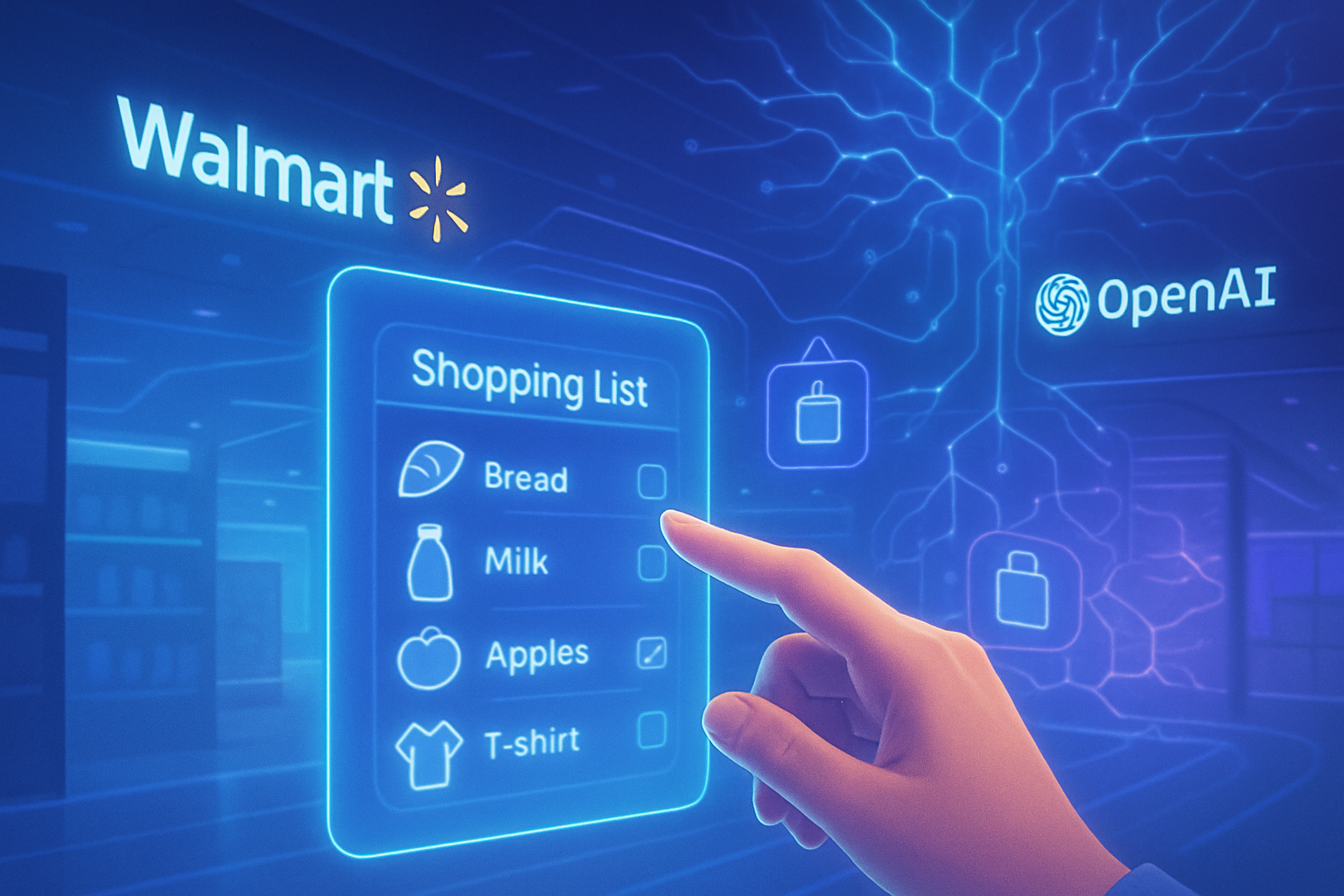
    The core of the Walmart-OpenAI partnership lies in its innovative approach to AI-driven shopping, fundamentally shifting from reactive search to proactive, "agentic commerce." At its heart, customers will be able to "Chat and Buy" directly within ChatGPT using natural language, either through text or voice commands. This goes far beyond simple product searches; the system is designed to understand complex requests and anticipate user needs. For instance, a user planning a "Taco Tuesday" dinner can simply ask ChatGPT to find all necessary ingredients, and the AI will curate a comprehensive grocery list, ready for purchase.

    Technically, this experience is powered by OpenAI's recently launched "Instant Checkout" feature, which enables direct purchases within the ChatGPT interface. This feature, initially rolled out for Etsy sellers and slated for Shopify (NYSE: SHOP) merchants, facilitates a frictionless transaction process, eliminating the need for users to navigate to external websites or applications. The underlying mechanism, dubbed "Agentic Commerce Protocol," was co-developed by OpenAI and Stripe (NYSE: STRIP), ensuring secure and efficient payment processing. Initially, the Instant Checkout system will support single-item purchases, with ambitious plans to expand to multi-item carts and additional geographical regions, signifying a phased but rapid deployment strategy.

    This approach dramatically differs from previous e-commerce models, which predominantly relied on keyword searches, curated product listings, and manual navigation. While some retailers have experimented with AI chatbots, their functionalities have largely been limited to customer service or basic product recommendations. The Walmart-OpenAI integration, however, introduces a truly multi-media, personalized, and contextual shopping experience. It's an AI that learns, plans, and predicts, effectively acting as a personal shopping assistant that evolves with the consumer's habits and preferences. Initial reactions from the AI research community and industry experts highlight this as a pivotal moment, demonstrating the practical application of large language models (LLMs) in transforming real-world consumer interactions at an unprecedented scale.

    Reshaping the Retail Landscape: Implications for AI Companies and Tech Giants

    This groundbreaking partnership between Walmart (NYSE: WMT) and OpenAI sends a clear signal to the entire tech and retail industry: AI is no longer just a backend optimization tool but a front-facing, revenue-generating engine. Walmart stands to benefit immensely, solidifying its position as an innovator in digital retail and potentially capturing a significant share of the burgeoning conversational commerce market. By being an early mover in integrating advanced LLMs into its core shopping experience, Walmart gains a strategic advantage over competitors, particularly Amazon (NASDAQ: AMZN), which has traditionally dominated online retail. While Amazon has its own AI capabilities (like Alexa), the direct, conversational "Chat and Buy" integration within a widely adopted platform like ChatGPT represents a novel and potentially more fluid user experience.

    For OpenAI, this collaboration is a massive validation of its generative AI capabilities and its strategic push into "agentic commerce." The partnership with a retail giant like Walmart demonstrates the commercial viability and scalability of its Instant Checkout and Agentic Commerce Protocol. This move positions OpenAI not just as a developer of foundational AI models but as a critical enabler of next-generation digital marketplaces. Other AI labs and tech companies will undoubtedly feel the pressure to innovate in similar conversational commerce spaces. Companies like Google (NASDAQ: GOOGL), Meta (NASDAQ: META), and Apple (NASDAQ: AAPL), all with significant AI investments and consumer-facing platforms, will likely accelerate their efforts to integrate sophisticated shopping functionalities into their own AI assistants and ecosystems to avoid being left behind.

    The potential disruption to existing products and services is substantial. Traditional e-commerce interfaces, comparison shopping sites, and even some niche shopping apps could face significant challenges as consumers gravitate towards the ease and intelligence of AI-driven conversational shopping. Market positioning will increasingly depend on the seamless integration of AI into the customer journey, with companies that can offer personalized, predictive, and frictionless experiences gaining a significant competitive edge. This partnership underscores a strategic shift where AI companies are becoming direct partners in consumer transactions, rather than just providing underlying technology, thereby reshaping the competitive dynamics across both the AI and retail sectors.

    The Broader AI Landscape: A Paradigm Shift in Consumer Interaction

    The Walmart-OpenAI partnership represents more than just a new feature; it signifies a profound shift in the broader AI landscape, particularly in how artificial intelligence is expected to interact with and serve consumers. This move towards "agentic commerce" aligns perfectly with the overarching trend of AI becoming more proactive and less reactive. Instead of merely responding to explicit commands, AI is now being designed to anticipate needs, plan complex tasks (like meal planning), and execute multi-step processes (like shopping and checkout) autonomously. This is a significant evolution from earlier AI applications, which were often siloed or offered limited interactive capabilities.

    The impacts are far-reaching. For consumers, it promises unparalleled convenience and personalization, potentially reducing decision fatigue and saving time. Imagine an AI that not only knows your dietary preferences but also your typical shopping list, prompting you to restock essentials before you even realize you're running low. However, this level of integration also raises potential concerns, particularly around data privacy and security. The linking of personal shopping habits and financial information to an AI platform necessitates robust safeguards and transparent data handling policies. There's also the question of algorithmic bias in product recommendations and the potential for over-reliance on AI for purchasing decisions, which could impact consumer autonomy.

    Comparing this to previous AI milestones, the Walmart-OpenAI collaboration stands out as a major step in the commercialization and mainstream adoption of advanced generative AI. While the introduction of voice assistants like Alexa and Google Assistant marked an initial foray into conversational AI, their shopping capabilities remained relatively rudimentary. This new partnership, leveraging the sophisticated understanding and generation capabilities of ChatGPT, pushes the boundaries into truly intelligent and transactional conversations. It echoes the transformative impact of early e-commerce platforms but with an added layer of AI-driven intelligence that fundamentally alters the user experience, moving from browsing to a guided, predictive interaction.

    Future Horizons: What's Next for AI-Driven Retail

    Looking ahead, the Walmart-OpenAI partnership is merely the beginning of a transformative era for AI-driven retail. In the near-term, we can expect the gradual rollout of the "Chat and Buy" feature to Walmart (NYSE: WMT) and Sam's Club customers across the US, initially focusing on single-item purchases. The expansion to multi-item carts and more complex shopping scenarios, such as subscription management and personalized recommendations based on evolving lifestyle needs, is a highly anticipated next step. Beyond basic transactions, the "Agentic Commerce Protocol" could evolve to integrate with smart home devices, automatically reordering groceries when stock is low, or suggesting recipes based on available ingredients and dietary goals.

    Long-term developments are poised to see AI becoming an indispensable personal shopping agent that understands not just what you want to buy, but why, when, and how you prefer to shop. This could lead to a hyper-personalized retail experience where AI anticipates needs even before they manifest, offering curated selections, exclusive deals, and proactive problem-solving. Potential applications extend beyond groceries to fashion, electronics, and even services, with AI assisting in booking appointments or managing subscriptions based on user preferences and schedules.

    However, several challenges need to be addressed for this vision to fully materialize. Ensuring the ethical use of AI, particularly concerning data privacy and algorithmic transparency, will be paramount. Developing robust security measures to protect sensitive customer data and financial information is crucial. Furthermore, refining the AI's understanding of nuanced human language and intent, especially in complex or ambiguous shopping scenarios, will require continuous development. Experts predict that the success of this model will spur other major retailers and tech companies to invest heavily in similar "agentic" AI solutions, leading to a highly competitive landscape where the most intelligent and trustworthy AI assistants will gain consumer loyalty. The evolution of the "Instant Checkout" feature to support a wider array of merchants and product categories will also be a key indicator of its broader market impact.

    The AI Retail Revolution: A Concluding Assessment

    The recent announcement of the partnership between Walmart (NYSE: WMT) and OpenAI to launch AI-driven shopping through ChatGPT marks a pivotal moment in the history of both artificial intelligence and retail. The key takeaway is the shift towards "agentic commerce," where AI moves beyond simple chatbots to become a proactive, intelligent assistant capable of understanding complex needs, planning purchases, and executing transactions directly within a conversational interface. This integration of OpenAI's advanced language models and "Instant Checkout" feature into Walmart's vast retail ecosystem is set to redefine consumer expectations for convenience, personalization, and efficiency in online shopping.

    This development holds immense significance in AI history, illustrating the maturation of large language models from experimental tools to commercially viable engines driving fundamental changes in consumer behavior. It underscores the accelerating trend of AI becoming deeply embedded in our daily lives, transforming mundane tasks into seamless, intelligent interactions. While offering unprecedented convenience, it also brings to the forefront critical discussions around data privacy, algorithmic ethics, and the evolving relationship between humans and AI in commercial contexts.

    In the long term, this partnership is likely to be remembered as a catalyst that spurred a new wave of innovation in conversational commerce. It sets a new benchmark for how retailers and technology companies will collaborate to leverage AI for enhanced customer experiences. What to watch for in the coming weeks and months includes the initial rollout and customer adoption rates of the "Chat and Buy" feature, the expansion of "Instant Checkout" to multi-item carts and other merchants, and how competitors will respond to this bold strategic move. The AI retail revolution has truly begun, and its trajectory will be shaped by how effectively these intelligent systems can deliver on their promise while navigating the inherent challenges of advanced AI integration.


    This content is intended for informational purposes only and represents analysis of current AI developments.

    TokenRing AI delivers enterprise-grade solutions for multi-agent AI workflow orchestration, AI-powered development tools, and seamless remote collaboration platforms.
    For more information, visit https://www.tokenring.ai/.

  • Walmart and OpenAI Forge New Frontier in E-commerce with ChatGPT Shopping Integration

    Walmart and OpenAI Forge New Frontier in E-commerce with ChatGPT Shopping Integration

    In a landmark announcement made today, Tuesday, October 14, 2025, retail giant Walmart (NYSE: WMT) has officially partnered with OpenAI to integrate a groundbreaking shopping feature directly into ChatGPT. This strategic collaboration is poised to redefine the landscape of online retail, moving beyond traditional search-and-click models to usher in an era of intuitive, conversational, and "agentic commerce." The immediate significance of this development lies in its potential to fundamentally transform consumer shopping behavior, offering unparalleled convenience and personalized assistance, while simultaneously intensifying the competitive pressures within the e-commerce and technology sectors.

    The essence of this partnership is to embed a comprehensive shopping experience directly within the ChatGPT interface, enabling customers to discover and purchase products from Walmart and Sam's Club through natural language commands. Termed "Instant Checkout," this feature allows users to engage with the AI chatbot for various shopping needs—from planning elaborate meals and restocking household essentials to exploring new products—with Walmart handling the fulfillment. This initiative represents a definitive leap from static search bars to an AI that proactively learns, plans, and predicts customer needs, promising a shopping journey that is not just efficient but also deeply personalized.

    The Technical Blueprint of Conversational Commerce

    The integration of Walmart's vast product catalog and fulfillment capabilities with OpenAI's advanced conversational AI creates a seamless, AI-first shopping experience. At its core, the system leverages sophisticated Natural Language Understanding (NLU) to interpret complex, multi-turn queries, discern user intent, and execute transactional actions. This allows users to articulate their shopping goals in everyday language, such as "Help me plan a healthy dinner for four with chicken," and receive curated product recommendations that can be added to a cart and purchased directly within the chat.

    A critical technical component is the "Instant Checkout" feature, which directly links a user's existing Walmart or Sam's Club account to ChatGPT, facilitating a frictionless transaction process without requiring users to navigate away from the chat interface. This capability is a significant departure from previous AI shopping tools that primarily offered recommendations or directed users to external websites. Furthermore, the system is designed for "multi-media, personalized and contextual" interactions, implying that the AI analyzes user input to provide highly relevant suggestions, potentially leveraging Walmart's internal AI for deeper personalization based on past purchases and browsing history. Walmart CEO Doug McMillon describes this as "agentic commerce in action," where the AI transitions from a reactive tool to a proactive agent that dynamically learns and anticipates customer needs. This integration is also part of Walmart's broader "super agents" framework, with customer-facing agents like "Sparky" designed for personalized recommendations and eventual automatic reordering of staple items.

    This approach dramatically differs from previous e-commerce models. Historically, online shopping has relied on explicit keyword searches and extensive product listings. The ChatGPT integration replaces this with an interactive, conversational interface that aims to understand and predict consumer needs with greater accuracy. Unlike traditional recommendation engines that react to browsing history, this new feature strives for proactive, predictive assistance. While Walmart has previously experimented with voice ordering and basic chatbots, the ChatGPT integration signifies a far more sophisticated level of contextual understanding and multi-turn conversational capabilities for complex shopping tasks. Initial reactions from the AI research community and industry experts highlight this as a "game-changing role" for AI in retail, recognizing its potential to revolutionize online shopping by embedding AI directly into the purchase flow. Data already indicates ChatGPT's growing role in driving referral traffic to retailers, underscoring the potential for in-chat checkout to become a major transactional channel.

    Reshaping the AI and Tech Landscape

    The Walmart-OpenAI partnership carries profound implications for AI companies, tech giants, and startups alike, igniting a new phase of competition and innovation in the AI commerce space. OpenAI, in particular, stands to gain immensely, extending ChatGPT's utility from a general conversational AI to a direct commerce platform. This move, coupled with similar integrations with partners like Shopify, positions ChatGPT as a potential central gateway for digital services, challenging traditional app store models and opening new revenue streams through transaction commissions. This solidifies OpenAI's position as a leading AI platform provider, showcasing the practical, revenue-generating applications of its large language models (LLMs).

    For Walmart (NYSE: WMT), this collaboration accelerates its "people-led, tech-powered" AI strategy, enabling it to offer hyper-personalized, convenient, and engaging shopping experiences. It empowers Walmart to narrow the personalization gap with competitors and enhance customer retention and basket sizes across its vast physical and digital footprint. The competitive implications for major tech giants are significant. Amazon (NASDAQ: AMZN), a long-time leader in AI-driven e-commerce, faces a direct challenge to its dominance. While Amazon has its own AI initiatives like Rufus, this partnership introduces a powerful new conversational shopping interface backed by a major retailer, compelling Amazon to accelerate its own investments in conversational commerce. Google (NASDAQ: GOOGL), whose core business relies on search-based advertising, could see disruption as agentic commerce encourages direct AI interaction for purchases rather than traditional searches. Google will need to further integrate shopping capabilities into its AI assistants and leverage its data to offer competitive, personalized experiences. Microsoft (NASDAQ: MSFT), a key investor in OpenAI, indirectly benefits as the partnership strengthens OpenAI's ecosystem and validates its AI strategy, potentially driving more enterprises to adopt Microsoft's cloud AI solutions.

    The potential for disruption to existing products and services is substantial. Traditional e-commerce search, comparison shopping engines, and even digital advertising models could be fundamentally altered as AI agents handle discovery and purchase directly. The shift from "scroll searching" to "goal searching" could reduce reliance on traditional product listing pages. Moreover, the rise of agentic commerce presents both challenges and opportunities for payment processors, demanding new fraud prevention methods and innovative payment tools for AI-initiated purchases. Customer service tools will also need to evolve to offer more integrated, transactional AI capabilities. Walmart's market positioning is bolstered as a frontrunner in "AI-first shopping experiences," leveraging OpenAI's cutting-edge AI to differentiate itself. OpenAI gains a critical advantage by monetizing its advanced AI models and broadening ChatGPT's application, cementing its role as a foundational technology provider for diverse industries. This collaborative innovation between a retail giant and a leading AI lab sets a precedent for future cross-industry AI collaborations.

    A Broader Lens: AI's March into Everyday Life

    The Walmart-OpenAI partnership transcends a mere business deal; it signifies a pivotal moment in the broader AI landscape, aligning with several major trends and carrying far-reaching societal and economic implications. This collaboration vividly illustrates the transition to "agentic commerce," where AI moves beyond being a reactive tool to a proactive, dynamic agent that learns, plans, and predicts customer needs. This aligns with the trend of conversational AI becoming a primary interface, with over half of consumers expected to use AI assistants for shopping by the end of 2025. OpenAI's strategy to embed commerce directly into ChatGPT, potentially earning commissions, positions AI platforms as direct conduits for transactions, challenging traditional digital ecosystems.

    Economically, the integration of AI in retail is predicted to significantly boost productivity and revenue, with generative AI alone potentially adding hundreds of billions annually to the retail sector. AI automates routine tasks, leading to substantial cost savings in areas like customer service and supply chain management. For consumers, this promises enhanced convenience, making online shopping more intuitive and accessible, potentially evolving human-technology interaction where AI assistants become integral to managing daily tasks.

    However, this advancement is not without its concerns. Data privacy is paramount, as the feature necessitates extensive collection and analysis of personal data, raising questions about transparency, consent, and security risks. The "black box" nature of some AI algorithms further complicates accountability. Ethical AI use is another critical area, with concerns about algorithmic bias perpetuating discrimination in recommendations or pricing. The ability of AI to hyper-personalize also raises ethical questions about potential consumer manipulation and the erosion of human agency as AI agents make increasingly autonomous purchasing decisions. Lastly, job displacement is a significant concern, as AI is poised to automate many routine tasks in retail, particularly in customer service and sales, with estimates suggesting a substantial percentage of retail jobs could be automated in the coming years. While new roles may emerge, a significant focus on employee reskilling and training, as exemplified by Walmart's internal AI literacy initiatives, will be crucial.

    Compared to previous AI milestones in e-commerce, this partnership represents a fundamental leap. Early e-commerce AI focused on basic recommendations and chatbots for FAQs. This new era transcends those reactive systems, moving towards proactive, agentic commerce where AI anticipates needs and executes purchases directly within the chat interface. The seamless conversational checkout and holistic enterprise integration across Walmart's operations signify that AI is no longer a supplementary tool but a core engine driving the entire business, marking a foundational shift in how consumers will interact with commerce.

    The Horizon of AI-Driven Retail

    Looking ahead, the Walmart-OpenAI partnership sets the stage for a dynamic evolution in AI-driven e-commerce. In the near-term, we can expect a refinement of the conversational shopping experience, with ChatGPT becoming even more adept at understanding nuanced requests and providing hyper-personalized product suggestions. The "Instant Checkout" feature will likely be streamlined further, and Walmart's internal AI initiatives, such as deploying ChatGPT Enterprise and training its workforce in AI literacy, will continue to expand, fostering a more AI-empowered retail ecosystem.

    Long-term developments point towards a future of truly "agentic" and immersive commerce. AI agents are expected to become increasingly proactive, learning individual preferences to anticipate needs and even make purchasing decisions autonomously, such as automatically reordering groceries or suggesting new outfits based on calendar events. Potential applications include advanced product discovery through multi-modal AI, where users can upload images to find similar items. Immersive commerce, leveraging Augmented Reality (AR) platforms like Walmart's "Retina," will aim to bring shopping into new virtual environments. Voice-activated shopping is also projected to dominate a significant portion of e-commerce sales, with AI assistants simplifying product discovery and transactions.

    However, several challenges must be addressed for widespread adoption. Integration complexity and high costs remain significant hurdles for many retailers. Data quality, privacy, and security are paramount, demanding transparent AI practices and robust safeguards to build customer trust. The shortage of AI/ML expertise within retail, alongside concerns about job displacement, necessitates substantial investment in talent development and employee reskilling. Experts predict that AI will become an essential rather than optional component of e-commerce, with hyper-personalization becoming the standard. The rise of agentic commerce will lead to smarter, faster, and more self-optimizing online storefronts, while AI will provide deeper insights into market trends and automate various operational tasks. The coming months will be critical to observe the initial rollout, user adoption, competitor responses, and the evolving capabilities of this groundbreaking AI shopping feature.

    A New Chapter in Retail History

    In summary, Walmart's partnership with OpenAI to embed a shopping feature within ChatGPT represents a monumental leap in the evolution of e-commerce. The key takeaways underscore a definitive shift towards conversational, personalized, and "agentic" shopping experiences, powered by seamless "Instant Checkout" capabilities and supported by Walmart's broader, enterprise-wide AI strategy. This development is not merely an incremental improvement but a foundational redefinition of how consumers will interact with online retail.

    This collaboration holds significant historical importance in the realm of AI. It marks one of the most prominent instances of a major traditional retailer integrating advanced generative AI directly into the consumer purchasing journey, moving AI from an auxiliary tool to a central transactional agent. It signals a democratization of AI in everyday life, challenging existing e-commerce paradigms and setting a precedent for future cross-industry AI integrations. The long-term impact on e-commerce will see a transformation in product discovery and marketing, demanding that retailers adapt their strategies to an AI-first approach. Consumer behavior will evolve towards greater convenience and personalization, with AI potentially managing a significant portion of shopping tasks.

    In the coming weeks and months, the industry will closely watch the rollout and adoption rates of this new feature, user feedback on the AI-powered shopping experience, and the specific use cases that emerge. The responses from competitors, particularly Amazon (NASDAQ: AMZN), will be crucial in shaping the future trajectory of AI-driven commerce. Furthermore, data on sales impact and referral traffic, alongside any further enhancements to the AI's capabilities, will provide valuable insights into the true disruptive potential of this partnership. This alliance firmly positions Walmart (NYSE: WMT) and OpenAI at the forefront of a new chapter in retail history, where AI is not just a tool, but a trusted shopping agent.


    This content is intended for informational purposes only and represents analysis of current AI developments.

    TokenRing AI delivers enterprise-grade solutions for multi-agent AI workflow orchestration, AI-powered development tools, and seamless remote collaboration platforms.
    For more information, visit https://www.tokenring.ai/.

  • Globant Unleashes Agentic Commerce Protocol 2.3: A New Era for AI-Powered Transactions

    Globant Unleashes Agentic Commerce Protocol 2.3: A New Era for AI-Powered Transactions

    Globant (NYSE: GLOB) has announced the highly anticipated launch of Globant Enterprise AI (GEAI) version 2.3, a groundbreaking update that integrates the innovative Agentic Commerce Protocol (ACP). Unveiled on October 6, 2025, this development marks a pivotal moment in the evolution of enterprise AI, empowering businesses to adopt cutting-edge advancements for truly AI-powered commerce. The introduction of ACP is set to redefine how AI agents interact with payment and fulfillment systems, ushering in an era of seamless, conversational, and autonomous transactions across the digital landscape.

    This latest iteration of Globant Enterprise AI positions the company at the forefront of transactional AI, enabling a future where AI agents can not only assist but actively complete purchases. The move reflects a broader industry shift towards intelligent automation and the increasing sophistication of AI agents, promising significant efficiency gains and expanded commercial opportunities for enterprises willing to embrace this transformative technology.

    The Technical Core: Unpacking the Agentic Commerce Protocol

    At the heart of GEAI 2.3's enhanced capabilities lies the Agentic Commerce Protocol (ACP), an open standard co-developed by industry giants Stripe and OpenAI. This protocol is the technical backbone for what OpenAI refers to as "Instant Checkout," designed to facilitate programmatic commerce flows directly between businesses, AI agents, and buyers. The ACP enables AI agents to engage in sophisticated conversational purchases by securely leveraging existing payment and fulfillment infrastructures.

    Key functionalities include the ability for AI agents to initiate and complete purchases autonomously through natural language interfaces, fundamentally automating and streamlining commerce. GEAI 2.3 also reinforces its support for the Model Context Protocol (MCP) and Agent-to-Agent (A2A) communication, building on previous updates. MCP allows GEAI agents to interact with a vast array of global enterprise tools and applications, while A2A facilitates autonomous communication and integration with external AI frameworks such as Agentforce, Google Cloud Platform, Azure AI Foundry, and Amazon Bedrock. A critical differentiator is ACP's design for secure and PCI compliant transactions, ensuring that payment credentials are transmitted from buyers to AI agents without exposing sensitive underlying details, thus establishing a robust and trustworthy framework for AI-driven commerce. Unlike traditional e-commerce where users navigate interfaces, ACP enables a proactive, agent-led transaction model.

    Initial reactions from the AI research community and industry experts highlight the significance of a standardized protocol for agentic commerce. While the concept of AI agents is not new, a secure, interoperable, and transaction-capable standard has been a missing piece. Globant's integration of ACP is seen as a crucial step towards mainstream adoption, though experts caution that the broader agentic commerce landscape is still in its nascent stages, characterized by experimentation and the need for further standardization around agent certification and liability protocols.

    Competitive Ripples: Reshaping the AI and Tech Landscape

    The launch of Globant Enterprise AI 2.3 with the Agentic Commerce Protocol is poised to send ripples across the AI and tech industry, impacting a diverse range of companies from established tech giants to agile startups. Companies like Stripe and OpenAI, as co-creators of ACP, stand to benefit immensely from its adoption, as it expands the utility and reach of their payment and AI platforms, respectively. For Globant, this move solidifies its market positioning as a leader in enterprise AI solutions, offering a distinct competitive advantage through its no-code agent creation and orchestration platform.

    This development presents a potential disruption to existing e-commerce platforms and service providers that rely heavily on traditional user-driven navigation and checkout processes. While not an immediate replacement, the ability of AI agents to embed commerce directly into conversational interfaces could shift market share towards platforms and businesses that seamlessly integrate with agentic commerce. Major cloud providers (e.g., Google Cloud Platform (NASDAQ: GOOGL), Microsoft Azure (NASDAQ: MSFT), Amazon Web Services (NASDAQ: AMZN)) will also see increased demand for their AI infrastructure as businesses build out multi-agent, multi-LLM ecosystems compatible with protocols like ACP.

    Startups focused on AI agents, conversational AI, and payment solutions could find new avenues for innovation by building services atop ACP. The protocol's open standard nature encourages a collaborative ecosystem, fostering new partnerships and specialized solutions. However, it also raises the bar for security, compliance, and interoperability, challenging smaller players to meet robust enterprise-grade requirements. The strategic advantage lies with companies that can quickly adapt their offerings to support autonomous, agent-driven transactions, leveraging the efficiency gains and expanded reach that ACP promises.

    Wider Significance: The Dawn of Transactional AI

    The integration of the Agentic Commerce Protocol into Globant Enterprise AI 2.3 represents more than just a product update; it signifies a major stride in the broader AI landscape, marking the dawn of truly transactional AI. This development fits squarely into the trend of AI agents evolving from mere informational tools to proactive, decision-making entities capable of executing complex tasks, including financial transactions. It pushes the boundaries of automation, moving beyond simple task automation to intelligent workflow orchestration where AI agents can manage financial tasks, streamline dispute resolutions, and even optimize investments.

    The impacts are far-reaching. E-commerce is set to transform from a browsing-and-clicking experience to one where AI agents can proactively offer personalized recommendations and complete purchases on behalf of users, expanding customer reach and embedding commerce directly into diverse applications. Industries like finance and healthcare are also poised for significant transformation, with agentic AI enhancing risk management, fraud detection, personalized care, and automation of clinical tasks. This advancement compares to previous AI milestones such by introducing a standardized mechanism for secure and autonomous AI-driven transactions, a capability that was previously largely theoretical or bespoke.

    However, the increased autonomy and transactional capabilities of agentic AI also introduce potential concerns. Security risks, including the exploitation of elevated privileges by malicious agents, become more pronounced. This necessitates robust technical controls, clear governance frameworks, and continuous risk monitoring to ensure safe and effective AI management. Furthermore, the question of liability in agent-led transactions will require careful consideration and potentially new regulatory frameworks as these systems become more prevalent. The readiness of businesses to structure their product data and infrastructure for autonomous interaction, becoming "integration-ready," will be crucial for widespread adoption.

    Future Developments: A Glimpse into the Agentic Future

    Looking ahead, the Agentic Commerce Protocol within Globant Enterprise AI 2.3 is expected to catalyze a rapid evolution in AI-powered commerce and enterprise operations. In the near term, we can anticipate a proliferation of specialized AI agents capable of handling increasingly complex transactional scenarios, particularly in the B2B sector where workflow integration and automated procurement will be paramount. The focus will be on refining the interoperability of these agents across different platforms and ensuring seamless integration with legacy enterprise systems.

    Long-term developments will likely involve the creation of "living ecosystems" where AI is not just a tool but an embedded, intelligent layer across every enterprise function. We can foresee AI agents collaborating autonomously to manage supply chains, execute marketing campaigns, and even design new products, all while transacting securely and efficiently. Potential applications on the horizon include highly personalized shopping experiences where AI agents anticipate needs and make purchases, automated financial advisory services, and self-optimizing business operations that react dynamically to market changes.

    Challenges that need to be addressed include further standardization of agent behavior and communication, the development of robust ethical guidelines for autonomous transactions, and enhanced security protocols to prevent fraud and misuse. Experts predict that the next phase will involve significant investment in AI governance and trust frameworks, as widespread adoption hinges on public and corporate confidence in the reliability and safety of agentic systems. The evolution of human-AI collaboration in these transactional contexts will also be a key area of focus, ensuring that human oversight remains effective without hindering the efficiency of AI agents.

    Comprehensive Wrap-Up: Redefining Digital Commerce

    Globant Enterprise AI 2.3, with its integration of the Agentic Commerce Protocol, represents a significant leap forward in the journey towards truly autonomous and intelligent enterprise solutions. The key takeaway is the establishment of a standardized, secure, and interoperable framework for AI agents to conduct transactions, moving beyond mere assistance to active participation in commerce. This development is not just an incremental update but a foundational shift, setting the stage for a future where AI agents play a central role in driving business operations and customer interactions.

    This moment in AI history is significant because it provides a concrete mechanism for the theoretical promise of AI agents to become a practical reality in the commercial sphere. It underscores the industry's commitment to building more intelligent, efficient, and integrated digital experiences. The long-term impact will likely be a fundamental reshaping of online shopping, B2B transactions, and internal enterprise workflows, leading to unprecedented levels of automation and personalization.

    In the coming weeks and months, it will be crucial to watch for the initial adoption rates of ACP, the emergence of new agentic commerce applications, and how the broader industry responds to the challenges of security, governance, and liability. The success of this protocol will largely depend on its ability to foster a robust and trustworthy ecosystem where businesses and consumers alike can confidently engage with transactional AI agents.

    This content is intended for informational purposes only and represents analysis of current AI developments.

    TokenRing AI delivers enterprise-grade solutions for multi-agent AI workflow orchestration, AI-powered development tools, and seamless remote collaboration platforms.
    For more information, visit https://www.tokenring.ai/.