Tag: AI Compute

  • The Glass Age: How Intel’s Breakthrough in Substrates is Rewriting the Rules of AI Compute

    The Glass Age: How Intel’s Breakthrough in Substrates is Rewriting the Rules of AI Compute

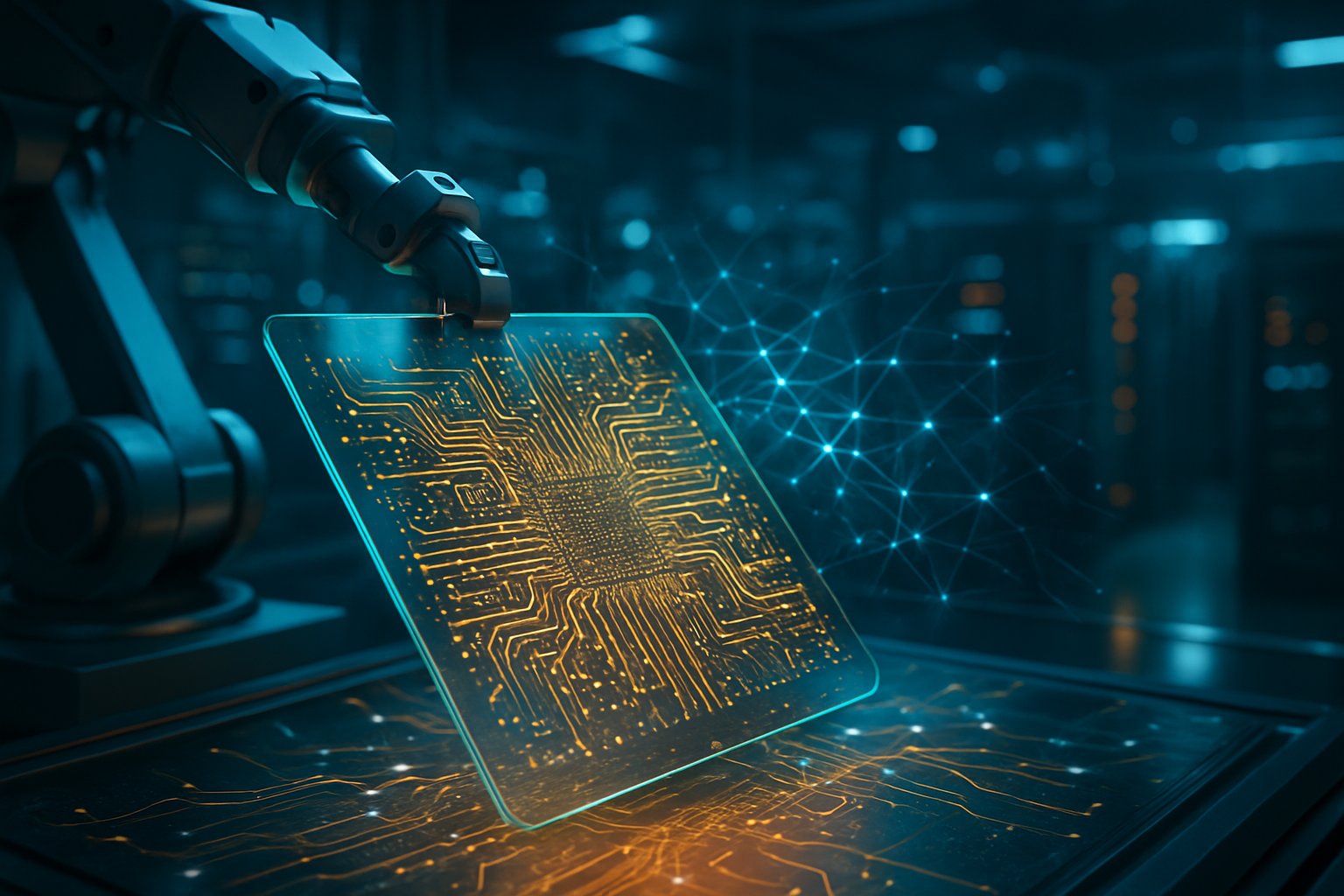
    The semiconductor industry has officially entered a new epoch. As of January 2026, the long-predicted "Glass Age" of chip packaging is no longer a roadmap item—it is a production reality. Intel Corporation (NASDAQ:INTC) has successfully transitioned its glass substrate technology from the laboratory to high-volume manufacturing, marking the most significant shift in chip architecture since the introduction of FinFET transistors. By moving away from traditional organic materials, Intel is effectively shattering the "warpage wall" that has threatened to stall the progress of trillion-parameter AI models.

    The immediate significance of this development cannot be overstated. As AI clusters scale to unprecedented sizes, the physical limitations of organic substrates—the "floors" upon which chips sit—have become a primary bottleneck. Traditional organic materials like Ajinomoto Build-up Film (ABF) are prone to bending and expanding under the extreme heat generated by modern AI accelerators. Intel’s pivot to glass provides a structurally rigid, thermally stable foundation that allows for larger, more complex "super-packages," enabling the density and power efficiency required for the next generation of generative AI.

    Technical Specifications and the Breakthrough

    Intel’s technical achievement centers on a high-performance glass core that replaces the traditional resin-based laminate. At the 2026 NEPCON Japan conference, Intel showcased its latest "10-2-10" architecture: a 78×77 mm glass core featuring ten redistribution layers on both the top and bottom. Unlike organic substrates, which can warp by more than 50 micrometers at large sizes, Intel’s glass panels remain ultra-flat, with less than 20 micrometers of deviation across a 100mm surface. This flatness is critical for maintaining the integrity of the tens of thousands of microscopic solder bumps that connect the processor to the substrate.

    A key technical differentiator is the use of Through-Glass Vias (TGVs) created via Laser-Induced Deep Etching (LIDE). This process allows for an interconnect density nearly ten times higher than what is possible with mechanical drilling in organic materials. Intel has achieved a "bump pitch" (the distance between connections) as small as 45 micrometers, supporting over 50,000 I/O connections per package. Furthermore, glass boasts a Coefficient of Thermal Expansion (CTE) that nearly matches silicon. This means that as a chip heats up to its peak power—often exceeding 1,000 watts in AI applications—the silicon and the glass expand at the same rate, reducing thermomechanical strain on internal joints by 50% compared to previous standards.

    Initial reactions from the semiconductor research community have been overwhelmingly positive, with analysts noting that glass substrates solve the "signal loss" problem that plagued high-frequency 2025-era chips. Glass offers a 60% lower dielectric loss, which translates to a 40% improvement in signal speeds. This capability is vital for the 1.6T networking standards and the ultra-fast data transfer rates required by the latest HBM4 (High Bandwidth Memory) stacks.

    Competitive Implications and Market Positioning

    The shift to glass substrates creates a new competitive theater for the world's leading chipmakers. Intel has secured a significant first-mover advantage, currently shipping its Xeon 6+ "Clearwater Forest" processors—the first high-volume products to utilize a glass core. By investing over $1 billion in its Chandler, Arizona facility, Intel is positioning itself as the premier foundry for companies like NVIDIA Corporation (NASDAQ:NVDA) and Apple Inc. (NASDAQ:AAPL), who are reportedly in negotiations to secure glass substrate capacity for their 2027 product cycles.

    However, the competition is accelerating. Samsung Electronics (KRX:005930) has mobilized a "Triple Alliance" between its display, foundry, and memory divisions to challenge Intel's lead. Samsung is currently running pilot lines in Korea and expects to reach mass production by late 2026. Meanwhile, Taiwan Semiconductor Manufacturing Company (NYSE:TSM) is taking a more measured approach with its CoPoS (Chip-on-Panel-on-Substrate) platform, focusing on refining the technology for its primary client, NVIDIA, with a target of 2028 for full-scale integration.

    For startups and specialized AI labs, this development is a double-edged sword. While glass substrates enable more powerful custom ASICs, the high cost of entry for advanced packaging could further consolidate power among "hyperscalers" like Google and Amazon, who have the capital to design their own glass-based silicon. Conversely, companies like Advanced Micro Devices, Inc. (NASDAQ:AMD) are already benefiting from the diversified supply chain; through its partnership with Absolics—a subsidiary of SKC—AMD is sampling glass-based AI accelerators to rival NVIDIA's dominant Blackwell architecture.

    Wider Significance for the AI Landscape

    Beyond the technical specifications, the emergence of glass substrates fits into a broader trend of "System-on-Package" (SoP) design. As the industry hits the "Power Wall"—where chips require more energy than can be efficiently cooled or delivered—packaging has become the new frontier of innovation. Glass acts as an ideal bridge to Co-Packaged Optics (CPO), where light replaces electricity for data transfer. Because glass is transparent and thermally stable, it allows optical engines to be integrated directly onto the substrate, a feat that Broadcom Inc. (NASDAQ:AVGO) and others are currently exploiting to reduce networking power consumption by up to 70%.

    This milestone echoes previous industry breakthroughs like the transition to 193nm lithography or the introduction of High-K Metal Gate technology. It represents a fundamental change in the materials science governing computing. However, the transition is not without concerns. The fragility of glass during the manufacturing process remains a challenge, and the industry must develop new handling protocols to prevent "shattering" events on the production line. Additionally, the environmental impact of new glass-etching chemicals is under scrutiny by global regulatory bodies.

    Comparatively, this shift is as significant as the move from vacuum tubes to transistors in terms of how we think about "packaging" intelligence. In the 2024–2025 era, the focus was on how many transistors could fit on a die; in 2026, the focus has shifted to how many dies can be reliably connected on a single, massive glass substrate.

    Future Developments and Long-Term Applications

    Looking ahead, the next 24 months will likely see the integration of HBM4 directly onto glass substrates, creating "reticle-busting" packages that exceed 100mm x 100mm. These massive units will essentially function as monolithic computers, capable of housing an entire trillion-parameter model's inference engine on a single piece of glass. Experts predict that by 2028, glass substrates will be the standard for all high-end data center hardware, eventually trickling down to consumer devices as AI-driven "personal agents" require more local processing power.

    The primary challenge remaining is yield optimization. While Intel has reported steady improvements, the complexity of drilling millions of TGVs without compromising the structural integrity of the glass is a feat of engineering that requires constant refinement. We should also expect to see new hybrid materials—combining the flexibility of organic layers with the rigidity of glass—emerging as "mid-tier" solutions for the broader market.

    Conclusion: A Clear Vision for the Future

    In summary, Intel’s successful commercialization of glass substrates marks the end of the "Organic Era" for high-performance computing. This development provides the necessary thermal and structural foundation to keep Moore’s Law alive, even as the physical limits of silicon are tested. The ability to match the thermal expansion of silicon while providing a tenfold increase in interconnect density ensures that the AI revolution will not be throttled by the limitations of its own housing.

    The significance of this development in AI history will likely be viewed as the moment when the "hardware bottleneck" was finally cracked. While the coming weeks will likely bring more announcements from Samsung and TSMC as they attempt to catch up, the long-term impact is clear: the future of AI is transparent, rigid, and made of glass. Watch for the first performance benchmarks of the Clearwater Forest Xeon chips in late Q1 2026, as they will serve as the first true test of this technology's real-world impact.


    This content is intended for informational purposes only and represents analysis of current AI developments.

    TokenRing AI delivers enterprise-grade solutions for multi-agent AI workflow orchestration, AI-powered development tools, and seamless remote collaboration platforms.
    For more information, visit https://www.tokenring.ai/.

  • The $30 Billion Hegemony: Anthropic and Microsoft Redefine the AI Arms Race with NVIDIA’s Vera Rubin

    The $30 Billion Hegemony: Anthropic and Microsoft Redefine the AI Arms Race with NVIDIA’s Vera Rubin

    In a move that has sent shockwaves through Silicon Valley and the global corridors of power, Anthropic has finalized a historic $30 billion compute agreement with Microsoft Corp. (NASDAQ:MSFT). This unprecedented alliance, officially cemented as we enter early 2026, marks a definitive shift in the "Cloud Wars," positioning Anthropic not just as a model builder, but as a primary architect of the next industrial revolution in intelligence. By securing massive tranches of dedicated data center capacity—scaling up to a staggering one gigawatt—Anthropic has effectively locked in the computational "oxygen" required to train its next generation of frontier models, Claude 5 and beyond.

    The deal is more than a simple cloud lease; it is a tripartite strategic alignment involving NVIDIA Corp. (NASDAQ:NVDA), which has contributed $10 billion to the financing alongside a $5 billion injection from Microsoft. This massive capital and infrastructure infusion values Anthropic at an eye-watering $350 billion, making it one of the most valuable private entities in history. More importantly, it grants Anthropic preferential access to NVIDIA’s most advanced silicon, transitioning from the current Grace Blackwell standard to the highly anticipated Vera Rubin architecture, which promises to break the "memory wall" that has long constrained the scaling of agentic AI.

    The Silicon Foundation: From Grace Blackwell to Vera Rubin

    Technically, this agreement represents the first large-scale commercial commitment to NVIDIA’s Vera Rubin platform (VR200), the successor to the already formidable Blackwell architecture. While Anthropic is currently deploying its Claude 4.5 suite on Blackwell-based GB200 NVL72 systems, the $30 billion deal ensures they will be the primary launch partner for Rubin in the second half of 2026. The leap from Blackwell to Rubin is not merely incremental; it is a fundamental redesign of the AI system. The Rubin architecture introduces the "Vera" CPU, featuring 88 custom "Olympus" Arm cores designed specifically to manage the high-speed data movement required for agentic workflows, where AI must not only process information but orchestrate complex, multi-step tasks across software environments.

    The technical specifications of the Vera Rubin platform are staggering. By utilizing HBM4 memory, the system delivers a memory bandwidth of 22 TB/s—a 2.8x increase over Blackwell. In terms of raw compute, the Rubin GPUs provide 50 PFLOPS of FP4 inference performance, more than doubling the capabilities of its predecessor. This massive jump in bandwidth is critical for Anthropic’s "Constitutional AI" approach, which requires significant overhead for real-time reasoning and safety checks. Industry experts note that the integration of the BlueField-4 DPU within the Rubin stack allows Anthropic to offload networking bottlenecks, potentially reducing the cost per token for large Mixture-of-Experts (MoE) models by an order of magnitude.

    The Great Cloud Realignment: Microsoft’s Multi-Lab Strategy

    This deal signals a profound strategic pivot for Microsoft. For years, the Redmond giant was viewed as the exclusive patron of OpenAI, but the $30 billion Anthropic deal confirms that Microsoft is diversifying its bets to mitigate "single-provider risk." By integrating Anthropic’s models into the Azure AI Foundry and Microsoft 365 Copilot, Microsoft is offering its enterprise customers a choice between the GPT and Claude ecosystems, effectively commoditizing the underlying model layer while capturing the lucrative compute margins. This move puts immense pressure on OpenAI to maintain its lead, as its primary benefactor is now actively funding and hosting its fiercest competitor.

    For Anthropic, the deal completes a masterful "multi-cloud" strategy. While Amazon.com Inc. (NASDAQ:AMZN) remains a significant partner with its $8 billion investment and integration into Amazon Bedrock, and Alphabet Inc. (NASDAQ:GOOGL) continues to provide access to its massive TPU clusters, the Microsoft deal ensures that Anthropic is not beholden to any single hardware roadmap or cloud ecosystem. This "vendor neutrality" allows Anthropic to play the three cloud titans against each other, ensuring they always have access to the cheapest and most powerful silicon available, whether it be NVIDIA GPUs, Google’s TPUs, or Amazon’s Trainium chips.

    The Gigawatt Era and the Industrialization of Intelligence

    The scale of this agreement—specifically the mention of "one gigawatt" of power capacity—marks the beginning of the "Gigawatt Era" of AI. We are moving past the phase where AI was a software curiosity and into a phase of heavy industrialization. A single gigawatt is enough to power roughly 750,000 homes, and dedicating that much energy to a single AI lab’s compute needs underscores the sheer physical requirements of future intelligence. This development aligns with the broader trend of AI companies becoming energy players, with Anthropic now needing to navigate the complexities of nuclear power agreements and grid stability as much as neural network architectures.

    However, the sheer concentration of power—both literal and metaphorical—has raised concerns among regulators and ethicists. The $30 billion price tag creates a "moat" that is virtually impossible for smaller startups to cross, potentially stifling innovation outside of the "Big Three" (OpenAI, Anthropic, and Google). Comparisons are already being made to the early days of the aerospace industry, where only a few "prime contractors" had the capital to build the next generation of jet engines. Anthropic’s move ensures they are a prime contractor in the AI age, but it also ties their destiny to the massive infrastructure of the very tech giants they once sought to provide a "safer" alternative to.

    The Road to Claude 5 and Beyond

    Looking ahead, the immediate focus for Anthropic will be the training of Claude 5 on the first waves of Vera Rubin hardware. Experts predict that Claude 5 will be the first model to truly master "long-horizon reasoning," capable of performing complex research and engineering tasks that span weeks rather than minutes. The increased memory bandwidth of HBM4 will allow for context windows that could theoretically encompass entire corporate codebases or libraries of legal documents, processed with near-instantaneous latency. The "Vera" CPU’s ability to handle agentic data movement suggests that the next generation of Claude will not just be a chatbot, but an autonomous operator capable of managing entire digital workflows.

    The next 18 months will be a period of intense infrastructure deployment. As Microsoft builds out the dedicated "Anthropic Zones" within Azure data centers, the industry will be watching to see if the promised efficiency gains of the Rubin architecture materialize. The primary challenge will be the supply chain; even with NVIDIA’s $10 billion stake, the global demand for HBM4 and advanced 2nm logic remains at a fever pitch. Any delays in the rollout of the Vera Rubin architecture could stall Anthropic’s ambitious roadmap and give competitors a window to reclaim the narrative.

    A New Epoch in the AI Arms Race

    The $30 billion deal between Anthropic, Microsoft, and NVIDIA is a watershed moment that defines the landscape of artificial intelligence for the late 2020s. It represents the final transition of AI from a venture-backed software experiment into a capital-intensive infrastructure play. By securing the most advanced silicon on the planet and the power to run it, Anthropic has positioned itself as a permanent fixture in the global technological hierarchy. The significance of this development cannot be overstated; it is the moment when the "AI safety" lab fully embraced the "AI scale" reality.

    In the coming months, the focus will shift from the boardroom to the data center. As the first Vera Rubin clusters come online, the true capabilities of this $30 billion investment will be revealed. For the tech industry, the message is clear: the cost of entry for frontier AI has reached the stratosphere, and the alliance between Anthropic, Microsoft, and NVIDIA has set a new, formidable standard for what it means to lead in the age of intelligence.


    This content is intended for informational purposes only and represents analysis of current AI developments.

    TokenRing AI delivers enterprise-grade solutions for multi-agent AI workflow orchestration, AI-powered development tools, and seamless remote collaboration platforms.
    For more information, visit https://www.tokenring.ai/.

  • Silicon Sovereignty: The 2nm GAA Race and the Battle for the Future of AI Compute

    Silicon Sovereignty: The 2nm GAA Race and the Battle for the Future of AI Compute

    The semiconductor industry has officially entered the era of Gate-All-Around (GAA) transistor technology, marking the most significant architectural shift in chip manufacturing in over a decade. As of January 2, 2026, the race for 2-nanometer (2nm) supremacy has reached a fever pitch, with Taiwan Semiconductor Manufacturing Company (NYSE:TSM), Samsung Electronics (KRX:005930), and Intel (NASDAQ:INTC) all deploying their most advanced nodes to satisfy the insatiable demand for high-performance AI compute. This transition represents more than just a reduction in size; it is a fundamental redesign of the transistor that promises to unlock unprecedented levels of energy efficiency and processing power for the next generation of artificial intelligence.

    While the technical hurdles have been immense, the stakes could not be higher. The winner of this race will dictate the pace of AI innovation for years to come, providing the underlying hardware for everything from autonomous vehicles and generative AI models to the next wave of ultra-powerful consumer electronics. TSMC currently leads the pack in high-volume manufacturing, but the aggressive strategies of Samsung and Intel are creating a fragmented market where performance, yield, and geopolitical security are becoming as important as the nanometer designation itself.

    The Technical Leap: Nanosheets, RibbonFETs, and the End of FinFET

    The move to the 2nm node marks the retirement of the FinFET (Fin Field-Effect Transistor) architecture, which has dominated the industry since the 22nm era. At the heart of the 2nm revolution is Gate-All-Around (GAA) technology. Unlike FinFETs, where the gate contacts the channel on three sides, GAA transistors feature a gate that completely surrounds the channel on all four sides. This design provides superior electrostatic control, drastically reducing current leakage and allowing for further voltage scaling. TSMC’s N2 process utilizes a "Nanosheet" architecture, while Samsung has dubbed its version Multi-Bridge Channel FET (MBCFET), and Intel has introduced "RibbonFET."

    Intel’s 18A node, which has become its primary "comeback" vehicle in 2026, pairs RibbonFET with another breakthrough: PowerVia. This backside power delivery system moves the power routing to the back of the wafer, separating it from the signal lines on the front. This reduces voltage drop and allows for higher clock speeds, giving Intel a distinct performance-per-watt advantage in high-performance computing (HPC) tasks. Benchmarks from late 2025 suggest that while Intel's 18A trails TSMC in pure transistor density—238 million transistors per square millimeter (MTr/mm²) compared to TSMC’s 313 MTr/mm²—it excels in raw compute performance, making it a formidable contender for the AI data center market.

    Samsung, which was the first to implement GAA at the 3nm stage, has utilized its early experience to launch the SF2 node. Although Samsung has faced well-documented yield struggles in the past, its SF2 process is now in mass production, powering the latest Exynos 2600 processors. The SF2 node offers an 8% increase in power efficiency over its predecessor, though it remains under pressure to improve its 40–50% yield rates to compete with TSMC’s mature 70% yields. The industry’s initial reaction has been a mix of cautious optimism for Samsung’s persistence and awe at TSMC’s ability to maintain high yields even at such extreme technical complexities.

    Market Positioning and the New Foundry Hierarchy

    The 2nm race has reshaped the strategic landscape for tech giants and AI startups alike. TSMC remains the primary choice for external chip design firms, having secured over 50% of its initial N2 capacity for Apple (NASDAQ:AAPL). The upcoming A20 Pro and M6 chips are expected to set new benchmarks for mobile and desktop efficiency, further cementing Apple’s lead in consumer hardware. However, TSMC’s near-monopoly on high-volume 2nm production has led to capacity constraints, forcing other major players like Qualcomm (NASDAQ:QCOM) and Nvidia (NASDAQ:NVDA) to explore multi-sourcing strategies.

    Nvidia, in a landmark move in late 2025, finalized a $5 billion investment in Intel’s foundry services. While Nvidia continues to rely on TSMC for its flagship "Rubin Ultra" AI GPUs, the investment in Intel provides a strategic hedge and access to U.S.-based manufacturing and advanced packaging. This move significantly benefits Intel, providing the capital and credibility needed to establish its "IDM 2.0" vision. Meanwhile, Microsoft (NASDAQ:MSFT) and Amazon (NASDAQ:AMZN) have begun leveraging Intel’s 18A node for their custom AI accelerators, seeking to reduce their total cost of ownership by moving away from off-the-shelf components.

    Samsung has found its niche as a "relief valve" for the industry. While it may not match TSMC’s density, its lower wafer costs—estimated at $22,000 to $25,000 compared to TSMC’s $30,000—have attracted cost-sensitive or capacity-constrained customers. Tesla (NASDAQ:TSLA) has reportedly secured SF2 capacity for its next-generation AI5 autonomous driving chips, and Meta (NASDAQ:META) is utilizing Samsung for its MTIA ASICs. This diversification of the foundry market is disrupting the previous winner-take-all dynamic, allowing for a more resilient global supply chain.

    Geopolitics, Energy, and the Broader AI Landscape

    The 2nm transition is not occurring in a vacuum; it is deeply intertwined with the global push for "silicon sovereignty." The ability to manufacture 2nm chips domestically has become a matter of national security for the United States and the European Union. Intel’s progress with 18A is a cornerstone of the U.S. CHIPS Act goals, providing a domestic alternative to the Taiwan-centric supply chain. This geopolitical dimension adds a layer of complexity to the 2nm race, as government subsidies and export controls on advanced lithography equipment from ASML (NASDAQ:ASML) influence where and how these chips are built.

    From an environmental perspective, the shift to GAA is a critical milestone. As AI data centers consume an ever-increasing share of the world’s electricity, the 25–30% power reduction offered by nodes like TSMC’s N2 is essential for sustainable growth. The industry is reaching a point where traditional scaling is no longer enough; architectural innovations like backside power delivery and advanced 3D packaging are now the primary drivers of efficiency. This mirrors previous milestones like the introduction of High-K Metal Gate (HKMG) or EUV lithography, but at a scale that impacts the global energy grid.

    However, concerns remain regarding the "yield gap" between TSMC and its rivals. If Samsung and Intel cannot stabilize their production lines, the industry risks a bottleneck where only a handful of companies—those with the deepest pockets—can afford the most advanced silicon. This could lead to a two-tier AI landscape, where the most capable models are restricted to the few firms that can secure TSMC’s premium capacity, potentially stifling innovation among smaller startups and research labs.

    The Horizon: 1.4nm and the High-NA EUV Era

    Looking ahead, the 2nm node is merely a stepping stone toward the "Angstrom Era." TSMC has already announced its A16 (1.6nm) node, scheduled for mass production in late 2026, which will incorporate its own version of backside power delivery. Intel is similarly preparing its 18AP node, which promises further refinements to the RibbonFET architecture. These near-term developments suggest that the pace of innovation is actually accelerating, rather than slowing down, as the industry tackles the limits of physics.

    The next major hurdle will be the widespread adoption of High-NA (Numerical Aperture) EUV lithography. Intel has taken an early lead in this area, installing the world’s first High-NA machines to prepare for the 1.4nm (Intel 14A) node. Experts predict that the integration of High-NA EUV will be the defining challenge of 2027 and 2028, requiring entirely new photoresists and mask technologies. Challenges such as thermal management in 3D-stacked chips and the rising cost of design—now exceeding $1 billion for a complex 2nm SoC—will need to be addressed by the broader ecosystem.

    A New Chapter in Semiconductor History

    The 2nm GAA race of 2026 represents a pivotal moment in semiconductor history. It is the point where the industry successfully navigated the transition away from FinFETs, ensuring that Moore’s Law—or at least the spirit of it—continues to drive the AI revolution. TSMC’s operational excellence has kept it at the forefront, but the emergence of a viable three-way competition with Intel and Samsung is a healthy development for a world that is increasingly dependent on advanced silicon.

    In the coming months, the industry will be watching the first consumer reviews of 2nm-powered devices and the performance of Intel’s 18A in enterprise data centers. The key takeaways from this era are clear: architecture matters as much as size, and the ability to manufacture at scale remains the ultimate competitive advantage. As we look toward the end of 2026, the focus will inevitably shift toward the 1.4nm horizon, but the lessons learned during the 2nm GAA transition will provide the blueprint for the next decade of compute.


    This content is intended for informational purposes only and represents analysis of current AI developments.

    TokenRing AI delivers enterprise-grade solutions for multi-agent AI workflow orchestration, AI-powered development tools, and seamless remote collaboration platforms.
    For more information, visit https://www.tokenring.ai/.