
Tag: AI Data Center

  • AMD’s Billion-Dollar Pivot: How the Acquisitions of ZT Systems and Silo AI Forged a Full-Stack Challenger to NVIDIA

    AMD’s Billion-Dollar Pivot: How the Acquisitions of ZT Systems and Silo AI Forged a Full-Stack Challenger to NVIDIA

    As of January 22, 2026, the competitive landscape of the artificial intelligence data center market has undergone a fundamental shift. Over the past eighteen months, Advanced Micro Devices (NASDAQ: AMD) has successfully executed a massive strategic transformation, pivoting from a high-performance silicon supplier into a comprehensive, full-stack AI infrastructure powerhouse. This metamorphosis was catalyzed by two multi-billion dollar acquisitions—ZT Systems and Silo AI—which have allowed the company to bridge the gap between hardware components and integrated system solutions.

    The immediate significance of this evolution cannot be overstated. By integrating ZT Systems’ world-class rack-level engineering with Silo AI’s deep bench of software scientists, AMD has effectively dismantled the "one-stop-shop" advantage previously held exclusively by NVIDIA (NASDAQ: NVDA). This strategic consolidation has provided hyperscalers and enterprise customers with a viable, open-standard alternative for large-scale AI training and inference, fundamentally altering the economics of the generative AI era.

    The Architecture of Transformation: Helios and the MI400 Series

    The technical cornerstone of AMD’s new strategy is the Helios rack-scale platform, a direct result of the $4.9 billion acquisition of ZT Systems. While AMD divested ZT’s manufacturing arm to avoid competing with partners like Dell Technologies (NYSE: DELL) and Hewlett Packard Enterprise (NYSE: HPE), it retained over 1,000 design and customer enablement engineers. This team has been instrumental in developing the Helios architecture, which integrates the new Instinct MI455X accelerators, "Venice" EPYC CPUs, and high-speed Pensando networking into a single, pre-configured liquid-cooled rack. This "plug-and-play" capability mirrors NVIDIA’s GB200 NVL72, allowing data center operators to deploy tens of thousands of GPUs with significantly reduced lead times.

    On the silicon front, the newly launched Instinct MI400 series represents a generational leap in memory architecture. Utilizing the CDNA 5 architecture on a cutting-edge 2nm process, the MI455X features an industry-leading 432GB of HBM4 memory and 19.6 TB/s of memory bandwidth. This memory-centric approach is specifically designed to address the "memory wall" in Large Language Model (LLM) training, offering nearly 1.5 times the capacity of competing solutions. Furthermore, the integration of Silo AI’s expertise has manifested in the AMD Enterprise AI Suite, a software layer that includes the SiloGen model-serving platform. This enables customers to run custom, open-source models like Poro and Viking with native optimization, closing the software usability gap that once defined the CUDA-vs-ROCm debate.

    Initial reactions from the AI research community have been notably positive, particularly regarding the release of ROCm 7.2. Developers are reporting that the latest software stack offers nearly seamless parity with PyTorch and JAX, with automated porting tools reducing the "CUDA migration tax" to a matter of days rather than months. Industry experts note that AMD’s commitment to the Ultra Accelerator Link (UALink) and Ultra Ethernet Consortium (UEC) standards provides a technical flexibility that proprietary fabrics cannot match, appealing to engineers who prioritize modularity in data center design.

    Disruption in the Data Center: The "Credible Second Source"

    The strategic positioning of AMD as a full-stack rival has profound implications for tech giants such as Microsoft (NASDAQ: MSFT), Meta (NASDAQ: META), and Alphabet (NASDAQ: GOOGL). These hyperscalers have long sought to diversify their supply chains to mitigate the high costs and supply constraints associated with a single-vendor ecosystem. With the ability to deliver entire AI clusters, AMD has moved from being a provider of "discount chips" to a strategic partner capable of co-designing the next generation of AI supercomputers. Meta, in particular, has emerged as a major beneficiary, leveraging AMD’s open-standard networking to integrate Instinct accelerators into its existing MTIA infrastructure.

    Market analysts estimate that AMD is on track to secure between 10% and 15% of the data center AI accelerator market by the end of 2026. This growth is not merely a result of price competition but of strategic advantages in "Agentic AI"—the next phase of autonomous AI agents that require massive local memory to handle long-context windows and multi-step reasoning. By offering higher memory footprints per GPU, AMD provides a superior total cost of ownership (TCO) for inference-heavy workloads, which currently dominate enterprise spending.

    This shift poses a direct challenge to the market positioning of other semiconductor players. While Intel (NASDAQ: INTC) continues to focus on its Gaudi line and foundry services, AMD’s aggressive acquisition strategy has allowed it to leapfrog into the high-end systems market. The result is a more balanced competitive landscape where NVIDIA remains the performance leader, but AMD serves as the indispensable "Credible Second Source," providing the leverage that enterprises need to scale their AI ambitions without being locked into a proprietary software silo.

    Broadening the AI Landscape: Openness vs. Optimization

    The wider significance of AMD’s transformation lies in its championship of the "Open AI Ecosystem." For years, the industry was bifurcated between NVIDIA’s highly optimized but closed ecosystem and various fragmented open-source efforts. By acquiring Silo AI—the largest private AI lab in Europe—AMD has signaled that it is no longer enough to just build the "plumbing" of AI; hardware companies must also contribute to the fundamental research of model architecture and optimization. The development of multilingual, open-source LLMs like Poro serves as a benchmark for how hardware vendors can support regional AI sovereignty and transparent AI development.

    This move fits into a broader trend of "Vertical Integration for the Masses." While companies like Apple (NASDAQ: AAPL) have long used vertical integration to control the user experience, AMD is using it to democratize the data center. By providing the system design (ZT Systems), the software stack (ROCm 7.2), and the model optimization (Silo AI), AMD is lowering the barrier to entry for tier-two cloud providers and sovereign nation-state AI projects. This approach contrasts sharply with the "black box" nature of early AI deployments, potentially fostering a more innovative and competitive environment for AI startups.

    However, this transition is not without concerns. The consolidation of system-level expertise into a few large players could lead to a different form of oligopoly. Critics point out that while AMD’s standards are "open," the complexity of managing 400GB+ HBM4 systems still requires a level of technical sophistication that only the largest entities possess. Nevertheless, compared to previous milestones like the initial launch of the MI300 series in 2023, the current state of AMD’s portfolio represents a more mature and holistic approach to AI computing.

    The Horizon: MI500 and the Era of 1,000x Gains

    Looking toward the near-term future, AMD has committed to an annual release cadence for its AI accelerators, with the Instinct MI500 already being previewed for a 2027 launch. This next generation, utilizing the CDNA 6 architecture, is expected to focus on "Silicon Photonics" and 3D stacking technologies to overcome the physical limits of current data transfer speeds. On the software side, the integration of Silo AI’s researchers is expected to yield new, highly specialized "Small Language Models" (SLMs) that are hardware-aware, meaning they are designed from the ground up to utilize the specific sparsity and compute features of the Instinct hardware.

    Applications on the horizon include "Real-time Multi-modal Orchestration," where AI systems can process video, voice, and text simultaneously with sub-millisecond latency. This will be critical for the rollout of autonomous industrial robotics and real-time translation services at a global scale. The primary challenge remains the continued evolution of the ROCm ecosystem; while significant strides have been made, maintaining parity with NVIDIA’s rapidly evolving software features will require sustained, multi-billion dollar R&D investments.

    Experts predict that by the end of the decade, the distinction between a "chip company" and a "software company" will have largely vanished in the AI sector. AMD’s current trajectory suggests they are well-positioned to lead this hybrid future, provided they can continue to successfully integrate their new acquisitions and maintain the pace of their aggressive hardware roadmap.

    A New Era of AI Competition

    AMD’s strategic transformation through the acquisitions of ZT Systems and Silo AI marks a definitive end to the era of NVIDIA’s uncontested dominance in the AI data center. By evolving into a full-stack provider, AMD has addressed its historical weaknesses in system-level engineering and software maturity. The launch of the Helios platform and the MI400 series demonstrates that AMD can now match, and in some areas like memory capacity, exceed the industry standard.

    In the history of AI development, 2024 and 2025 will be remembered as the years when the "hardware wars" shifted from a battle of individual chips to a battle of integrated ecosystems. AMD’s successful pivot ensures that the future of AI will be built on a foundation of competition and open standards, rather than vendor lock-in.

    In the coming months, observers should watch for the first major performance benchmarks of the MI455X in large-scale training clusters and for announcements regarding new hyperscale partnerships. As the "Agentic AI" revolution takes hold, AMD’s focus on high-bandwidth, high-capacity memory systems may very well make it the primary engine for the next generation of autonomous intelligence.


    This content is intended for informational purposes only and represents analysis of current AI developments.

    TokenRing AI delivers enterprise-grade solutions for multi-agent AI workflow orchestration, AI-powered development tools, and seamless remote collaboration platforms.
    For more information, visit https://www.tokenring.ai/.
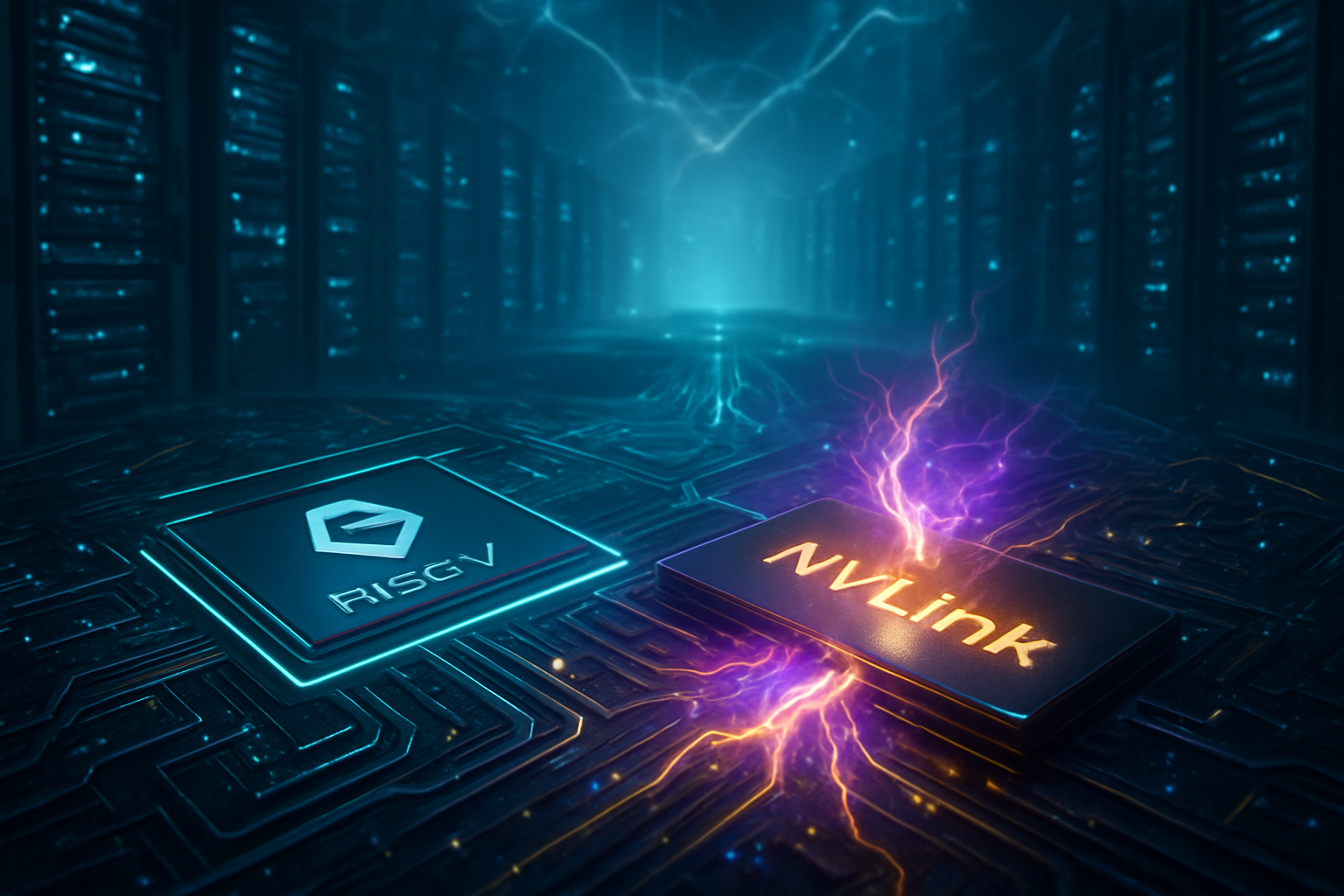
  • The RISC-V Revolution: SiFive and NVIDIA Shatter the Proprietary Glass Ceiling with NVLink Fusion

    The RISC-V Revolution: SiFive and NVIDIA Shatter the Proprietary Glass Ceiling with NVLink Fusion

    In a move that signals a tectonic shift in the semiconductor landscape, SiFive, the leader in RISC-V computing, announced on January 15, 2026, a landmark strategic partnership with NVIDIA (NASDAQ: NVDA) to integrate NVIDIA NVLink Fusion into its high-performance RISC-V processor platforms. This collaboration grants RISC-V "first-class citizen" status within the NVIDIA hardware ecosystem, providing the open-standard architecture with the high-speed, cache-coherent interconnectivity previously reserved for NVIDIA’s own Grace and Vera CPUs.

    The immediate significance of this announcement cannot be overstated. By adopting NVLink-C2C (Chip-to-Chip) technology, SiFive is effectively removing the primary barrier that has kept RISC-V out of the most demanding AI data centers: the lack of a high-bandwidth pipeline to the world’s most powerful GPUs. This integration allows hyperscalers and chip designers to pair highly customizable RISC-V CPU cores with NVIDIA’s industry-leading accelerators, creating a formidable alternative to the proprietary x86 and ARM architectures that have long dominated the server market.

    Technical Synergy: Unlocking the Rubin Architecture

    The technical cornerstone of this partnership is the integration of NVLink Fusion, specifically the NVLink-C2C variant, into SiFive’s next-generation data center-class compute subsystems. Tied to the newly unveiled NVIDIA Rubin platform, this integration utilizes sixth-generation NVLink technology, which boasts a staggering 3.6 TB/s of bidirectional bandwidth per GPU. Unlike traditional PCIe lanes, which often create bottlenecks in AI training workloads, NVLink-C2C provides a fully cache-coherent link, allowing the CPU and GPU to share memory resources with near-zero latency.

    This technical leap enables SiFive processors to tap into the full CUDA-X software stack, including critical libraries like NCCL (NVIDIA Collective Communications Library) for multi-GPU scaling. Previously, RISC-V implementations were often "bolted on" via standard peripheral interfaces, resulting in significant performance penalties during large-scale AI model training and inference. By becoming an NVLink Fusion licensee, SiFive ensures that its silicon can communicate with NVIDIA GPUs with the same efficiency as proprietary designs. Initial designs utilizing this IP are expected to hit the market in 2027, targeting high-performance computing (HPC) and massive-scale AI clusters.

    Industry experts have noted that this differs significantly from previous "open" attempts at interconnectivity. While standard protocols like CXL (Compute Express Link) have made strides, NVLink remains the gold standard for pure AI throughput. The AI research community has reacted with enthusiasm, noting that the ability to "right-size" the CPU using RISC-V’s modular instructions—while maintaining a high-speed link to NVIDIA’s compute power—could lead to unprecedented efficiency in specialized LLM (Large Language Model) environments.

    Disruption in the Data Center: The End of Vendor Lock-in?

    This partnership has immediate and profound implications for the competitive landscape of the semiconductor industry. For years, companies like ARM Holdings (NASDAQ: ARM) have benefited from being the primary alternative to the x86 duopoly of Intel (NASDAQ: INTC) and Advanced Micro Devices (NASDAQ: AMD). However, as ARM has moved toward designing its own complete chips and tightening its licensing terms, tech giants like Meta, Google, and Amazon have sought greater architectural freedom. SiFive’s new capability offers these hyperscalers exactly what they have been asking for: the ability to build fully custom, "AI-native" CPUs that don't sacrifice performance in the NVIDIA ecosystem.

    NVIDIA also stands to benefit strategically. By opening NVLink to SiFive, NVIDIA is hedging its bets against the emergence of UALink (Ultra Accelerator Link), a rival open interconnect standard backed by a coalition of its competitors. By making NVLink available to the RISC-V community, NVIDIA is essentially making its proprietary interconnect the de facto standard for the entire "custom silicon" movement. This move potentially sidelines x86 in AI-native server racks, as the industry shifts toward specialized, co-designed CPU-GPU systems that prioritize energy efficiency and high-bandwidth coherence over legacy compatibility.

    For startups and specialized AI labs, this development lowers the barrier to entry for custom silicon. A startup can now license SiFive’s high-performance cores and, thanks to the NVLink integration, ensure their custom chip will be compatible with the world’s most widely used AI infrastructure on day one. This levels the playing field against larger competitors who have the resources to design complex interconnects from scratch.

    Broader Significance: The Rise of Modular Computing

    The adoption of NVLink by SiFive fits into a broader trend toward the "disaggregation" of the data center. We are moving away from a world of "general-purpose" servers and toward a world of "composable" infrastructure. In this new landscape, the instruction set architecture (ISA) becomes less important than the ability of the components to communicate at light speed. RISC-V, with its open, modular nature, is perfectly suited for this transition, and the NVIDIA partnership provides the high-octane fuel needed for that engine.

    However, this milestone also raises concerns about the future of truly "open" hardware. While RISC-V is an open standard, NVLink is proprietary. Some purists in the open-source community worry that this "fusion" could lead to a new form of "interconnect lock-in," where the CPU is open but its primary method of communication is controlled by a single dominant vendor. Comparisons are already being made to the early days of the PC industry, where open standards were often "extended" by dominant players to maintain market control.

    Despite these concerns, the move is widely seen as a victory for energy efficiency. Data centers are currently facing a crisis of power consumption, and the ability to strip away the legacy "cruft" of x86 in favor of a lean, mean RISC-V design optimized for AI data movement could save megawatts of power at scale. This follows in the footsteps of previous milestones like the introduction of the first GPU-accelerated supercomputers, but with a focus on the CPU's role as an efficient traffic controller rather than a primary workhorse.

    Future Outlook: The Road to 2027 and Beyond

    Looking ahead, the next 18 to 24 months will be a period of intense development as the first SiFive-based "NVLink-Series" processors move through the design and tape-out phases. We expect to see hyperscalers announce their own custom RISC-V/NVIDIA hybrid chips by early 2027, specifically optimized for the "Rubin" and "Vera" generation of accelerators. These chips will likely feature specialized instructions for data pre-processing and vector management, tasks where RISC-V's extensibility shines.

    One of the primary challenges that remain is the software ecosystem. While CUDA support is a massive win, the broader RISC-V software ecosystem for server-side applications still needs to mature to match the decades of optimization found in x86 and ARM. Experts predict that the focus of the RISC-V International foundation will now shift heavily toward standardizing "AI-native" extensions to ensure that the performance gains offered by NVLink are not lost to software inefficiencies.

    In the long term, this partnership may be remembered as the moment the "proprietary vs. open" debate in hardware was finally settled in favor of a hybrid approach. If SiFive and NVIDIA can prove that an open CPU with a proprietary interconnect can outperform the best "all-proprietary" stacks from ARM or Intel, it will rewrite the playbook for how semiconductors are designed and sold for the rest of the decade.

    A New Era for AI Infrastructure

    The partnership between SiFive and NVIDIA marks a watershed moment for the AI industry. By bringing the world’s most advanced interconnect to the world’s most flexible processor architecture, these two companies have cleared a path for a new generation of high-performance, energy-efficient, and highly customizable data centers. The significance of this development lies not just in the hardware specifications, but in the shift in power dynamics it represents—away from legacy architectures and toward a more modular, "best-of-breed" approach to AI compute.

    As we move through 2026, the tech world will be watching closely for the first silicon samples and early performance benchmarks. The success of this integration could determine whether RISC-V becomes the dominant architecture for the AI era or remains a niche alternative. For now, the message is clear: the proprietary stranglehold on the data center has been broken, and the future of AI hardware is more open, and more connected, than ever before.

    Watch for further announcements during the upcoming spring developer conferences, where more specific implementation details of the SiFive/NVIDIA "Rubin" subsystems are expected to be unveiled.


    This content is intended for informational purposes only and represents analysis of current AI developments.

    TokenRing AI delivers enterprise-grade solutions for multi-agent AI workflow orchestration, AI-powered development tools, and seamless remote collaboration platforms.
    For more information, visit https://www.tokenring.ai/.

  • Qualcomm’s AI Chips: A Bold Bid to Reshape the Data Center Landscape

    Qualcomm’s AI Chips: A Bold Bid to Reshape the Data Center Landscape

    Qualcomm (NASDAQ: QCOM) has officially launched a formidable challenge to Nvidia's (NASDAQ: NVDA) entrenched dominance in the artificial intelligence (AI) data center market with the unveiling of its new AI200 and AI250 chips. This strategic move, announced as the company seeks to diversify beyond its traditional smartphone chip business, signals a significant intent to capture a share of the burgeoning AI infrastructure sector, particularly focusing on the rapidly expanding AI inference segment. The immediate market reaction has been notably positive, with Qualcomm's stock experiencing a significant surge, reflecting investor confidence in its strategic pivot and the potential for increased competition in the lucrative AI chip space.

    Qualcomm's entry is not merely about introducing new hardware; it represents a comprehensive strategy aimed at redefining rack-scale AI inference. By leveraging its decades of expertise in power-efficient chip design from the mobile industry, Qualcomm is positioning its new accelerators as a cost-effective, high-performance alternative optimized for generative AI workloads, including large language models (LLMs) and multimodal models (LMMs). This initiative is poised to intensify competition, offer more choices to enterprises and cloud providers, and potentially drive down the total cost of ownership (TCO) for deploying AI at scale.

    Technical Prowess: Unpacking the AI200 and AI250

    Qualcomm's AI200 and AI250 chips are engineered as purpose-built accelerators for rack-scale AI inference, designed to deliver a compelling blend of performance, efficiency, and cost-effectiveness. These solutions build upon Qualcomm's established Hexagon Neural Processing Unit (NPU) technology, which has been a cornerstone of AI processing in billions of mobile devices and PCs.

    The Qualcomm AI200, slated for commercial availability in 2026, boasts substantial memory capabilities, supporting 768 GB of LPDDR per card. This high memory capacity at a lower cost is crucial for efficiently handling the memory-intensive requirements of large language and multimodal models. It is optimized for general inference tasks and a broad spectrum of AI workloads.

    The more advanced Qualcomm AI250, expected in 2027, introduces a groundbreaking "near-memory computing" architecture. Qualcomm claims this innovative design will deliver over ten times higher effective memory bandwidth and significantly lower power consumption compared to existing solutions. This represents a generational leap in efficiency, enabling more efficient "disaggregated AI inferencing" and offering a substantial advantage for the most demanding generative AI applications.

    Both rack solutions incorporate direct liquid cooling for optimal thermal management and include PCIe for scale-up and Ethernet for scale-out capabilities, ensuring robust connectivity within data centers. Security is also a priority, with confidential computing features integrated to protect AI workloads. Qualcomm emphasizes an industry-leading rack-level power consumption of 160 kW, aiming for superior performance per dollar per watt. A comprehensive, hyperscaler-grade software stack supports leading machine learning frameworks like TensorFlow, PyTorch, and ONNX, alongside one-click deployment for Hugging Face models via the Qualcomm AI Inference Suite, facilitating seamless adoption.

    This approach significantly differs from previous Qualcomm attempts in the data center, such as the Centriq CPU initiative, which was ultimately discontinued. The current strategy leverages Qualcomm's core strength in power-efficient NPU design, scaling it for data center environments. Against Nvidia, the key differentiator lies in Qualcomm's explicit focus on AI inference rather than training, a segment where operational costs and power efficiency are paramount. While Nvidia dominates both training and inference, Qualcomm aims to disrupt the inference market with superior memory capacity, bandwidth, and a lower TCO. Initial reactions from industry experts and investors have been largely positive, with Qualcomm's stock soaring. Analysts like Holger Mueller acknowledge Qualcomm's technical prowess but caution about the challenges of penetrating the cloud data center market. The commitment from Saudi AI company Humain to deploy 200 megawatts of Qualcomm AI systems starting in 2026 further validates Qualcomm's data center ambitions.

    Reshaping the Competitive Landscape: Market Implications

    Qualcomm's foray into the AI data center market with the AI200 and AI250 chips carries significant implications for AI companies, tech giants, and startups alike. The strategic focus on AI inference, combined with a strong emphasis on total cost of ownership (TCO) and power efficiency, is poised to create new competitive dynamics and potential disruptions.

    Companies that stand to benefit are diverse. Qualcomm (NASDAQ: QCOM) itself is a primary beneficiary, as this move diversifies its revenue streams beyond its traditional mobile market and positions it in a high-growth sector. Cloud service providers and hyperscalers such as Microsoft (NASDAQ: MSFT), Amazon (NASDAQ: AMZN), and Meta (NASDAQ: META) are actively engaging with Qualcomm. These tech giants are constantly seeking to optimize the cost and energy consumption of their massive AI workloads, making Qualcomm's offerings an attractive alternative to current solutions. Enterprises and AI developers running large-scale generative AI inference models will also benefit from potentially lower operational costs and improved memory efficiency. Startups, particularly those deploying generative AI applications, could find Qualcomm's solutions appealing for their cost-efficiency and scalability, as exemplified by the commitment from Saudi AI company Humain.

    The competitive implications are substantial. Nvidia (NASDAQ: NVDA), currently holding an overwhelming majority of the AI GPU market, particularly for training, faces its most direct challenge in the inference segment. Qualcomm's focus on power efficiency and TCO directly pressures Nvidia's pricing and market share, especially for cloud customers. AMD (NASDAQ: AMD) and Intel (NASDAQ: INTC), also vying for a larger slice of the AI pie with their Instinct and Gaudi accelerators, respectively, will find themselves in even fiercer competition. Qualcomm's unique blend of mobile-derived power efficiency scaled for data centers provides a distinct offering. Furthermore, hyperscalers developing their own custom silicon, like Amazon's Trainium and Inferentia or Google's (NASDAQ: GOOGL) TPUs, might re-evaluate their build-or-buy decisions, potentially integrating Qualcomm's chips alongside their proprietary hardware.

    Potential disruption to existing products or services includes a possible reduction in the cost of AI inference services for end-users and enterprises, making powerful generative AI more accessible. Data center operators may diversify their hardware suppliers, lessening reliance on a single vendor. Qualcomm's market positioning and strategic advantages stem from its laser focus on inference, leveraging its mobile expertise for superior energy efficiency and TCO. The AI250's near-memory computing architecture promises a significant advantage in memory bandwidth, crucial for large generative AI models. Flexible deployment options (standalone chips, accelerator cards, or full racks) and a robust software ecosystem further enhance its appeal. While challenges remain, particularly Nvidia's entrenched software ecosystem (CUDA) and Qualcomm's later entry into the market, this move signifies a serious bid to reshape the AI data center landscape.

    Broader Significance: An Evolving AI Landscape

    Qualcomm's AI200 and AI250 chips represent more than just new hardware; they signify a critical juncture in the broader artificial intelligence landscape, reflecting evolving trends and the increasing maturity of AI deployment. This strategic pivot by Qualcomm (NASDAQ: QCOM) underscores the industry's shift towards more specialized, efficient, and cost-effective solutions for AI at scale.

    This development fits into the broader AI landscape and trends by accelerating the diversification of AI hardware. For years, Nvidia's (NASDAQ: NVDA) GPUs have been the de facto standard for AI, but the immense computational and energy demands of modern AI, particularly generative AI, are pushing for alternatives. Qualcomm's entry intensifies competition, which is crucial for fostering innovation and preventing a single point of failure in the global AI supply chain. It also highlights the growing importance of AI inference at scale. As large language models (LLMs) and multimodal models (LMMs) move from research labs to widespread commercial deployment, the demand for efficient hardware to run (infer) these models is skyrocketing. Qualcomm's specialized focus on this segment positions it to capitalize on the operational phase of AI, where TCO and power efficiency are paramount. Furthermore, this move aligns with the trend towards hybrid AI, where processing occurs both in centralized cloud data centers (Qualcomm's new focus) and at the edge (its traditional strength with Snapdragon processors), addressing diverse needs for latency, data security, and privacy. For Qualcomm itself, it's a significant strategic expansion to diversify revenue streams beyond the slowing smartphone market.

    The impacts are potentially transformative. Increased competition will likely drive down costs and accelerate innovation across the AI accelerator market, benefiting enterprises and cloud providers. More cost-effective generative AI deployment could democratize access to powerful AI capabilities, enabling a wider range of businesses to leverage cutting-edge models. For Qualcomm, it's a critical step for long-term growth and market diversification, as evidenced by the positive investor reaction and early customer commitments like Humain.

    However, potential concerns persist. Nvidia's deeply entrenched software ecosystem (CUDA) and its dominant market share present a formidable barrier to entry. Qualcomm's past attempts in the server market were not sustained, raising questions about long-term commitment. The chips' availability in 2026 and 2027 means the full competitive impact is still some time away, allowing rivals to further innovate. Moreover, the actual performance and pricing relative to competitors will be the ultimate determinant of success.

    In comparison to previous AI milestones and breakthroughs, Qualcomm's AI200 and AI250 represent an evolutionary, rather than revolutionary, step in AI hardware deployment. Previous milestones, such as the emergence of deep learning or the development of large transformer models like GPT-3, focused on breakthroughs in AI capabilities. Qualcomm's significance lies in making these powerful, yet resource-intensive, AI capabilities more practical, efficient, and affordable for widespread operational use. It's a critical step in industrializing AI, shifting from demonstrating what AI can do to making it economically viable and sustainable for global deployment. This emphasis on "performance per dollar per watt" is a crucial enabler for the next phase of AI integration across industries.

    The Road Ahead: Future Developments and Predictions

    The introduction of Qualcomm's (NASDAQ: QCOM) AI200 and AI250 chips sets the stage for a dynamic future in AI hardware, characterized by intensified competition, a relentless pursuit of efficiency, and the proliferation of AI across diverse platforms. The horizon for AI hardware is rapidly expanding, and Qualcomm aims to be at the forefront of this transformation.

    In the near-term (2025-2027), the market will keenly watch the commercial rollout of the AI200 in 2026 and the AI250 in 2027. These data center chips are expected to deliver on their promise of rack-scale AI inference, particularly for LLMs and LMMs. Simultaneously, Qualcomm will continue to push its Snapdragon platforms for on-device AI in PCs, with chips like the Snapdragon X Elite (45 TOPS AI performance) driving the next generation of Copilot+ PCs. In the automotive sector, the Snapdragon Digital Chassis platforms will see further integration of dedicated NPUs, targeting significant performance boosts for multimodal AI in vehicles. The company is committed to an annual product cadence for its data center roadmap, signaling a sustained, aggressive approach.

    Long-term developments (beyond 2027) for Qualcomm envision a significant diversification of revenue, with a goal of approximately 50% from non-handset segments by fiscal year 2029, driven by automotive, IoT, and data center AI. This strategic shift aims to insulate the company from potential volatility in the smartphone market. Qualcomm's continued innovation in near-memory computing architectures, as seen in the AI250, suggests a long-term focus on overcoming memory bandwidth bottlenecks, a critical challenge for future AI models.

    Potential applications and use cases are vast. In data centers, the chips will power more efficient generative AI services, enabling new capabilities for cloud providers and enterprises. On the edge, advanced Snapdragon processors will bring sophisticated generative AI models (1-70 billion parameters) to smartphones, PCs, automotive systems (ADAS, autonomous driving, digital cockpits), and various IoT devices for automation, robotics, and computer vision. Extended Reality (XR) and wearables will also benefit from enhanced on-device AI processing.

    However, challenges that need to be addressed are significant. The formidable lead of Nvidia (NASDAQ: NVDA) with its CUDA ecosystem remains a major hurdle. Qualcomm must demonstrate not just hardware prowess but also a robust, developer-friendly software stack to attract and retain customers. Competition from AMD (NASDAQ: AMD), Intel (NASDAQ: INTC), and hyperscalers' custom silicon (Google's (NASDAQ: GOOGL) TPUs, Amazon's (NASDAQ: AMZN) Inferentia/Trainium) will intensify. Qualcomm also needs to overcome past setbacks in the server market and build trust with data center clients who are typically cautious about switching vendors. Geopolitical risks in semiconductor manufacturing and its dependence on the Chinese market also pose external challenges.

    Experts predict a long-term growth cycle for Qualcomm as it diversifies into AI-driven infrastructure, with analysts generally rating its stock as a "moderate buy." The expectation is that an AI-driven upgrade cycle across various devices will significantly boost Qualcomm's stock. Some project Qualcomm to secure a notable market share in the laptop segment and contribute significantly to the overall semiconductor market revenue by 2028, largely driven by the shift towards parallel AI computing. The broader AI hardware horizon points to specialized, energy-efficient architectures, advanced process nodes (2nm chips, HBM4 memory), heterogeneous integration, and a massive proliferation of edge AI, where Qualcomm is well-positioned. By 2034, 80% of AI spending is projected to be on inference at the edge, making Qualcomm's strategy particularly prescient.

    A New Era of AI Competition: Comprehensive Wrap-up

    Qualcomm's (NASDAQ: QCOM) strategic entry into the AI data center market with its AI200 and AI250 chips represents a pivotal moment in the ongoing evolution of artificial intelligence hardware. This bold move signals a determined effort to challenge Nvidia's (NASDAQ: NVDA) entrenched dominance, particularly in the critical and rapidly expanding domain of AI inference. By leveraging its core strengths in power-efficient chip design, honed over decades in the mobile industry, Qualcomm is positioning itself as a formidable competitor offering compelling alternatives focused on efficiency, lower total cost of ownership (TCO), and high performance for generative AI workloads.

    The key takeaways from this announcement are multifaceted. Technically, the AI200 and AI250 promise superior memory capacity (768 GB LPDDR for AI200) and groundbreaking near-memory computing (for AI250), designed to address the memory-intensive demands of large language and multimodal models. Strategically, Qualcomm is targeting the AI inference segment, a market projected to be worth hundreds of billions, where operational costs and power consumption are paramount. This move diversifies Qualcomm's revenue streams, reducing its reliance on the smartphone market and opening new avenues for growth. The positive market reception and early customer commitments, such as with Saudi AI company Humain, underscore the industry's appetite for viable alternatives in AI hardware.

    This development's significance in AI history lies not in a new AI breakthrough, but in the industrialization and democratization of advanced AI capabilities. While previous milestones focused on pioneering AI models or algorithms, Qualcomm's initiative is about making the deployment of these powerful models more economically feasible and energy-efficient for widespread adoption. It marks a crucial step in translating cutting-edge AI research into practical, scalable, and sustainable enterprise solutions, pushing the industry towards greater hardware diversity and efficiency.

    Final thoughts on the long-term impact suggest a more competitive and innovative AI hardware landscape. Qualcomm's sustained commitment, annual product cadence, and focus on TCO could drive down costs across the industry, accelerating the integration of generative AI into various applications and services. This increased competition will likely spur further innovation from all players, ultimately benefiting end-users with more powerful, efficient, and affordable AI.

    What to watch for in the coming weeks and months includes further details on partnerships with major cloud providers, more specific performance benchmarks against Nvidia and AMD offerings, and updates on the AI200's commercial availability in 2026. The evolution of Qualcomm's software ecosystem and its ability to attract and support the developer community will be critical. The industry will also be observing how Nvidia and other competitors respond to this direct challenge, potentially with new product announcements or strategic adjustments. The battle for AI data center dominance has truly intensified, promising an exciting future for AI hardware innovation.


    This content is intended for informational purposes only and represents analysis of current AI developments.

    TokenRing AI delivers enterprise-grade solutions for multi-agent AI workflow orchestration, AI-powered development tools, and seamless remote collaboration platforms.
    For more information, visit https://www.tokenring.ai/.