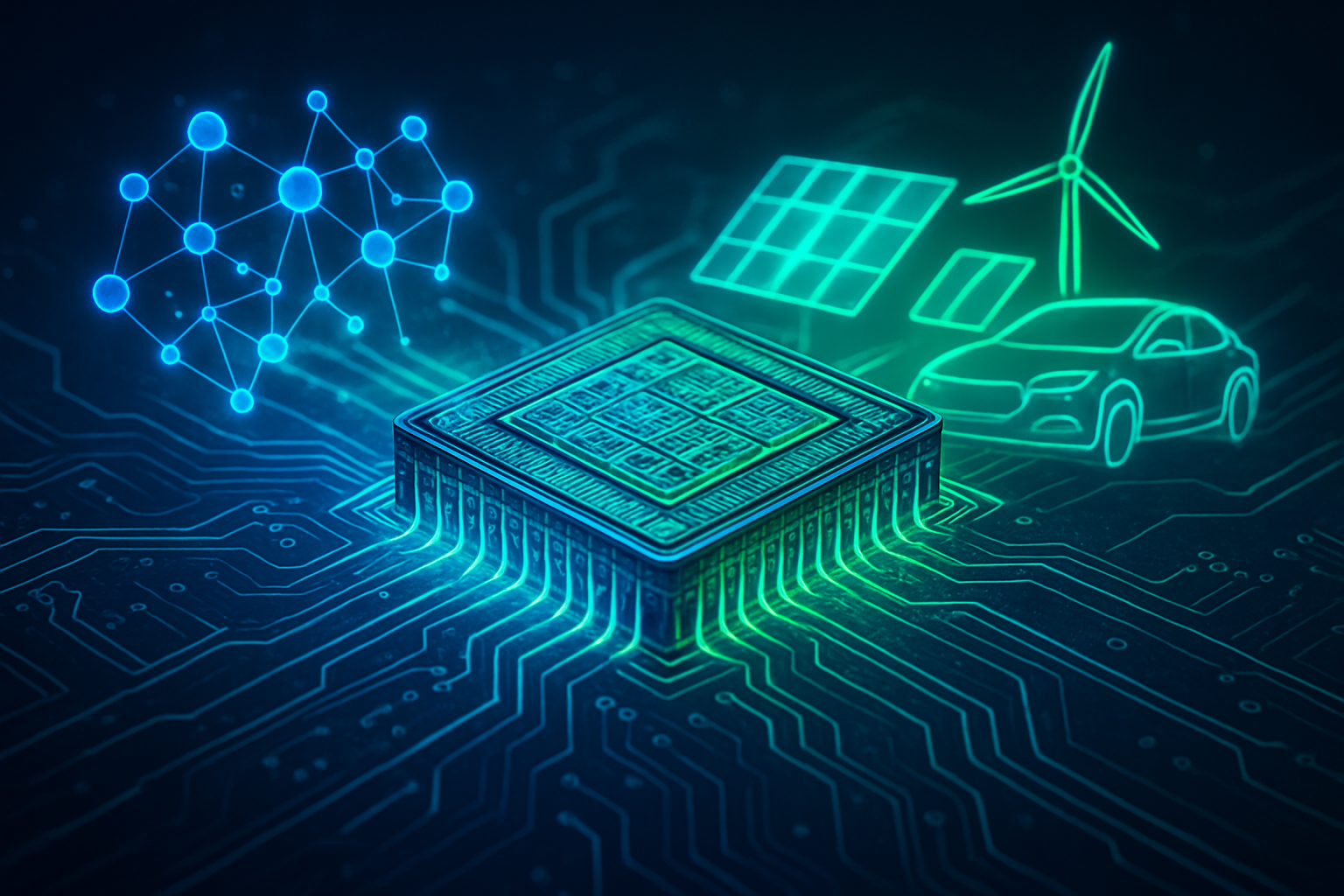
In a rapidly evolving technological landscape where efficiency and power density are paramount, Navitas Semiconductor (NASDAQ: NVTS) has emerged as a pivotal force in the Gallium Nitride (GaN) power IC market. As of October 2025, Navitas is not merely participating but actively leading the charge, redefining power electronics with its integrated GaN solutions. The company's innovations are critical for unlocking the next generation of high-performance computing, particularly in AI data centers, while simultaneously accelerating the transition to electric vehicles (EVs) and more sustainable energy solutions. Navitas's strategic focus on integrating GaN power FETs with crucial control and protection circuitry onto a single chip is fundamentally transforming how power is managed, offering unprecedented gains in speed, efficiency, and miniaturization across a multitude of industries.
The immediate significance of Navitas's advancements cannot be overstated. With global demand for energy-efficient power solutions escalating, especially with the exponential growth of AI workloads, Navitas's GaNFast™ and GaNSense™ technologies are becoming indispensable. Their collaboration with NVIDIA (NASDAQ: NVDA) to power advanced AI infrastructure, alongside significant inroads into the EV and solar markets, underscores a broadening impact that extends far beyond consumer electronics. By enabling devices to operate faster, cooler, and with a significantly smaller footprint, Navitas is not just optimizing existing technologies but is actively creating pathways for entirely new classes of high-power, high-efficiency applications crucial for the future of technology and environmental sustainability.
Unpacking the GaN Advantage: Navitas's Technical Prowess
Navitas Semiconductor's technical leadership in GaN power ICs is built upon a foundation of proprietary innovations that fundamentally differentiate its offerings from traditional silicon-based power semiconductors. At the core of their strategy are the GaNFast™ power ICs, which monolithically integrate GaN power FETs with essential control, drive, sensing, and protection circuitry. This "digital-in, power-out" architecture is a game-changer, simplifying power system design while drastically enhancing speed, efficiency, and reliability. Compared to silicon, GaN's wider bandgap (over three times greater) allows for smaller, faster-switching transistors with ultra-low resistance and capacitance, operating up to 100 times faster.
Further bolstering their portfolio, Navitas introduced GaNSense™ technology, which embeds real-time, autonomous sensing and protection circuits directly into the IC. This includes lossless current sensing and ultra-fast over-current protection, responding in a mere 30 nanoseconds, thereby eliminating the need for external components that often introduce delays and complexity. For high-reliability sectors, particularly in advanced AI, GaNSafe™ provides robust short-circuit protection and enhanced reliability. The company's strategic acquisition of GeneSiC has also expanded its capabilities into Silicon Carbide (SiC) technology, allowing Navitas to address even higher power and voltage applications, creating a comprehensive wide-bandgap (WBG) portfolio.
This integrated approach significantly differs from previous power management solutions, which typically relied on discrete silicon components or less integrated GaN designs. By consolidating multiple functions onto a single GaN chip, Navitas reduces component count, board space, and system design complexity, leading to smaller, lighter, and more energy-efficient power supplies. Initial reactions from the AI research community and industry experts have been overwhelmingly positive, with particular excitement around the potential for Navitas's technology to enable the unprecedented power density and efficiency required by next-generation AI data centers and high-performance computing platforms. The ability to manage power at higher voltages and frequencies with greater efficiency is seen as a critical enabler for the continued scaling of AI.
Reshaping the AI and Tech Landscape: Competitive Implications
Navitas Semiconductor's advancements in GaN power IC technology are poised to significantly reshape the competitive landscape for AI companies, tech giants, and startups alike. Companies heavily invested in high-performance computing, particularly those developing AI accelerators, servers, and data center infrastructure, stand to benefit immensely. Tech giants like NVIDIA (NASDAQ: NVDA), a key partner for Navitas, are already leveraging GaN and SiC solutions for their "AI factory" computing platforms. This partnership highlights how Navitas's 800V DC power devices are becoming crucial for addressing the unprecedented power density and scalability challenges of modern AI workloads, where traditional 54V systems fall short.
The competitive implications are profound. Major AI labs and tech companies that adopt Navitas's GaN solutions will gain a significant strategic advantage through enhanced power efficiency, reduced cooling requirements, and smaller form factors for their hardware. This can translate into lower operational costs for data centers, increased computational density, and more compact, powerful AI-enabled devices. Conversely, companies that lag in integrating advanced GaN technologies risk falling behind in performance and efficiency metrics, potentially disrupting existing product lines that rely on less efficient silicon-based power management.
Market positioning is also shifting. Navitas's strong patent portfolio and integrated GaN/SiC offerings solidify its position as a leader in the wide-bandgap semiconductor space. Its expansion beyond consumer electronics into high-growth sectors like EVs, solar/energy storage, and industrial applications, including new 80-120V GaN devices for 48V DC-DC converters, demonstrates a robust diversification strategy. This allows Navitas to capture market share in multiple critical segments, creating a strong competitive moat. Startups focused on innovative power solutions or compact AI hardware will find Navitas's integrated GaN ICs an essential building block, enabling them to bring more efficient and powerful products to market faster, potentially disrupting incumbents still tied to older silicon technologies.
Broader Significance: Powering a Sustainable and Intelligent Future
Navitas Semiconductor's pioneering work in GaN power IC technology extends far beyond incremental improvements; it represents a fundamental shift in the broader semiconductor landscape and aligns perfectly with major global trends towards increased intelligence and sustainability. This development is not just about faster chargers or smaller adapters; it's about enabling the very infrastructure that underpins the future of AI, electric mobility, and renewable energy. The inherent efficiency of GaN significantly reduces energy waste, directly impacting the carbon footprint of countless electronic devices and large-scale systems.
The impact of widespread GaN adoption, spearheaded by companies like Navitas, is multifaceted. Environmentally, it means less energy consumption, reduced heat generation, and smaller material usage, contributing to greener technology across all applications. Economically, it drives innovation in product design, allows for higher power density in confined spaces (critical for EVs and compact AI servers), and can lead to lower operating costs for enterprises. Socially, it enables more convenient and powerful personal electronics and supports the development of robust, reliable infrastructure for smart cities and advanced industrial automation.
While the benefits are substantial, potential concerns often revolve around the initial cost premium of GaN technology compared to mature silicon, as well as ensuring robust supply chains for widespread adoption. However, as manufacturing scales—evidenced by Navitas's transition to 8-inch wafers—costs are expected to decrease, making GaN even more competitive. This breakthrough draws comparisons to previous AI milestones that required significant hardware advancements. Just as specialized GPUs became essential for deep learning, efficient wide-bandgap semiconductors are now becoming indispensable for powering increasingly complex and demanding AI systems, marking a new era of hardware-software co-optimization.
The Road Ahead: Future Developments and Predictions
The future of GaN power IC technology, with Navitas Semiconductor at its forefront, is brimming with anticipated near-term and long-term developments. In the near term, we can expect to see further integration of GaN with advanced sensing and control features, making power management units even smarter and more autonomous. The collaboration with NVIDIA is likely to deepen, leading to specialized GaN and SiC solutions tailored for even more powerful AI accelerators and modular data center power architectures. We will also see an accelerated rollout of GaN-based onboard chargers and traction inverters in new EV models, driven by the need for longer ranges and faster charging times.
Long-term, the potential applications and use cases for GaN are vast and transformative. Beyond current applications, GaN is expected to play a crucial role in next-generation robotics, advanced aerospace systems, and high-frequency communications (e.g., 6G infrastructure), where its high-speed switching capabilities and thermal performance are invaluable. The continued scaling of GaN on 8-inch wafers will drive down costs and open up new mass-market opportunities, potentially making GaN ubiquitous in almost all power conversion stages, from consumer devices to grid-scale energy storage.
However, challenges remain. Further research is needed to push GaN devices to even higher voltage and current ratings without compromising reliability, especially in extremely harsh environments. Standardizing GaN-specific design tools and methodologies will also be critical for broader industry adoption. Experts predict that the market for GaN power devices will continue its exponential growth, with Navitas maintaining a leading position due to its integrated solutions and diverse application portfolio. The convergence of AI, electrification, and sustainable energy will be the primary accelerators, with GaN acting as a foundational technology enabling these paradigm shifts.
A New Era of Power: Navitas's Enduring Impact
Navitas Semiconductor's pioneering efforts in Gallium Nitride (GaN) power IC technology mark a significant inflection point in the history of power electronics and its symbiotic relationship with artificial intelligence. The key takeaways are clear: Navitas's integrated GaNFast™, GaNSense™, and GaNSafe™ technologies, complemented by its SiC offerings, are delivering unprecedented levels of efficiency, power density, and reliability. This is not merely an incremental improvement but a foundational shift from silicon that is enabling the next generation of AI data centers, accelerating the EV revolution, and driving global sustainability initiatives.
This development's significance in AI history cannot be overstated. Just as software algorithms and specialized processors have driven AI advancements, the ability to efficiently power these increasingly demanding systems is equally critical. Navitas's GaN solutions are providing the essential hardware backbone for AI's continued exponential growth, allowing for more powerful, compact, and energy-efficient AI hardware. The implications extend to reducing the massive energy footprint of AI, making it a more sustainable technology in the long run.
Looking ahead, the long-term impact of Navitas's work will be felt across every sector reliant on power conversion. We are entering an era where power solutions are not just components but strategic enablers of technological progress. What to watch for in the coming weeks and months includes further announcements regarding strategic partnerships in high-growth markets, advancements in GaN manufacturing processes (particularly the transition to 8-inch wafers), and the introduction of even higher-power, more integrated GaN and SiC solutions that push the boundaries of what's possible in power electronics. Navitas is not just building chips; it's building the power infrastructure for an intelligent and sustainable future.
This content is intended for informational purposes only and represents analysis of current AI developments.
TokenRing AI delivers enterprise-grade solutions for multi-agent AI workflow orchestration, AI-powered development tools, and seamless remote collaboration platforms.
For more information, visit https://www.tokenring.ai/.