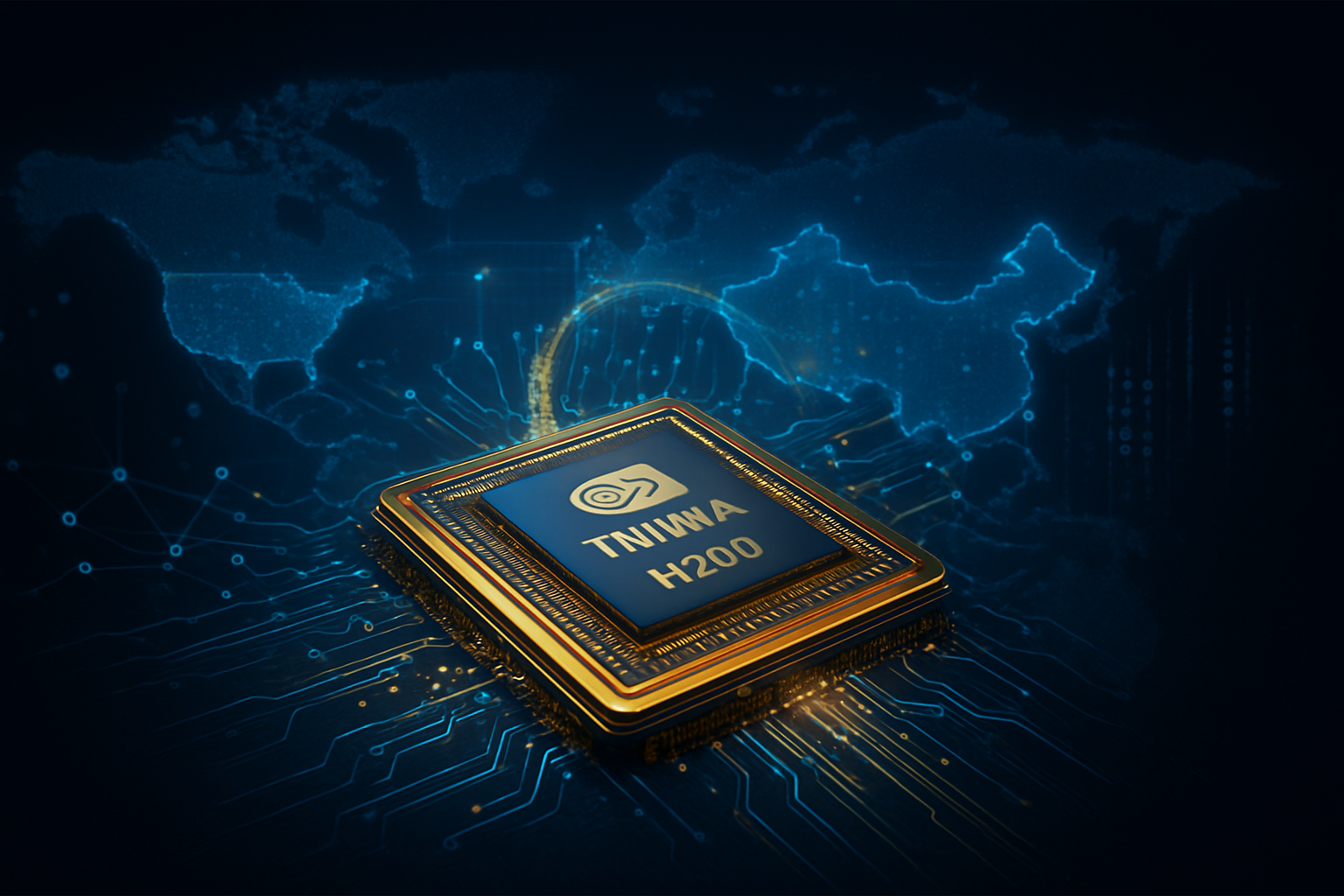
In a move that has sent shockwaves through both Silicon Valley and Beijing, the Trump administration has officially authorized the export of NVIDIA H200 GPU accelerators to the Chinese market. The decision, finalized in late January 2026, marks a dramatic reversal of the multi-year "presumption of denial" policy that had effectively crippled the sales of high-end American AI hardware to China. By replacing blanket bans with a transactional, security-monitored framework, the U.S. government aims to reassert American influence over global AI ecosystems while capturing significant federal revenue from the world’s second-largest economy.
The policy shift is being hailed by industry leaders as a pragmatic "thaw" in tech relations, though it comes with a complex web of restrictions that distinguish it from the unrestricted trade of the past decade. For NVIDIA (NASDAQ: NVDA), the announcement represents a lifeline for its Chinese business, which had previously been relegated to selling "degraded" or lower-performance chips like the H20 to comply with strict 2023 and 2024 export controls. Under the new regime, the H200—one of the most powerful AI training and inference chips currently in production—will finally be available to vetted Chinese commercial entities.
Advanced Silicon and the "Vulnerability Screening" Mandate
The technical specifications of the NVIDIA H200 represent a massive leap forward for the Chinese AI industry. Built on the Hopper architecture, the H200 is the first GPU to feature HBM3e memory, delivering 141GB of capacity and 4.8 TB/s of memory bandwidth. Compared to the H100, the H200 offers nearly double the inference performance for large language models (LLMs) like Llama 3 or GPT-4. This bandwidth is the critical factor in modern AI scaling, and its availability in China is expected to dramatically shorten the training cycles for domestic Chinese models which had been stagnating under previous hardware constraints.
To maintain a strategic edge, the U.S. Department of Commerce’s Bureau of Industry and Security (BIS) has introduced a new "regulatory sandwich." Under the January 13, 2026 ruling, chips are permitted for export only if their Total Processing Performance (TPP) remains below 21,000 and DRAM bandwidth stays under 6,500 GB/s. While the H200 fits within these specific bounds, the administration has eliminated the practice of "binning" or hardware-level performance capping for the Chinese market. Instead, the focus has shifted to who is using the chips and how they are being deployed.
A key technical innovation in this policy is the "U.S. First" testing protocol. Before any H200 units are shipped to China, they must first be imported from manufacturing hubs into specialized American laboratories. There, they undergo "vulnerability screening" and technical verification to ensure no unauthorized firmware modifications have been made. This allows the U.S. government to maintain a literal hands-on check on the hardware before it enters the Chinese supply chain, a logistical hurdle that experts say is unprecedented in the history of semiconductor trade.
Initial reactions from the AI research community have been cautiously optimistic. While researchers at institutions like Tsinghua University welcome the performance boost, there is lingering skepticism regarding the mandatory U.S. testing phase. Industry analysts note that this requirement could introduce a 4-to-6 week delay in the supply chain. However, compared to the alternative—developing sovereign silicon that still lags generations behind NVIDIA—most Chinese tech giants see this as a necessary price for performance.
Revenue Levies and the Battle for Market Dominance
The financial implications for NVIDIA are profound. Before the 2023 restrictions, China accounted for approximately 20% to 25% of NVIDIA’s data center revenue. This figure had plummeted as Chinese firms were forced to choose between underpowered U.S. chips and domestic alternatives. With the H200 now on the table, analysts predict a massive surge in capital expenditure from Chinese "hyperscalers" such as Alibaba (NYSE: BABA), Tencent (HKG: 0700), and Baidu (NASDAQ: BIDU). These companies have been eager to upgrade their aging infrastructure to compete with Western AI capabilities.
However, the "Trump Thaw" is far from a free pass. The administration has imposed a mandatory 25% "revenue levy" on all H200 sales to China, structured as a Section 232 national security tariff. This ensures that the U.S. Treasury benefits directly from every transaction. Additionally, NVIDIA is subject to volume caps: the total number of H200s exported to China cannot exceed 50% of the volume sold to U.S. domestic customers. This "America First" ratio is designed to ensure that the U.S. always maintains a larger, more advanced install base of AI compute power.
The move also places intense pressure on Advanced Micro Devices (NASDAQ: AMD), which has been seeking its own licenses for the Instinct MI325X series. As the market opens, a new competitive landscape is emerging where U.S. companies are not just competing against each other, but against the rising tide of Chinese domestic competitors like Huawei. By allowing the H200 into China, the U.S. is effectively attempting to "crowd out" Huawei’s Ascend 910C chips, making it harder for Chinese firms to justify the switch to a domestic ecosystem that remains more difficult to program for.
Strategic advantages for ByteDance—the parent company of TikTok—are also in the spotlight. ByteDance has historically been one of NVIDIA's largest customers in Asia, using GPUs for its massive recommendation engines and generative AI projects. The ability to legally procure H200s gives ByteDance a clear path to maintaining its global competitive edge, provided it can navigate the stringent end-user vetting processes required by the new BIS rules.
The Geopolitical "AI Overwatch" and a Fragile Thaw
The broader significance of this decision cannot be overstated. It signals a shift in the U.S. strategy from total containment to a "managed dependency." By allowing China to buy NVIDIA’s second-best hardware (with the newer Blackwell architecture still largely restricted), the U.S. keeps the Chinese tech sector tethered to American software stacks like CUDA. Experts argue that if China were forced to fully decouple, they would eventually succeed in building a parallel, independent tech ecosystem. This policy is an attempt to delay that "Sputnik moment" indefinitely.
This strategy has not been without fierce domestic opposition. On January 21, 2026, the House Foreign Affairs Committee advanced the "AI Overwatch Act" (H.R. 6875), a bipartisan effort to grant Congress the power to veto specific export licenses. Critics of the administration, including many "China hawks," argue that the H200 is too powerful to be exported safely. They contend that the 25% tariff is a "pay-to-play" scheme that prioritizes corporate profits and short-term federal revenue over long-term national security, fearing that the hardware will inevitably be diverted to military AI projects.
Comparing this to previous AI milestones, such as the 2022 ban on the A100, the current situation represents a much more transactional approach to geopolitics. The administration's "AI and Crypto Czar," David Sacks, has defended the policy by stating that the U.S. must lead the global AI ecosystem through engagement rather than isolation. The "thaw" is seen as a way to lower the temperature on trade relations while simultaneously building a massive federal war chest funded by Chinese tech spending.
Beijing’s response has been characteristically measured but complex. While the Ministry of Industry and Information Technology (MIIT) has granted "in-principle" approval for firms to order H200s, they have also reportedly mandated that for every U.S. chip purchased, a corresponding investment must be made in domestic silicon. This "one-for-one" quota system indicates that while China is happy to have access to NVIDIA’s power, it remains fully committed to its long-term goal of self-reliance.
Future Developments: Blackwell and the Parity Race
As we look toward the remainder of 2026, the primary question is whether this policy will extend to NVIDIA’s next-generation Blackwell architecture. Currently, the B200 remains restricted, keeping the "performance gap" between the U.S. and China at approximately 12 to 18 months. However, if the H200 export experiment is deemed a financial and security success, there is already talk in Washington of a "Blackwell Lite" variant being introduced by 2027.
The near-term focus will be on the logistical execution of the "vulnerability screening" labs. If these facilities become a bottleneck, it could lead to renewed friction between the White House and the tech industry. Furthermore, the world will be watching to see if other nations, particularly in the Middle East and Southeast Asia, demand similar "case-by-case" license review policies to access the highest tiers of American compute power.
Predicting the next moves of the Chinese "national champions" is also vital. With access to H200s, will Alibaba and Baidu finally reach parity with U.S.-based models like Claude or Gemini? Or will the U.S. domestic volume caps ensure that American labs always have a two-to-one advantage in raw compute? Most experts believe that while the H200 will prevent a total collapse of the Chinese AI sector, the structural advantages of the U.S. ecosystem—combined with the new 25% "AI Tax"—will keep the American lead intact.
A New Chapter in the Silicon Cold War
The approval of NVIDIA H200 exports to China is a defining moment in the history of artificial intelligence and international trade. It represents a pivot from the "small yard, high fence" strategy toward a more dynamic "toll-booth" model. By allowing high-performance hardware to flow into China under strict supervision and high taxation, the Trump administration is betting that economic interdependency can be used as a tool for national security rather than a vulnerability.
In the coming weeks, the industry will watch closely for the first confirmed shipments of H200s landing in Shanghai and the resulting benchmarks from Chinese AI labs. The success or failure of this policy will likely dictate the trajectory of U.S.-China relations for the rest of the decade. If the H200s are used to create breakthroughs that threaten U.S. interests, the "AI Overwatch Act" will almost certainly be invoked to shut the gates once again.
Ultimately, the H200 export decision is a high-stakes gamble. It provides NVIDIA and the U.S. Treasury with a massive financial windfall while offering China the tools it needs to stay in the AI race. Whether this leads to a stable "technological co-existence" or merely fuels the next phase of an escalating AI arms race remains the most critical question of 2026.
This content is intended for informational purposes only and represents analysis of current AI developments.
TokenRing AI delivers enterprise-grade solutions for multi-agent AI workflow orchestration, AI-powered development tools, and seamless remote collaboration platforms.
For more information, visit https://www.tokenring.ai/.