
Tag: AI Glasses

  • Beyond the Noise: How Meta’s ‘Conversation Focus’ is Redefining Personal Audio and the Hearing Aid Industry

    Beyond the Noise: How Meta’s ‘Conversation Focus’ is Redefining Personal Audio and the Hearing Aid Industry

    As the calendar turns to early 2026, the artificial intelligence landscape is no longer dominated solely by chatbots and image generators. Instead, the focus has shifted to the "ambient AI" on our faces. Meta Platforms Inc. (NASDAQ: META) has taken a decisive lead in this transition with the full rollout of its "Conversation Focus" feature—a sophisticated AI-driven audio suite for its Ray-Ban Meta and Oakley Meta smart glasses. By solving the "cocktail party problem," this technology allows wearers to isolate and amplify a single human voice in a chaotic, noisy room, transforming a stylish accessory into a powerful tool for sensory enhancement.

    The immediate significance of this development cannot be overstated. For decades, isolating specific speech in high-decibel environments was a challenge reserved for high-end, medical-grade hearing aids costing thousands of dollars. With the v21 software update in late 2025 and the early 2026 expansion to its new "Display" models, Meta has effectively democratized "superhuman hearing." This move bridges the gap between consumer electronics and assistive health technology, making it socially acceptable—and even trendy—to wear augmented audio devices in public settings.

    The Science of Silence: Neural Beamforming and Llama Integration

    Technically, "Conversation Focus" represents a massive leap over previous directional audio attempts. At its core, the system utilizes a five-to-six microphone array embedded in the frames of the glasses. Traditional beamforming uses simple geometry to focus on sounds coming from a specific direction, but Meta’s approach utilizes "Neural Beamforming." This process uses on-device neural networks to dynamically estimate acoustic weights in real-time, distinguishing between a friend’s voice and the "diffuse noise" of a clattering restaurant or a passing train.

    Powered by the Qualcomm (NASDAQ: QCOM) Snapdragon AR1+ Gen 1 chipset, the glasses process this audio locally with a latency of less than 20 milliseconds. This local execution is critical for both privacy and the "naturalness" of the conversation. The AI creates a focused "audio bubble" with a radius of approximately 1.8 meters (6 feet). When the wearer gazes at a speaker, the AI identifies that speaker’s specific vocal timbre and applies an adaptive gain, lifting the voice by roughly 6 decibels relative to the background noise.

    The integration of Meta’s own Small Language Models (SLMs), specifically variants of Llama 3.2-1B and the newly released Llama 4, allows the glasses to move beyond simple filtering. The AI can now understand the intent of the user. If a wearer turns their head but remains engaged with the original speaker, the AI can maintain the "lock" on that voice using spatial audio anchors. Initial reactions from the AI research community have been overwhelmingly positive, with experts at AICerts and Counterpoint Research noting that Meta has successfully moved the needle from "gimmicky recording glasses" to "indispensable daily-use hardware."

    A Market in Flux: The Disruptive Power of 'Hearables'

    The strategic implications of Conversation Focus are rippling through the tech sector, placing Meta in direct competition with both Silicon Valley giants and traditional medical companies. By partnering with EssilorLuxottica (EPA: EL), Meta has secured a global retail footprint of over 18,000 stores, including LensCrafters and Sunglass Hut. This gives Meta a physical distribution advantage that Apple Inc. (NASDAQ: AAPL) and Alphabet Inc. (NASDAQ: GOOGL) are currently struggling to match in the eyewear space.

    For the traditional hearing aid industry, dominated by players like Sonova (SWX: SOON) and Demant, this is a "Blackberry moment." While these companies offer FDA-cleared medical devices, Meta’s $300–$400 price point and Ray-Ban styling are cannibalizing the "mild-to-moderate" hearing loss segment. Apple has responded by adding "Hearing Aid Mode" to its AirPods Pro, but Meta’s advantage lies in the form factor: it is socially awkward to wear earbuds during a dinner party, but perfectly normal to wear glasses. Meanwhile, Google has shifted to an ecosystem strategy, partnering with Warby Parker (NYSE: WRBY) to bring its Gemini AI to a variety of frames, though it currently lags behind Meta in audio isolation precision.

    The Social Contract: Privacy and the 'New Glasshole' Debate

    The broader significance of AI-powered hearing is as much social as it is technical. We are entering an era of "selective reality," where two people in the same room may no longer share the same auditory experience. While this enhances accessibility for those with sensory processing issues, it has sparked a fierce debate over "sensory solipsism"—the idea that users are becoming disconnected from their shared environment by filtering out everything but their immediate interests.

    Privacy concerns have also resurfaced with a vengeance. Unlike cameras, which usually have a physical or LED indicator, "Conversation Focus" involves always-on microphones that can process and potentially transcribe ambient conversations. In the European Union, the EU AI Act has placed such real-time biometric processing under high-risk classification, leading to regulatory friction. Critics argue that "superhuman hearing" is a polite term for "eavesdropping," raising questions about consent in public-private spaces like coffee shops or offices. The "New Glasshole" debate of 2026 isn't about people taking photos; it's about whether the person across from you is using AI to index every word you say.

    Looking Ahead: Holograms and Neural Interfaces

    The future of Meta’s eyewear roadmap is even more ambitious. The "Conversation Focus" feature is seen as a foundational step toward "Project Orion," Meta's upcoming holographic glasses. In the near term, experts predict that Llama 4 will enable "Intent-Based Hearing," where the glasses can automatically switch focus based on who the wearer is looking at or even when a specific keyword—like the user's name—is whispered in a crowd.

    We are also seeing the first clinical trials for "Cognitive Load Reduction." Research suggests that by using AI to reduce the effort required to listen in noisy rooms, these glasses could potentially slow the onset of cognitive decline in seniors. Furthermore, Meta is expected to integrate its EMG (Electromyography) wristband technology, allowing users to control their audio bubble with subtle finger pinches rather than voice commands, making the use of AI hearing even more discrete.

    A New Era of Augmented Humanity

    The launch of Conversation Focus marks a pivotal moment in AI history. It represents the point where AI transitioned from being a digital assistant on a screen to an active filter for our biological senses. By tackling the complex "cocktail party problem," Meta has moved beyond the realm of social media and into the realm of human enhancement.

    In the coming months, watch for the inevitable regulatory battles in the EU and North America regarding audio privacy and consent. Simultaneously, keep an eye on Apple’s rumored "Vision Glasses" and Google’s Gemini-integrated eyewear, as the battle for the "front-row seat to the human experience"—the face—intensifies. For now, Meta has the clear lead, proving that the future of AI isn't just about what we see, but how we hear the world around us.


    This content is intended for informational purposes only and represents analysis of current AI developments.

    TokenRing AI delivers enterprise-grade solutions for multi-agent AI workflow orchestration, AI-powered development tools, and seamless remote collaboration platforms.
    For more information, visit https://www.tokenring.ai/.
  • Meta Unveils v21 Update for AI Glasses: “Conversation Focus” and Multimodal Spotify Integration Redefine Ambient Computing

    Meta Unveils v21 Update for AI Glasses: “Conversation Focus” and Multimodal Spotify Integration Redefine Ambient Computing

    Just in time for the 2025 holiday season, Meta Platforms (NASDAQ:META) has released its highly anticipated v21 software update for its Ray-Ban Meta smart glasses. This update, which began rolling out globally on December 16, 2025, represents the most significant leap in the device’s capabilities since its launch, shifting the narrative from a simple "social camera" to a sophisticated AI-driven assistant. By leveraging advanced multimodal AI and edge computing, Meta is positioning its eyewear as a primary interface for the "post-smartphone" era, prioritizing utility and accessibility over the virtual-reality-first vision of years past.

    The significance of the v21 update lies in its focus on "superpower" features that solve real-world problems. The two headline additions—"Conversation Focus" and the "Look & Play" Spotify (NYSE:SPOT) integration—demonstrate a move toward proactive AI. Rather than waiting for a user to ask a question, the glasses are now capable of filtering the physical world and curating experiences based on visual context. As the industry moves into 2026, this update serves as a definitive statement on Meta’s strategy: dominating the face with lightweight, AI-augmented hardware that people actually want to wear every day.

    The Engineering Behind the "Superpowers": Conversation Focus and Multimodal Vision

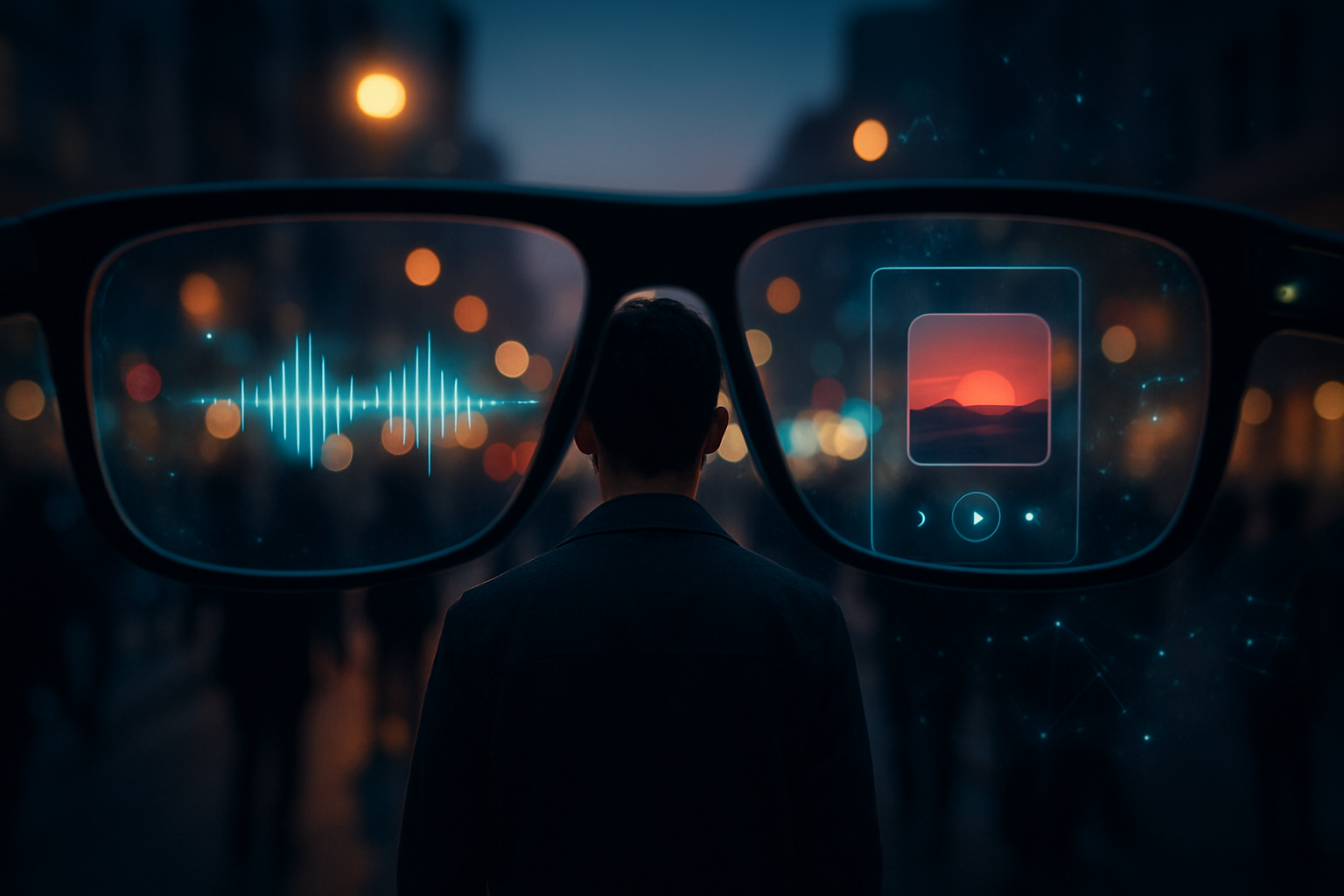
    At the heart of the v21 update is Conversation Focus, a technical breakthrough aimed at solving the "cocktail party problem." While traditional active noise cancellation in devices like the Apple (NASDAQ:AAPL) AirPods Pro 2 blocks out the world, Conversation Focus uses selective amplification. Utilizing the glasses' five-microphone beamforming array and the Snapdragon AR1 Gen1 processor, the system creates a narrow audio "pickup zone" directly in front of the wearer. The AI identifies human speech patterns and isolates the voice of the person the user is looking at, suppressing background noise like clinking dishes or traffic with sub-10ms latency. This real-time spatial processing allows users to hold clear conversations in environments that would otherwise be deafening.

    The second major pillar of the update is "Look & Play," a multimodal integration with Spotify that transforms the wearer’s surroundings into a musical prompt. By using the phrase, "Hey Meta, play a song to match this view," the 12MP camera captures a frame and uses on-device scene recognition to analyze the "vibe" of the environment. Whether the user is staring at a snowy mountain peak, a festive Christmas market, or a quiet rainy street, the AI analyzes visual tokens—such as lighting, color palette, and objects—and cross-references them with the user’s Spotify listening history. The result is a personalized soundtrack that feels cinematically tailored to the moment, a feat that would be impossible with traditional voice-only assistants.

    Beyond these flagship features, v21 introduces several quality-of-life improvements. Users can now record Hyperlapse videos for up to 30 minutes and capture Slow Motion clips, features previously reserved for high-end smartphones. The update also expands language support to include Telugu and Kannada, signaling Meta’s aggressive push into the Indian market. Additionally, a new "Find Device" feature provides the last known location of the glasses, and voice-controlled fitness integrations now sync directly with Garmin (NYSE:GRMN) and Strava, allowing athletes to manage their workouts entirely hands-free.

    Market Positioning: Meta’s Strategic Pivot to AI Wearables

    The v21 update cements Meta’s lead in the smart glasses category, a market where Snap Inc. (NYSE:SNAP) and Google have struggled to find a foothold. By focusing on audio and AI rather than full-field augmented reality (AR) displays, Meta has successfully bypassed the weight and battery life issues that plague bulkier headsets. Industry analysts view this as a strategic pivot away from the "Metaverse" branding of 2021 toward a more grounded "Ambient AI" approach. By turning the glasses into a functional hearing aid and a context-aware media player, Meta is targeting a much broader demographic than the early-adopter tech crowd.

    The competitive implications are particularly sharp for Apple. While the Vision Pro remains a high-end niche product for spatial computing, Meta’s glasses are competing for the "all-day wear" market. Conversation Focus, in particular, puts Meta in direct competition with the hearing-health features of the AirPods Pro. For Spotify, this partnership provides a unique moat against Apple Music, as the deep multimodal integration offers a level of contextual awareness that is currently unavailable on other platforms. As we move into 2026, the battle for the "operating system of the face" is no longer about who can project the most pixels, but who can provide the most intelligent audio and visual assistance.

    The Wider Significance: Privacy, Accessibility, and the Era of Constant Interpretation

    The release of v21 marks a shift in the broader AI landscape toward "always-on" multimodal models. Previous AI milestones were defined by chatbots (like ChatGPT) that waited for text input; this new era is defined by AI that is constantly interpreting the world alongside the user. This has profound implications for accessibility. For individuals with hearing impairments or sensory processing disorders, Conversation Focus is a life-changing tool that is "socially invisible," removing the stigma often associated with traditional hearing aids.

    However, the "Look & Play" feature raises fresh concerns among privacy advocates. For the AI to "match the view," the camera must be active more frequently, and the AI must constantly analyze the user’s surroundings. While Meta emphasizes that processing is done on-device and frames are not stored on their servers unless explicitly saved, the social friction of being around "always-interpreting" glasses remains a hurdle. This update forces a conversation about the trade-off between convenience and the sanctity of private spaces in a world where everyone’s glasses are "seeing" and "hearing" with superhuman clarity.

    Looking Ahead: The Road to Orion and Full AR

    Looking toward 2026, experts predict that the v21 update is a bridge to Meta’s next generation of hardware, often referred to by the codename "Orion." The software improvements seen in v21—specifically the low-latency audio processing and multimodal scene understanding—are the foundational building blocks for true AR glasses that will eventually overlay digital information onto the physical world. We expect to see "Conversation Focus" evolve into "Visual Focus," where AI could highlight specific objects or people in a crowded field of vision.

    The next major challenge for Meta will be battery efficiency. As the AI becomes more proactive, the power demands on the Snapdragon AR1 Gen1 chip increase. Future updates will likely focus on "low-power" vision modes that allow the glasses to stay contextually aware without draining the battery in under four hours. Furthermore, we may soon see the integration of "Memory" features, where the glasses can remind you where you left your keys or the name of the person you met at a conference last week, further cementing the device as an essential cognitive peripheral.

    Conclusion: A Milestone in the Evolution of Personal AI

    The v21 update for Meta’s AI glasses is more than just a software patch; it is a declaration of intent. By successfully implementing Conversation Focus and the "Look & Play" multimodal integration, Meta has demonstrated that smart glasses can provide tangible, "superhuman" utility in everyday life. This update marks the moment where AI moved from the screen to the senses, becoming a filter through which we hear and see the world.

    As we close out 2025, the key takeaway is that the most successful AI hardware might not be the one that replaces the smartphone, but the one that enhances the human experience without getting in the way. The long-term impact of this development will be measured by how quickly these "assistive" features become standard across the industry. For now, Meta holds a significant lead, and all eyes—and ears—will be on how they leverage this momentum in the coming year.


    This content is intended for informational purposes only and represents analysis of current AI developments.

    TokenRing AI delivers enterprise-grade solutions for multi-agent AI workflow orchestration, AI-powered development tools, and seamless remote collaboration platforms.
    For more information, visit https://www.tokenring.ai/.
  • Apple Pivots from Vision Pro Overhaul to Accelerate AI Glasses Development

    Apple Pivots from Vision Pro Overhaul to Accelerate AI Glasses Development

    Apple (NASDAQ: AAPL) is reportedly making a significant strategic pivot, shifting its focus from an overhaul of the Vision Pro headset to prioritize the accelerated development of AI-powered smart glasses. This decision marks a substantial redirection in the tech giant's wearable technology roadmap, signaling a strong intent to compete in the burgeoning market for more accessible and integrated AI wearables. The move underscores Apple's recognition of the challenges faced by the high-priced, immersive Vision Pro and its ambition to deliver a more mass-market friendly device that integrates seamlessly into daily life.

    This strategic redirection reflects a calculated response to the current market landscape, where consumer demand appears to favor lightweight, socially acceptable smart eyewear over bulky, albeit powerful, mixed-reality headsets. By reallocating engineering resources and accelerating its AI glasses project, Apple is setting the stage for a new era of personal computing, heavily reliant on artificial intelligence and a revamped user interaction paradigm.

    A Clear Vision for AI: Shifting Resources from Immersive to Integrated

    Apple's decision to halt the development of a cheaper and lighter iteration of its Vision Pro headset (reportedly code-named N100 or "Vision Air") in favor of AI-powered smart glasses highlights a fundamental re-evaluation of its wearable strategy. The initial Vision Pro, launched at a premium price point of $3,499, has faced considerable criticism for its prohibitive cost, substantial form factor, and niche appeal, leading to an underwhelming market reception and slower-than-anticipated adoption rates. Reports suggest sales have fallen short of initial projections, with some estimates placing units sold below 1 million since its February 2024 launch. This stands in stark contrast to the unexpected success and growing traction of more discreet, AI-equipped smart glasses from competitors like Meta (NASDAQ: META).

    Apple is reportedly pursuing at least two distinct models of AI-powered smart glasses. The first, an iPhone-dependent model (N50), is envisioned as a companion device that offloads much of its processing to a connected iPhone, notably lacking an integrated display. This design choice aims to achieve a significantly lighter, more comfortable, and potentially more affordable product, with a target price point below $1,000. This model is anticipated to be unveiled as early as next year, with a potential market release in 2027. The second, more advanced version, will feature an integrated display, and its development timeline is reportedly being accelerated to directly compete with display-equipped smart glasses already entering the market from rivals.

    The technical specifications and capabilities of these AI glasses are expected to revolve heavily around advanced AI integration, with a strong emphasis on voice controls powered by a "next-generation Siri." This revamped virtual assistant, anticipated for a spring 2026 launch, is central to the user experience, enabling seamless interaction through natural language. Key features are likely to include integrated cameras for recording, multiple microphones for superior voice command recognition, speakers for audio playback, and advanced health-tracking capabilities. Crucially, Apple plans to offer these glasses in a variety of styles and frame options, consciously positioning them as a fashion accessory rather than a purely technical gadget, a significant departure from the utilitarian design of the Vision Pro. This strategic shift moves away from the complex, immersive, and isolated experience of mixed reality towards a more subtle, always-on, and socially integrated form of spatial computing.

    Reshaping the Wearable Landscape: Industry Implications and Competitive Dynamics

    This strategic pivot by Apple carries profound implications for the AI and tech industries, reshaping competitive landscapes and potentially disrupting existing product categories. By prioritizing AI glasses, Apple is directly intensifying its rivalry with Meta (NASDAQ: META), which has already established a strong foothold in the smart eyewear market with its successful Ray-Ban Meta Smart Glasses. Meta's early success demonstrated a clear consumer appetite for a more discreet, fashion-forward, and AI-integrated wearable, a segment Apple now aims to dominate. This move will undoubtedly accelerate the race for advanced, AI-powered wearable devices, pushing both companies to innovate rapidly in areas like on-device AI, natural language processing, and sensor technology.

    Beyond Meta, this shift also puts pressure on other tech giants and startups exploring the wearable space. Companies like Google (NASDAQ: GOOGL), which has its own history with smart glasses, and numerous smaller firms developing niche AR/VR hardware, will need to reassess their strategies in light of Apple's renewed focus. The emphasis on an iPhone-dependent model initially suggests a tight integration within Apple's existing ecosystem, further solidifying customer loyalty and creating a powerful new accessory category. This could potentially disrupt the market for traditional smartwatches and other personal tech, as AI glasses could absorb some of their functionalities, offering a more seamless and hands-free interaction with digital information.

    Apple's market positioning stands to gain significant strategic advantages. By moving towards a more affordable and aesthetically pleasing form factor, the company aims for mass-market adoption, something the Vision Pro struggled to achieve. This democratizes access to spatial computing and AI-driven experiences, potentially creating a new paradigm for how users interact with technology daily. The reallocation of engineering talent and resources from the Vision Pro overhaul to the AI glasses project signifies a clear directive from Apple's leadership, indicating a strong belief in the long-term potential of this product category. This focus will also likely redirect developer attention, spurring the creation of new applications and experiences specifically tailored for the AI glasses ecosystem, particularly around the capabilities of the "next-generation Siri" and integrated camera functionalities.

    Broader AI Landscape: A New Frontier for Ubiquitous Computing

    Apple's strategic shift to AI glasses fits squarely within the broader AI landscape and emerging trends towards ubiquitous and ambient computing. The move signifies a strong endorsement of the concept that AI should be seamlessly integrated into our daily lives, accessible without the friction of traditional screens or bulky hardware. This vision aligns with the industry-wide push for more natural human-computer interaction, where voice, gestures, and contextual awareness driven by AI become primary modes of engagement. The development of an "iPhone-dependent" model, initially lacking its own display, underscores a belief that the true power of AI glasses lies not in a standalone immersive experience, but in enhancing and extending the capabilities of existing personal devices, acting as an intelligent interface to the digital world.

    The potential impacts of this development are far-reaching. On one hand, it could accelerate the adoption of AI-powered assistants and contextual computing, making information and digital services more readily available in real-time. Imagine receiving subtle, AI-driven notifications about your surroundings, instant translations, or augmented navigation cues directly within your field of vision or through discreet audio. This could revolutionize how we work, learn, and navigate our environments. However, potential concerns also arise, particularly regarding privacy. The integration of cameras and microphones into an always-on wearable device raises questions about data collection, surveillance, and the potential for misuse. Apple's historically strong stance on privacy will be rigorously tested as it ventures into this highly sensitive product category.

    Comparing this to previous AI milestones, Apple's move echoes the transformative impact of the original iPhone, which integrated multiple technologies into a single, intuitive device, fundamentally changing personal computing. While not a breakthrough in core AI research, this strategic hardware pivot is a significant step in democratizing AI's application. It represents a commitment to moving AI beyond cloud-based services and into personal, wearable hardware, similar to how smartphones brought powerful computing into everyone's pockets. The emphasis on a "next-generation Siri" also suggests a significant investment in improving conversational AI, a critical component for natural interaction with these glasses. This development marks a pivotal moment in the evolution of wearable technology, potentially defining the next major platform shift after smartphones.

    The Road Ahead: Anticipated Developments and Future Challenges

    The immediate future following Apple's strategic pivot will likely see an acceleration of internal development and external partnerships aimed at bringing its AI glasses to market. Experts predict that the initial iPhone-dependent model (N50) could see a public unveiling as early as next year, with a potential market release in 2027. This timeframe suggests intense engineering efforts to refine the hardware, optimize the AI integration, and ensure seamless connectivity with the iPhone ecosystem. The subsequent display-equipped model, while further out, is also expected to see an accelerated development timeline, driven by the competitive landscape.

    Potential applications and use cases for these AI glasses are vast and varied. Beyond basic notifications and hands-free communication, we can anticipate advanced augmented reality overlays for navigation, real-time language translation, intelligent contextual information delivery (e.g., identifying landmarks or products), and even sophisticated health and wellness monitoring. Imagine a device that discreetly guides you through a new city, provides instant nutritional information about food, or offers personalized fitness coaching based on your activity and surroundings – all without pulling out a phone. The revamped "next-generation Siri" will be crucial, enabling highly intuitive voice commands and proactive AI assistance.

    However, significant challenges lie ahead. Miniaturization of powerful AI chips, efficient battery life, and robust connectivity in a sleek, fashionable form factor remain formidable engineering hurdles. User acceptance and overcoming the "glasshole" stigma associated with early smart glasses will also be critical. Apple will need to strike a delicate balance between functionality, design, and privacy to ensure widespread adoption. What experts predict next is a fierce innovation race, particularly in on-device AI processing to reduce reliance on cloud computing, and in the development of sophisticated yet unobtrusive display technologies for the more advanced models. The integration of advanced sensors for environmental awareness and biometric data will also be key areas of focus.

    A New Chapter for Apple and AI Wearables

    Apple's strategic shift to halt the Vision Pro overhaul and instead focus its considerable resources on developing AI glasses marks a pivotal moment in the company's trajectory and the broader evolution of personal computing. This decision underscores a clear recognition of the market's demand for more accessible, integrated, and socially acceptable AI-powered wearables, moving away from the niche appeal of immersive mixed-reality headsets. The immediate significance lies in Apple's renewed commitment to democratizing spatial computing and defining the next generation of human-computer interaction through advanced AI.

    This development holds profound significance in AI history, not as a breakthrough in foundational AI research, but as a critical step in the commercialization and widespread integration of AI into everyday life. By leveraging its ecosystem and design prowess, Apple aims to make ambient intelligence a tangible reality for millions. The move solidifies the trend towards ubiquitous computing, where AI seamlessly augments our senses and interactions with the world.

    In the coming weeks and months, industry observers will be closely watching for further details on Apple's AI glasses roadmap, particularly any glimpses of design patents, software development kits, or official announcements regarding the "next-generation Siri." The competitive response from rivals like Meta (NASDAQ: META) and Google (NASDAQ: GOOGL) will also be a key area to monitor, as the race to dominate the smart eyewear market heats up. This strategic pivot by Apple is not merely a change in product focus; it represents a bold statement about the future of personal technology, where AI-integrated wearables are poised to become the next indispensable device.

    This content is intended for informational purposes only and represents analysis of current AI developments.

    TokenRing AI delivers enterprise-grade solutions for multi-agent AI workflow orchestration, AI-powered development tools, and seamless remote collaboration platforms.
    For more information, visit https://www.tokenring.ai/.