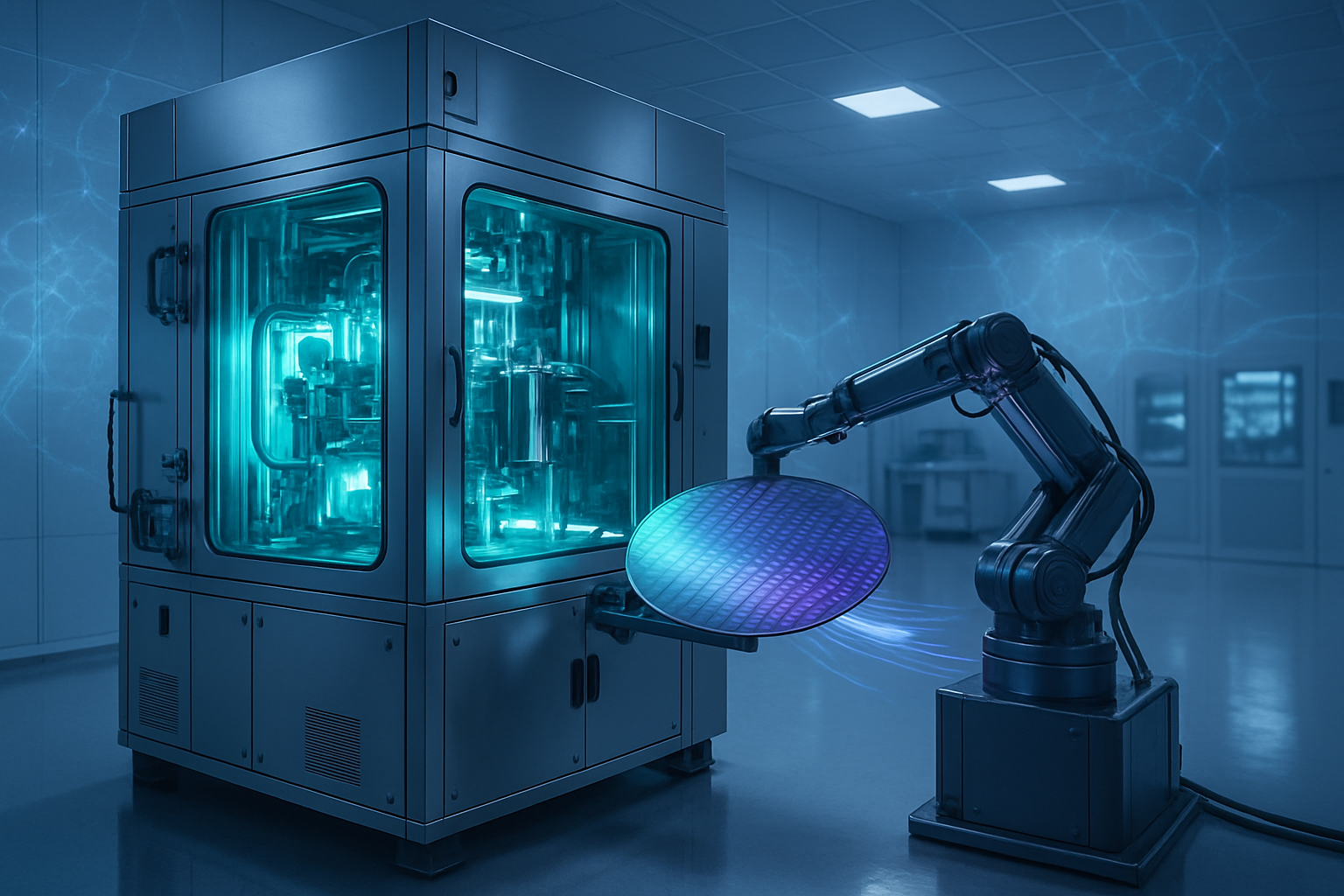
The global semiconductor industry is in the throes of an unprecedented investment surge, largely propelled by the insatiable demand for Artificial Intelligence (AI) and high-performance computing (HPC). As of October 5, 2025, this robust recovery is setting the stage for substantial market expansion, with projections indicating a global semiconductor market reaching approximately $697 billion this year, an 11% increase from 2024. This burgeoning market is expected to hit a staggering $1 trillion by 2030, underscoring AI's transformative power across the tech landscape.
Amidst this supercycle, Entegris, Inc. (NASDAQ: ENTG), a vital supplier of advanced materials and process solutions, has strategically positioned itself to capitalize on these trends. The company has demonstrated strong financial performance, securing significant U.S. CHIPS Act funding and announcing a massive $700 million domestic investment in R&D and manufacturing. This, coupled with substantial increases in institutional stakes from major players like Vanguard Group Inc., Principal Financial Group Inc., and Goldman Sachs Group Inc., signals a profound confidence in Entegris's indispensable role in enabling next-generation AI technologies and the broader semiconductor ecosystem. The immediate significance of these movements points to a sustained, AI-driven growth phase for semiconductors, a prioritization of advanced manufacturing capabilities, and a strategic reshaping of global supply chains towards greater resilience and domestic self-reliance.
The Microcosm of Progress: Advanced Materials and Manufacturing at AI's Core
The current AI revolution is intrinsically linked to groundbreaking advancements in semiconductor technology, where the pursuit of ever-smaller, more powerful, and energy-efficient chips is paramount. This technical frontier is defined by the relentless march towards advanced process nodes, sophisticated packaging, high-bandwidth memory, and innovative material science. The global semiconductor market's projected surge to $697 billion in 2025, with AI chips alone expected to generate over $150 billion in sales, vividly illustrates the immense focus on these critical areas.
At the heart of this technical evolution are advanced process nodes, specifically 3nm and the rapidly emerging 2nm technology. These nodes are vital for AI as they dramatically increase transistor density on a chip, leading to unprecedented computational power and significantly improved energy efficiency. While 3nm technology is already powering advanced processors, TSMC's 2nm chip, introduced in April 2025 with mass production slated for late 2025, promises a 10-15% boost in computing speed at the same power or a 20-30% reduction in power usage. This leap is achieved through Gate-All-Around (GAA) or nanosheet transistor architectures, which offer superior gate control compared to older planar designs, and relies on complex Extreme Ultraviolet (EUV) lithography – a stark departure from less demanding techniques of prior generations. These advancements are set to supercharge AI applications from real-time language translation to autonomous systems.
Complementing smaller nodes, advanced packaging has emerged as a critical enabler, overcoming the physical limits and escalating costs of traditional transistor scaling. Techniques like 2.5D packaging, exemplified by TSMC's CoWoS (Chip-on-Wafer-on-Substrate), integrate multiple chips (e.g., GPUs and HBM stacks) on a silicon interposer, drastically reducing data travel distance and improving communication speed and energy efficiency. More ambitiously, 3D stacking vertically integrates wafers and dies using Through-Silicon Vias (TSVs), offering ultimate density and efficiency. AI accelerator chips utilizing 3D stacking have demonstrated a 50% improvement in performance per watt, a crucial metric for AI training models and data centers. These methods fundamentally differ from traditional 2D packaging by creating ultra-wide, extremely short communication buses, effectively shattering the "memory wall" bottleneck.
High-Bandwidth Memory (HBM) is another indispensable component for AI and HPC systems, delivering unparalleled data bandwidth, lower latency, and superior power efficiency. Following HBM3 and HBM3E, the JEDEC HBM4 specification, finalized in April 2025, doubles the interface width to 2048-bits and specifies a maximum data rate of 8 Gb/s, translating to a staggering 2.048 TB/s memory bandwidth per stack. This 3D-stacked DRAM technology, with up to 16-high configurations, offers capacities up to 64GB in a single stack, alongside improved power efficiency. This represents a monumental leap from traditional DDR4 or GDDR5, crucial for the massive data throughput demanded by complex AI models.
Crucially, material science innovations are pivotal. Molybdenum (Mo) is transforming advanced metallization, particularly for 3D architectures. Its substantially lower electrical resistance in nano-scale interconnects, compared to tungsten, is vital for signals traversing hundreds of vertical layers. Companies like Lam Research (NASDAQ: LRCX) have introduced specialized tools, ALTUS Halo for deposition and Akara for etching, to facilitate molybdenum's mass production. This breakthrough mitigates resistance issues at an atomic scale, a fundamental roadblock for dense 3D chips. Entegris (NASDAQ: ENTG) is a foundational partner in this ecosystem, providing essential materials solutions, microcontamination control products (like filters capturing contaminants down to 1nm), and advanced materials handling systems (such as FOUPs) that are indispensable for achieving the high yields and reliability required for these cutting-edge processes. Their significant R&D investments, partly bolstered by CHIPS Act funding, directly support the miniaturization and performance requirements of future AI chips, enabling services that demand double the bandwidth and 40% improved power efficiency.
The AI research community and industry experts have universally lauded these semiconductor advancements as foundational enablers. They recognize that this hardware evolution directly underpins the scale and complexity of current and future AI models, driving an "AI supercycle" where the global semiconductor market could exceed $1 trillion by 2030. Experts emphasize the hardware-dependent nature of the deep learning revolution, highlighting the critical role of advanced packaging for performance and efficiency, HBM for massive data throughput, and new materials like molybdenum for overcoming physical limitations. While acknowledging challenges in manufacturing complexity, high costs, and talent shortages, the consensus remains that continuous innovation in semiconductors is the bedrock upon which the future of AI will be built.
Strategic Realignment: How Semiconductor Investments Reshape the AI Landscape
The current surge in semiconductor investments, fueled by relentless innovation in advanced nodes, HBM4, and sophisticated packaging, is fundamentally reshaping the competitive dynamics across AI companies, tech giants, and burgeoning startups. As of October 5, 2025, the "AI supercycle" is driving an estimated $150 billion in AI chip sales this year, with significant capital expenditures projected to expand capacity and accelerate R&D. This intense focus on cutting-edge hardware is creating both immense opportunities and formidable challenges for players across the AI ecosystem.
Leading the charge in benefiting from these advancements are the major AI chip designers and the foundries that manufacture their designs. NVIDIA Corp. (NASDAQ: NVDA) remains the undisputed leader, with its Blackwell architecture and GB200 NVL72 platforms designed for trillion-parameter models, leveraging the latest HBM and advanced interconnects. However, rivals like Advanced Micro Devices Inc. (NASDAQ: AMD) are gaining traction with their MI300 series, focusing on inference workloads and utilizing 2.5D interposers and 3D-stacked memory. Intel Corp. (NASDAQ: INTC) is also making aggressive moves with its Gaudi 3 AI accelerators and a significant $5 billion strategic partnership with NVIDIA for co-developing AI infrastructure, aiming to leverage its internal foundry capabilities and advanced packaging technologies like EMIB to challenge the market. The foundries themselves, particularly Taiwan Semiconductor Manufacturing Company Ltd. (NYSE: TSM) and Samsung Electronics Co., Ltd. (KRX: 005930), are indispensable, as their leadership in 2nm/1.4nm process nodes and advanced packaging solutions like CoWoS and I-Cube directly dictates the pace of AI innovation.
The competitive landscape is further intensified by the hyperscale cloud providers—Alphabet Inc. (NASDAQ: GOOGL) (Google DeepMind), Amazon.com Inc. (NASDAQ: AMZN) (AWS), Microsoft Corp. (NASDAQ: MSFT), and Meta Platforms Inc. (NASDAQ: META)—who are heavily investing in custom silicon. Google's Tensor Processing Units (TPUs) and new Arm-based Axion CPUs, Amazon's Graviton4, Trainium, and Inferentia chips, and Microsoft's Azure Maia 100 and Cobalt 100 processors exemplify a strategic shift towards vertical integration. By designing their own AI chips, these tech giants gain significant advantages in performance, latency, cost-efficiency, and strategic control over their AI infrastructure, optimizing hardware and software specifically for their vast cloud-based AI workloads. This trend extends to major AI labs like OpenAI, which plans to launch its own custom AI chips by 2026, signaling a broader movement towards hardware optimization to fuel increasingly complex AI models.
This strategic realignment also brings potential disruption. The dominance of general-purpose GPUs, while still critical for AI training, is being gradually challenged by specialized AI accelerators and custom ASICs, particularly for inference workloads. The prioritization of HBM production by memory manufacturers like SK Hynix Inc. (KRX: 000660), Samsung, and Micron Technology Inc. (NASDAQ: MU) could also influence the supply and pricing of less specialized memory. For startups, while leading-edge hardware remains expensive, the growing availability of cloud-based AI services powered by these advancements, coupled with the emergence of specialized AI-dedicated chips, offers new avenues for high-performance AI access. Foundational material suppliers like Entegris (NASDAQ: ENTG) play a critical, albeit often behind-the-scenes, role, providing the high-purity chemicals, advanced materials, and contamination control solutions essential for manufacturing these next-generation chips, thereby enabling the entire ecosystem. The strategic advantages now lie with companies that can either control access to cutting-edge manufacturing capabilities, design highly optimized custom silicon, or build robust software ecosystems around their hardware, thereby creating strong barriers to entry and fostering customer loyalty in this rapidly evolving AI-driven market.
The Broader AI Canvas: Geopolitics, Supply Chains, and the Trillion-Dollar Horizon
The current wave of semiconductor investment and innovation transcends mere technological upgrades; it fundamentally reshapes the broader AI landscape and global geopolitical dynamics. As of October 5, 2025, the "AI Supercycle" is propelling the semiconductor market towards an astounding $1 trillion valuation by 2030, a trajectory driven almost entirely by the escalating demands of artificial intelligence. This profound shift is not just about faster chips; it's about powering the next generation of AI, while simultaneously raising critical societal, economic, and geopolitical questions.
These advancements are fueling AI development by enabling increasingly specialized and energy-efficient architectures. The industry is witnessing a dramatic pivot towards custom AI accelerators and Application-Specific Integrated Circuits (ASICs), designed for specific AI workloads in data centers and at the edge. Advanced packaging technologies, such as 2.5D/3D integration and hybrid bonding, are becoming the new frontier for performance gains as traditional transistor scaling slows. Furthermore, nascent fields like neuromorphic computing, which mimics the human brain for ultra-low power AI, and silicon photonics, using light for faster data transfer, are gaining traction. Ironically, AI itself is revolutionizing chip design and manufacturing, with AI-powered Electronic Design Automation (EDA) tools drastically accelerating design cycles and improving chip quality.
The societal and economic impacts are immense. The projected $1 trillion semiconductor market underscores massive economic growth, driven by AI-optimized hardware across cloud, autonomous systems, and edge computing. This creates new jobs in engineering and manufacturing but also raises concerns about potential job displacement due to AI automation, highlighting the need for proactive reskilling and ethical frameworks. AI-driven productivity gains promise to reduce costs across industries, with "Physical AI" (autonomous robots, humanoids) expected to drive the next decade of innovation. However, the uneven global distribution of advanced AI capabilities risks widening existing digital divides, creating a new form of inequality.
Amidst this progress, significant concerns loom. Geopolitically, the semiconductor industry is at the epicenter of a "Global Chip War," primarily between the United States and China, driven by the race for AI dominance and national security. Export controls, tariffs, and retaliatory measures are fragmenting global supply chains, leading to aggressive onshoring and "friendshoring" efforts, exemplified by the U.S. CHIPS and Science Act, which allocates over $52 billion to boost domestic semiconductor manufacturing and R&D. Energy consumption is another daunting challenge; AI-driven data centers already consume vast amounts of electricity, with projections indicating a 50% annual growth in AI energy requirements through 2030, potentially accounting for nearly half of total data center power. This necessitates breakthroughs in hardware efficiency to prevent AI scaling from hitting physical and economic limits. Ethical considerations, including algorithmic bias, privacy concerns, and diminished human oversight in autonomous systems, also demand urgent attention to ensure AI development aligns with human welfare.
Comparing this era to previous technological shifts, the current period represents a move "beyond Moore's Law," where advanced packaging and heterogeneous integration are the new drivers of performance. It marks a deeper level of specialization than the rise of general-purpose GPUs, with a profound shift towards custom ASICs for specific AI tasks. Crucially, the geopolitical stakes are uniquely high, making control over semiconductor technology a central pillar of national security and technological sovereignty, reminiscent of historical arms races.
The Horizon of Innovation: Future Developments in AI and Semiconductors
The symbiotic relationship between AI and semiconductors is poised to accelerate innovation at an unprecedented pace, driving both fields into new frontiers. As of October 5, 2025, AI is not merely a consumer of advanced semiconductor technology but also a crucial tool for its development, design, and manufacturing. This dynamic interplay is widely recognized as the defining technological narrative of our time, promising transformative applications while presenting formidable challenges.
In the near term (1-3 years), AI will continue to revolutionize chip design and optimization. AI-powered Electronic Design Automation (EDA) tools are drastically reducing chip design times, enhancing verification, and predicting performance issues, leading to faster time-to-market and lower development costs. Companies like Synopsys (NASDAQ: SNPS) are integrating generative AI into their EDA suites to streamline the entire chip development lifecycle. The relentless demand for AI is also solidifying 3nm and 2nm process nodes as the industry standard, with TSMC (NYSE: TSM), Samsung (KRX: 005930), and Rapidus leading efforts to produce these cutting-edge chips. The market for specialized AI accelerators, including GPUs, TPUs, NPUs, and ASICs, is projected to exceed $200 billion by 2025, driving intense competition and continuous innovation from players like NVIDIA (NASDAQ: NVDA), AMD (NASDAQ: AMD), and Google (NASDAQ: GOOGL). Furthermore, edge AI semiconductors, designed for low-power efficiency and real-time decision-making on devices, will proliferate in autonomous drones, smart cameras, and industrial robots. AI itself is optimizing manufacturing processes, with predictive maintenance, advanced defect detection, and real-time process adjustments enhancing precision and yield in semiconductor fabrication.
Looking further ahead (beyond 3 years), more transformative changes are on the horizon. Neuromorphic computing, inspired by the human brain, promises drastically lower energy consumption for AI tasks, with players like Intel (NASDAQ: INTC) (Loihi 2) and IBM (NYSE: IBM) (TrueNorth) leading the charge. AI-driven computational material science will accelerate the discovery of new semiconductor materials with desired properties, expanding the materials funnel exponentially. The convergence of AI with quantum and optical computing could unlock problem-solving capabilities far beyond classical computing, potentially revolutionizing fields like drug discovery. Advanced packaging techniques will become even more essential, alongside innovations in ultra-fast interconnects to address data movement bottlenecks. A paramount long-term focus will be on sustainable AI chips to counter the escalating power consumption of AI systems, leading to energy-efficient designs and potentially fully autonomous manufacturing facilities managed by AI and robotics.
These advancements will fuel a vast array of applications. Increasingly complex Generative AI and Large Language Models (LLMs) will be powered by highly efficient accelerators, enabling more sophisticated interactions. Fully autonomous vehicles, robotics, and drones will rely on advanced edge AI chips for real-time decision-making. Healthcare will benefit from immense computational power for personalized medicine and drug discovery. Smart cities and industrial automation will leverage AI-powered chips for predictive analytics and operational optimization. Consumer electronics will feature enhanced AI capabilities, offering more intelligent user experiences. Data centers, projected to account for 60% of the AI chip market by 2025, will continue to drive demand for high-performance AI chips for machine learning and natural language processing.
However, significant challenges persist. The escalating complexity and cost of manufacturing chips at advanced nodes (3nm and below) pose substantial barriers. The burgeoning energy consumption of AI systems, with projections indicating a 50% annual growth through 2030, necessitates breakthroughs in hardware efficiency and heat dissipation. A deepening global talent shortage in the semiconductor industry, coupled with fierce competition for AI and machine learning specialists, threatens to impede innovation. Supply chain resilience remains a critical concern, vulnerable to geopolitical risks, trade tariffs, and a reliance on foreign components. Experts predict that the future of AI hinges on continuous hardware innovation, with the global semiconductor market potentially reaching $1.3 trillion by 2030, driven by generative AI. Leading companies like TSMC, NVIDIA, AMD, and Google are expected to continue driving this innovation. Addressing the talent crunch, diversifying supply chains, and investing in energy-efficient designs will be crucial for sustaining the rapid growth in this symbiotic relationship, with the potential for reconfigurable hardware to adapt to evolving AI algorithms offering greater flexibility.
A New Silicon Age: AI's Enduring Legacy and the Road Ahead
The semiconductor industry stands at the precipice of a new silicon age, entirely reshaped by the demands and advancements of Artificial Intelligence. The "AI Supercycle," as observed in late 2024 and throughout 2025, is characterized by unprecedented investment, rapid technical innovation, and profound geopolitical shifts, all converging to propel the global semiconductor market towards an astounding $1 trillion valuation by 2030. Key takeaways highlight AI as the dominant catalyst for this growth, driving a relentless pursuit of advanced manufacturing nodes like 2nm, sophisticated packaging solutions, and high-bandwidth memory such as HBM4. Foundational material suppliers like Entegris, Inc. (NASDAQ: ENTG), with its significant domestic investments and increasing institutional backing, are proving indispensable in enabling these cutting-edge technologies.
This era marks a pivotal moment in AI history, fundamentally redefining the capabilities of intelligent systems. The shift towards specialized AI accelerators and custom silicon by tech giants—Alphabet Inc. (NASDAQ: GOOGL), Amazon.com Inc. (NASDAQ: AMZN), Microsoft Corp. (NASDAQ: MSFT), and Meta Platforms Inc. (NASDAQ: META)—alongside the continued dominance of NVIDIA Corp. (NASDAQ: NVDA) and the aggressive strategies of Advanced Micro Devices Inc. (NASDAQ: AMD) and Intel Corp. (NASDAQ: INTC), underscores a deepening hardware-software co-design paradigm. The long-term impact promises a future where AI is pervasive, powering everything from fully autonomous systems and personalized healthcare to smarter infrastructure and advanced generative models. However, this future is not without its challenges, including escalating energy consumption, a critical global talent shortage, and complex geopolitical dynamics that necessitate resilient supply chains and ethical governance.
In the coming weeks and months, the industry will be watching closely for further advancements in 2nm and 1.4nm process node development, the widespread adoption of HBM4 across next-generation AI accelerators, and the continued strategic partnerships and investments aimed at securing manufacturing capabilities and intellectual property. The ongoing "Global Chip War" will continue to shape investment decisions and supply chain strategies, emphasizing regionalization efforts like those spurred by the U.S. CHIPS Act. Ultimately, the symbiotic relationship between AI and semiconductors will continue to be the primary engine of technological progress, demanding continuous innovation, strategic foresight, and collaborative efforts to navigate the opportunities and challenges of this transformative era.
This content is intended for informational purposes only and represents analysis of current AI developments.
TokenRing AI delivers enterprise-grade solutions for multi-agent AI workflow orchestration, AI-powered development tools, and seamless remote collaboration platforms.
For more information, visit https://www.tokenring.ai/.