Tag: AI Litigation Task Force

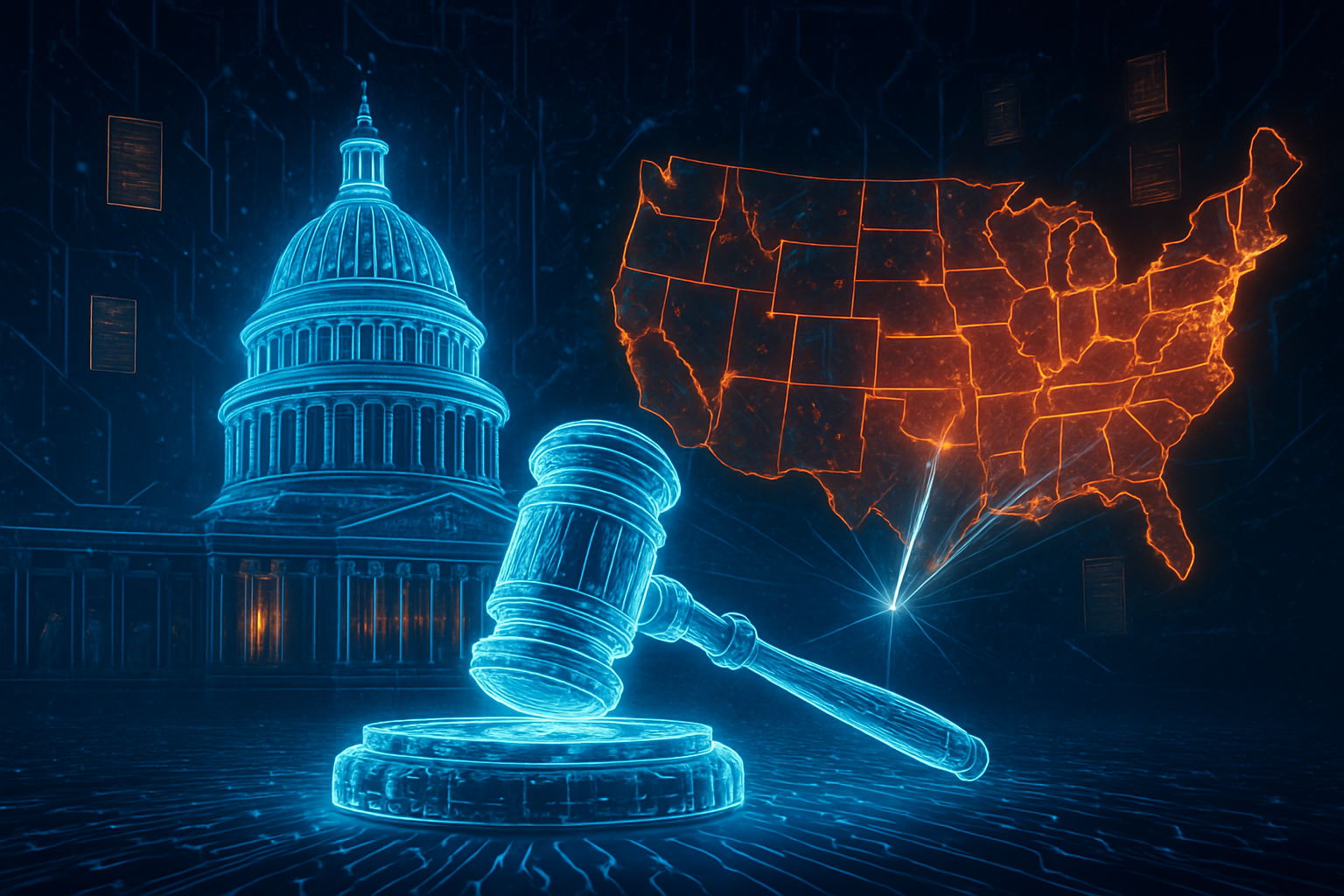
  • Federal Supremacy: Trump’s 2025 AI Executive Order Sets the Stage for Legal Warfare Against State Regulations

    Federal Supremacy: Trump’s 2025 AI Executive Order Sets the Stage for Legal Warfare Against State Regulations

    On December 11, 2025, President Trump signed the landmark Executive Order "Ensuring a National Policy Framework for Artificial Intelligence," a move that signaled a radical shift in the U.S. approach to technology governance. Designed to dismantle a burgeoning "patchwork" of state-level AI safety and bias laws, the order prioritizes a "light-touch" federal environment to accelerate American innovation. The administration argues that centralized control is not merely a matter of efficiency but a national security imperative to maintain a lead in the global AI race against adversaries like China.

    The immediate significance of the order lies in its aggressive stance against state autonomy. By establishing a dedicated legal and financial mechanism to suppress local regulations, the White House is seeking to create a unified domestic market for AI development. This move has effectively drawn a battle line between the federal government and tech-heavy states like California and Colorado, setting the stage for what legal experts predict will be a defining constitutional clash over the future of the digital economy.

    The AI Litigation Task Force: Technical and Legal Mechanisms of Preemption

    The crown jewel of the new policy is the establishment of the AI Litigation Task Force within the Department of Justice (DOJ). Directed by Attorney General Pam Bondi and closely coordinated with White House Special Advisor for AI and Crypto, David Sacks, this task force is mandated to challenge any state AI laws deemed inconsistent with the federal framework. Unlike previous regulatory bodies focused on safety or ethics, this unit’s "sole responsibility" is to sue states to strike down "onerous" regulations. The task force leverages the Dormant Commerce Clause, arguing that because AI models are developed and deployed across state lines, they constitute a form of interstate commerce that only the federal government has the authority to regulate.

    Technically, the order introduces a novel "Truthful Output" doctrine aimed at dismantling state-mandated bias mitigation and safety filters. The administration argues that laws like Colorado's (SB 24-205), which require developers to prevent "disparate impact" or algorithmic discrimination, essentially force AI models to embed "ideological bias." Under the new EO, the Federal Trade Commission (FTC) is directed to characterize state-mandated alterations to an AI’s output as "deceptive acts or practices" under Section 5 of the FTC Act. This frames state safety requirements not as consumer protections, but as forced modifications that degrade the accuracy and "truthfulness" of the AI’s capabilities.

    Furthermore, the order weaponizes federal funding to ensure compliance. The Secretary of Commerce has been instructed to evaluate state AI laws; those found to be "excessive" risk the revocation of federal Broadband Equity Access and Deployment (BEAD) funding. This puts billions of dollars at stake for states like California, which currently has an estimated $1.8 billion in broadband infrastructure funding that could be withheld if it continues to enforce its Transparency in Frontier AI Act (SB 53).

    Industry Impact: Big Tech Wins as State Walls Crumble

    The executive order has been met with a wave of support from the world's most powerful technology companies and venture capital firms. For giants like NVIDIA (NASDAQ: NVDA), Microsoft (NASDAQ: MSFT), and Alphabet (NASDAQ: GOOGL), the promise of a single, unified federal standard significantly reduces the "compliance tax" of operating in the U.S. market. By removing the need to navigate 50 different sets of safety and disclosure rules, these companies can move faster toward the deployment of multi-modal "frontier" models. Meta Platforms (NASDAQ: META) and Amazon (NASDAQ: AMZN) also stand to benefit from a regulatory environment that favors scale and rapid iteration over the "precautionary principle" that defined earlier state-level legislative attempts.

    Industry leaders, including OpenAI’s Sam Altman and xAI’s Elon Musk, have lauded the move as essential for the planned $500 billion AI infrastructure push. The removal of state-level "red tape" is seen as a strategic advantage for domestic AI labs that are currently competing in a high-stakes race to develop Artificial General Intelligence (AGI). Prominent venture capital firms like Andreessen Horowitz have characterized the EO as a "death blow" to the "decelerationist" movement, arguing that state laws were threatening to drive innovation—and capital—out of the United States.

    However, the disruption is not universal. Startups that had positioned themselves as "safe" or "ethical" alternatives, specifically tailoring their products to meet the rigorous standards of California or the European Union, may find their market positioning eroded. The competitive landscape is shifting away from compliance-as-a-feature toward raw performance and speed, potentially squeezing out smaller players who lack the hardware resources of the tech titans.

    Wider Significance: A Historic Pivot from Safety to Dominance

    The "Ensuring a National Policy Framework for Artificial Intelligence" EO represents a total reversal of the Biden administration’s 2023 approach, which focused heavily on "red-teaming" and mitigating existential risks. This new framework treats AI as the primary engine of the 21st-century economy, similar to how the federal government viewed the development of the internet or the interstate highway system. It marks a shift from a "safety-first" paradigm to an "innovation-first" doctrine, reflecting a broader belief that the greatest risk to the U.S. is not the AI itself, but falling behind in the global technological hierarchy.

    Critics, however, have raised significant concerns regarding the erosion of state police powers and the potential for a "race to the bottom" in terms of consumer safety. Civil society organizations, including the ACLU, have criticized the use of BEAD funding as "federal bullying," arguing that denying internet access to vulnerable populations to protect tech profits is an unprecedented overreach. There are also deep concerns that the "Truthful Output" doctrine could be used to suppress researchers from flagging bias or inaccuracies in AI models, effectively creating a federal shield for corporate liability.

    The move also complicates the international landscape. While the U.S. moves toward a "light-touch" deregulated model, the European Union is moving forward with its stringent AI Act. This creates a widening chasm in global tech policy, potentially leading to a "splinternet" where American AI models are functionally different—and perhaps prohibited—in European markets.

    Future Developments: The Road to the Supreme Court

    Looking ahead to the rest of 2026, the primary battleground will shift from the White House to the courtroom. A coalition of 20 states, led by California Governor Gavin Newsom and several state Attorneys General, has already signaled its intent to sue the federal government. They argue that the executive order violates the Tenth Amendment and that the threat to withhold broadband funding is unconstitutional. Legal scholars predict that these cases could move rapidly through the appeals process, potentially reaching the Supreme Court by early 2027.

    In the near term, we can expect the AI Litigation Task Force to file its first lawsuits against Colorado and California within the next 90 days. Concurrently, the White House is working with Congressional allies to codify this executive order into a permanent federal law that would provide a statutory basis for preemption. This would effectively "lock in" the deregulatory framework regardless of future changes in the executive branch.

    Experts also predict a surge in "frontier" model releases as companies no longer fear state-level repercussions for "critical incidents" or safety failures. The focus will likely shift to massive infrastructure projects—data centers and power grids—as the administration’s $500 billion AI push begins to take physical shape across the American landscape.

    A New Era of Federal Tech Power

    President Trump’s 2025 Executive Order marks a watershed moment in the history of artificial intelligence. By centralizing authority and aggressively preempting state-level restrictions, the administration has signaled that the United States is fully committed to a high-speed, high-stakes technological expansion. The establishment of the AI Litigation Task Force is an unprecedented use of the DOJ’s resources to act as a shield for a specific industry, highlighting just how central AI has become to the national interest.

    The takeaway for the coming months is clear: the "patchwork" of state regulation is under siege. Whether this leads to a golden age of American innovation or a dangerous rollback of consumer protections remains to be seen. What is certain is that the legal and political architecture of the 21st century is being rewritten in real-time.

    As we move further into 2026, all eyes will be on the first volley of lawsuits from the DOJ and the response from the California legislature. The outcome of this struggle will define the boundaries of federal power and state sovereignty in the age of intelligent machines.


    This content is intended for informational purposes only and represents analysis of current AI developments.

    TokenRing AI delivers enterprise-grade solutions for multi-agent AI workflow orchestration, AI-powered development tools, and seamless remote collaboration platforms.
    For more information, visit https://www.tokenring.ai/.
  • Trump Signs “National Policy Framework” Executive Order to Preempt State AI Laws and Launch Litigation Task Force

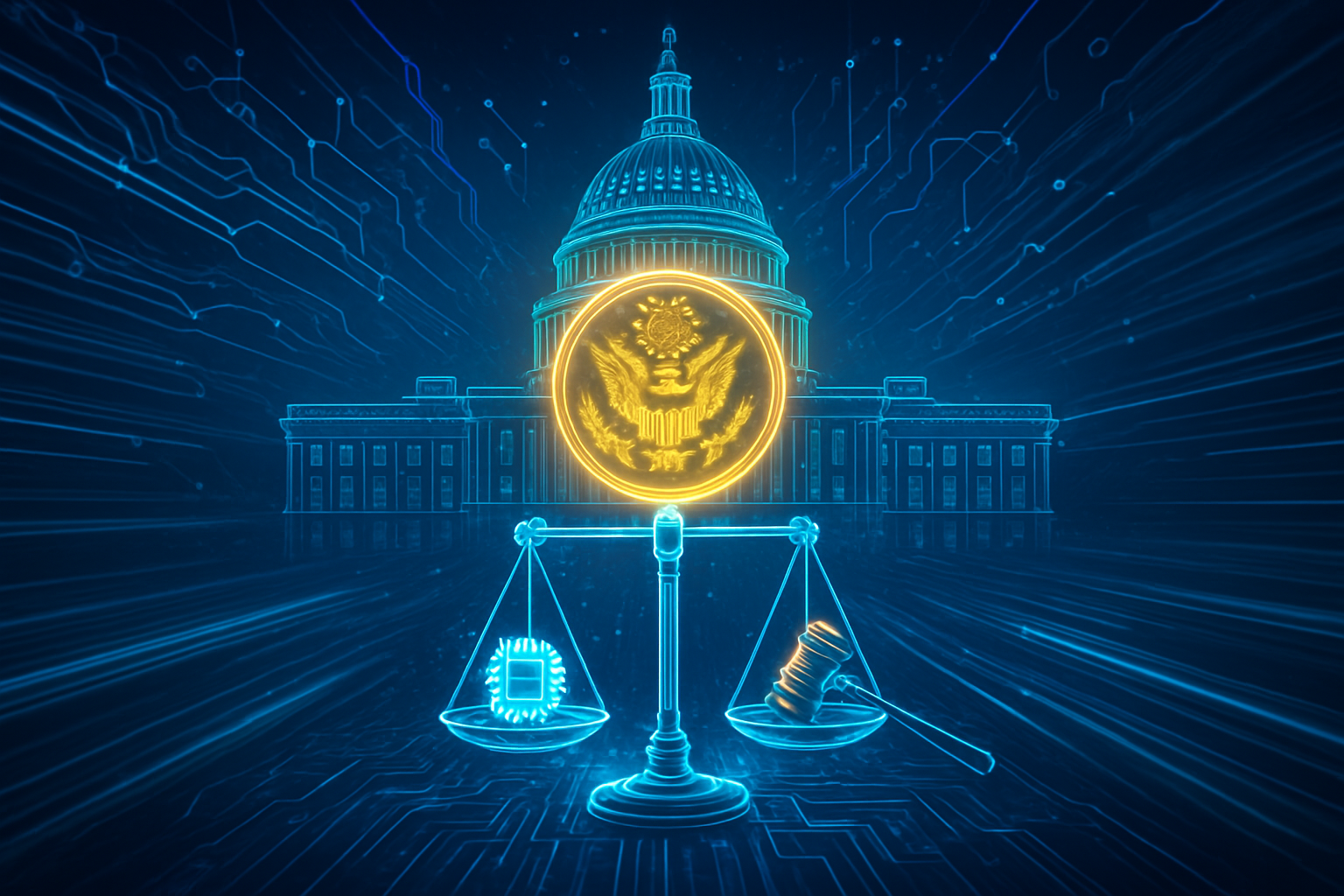
    Trump Signs “National Policy Framework” Executive Order to Preempt State AI Laws and Launch Litigation Task Force

    In a move that fundamentally reshapes the American regulatory landscape, President Donald Trump has signed Executive Order 14365, titled "Ensuring a National Policy Framework for Artificial Intelligence." Signed on December 11, 2025, the order seeks to dismantle what the administration describes as a "suffocating patchwork" of state-level AI regulations, replacing them with a singular, minimally burdensome federal standard. By asserting federal preemption over state laws, the White House aims to accelerate domestic AI development and ensure the United States maintains its technological lead over global adversaries, specifically China.

    The centerpiece of this executive action is the creation of a high-powered AI Litigation Task Force within the Department of Justice. This specialized unit is tasked with aggressively challenging any state laws—such as California’s transparency mandates or Colorado’s algorithmic discrimination bans—that the administration deems unconstitutional or obstructive to interstate commerce. As the current date of December 29, 2025, approaches the new year, the tech industry is already bracing for a wave of federal lawsuits designed to clear the "AI Autobahn" of state-level red tape.

    Centralizing Control: The "Truthful Outputs" Doctrine and Federal Preemption

    Executive Order 14365 introduces several landmark provisions designed to centralize AI governance under the federal umbrella. Most notable is the "Truthful Outputs" doctrine, which targets state laws requiring AI models to mitigate bias or filter specific types of content. The administration argues that many state-level mandates force developers to bake "ideological biases" into their systems, potentially violating the First Amendment and the Federal Trade Commission Act’s prohibitions on deceptive practices. By establishing a federal standard for "truthfulness," the order effectively prohibits states from mandating what the White House calls "woke" algorithmic adjustments.

    The order also leverages significant financial pressure to ensure state compliance. It explicitly authorizes the federal government to withhold grants from the $42.5 billion Broadband Equity Access and Deployment (BEAD) program from states that refuse to align their AI regulations with the new federal framework. This move puts billions of dollars in infrastructure funding at risk for states like California, which has an estimated $1.8 billion on the line. The administration’s strategy is clear: use the power of the purse to force a unified regulatory environment that favors rapid deployment over precautionary oversight.

    The AI Litigation Task Force, led by the Attorney General in consultation with Special Advisor for AI and Crypto David Sacks and Michael Kratsios, is scheduled to be fully operational by January 10, 2026. Its primary objective is to file "friend of the court" briefs and direct lawsuits against state governments that enforce laws like California’s SB 53 (the Transparency in Frontier Artificial Intelligence Act) or Colorado’s SB 24-205. The task force will argue that these laws unconstitutionally regulate interstate commerce and represent a form of "compelled speech" that hampers the development of frontier models.

    Initial reactions from the AI research community have been polarized. While some researchers at major labs welcome the clarity of a single federal standard, others express concern that the "Truthful Outputs" doctrine could lead to the removal of essential safety guardrails. Critics argue that by labeling bias-mitigation as "deception," the administration may inadvertently encourage the deployment of models that are prone to hallucination or harmful outputs, provided they meet the federal definition of "truthfulness."

    A "Big Tech Coup": Industry Giants Rally Behind Federal Unity

    The tech sector has largely hailed the executive order as a watershed moment for American innovation. Major players including Meta Platforms (NASDAQ: META), Alphabet (NASDAQ: GOOGL), and Microsoft (NASDAQ: MSFT) have long lobbied for federal preemption to avoid the logistical nightmare of complying with 50 different sets of rules. Following the announcement, market analysts at Wedbush described the order as a "major win for Big Tech," estimating that it could reduce compliance-related R&D costs by as much as 15% to 20% for the industry's largest developers.

    Nvidia (NASDAQ: NVDA), the primary provider of the hardware powering the AI revolution, saw its shares rise nearly 4% in the days following the signing. CEO Jensen Huang emphasized that navigating a "patchwork" of regulations would pose a national security risk, stating that the U.S. needs a "single federal standard" to enable companies to move at the speed of the market. Similarly, Palantir (NYSE: PLTR) CEO Alex Karp praised the move for its focus on "meritocracy and lethal technology," positioning the unified framework as a necessary step in winning the global AI arms race.

    For startups and smaller AI labs, the order provides a double-edged sword. While the reduction in regulatory complexity is a boon for those with limited legal budgets, the administration’s focus on "frontier models" often favors the incumbents who have already scaled. However, by removing the threat of disparate state-level lawsuits, the EO lowers the barrier to entry for new companies looking to deploy "agentic AI" across state lines without fear of localized prosecution or heavy-handed transparency requirements.

    Strategic positioning among these giants is already shifting. Microsoft has reportedly deepened its involvement in the "Genesis Mission," a public-private partnership launched alongside the EO to integrate AI into federal infrastructure. Meanwhile, Alphabet and Meta are expected to use the new federal protections to push back against state-level "bias audits" that they claim expose proprietary trade secrets. The market's reaction suggests that investors view the "regulatory relief" narrative as a primary driver for continued growth in AI capital expenditure throughout 2026.

    National Security and the Global AI Arms Race

    The broader significance of Executive Order 14365 lies in its framing of AI as a "National Security Imperative." President Trump has repeatedly stated that the U.S. cannot afford the luxury of "50 different approvals" when competing with a "unified" adversary like China. This geopolitical lens transforms regulatory policy into a tool of statecraft, where any state-level "red tape" is viewed as a form of "unintentional sabotage" of the national interest. The administration’s rhetoric suggests that domestic efficiency is the only way to counter the strategic advantage of China’s top-down governance model.

    This shift represents a significant departure from the previous administration’s focus on "voluntary safeguards" and civil rights protections. By prioritizing "winning the race" over precautionary regulation, the U.S. is signaling a return to a more aggressive, pro-growth stance. However, this has raised concerns among civil liberties groups and some lawmakers who fear that the "Truthful Outputs" doctrine could be used to suppress research into algorithmic fairness or to protect models that generate controversial content under the guise of "national security."

    Comparisons are already being drawn to previous technological milestones, such as the deregulation of the early internet or the federalization of aviation standards. Proponents argue that just as the internet required a unified federal approach to flourish, AI needs a "borderless" domestic market to reach its full potential. Critics, however, warn that AI is far more transformative and potentially dangerous than previous technologies, and that removing the "laboratory of the states" (where individual states test different regulatory approaches) could lead to systemic risks that a single federal framework might overlook.

    The societal impact of this order will likely be felt most acutely in the legal and ethical domains. As the AI Litigation Task Force begins its work, the courts will become the primary battleground for defining the limits of state power in the digital age. The outcome of these cases will determine not only how AI is regulated but also how the First Amendment is applied to machine-generated speech—a legal frontier that remains largely unsettled as 2025 comes to a close.

    The Road Ahead: 2026 and the Future of Federal AI

    In the near term, the industry expects a flurry of legal activity as the AI Litigation Task Force files its first round of challenges in January 2026. States like California and Colorado have already signaled their intent to defend their laws, setting the stage for a Supreme Court showdown that could redefine federalism for the 21st century. Beyond the courtroom, the administration is expected to follow up this EO with legislative proposals aimed at codifying the "National Policy Framework" into permanent federal law, potentially through a new "AI Innovation Act."

    Potential applications on the horizon include the rapid deployment of "agentic AI" in critical sectors like energy, finance, and defense. With state-level hurdles removed, companies may feel more confident in launching autonomous systems that manage power grids or execute complex financial trades across the country. However, the challenge of maintaining public trust remains. If the removal of state-level oversight leads to high-profile AI failures or privacy breaches, the administration may face increased pressure to implement federal safety standards that are as rigorous as the state laws they replaced.

    Experts predict that 2026 will be the year of "regulatory consolidation." As the federal government asserts its authority, we may see the emergence of a new federal agency or a significantly empowered existing department (such as the Department of Commerce) tasked with the day-to-day oversight of AI development. The goal will be to create a "one-stop shop" for AI companies, providing the regulatory certainty needed for long-term investment while ensuring that "America First" remains the guiding principle of technological development.

    A New Era for American Artificial Intelligence

    Executive Order 14365 marks a definitive turning point in the history of AI governance. By prioritizing federal unity and national security over state-level experimentation, the Trump administration has signaled that the era of "precautionary" AI regulation is over in the United States. The move provides the "regulatory certainty" that tech giants have long craved, but it also strips states of their traditional role as regulators of emerging technologies that affect their citizens' daily lives.

    The significance of this development cannot be overstated. It is a bold bet that domestic deregulation is the key to winning the global technological competition of the century. Whether this approach leads to a new era of American prosperity or creates unforeseen systemic risks remains to be seen. What is certain is that the legal and political landscape for AI has been irrevocably altered, and the "AI Litigation Task Force" will be the tip of the spear in enforcing this new vision.

    In the coming weeks and months, the tech world will be watching the DOJ closely. The first lawsuits filed by the task force will serve as a bellwether for how aggressively the administration intends to pursue its preemption strategy. For now, the "AI Autobahn" is open, and the world’s most powerful tech companies are preparing to accelerate.


    This content is intended for informational purposes only and represents analysis of current AI developments.

    TokenRing AI delivers enterprise-grade solutions for multi-agent AI workflow orchestration, AI-powered development tools, and seamless remote collaboration platforms.
    For more information, visit https://www.tokenring.ai/.