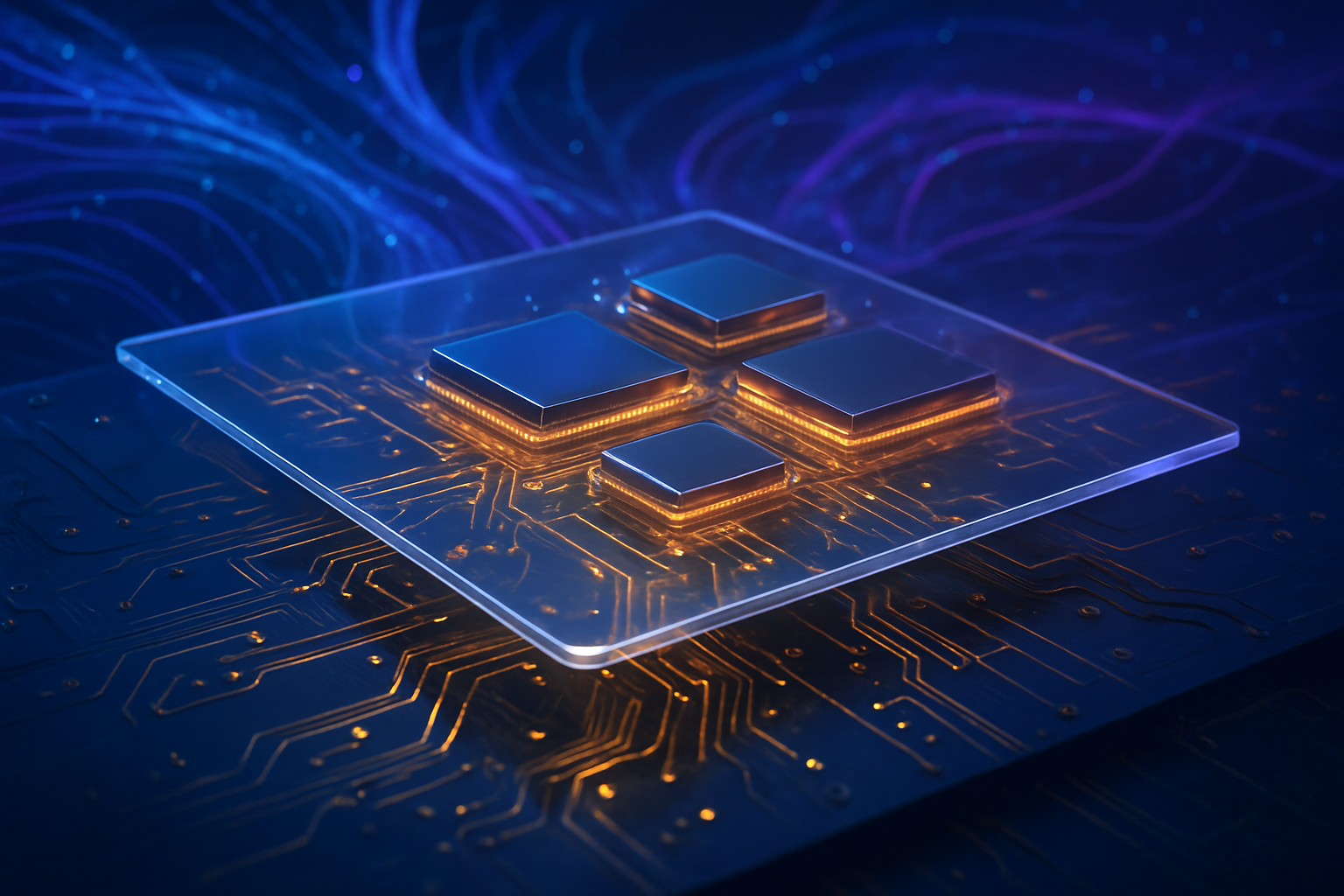
The semiconductor industry has reached a historic inflection point in early 2026 as the foundational materials of computing undergo their most significant change in decades. In a decisive pivot to meet the insatiable thermal and interconnect demands of generative artificial intelligence, industry titans Intel (Nasdaq: INTC) and Samsung Electronics (KRX: 005930) have officially commenced the transition from organic resin substrates to glass. This shift represents a fundamental redesign of the "brain" of the AI data center, moving away from the plastic-like materials that have dominated the industry for forty years toward a rigid, ultra-flat glass architecture capable of supporting the massive multi-chiplet arrays required by the next generation of Large Language Models (LLMs).
The immediate significance of this move cannot be overstated. As AI accelerators push past the 1,000-watt power envelope, traditional organic substrates—primarily based on Ajinomoto Build-up Film (ABF)—have hit a "warpage wall." These legacy materials tend to bend and buckle under high heat, leading to connection failures and limiting the number of chiplets that can be stitched together. By adopting glass, manufacturers are effectively providing a "granite foundation" for silicon, enabling the construction of larger, more powerful, and more energy-efficient AI systems. Intel’s recent deployment of its first glass-core processors marks the beginning of an era where material science, rather than just transistor shrinking, dictates the pace of AI progress.
The Technical Leap: Solving the Warpage Wall
At the heart of this transition is the superior physical properties of glass compared to organic resins. Organic substrates possess a Coefficient of Thermal Expansion (CTE) that differs significantly from the silicon chips they support. When an AI chip heats up during training or inference, the organic board expands at a different rate than the silicon, causing the "potato-chip" effect—a warping that can crack microscopic solder bumps. Glass, however, can be engineered to match the CTE of silicon almost perfectly (3–5 ppm/°C). This allows for a 10x increase in interconnect density through the use of Through-Glass Vias (TGVs), which are vertical electrical connections drilled directly through the glass core.
The flatness of glass is its other primary weapon. As of February 2026, Intel’s "Thick Core" glass substrates have demonstrated warpage levels of less than 20μm across a 100mm span, compared to over 50μm for high-end organic alternatives. This extreme flatness is critical for ultra-fine lithography; it allows engineers to pack more chiplets (GPUs, HBM memory, and I/O dies) closer together with tighter pitches. Furthermore, glass offers 60% lower dielectric loss, meaning signals travel faster and with significantly less power consumption—a vital metric for the high-bandwidth interconnects that link HBM4 memory to AI processing cores.
Initial reactions from the AI research community have been overwhelmingly positive, though tempered by the logistical hurdles of high-volume manufacturing. Dr. Aris Thompson, a senior packaging analyst, noted that "the transition to glass is essentially the 'save game' for Moore’s Law." While organic substrates were reaching their physical limits at two reticle sizes, glass substrates are expected to support "System-in-Package" designs that are five to ten times larger than anything currently on the market. However, industry experts caution that yield rates remain the primary battleground, with current glass production yields hovering between 75% and 85%, significantly lower than the 95% maturity of the organic ecosystem.
Competitive Landscapes and Strategic Alliances
The race to dominate the glass substrate market has created a new competitive dynamic between Intel and Samsung. Intel (Nasdaq: INTC) currently holds the first-mover advantage, having integrated glass core technology into its newly launched Xeon 6+ "Clearwater Forest" processors manufactured in Chandler, Arizona. Intel’s strategy is not just internal; the company has begun licensing its portfolio of over 600 glass-related patents to specialist manufacturers like JNTC. By doing so, Intel is positioning itself as the "open standard" for glass packaging, hoping to entice AI giants like NVIDIA (Nasdaq: NVDA) and Apple (Nasdaq: AAPL) to utilize Intel Foundry services for their 2027 hardware cycles.
Samsung Electronics (KRX: 005930) has responded with a formidable "Triple Alliance" across its internal divisions. Samsung Electro-Mechanics (SEMCO) is spearheading the substrate production, while Samsung Display is repurposing its expertise in high-precision glass handling from its OLED production lines. This vertical integration allows Samsung to control the entire value chain—from the raw glass panel to the final interposer. Samsung recently announced a joint venture with Sumitomo Chemical (TYO: 4005) to secure specialized glass core materials, a strategic move to insulate itself from the "Glass Cloth Crisis" currently affecting the global supply chain.
This pivot places significant pressure on Taiwan Semiconductor Manufacturing Company (TSMC) (NYSE: TSM). While TSMC remains the undisputed leader in organic Chip-on-Wafer-on-Substrate (CoWoS) packaging, it has been forced to accelerate its own "Rectangular Revolution." TSMC is now fast-tracking its Fan-Out Panel-Level Packaging (FOPLP) on glass, with pilot lines expected to debut later this year. Meanwhile, smaller players like Absolics, a subsidiary of SKC, have completed high-volume facilities in Georgia, aiming to capture custom AI hardware contracts from AMD (Nasdaq: AMD) and Amazon (Nasdaq: AMZN) by the end of 2026.
The Broader AI Landscape: Efficiency and Sustainability
The shift to glass substrates is more than a technical footnote; it is a critical response to the environmental and economic pressures of the AI boom. As training LLMs becomes increasingly energy-intensive, the 50% reduction in power consumption for signal transmission offered by glass becomes a vital tool for sustainability. This development fits into the broader trend of "Advanced Packaging" becoming the primary driver of semiconductor performance, as traditional node shrinking becomes prohibitively expensive and physically difficult.
However, the transition is not without concerns. The sudden surge in demand for high-grade "T-glass" cloth, essential for these substrates, has led to a market shortage. Suppliers like Nitto Boseki (TYO: 3110) are struggling to keep pace, leading to a bidding war between the major foundries. This "Glass Cloth Crisis" threatens to inflate the cost of AI hardware in the short term, potentially creating a bottleneck for startups and mid-sized AI labs that lack the purchasing power of "Big Tech."
In historical context, the move to glass mirrors the industry’s transition from ceramic to organic substrates in the 1990s. Just as that shift enabled the rise of the personal computer and the mobile era, the move to glass is seen as the prerequisite for the "General AI" era. By allowing for larger and more complex chiplet architectures, glass substrates are enabling the hardware that will run the next generation of trillion-parameter models, which were previously constrained by the physical limits of organic packaging.
Future Horizons: HBM4 and Beyond
Looking ahead, the roadmap for glass substrates extends far beyond simple CPU and GPU cores. By 2028, experts predict that glass will be the primary material for the interposers used in HBM4 (High Bandwidth Memory). As memory stacks become taller and more dense, the thermal stability of glass will be essential to prevent heat from the logic die from degrading the memory’s performance. This will lead to AI accelerators that are not only faster but significantly more compact, potentially leading to "edge AI" servers with the power of today's massive data centers.
We are also likely to see the emergence of optical interconnects integrated directly into the glass substrate. Because glass is transparent and can be etched with extreme precision, it is an ideal medium for co-packaged optics. This would allow for data to be moved via light rather than electricity between chips, virtually eliminating latency and further slashing power consumption. The long-term vision is a "universal substrate" where logic, memory, and high-speed networking are all fused onto a single, massive glass panel.
The immediate challenge remains scaling. While Intel has proven mass production is possible with the Xeon 6+, scaling this to the millions of units required by the global AI market will require significant investment in new "Panel-Level" manufacturing equipment. Experts predict that 2026 will be the "Year of Validation," with 2027 and 2028 seeing a flood of glass-based AI products from every major hardware vendor.
Summary and Final Thoughts
The transition to glass substrates by Intel and Samsung marks a definitive end to the era of organic-dominated semiconductor packaging. By solving the critical issues of warpage, thermal management, and signal integrity, glass provides the necessary infrastructure for the next decade of AI growth. Intel’s early lead in Arizona and Samsung’s vertically integrated alliance represent two different paths to the same goal: providing the physical foundation for the most complex machines ever built.
As we move through the first half of 2026, the key metrics to watch will be yield stability and the resolution of the glass cloth supply chain issues. For investors and industry observers, the performance of the Xeon 6+ in real-world AI workloads will be the first true test of this technology’s promise. If glass delivers on its potential to slash power while boosting interconnect density, the current "silicon gold rush" may soon be remembered as the "glass revolution."
This content is intended for informational purposes only and represents analysis of current AI developments.
TokenRing AI delivers enterprise-grade solutions for multi-agent AI workflow orchestration, AI-powered development tools, and seamless remote collaboration platforms.
For more information, visit https://www.tokenring.ai/.