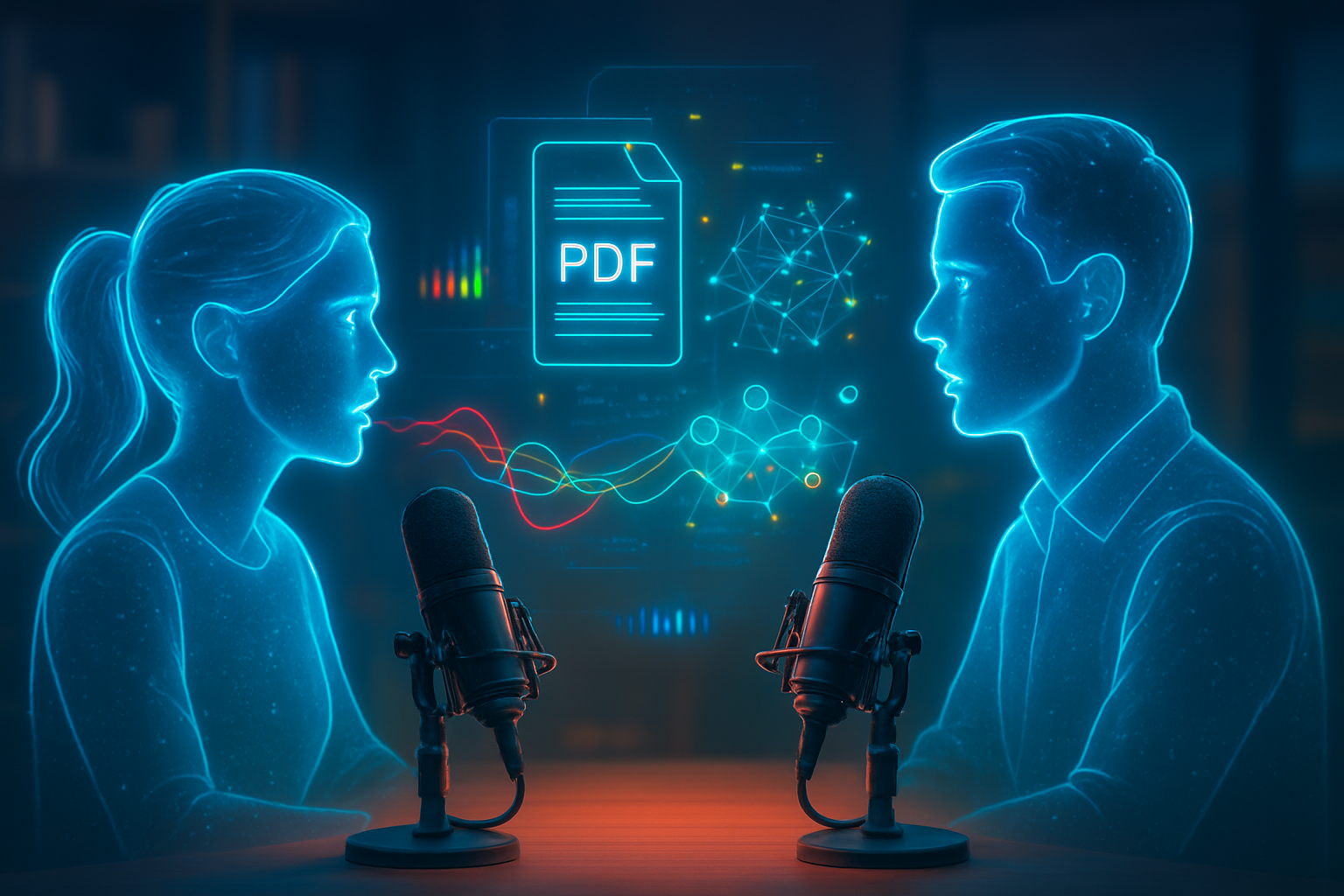
As we move into early 2026, the digital media landscape has been fundamentally reshaped by a tool that once began as a modest experimental project. Google (NASDAQ: GOOGL) has transformed NotebookLM from a niche researcher’s utility into a cultural juggernaut, primarily through the explosive viral success of its "Audio Overviews." What started as a way to summarize PDFs has evolved into a sophisticated, multi-speaker podcasting engine that allows users to turn any collection of documents—from medical journals to recipe books—into a high-fidelity, bantering discussion between synthetic personalities.
The immediate significance of this development cannot be overstated. We have transitioned from an era where "reading" was the primary method of data consumption to a "listening-first" paradigm. By automating the labor-intensive process of scriptwriting, recording, and editing, Google has democratized the podcasting medium, allowing anyone with a set of notes to generate professional-grade audio content in under a minute. This shift has not only changed how students and professionals study but has also birthed a new genre of "AI-native" entertainment that currently dominates social media feeds.
The Technical Leap: From Synthetic Banter to Interactive Tutoring
At the heart of the 2026 iteration of NotebookLM is the Gemini 2.5 Flash architecture, a model optimized specifically for low-latency, multimodal reasoning. Unlike earlier versions that produced static audio files, the current "Audio Overviews" are dynamic. The most significant technical advancement is the "Interactive Mode," which allows listeners to interrupt the AI hosts in real-time. By clicking a "hand-raise" icon, a user can ask a clarifying question; the AI hosts will pause their scripted banter, answer the question using grounded citations from the uploaded sources, and then pivot back to their original conversation without losing the narrative thread.
Technically, this required a breakthrough in how Large Language Models (LLMs) handle "state." The AI must simultaneously manage the transcript of the pre-planned summary, the live audio stream, and the user’s spontaneous input. Google has also introduced "Audience Tuning," where users can specify the expertise level and emotional tone of the hosts. Whether the goal is a skeptical academic debate or a simplified explanation for a five-year-old, the underlying model now adjusts its vocabulary, pacing, and "vibe" to match the requested persona. This level of granular control differs sharply from the "black box" generation seen in 2024, where users had little say in how the hosts performed.
The AI research community has lauded these developments as a major milestone in "grounded creativity." While earlier synthetic audio often suffered from "hallucinations"—making up facts to fill the silence—NotebookLM’s strict adherence to user-provided documents provides a layer of factual integrity. However, some experts remain wary of the "uncanny valley" effect. As the AI hosts become more adept at human-like stutters, laughter, and "ums," the distinction between human-driven dialogue and algorithmic synthesis is becoming increasingly difficult for the average listener to detect.
Market Disruption: The Battle for the Ear
The success of NotebookLM has sent shockwaves through the tech industry, forcing competitors to pivot their audio strategies. Spotify (NYSE: SPOT) has responded by integrating "AI DJ 2.0" and creator tools that allow blog posts to be automatically converted into Spotify-ready podcasts, focusing on distribution and monetization. Meanwhile, Meta (NASDAQ: META) has released "NotebookLlama," an open-source alternative that allows developers to run similar audio synthesis locally, appealing to enterprise clients who are hesitant to upload proprietary data to Google’s servers.
For Google, NotebookLM serves as a strategic "loss leader" for the broader Workspace ecosystem. By keeping the tool free and integrated with Google Drive, the company is securing a massive user base that is becoming reliant on Gemini-powered insights. This poses a direct threat to startups like Wondercraft AI and Jellypod, which have had to pivot toward "pro-grade" features—such as custom music beds, 500+ distinct voice profiles, and granular script editing—to compete with Google’s "one-click" simplicity.
The competitive landscape is no longer just about who has the best voice; it is about who has the most integrated workflow. OpenAI, partnered with Microsoft (NASDAQ: MSFT), has focused on "Advanced Voice Mode" for ChatGPT, which prioritizes one-on-one companionship and real-time assistance over the "produced" podcast format of NotebookLM. This creates a clear market split: Google owns the "automated content" space, while OpenAI leads in the "personal assistant" category.
Cultural Implications: The Rise of "AI Slop" vs. Deep Authenticity
The wider significance of the AI podcast trend lies in how it challenges our definition of "content." On platforms like TikTok and X, "AI Meltdown" clips have become a recurring viral trend, where users feed the AI its own transcripts until the hosts appear to have an existential crisis about their artificial nature. While humorous, these moments highlight a deeper societal anxiety about the blurring lines between human and machine. There is a growing concern that the internet is being flooded with "AI slop"—low-effort, high-volume content that looks and sounds professional but lacks original human insight.
Comparisons are often made to the early days of the "dead internet theory," but the reality is more nuanced. NotebookLM has become an essential accessibility tool for the visually impaired and for those with neurodivergent learning styles who process audio information more effectively than text. It is a milestone that mirrors the shift from the printing press to the radio, yet it moves at the speed of the silicon age.
However, the "authenticity backlash" is already in full swing. High-end human podcasters are increasingly leaning into "messy" production—unscripted tangents, background noise, and emotional vulnerability—as a badge of human authenticity. In a world where a perfect summary is just a click away, the value of a uniquely human perspective, with all its flaws and biases, has ironically increased.
The Horizon: From Summaries to Live Intermodal Agents
Looking toward the end of 2026 and beyond, we expect the transition from "Audio Overviews" to "Live Video Overviews." Google has already begun testing features that generate automated YouTube-style explainers, complete with AI-generated infographics and "talking head" avatars that match the audio hosts. This would effectively automate the entire pipeline of educational content creation, from source document to finished video.
Challenges remain, particularly regarding intellectual property and the "right to voice." As "Personal Audio Signatures" allow users to clone their own voices to read back their research, the legal framework for voice ownership is still being written. Experts predict that the next frontier will be "cross-lingual synthesis," where a user can upload a document in Japanese and listen to a debate about it in fluent, accented Spanish, with all the cultural nuances intact.
The ultimate application of this technology lies in the "Personal Daily Briefing." Imagine an AI that has access to your emails, your calendar, and your reading list, which then records a bespoke 15-minute podcast for your morning commute. This level of hyper-personalization is the logical conclusion of the trend Google has started—a world where the "news" is curated and performed specifically for an audience of one.
A New Chapter in Information Consumption
The rise of Google’s NotebookLM and the subsequent explosion of AI-generated podcasts represent a turning point in the history of artificial intelligence. We are moving away from LLMs as mere text-generators and toward LLMs as "experience-generators." The key takeaway from this development is that the value of AI is increasingly found in its ability to synthesize and perform information, rather than just retrieve it.
In the coming weeks and months, keep a close watch on the "Interactive Mode" rollout and whether competitors like OpenAI launch a direct "Podcast Mode" to challenge Google’s dominance. As the tools for creation become more accessible, the barrier to entry for media production will vanish, leaving only one question: in an infinite sea of perfectly produced content, what will we actually choose to listen to?
This content is intended for informational purposes only and represents analysis of current AI developments.
TokenRing AI delivers enterprise-grade solutions for multi-agent AI workflow orchestration, AI-powered development tools, and seamless remote collaboration platforms.
For more information, visit https://www.tokenring.ai/.