Tag: AI Policy 2026

  • US Eases NVIDIA H200 Exports to China with 25% Revenue Tariff

    US Eases NVIDIA H200 Exports to China with 25% Revenue Tariff

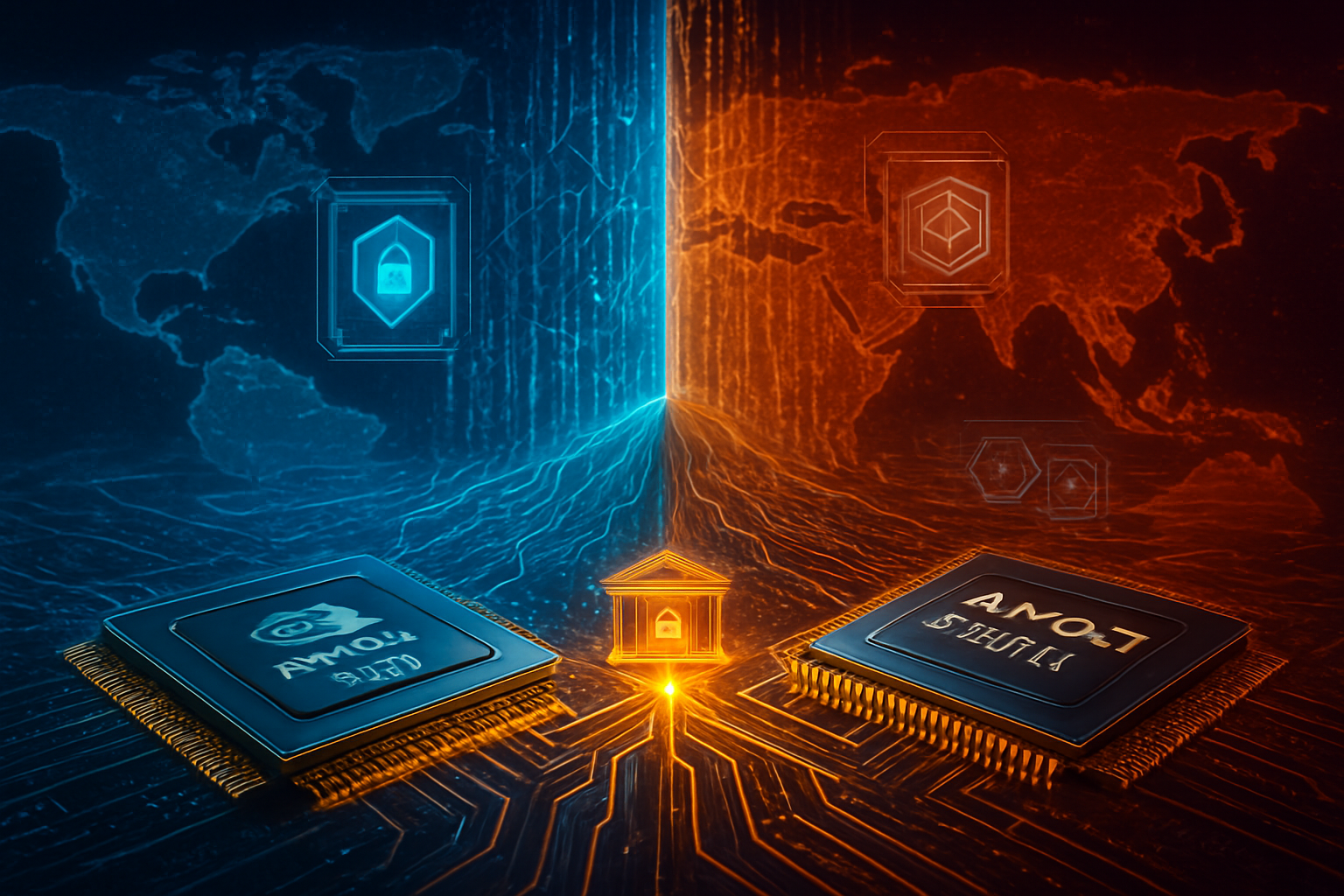
    In a move that signals a seismic shift in global technology trade, the Trump administration has finalized a new export policy for high-end artificial intelligence semiconductors. Effectively ending the "presumption of denial" that has defined U.S.-China chip relations for nearly four years, the Department of Commerce’s Bureau of Industry and Security (BIS) announced on January 13, 2026, that it would transition to a "case-by-case review" for elite hardware. This policy specifically clears the path for NVIDIA (NASDAQ: NVDA) and AMD (NASDAQ: AMD) to resume sales of their sophisticated H200 and Instinct MI325X accelerators to approved Chinese customers.

    The relaxation comes with a historic caveat: a mandatory 25% revenue tariff—dubbed the "Trump Cut" by industry insiders—on all such exports. By requiring these Taiwan-made chips to be routed through the United States for mandatory security testing before re-export, the administration has successfully leveraged Section 232 of the Trade Expansion Act to claim a quarter of the revenue from every transaction. The administration frames the policy as a way to support American manufacturing and job growth while maintaining a "technological leash" on Beijing, though the move has already sparked a firestorm of criticism from congressional hawks who view the deal as a dangerous gamble with national security.

    The Technical Threshold: TPP Scores and the H200 Standard

    The technical foundation of this policy shift rests on a new metrics-based classification system. The Bureau of Industry and Security has established a ceiling for "approved" exports based on a Total Processing Performance (TPP) score of 21,000 and a DRAM memory bandwidth limit of 6,500 GB/s. This carefully calibrated threshold allows for the export of the NVIDIA H200, which features approximately 141GB of HBM3e memory and a TPP score of roughly 15,832. Similarly, AMD’s Instinct MI325X, despite its massive 256GB memory capacity and higher raw bandwidth of 6.0 TB/s, falls just under the performance cap with a TPP score of 20,800.

    This shift represents a departure from previous Biden-era "performance density" rules that effectively banned anything more powerful than the aged H100. By focusing on the H200 and MI325X, the U.S. is permitting China access to hardware capable of training large language models (LLMs) and running high-concurrency inference, but stopping short of the next-generation "Blackwell" and "Instinct MI350" architectures. To enforce the 25% tariff, the government has mandated that these chips must physically enter the U.S. to undergo "third-party integrity verification" at independent labs, a process that verifies no "backdoors" or unauthorized modifications exist before they are shipped to China.

    Initial reactions from the AI research community are mixed. While some engineers argue that the H200 provides more than enough "compute juice" for China to bridge the gap in generative AI, others point out that the 25% premium will make large-scale clusters prohibitively expensive. "This isn't just an export license; it's a toll road for AI," noted one lead researcher at a Silicon Valley lab. Experts also highlight that while the hardware is being released, the software interconnects—such as NVIDIA’s proprietary NVLink—remain under strict scrutiny, potentially limiting the scale at which these chips can be networked in Chinese data centers.

    Market Implications: Clearing Inventory and Strategic Hedging

    For the giants of the semiconductor industry, the announcement is a double-edged sword. NVIDIA, which was reportedly sitting on an estimated $4.5 billion in unsold inventory due to previous restrictions, saw its stock fluctuate as investors weighed the benefit of renewed Chinese revenue against the 25% tariff hit. CEO Jensen Huang has remained publicly upbeat, characterizing the move as a "turning point" that allows the company to rebuild relationships with Chinese hyperscalers like Alibaba and Tencent. However, in a move of strategic caution, NVIDIA has reportedly begun requiring full upfront payment from Chinese clients to mitigate the risk of sudden policy reversals.

    AMD (NASDAQ: AMD) stands to benefit significantly from the increased memory capacity of its MI325X, which many analysts believe is superior for the specific "inference-heavy" workloads currently prioritized by Chinese firms. By positioning the MI325X as a viable alternative to NVIDIA’s ecosystem, AMD could capture a significant portion of the newly reopened market. Meanwhile, tech giants like Microsoft (NASDAQ: MSFT) and Intel (NASDAQ: INTC) are watching closely. Microsoft CEO Satya Nadella, speaking recently at Davos, emphasized that while chip availability is crucial, the real competition in 2026 will be defined by energy infrastructure and the "diffusion" of AI into tangible business products.

    The competitive landscape is further complicated by the 25% "Trump Cut." To maintain profit margins, analysts expect chipmakers to pass at least some of the cost to Chinese buyers, potentially pricing the H200 at over $35,000 per unit in the region. This price hike creates a "protectionist window" for Chinese domestic chipmakers, such as Huawei, to offer their own Ascend series at a massive discount. "We are effectively subsidizing the development of the Huawei Ascend 910C by making our own chips 25% more expensive in the eyes of the Chinese consumer," warned one semiconductor analyst.

    National Security and the "AI OVERWATCH" Counter-Movement

    The wider significance of this policy lies in its attempt to treat AI compute as a sovereign economic asset rather than just a restricted military technology. By monetizing the export of AI chips, the Trump administration is treating "compute" similarly to how oil or grain has been traded in past geopolitical eras. However, this "Silicon Realpolitik" has created a rift within the Republican party and invited sharp rebukes from Democratic leadership. Representative Raja Krishnamoorthi, the Ranking Member of the House Select Committee on China, has described the policy as a "disastrous dereliction of duty," claiming that U.S. national security is now "for sale."

    In response to the administration's move, a bipartisan group of lawmakers led by House Foreign Affairs Committee Chairman Brian Mast introduced the AI OVERWATCH Act on January 21, 2026. This legislation seeks to codify a two-year ban on the most advanced "Blackwell" class chips and would grant Congress the power to block specific export licenses through a joint resolution. The act argues that the current "case-by-case" review process lacks transparency and allows the executive branch too much leeway in defining what constitutes a "national security risk."

    This development marks a pivotal moment in the "Great Tech Rivalry." For years, the U.S. has used a "small yard, high fence" strategy—strictly protecting a narrow set of technologies. The new 25% tariff policy suggests the "yard" is expanding, but the "fence" is being replaced by a "gated community" where access can be bought for the right price. Critics argue this sends a confusing message to allies like the Netherlands and Japan, who have been pressured by the U.S. to implement their own strict bans on chip-making equipment from companies like ASML (NASDAQ: ASML).

    The Path Forward: Retaliation and Domestic Alternatives

    Looking ahead, the success of this policy depends largely on Beijing's response. Already, reports from late January 2026 indicate that Chinese customs officials have begun blocking shipments of the newly approved H200 chips at the border. The Chinese Ministry of Commerce has signaled that it will not simply allow the U.S. government to collect a "tax" on its technology imports. Instead, Beijing is reportedly "encouraging" domestic firms to double down on homegrown architectures, specifically the Huawei Ascend 910C and the Biren BR100, which are not subject to U.S. tariffs.

    In the near term, we can expect a period of intense "grey market" activity as firms attempt to bypass the 25% tariff through third-party nations. However, the mandatory U.S.-based testing requirement is designed specifically to close these loopholes. If the policy holds, 2026 will likely see the emergence of two distinct AI ecosystems: a high-cost, U.S.-monitored ecosystem in the West, and a subsidized, state-driven ecosystem in China.

    Experts predict that the next major flashpoint will be the "AI OVERWATCH Act." If passed, it could effectively nullify the administration's new policy by February or March, leading to further market volatility. For now, the semiconductor industry remains in a state of "cautious execution," waiting to see if the H200s currently sitting in U.S. testing labs will ever actually make it to data centers in Shanghai or Shenzhen.

    Summary and Final Thoughts

    The Trump administration's decision to ease H200 and MI325X exports in exchange for a 25% revenue tariff is perhaps the most aggressive attempt yet to blend economic populism with high-tech statecraft. By moving away from a blanket ban, the U.S. is attempting to reclaim its position as the global provider of AI infrastructure while ensuring that the American treasury—not just Silicon Valley—benefits from the trade.

    The key takeaways from this development are:

    • The 21,000 TPP Threshold: A new technical "red line" has been drawn, allowing H200-class hardware while keeping next-gen chips out of reach.
    • The Revenue-Sharing Model: The 25% tariff via mandatory U.S. routing is a novel use of trade law to "tax" high-tech exports.
    • Congressional Pushback: The AI OVERWATCH Act represents a significant hurdle that could still derail the administration's plan.
    • Beijing's Counter-Move: China's potential "counter-embargo" suggests that the trade war is entering a more localized, tit-for-tat phase.

    In the history of AI, January 2026 may be remembered as the moment when the "AI Arms Race" officially became a "Managed AI Trade." For investors and tech leaders, the coming weeks will be critical as the first batch of "tariffed" chips attempts to clear Chinese customs.


    This content is intended for informational purposes only and represents analysis of current AI developments.

    TokenRing AI delivers enterprise-grade solutions for multi-agent AI workflow orchestration, AI-powered development tools, and seamless remote collaboration platforms.
    For more information, visit https://www.tokenring.ai/.
  • Silicon Sovereignty: US Levies 25% Section 232 Tariffs on Advanced AI Silicon

    Silicon Sovereignty: US Levies 25% Section 232 Tariffs on Advanced AI Silicon

    In a move that fundamentally reshapes the global semiconductor landscape, the United States government has officially implemented a 25% ad valorem tariff on high-performance AI and computing chips under Section 232 of the Trade Expansion Act of 1962. Formalized via a Presidential Proclamation on January 14, 2026, the tariffs specifically target high-end accelerators that form the backbone of modern large language model (LLM) training and inference. The policy, which went into effect at 12:01 a.m. EST on January 15, marks the beginning of an aggressive "tariffs-for-investment" strategy designed to force the relocation of advanced manufacturing to American soil.

    The immediate significance of this announcement cannot be overstated. By leveraging national security justifications—the hallmark of Section 232—the administration is effectively placing a premium on advanced silicon that is manufactured outside of the United States. While the measure covers a broad range of high-performance logic circuits, it explicitly identifies industry workhorses like NVIDIA’s H200 and AMD’s Instinct MI325X as primary targets. This shift signals a transition from "efficiency-first" global supply chains to a "security-first" domestic mandate, creating a bifurcated market for the world's most valuable technology.

    High-Performance Hardware in the Crosshairs

    The technical scope of the new tariffs is defined by rigorous performance benchmarks rather than just brand names. According to the Proclamation’s Annex, the 25% duty applies to integrated circuits with a Total Processing Performance (TPP) between 14,000 and 21,100, combined with DRAM bandwidth exceeding 4,500 GB/s. This technical net specifically ensnares the NVIDIA (NASDAQ: NVDA) H200, which features 141GB of HBM3E memory, and the AMD (NASDAQ: AMD) Instinct MI325X, a high-capacity 256GB HBM3E powerhouse. These specifications are essential for the massive throughput required by the Blackwell architecture and AMD’s latest enterprise offerings.

    This policy differs from previous export controls by focusing on the import of finished silicon into the U.S., rather than just restricting sales to foreign adversaries. It essentially creates a financial barrier that penalizes domestic reliance on foreign fabrication plants (fabs). Initial reactions from the AI research community have been a mix of strategic concern and cautious optimism. While some researchers fear the short-term cost of compute will rise, industry experts note that the technical specifications are carefully calibrated to capture the current "sweet spot" of enterprise AI, ensuring the government has maximum leverage over the most critical components of the AI revolution.

    Market Disruptions and the "Startup Shield"

    The market implications for tech giants and emerging startups are vastly different due to a sophisticated system of "end-use focused" exemptions. Major hyperscalers such as Microsoft (NASDAQ: MSFT), Alphabet (NASDAQ: GOOGL), and Meta (NASDAQ: META) are largely shielded from the immediate 25% price hike, provided the chips are destined for U.S.-based data centers. This carve-out ensures that the ongoing build-out of the "AI Factory" infrastructure—currently dominated by NVIDIA’s Blackwell (B200/GB200) systems—remains economically viable within American borders.

    Furthermore, the administration has introduced a "Startup Shield," exempting domestic AI developers and R&D labs from the tariffs. This strategic move is intended to maintain the competitive advantage of the U.S. innovation ecosystem while the manufacturing base catches up. However, companies that import these chips for secondary testing or re-export purposes without a domestic end-use certification will face the full 25% levy. This creates a powerful incentive for firms like NVIDIA and AMD to prioritize U.S. customers and domestic supply chain partners, potentially disrupting long-standing distribution channels in Asia and Europe.

    Geopolitical Realignment and the Taiwan Agreement

    This tariff rollout is the "Phase 1" of a broader geopolitical strategy to reshore 2nm and 3nm manufacturing. Coinciding with the tariff announcement, the U.S. and Taiwan signed a landmark $250 billion investment agreement. Under this deal, Taiwanese firms like TSMC (NYSE: TSM) have committed to massive new capacity in states like Arizona. In exchange, these companies receive "preferential Section 232 treatment," allowing them to import advanced chips duty-free at a ratio tied to their U.S. investment milestones. This effectively turns the tariff into a tool for industrial policy, rewarding companies that move their most advanced "crown jewel" fabrication processes to the U.S.

    The move fits into a broader trend of "computational nationalism," where the ability to produce and control AI silicon is viewed as a prerequisite for national sovereignty. It mirrors historical milestones like the 1980s semiconductor trade disputes but on a far more accelerated and high-stakes scale. By targeting the H200 and MI325X—chips that are currently "sold out" through much of 2026—the U.S. is leveraging high demand to force a permanent shift in where the next generation of silicon, such as NVIDIA's Rubin or AMD's MI455X, will be born.

    The Horizon: Rubin, MI455X, and the 2nm Era

    Looking ahead, the industry is already preparing for the "post-Blackwell" era. At CES 2026, NVIDIA CEO Jensen Huang detailed the Rubin (R100) architecture, which utilizes HBM4 memory and a 3nm process, scheduled for production in late 2026. Similarly, AMD has unveiled the MI455X, a 2nm-node beast with 432GB of HBM4 memory. The new Section 232 tariffs are designed to ensure that by the time these next-generation chips reach volume production, the domestic infrastructure—bolstered by the "Tariff Offset Program"—will be ready to handle a larger share of the manufacturing load.

    Near-term challenges remain, particularly regarding the complexity of end-use certifications and the potential for a "grey market" of non-certified silicon. However, analysts predict that the tariff will accelerate the adoption of "American-made" silicon as a premium tier for government and high-security enterprise contracts. As the U.S. domestic fabrication capacity from Intel (NASDAQ: INTC) and TSMC’s American fabs comes online between 2026 and 2028, the financial pressure of the 25% tariff is expected to transition into a permanent structural advantage for domestically produced AI hardware.

    A Pivot Point in AI History

    The January 2026 Section 232 tariffs represent a definitive pivot point in the history of artificial intelligence. It marks the moment when the U.S. government decided that the strategic risk of a distant supply chain outweighed the benefits of globalized production. By exempting startups and domestic data centers, the policy attempts a delicate "Goldilocks" approach: punishing foreign dependency without stifling the very innovation that the chips are meant to power.

    As we move deeper into 2026, the industry will be watching the "Tariff Offset Program" closely to see how quickly it can spur actual domestic output. The success of this measure will be measured not by the revenue the tariffs collect, but by the number of advanced fabs that break ground on American soil in the coming months. For NVIDIA, AMD, and the rest of the semiconductor world, the message is clear: the future of AI is no longer just about who has the fastest chip, but where that chip is made.


    This content is intended for informational purposes only and represents analysis of current AI developments.

    TokenRing AI delivers enterprise-grade solutions for multi-agent AI workflow orchestration, AI-powered development tools, and seamless remote collaboration platforms.
    For more information, visit https://www.tokenring.ai/.