Tag: AI Roadmap

  • Meta’s 2026 AI Gambit: Inside the ‘Mango’ and ‘Avocado’ Roadmap and the Rise of Superintelligence Labs

    Meta’s 2026 AI Gambit: Inside the ‘Mango’ and ‘Avocado’ Roadmap and the Rise of Superintelligence Labs

    In a sweeping strategic reorganization aimed at reclaiming the lead in the global artificial intelligence race, Meta Platforms, Inc. (NASDAQ:META) has unveiled its aggressive 2026 AI roadmap. At the heart of this transformation is the newly formed Meta Superintelligence Labs (MSL), a centralized powerhouse led by the high-profile recruit Alexandr Wang, founder of Scale AI. This pivot marks a definitive end to Meta’s era of "open research" and signals a transition into a "frontier product" company, prioritizing proprietary superintelligence over the open-source philosophy that defined the Llama series.

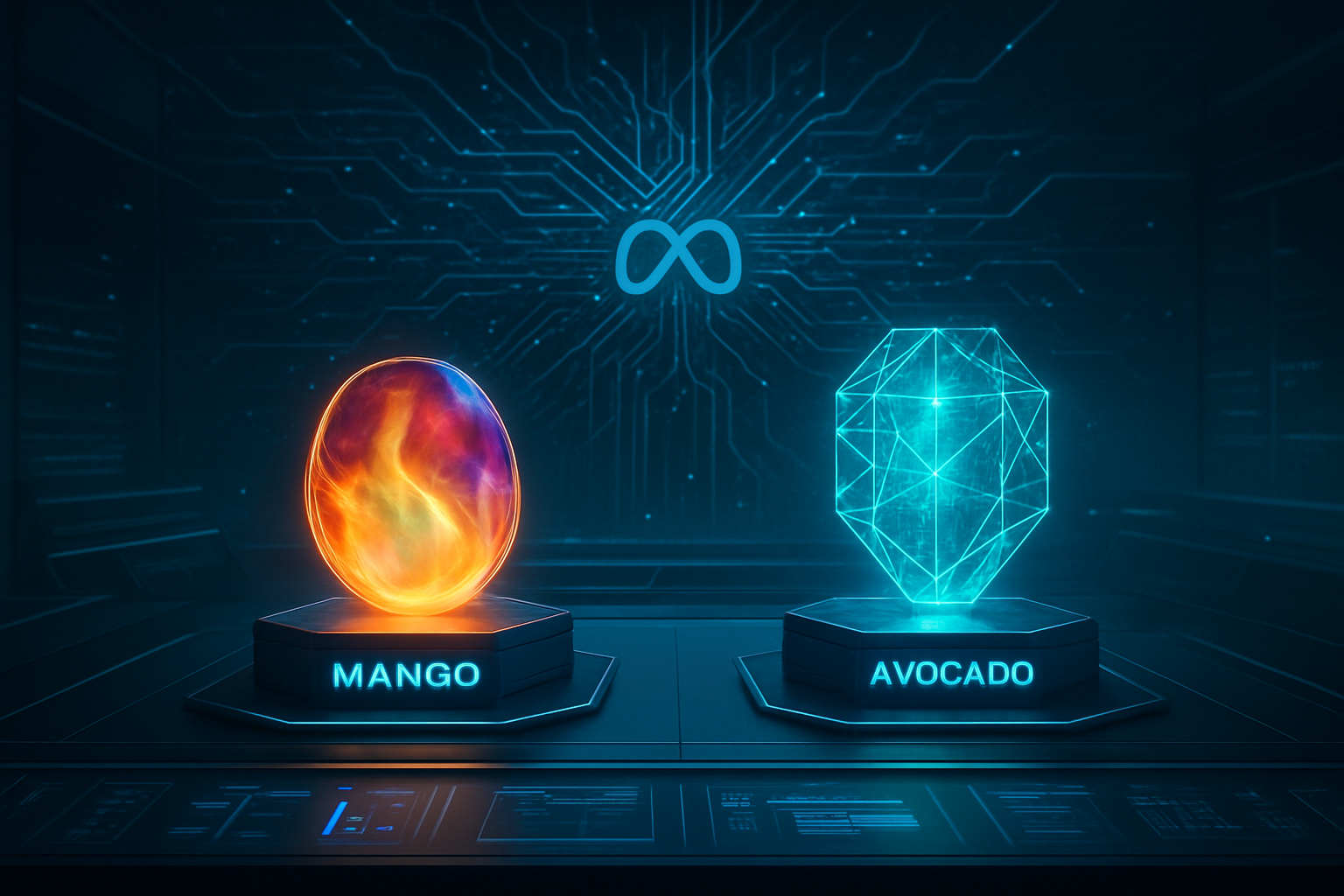
    The 2026 roadmap is anchored by two flagship models: "Mango," a high-fidelity multimodal world model designed to dominate the generative video space, and "Avocado," a reasoning-focused Large Language Model (LLM) built to close the logic and coding gap with industry leaders. As of January 2, 2026, these developments represent Mark Zuckerberg’s most expensive bet yet, following a landmark $14.3 billion investment in Scale AI and a radical internal restructuring that has sent shockwaves through the Silicon Valley talent pool.

    Technical Foundations: The Power of Mango and Avocado

    The technical specifications of Meta’s new arsenal suggest a move toward "World Models"—systems that don't just predict the next pixel or word but understand the underlying physical laws of reality. Mango, Meta’s answer to OpenAI’s Sora and the Veo series from Alphabet Inc. (NASDAQ:GOOGL), is a multimodal engine optimized for real-time video generation. Unlike previous iterations that struggled with physics and temporal consistency, Mango is built on a "social-first" architecture. It is designed to generate 5-10 second high-fidelity clips with perfect lip-syncing and environmental lighting, intended for immediate integration into Instagram Reels and WhatsApp. Early internal reports suggest Mango prioritizes generation speed, aiming to allow creators to "remix" their reality in near real-time using AR glasses and mobile devices.

    On the text and logic front, Avocado represents a generational leap in reasoning. While the Llama series focused on broad accessibility, Avocado is a proprietary powerhouse targeting advanced coding and complex problem-solving. Meta researchers claim Avocado is pushing toward a 60% score on the SWE-bench Verified benchmark, a critical metric for autonomous software engineering. This model utilizes a refined "Chain of Thought" architecture, aiming to match the cognitive depth of OpenAI’s latest "o-series" models. However, the path to Avocado has not been without hurdles; training-related performance issues pushed its initial late-2025 release into the first quarter of 2026, as MSL engineers work to stabilize its logical consistency across multi-step mathematical proofs.

    Market Disruption and the Scale AI Alliance

    The formation of Meta Superintelligence Labs (MSL) has fundamentally altered the competitive landscape of the AI industry. By appointing Alexandr Wang as Chief AI Officer, Meta has effectively "verticalized" its AI supply chain. The $14.3 billion deal for a near-majority stake in Scale AI—Meta’s largest investment since WhatsApp—has created a "data moat" that competitors are finding difficult to breach. This move prompted immediate retaliation from rivals; OpenAI and Microsoft Corporation (NASDAQ:MSFT) reportedly shifted their data-labeling contracts away from Scale AI to avoid feeding Meta’s training pipeline, while Google terminated a $200 million annual contract with the firm.

    This aggressive positioning places Meta in a direct "spending war" with the other tech giants. With a projected annual capital expenditure exceeding $70 billion for 2026, Meta is leveraging its massive distribution network of over 3 billion daily active users as its primary competitive advantage. While OpenAI remains the "gold standard" for frontier capabilities, Meta’s strategy is to bake Mango and Avocado so deeply into the world’s most popular social apps that users never feel the need to leave the Meta ecosystem for their AI needs. This "distribution-first" approach is a direct challenge to Google’s search dominance and Microsoft’s enterprise AI lead.

    Cultural Pivot: From Open Research to Proprietary Power

    Beyond the technical benchmarks, the 2026 roadmap signifies a profound cultural shift within Meta. The departure of Yann LeCun, the "Godfather of AI" and longtime Chief AI Scientist, in late 2025 marked the end of an era. LeCun’s exit, reportedly fueled by a rift over the focus on LLMs and the move away from open-source, has left the research community in mourning. For years, Meta was the primary benefactor of the open-weights movement, but the proprietary nature of Avocado suggests that the "arms race" has become too expensive for altruism. Developer adoption of Meta’s models reportedly dipped from 19% to 11% in the wake of this shift, as the open-source community migrated toward alternatives like Alibaba’s Qwen and Mistral.

    This pivot also highlights the increasing importance of "Superintelligence" as a corporate mission. By consolidating FAIR (Fundamental AI Research) and the elite TBD Lab under Wang’s MSL, Meta is signaling that general-purpose chatbots are no longer the goal. The new objective is "agentic AI"—systems that can architect software, manage complex workflows, and understand the physical world through Mango’s visual engine. This mirrors the broader industry trend where the "AI assistant" is evolving into an "AI coworker," capable of autonomous reasoning and execution.

    The Horizon: Integration and Future Challenges

    Looking ahead to the first half of 2026, the industry is closely watching the public rollout of the MSL suite. The near-term focus will be the integration of Mango into Meta’s Quest and Ray-Ban smart glasses, potentially enabling a "Live World Overlay" where AI can identify objects and generate virtual modifications to the user's environment in real-time. For Avocado, the long-term play involves an enterprise API that could rival GitHub Copilot, offering deep integration into the software development lifecycle for Meta’s corporate partners.

    However, significant challenges remain. Meta must navigate the internal friction between its legacy research teams and the high-pressure "demo, don't memo" culture introduced by Alexandr Wang. Furthermore, the massive compute requirements for these "world models" will continue to test the limits of global energy grids and GPU supply chains. Experts predict that the success of the 2026 roadmap will depend not just on the models' benchmarks, but on whether Meta can translate these high-fidelity generations into meaningful revenue through its advertising engine and the burgeoning metaverse economy.

    Summary: A Defining Moment for Meta

    Meta’s 2026 AI roadmap represents a "burn the boats" moment for Mark Zuckerberg. By centralizing power under Alexandr Wang and the MSL, the company has traded its reputation as an open-source champion for a shot at becoming the world's leading superintelligence provider. The Mango and Avocado models are the physical and logical pillars of this new strategy, designed to outpace Sora and the o-series through sheer scale and distribution.

    As we move further into 2026, the true test will be the user experience. If Mango can turn every Instagram user into a high-end cinematographer and Avocado can turn every hobbyist into a software architect, Meta may well justify its $70 billion-plus annual investment. For now, the tech world watches as the "Superintelligence Labs" prepare to launch their most ambitious projects yet, potentially redefining the relationship between human creativity and machine logic.


    This content is intended for informational purposes only and represents analysis of current AI developments.

    TokenRing AI delivers enterprise-grade solutions for multi-agent AI workflow orchestration, AI-powered development tools, and seamless remote collaboration platforms.
    For more information, visit https://www.tokenring.ai/.

  • The Rubin Revolution: NVIDIA Unveils 2026 Roadmap to Cement AI Dominance Beyond Blackwell

    The Rubin Revolution: NVIDIA Unveils 2026 Roadmap to Cement AI Dominance Beyond Blackwell

    As the artificial intelligence industry continues its relentless expansion, NVIDIA (NASDAQ: NVDA) has officially pulled back the curtain on its next-generation architecture, codenamed "Rubin." Slated for a late 2026 release, the Rubin (R100) platform represents a pivotal shift in the company’s strategy, moving from a biennial release cycle to a blistering yearly cadence. This aggressive roadmap is designed to preemptively stifle competition and address the insatiable demand for the massive compute power required by next-generation frontier models.

    The announcement of Rubin comes at a time when the AI sector is transitioning from experimental pilot programs to industrial-scale "AI factories." By leapfrogging the current Blackwell architecture with a suite of radical technical innovations—including 3nm process technology and the first mass-market adoption of HBM4 memory—NVIDIA is signaling that it intends to remain the primary architect of the global AI infrastructure for the remainder of the decade.

    Technical Deep Dive: 3nm Precision and the HBM4 Breakthrough

    The Rubin R100 GPU is a masterclass in semiconductor engineering, pushing the physical limits of what is possible in silicon fabrication. At its core, the architecture leverages TSMC (NYSE: TSM) N3P (3nm) process technology, a significant jump from the 4nm node used in the Blackwell generation. This transition allows for a massive increase in transistor density and, more importantly, a substantial improvement in energy efficiency—a critical factor as data center power constraints become the primary bottleneck for AI scaling.

    Perhaps the most significant technical advancement in the Rubin architecture is the implementation of a "4x reticle" design. While the previous Blackwell chips pushed the limits of lithography with a 3.3x reticle size, Rubin utilizes TSMC’s CoWoS-L packaging to integrate two massive, reticle-sized compute dies alongside two dedicated I/O tiles. This modular, chiplet-based approach allows NVIDIA to bypass the physical size limits of a single silicon wafer, effectively creating a "super-chip" that offers up to 50 petaflops of FP4 dense compute per socket—nearly triple the performance of the Blackwell B200.

    Complementing this raw compute power is the integration of HBM4 (High Bandwidth Memory 4). The R100 is expected to feature eight HBM4 stacks, providing a staggering 288GB of capacity and a memory bandwidth of 13 TB/s. This move is specifically designed to shatter the "memory wall" that has plagued large language model (LLM) training. By using a customized logic base die for the HBM4 stacks, NVIDIA has achieved lower latency and tighter integration than ever before, ensuring that the GPU's processing cores are never "starved" for data during the training of multi-trillion parameter models.

    The Competitive Moat: Yearly Cadence and Market Share

    NVIDIA’s shift to a yearly release cadence—moving from Blackwell in 2024 to Blackwell Ultra in 2025 and Rubin in 2026—is a strategic masterstroke aimed at maintaining its 80-90% market share. By accelerating its roadmap, NVIDIA forces competitors like AMD (NASDAQ: AMD) and Intel (NASDAQ: INTC) into a "generational lag." Just as rivals begin to ship hardware that competes with NVIDIA’s current flagship, the Santa Clara giant is already moving to the next iteration, effectively rendering the competition's "latest and greatest" obsolete upon arrival.

    This rapid refresh cycle also presents a significant challenge to the custom silicon efforts of hyperscalers. While Google (NASDAQ: GOOGL) with its TPU v7 and Amazon (NASDAQ: AMZN) with Trainium 3 have made significant strides in internalizing their AI workloads, NVIDIA’s sheer pace of innovation makes it difficult for internal teams to keep up. For many enterprises and "neoclouds," the certainty of NVIDIA’s performance lead outweighs the potential cost savings of custom silicon, especially when time-to-market for new AI capabilities is the primary competitive advantage.

    Furthermore, the Rubin architecture is not just a chip; it is a full-system refresh. The introduction of the "Vera" CPU—NVIDIA's successor to the Grace CPU—features custom "Olympus" cores that move away from off-the-shelf Arm designs. When paired with the R100 GPU in a "Vera Rubin Superchip," the system delivers unprecedented levels of performance-per-watt. This vertical integration of CPU, GPU, and networking (via the new 1.6 Tb/s X1600 switches) creates a proprietary ecosystem that is incredibly difficult for competitors to replicate, further entrenching NVIDIA’s dominance across the entire AI stack.

    Broader Significance: Power, Scaling, and the Future of AI Factories

    The Rubin roadmap arrives amidst a global debate over the sustainability of AI scaling. As models grow larger, the energy required to train and run them has become a matter of national security and environmental concern. The efficiency gains provided by the 3nm Rubin architecture are not just a technical "nice-to-have"; they are an existential necessity for the industry. By delivering more compute per watt, NVIDIA is enabling the continued scaling of AI without necessitating a proportional increase in global energy consumption.

    This development also highlights the shift from "chips" to "racks" as the unit of compute. NVIDIA’s NVL144 and NVL576 systems, which will house the Rubin architecture, are essentially liquid-cooled supercomputers in a box. This transition signifies that the future of AI will be won not by those who make the best individual processors, but by those who can orchestrate thousands of interconnected dies into a single, cohesive "AI factory." This "system-on-a-rack" approach is what allows NVIDIA to maintain its premium pricing and high margins, even as the price of individual transistors continues to fall.

    However, the rapid pace of development also raises concerns about electronic waste and the capital expenditure (CapEx) burden on cloud providers. With hardware becoming "legacy" in just 12 to 18 months, the pressure on companies like Microsoft (NASDAQ: MSFT) and Meta to constantly refresh their infrastructure is immense. This "NVIDIA tax" is a double-edged sword: it drives the industry forward at breakneck speed, but it also creates a high barrier to entry that could centralize AI power in the hands of a few trillion-dollar entities.

    Future Horizons: Beyond Rubin to the Feynman Era

    Looking past 2026, NVIDIA has already teased its 2028 architecture, codenamed "Feynman." While details remain scarce, the industry expects Feynman to lean even more heavily into co-packaged optics (CPO) and photonics, replacing traditional copper interconnects with light-based data transfer to overcome the physical limits of electricity. The "Rubin Ultra" variant, expected in 2027, will serve as a bridge, introducing 12-Hi HBM4e memory and further refining the 3nm process.

    The challenges ahead are primarily physical and geopolitical. As NVIDIA approaches the 2nm and 1.4nm nodes with future architectures, the complexity of manufacturing will skyrocket, potentially leading to supply chain vulnerabilities. Additionally, as AI becomes a "sovereign" technology, export controls and trade tensions could impact NVIDIA’s ability to distribute its most advanced Rubin systems globally. Nevertheless, the roadmap suggests that NVIDIA is betting on a future where AI compute is as fundamental to the global economy as electricity or oil.

    Conclusion: A New Standard for the AI Era

    The Rubin architecture is more than just a hardware update; it is a declaration of intent. By committing to a yearly release cadence and pushing the boundaries of 3nm technology and HBM4 memory, NVIDIA is attempting to close the door on its competitors for the foreseeable future. The R100 GPU and Vera CPU represent the most sophisticated AI hardware ever conceived, designed specifically for the exascale requirements of the late 2020s.

    As we move toward 2026, the key metrics to watch will be the yield rates of TSMC’s 3nm process and the adoption of liquid-cooled rack systems by major data centers. If NVIDIA can successfully execute this transition, it will not only maintain its market dominance but also accelerate the arrival of "Artificial General Intelligence" (AGI) by providing the necessary compute substrate years ahead of schedule. For the tech industry, the message is clear: the Rubin era has begun, and the pace of innovation is only going to get faster.


    This content is intended for informational purposes only and represents analysis of current AI developments.

    TokenRing AI delivers enterprise-grade solutions for multi-agent AI workflow orchestration, AI-powered development tools, and seamless remote collaboration platforms.
    For more information, visit https://www.tokenring.ai/.