Tag: AI Silicon

  • The Custom Silicon Gold Rush: How Broadcom and the ‘Cloud Titans’ are Challenging Nvidia’s AI Dominance

    The Custom Silicon Gold Rush: How Broadcom and the ‘Cloud Titans’ are Challenging Nvidia’s AI Dominance

    As of January 22, 2026, the artificial intelligence industry has reached a pivotal inflection point, shifting from a mad scramble for general-purpose hardware to a sophisticated era of architectural vertical integration. Broadcom (NASDAQ: AVGO), long the silent architect of the internet’s backbone, has emerged as the primary beneficiary of this transition. In its latest fiscal report, the company revealed a staggering $73 billion AI-specific order backlog, signaling that the world’s largest tech companies—Google (NASDAQ: GOOGL), Meta (NASDAQ: META), and now OpenAI—are increasingly bypassing traditional GPU vendors in favor of custom-tailored silicon.

    This surge in custom "XPUs" (AI accelerators) marks a fundamental change in the economics of the cloud. By partnering with Broadcom to design application-specific integrated circuits (ASICs), the "Cloud Titans" are achieving performance-per-dollar metrics that were previously unthinkable. This development not only threatens the absolute dominance of the general-purpose GPU but also suggests that the next phase of the AI race will be won by those who own their entire hardware and software stack.

    Custom XPUs: The Technical Blueprint of the Million-Accelerator Era

    The technical centerpiece of this shift is the arrival of seventh and eighth-generation custom accelerators. Google’s TPU v7, codenamed "Ironwood," which entered mass deployment in late 2025, has set a new benchmark for efficiency. By optimizing the silicon specifically for Google’s internal software frameworks like JAX and XLA, Broadcom and Google have achieved a 70% reduction in cost-per-token compared to the previous generation. This leap puts custom silicon at parity with, and in some specific training workloads, ahead of Nvidia’s (NASDAQ: NVDA) Blackwell architecture.

    Beyond the compute cores themselves, Broadcom is solving the "interconnect bottleneck" that has historically limited AI scaling. The introduction of the Tomahawk 6 (Davisson) switch—the industry’s first 102.4 Terabits per second (Tbps) single-chip Ethernet switch—allows for the creation of "flat" network topologies. This enables hyperscalers to link up to one million XPUs in a single, cohesive fabric. In early 2026, this "Million-XPU" cluster capability has become the new standard for training the next generation of Frontier Models, which now require compute power measured in gigawatts rather than megawatts.

    A critical technical differentiator for Broadcom is its 3rd-generation Co-Packaged Optics (CPO) technology. As AI power demands reach nearly 200kW per server rack, traditional pluggable optical modules have become a primary source of heat and energy waste. Broadcom’s CPO integrates optical interconnects directly onto the chip package, reducing power consumption for data movement by 30-40%. This integration is essential for the 3nm and upcoming 2nm production nodes, where thermal management is as much of a constraint as transistor density.

    Industry experts note that this move toward ASICs represents a "de-generalization" of AI hardware. While Nvidia’s H100 and B200 series are designed to run any model for any customer, custom silicon like Meta’s MTIA (Meta Training and Inference Accelerator) is stripped of unnecessary components. This leaner design allows for more area on the die to be dedicated to high-bandwidth memory (HBM3e and HBM4) and specialized matrix-math units, specifically tuned for the recommendation algorithms and Large Language Models (LLMs) that drive Meta’s core business.

    Market Shift: The Rise of the ASIC Alliances

    The financial implications of this shift are profound. Broadcom’s AI-related semiconductor revenue hit $6.5 billion in the final quarter of 2025, a 74% year-over-year increase, with guidance for Q1 2026 suggesting a jump to $8.2 billion. This trajectory has repositioned Broadcom not just as a component supplier, but as a strategic peer to the world's most valuable companies. The company’s shift toward selling complete "AI server racks"—inclusive of custom silicon, high-speed switches, and integrated optics—has increased the total dollar value of its customer engagements ten-fold.

    Meta has particularly leaned into this strategy through its "Project Santa Barbara" rollout in early 2026. By doubling its in-house chip capacity using Broadcom-designed silicon, Meta is significantly reducing its "Nvidia tax"—the premium paid for general-purpose flexibility. For Meta and Google, every dollar saved on hardware procurement is a dollar that can be reinvested into data acquisition and model training. This vertical integration provides a massive strategic advantage, allowing these giants to offer AI services at lower price points than competitors who rely solely on off-the-shelf components.

    Nvidia, while still the undisputed leader in the broader enterprise and startup markets due to its dominant CUDA software ecosystem, is facing a narrowing "moat" at the very top of the market. The "Big 5" hyperscalers, which account for a massive portion of Nvidia's revenue, are bifurcating their fleets: using Nvidia for third-party cloud customers who require the flexibility of CUDA, while shifting their own massive internal workloads to custom Broadcom-assisted silicon. This trend is further evidenced by Amazon (NASDAQ: AMZN), which continues to iterate on its Trainium and Inferentia lines, and Microsoft (NASDAQ: MSFT), which is now deploying its Maia 200 series across its Azure Copilot services.

    Perhaps the most disruptive announcement of the current cycle is the tripartite alliance between Broadcom, OpenAI, and various infrastructure partners to develop "Titan," a custom AI accelerator designed to power a 10-gigawatt computing initiative. This move by OpenAI signals that even the premier AI research labs now view custom silicon as a prerequisite for achieving Artificial General Intelligence (AGI). By moving away from general-purpose hardware, OpenAI aims to gain direct control over the hardware-software interface, optimizing for the unique inference requirements of its most advanced models.

    The Broader AI Landscape: Verticalization as the New Standard

    The boom in custom silicon reflects a broader trend in the AI landscape: the transition from the "exploration phase" to the "optimization phase." In 2023 and 2024, the goal was simply to acquire as much compute as possible, regardless of cost. In 2026, the focus has shifted to efficiency, sustainability, and total cost of ownership (TCO). This move toward verticalization mirrors the historical evolution of the smartphone industry, where Apple’s move to its own A-series and M-series silicon allowed it to outpace competitors who relied on generic chips.

    However, this trend also raises concerns about market fragmentation. As each tech giant develops its own proprietary hardware and optimized software stack (such as Google’s XLA or Meta’s PyTorch-on-MTIA), the AI ecosystem could become increasingly siloed. For developers, this means that a model optimized for AWS’s Trainium may not perform identically on Google’s TPU or Microsoft’s Maia, potentially complicating the landscape for multi-cloud AI deployments.

    Despite these concerns, the environmental impact of custom silicon cannot be overlooked. General-purpose GPUs are, by definition, less efficient than specialized ASICs for specific tasks. By stripping away the "dark silicon" that isn't used for AI training and inference, and by utilizing Broadcom's co-packaged optics, the industry is finding a path toward scaling AI without a linear increase in carbon footprint. The "performance-per-watt" metric has replaced raw TFLOPS as the most critical KPI for data center operators in 2026.

    This milestone also highlights the critical role of the semiconductor supply chain. While Broadcom designs the architecture, the entire ecosystem remains dependent on TSMC’s advanced nodes. The fierce competition for 3nm and 2nm capacity has turned the semiconductor foundry into the ultimate geopolitical and economic chokepoint. Broadcom’s success is largely due to its ability to secure massive capacity at TSMC, effectively acting as an aggregator of demand for the world’s largest tech companies.

    Future Horizons: The 2nm Era and Beyond

    Looking ahead, the roadmap for custom silicon is increasingly ambitious. Broadcom has already secured significant capacity for the 2nm production node, with initial designs for "TPU v9" and "Titan 2" expected to tape out in late 2026. These next-generation chips will likely integrate even more advanced memory technologies, such as HBM4, and move toward "chiplet" architectures that allow for even greater customization and yield efficiency.

    In the near term, we expect to see the "Million-XPU" clusters move from experimental projects to the backbone of global AI infrastructure. The challenge will shift from designing the chips to managing the staggering power and cooling requirements of these mega-facilities. Liquid cooling and on-chip thermal management will become standard features of any Broadcom-designed system by 2027. We may also see the rise of "Edge-ASICs," as companies like Meta and Google look to bring custom AI acceleration to consumer devices, further integrating Broadcom's IP into the daily lives of billions.

    Experts predict that the next major hurdle will be the "IO Wall"—the speed at which data can be moved between chips. While Tomahawk 6 and CPO have provided a temporary reprieve, the industry is already looking toward all-optical computing and neural-inspired architectures. Broadcom’s role as the intermediary between the hyperscalers and the foundries ensures it will remain at the center of these developments for the foreseeable future.

    Conclusion: The Era of the Silent Giant

    The current surge in Broadcom’s fortunes is more than just a successful earnings cycle; it is a testament to the company’s role as the indispensable architect of the AI age. By enabling Google, Meta, and OpenAI to build their own "digital brains," Broadcom has fundamentally altered the competitive dynamics of the technology sector. The company's $73 billion backlog serves as a leading indicator of a multi-year investment cycle that shows no signs of slowing.

    As we move through 2026, the key takeaway is that the AI revolution is moving "south" on the stack—away from the applications and toward the very atoms of the silicon itself. The success of this transition will determine which companies survive the high-cost "arms race" of AI and which are left behind. For now, the path to the future of AI is being paved by custom ASICs, with Broadcom holding the master blueprint.

    Watch for further announcements regarding the deployment of OpenAI’s "Titan" and the first production benchmarks of TPU v8 later this year. These milestones will likely confirm whether the ASIC-led strategy can truly displace the general-purpose GPU as the primary engine of intelligence.


    This content is intended for informational purposes only and represents analysis of current AI developments.

    TokenRing AI delivers enterprise-grade solutions for multi-agent AI workflow orchestration, AI-powered development tools, and seamless remote collaboration platforms.
    For more information, visit https://www.tokenring.ai/.

  • Silicon Dominance: TSMC Shatters Records as AI Gold Rush Fuels Unprecedented Q4 Surge

    Silicon Dominance: TSMC Shatters Records as AI Gold Rush Fuels Unprecedented Q4 Surge

    In a definitive signal that the artificial intelligence revolution is only accelerating, Taiwan Semiconductor Manufacturing Company (NYSE: TSM) reported staggering record-breaking financial results for the fourth quarter of 2025. On January 15, 2026, the world’s largest contract chipmaker revealed that its quarterly net income surged 35% year-over-year to NT$505.74 billion (approximately US$16.01 billion), far exceeding analyst expectations and cementing its role as the indispensable foundation of the global AI economy.

    The results highlight a historic shift in the semiconductor landscape: for the first time, High-Performance Computing (HPC) and AI applications accounted for 58% of the company's annual revenue, officially dethroning the smartphone segment as TSMC’s primary growth engine. This "AI megatrend," as described by TSMC leadership, has pushed the company to a record quarterly revenue of US$33.73 billion, as tech giants scramble to secure the advanced silicon necessary to power the next generation of large language models and autonomous systems.

    The Push for 2nm and Beyond

    The technical milestones achieved in Q4 2025 represent a significant leap forward in Moore’s Law. TSMC officially announced the commencement of high-volume manufacturing (HVM) for its 2-nanometer (N2) process node at its Hsinchu and Kaohsiung facilities. The N2 node marks a radical departure from previous generations, utilizing the company’s first-generation nanosheet (Gate-All-Around or GAA) transistor architecture. This transition away from the traditional FinFET structure allows for a 10–15% increase in speed or a 25–30% reduction in power consumption compared to the already industry-leading 3nm (N3E) process.

    Furthermore, advanced technologies—classified as 7nm and below—now account for a massive 77% of TSMC’s total wafer revenue. The 3nm node has reached full maturity, contributing 28% of the quarter’s revenue as it powers the latest flagship mobile devices and AI accelerators. Industry experts have lauded TSMC’s ability to maintain a 62.3% gross margin despite the immense complexity of ramping up GAA architecture, a feat that competitors have struggled to match. Initial reactions from the research community suggest that the successful 2nm ramp-up effectively grants the AI industry a two-year head start on realizing complex "agentic" AI systems that require extreme on-chip efficiency.

    Market Implications for Tech Giants

    The implications for the "Magnificent Seven" and the broader startup ecosystem are profound. NVIDIA (NASDAQ: NVDA), the primary architect of the AI boom, remains TSMC’s largest customer for high-end AI GPUs, but the Q4 results show a diversifying base. Apple (NASDAQ: AAPL) has secured the lion’s share of initial 2nm capacity for its upcoming silicon, while Advanced Micro Devices (NASDAQ: AMD) and various hyperscalers developing custom ASICs—including Google's parent Alphabet (NASDAQ: GOOGL) and Amazon (NASDAQ: AMZN)—are aggressively vying for space on TSMC's production lines.

    TSMC’s strategic advantage is further bolstered by its massive expansion of CoWoS (Chip on Wafer on Substrate) advanced packaging capacity. By resolving the "packaging crunch" that bottlenecked AI chip supply throughout 2024 and early 2025, TSMC has effectively shortened the lead times for enterprise-grade AI hardware. This development places immense pressure on rival foundries like Intel (NASDAQ: INTC) and Samsung, who must now race to prove their own GAA implementations can achieve comparable yields. For startups, the increased supply of AI silicon means more affordable compute credits and a faster path to training specialized vertical models.

    The Global AI Landscape and Strategic Concerns

    Looking at the broader landscape, TSMC’s performance serves as a powerful rebuttal to skeptics who predicted an "AI bubble" burst in late 2025. Instead, the data suggests a permanent structural shift in global computing. The demand is no longer just for "training" chips but is increasingly shifting toward "inference" at scale, necessitating the high-efficiency 2nm and 3nm chips TSMC is uniquely positioned to provide. This milestone marks the first time in history that a single foundry has held such a critical bottleneck over the most transformative technology of a generation.

    However, this dominance brings significant geopolitical and environmental scrutiny. To mitigate concentration risks, TSMC confirmed it is accelerating its Arizona footprint, applying for permits for a fourth factory and its first U.S.-based advanced packaging plant. This move aims to create a "manufacturing cluster" in North America, addressing concerns about supply chain resilience in the Taiwan Strait. Simultaneously, the energy requirements of these advanced fabs remain a point of contention, as the power-hungry EUV (Extreme Ultraviolet) lithography machines required for 2nm production continue to challenge global sustainability goals.

    Future Roadmaps and 1.6nm Ambitions

    The roadmap for 2026 and beyond looks even more aggressive. TSMC announced a record-shattering capital expenditure budget of US$52 billion to US$56 billion for the coming year, with up to 80% dedicated to advanced process technologies. This investment is geared toward the upcoming N2P node, an enhanced version of the 2nm process, and the even more ambitious A16 (1.6-nanometer) node, which is slated for volume production in the second half of 2026. The A16 process will introduce backside power delivery, a technical revolution that separates the power circuitry from the signal circuitry to further maximize performance.

    Experts predict that the focus will soon shift from pure transistor density to "system-level" scaling. This includes the integration of high-bandwidth memory (HBM4) and sophisticated liquid cooling solutions directly into the chip packaging. The challenge remains the physical limits of silicon; as transistors approach the atomic scale, the industry must solve unprecedented thermal and quantum tunneling issues. Nevertheless, TSMC’s guidance of nearly 30% revenue growth for 2026 suggests they are confident in their ability to overcome these hurdles.

    Summary of the Silicon Era

    In summary, TSMC’s Q4 2025 earnings report is more than just a financial statement; it is a confirmation that the AI era is still in its high-growth phase. By successfully transitioning to 2nm GAA technology and significantly expanding its advanced packaging capabilities, TSMC has cleared the path for more powerful, efficient, and accessible artificial intelligence. The company’s record-breaking $16 billion quarterly profit is a testament to its status as the gatekeeper of modern innovation.

    In the coming weeks and months, the market will closely monitor the yields of the new 2nm lines and the progress of the Arizona expansion. As the first 2nm-powered consumer and enterprise products hit the market later this year, the gap between those with access to TSMC’s "leading-edge" silicon and those without will likely widen. For now, the global tech industry remains tethered to a single island, waiting for the next batch of silicon that will define the future of intelligence.


    This content is intended for informational purposes only and represents analysis of current AI developments.

    TokenRing AI delivers enterprise-grade solutions for multi-agent AI workflow orchestration, AI-powered development tools, and seamless remote collaboration platforms.
    For more information, visit https://www.tokenring.ai/.
  • The Rubin Revolution: NVIDIA Unveils Vera Rubin Architecture at CES 2026, Cementing Annual Silicon Dominance

    The Rubin Revolution: NVIDIA Unveils Vera Rubin Architecture at CES 2026, Cementing Annual Silicon Dominance

    In a landmark keynote at the 2026 Consumer Electronics Show (CES) in Las Vegas, NVIDIA (NASDAQ: NVDA) CEO Jensen Huang officially introduced the "Vera Rubin" architecture, a comprehensive platform redesign that signals the most aggressive expansion of AI compute power in the company’s history. Named after the pioneering astronomer who confirmed the existence of dark matter, the Rubin platform is not merely a component upgrade but a full-stack architectural overhaul designed to power the next generation of "agentic AI" and trillion-parameter models.

    The announcement marks a historic shift for the semiconductor industry as NVIDIA formalizes its transition to a yearly release cadence. By moving from a multi-year cycle to an annual "Blackwell-to-Rubin" pace, NVIDIA is effectively challenging the rest of the industry to match its blistering speed of innovation. With the Vera Rubin platform slated for full production in the second half of 2026, the tech giant is positioning itself to remain the indispensable backbone of the global AI economy.

    Breaking the Memory Wall: Technical Specifications of the Rubin Platform

    The heart of the new architecture lies in the Rubin GPU, a massive 336-billion transistor processor built on a cutting-edge 3nm process from TSMC (NYSE: TSM). For the first time, NVIDIA is utilizing a dual-die "reticle-sized" package that functions as a single unified accelerator, delivering an astonishing 50 PFLOPS of inference performance at NVFP4 precision. This represents a five-fold increase over the Blackwell architecture released just two years prior. Central to this leap is the transition to HBM4 memory, with each Rubin GPU sporting up to 288GB of high-bandwidth memory. By utilizing a 2048-bit interface, Rubin achieves an aggregate bandwidth of 22 TB/s per GPU, a crucial advancement for overcoming the "memory wall" that has previously bottlenecked large-scale Mixture-of-Experts (MoE) models.

    Complementing the GPU is the newly unveiled Vera CPU, which replaces the previous Grace architecture with custom-designed "Olympus" Arm (NASDAQ: ARM) cores. The Vera CPU features 88 high-performance cores with Spatial Multi-Threading (SMT) support, doubling the L2 cache per core compared to its predecessor. This custom silicon is specifically optimized for data orchestration and managing the complex workflows required by autonomous AI agents. The connection between the Vera CPU and Rubin GPU is facilitated by the second-generation NVLink-C2C, providing a 1.8 TB/s coherent memory space that allows the two chips to function as a singular, highly efficient super-processor.

    The technical community has responded with a mixture of awe and strategic concern. Industry experts at the show highlighted the "token-to-power" efficiency of the Rubin platform, noting that the third-generation Transformer Engine's hardware-accelerated adaptive compression will be vital for making 100-trillion-parameter models economically viable. However, researchers also point out that the sheer density of the Rubin architecture necessitates a total move toward liquid-cooled data centers, as the power requirements per rack continue to climb into the hundreds of kilowatts.

    Strategic Disruption and the Annual Release Paradigm

    NVIDIA’s shift to a yearly release cadence—moving from Hopper (2022) to Blackwell (2024), Blackwell Ultra (2025), and now Rubin (2026)—is a strategic masterstroke that places immense pressure on competitors like AMD (NASDAQ: AMD) and Intel (NASDAQ: INTC). By shortening the lifecycle of its flagship products, NVIDIA is forcing cloud service providers (CSPs) and enterprise customers into a continuous upgrade cycle. This "perpetual innovation" strategy ensures that the latest frontier models are always developed on NVIDIA hardware, making it increasingly difficult for startups or rival labs to gain a foothold with alternative silicon.

    Major infrastructure partners, including Dell Technologies (NYSE: DELL) and Super Micro Computer (NASDAQ: SMCI), are already pivoting to support the Rubin NVL72 rack-scale systems. These 100% liquid-cooled racks are designed to be "cableless" and modular, with NVIDIA claiming that deployment times for a full cluster have dropped from several hours to just five minutes. This focus on "the rack as the unit of compute" allows NVIDIA to capture a larger share of the data center value chain, effectively selling entire supercomputers rather than just individual chips.

    The move also creates a supply chain "arms race." Memory giants such as SK Hynix (KRX: 000660) and Micron (NASDAQ: MU) are now operating on accelerated R&D schedules to meet NVIDIA’s annual demands for HBM4. While this benefits the semiconductor ecosystem's revenue, it raises concerns about "buyer's remorse" for enterprises that invested heavily in Blackwell systems only to see them surpassed within 12 months. Nevertheless, for major AI labs like OpenAI and Anthropic, the Rubin platform's ability to handle the next generation of reasoning-heavy AI agents is a competitive necessity that outweighs the rapid depreciation of older hardware.

    The Broader AI Landscape: From Chatbots to Autonomous Agents

    The Vera Rubin architecture arrives at a pivotal moment in the AI trajectory, as the industry moves away from simple generative chatbots toward "Agentic AI"—systems capable of multi-step reasoning, tool use, and autonomous problem-solving. These agents require massive amounts of "Inference Context Memory," a challenge NVIDIA is addressing with the BlueField-4 DPU. By offloading KV cache data and managing infrastructure tasks at the chip level, the Rubin platform enables agents to maintain much larger context windows, allowing them to remember and process complex project histories without a performance penalty.

    This development mirrors previous industry milestones, such as the introduction of the CUDA platform or the launch of the H100, but at a significantly larger scale. The Rubin platform is essentially the hardware manifestation of the "Scaling Laws," proving that NVIDIA believes more compute and more bandwidth remain the primary paths to Artificial General Intelligence (AGI). By integrating ConnectX-9 SuperNICs and Spectrum-6 Ethernet Switches into the platform, NVIDIA is also solving the "scale-out" problem, allowing thousands of Rubin GPUs to communicate with the low latency required for real-time collaborative AI.

    However, the wider significance of the Rubin launch also brings environmental and accessibility concerns to the forefront. The power density of the NVL72 racks means that only the most modern, liquid-cooled data centers can house these systems, potentially widening the gap between "compute-rich" tech giants and "compute-poor" academic institutions or smaller nations. As NVIDIA cements its role as the gatekeeper of high-end AI compute, the debate over the centralization of AI power is expected to intensify throughout 2026.

    Future Horizons: The Path Beyond Rubin

    Looking ahead, NVIDIA’s roadmap suggests that the Rubin architecture is just the beginning of a new era of "Physical AI." During the CES keynote, Huang teased future iterations, likely to be dubbed "Rubin Ultra," which will further refine the 3nm process and explore even more advanced packaging techniques. The long-term goal appears to be the creation of a "World Engine"—a computing platform capable of simulating the physical world in real-time to train autonomous robots and self-driving vehicles in high-fidelity digital twins.

    The challenges remaining are primarily physical and economic. As chips approach the limits of Moore’s Law, NVIDIA is increasingly relying on "system-level" scaling. This means the future of AI will depend as much on innovations in liquid cooling and power delivery as it does on transistor density. Experts predict that the next two years will see a massive surge in the construction of specialized "AI factories"—data centers built from the ground up specifically to house Rubin-class hardware—as enterprises move from experimental AI to full-scale autonomous operations.

    Conclusion: A New Standard for the AI Era

    The launch of the Vera Rubin architecture at CES 2026 represents a definitive moment in the history of computing. By delivering a 5x leap in inference performance and introducing the first true HBM4-powered platform, NVIDIA has not only raised the bar for technical excellence but has also redefined the speed at which the industry must operate. The transition to an annual release cadence ensures that NVIDIA remains at the center of the AI universe, providing the essential infrastructure for the transition from generative models to autonomous agents.

    Key takeaways from the announcement include the critical role of the Vera CPU in managing agentic workflows, the staggering 22 TB/s memory bandwidth of the Rubin GPU, and the shift toward liquid-cooled, rack-scale units as the standard for enterprise AI. As the first Rubin systems begin shipping later this year, the tech world will be watching closely to see how these advancements translate into real-world breakthroughs in scientific research, autonomous systems, and the quest for AGI. For now, one thing is clear: the Rubin era has arrived, and the pace of AI development is only getting faster.


    This content is intended for informational purposes only and represents analysis of current AI developments.

    TokenRing AI delivers enterprise-grade solutions for multi-agent AI workflow orchestration, AI-powered development tools, and seamless remote collaboration platforms.
    For more information, visit https://www.tokenring.ai/.
  • The Great Decoupling: Microsoft and Amazon Challenge the Nvidia Hegemony with Intel 18A Custom Silicon

    The Great Decoupling: Microsoft and Amazon Challenge the Nvidia Hegemony with Intel 18A Custom Silicon

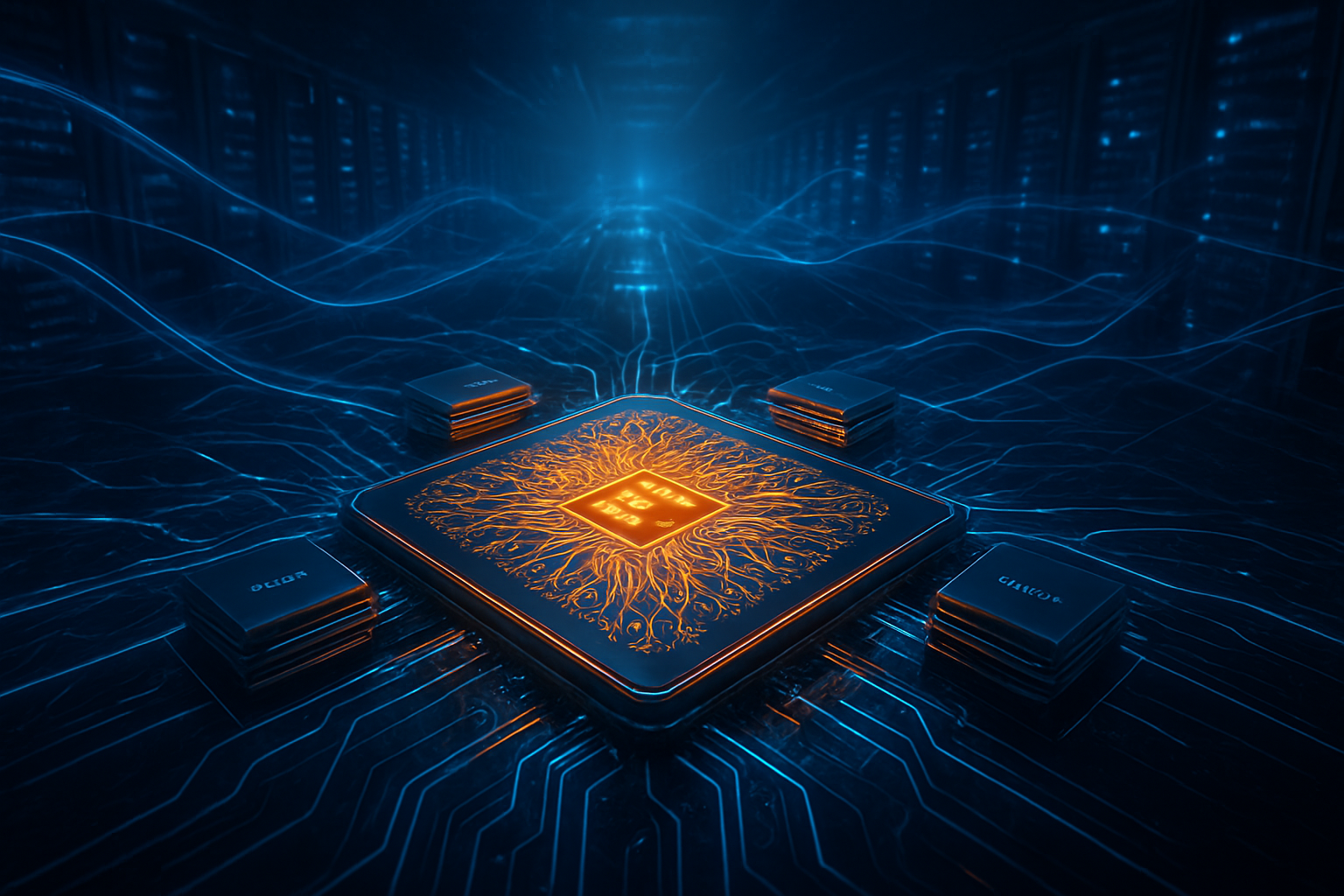
    As 2025 draws to a close, the artificial intelligence industry is witnessing a tectonic shift in its underlying infrastructure. For years, the "Nvidia tax"—the massive premiums paid for high-end H100 and Blackwell GPUs—was an unavoidable cost of doing business in the AI era. However, a new alliance between hyperscale giants and a resurgent Intel (NASDAQ: INTC) is fundamentally rewriting the rules of the game. With the arrival of Microsoft (NASDAQ: MSFT) Maia 2 and Amazon (NASDAQ: AMZN) Trainium3, the era of "one-size-fits-all" hardware is ending, replaced by a sophisticated landscape of custom-tailored silicon designed for maximum efficiency and architectural sovereignty.

    The significance of this development cannot be overstated. By late 2025, Microsoft and Amazon have moved beyond experimental internal hardware to high-volume manufacturing of custom accelerators that rival the performance of the world’s most advanced GPUs. Central to this transition is Intel’s 18A (1.8nm-class) process node, which has officially entered high-volume manufacturing at facilities in Arizona and Ohio. This partnership marks the first time in a decade that a domestic foundry has challenged the dominance of TSMC (NYSE: TSM), providing hyperscalers with a "geographic escape valve" and a direct path to vertical integration.

    Technical Frontiers: The Power of 18A, Maia 2, and Trainium3

    The technical foundation of this shift lies in Intel’s 18A process node, which has introduced two breakthrough technologies: RibbonFET and PowerVia. RibbonFET, a Gate-All-Around (GAA) transistor architecture, allows for more precise control over electrical current, significantly reducing power leakage. Even more critical is PowerVia, the industry’s first backside power delivery system. By moving power routing to the back of the wafer and away from signal lines, Intel has successfully reduced voltage drop and increased transistor density. For Microsoft’s Maia 2, which is built on the enhanced 18A-P variant, these innovations translate to a staggering 20–30% increase in performance-per-watt over its predecessor, the Maia 100.

    Microsoft's Maia 2 is designed with a "systems-first" philosophy. Rather than being a standalone component, it is integrated into a custom liquid-cooled rack system and works in tandem with the Azure Boost DPU to optimize the entire data path. This vertical co-design is specifically optimized for large language models (LLMs) like GPT-5 and Microsoft’s internal "MAI" model family. While the chip maintains a massive, reticle-limited die size, it utilizes Intel’s EMIB (Embedded Multi-die Interconnect Bridge) and Foveros packaging to manage yields and interconnectivity, allowing Azure to scale its AI clusters more efficiently than ever before.

    Amazon Web Services (AWS) has taken a parallel but distinct path with its Trainium3 and AI Fabric chips. While Trainium2, built on a 5nm process, became generally available in late 2024 to power massive workloads for partners like Anthropic, the move to Intel 18A for Trainium3 represents a quantum leap. Trainium3 is projected to deliver 4.4x the compute performance of its predecessor, specifically targeting the exascale training requirements of trillion-parameter models. Furthermore, AWS is co-developing a next-generation "AI Fabric" chip with Intel on the 18A node, designed to provide high-speed, low-latency interconnects for "UltraClusters" containing upwards of 100,000 chips.

    Industry Disruption: The End of the GPU Monopoly

    This surge in custom silicon is creating a "Great Decoupling" in the semiconductor market. While Nvidia (NASDAQ: NVDA) remains the "training king," holding an estimated 80–86% share of the high-end GPU market with its Blackwell architecture, its dominance is being eroded in the high-volume inference sector. By late 2025, custom ASICs like Google (NASDAQ: GOOGL) TPU v7, Meta (NASDAQ: META) MTIA, and the new Microsoft and Amazon chips are capturing nearly 40% of all AI inference workloads. This shift is driven by the relentless pursuit of lower "cost-per-token," where specialized chips can offer a 50–70% lower total cost of ownership (TCO) compared to general-purpose GPUs.

    The competitive implications for major AI labs are profound. Companies that own their own silicon can offer proprietary performance boosts and pricing tiers that are unavailable on competing clouds. This creates a "vertical lock-in" effect, where an AI startup might find that its model runs significantly faster or cheaper on Azure's Maia 2 than on any other platform. Furthermore, the partnership with Intel Foundry has allowed Microsoft and Amazon to bypass the supply chain bottlenecks that have plagued the industry for years, giving them a strategic advantage in capacity planning and deployment speed.

    Intel itself is a primary beneficiary of this trend. By successfully executing its "five nodes in four years" roadmap and securing Microsoft and Amazon as anchor customers for 18A, Intel has re-established itself as a viable alternative to TSMC. This diversification is not just a business win for Intel; it is a stabilization of the global AI supply chain. With Marvell (NASDAQ: MRVL) providing design assistance for these custom chips, a new ecosystem is forming around domestic manufacturing that reduces the industry's reliance on the geopolitically sensitive Taiwan Strait.

    Wider Significance: Infrastructure Sovereignty and the Economic Shift

    The broader impact of the custom silicon wars is the emergence of "Infrastructure Sovereignty." In the early 2020s, AI development was limited by who could buy the most GPUs. In late 2025, the constraint is shifting to who can design the most efficient architecture. This move toward vertical integration—controlling everything from the transistor to the transformer model—allows hyperscalers to optimize their entire stack for energy efficiency, a critical factor as AI data centers consume an ever-increasing share of the global power grid.

    This trend also signals a move toward "Sovereign AI" for nations and large enterprises. By utilizing custom ASICs and domestic foundries, organizations can ensure their AI infrastructure is resilient to trade disputes and export controls. The success of the Intel 18A node has effectively ended the TSMC monopoly, creating a more competitive and resilient supply chain. Experts compare this milestone to the transition from general-purpose CPUs to specialized graphics hardware in the late 1990s, suggesting we are entering a phase where the hardware is finally catching up to the specific mathematical requirements of neural networks.

    However, this transition is not without its concerns. The concentration of custom hardware within a few "Big Tech" hands could stifle competition among smaller cloud providers who cannot afford the multi-billion-dollar R&D costs of developing their own silicon. There is also the risk of architectural fragmentation, where models optimized for AWS Trainium might perform poorly on Azure Maia, forcing developers to choose an ecosystem early in their lifecycle and potentially limiting the portability of AI advancements.

    Future Outlook: Scaling to the Exascale and Beyond

    Looking toward 2026 and 2027, the roadmap for custom silicon suggests even more aggressive scaling. Microsoft is already working on the successor to Maia 2, codenamed "Braga," which is expected to further refine the chiplet architecture and integrate even more advanced HBM4 memory. Meanwhile, AWS is expected to push the boundaries of networking with its 18A fabric chips, aiming to create "logical supercomputers" that span entire data center regions, allowing for the training of models with tens of trillions of parameters.

    The next major challenge for these hyperscalers will be software compatibility. While Nvidia's CUDA remains the gold standard for developer ease-of-use, the success of custom silicon depends on the maturation of open-source compilers like Triton and PyTorch. If Microsoft and Amazon can make the transition from Nvidia to custom silicon seamless for developers, the "Nvidia tax" may eventually become a relic of the past. Experts predict that by 2027, more than half of all AI compute in the cloud will run on non-Nvidia hardware.

    Conclusion: A New Era of AI Infrastructure

    The 2025 rollout of Microsoft’s Maia 2 and Amazon’s Trainium3 on Intel’s 18A node represents a watershed moment in the history of computing. It marks the successful execution of a multi-year strategy by hyperscalers to reclaim control over their hardware destiny. By partnering with Intel to build a domestic, high-performance manufacturing pipeline, these companies have not only reduced their dependence on third-party vendors but have also pioneered new technologies like backside power delivery and specialized AI fabrics.

    The key takeaway is that the AI revolution is no longer just about software and algorithms; it is a battle of atoms and energy. The significance of this development will be felt for decades as the industry moves toward a more fragmented, specialized, and efficient hardware landscape. In the coming months, the industry will be watching closely as these chips move into full-scale production, looking for the first real-world benchmarks that will determine which hyperscaler holds the ultimate advantage in the "Custom Silicon Wars."


    This content is intended for informational purposes only and represents analysis of current AI developments.

    TokenRing AI delivers enterprise-grade solutions for multi-agent AI workflow orchestration, AI-powered development tools, and seamless remote collaboration platforms.
    For more information, visit https://www.tokenring.ai/.

  • TSMC Commences 2nm Volume Production: The Next Frontier of AI Silicon

    TSMC Commences 2nm Volume Production: The Next Frontier of AI Silicon

    HSINCHU, Taiwan — In a move that solidifies its absolute dominance over the global semiconductor landscape, Taiwan Semiconductor Manufacturing Company (NYSE: TSM) has officially commenced high-volume manufacturing (HVM) of its 2-nanometer (N2) process node as of the fourth quarter of 2025. This milestone marks the industry's first successful transition to Gate-all-around Field-Effect Transistor (GAAFET) architecture at scale, providing the foundational hardware necessary to power the next generation of generative AI models and hyper-efficient mobile devices.

    The commencement of N2 production is not merely a generational shrink; it represents a fundamental re-engineering of the transistor itself. By moving away from the FinFET structure that has defined the industry for over a decade, TSMC is addressing the physical limitations of silicon at the atomic scale. As of late December 2025, the company’s facilities in Baoshan and Kaohsiung are operating at full tilt, signaling a new era of "AI Silicon" that promises to break the energy-efficiency bottlenecks currently stifling data center expansion and edge computing.

    Technical Mastery: GAAFET and the 70% Yield Milestone

    The technical leap from 3nm (N3P) to 2nm (N2) is defined by the implementation of "nanosheet" GAAFET technology. Unlike traditional FinFETs, where the gate covers three sides of the channel, the N2 architecture features a gate that completely surrounds the channel on all four sides. This provides superior electrostatic control, drastically reducing sub-threshold leakage—a critical issue as transistors approach the size of individual molecules. TSMC reports that this transition has yielded a 10–15% performance gain at the same power envelope, or a staggering 25–30% reduction in power consumption at the same clock speeds compared to its refined 3nm process.

    Perhaps the most significant technical achievement is the reported 70% yield rate for logic chips at the Baoshan (Hsinchu) and Kaohsiung facilities. For a brand-new node using a novel transistor architecture, a 70% yield is considered exceptionally high, far outstripping the early-stage yields of competitors. This success is attributed to TSMC's "NanoFlex" technology, which allows chip designers to mix and match different nanosheet widths within a single design, optimizing for either high performance or extreme power efficiency depending on the specific block’s requirements.

    Initial reactions from the AI research community and hardware engineers have been overwhelmingly positive. Experts note that the 25-30% power reduction is the "holy grail" for the next phase of AI development. As large language models (LLMs) move toward "on-device" execution, the thermal constraints of smartphones and laptops have become the primary limiting factor. The N2 node effectively provides the thermal headroom required to run sophisticated neural engines without compromising battery life or device longevity.

    Market Dominance: Apple and Nvidia Lead the Charge

    The immediate beneficiaries of this production ramp are the industry’s "Big Tech" titans, most notably Apple (NASDAQ: AAPL) and Nvidia (NASDAQ: NVDA). While Apple’s latest A19 Pro chips utilized a refined 3nm process, the company has reportedly secured the lion's share of TSMC’s initial 2nm capacity for its 2026 product cycle. This strategic "pre-booking" ensures that Apple maintains a hardware lead in consumer AI, potentially allowing for the integration of more complex "Apple Intelligence" features that run natively on the A20 chip.

    For Nvidia, the shift to 2nm is vital for the roadmap beyond its current Blackwell and Rubin architectures. While the standard Rubin GPUs are built on 3nm, the upcoming "Rubin Ultra" and the successor "Feynman" architecture are expected to leverage the N2 and subsequent A16 nodes. The power efficiency of 2nm is a strategic advantage for Nvidia, as data center operators are increasingly limited by power grid capacity rather than floor space. By delivering more TFLOPS per watt, Nvidia can maintain its market lead against rivals like Advanced Micro Devices (NASDAQ: AMD) and Intel (NASDAQ: INTC).

    The competitive implications for Intel and Samsung (KRX: 005930) are stark. While Intel’s 18A node aims to compete with TSMC’s 2nm by introducing "PowerVia" (backside power delivery) earlier, TSMC’s superior yield rates and massive manufacturing scale remain a formidable moat. Samsung, despite being the first to move to GAAFET at 3nm, has reportedly struggled with yield consistency, leading major clients like Qualcomm (NASDAQ: QCOM) to remain largely within the TSMC ecosystem for their flagship Snapdragon processors.

    The Wider Significance: Breaking the AI Energy Wall

    Looking at the broader AI landscape, the commencement of 2nm production arrives at a critical juncture. The industry has been grappling with the "energy wall"—the point at which the power requirements for training and deploying AI models become economically and environmentally unsustainable. TSMC’s N2 node provides a much-needed reprieve, potentially extending the viability of the current scaling laws that have driven AI progress over the last three years.

    This milestone also highlights the increasing "silicon-centric" nature of geopolitics. The successful ramp-up at the Kaohsiung facility, which was accelerated by six months, underscores Taiwan’s continued role as the indispensable hub of the global technology supply chain. However, it also raises concerns regarding the concentration of advanced manufacturing. As AI becomes a foundational utility for modern economies, the reliance on a single company for the most advanced 2nm chips creates a single point of failure that global policymakers are still struggling to address through initiatives like the U.S. CHIPS Act.

    Comparisons to previous milestones, such as the move to FinFET at 16nm or the introduction of EUV (Extreme Ultraviolet) lithography at 7nm, suggest that the 2nm transition will have a decade-long tail. Just as those breakthroughs enabled the smartphone revolution and the first wave of cloud computing, the N2 node is the literal "bedrock" upon which the agentic AI era will be built. It transforms AI from a cloud-based service into a ubiquitous, energy-efficient local presence.

    Future Horizons: N2P, A16, and the Road to 1.6nm

    TSMC’s roadmap does not stop at the base N2 node. The company has already detailed the "N2P" process, an enhanced version of 2nm scheduled for 2026, which will introduce Backside Power Delivery (BSPDN). This technology moves the power rails to the rear of the wafer, further reducing voltage drop and freeing up space for signal routing. Following N2P, the "A16" node (1.6nm) is expected to debut in late 2026 or early 2027, promising another 10% performance jump and even more sophisticated power delivery systems.

    The potential applications for this silicon are vast. Beyond smartphones and AI accelerators, the 2nm node is expected to revolutionize autonomous driving systems, where real-time processing of sensor data must be balanced with the limited battery capacity of electric vehicles. Furthermore, the efficiency gains of N2 could enable a new generation of sophisticated AR/VR glasses that are light enough for all-day wear while possessing the compute power to render complex digital overlays in real-time.

    Challenges remain, particularly regarding the astronomical cost of these chips. With 2nm wafers estimated to cost nearly $30,000 each, the "cost-per-transistor" trend is no longer declining as rapidly as it once did. Experts predict that this will lead to a surge in "chiplet" designs, where only the most critical compute elements are built on 2nm, while less sensitive components are relegated to older, cheaper nodes.

    A New Standard for the Silicon Age

    The official commencement of 2nm volume production at TSMC is a defining moment for the late 2025 tech landscape. By successfully navigating the transition to GAAFET architecture and achieving a 70% yield at its Baoshan and Kaohsiung sites, TSMC has once again moved the goalposts for the entire semiconductor industry. The 10-15% performance gain and 25-30% power reduction are the essential ingredients for the next evolution of artificial intelligence.

    In the coming months, the industry will be watching for the first "tape-outs" of consumer silicon from Apple and the first high-performance computing (HPC) samples from Nvidia. As these 2nm chips begin to filter into the market throughout 2026, the gap between those who have access to TSMC’s leading-edge capacity and those who do not will likely widen, further concentrating power among the elite tier of AI developers.

    Ultimately, the N2 node represents the triumph of precision engineering over the daunting physics of the sub-atomic world. As we look toward the 1.6nm A16 era, it is clear that while Moore's Law may be slowing, the ingenuity of the semiconductor industry continues to provide the horsepower necessary for the AI revolution to reach its full potential.


    This content is intended for informational purposes only and represents analysis of current AI developments.

    TokenRing AI delivers enterprise-grade solutions for multi-agent AI workflow orchestration, AI-powered development tools, and seamless remote collaboration platforms.
    For more information, visit https://www.tokenring.ai/.

  • The Great Decoupling: How Hyperscaler Custom Silicon is Eroding NVIDIA’s Iron Grip on AI

    The Great Decoupling: How Hyperscaler Custom Silicon is Eroding NVIDIA’s Iron Grip on AI

    As we close out 2025, the artificial intelligence industry has reached a pivotal "Great Decoupling." For years, the rapid advancement of AI was synonymous with the latest hardware from NVIDIA (NASDAQ: NVDA), but a massive shift is now visible across the global data center landscape. The world’s largest cloud providers—Amazon (NASDAQ: AMZN), Google (NASDAQ: GOOGL), Microsoft (NASDAQ: MSFT), and Meta (NASDAQ: META)—have successfully transitioned from being NVIDIA’s biggest customers to its most formidable competitors. By deploying their own custom-designed AI chips at scale, these "hyperscalers" are fundamentally altering the economics of the AI revolution.

    This shift is not merely a hedge against supply chain volatility; it is a strategic move toward vertical integration. With the launch of next-generation hardware like Google’s TPU v7 "Ironwood" and Amazon’s Trainium3, the era of the universal GPU is giving way to a more fragmented, specialized hardware ecosystem. While NVIDIA still maintains a lead in raw performance for frontier model training, the hyperscalers have begun to dominate the high-volume inference market, offering performance-per-dollar metrics that the "NVIDIA tax" simply cannot match.

    The Rise of Specialized Architectures: Ironwood, Axion, and Trainium3

    The technical landscape of late 2025 is defined by a move away from general-purpose GPUs toward Application-Specific Integrated Circuits (ASICs). Google’s recent unveiling of the TPU v7, codenamed Ironwood, represents the pinnacle of this trend. Built to challenge NVIDIA’s Blackwell architecture, Ironwood delivers a staggering 4.6 PetaFLOPS of FP8 performance per chip. By utilizing an Optical Circuit Switch (OCS) and a 3D torus fabric, Google can link over 9,000 of these chips into a single Superpod, creating a unified AI engine with nearly 2 Petabytes of shared memory. Supporting this is Google’s Axion, a custom Arm-based CPU that handles the "grunt work" of data preparation, boasting 60% better energy efficiency than traditional x86 processors.

    Amazon has taken a similarly aggressive path with the release of Trainium3. Built on a cutting-edge 3nm process, Trainium3 is designed specifically for the cost-conscious enterprise. A single Trainium3 UltraServer rack now delivers 0.36 ExaFLOPS of aggregate FP8 performance, with AWS claiming that these clusters are between 40% and 65% cheaper to run than comparable NVIDIA Blackwell setups. Meanwhile, Meta has focused its internal efforts on the MTIA v2 (Meta Training and Inference Accelerator), which now powers the recommendation engines for billions of users on Instagram and Facebook. Meta’s "Artemis" chip achieves a power efficiency of 7.8 TOPS per watt, significantly outperforming the aging H100 generation in specific inference tasks.

    Microsoft, while facing some production delays with its Maia 200 "Braga" silicon, has doubled down on a "system-level" approach. Rather than just focusing on the AI accelerator, Microsoft is integrating its Maia 100 chips with custom Cobalt 200 CPUs and Azure Boost DPUs (Data Processing Units). This holistic architecture aims to eliminate the data bottlenecks that often plague heterogeneous clusters. The industry reaction has been one of cautious pragmatism; while researchers still prefer the flexibility of NVIDIA’s CUDA for experimental work, production-grade AI is increasingly moving to these specialized platforms to manage the skyrocketing costs of token generation.

    Shifting the Power Dynamics: From Monolith to Multi-Vendor

    The competitive implications of this silicon surge are profound. For years, NVIDIA enjoyed gross margins exceeding 75%, driven by a lack of viable alternatives. However, as Amazon and Google move internal workloads—and those of major partners like Anthropic—onto their own silicon, NVIDIA’s pricing power is under threat. We are seeing a "Bifurcation of Spend" in the market: NVIDIA remains the "Ferrari" of the AI world, used for training the most complex frontier models where software flexibility is paramount. In contrast, custom hyperscaler chips have become the "workhorses," capturing nearly 40% of the inference market where cost-per-token is the only metric that matters.

    This development creates a strategic advantage for the hyperscalers that extends beyond mere cost savings. By controlling the silicon, companies like Google and Amazon can optimize their entire software stack—from the compiler to the cloud API—resulting in a "seamless" experience that is difficult for third-party hardware to replicate. For AI startups, this means a broader menu of options. A developer can now choose to train a model on NVIDIA Blackwell instances for maximum speed, then deploy it on AWS Inferentia3 or Google TPUs for cost-effective scaling. This multi-vendor reality is breaking the software lock-in that NVIDIA’s CUDA ecosystem once enjoyed, as open-source frameworks like Triton and OpenXLA make it easier to port code across different hardware architectures.

    Furthermore, the rise of custom silicon allows hyperscalers to offer "sovereign" AI solutions. By reducing their reliance on a single hardware provider, these giants are less vulnerable to geopolitical trade restrictions and supply chain bottlenecks at Taiwan Semiconductor Manufacturing Company (NYSE: TSM). This vertical integration provides a level of stability that is highly attractive to enterprise customers and government agencies who are wary of the volatility seen in the GPU market over the last three years.

    Vertical Integration and the Sustainability Mandate

    Beyond the balance sheets, the shift toward custom silicon is a response to the looming energy crisis facing the AI industry. General-purpose GPUs are notoriously power-hungry, often requiring massive cooling infrastructure and specialized power grids. Custom ASICs like Meta’s MTIA and Google’s Axion are designed with "surgical precision," stripping away the legacy components of a GPU to focus entirely on tensor operations. This results in a dramatic reduction in the carbon footprint per inference, a critical factor as global regulators begin to demand transparency in the environmental impact of AI data centers.

    This trend also mirrors previous milestones in the computing industry, such as Apple’s transition to M-series silicon for its Mac line. Just as Apple proved that vertically integrated hardware and software could outperform generic components, the hyperscalers are proving that the "AI-first" data center requires "AI-first" silicon. We are moving away from the era of "brute force" computing—where more GPUs were the answer to every problem—toward an era of architectural elegance. This shift is essential for the long-term viability of the industry, as the power demands of models like Gemini 3.0 and GPT-5 would be unsustainable on 2023-era hardware.

    However, this transition is not without its concerns. There is a growing "silicon divide" between the Big Four and the rest of the industry. Smaller cloud providers and independent data centers lack the billions of dollars in R&D capital required to design their own chips, potentially leaving them at a permanent cost disadvantage. There is also the risk of fragmentation; if every cloud provider has its own proprietary hardware and software stack, the dream of a truly portable, open AI ecosystem may become harder to achieve.

    The Road to 2026: The Silicon Arms Race Accelerates

    The near-term future promises an even more intense "Silicon Arms Race." NVIDIA is not standing still; the company has already confirmed its "Rubin" architecture for a late 2026 release, which will feature HBM4 memory and a new "Vera" CPU designed to reclaim the efficiency crown. NVIDIA’s strategy is to move even faster, shifting to an annual release cadence to stay ahead of the hyperscalers' design cycles. We expect to see NVIDIA lean heavily into "Reasoning" models that require the high-precision FP4 throughput that their Blackwell Ultra (B300) chips are uniquely optimized for.

    On the hyperscaler side, the focus will shift toward "Agentic" AI. Next-generation chips like the rumored Trainium4 and Maia 200 are expected to include hardware-level optimizations for long-context memory and agentic reasoning, allowing AI models to "think" for longer periods without a massive spike in latency. Experts predict that by 2027, the majority of AI inference will happen on non-NVIDIA hardware, while NVIDIA will pivot to become the primary provider for the "Super-Intelligence" clusters used by research labs like OpenAI and xAI.

    A New Era of Computing

    The rise of custom silicon marks the end of the "GPU Monoculture" that defined the early 2020s. We are witnessing a fundamental re-architecting of the world's computing infrastructure, where the chip, the compiler, and the cloud are designed as a single, cohesive unit. This development is perhaps the most significant milestone in AI history since the introduction of the Transformer architecture, as it provides the physical foundation upon which the next decade of intelligence will be built.

    As we look toward 2026, the key metric for the industry will no longer be the number of GPUs a company owns, but the efficiency of the silicon it has designed. For investors and technologists alike, the coming months will be a period of intense observation. Watch for the general availability of Microsoft’s Maia 200 and the first benchmarks of NVIDIA’s Rubin. The "Great Decoupling" is well underway, and the winners will be those who can most effectively marry the brilliance of AI software with the precision of custom-built silicon.


    This content is intended for informational purposes only and represents analysis of current AI developments.

    TokenRing AI delivers enterprise-grade solutions for multi-agent AI workflow orchestration, AI-powered development tools, and seamless remote collaboration platforms.
    For more information, visit https://www.tokenring.ai/.
  • The Great Decoupling: How Custom Silicon is Breaking NVIDIA’s Iron Grip on the AI Cloud

    The Great Decoupling: How Custom Silicon is Breaking NVIDIA’s Iron Grip on the AI Cloud

    As we close out 2025, the landscape of artificial intelligence infrastructure has undergone a seismic shift. For years, the industry’s reliance on NVIDIA Corp. (NASDAQ: NVDA) was absolute, with the company’s H100 and Blackwell GPUs serving as the undisputed currency of the AI revolution. However, the final months of 2025 have confirmed a new reality: the era of the "General Purpose GPU" monopoly is ending. Cloud hyperscalers—Alphabet Inc. (NASDAQ: GOOGL), Amazon.com Inc. (NASDAQ: AMZN), and Microsoft Corp. (NASDAQ: MSFT)—have successfully transitioned from being NVIDIA’s biggest customers to its most formidable competitors, deploying custom-built AI Application-Specific Integrated Circuits (ASICs) at a scale previously thought impossible.

    This transition is not merely about saving costs; it is a fundamental re-engineering of the AI stack. By bypassing traditional GPUs, these tech giants are gaining unprecedented control over their supply chains, energy consumption, and software ecosystems. With the recent launch of Google’s seventh-generation TPU, "Ironwood," and Amazon’s "Trainium3," the performance gap that once protected NVIDIA has all but vanished, ushering in a "Great Decoupling" that is redefining the economics of the cloud.

    The Technical Frontier: Ironwood, Trainium3, and the Push for 3nm

    The technical specifications of 2025’s custom silicon represent a quantum leap over the experimental chips of just two years ago. Google’s Ironwood (TPU v7), unveiled in late 2025, has become the new benchmark for scaling. Built on a cutting-edge 3nm process, Ironwood delivers a staggering 4.6 PetaFLOPS of FP8 performance per chip, narrowly edging out the standard NVIDIA Blackwell B200. What sets Ironwood apart is its "optical switching" fabric, which allows Google to link 9,216 chips into a single "Superpod" with 1.77 Petabytes of shared HBM3e memory. This architecture virtually eliminates the communication bottlenecks that plague traditional Ethernet-based GPU clusters, making it the preferred choice for training the next generation of trillion-parameter models.

    Amazon’s Trainium3, launched at re:Invent in December 2025, focuses on a different technical triumph: the "Total Cost of Ownership" (TCO). While its raw compute of 2.5 PetaFLOPS trails NVIDIA’s top-tier Blackwell Ultra, the Trainium3 UltraServer packs 144 chips into a single rack, delivering 0.36 ExaFLOPS of aggregate performance at a fraction of the power draw. Amazon’s dual-chiplet design allows for high yields and lower manufacturing costs, enabling AWS to offer AI training credits at prices 40% to 65% lower than equivalent NVIDIA-based instances.

    Microsoft, while facing some design hurdles with its Maia 200 (now expected in early 2026), has pivoted its technical strategy toward vertical integration. At Ignite 2025, Microsoft showcased the Azure Cobalt 200, a 3nm Arm-based CPU designed to work in tandem with the Azure Boost DPU (Data Processing Unit). This combination offloads networking and storage tasks from the AI accelerators, ensuring that even the current Maia 100 chips operate at near-peak theoretical utilization. This "system-level" approach differs from NVIDIA’s "chip-first" philosophy, focusing on how data moves through the entire data center rather than just the speed of a single processor.

    Market Disruption: The End of the "GPU Tax"

    The strategic implications of this shift are profound. For years, cloud providers were forced to pay what many called the "NVIDIA Tax"—massive premiums that resulted in 80% gross margins for the chipmaker. By 2025, the hyperscalers have reclaimed this margin. For Meta Platforms Inc. (NASDAQ: META), which recently began renting Google’s TPUs to supplement its own internal MTIA (Meta Training and Inference Accelerator) efforts, the move to custom silicon represents a multi-billion dollar saving in capital expenditure.

    This development has created a new competitive dynamic between major AI labs. Anthropic, backed heavily by Amazon and Google, now does the vast majority of its training on Trainium and TPU clusters. This gives them a significant cost advantage over OpenAI, which remains more closely tied to NVIDIA hardware via its partnership with Microsoft. However, even that is changing; Microsoft’s move to make its Azure Foundry "hardware agnostic" allows it to shift internal workloads like Microsoft 365 Copilot onto Maia silicon, freeing up its limited NVIDIA supply for high-paying external customers.

    Furthermore, the rise of custom ASICs is disrupting the startup ecosystem. New AI companies are no longer defaulting to CUDA (NVIDIA’s proprietary software platform). With the emergence of OpenXLA and PyTorch 2.5+, which provide seamless abstraction layers across different hardware types, the "software moat" that once protected NVIDIA is being drained. Amazon’s shocking announcement that its upcoming Trainium4 will natively support CUDA-compiled kernels is perhaps the final nail in the coffin for hardware lock-in, signaling a future where code can run on any silicon, anywhere.

    The Wider Significance: Power, Sovereignty, and Sustainability

    Beyond the corporate balance sheets, the rise of custom AI silicon addresses the most pressing crisis facing the tech industry: the power grid. As of late 2025, data centers are consuming an estimated 8% of total US electricity. Custom ASICs like Google’s Ironwood are designed with "inference-first" architectures that are up to 3x more energy-efficient than general-purpose GPUs. This efficiency is no longer a luxury; it is a requirement for obtaining building permits for new data centers in power-constrained regions like Northern Virginia and Dublin.

    This trend also reflects a broader move toward "Technological Sovereignty." During the supply chain crunches of 2023 and 2024, hyperscalers were "price takers," at the mercy of NVIDIA’s allocation schedules. In 2025, they are "price makers." By controlling the silicon design, Google, Amazon, and Microsoft can dictate their own roadmap, optimizing hardware for specific model architectures like Mixture-of-Experts (MoE) or State Space Models (SSM) that were not yet mainstream when NVIDIA’s Blackwell was first designed.

    However, this shift is not without concerns. The fragmentation of the hardware landscape could lead to a "two-tier" AI world: one where the "Big Three" cloud providers have access to hyper-efficient, low-cost custom silicon, while smaller cloud providers and sovereign nations are left competing for increasingly expensive, general-purpose GPUs. This could further centralize the power of AI development into the hands of a few trillion-dollar entities, raising antitrust questions that regulators in the US and EU are already beginning to probe as we head into 2026.

    The Horizon: Inference-First and the 2nm Race

    Looking ahead to 2026 and 2027, the focus of custom silicon is expected to shift from "Training" to "Massive-Scale Inference." As AI models become embedded in every aspect of computing—from operating systems to real-time video translation—the demand for chips that can run models cheaply and instantly will skyrocket. We expect to see "Edge-ASICs" from these hyperscalers that bridge the gap between the cloud and local devices, potentially challenging the dominance of Apple Inc. (NASDAQ: AAPL) in the AI-on-device space.

    The next major milestone will be the transition to 2nm process technology. Reports suggest that both Google and Amazon have already secured 2nm capacity at Taiwan Semiconductor Manufacturing Co. (NYSE: TSM) for 2026. These next-gen chips will likely integrate "Liquid-on-Chip" cooling technologies to manage the extreme heat densities of trillion-parameter processing. The challenge will remain software; while abstraction layers have improved, the "last mile" of optimization for custom silicon still requires specialized engineering talent that remains in short supply.

    A New Era of AI Infrastructure

    The rise of custom AI silicon marks the end of the "GPU Gold Rush" and the beginning of the "ASIC Integration" era. By late 2025, the hyperscalers have proven that they can not only match NVIDIA’s performance but exceed it in the areas that matter most: scale, cost, and efficiency. This development is perhaps the most significant in the history of AI hardware, as it breaks the bottleneck that threatened to stall AI progress due to high costs and limited supply.

    As we move into 2026, the industry will be watching closely to see how NVIDIA responds to this loss of market share. While NVIDIA remains the leader in raw innovation and software ecosystem depth, the "Great Decoupling" is now an irreversible reality. For enterprises and developers, this means more choice, lower costs, and a more resilient AI infrastructure. The AI revolution is no longer being fought on a single front; it is being won in the custom-built silicon foundries of the world’s largest cloud providers.


    This content is intended for informational purposes only and represents analysis of current AI developments.

    TokenRing AI delivers enterprise-grade solutions for multi-agent AI workflow orchestration, AI-powered development tools, and seamless remote collaboration platforms.
    For more information, visit https://www.tokenring.ai/.
  • The Symbiotic Revolution: How Hardware-Software Co-Design is Unleashing AI’s True Potential

    The Symbiotic Revolution: How Hardware-Software Co-Design is Unleashing AI’s True Potential

    In the rapidly evolving landscape of artificial intelligence, a fundamental shift is underway: the increasingly tight integration of chip hardware and AI software. This symbiotic relationship, often termed hardware-software co-design, is no longer a mere optimization but a critical necessity for unlocking the next generation of AI capabilities. As AI models, particularly large language models (LLMs) and generative AI, grow exponentially in complexity and demand unprecedented computational power, the traditional approach of developing hardware and software in isolation is proving insufficient. The industry is witnessing a holistic embrace of co-design, where silicon and algorithms are crafted in unison, forging a path to unparalleled performance, efficiency, and innovation.

    This integrated approach is immediately significant because it addresses the core bottlenecks that have constrained AI's progress. By tailoring hardware architectures to the specific demands of AI workloads and simultaneously optimizing software to exploit these specialized capabilities, developers are achieving breakthroughs in speed, energy efficiency, and scalability. This synergy is not just about incremental gains; it's about fundamentally redefining what's possible in AI, enabling real-time applications, pushing AI to the edge, and fostering the development of entirely new model architectures that were once deemed computationally intractable. The future of AI is being built on this foundation of deeply intertwined hardware and software.

    The Engineering Behind AI's New Frontier: Unpacking Hardware-Software Co-Design

    The technical essence of hardware-software co-design in AI silicon lies in its departure from the general-purpose computing paradigm. Historically, CPUs and even early GPUs were designed with broad applicability in mind, leading to inefficiencies when confronted with the highly parallel and matrix-multiplication-heavy workloads characteristic of deep learning. The co-design philosophy, however, involves a deliberate, iterative process where hardware architects and AI software engineers collaborate from conception to deployment.

    Specific details of this advancement include the proliferation of specialized AI accelerators like NVIDIA's (NASDAQ: NVDA) GPUs, Google's (NASDAQ: GOOGL) Tensor Processing Units (TPUs), and a growing array of Application-Specific Integrated Circuits (ASICs) and Neural Processing Units (NPUs) from companies like AMD (NASDAQ: AMD), Intel (NASDAQ: INTC), and Apple (NASDAQ: AAPL). These chips feature architectures explicitly designed for AI, incorporating vast numbers of processing cores, optimized memory hierarchies (e.g., High-Bandwidth Memory or HBM), and instruction sets tailored for AI operations. Software stacks, from low-level drivers and compilers to high-level AI frameworks like TensorFlow and PyTorch, are then meticulously optimized to leverage these hardware features. This includes techniques such as low-precision arithmetic (INT8, BF16 quantization), sparsity exploitation, and graph optimization, which are implemented at both hardware and software levels to reduce computational load and memory footprint without significant accuracy loss.

    This approach differs significantly from previous methods where hardware was a fixed target for software optimization. Instead, hardware designers now incorporate insights from AI model architectures and training/inference patterns directly into chip design, while software developers adapt their algorithms to best utilize the unique characteristics of the underlying silicon. For instance, Google's TPUs were designed from the ground up for TensorFlow workloads, offering a tightly coupled hardware-software ecosystem. Similarly, Apple's M-series chips integrate powerful Neural Engines directly onto the SoC, enabling highly efficient on-device AI. Initial reactions from the AI research community and industry experts have been overwhelmingly positive, recognizing this trend as indispensable for sustaining the pace of AI innovation. Researchers are increasingly exploring "hardware-aware" AI model design, where model architectures are developed with the target hardware in mind, leading to more efficient and performant solutions.

    Reshaping the AI Competitive Landscape: Winners, Losers, and Strategic Plays

    The trend of tighter hardware-software integration is profoundly reshaping the competitive landscape across AI companies, tech giants, and startups, creating clear beneficiaries and potential disruptors. Companies that possess both deep expertise in chip design and robust AI software capabilities are poised to dominate this new era.

    NVIDIA (NASDAQ: NVDA) stands out as a prime beneficiary, having pioneered the GPU-accelerated computing paradigm for AI. Its CUDA platform, a tightly integrated software stack with its powerful GPUs, has created a formidable ecosystem that is difficult for competitors to replicate. Google (NASDAQ: GOOGL) with its TPUs and custom AI software stack for its cloud services and internal AI research, is another major player leveraging co-design to its advantage. Apple (NASDAQ: AAPL) has strategically integrated its Neural Engine into its M-series chips, enabling powerful on-device AI capabilities that enhance user experience and differentiate its products. Other chipmakers like AMD (NASDAQ: AMD) and Intel (NASDAQ: INTC) are aggressively investing in their own AI accelerators and software platforms, such as AMD's Vitis AI, to compete in this rapidly expanding market.

    The competitive implications are significant. Major AI labs and tech companies that can design or heavily influence custom AI silicon will gain strategic advantages in terms of performance, cost-efficiency, and differentiation. This could lead to a further consolidation of power among the tech giants with the resources to pursue such vertical integration. Startups in specialized AI hardware or software optimization stand to benefit if they can offer unique solutions that integrate seamlessly into existing ecosystems or carve out niche markets. However, those relying solely on general-purpose hardware or lacking the ability to optimize across the stack may find themselves at a disadvantage. Potential disruption to existing products or services includes the accelerated obsolescence of less optimized AI hardware and a shift towards cloud-based or edge AI solutions powered by highly integrated systems. Market positioning will increasingly hinge on a company's ability to deliver end-to-end optimized AI solutions, from the silicon up to the application layer.

    The Broader Canvas: AI's Evolution Through Integrated Design

    This push for tighter hardware-software integration is not an isolated phenomenon but a central pillar in the broader AI landscape, reflecting a maturing industry focused on efficiency and real-world deployment. It signifies a move beyond theoretical AI breakthroughs to practical, scalable, and sustainable AI solutions.

    The impact extends across various domains. In enterprise AI, optimized silicon and software stacks mean faster data processing, more accurate predictions, and reduced operational costs for tasks like fraud detection, supply chain optimization, and personalized customer experiences. For consumer AI, it enables more powerful on-device capabilities, enhancing privacy by reducing reliance on cloud processing for features like real-time language translation, advanced photography, and intelligent assistants. However, potential concerns include the increasing complexity of the AI development ecosystem, which could raise the barrier to entry for smaller players. Furthermore, the reliance on specialized hardware could lead to vendor lock-in, where companies become dependent on a specific hardware provider's ecosystem. Comparisons to previous AI milestones reveal a consistent pattern: each significant leap in AI capability has been underpinned by advancements in computing power. Just as GPUs enabled the deep learning revolution, co-designed AI silicon is enabling the era of ubiquitous, high-performance AI.

    This trend fits into the broader AI landscape by facilitating the deployment of increasingly complex models, such as multimodal LLMs that seamlessly integrate text, vision, and audio. These models demand unprecedented computational throughput and memory bandwidth, which only a tightly integrated hardware-software approach can efficiently deliver. It also drives the trend towards "AI everywhere," making sophisticated AI capabilities accessible on a wider range of devices, from data centers to edge devices like smartphones and IoT sensors. The emphasis on energy efficiency, a direct outcome of co-design, is crucial for sustainable AI development, especially as the carbon footprint of large AI models becomes a growing concern.

    The Horizon of AI: Anticipating Future Developments

    Looking ahead, the trajectory of hardware-software integration in AI silicon promises a future brimming with innovation, pushing the boundaries of what AI can achieve. The near-term will see continued refinement of existing co-design principles, with a focus on even greater specialization and energy efficiency.

    Expected near-term developments include the widespread adoption of chiplets and modular AI accelerators, allowing for more flexible and scalable custom hardware solutions. We will also see advancements in in-memory computing and near-memory processing, drastically reducing data movement bottlenecks and power consumption. Furthermore, the integration of AI capabilities directly into network infrastructure and storage systems will create "AI-native" computing environments. Long-term, experts predict the emergence of entirely new computing paradigms, potentially moving beyond von Neumann architectures to neuromorphic computing or quantum AI, where hardware is fundamentally designed to mimic biological brains or leverage quantum mechanics for AI tasks. These radical shifts will necessitate even deeper hardware-software co-design.

    Potential applications and use cases on the horizon are vast. Autonomous systems, from self-driving cars to robotic surgery, will achieve new levels of reliability and real-time decision-making thanks to highly optimized edge AI. Personalized medicine will benefit from accelerated genomic analysis and drug discovery. Generative AI will become even more powerful and versatile, enabling hyper-realistic content creation, advanced material design, and sophisticated scientific simulations. However, challenges remain. The complexity of designing and optimizing these integrated systems requires highly specialized talent, and the development cycles can be lengthy and expensive. Standardization across different hardware and software ecosystems is also a significant hurdle. Experts predict that the next wave of AI breakthroughs will increasingly come from those who can master this interdisciplinary art of co-design, leading to a golden age of specialized AI hardware and software ecosystems tailored for specific problems.

    A New Era of AI Efficiency and Innovation

    The escalating trend of tighter integration between chip hardware and AI software marks a pivotal moment in the history of artificial intelligence. It represents a fundamental shift from general-purpose computing to highly specialized, purpose-built AI systems, addressing the insatiable computational demands of modern AI models. This hardware-software co-design paradigm is driving unprecedented gains in performance, energy efficiency, and scalability, making previously theoretical AI applications a tangible reality.

    Key takeaways include the critical role of specialized AI accelerators (GPUs, TPUs, ASICs, NPUs) working in concert with optimized software stacks. This synergy is not just an optimization but a necessity for the advancement of complex AI models like LLMs. Companies like NVIDIA (NASDAQ: NVDA), Google (NASDAQ: GOOGL), and Apple (NASDAQ: AAPL), with their vertically integrated hardware and software capabilities, are leading this charge, reshaping the competitive landscape and setting new benchmarks for AI performance. The wider significance of this development lies in its potential to democratize powerful AI, enabling more robust on-device capabilities, fostering sustainable AI development through energy efficiency, and paving the way for entirely new classes of AI applications across industries.

    The long-term impact of this symbiotic revolution cannot be overstated. It is laying the groundwork for AI that is not only more intelligent but also more efficient, accessible, and adaptable. As we move forward, watch for continued innovation in chiplet technology, in-memory computing, and the emergence of novel computing architectures tailored for AI. The convergence of hardware and software is not merely a trend; it is the future of AI, promising to unlock capabilities that will redefine technology and society in the coming weeks and months.


    This content is intended for informational purposes only and represents analysis of current AI developments.

    TokenRing AI delivers enterprise-grade solutions for multi-agent AI workflow orchestration, AI-powered development tools, and seamless remote collaboration platforms.
    For more information, visit https://www.tokenring.ai/.