Tag: AI Workforce

  • The Great AI Pivot: Forbes Report Reveals 12 Million New Roles Amidst Targeted Job Losses

    The Great AI Pivot: Forbes Report Reveals 12 Million New Roles Amidst Targeted Job Losses

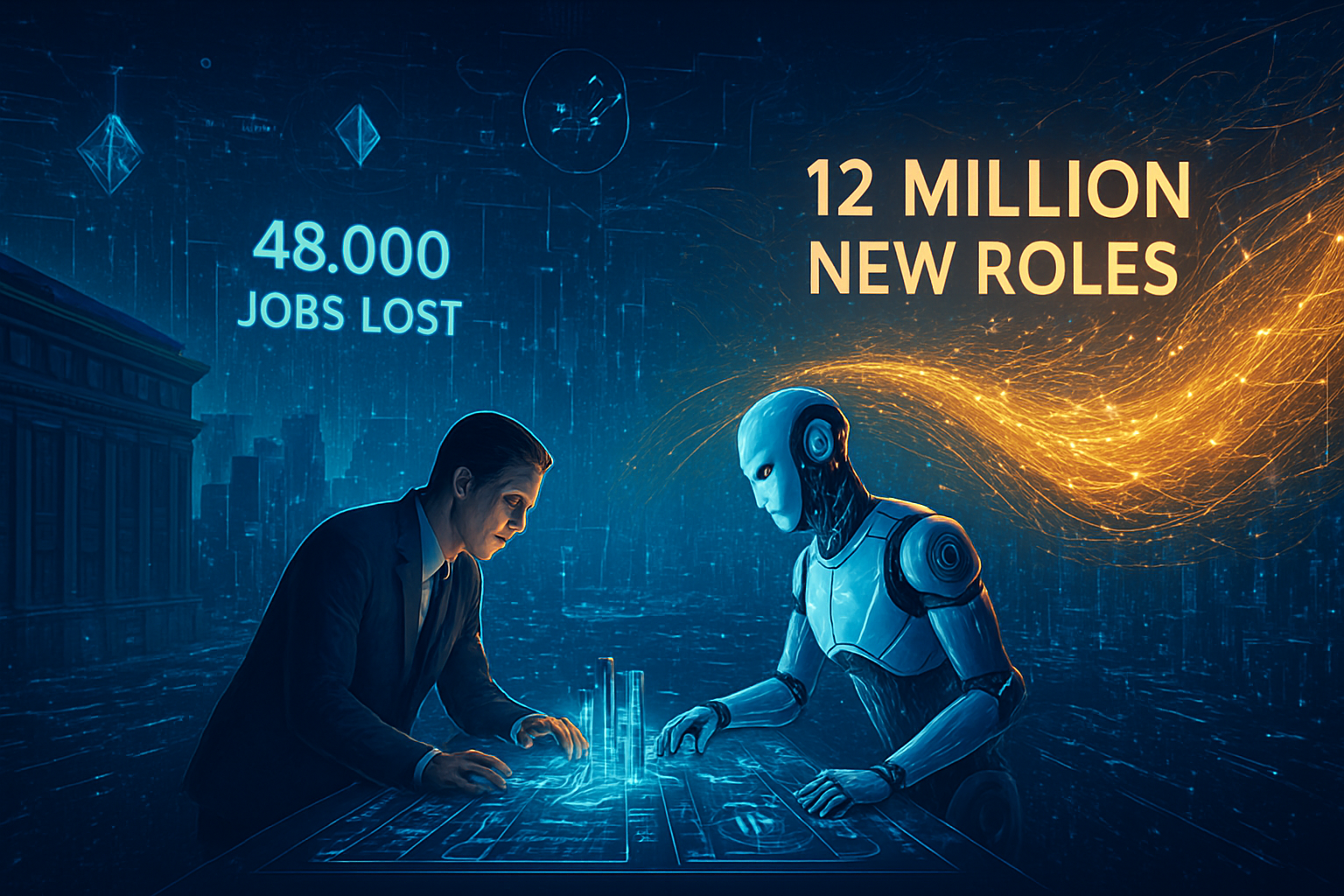
    The latest Forbes AI Workforce Report 2025 has sent ripples through the global economy, unveiling a paradoxical landscape of labor. While the report acknowledges a stark 48,414 job losses directly attributed to artificial intelligence in the United States this year, it counterbalances those figures with a staggering projection: the creation of 12 million new roles globally by the end of 2025. This data marks a definitive shift in the narrative from a "robot takeover" to a massive, systemic reorganization of human labor.

    The significance of these findings cannot be overstated. As of December 25, 2025, the global workforce is no longer merely "preparing" for AI; it is actively being restructured by it. The report highlights that while the displacement of nearly 50,000 workers is a localized tragedy for those affected, the broader trend is one of "augmentation" and "redesign." This suggests that the primary challenge of the mid-2020s is not a lack of work, but a profound mismatch between existing skills and the requirements of a new, AI-integrated economy.

    The Anatomy of the 12 Million: Beyond the 48k Baseline

    The report’s data, drawing from analysts at Challenger, Gray & Christmas and the World Economic Forum, provides a granular look at the current transition. The 48,414 job cuts in the U.S. represent roughly 4% of total layoffs for the year, indicating that while AI is a factor, it is not yet the primary driver of unemployment. These losses are largely concentrated in routine data processing, basic administrative support, and junior-level technical roles. In contrast, the 12 million new roles are emerging in "AI-adjacent" sectors where human judgment remains indispensable—such as AI-assisted healthcare diagnostics, ethical compliance, and complex supply chain orchestration.

    Technically, this shift is driven by the maturation of Agentic AI—systems capable of executing multi-step workflows rather than just answering prompts. Unlike the early generative AI of 2023, the 2025 models are integrated into enterprise resource planning (ERP) systems, allowing them to handle the "drudge work" of logistics and data entry. This leaves humans to focus on exception handling and strategic decision-making. Initial reactions from the AI research community have been cautiously optimistic, with many noting that the "productivity frontier" is moving faster than previously anticipated, necessitating a rethink of the standard 40-hour work week.

    Industry experts emphasize that the "new roles" are not just for Silicon Valley engineers. They include "Prompt Architects" in marketing firms, "AI Safety Auditors" in legal departments, and "Human-in-the-Loop" supervisors in manufacturing. The technical specification for the modern worker has shifted from "knowing the answer" to "knowing how to verify the machine's answer." This fundamental change in the human-machine interface is what is driving the massive demand for a new type of professional.

    Corporate Strategy: The Rise of the Internal AI Academy

    The Forbes report reveals a strategic pivot among tech giants and Fortune 500 companies. IBM (NYSE: IBM) and Amazon (NASDAQ: AMZN) have emerged as leaders in this transition, moving away from expensive external hiring toward "internal redeployment." IBM, in particular, has been vocal about its "AI First" internal training programs, which aim to transition thousands of back-office employees into AI-augmented roles. This strategy not only mitigates the social cost of layoffs but also retains institutional knowledge that is often lost during traditional downsizing.

    For major AI labs like Microsoft (NASDAQ: MSFT) and Alphabet Inc. (NASDAQ: GOOGL), the report suggests a competitive advantage for those who can provide the most "user-friendly" orchestration tools. As companies scramble to reskill their workforces, the platforms that require the least amount of technical "re-learning" are winning the market. This has led to a surge in specialized startups focusing on "No-Code AI" and "Natural Language Orchestration," threatening to disrupt traditional software-as-a-service (SaaS) models that rely on complex, manual user interfaces.

    The market positioning is clear: companies that view AI as a tool for "headcount reduction" are seeing short-term gains but long-term talent shortages. Conversely, those investing in the "Great Reskilling"—the report notes that 68% of C-suite leaders now prioritize human-AI collaboration—are building more resilient operations. This strategic advantage is becoming the primary differentiator in the 2025 fiscal landscape.

    The Societal Blueprint: Addressing the Entry-Level Crisis

    Beyond the corporate balance sheets, the Forbes report examines the wider societal implications of this shift. One of the most concerning trends identified is the "hollowing out" of entry-level positions. Historically, junior roles served as a training ground for future leaders. With AI now performing the tasks of junior coders, paralegals, and analysts, the "on-ramp" to professional careers is being dismantled. This creates a potential talent gap in the 2030s if the industry does not find new ways to apprentice young workers in an AI-dominated environment.

    The "massive reskilling shift" involves an estimated 120 million workers globally who will need retraining by 2027. This is a milestone that dwarfs previous industrial revolutions in both speed and scale. The report notes that the premium has shifted heavily toward "human-centric" skills: empathy, leadership, and complex problem-solving. In a world where a machine can write a perfect legal brief, the value of a lawyer who can navigate the emotional nuances of a courtroom or a negotiation has skyrocketed.

    However, concerns remain regarding the "digital divide." While 12 million new roles are being created, they are not necessarily appearing in the same geographic regions or socioeconomic brackets where the 48,000 jobs were lost. This geographic and skill-based mismatch is a primary concern for policymakers, who are now looking at "AI Transition Credits" and subsidized lifelong learning programs to ensure that the workforce is not left behind.

    The Horizon: Predictive Maintenance of the Human Workforce

    Looking ahead, the next 18 to 24 months will likely see the emergence of "Personalized AI Career Coaches"—AI systems designed to help workers identify their skill gaps and navigate their own reskilling journeys. Experts predict that the concept of a "static degree" is effectively dead; the future of work is a continuous cycle of micro-learning and adaptation. The report suggests that by 2026, "AI Fluency" will be as fundamental a requirement as literacy or basic numeracy.

    The challenges are significant. Educational institutions are currently struggling to keep pace with the 12-million-role demand, leading to a "skills vacuum" that private companies are having to fill themselves. We can expect to see more partnerships between tech companies and universities to create "fast-track" AI certifications. The long-term success of this transition depends on whether the 12 million roles can be filled quickly enough to offset the social friction caused by localized job losses.

    Final Reflections: A History in the Making

    The Forbes AI Workforce Report 2025 serves as a definitive marker in the history of the Fourth Industrial Revolution. It confirms that while the "AI apocalypse" for jobs hasn't materialized in the way doomsayers predicted, the "AI transformation" is deeper and more demanding than many optimists hoped. The net gain of 11.95 million roles is a cause for celebration, but it comes with the heavy responsibility of global reskilling.

    As we move into 2026, the key metric to watch will not be the number of jobs lost, but the speed of "time-to-retrain." The significance of this development lies in its confirmation that AI is not a replacement for human ingenuity, but a powerful new canvas for it. The coming months will be defined by how well society manages the transition of the 48,000 to the 12 million, ensuring that the AI-driven economy is as inclusive as it is productive.


    This content is intended for informational purposes only and represents analysis of current AI developments.

    TokenRing AI delivers enterprise-grade solutions for multi-agent AI workflow orchestration, AI-powered development tools, and seamless remote collaboration platforms.
    For more information, visit https://www.tokenring.ai/.

  • India’s Silicon Ascent: Maharashtra Eyes Chip Capital Crown by 2030, Fueling AI Ambitions

    India’s Silicon Ascent: Maharashtra Eyes Chip Capital Crown by 2030, Fueling AI Ambitions

    India is rapidly accelerating its ambitions in the global semiconductor landscape, with the state of Maharashtra spearheading a monumental drive to emerge as the nation's chip capital by 2030. This strategic push is not merely about manufacturing; it's intricately woven into India's broader Artificial Intelligence (AI) strategy, aiming to cultivate a robust indigenous ecosystem for chip design, fabrication, and packaging, thereby powering the next generation of AI innovations and ensuring technological sovereignty.

    At the heart of this talent cultivation lies the NaMo Semiconductor Lab, an initiative designed to sculpt future chip designers and engineers. These concerted efforts represent a pivotal moment for India, positioning it as a significant player in the high-stakes world of advanced electronics and AI, moving beyond being just a consumer to a formidable producer of critical technological infrastructure.

    Engineering India's AI Future: From Design to Fabrication

    India's journey towards semiconductor self-reliance is underpinned by the India Semiconductor Mission (ISM), launched in December 2021 with a substantial outlay of approximately $9.2 billion (₹76,000 crore). This mission provides a robust policy framework and financial incentives to attract both domestic and international investments into semiconductor and display manufacturing. As of August 2025, ten projects have already been approved, committing a cumulative investment of about $18.23 billion (₹1.60 trillion), signaling a strong trajectory towards establishing India as a reliable alternative hub in global technology supply chains. India anticipates its first domestically produced semiconductor chip to hit the market by the close of 2025, a testament to the accelerated pace of these initiatives.

    Maharashtra, in particular, has carved out its own pioneering semiconductor policy, actively fostering an ecosystem conducive to chip manufacturing. Key developments include the inauguration of RRP Electronics Ltd.'s first semiconductor manufacturing OSAT (Outsourced Semiconductor Assembly and Test) facility in Navi Mumbai in September 2024, backed by an investment of ₹12,035 crore, with plans for a FAB Manufacturing unit in its second phase. Furthermore, the Maharashtra cabinet has greenlit a significant $10 billion (₹83,947 crore) investment proposal for a semiconductor chip manufacturing unit by a joint venture between Tower Semiconductor and the Adani Group (NSE: ADANIENT) in Taloja, Navi Mumbai, targeting an initial capacity of 40,000 wafer starts per month (WSPM). The Vedanta Group (NSE: VEDL), in partnership with Foxconn (TWSE: 2317), has also proposed a massive ₹1.6 trillion (approximately $20.8 billion) investment for a semiconductor and display fabs manufacturing unit in Maharashtra. These initiatives are designed to reduce India's reliance on foreign imports and foster a "Chip to Ship" philosophy, emphasizing indigenous manufacturing from design to the final product.

    The NaMo Semiconductor Laboratory, approved at IIT Bhubaneswar and funded under the MPLAD Scheme with an estimated cost of ₹4.95 crore, is a critical component in developing the necessary human capital. This lab aims to equip Indian youth with industry-ready skills in chip manufacturing, design, and packaging, positioning IIT Bhubaneswar as a hub for semiconductor research and skilling. India already boasts 20% of the global chip design talent, with a vibrant academic ecosystem where students from 295 universities utilize advanced Electronic Design Automation (EDA) tools. The NaMo Lab will further enhance these capabilities, complementing existing facilities like the Silicon Carbide Research and Innovation Centre (SiCRIC) at IIT Bhubaneswar, and directly supporting the "Make in India" and "Design in India" initiatives.

    Reshaping the AI Industry Landscape

    India's burgeoning semiconductor sector is poised to significantly impact AI companies, both domestically and globally. By fostering indigenous chip design and manufacturing, India aims to create a more resilient supply chain, reducing the vulnerability of its AI ecosystem to geopolitical fluctuations and foreign dependencies. This localized production will directly benefit Indian AI startups and tech giants by providing easier access to specialized AI hardware, potentially at lower costs, and with greater customization options tailored to local needs.

    For major AI labs and tech companies, particularly those with a significant presence in India, this development presents both opportunities and competitive implications. Companies like Tata Electronics, which has already announced plans for semiconductor manufacturing, stand to gain strategic advantages. The availability of locally manufactured advanced chips, including those optimized for AI workloads, could accelerate innovation in areas such as machine learning, large language models, and edge AI applications. This could lead to a surge in AI-powered products and services developed within India, potentially disrupting existing markets and creating new ones.

    Furthermore, the "Design Linked Incentive (DLI)" scheme, which has already approved 23 chip-design projects led by local startups and MSMEs, is fostering a new wave of indigenous AI hardware development. Chips designed for surveillance cameras, energy meters, and IoT devices will directly feed into India's smart city and smart mobility initiatives, which are central to its AI for All vision. This localized hardware development could give Indian companies a unique competitive edge in developing AI solutions specifically suited for the diverse Indian market, and potentially for other emerging economies. The strategic advantage lies not just in manufacturing, but in owning the entire value chain from design to deployment, fostering a robust and self-reliant AI ecosystem.

    A Cornerstone of India's "AI for All" Vision

    India's semiconductor drive is intrinsically linked to its ambitious "AI for All" vision, positioning AI as a catalyst for inclusive growth and societal transformation. The national strategy, initially articulated by NITI Aayog in 2018 and further solidified by the IndiaAI Mission launched in 2024 with an allocation of ₹10,300 crore over five years, aims to establish India as a global leader in AI. Advanced chips are the fundamental building blocks for powering AI technologies, from data centers running large language models to edge devices enabling real-time AI applications. Without a robust and reliable supply of these chips, India's AI ambitions would be severely hampered.

    The impact extends far beyond economic growth. This initiative is a critical component of building a resilient AI infrastructure. The IndiaAI Mission focuses on developing a high-end common computing facility equipped with 18,693 Graphics Processing Units (GPUs), making it one of the most extensive AI compute infrastructures globally. The government has also approved ₹107.3 billion ($1.24 billion) in 2024 for AI-specific data center infrastructure, with investments expected to exceed $100 billion by 2027. This infrastructure, powered by increasingly indigenous semiconductors, will be vital for training and deploying complex AI models, ensuring that India has the computational backbone necessary to compete on the global AI stage.

    Potential concerns, however, include the significant capital investment required, the steep learning curve for advanced manufacturing processes, and the global competition for talent and resources. While India boasts a large pool of engineering talent, scaling up to meet the specialized demands of semiconductor manufacturing and advanced AI chip design requires continuous investment in education and training. Comparisons to previous AI milestones highlight that access to powerful, efficient computing hardware has always been a bottleneck. By proactively addressing this through a national semiconductor strategy, India is laying a crucial foundation that could prevent future compute-related limitations from impeding its AI progress.

    The Horizon: From Indigenous Chips to Global AI Leadership

    The near-term future promises significant milestones for India's semiconductor and AI sectors. The expectation of India's first domestically produced semiconductor chip reaching the market by the end of 2025 is a tangible marker of progress. The broader goal is for India to be among the top five semiconductor manufacturing nations by 2029, establishing itself as a reliable alternative hub for global technology supply chains. This trajectory indicates a rapid scaling up of production capabilities and a deepening of expertise across the semiconductor value chain.

    Looking further ahead, the potential applications and use cases are vast. Indigenous semiconductor capabilities will enable the development of highly specialized AI chips for various sectors, including defense, healthcare, agriculture, and smart infrastructure. This could lead to breakthroughs in areas such as personalized medicine, precision agriculture, autonomous systems, and advanced surveillance, all powered by chips designed and manufactured within India. Challenges that need to be addressed include attracting and retaining top-tier global talent, securing access to critical raw materials, and navigating the complex geopolitical landscape that often influences semiconductor trade and technology transfer. Experts predict that India's strategic investments will not only foster economic growth but also enhance national security and technological sovereignty, making it a formidable player in the global AI race.

    The integration of AI into diverse sectors, from smart cities to smart mobility, will be accelerated by the availability of locally produced, AI-optimized hardware. This synergy between semiconductor prowess and AI innovation is expected to contribute approximately $400 billion to the national economy by 2030, transforming India into a powerhouse of digital innovation and a leader in responsible AI development.

    A New Era of Self-Reliance in AI

    India's aggressive push into the semiconductor sector, exemplified by Maharashtra's ambitious goal to become the country's chip capital by 2030 and the foundational work of the NaMo Semiconductor Lab, marks a transformative period for the nation's technological landscape. This concerted effort is more than an industrial policy; it's a strategic imperative directly fueling India's broader AI strategy, aiming for self-reliance and global leadership in a domain critical to future economic growth and societal progress. The synergy between fostering indigenous chip design and manufacturing and cultivating a skilled AI workforce is creating a virtuous cycle, where advanced hardware enables sophisticated AI applications, which in turn drives demand for more powerful and specialized chips.

    The significance of this development in AI history cannot be overstated. By investing heavily in the foundational technology that powers AI, India is securing its place at the forefront of the global AI revolution. This proactive stance distinguishes India from many nations that primarily focus on AI software and applications, often relying on external hardware. The long-term impact will be a more resilient, innovative, and sovereign AI ecosystem capable of addressing unique national challenges and contributing significantly to global technological advancements.

    In the coming weeks and months, the world will be watching for further announcements regarding new fabrication plants, partnerships, and the first indigenous chips rolling off production lines. The success of Maharashtra's blueprint and the output of institutions like the NaMo Semiconductor Lab will be key indicators of India's trajectory. This is not just about building chips; it's about building the future of AI, Made in India, for India and the world.

    This content is intended for informational purposes only and represents analysis of current AI developments.

    TokenRing AI delivers enterprise-grade solutions for multi-agent AI workflow orchestration, AI-powered development tools, and seamless remote collaboration platforms.
    For more information, visit https://www.tokenring.ai/.