Tag: Alpamayo

  • The Thinking Machine: NVIDIA’s Alpamayo Redefines Autonomous Driving with ‘Chain-of-Thought’ Reasoning

    The Thinking Machine: NVIDIA’s Alpamayo Redefines Autonomous Driving with ‘Chain-of-Thought’ Reasoning

    In a move that many industry analysts are calling the "ChatGPT moment for physical AI," NVIDIA (NASDAQ:NVDA) has officially launched its Alpamayo model family, a groundbreaking Vision-Language-Action (VLA) architecture designed to bring human-like logic to the world of autonomous vehicles. Announced at the 2026 Consumer Electronics Show (CES) following a technical preview at NeurIPS in late 2025, Alpamayo represents a radical departure from traditional "black box" self-driving stacks. By integrating a deep reasoning backbone, the system can "think" through complex traffic scenarios, moving beyond simple pattern matching to genuine causal understanding.

    The immediate significance of Alpamayo lies in its ability to solve the "long-tail" problem—the infinite variety of rare and unpredictable events that have historically confounded autonomous systems. Unlike previous iterations of self-driving software that rely on massive libraries of pre-recorded data to dictate behavior, Alpamayo uses its internal reasoning engine to navigate situations it has never encountered before. This development marks the shift from narrow AI perception to a more generalized "Physical AI" capable of interacting with the real world with the same cognitive flexibility as a human driver.

    The technical foundation of Alpamayo is its unique 10-billion-parameter VLA architecture, which merges high-level semantic reasoning with low-level vehicle control. At its core is the "Cosmos Reason" backbone, an 8.2-billion-parameter vision-language model post-trained on millions of visual samples to develop what NVIDIA engineers call "physical common sense." This is paired with a 2.3-billion-parameter "Action Expert" that translates logical conclusions into precise driving commands. To handle the massive data flow from 360-degree camera arrays in real-time, NVIDIA utilizes a "Flex video tokenizer," which compresses visual input into a fraction of the usual tokens, allowing for end-to-end processing latency of just 99 milliseconds on NVIDIA’s DRIVE AGX Thor hardware.

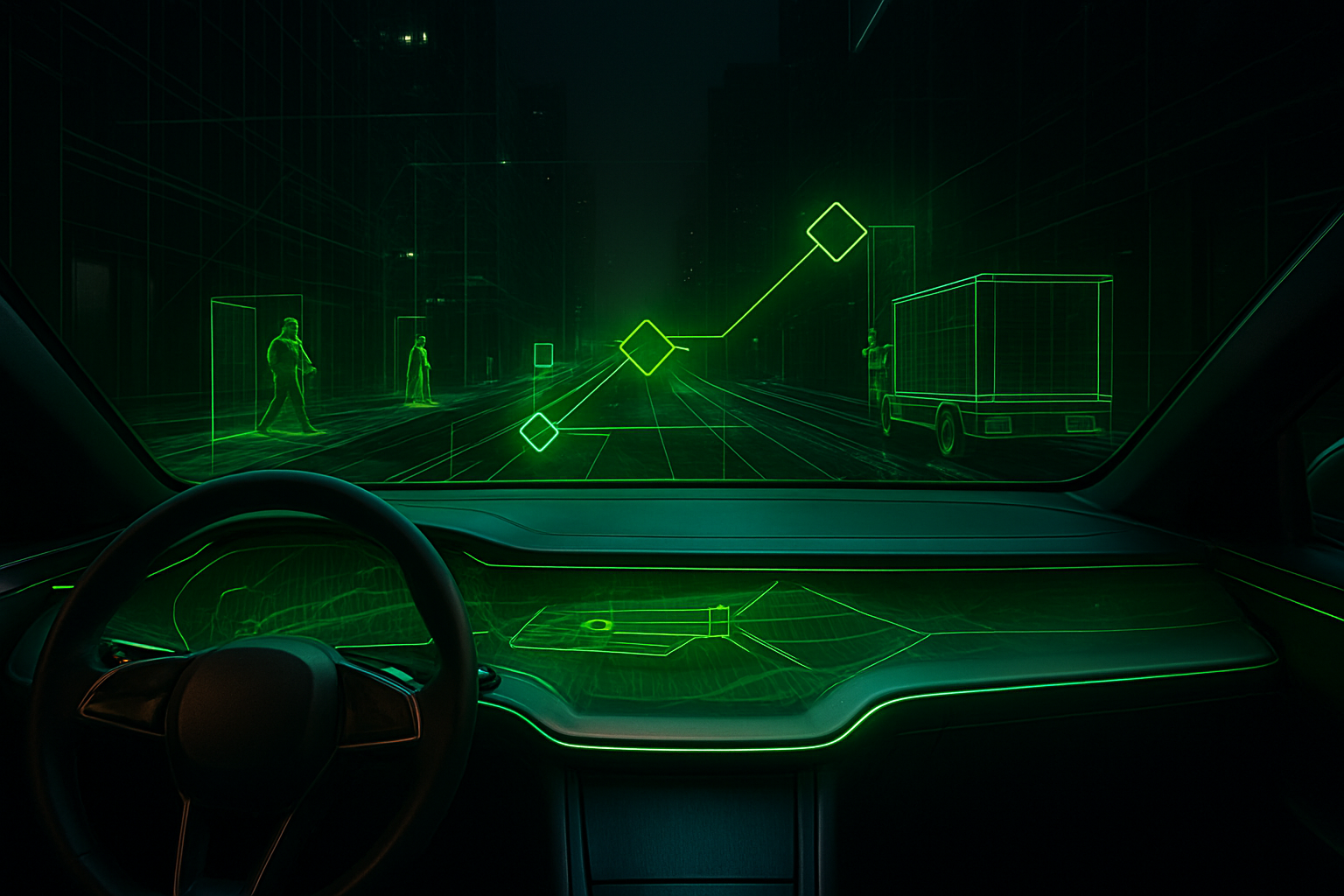
    What sets Alpamayo apart from existing technology is its implementation of "Chain of Causation" (CoC) reasoning. This is a specialized form of the "Chain-of-Thought" (CoT) prompting used in large language models like GPT-4, adapted specifically for physical environments. Instead of outputting a simple steering angle, the model generates structured reasoning traces. For instance, when encountering a double-parked delivery truck, the model might internally reason: "I see a truck blocking my lane. I observe no oncoming traffic and a dashed yellow line. I will check the left blind spot and initiate a lane change to maintain progress." This transparency is a massive leap forward from the opaque decision-making of previous end-to-end systems.

    Initial reactions from the AI research community have been overwhelmingly positive, with experts praising the model's "explainability." Dr. Sarah Chen of the Stanford AI Lab noted that Alpamayo’s ability to articulate its intent provides a much-needed bridge between neural network performance and regulatory safety requirements. Early performance benchmarks released by NVIDIA show a 35% reduction in off-road incidents and a 25% decrease in "close encounter" safety risks compared to traditional trajectory-only models. Furthermore, the model achieved a 97% rating on NVIDIA’s "Comfort Excel" metric, indicating a significantly smoother, more human-like driving experience that minimizes the jerky movements often associated with AI drivers.

    The rollout of Alpamayo is set to disrupt the competitive landscape of the automotive and AI sectors. By offering Alpamayo as part of an open-source ecosystem—including the AlpaSim simulation framework and Physical AI Open Datasets—NVIDIA is positioning itself as the "Android of Autonomy." This strategy stands in direct contrast to the closed, vertically integrated approach of companies like Tesla (NASDAQ:TSLA), which keeps its Full Self-Driving (FSD) stack entirely proprietary. NVIDIA’s move empowers a wide range of manufacturers to deploy high-level autonomy without having to build their own multi-billion-dollar AI models from scratch.

    Major automotive players are already lining up to integrate the technology. Mercedes-Benz (OTC:MBGYY) has announced that its upcoming 2026 CLA sedan will be the first production vehicle to feature Alpamayo-enhanced driving capabilities under its "MB.Drive Assist Pro" branding. Similarly, Uber (NYSE:UBER) and Lucid (NASDAQ:LCID) have confirmed they are leveraging the Alpamayo architecture to accelerate their respective robotaxi and luxury consumer vehicle roadmaps. For these companies, Alpamayo provides a strategic shortcut to Level 4 autonomy, reducing R&D costs while significantly improving the safety profile of their vehicles.

    The market positioning here is clear: NVIDIA is moving up the value chain from providing the silicon for AI to providing the intelligence itself. For startups in the autonomous delivery and robotics space, Alpamayo serves as a foundational layer that can be fine-tuned for specific tasks, such as sidewalk delivery or warehouse logistics. This democratization of high-end VLA models could lead to a surge in AI-driven physical products, potentially making specialized autonomous software companies redundant if they cannot compete with the generalized reasoning power of the Alpamayo framework.

    The broader significance of Alpamayo extends far beyond the automotive industry. It represents the successful convergence of Large Language Models (LLMs) and physical robotics, a trend that is rapidly becoming the defining frontier of the 2026 AI landscape. For years, AI was confined to digital spaces—processing text, code, and images. With Alpamayo, we are seeing the birth of "General Purpose Physical AI," where the same reasoning capabilities that allow a model to write an essay are applied to the physics of moving a multi-ton vehicle through a crowded city street.

    However, this transition is not without its concerns. The primary debate centers on the reliability of the "Chain of Causation" traces. While they provide an explanation for the AI's behavior, critics argue that there is a risk of "hallucinated reasoning," where the model’s linguistic explanation might not perfectly match the underlying neural activations that drive the physical action. NVIDIA has attempted to mitigate this through "consistency training" using Reinforcement Learning, but ensuring that a machine's "words" and "actions" are always in sync remains a critical hurdle for widespread public trust and regulatory certification.

    Comparing this to previous breakthroughs, Alpamayo is to autonomous driving what AlexNet was to computer vision or what the Transformer was to natural language processing. It provides a new architectural template that others will inevitably follow. By moving the goalpost from "driving by sight" to "driving by thinking," NVIDIA has effectively moved the industry into a new epoch of cognitive robotics. The impact will likely be felt in urban planning, insurance models, and even labor markets, as the reliability of autonomous transport reaches parity with human operators.

    Looking ahead, the near-term evolution of Alpamayo will likely focus on multi-modal expansion. Industry insiders predict that the next iteration, potentially titled Alpamayo-V2, will incorporate audio processing to allow vehicles to respond to sirens, verbal commands from traffic officers, or even the sound of a nearby bicycle bell. In the long term, the VLA architecture is expected to migrate from cars into a diverse array of form factors, including humanoid robots and industrial manipulators, creating a unified reasoning framework for all "thinking" hardware.

    The primary challenges remaining involve scaling the reasoning capabilities to even more complex, low-visibility environments—such as heavy snowstorms or unmapped rural roads—where visual data is sparse and the model must rely almost entirely on physical intuition. Experts predict that the next two years will see an "arms race" in reasoning-based data collection, as companies scramble to find the most challenging edge cases to further refine their models’ causal logic.

    What happens next will be a critical test of the "open" vs. "closed" AI models. As Alpamayo-based vehicles hit the streets in large numbers throughout 2026, the real-world data will determine if a generalized reasoning model can truly outperform a specialized, proprietary system. If NVIDIA’s approach succeeds, it could set a standard for all future human-robot interactions, where the ability to explain "why" a machine acted is just as important as the action itself.

    NVIDIA's Alpamayo model represents a pivotal shift in the trajectory of artificial intelligence. By successfully marrying Vision-Language-Action architectures with Chain-of-Thought reasoning, the company has addressed the two biggest hurdles in autonomous technology: safety in unpredictable scenarios and the need for explainable decision-making. The transition from perception-based systems to reasoning-based "Physical AI" is no longer a theoretical goal; it is a commercially available reality.

    The significance of this development in AI history cannot be overstated. It marks the moment when machines began to navigate our world not just by recognizing patterns, but by understanding the causal rules that govern it. As we look toward the final months of 2026, the focus will shift from the laboratory to the road, as the first Alpamayo-powered consumer vehicles begin to demonstrate whether silicon-based reasoning can truly match the intuition and safety of the human mind.

    For the tech industry and society at large, the message is clear: the age of the "thinking machine" has arrived, and it is behind the wheel. Watch for further announcements regarding "AlpaSim" updates and the performance of the first Mercedes-Benz CLA models hitting the market this quarter, as these will be the first true barometers of Alpamayo’s success in the wild.


    This content is intended for informational purposes only and represents analysis of current AI developments.

    TokenRing AI delivers enterprise-grade solutions for multi-agent AI workflow orchestration, AI-powered development tools, and seamless remote collaboration platforms.
    For more information, visit https://www.tokenring.ai/.
  • Beyond Reactive Driving: NVIDIA Unveils ‘Alpamayo,’ an Open-Source Reasoning Engine for Autonomous Vehicles

    Beyond Reactive Driving: NVIDIA Unveils ‘Alpamayo,’ an Open-Source Reasoning Engine for Autonomous Vehicles

    At the 2026 Consumer Electronics Show (CES), NVIDIA (NASDAQ: NVDA) dramatically shifted the landscape of autonomous transportation by unveiling "Alpamayo," a comprehensive open-source software stack designed to bring reasoning capabilities to self-driving vehicles. Named after the iconic Peruvian peak, Alpamayo marks a pivot for the chip giant from providing the underlying hardware "picks and shovels" to offering the intellectual blueprint for the future of physical AI. By open-sourcing the "brain" of the vehicle, NVIDIA aims to solve the industry’s most persistent hurdle: the "long-tail" of rare and complex edge cases that have prevented Level 4 autonomy from reaching the masses.

    The announcement is being hailed as the "ChatGPT moment for physical AI," signaling a move away from the traditional, reactive "black box" AI systems that have dominated the industry for a decade. Rather than simply mapping pixels to steering commands, Alpamayo treats driving as a semantic reasoning problem, allowing vehicles to deliberate on human intent and physical laws in real-time. This transparency is expected to accelerate the development of autonomous fleets globally, democratizing advanced self-driving technology that was previously the exclusive domain of a handful of tech giants.

    The Architecture of Reasoning: Inside Alpamayo 1

    At the heart of the stack is Alpamayo 1, a 10-billion-parameter Vision-Language-Action (VLA) model. This foundation model is bifurcated into two distinct components: the 8.2-billion-parameter "Cosmos-Reason" backbone and a 2.3-billion-parameter "Action Expert." While previous iterations of self-driving software relied on pattern matching—essentially asking "what have I seen before that looks like this?"—Alpamayo utilizes "Chain-of-Causation" logic. The Cosmos-Reason backbone processes the environment semantically, allowing the vehicle to generate internal "logic logs." For example, if a child is standing near a ball on a sidewalk, the system doesn't just see a pedestrian; it reasons that the child may chase the ball into the street, preemptively adjusting its trajectory.

    To support this reasoning engine, NVIDIA has paired the model with AlpaSim, an open-source simulation framework that utilizes neural reconstruction through Gaussian Splatting. This allows developers to take real-world camera data and instantly transform it into a high-fidelity 3D environment where they can "re-drive" scenes with different variables. If a vehicle encounters a confusing construction zone, AlpaSim can generate thousands of "what-if" scenarios based on that single event, teaching the AI how to handle novel permutations of the same problem. The stack is further bolstered by over 1,700 hours of curated "physical AI" data, gathered across 25 countries to ensure the model understands global diversity in infrastructure and human behavior.

    From a hardware perspective, Alpamayo is "extreme-codesigned" to run on the NVIDIA DRIVE Thor SoC, which utilizes the Blackwell architecture to deliver 508 TOPS of performance. For more demanding deployments, NVIDIA’s Hyperion platform can house dual-Thor configurations, providing the massive computational overhead required for real-time VLA inference. This tight integration ensures that the high-level reasoning of the teacher models can be distilled into high-performance runtime models that operate at a 10Hz frequency without latency—a critical requirement for high-speed safety.

    Disrupting the Proprietary Advantage: A Challenge to Tesla and Beyond

    The move to open-source Alpamayo is seen by market analysts as a direct challenge to the proprietary lead held by Tesla, Inc. (NASDAQ: TSLA). For years, Tesla’s Full Self-Driving (FSD) system has been considered the benchmark for end-to-end neural network driving. However, by providing a high-quality, open-source alternative, NVIDIA has effectively lowered the barrier to entry for the rest of the automotive industry. Legacy automakers who were struggling to build their own AI stacks can now adopt Alpamayo as a foundation, allowing them to skip a decade of research and development.

    This strategic shift has already garnered significant industry support. Mercedes-Benz Group AG (OTC: MBGYY) has been named a lead partner, announcing that its 2026 CLA model will be the first production vehicle to integrate Alpamayo-derived teacher models for point-to-point navigation. Similarly, Uber Technologies, Inc. (NYSE: UBER) has signaled its intent to use the Alpamayo and Hyperion reference design for its next-generation robotaxi fleet, scheduled for a 2027 rollout. Other major players, including Lucid Group, Inc. (NASDAQ: LCID), Toyota Motor Corporation (NYSE: TM), and Stellantis N.V. (NYSE: STLA), have initiated pilot programs to evaluate how the stack can be integrated into their specific vehicle architectures.

    The competitive implications are profound. If Alpamayo becomes the industry standard, the primary differentiator between car brands may shift from the "intelligence" of the driving software to the quality of the sensor suite and the luxury of the cabin experience. Furthermore, by providing "logic logs" that explain why a car made a specific maneuver, NVIDIA is addressing the regulatory and legal anxieties that have long plagued the sector. This transparency could shift the liability landscape, allowing manufacturers to defend their AI’s decisions in court using a "reasonable person" standard rather than being held to the impossible standard of a perfect machine.

    Solving the Long-Tail: Broad Significance of Physical AI

    The broader significance of Alpamayo lies in its approach to the "long-tail" problem. In autonomous driving, the first 95% of the task—staying in lanes, following traffic lights—was solved years ago. The final 5%, involving ambiguous hand signals from traffic officers, fallen debris, or extreme weather, has proven significantly harder. By treating these as reasoning problems rather than visual recognition tasks, Alpamayo brings "common sense" to the road. This shift aligns with the wider trend in the AI landscape toward multimodal models that can understand the physical laws of the world, a field often referred to as Physical AI.

    However, the transition to reasoning-based systems is not without its concerns. Critics point out that while a model can "reason" on paper, the physical validation of these decisions remains a monumental task. The complexity of integrating such a massive software stack into the existing hardware of traditional OEMs (Original Equipment Manufacturers) could take years, leading to a "deployment gap" where the software is ready but the vehicles are not. Additionally, there are questions regarding the computational cost; while DRIVE Thor is powerful, running a 10-billion-parameter model in real-time remains an expensive endeavor that may initially be limited to premium vehicle segments.

    Despite these challenges, Alpamayo represents a milestone in the evolution of AI. It moves the industry closer to a unified "foundation model" for the physical world. Just as Large Language Models (LLMs) changed how we interact with text, VLAs like Alpamayo are poised to change how machines interact with the three-dimensional space. This has implications far beyond cars, potentially serving as the operating system for humanoid robots, delivery drones, and automated industrial machinery.

    The Road Ahead: 2026 and Beyond

    In the near term, the industry will be watching the Q1 2026 rollout of the Mercedes-Benz CLA to see how Alpamayo performs in real-world consumer hands. The success of this launch will likely determine the pace at which other automakers commit to the stack. We can also expect NVIDIA to continue expanding the Alpamayo ecosystem, with rumors already circulating about a "Mini-Alpamayo" designed for lower-power edge devices and urban micro-mobility solutions like e-bikes and delivery bots.

    The long-term vision for Alpamayo involves a fully interconnected ecosystem where vehicles "talk" to each other not just through position data, but through shared reasoning. If one vehicle encounters a road hazard and "reasons" a path around it, that logic can be shared across the cloud to all other Alpamayo-enabled vehicles in the vicinity. This collective intelligence could lead to a dramatic reduction in traffic accidents and a total optimization of urban transit. The primary challenge remains the rigorous safety validation required to move from L2+ "hands-on" systems to true L4 "eyes-off" autonomy in diverse regulatory environments.

    A New Chapter for Autonomous Mobility

    NVIDIA’s Alpamayo announcement marks a definitive end to the era of the "secretive AI" in the automotive sector. By choosing an open-source path, NVIDIA is betting that a transparent, collaborative ecosystem will reach Level 4 autonomy faster than any single company working in isolation. The shift from reactive pattern matching to deliberative reasoning is the most significant technical leap the industry has seen since the introduction of deep learning for computer vision.

    As we move through 2026, the key metrics of success will be the speed of adoption by major OEMs and the reliability of the "Chain-of-Causation" logs in real-world scenarios. If Alpamayo can truly solve the "long-tail" through reasoning, the dream of a fully autonomous society may finally be within reach. For now, the tech world remains focused on the first fleet of Alpamayo-powered vehicles hitting the streets, as the industry begins to scale the steepest peak in AI development.


    This content is intended for informational purposes only and represents analysis of current AI developments.

    TokenRing AI delivers enterprise-grade solutions for multi-agent AI workflow orchestration, AI-powered development tools, and seamless remote collaboration platforms.
    For more information, visit https://www.tokenring.ai/.
  • NVIDIA’s ‘ChatGPT Moment’: Jensen Huang Unveils Alpamayo and the Dawn of Physical AI at CES 2026

    NVIDIA’s ‘ChatGPT Moment’: Jensen Huang Unveils Alpamayo and the Dawn of Physical AI at CES 2026

    At the 2026 Consumer Electronics Show (CES) in Las Vegas, NVIDIA (NASDAQ: NVDA) officially declared the arrival of the "ChatGPT moment" for physical AI and robotics. CEO Jensen Huang, in a visionary keynote, signaled a monumental pivot from generative AI focused on digital content to "embodied AI" that can perceive, reason, and interact with the physical world. This announcement marks a transition where AI moves beyond the confines of a screen and into the gears of global industry, infrastructure, and transportation.

    The centerpiece of this declaration was the launch of the Alpamayo platform, a comprehensive autonomous driving and robotics framework designed to bridge the gap between digital intelligence and physical execution. By integrating large-scale Vision-Language-Action (VLA) models with high-fidelity simulation, NVIDIA aims to standardize the "brain" of future autonomous agents. This move is not merely an incremental update; it is a fundamental restructuring of how machines learn to navigate and manipulate their environments, promising to do for robotics what large language models did for natural language processing.

    The Technical Core: Alpamayo and the Cosmos Architecture

    The Alpamayo platform represents a significant departure from previous "pattern matching" approaches to robotics. At its heart is Alpamayo 1, a 10-billion parameter Vision-Language-Action (VLA) model that utilizes chain-of-thought reasoning. Unlike traditional systems that react to sensor data using fixed algorithms, Alpamayo can process complex "edge cases"—such as a chaotic construction site or a pedestrian making an unpredictable gesture—and provide a "reasoning trace" that explains its chosen trajectory. This transparency is a breakthrough in AI safety, allowing developers to understand why a robot made a specific decision in real-time.

    Supporting Alpamayo is the new NVIDIA Cosmos architecture, which Huang described as the "operating system for the physical world." Cosmos includes three specialized models: Cosmos Predict, which generates high-fidelity video of potential future world states to help robots plan actions; Cosmos Transfer, which converts 3D spatial inputs into photorealistic simulations; and Cosmos Reason 2, a multimodal reasoning model that acts as a "physics critic." Together, these models allow robots to perform internal simulations of physics before moving an arm or accelerating a vehicle, drastically reducing the risk of real-world errors.

    To power these massive models, NVIDIA showcased the Vera Rubin hardware architecture. The successor to the Blackwell line, Rubin is a co-designed six-chip system featuring the Vera CPU and Rubin GPU, delivering a staggering 50 petaflops of inference capability. For edge applications, NVIDIA released the Jetson T4000, which brings Blackwell-level compute to compact robotic forms, enabling humanoid robots like the Isaac GR00T N1.6 to perform complex, multi-step tasks with 4x the efficiency of previous generations.

    Strategic Realignment and Market Disruption

    The launch of Alpamayo and the broader Physical AI roadmap has immediate implications for the global tech landscape. NVIDIA (NASDAQ: NVDA) is no longer positioning itself solely as a chipmaker but as the foundational platform for the "Industrial AI" era. By making Alpamayo an open-source family of models and datasets—including 1,700 hours of multi-sensor data from 2,500 cities—NVIDIA is effectively commoditizing the software layer of autonomous driving, a direct challenge to the proprietary "walled garden" approach favored by companies like Tesla (NASDAQ: TSLA).

    The announcement of a deepened partnership with Siemens (OTC: SIEGY) to create an "Industrial AI Operating System" positions NVIDIA as a critical player in the $500 billion manufacturing sector. The Siemens Electronics Factory in Erlangen, Germany, is already being utilized as the blueprint for a fully AI-driven adaptive manufacturing site. In this ecosystem, "Agentic AI" replaces rigid automation; robots powered by NVIDIA's Nemotron-3 and NIM microservices can now handle everything from PCB design to complex supply chain logistics without manual reprogramming.

    Analysts from J.P. Morgan (NYSE: JPM) and Wedbush have reacted with bullish enthusiasm, suggesting that NVIDIA’s move into physical AI could unlock a 40% upside in market valuation. Other partners, including Mercedes-Benz (OTC: MBGYY), have already committed to the Alpamayo stack, with the 2026 CLA model slated to be the first consumer vehicle to feature the full reasoning-based autonomous system. By providing the tools for Caterpillar (NYSE: CAT) and Foxconn to build autonomous agents, NVIDIA is successfully diversifying its revenue streams far beyond the data center.

    A Broader Significance: The Shift to Agentic AI

    NVIDIA’s "ChatGPT moment" signifies a profound shift in the broader AI landscape. We are moving from "Chatty AI"—systems that assist with emails and code—to "Competent AI"—systems that build cars, manage warehouses, and drive through city streets. This evolution is defined by World Foundation Models (WFMs) that possess an inherent understanding of physical laws, a milestone that many researchers believe is the final hurdle before achieving Artificial General Intelligence (AGI).

    However, this leap into physical AI brings significant concerns. The ability for machines to "reason" and act autonomously in public spaces raises questions about liability, cybersecurity, and the displacement of labor in manufacturing and logistics. Unlike a hallucination in a chatbot, a "hallucination" in a 40-ton autonomous truck or a factory arm has life-and-death consequences. NVIDIA’s focus on "reasoning traces" and the Cosmos Reason 2 critic model is a direct attempt to address these safety concerns, yet the "long tail" of unpredictable real-world scenarios remains a daunting challenge.

    The comparison to the original ChatGPT launch is apt because of the "zero-to-one" shift in capability. Before ChatGPT, LLMs were curiosities; afterward, they were infrastructure. Similarly, before Alpamayo and Cosmos, robotics was largely a field of specialized, rigid machines. NVIDIA is betting that CES 2026 will be remembered as the point where robotics became a general-purpose, software-defined technology, accessible to any industry with the compute power to run it.

    The Roadmap Ahead: 2026 and Beyond

    NVIDIA’s roadmap for the Alpamayo platform is aggressive. Following the CES announcement, the company expects to begin full-stack autonomous vehicle testing on U.S. roads in the first quarter of 2026. By late 2026, the first production vehicles using the Alpamayo stack will hit the market. Looking further ahead, NVIDIA and its partners aim to launch dedicated Robotaxi services in 2027, with the ultimate goal of achieving "peer-to-peer" fully autonomous driving—where consumer vehicles can navigate any environment without human intervention—by 2028.

    In the manufacturing sector, the rollout of the Digital Twin Composer in mid-2026 will allow factory managers to run "what-if" scenarios in a simulated environment that is perfectly synced with the physical world. This will enable factories to adapt to supply chain shocks or design changes in minutes rather than months. The challenge remains the integration of these high-level AI models with legacy industrial hardware, a hurdle that the Siemens partnership is specifically designed to overcome.

    Conclusion: A Turning Point in Industrial History

    The announcements at CES 2026 mark a definitive end to the era of AI as a digital-only phenomenon. By providing the hardware (Rubin), the software (Alpamayo), and the simulation environment (Cosmos), NVIDIA has positioned itself as the architect of the physical AI revolution. The "ChatGPT moment" for robotics is not just a marketing slogan; it is a declaration that the physical world is now as programmable as the digital one.

    The long-term impact of this development cannot be overstated. As autonomous agents become ubiquitous in manufacturing, construction, and transportation, the global economy will likely experience a productivity surge unlike anything seen since the Industrial Revolution. For now, the tech world will be watching closely as the first Alpamayo-powered vehicles and "Agentic" factories go online in the coming months, testing whether NVIDIA's reasoning-based AI can truly master the unpredictable nature of reality.


    This content is intended for informational purposes only and represents analysis of current AI developments.

    TokenRing AI delivers enterprise-grade solutions for multi-agent AI workflow orchestration, AI-powered development tools, and seamless remote collaboration platforms.
    For more information, visit https://www.tokenring.ai/.
  • NVIDIA Shatters the ‘Long Tail’ Barrier with Alpamayo: A New Era of Reasoning for Autonomous Vehicles

    NVIDIA Shatters the ‘Long Tail’ Barrier with Alpamayo: A New Era of Reasoning for Autonomous Vehicles

    In a move that industry analysts are calling the "ChatGPT moment" for physical artificial intelligence, NVIDIA (NASDAQ: NVDA) has officially unveiled Alpamayo, a groundbreaking suite of open-source reasoning models specifically engineered for the next generation of autonomous vehicles (AVs). Launched at CES 2026, the Alpamayo family represents a fundamental departure from the pattern-matching algorithms of the past, introducing a "Chain-of-Causation" framework that allows vehicles to think, reason, and explain their decisions in real-time.

    The significance of this release cannot be overstated. By open-sourcing these high-parameter models, NVIDIA is attempting to commoditize the "brain" of the self-driving car, providing a sophisticated, transparent alternative to the opaque "black box" systems that have dominated the industry for the last decade. As urban environments become more complex and the "long-tail" of rare driving scenarios continues to plague existing systems, Alpamayo offers a cognitive bridge that could finally bring Level 4 and Level 5 autonomy to the mass market.

    The Technical Leap: From Pattern Matching to Logical Inference

    At the heart of Alpamayo is a novel Vision-Language-Action (VLA) architecture. Unlike traditional autonomous stacks that use separate, siloed modules for perception, planning, and control, Alpamayo-R1—the flagship 10-billion-parameter model—integrates these functions into a single, cohesive reasoning engine. The model utilizes an 8.2-billion-parameter backbone for cognitive reasoning, paired with a 2.3-billion-parameter "Action Expert" decoder. This decoder uses a technique called Flow Matching to translate abstract logical conclusions into smooth, physically viable driving trajectories that prioritize both safety and passenger comfort.

    The most transformative feature of Alpamayo is its Chain-of-Causation reasoning. While previous end-to-end models relied on brute-force data to recognize patterns (e.g., "if pixels look like this, turn left"), Alpamayo evaluates cause-and-effect. If the model encounters a rare scenario, such as a construction worker using a flare or a sinkhole in the middle of a suburban street, it doesn't need to have seen that specific event millions of times in training. Instead, it applies general physical rules—such as "unstable surfaces are not drivable"—to deduce a safe path. Furthermore, the model generates a "reasoning trace," a text-based explanation of its logic (e.g., "Yielding to pedestrian; traffic light inactive; proceeding with caution"), providing a level of transparency previously unseen in AI-driven transport.

    This approach stands in stark contrast to the "black box" methods favored by early iterations of Tesla (NASDAQ: TSLA) Full Self-Driving (FSD). While Tesla’s approach has been highly scalable through massive data collection, it has often struggled with explainability—making it difficult for engineers to diagnose why a system made a specific error. NVIDIA’s Alpamayo solves this by making the AI’s "thought process" auditable. Initial reactions from the research community have been overwhelmingly positive, with experts noting that the integration of reasoning into the Vera Rubin platform—NVIDIA’s latest 6-chip AI architecture—allows these complex models to run with minimal latency and at a fraction of the power cost of previous generations.

    The 'Android of Autonomy': Reshaping the Competitive Landscape

    NVIDIA’s decision to release Alpamayo’s weights on platforms like Hugging Face is a strategic masterstroke designed to position the company as the horizontal infrastructure provider for the entire automotive world. By offering the model, the AlpaSim simulation framework, and over 1,700 hours of open driving data, NVIDIA is effectively building the "Android" of the autonomous vehicle industry. This allows traditional automakers to "leapfrog" years of expensive research and development, focusing instead on vehicle design and brand experience while relying on NVIDIA for the underlying intelligence.

    Early adopters are already lining up. Mercedes-Benz (OTC: MBGYY), a long-time NVIDIA partner, has announced that Alpamayo will power the reasoning engine in its upcoming 2027 CLA models. Other manufacturers, including Lucid Group (NASDAQ: LCID) and Jaguar Land Rover, are expected to integrate Alpamayo to compete with the vertically integrated software stacks of Tesla and Alphabet (NASDAQ: GOOGL) subsidiary Waymo. For these companies, Alpamayo provides a way to maintain a competitive edge without the multi-billion-dollar overhead of building a proprietary reasoning model from scratch.

    This development poses a significant challenge to the proprietary moats of specialized AV companies. If a high-quality, explainable reasoning model is available for free, the value proposition of closed-source systems may begin to erode. Furthermore, by setting a new standard for "auditable intent" through reasoning traces, NVIDIA is likely to influence future safety regulations. If regulators begin to demand that every autonomous action be accompanied by a logical explanation, companies with "black box" architectures may find themselves forced to overhaul their systems to comply with new transparency requirements.

    A Paradigm Shift in the Global AI Landscape

    The launch of Alpamayo fits into a broader trend of "Physical AI," where large-scale reasoning models are moved out of the data center and into the physical world. For years, the AI community has debated whether the logic found in Large Language Models (LLMs) could be successfully applied to robotics. Alpamayo serves as a definitive "yes," proving that the same transformer-based architectures that power chatbots can be adapted to navigate the physical complexities of a four-way stop or a crowded city center.

    However, this breakthrough is not without its concerns. The transition to open-source reasoning models raises questions about liability and safety. While NVIDIA has introduced the "Halos" safety stack—a classical, rule-based backup layer that can override the AI if it proposes a dangerous trajectory—the shift toward a model that "reasons" rather than "follows a script" creates a new set of edge cases. If a reasoning model makes a logically sound but physically incorrect decision, determining fault becomes a complex legal challenge.

    Comparatively, Alpamayo represents a milestone similar to the release of the original ResNet or the Transformer paper. It marks the moment when autonomous driving moved from a problem of perception (seeing the road) to a problem of cognition (understanding the road). This shift is expected to accelerate the deployment of autonomous trucking and delivery services, where the ability to navigate unpredictable environments like loading docks and construction zones is paramount.

    The Road Ahead: 2026 and Beyond

    In the near term, the industry will be watching the first real-world deployments of Alpamayo-based systems in pilot fleets. The primary challenge remains the "latency-to-safety" ratio—ensuring that a 10-billion-parameter model can reason fast enough to react to a child darting into the street at 45 miles per hour. NVIDIA claims the Rubin platform has solved this through specialized hardware acceleration, but real-world validation will be the ultimate test.

    Looking further ahead, the implications of Alpamayo extend far beyond the passenger car. The reasoning architecture developed for Alpamayo is expected to be adapted for humanoid robotics and industrial automation. Experts predict that by 2028, we will see "Alpamayo-derivative" models powering everything from warehouse robots to autonomous drones, all sharing a common logical framework for interacting with the human world. The goal is a unified "World Model" where AI understands physics and social norms as well as any human operator.

    A Turning Point for Mobile Intelligence

    NVIDIA’s Alpamayo represents a decisive turning point in the history of artificial intelligence. By successfully merging high-level reasoning with low-level vehicle control, NVIDIA has provided a solution to the "long-tail" problem that has stalled the autonomous vehicle industry for years. The move to an open-source model ensures that this technology will proliferate rapidly, potentially democratizing access to safe, reliable self-driving technology.

    As we move into the coming months, the focus will shift to how quickly automakers can integrate these models and how regulators will respond to the newfound transparency of "reasoning traces." One thing is certain: the era of the "black box" car is ending, and the era of the reasoning vehicle has begun. Investors and consumers alike should watch for the first Alpamayo-powered test drives, as they will likely signal the start of a new chapter in human mobility.


    This content is intended for informational purposes only and represents analysis of current AI developments.

    TokenRing AI delivers enterprise-grade solutions for multi-agent AI workflow orchestration, AI-powered development tools, and seamless remote collaboration platforms.
    For more information, visit https://www.tokenring.ai/.
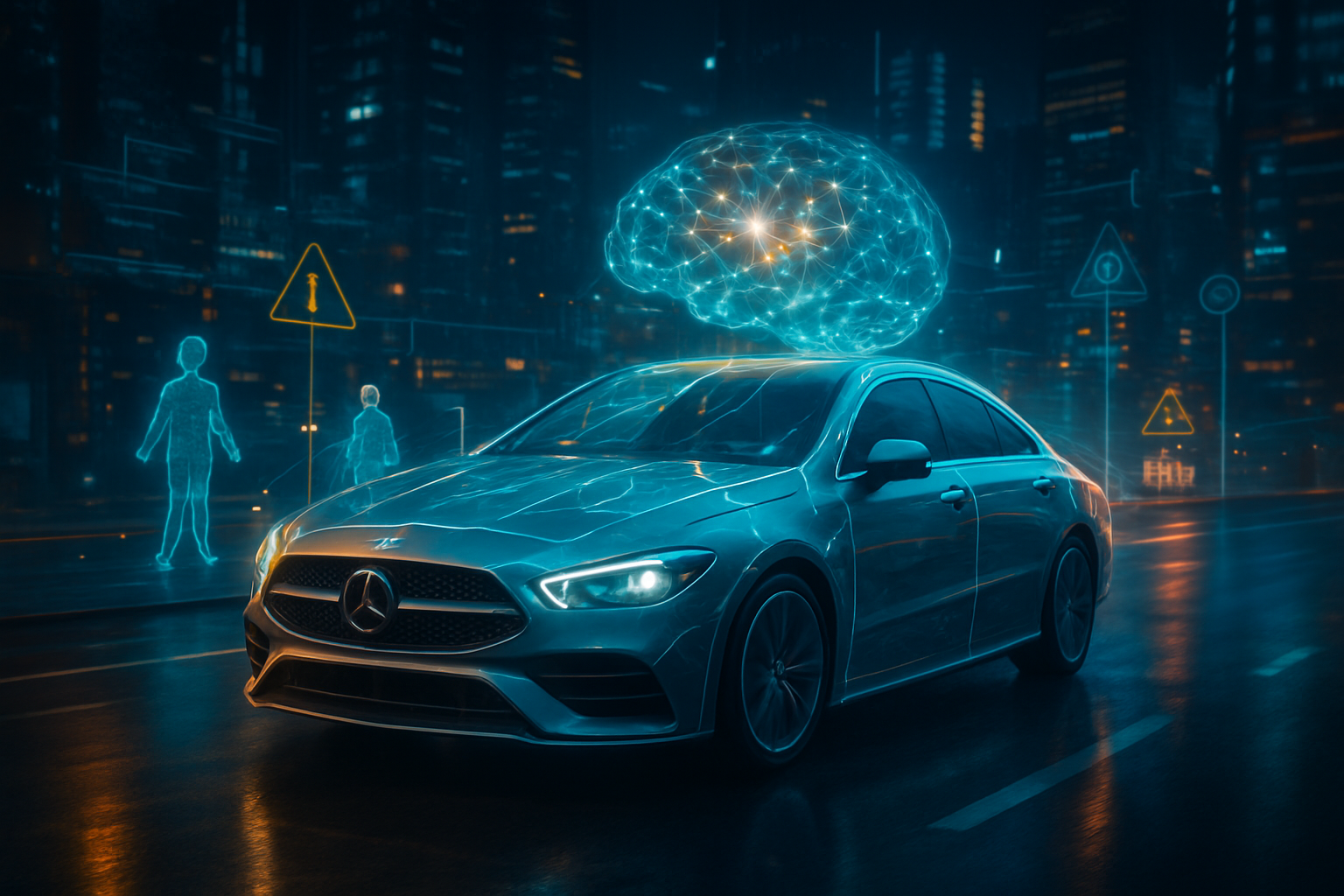
  • NVIDIA Alpamayo: Bringing Human-Like Reasoning to Self-Driving Cars

    NVIDIA Alpamayo: Bringing Human-Like Reasoning to Self-Driving Cars

    At the 2026 Consumer Electronics Show (CES) in Las Vegas, NVIDIA (NASDAQ:NVDA) CEO Jensen Huang delivered what many are calling a watershed moment for the automotive industry. The company officially unveiled Alpamayo, a revolutionary family of "Physical AI" models designed to bring human-like reasoning to self-driving cars. Moving beyond the traditional pattern-matching and rule-based systems that have defined autonomous vehicle (AV) development for a decade, Alpamayo introduces a cognitive layer capable of "thinking through" complex road scenarios in real-time. This announcement marks a fundamental shift in how machines interact with the physical world, promising to solve the stubborn "long tail" of rare driving events that have long hindered the widespread adoption of fully autonomous transport.

    The immediate significance of Alpamayo lies in its departure from the "black box" nature of previous end-to-end neural networks. By integrating chain-of-thought reasoning directly into the driving stack, NVIDIA is providing vehicles with the ability to explain their decisions, interpret social cues from pedestrians, and navigate environments they have never encountered before. The announcement was punctuated by a major commercial milestone: a deep, multi-year partnership with Mercedes-Benz Group AG (OTC:MBGYY), which will see the Alpamayo-powered NVIDIA DRIVE platform debut in the all-new Mercedes-Benz CLA starting in the first quarter of 2026.

    A New Architecture: Vision-Language-Action and Reasoning Traces

    Technically, Alpamayo 1 is built on a massive 10-billion-parameter Vision-Language-Action (VLA) architecture. Unlike current systems that translate sensor data directly into steering and braking commands, Alpamayo generates an internal "reasoning trace." This is a step-by-step logical path where the AI identifies objects, assesses their intent, and weighs potential outcomes before executing a maneuver. For example, if the car encounters a traffic officer using unconventional hand signals at a construction site, Alpamayo doesn’t just see an obstacle; it "reasons" that the human figure is directing traffic and interprets the specific gestures based on the context of the surrounding cones and vehicles.

    This approach represents a radical departure from the industry’s previous reliance on massive, brute-forced datasets of every possible driving scenario. Instead of needing to see a million examples of a sinkhole to know how to react, Alpamayo uses causal and physical reasoning to understand that a hole in the road violates the "drivable surface" rule and poses a structural risk to the vehicle. To support these computationally intensive models, NVIDIA also announced the mass production of its Rubin AI platform. The Rubin architecture, featuring the new Vera CPU, is designed to handle the massive token generation required for real-time reasoning at one-tenth the cost and power consumption of previous generations, making it viable for consumer-grade electric vehicles.

    Market Disruption and the Competitive Landscape

    The introduction of Alpamayo creates immediate pressure on other major players in the AV space, most notably Tesla (NASDAQ:TSLA) and Alphabet’s (NASDAQ:GOOGL) Waymo. While Tesla has championed an end-to-end neural network approach with its Full Self-Driving (FSD) software, NVIDIA’s Alpamayo adds a layer of explainability and symbolic reasoning that Tesla’s current architecture lacks. For Mercedes-Benz, the partnership serves as a massive strategic advantage, allowing the legacy automaker to leapfrog competitors in software-defined vehicle capabilities. By integrating Alpamayo into the MB.OS ecosystem, Mercedes is positioning itself as the gold standard for "Level 3 plus" autonomy, where the car can handle almost all driving tasks with a level of nuance previously reserved for human drivers.

    Industry experts suggest that NVIDIA’s decision to open-source the Alpamayo 1 weights on Hugging Face and release the AlpaSim simulation framework on GitHub is a strategic masterstroke. By providing the "teacher model" and the simulation tools to the broader research community, NVIDIA is effectively setting the industry standard for Physical AI. This move could disrupt smaller AV startups that have spent years building proprietary rule-based stacks, as the barrier to entry for high-level reasoning is now significantly lowered for any manufacturer using NVIDIA hardware.

    Solving the Long Tail: The Wider Significance of Physical AI

    The "long tail" of autonomous driving—the infinite variety of rare, unpredictable events like a loose animal on a highway or a confusing detour—has been the primary roadblock to Level 5 autonomy. Alpamayo’s ability to "decompose" a novel, complex scenario into familiar logical components allows it to avoid the "frozen" state that often plagues current AVs when they encounter something outside their training data. This shift from reactive to proactive AI fits into the broader 2026 trend of "General Physical AI," where models are no longer confined to digital screens but are given the "bodies" (cars, robots, drones) to interact with the world.

    However, the move toward reasoning-based AI also brings new concerns regarding safety certification. To address this, NVIDIA and Mercedes-Benz highlighted the NVIDIA Halos safety system. This dual-stack architecture runs the Alpamayo reasoning model alongside a traditional, deterministic safety fallback. If the AI’s reasoning confidence drops below a specific threshold, the Halos system immediately reverts to rigid safety guardrails. This "belt and suspenders" approach is what allowed the new CLA to achieve a EuroNCAP five-star safety rating, a crucial milestone for public and regulatory acceptance of AI-driven transport.

    The Horizon: From Luxury Sedans to Universal Autonomy

    Looking ahead, the Alpamayo family is expected to expand beyond luxury passenger vehicles. NVIDIA hinted at upcoming versions of the model optimized for long-haul trucking and last-mile delivery robots. The near-term focus will be the successful rollout of the Mercedes-Benz CLA in the United States, followed by European and Asian markets later in 2026. Experts predict that as the Alpamayo model "learns" from real-world reasoning traces, the speed of its logic will increase, eventually allowing for "super-human" reaction times that account not just for physics, but for the predicted social behavior of other drivers.

    The long-term challenge remains the "compute gap" between high-end hardware like the Rubin platform and the hardware found in budget-friendly vehicles. While NVIDIA has driven down the cost of token generation, the real-time execution of a 10-billion-parameter model still requires significant onboard power. Future developments will likely focus on "distilling" these massive reasoning models into smaller, more efficient versions that can run on lower-tier NVIDIA DRIVE chips, potentially democratizing human-like reasoning across the entire automotive market by the end of the decade.

    Conclusion: A Turning Point in the History of AI

    NVIDIA’s Alpamayo announcement at CES 2026 represents more than just an incremental update to self-driving software; it is a fundamental re-imagining of how AI perceives and acts within the physical world. By bridging the gap between the linguistic reasoning of Large Language Models and the spatial requirements of driving, NVIDIA has provided a blueprint for the next generation of autonomous systems. The partnership with Mercedes-Benz provides the necessary commercial vehicle to prove this technology on public roads, shifting the conversation from "if" cars can drive themselves to "how well" they can reason through the complexities of human life.

    As we move into the first quarter of 2026, the tech world will be watching the U.S. launch of the Alpamayo-equipped CLA with intense scrutiny. If the system delivers on its promise of handling long-tail scenarios with the grace of a human driver, it will likely be remembered as the moment the "AI winter" for autonomous vehicles finally came to an end. For now, NVIDIA has once again asserted its dominance not just as a chipmaker, but as the primary architect of the world’s most advanced physical intelligences.


    This content is intended for informational purposes only and represents analysis of current AI developments.

    TokenRing AI delivers enterprise-grade solutions for multi-agent AI workflow orchestration, AI-powered development tools, and seamless remote collaboration platforms.
    For more information, visit https://www.tokenring.ai/.