Tag: Alphabet Inc.

  • The Great Traffic War: How Google Gemini Seized 20% of the AI Market and Challenged ChatGPT’s Hegemony

    The Great Traffic War: How Google Gemini Seized 20% of the AI Market and Challenged ChatGPT’s Hegemony

    In a dramatic shift that has reshaped the artificial intelligence landscape over the past twelve months, Alphabet Inc. (NASDAQ: GOOGL) has successfully leveraged its massive Android ecosystem to break the near-monopoly once held by OpenAI. As of January 26, 2026, new industry data confirms that Google Gemini has surged to a commanding 20% share of global LLM (Large Language Model) traffic, marking the most significant competitive challenge to ChatGPT since the AI boom began. This rapid ascent from a mere 5% market share a year ago signals a pivotal moment in the "Traffic War," as the battle for AI dominance moves from standalone web interfaces to deep system-level integration.

    The implications of this surge are profound for the tech industry. While ChatGPT remains the individual market leader, its absolute dominance is waning under the pressure of Google’s "ambient AI" strategy. By making Gemini the default intelligence layer for billions of devices, Google has transformed the generative AI market from a destination-based experience into a seamless, omnipresent utility. This shift has forced a strategic "Code Red" at OpenAI and its primary backer, Microsoft Corp. (NASDAQ: MSFT), as they scramble to defend their early lead against the sheer distributional force of the Android and Chrome ecosystems.

    The Engine of Growth: Technical Integration and Gemini 3

    The technical foundation of Gemini’s 237% year-over-year growth lies in the release of Gemini 3 and its specialized mobile architecture. Unlike previous iterations that functioned primarily as conversational wrappers, Gemini 3 introduces a native multi-modal reasoning engine that operates with unprecedented speed and a context window exceeding one million tokens. This allow users to upload entire libraries of documents or hour-long video files directly through their mobile interface—a technical feat that remains a struggle for competitors constrained by smaller context windows.

    Crucially, Google has optimized this power for mobile via Gemini Nano, an on-device version of the model that handles summarization, smart replies, and sensitive data processing without ever sending information to the cloud. This hybrid approach—using on-device hardware for speed and privacy while offloading complex reasoning to the cloud—has given Gemini a distinct performance edge. Users are reporting significantly lower latency in "Gemini Live" voice interactions compared to ChatGPT’s voice mode, primarily because the system is integrated directly into the Android kernel.

    Industry experts have been particularly impressed by Gemini’s "Screen Awareness" capabilities. By integrating with the Android operating system at a system level, Gemini can "see" what a user is doing in other apps. Whether it is summarizing a long thread in a third-party messaging app or extracting data from a mobile banking statement to create a budget in Google Sheets, the model’s ability to interact across the OS has turned it into a true digital agent rather than just a chatbot. This "system-level" advantage is a moat that standalone apps like ChatGPT find nearly impossible to replicate without similar OS ownership.

    A Seismic Shift in Market Positioning

    The surge to 20% market share has fundamentally altered the competitive dynamics between AI labs and tech giants. For Alphabet Inc., this represents a successful defense of its core Search business, which many predicted would be cannibalized by AI. Instead, Google has integrated AI Overviews into its search results and linked them directly to Gemini, capturing user intent before it can migrate to OpenAI’s platforms. This strategic advantage is further bolstered by a reported $5 billion annual agreement with Apple Inc. (NASDAQ: AAPL), which utilizes Gemini models to enhance Siri’s capabilities, effectively placing Google’s AI at the heart of the world’s two largest mobile operating systems.

    For OpenAI, the loss of nearly 20 points of market share in a single year has triggered a strategic pivot. While ChatGPT remains the preferred tool for high-level reasoning, coding, and complex creative writing, it is losing the battle for "casual utility." To counter Google’s distribution advantage, OpenAI has accelerated the development of its own search product and is reportedly exploring "SearchGPT" as a direct competitor to Google Search. However, without a mobile OS to call its own, OpenAI remains dependent on browser traffic and app downloads, a disadvantage that has allowed Gemini to capture the "middle market" of users who prefer the convenience of a pre-installed assistant.

    The broader tech ecosystem is also feeling the ripple effects. Startups that once built "wrappers" around OpenAI’s API are finding it increasingly difficult to compete with Gemini’s free, integrated features. Conversely, companies within the Android and Google Workspace ecosystem are seeing increased productivity as Gemini becomes a native feature of their existing workflows. The "Traffic War" has proven that in the AI era, distribution and ecosystem integration are just as important as the underlying model’s parameters.

    Redefining the AI Landscape and User Expectations

    This milestone marks a transition from the "Discovery Phase" of AI—where users sought out ChatGPT to see what was possible—to the "Utility Phase," where AI is expected to be present wherever the user is working. Gemini’s growth reflects a broader trend toward "Ambient AI," where the technology fades into the background of the operating system. This shift mirrors the early days of the browser wars or the transition from desktop to mobile, where the platforms that controlled the entry points (the OS and the hardware) eventually dictated the market leaders.

    However, Gemini’s rapid ascent has not been without controversy. Privacy advocates and regulatory bodies in both the EU and the US have raised concerns about Google’s "bundling" of Gemini with Android. Critics argue that by making Gemini the default assistant, Google is using its dominant position in mobile to stifle competition in the nascent AI market—a move that echoes the antitrust battles of the 1990s. Furthermore, the reliance on "Screen Awareness" has sparked intense debate over data privacy, as the AI essentially has a constant view of everything the user does on their device.

    Despite these concerns, the market’s move toward 20% Gemini adoption suggests that for the average consumer, the convenience of integration outweighs the desire for a standalone provider. This mirrors the historical success of Google Maps and Gmail, which used similar ecosystem advantages to displace established incumbents. The "Traffic War" is proving that while OpenAI may have started the race, Google’s massive infrastructure and user base provide a "flywheel effect" that is incredibly difficult to slow down once it gains momentum.

    The Road Ahead: Gemini 4 and the Agentic Future

    Looking toward late 2026 and 2027, the battle is expected to evolve from simple text and voice interactions to "Agentic AI"—models that can take actions on behalf of the user. Google is already testing "Project Astra" features that allow Gemini to navigate websites, book travel, and manage complex schedules across both Android and Chrome. If Gemini can successfully transition from an assistant that "talks" to an agent that "acts," its market share could climb even higher, potentially reaching parity with ChatGPT by 2027.

    Experts predict that OpenAI will respond by doubling down on "frontier" intelligence, focusing on the o1 and GPT-5 series to maintain its status as the "smartest" model for professional and scientific use. We may see a bifurcated market: OpenAI serving as the premium "Specialist" for high-stakes tasks, while Google Gemini becomes the ubiquitous "Generalist" for the global masses. The primary challenge for Google will be maintaining model quality and safety at such a massive scale, while OpenAI must find a way to secure its own distribution channels, possibly through a dedicated "AI phone" or deeper partnerships with hardware manufacturers like Samsung Electronics Co., Ltd. (KRX: 005930).

    Conclusion: A New Era of AI Competition

    The surge of Google Gemini to a 20% market share represents more than just a successful product launch; it is a validation of the "ecosystem-first" approach to artificial intelligence. By successfully transitioning billions of Android users from the legacy Google Assistant to Gemini, Alphabet has proven that it can compete with the fast-moving agility of OpenAI through sheer scale and integration. The "Traffic War" has officially moved past the stage of novelty and into a grueling battle for daily user habits.

    As we move deeper into 2026, the industry will be watching closely to see if OpenAI can reclaim its lost momentum or if Google’s surge is the beginning of a long-term trend toward AI consolidation within the major tech platforms. The current balance of power suggests a highly competitive, multi-polar AI world where the winner is not necessarily the company with the best model, but the company that is most accessible to the user. For now, the "Traffic War" continues, with the Android ecosystem serving as Google’s most powerful weapon in the fight for the future of intelligence.


    This content is intended for informational purposes only and represents analysis of current AI developments.

    TokenRing AI delivers enterprise-grade solutions for multi-agent AI workflow orchestration, AI-powered development tools, and seamless remote collaboration platforms.
    For more information, visit https://www.tokenring.ai/.
  • Gemini 3 Flash Redefines the Developer Experience with Terminal-Native AI and Real-Time PR Automation

    Gemini 3 Flash Redefines the Developer Experience with Terminal-Native AI and Real-Time PR Automation

    Alphabet Inc. (NASDAQ: GOOGL) has officially ushered in a new era of developer productivity with the global rollout of Gemini 3 Flash. Announced in late 2025 and seeing its full release this January 2026, the model is designed to be the "frontier intelligence built for speed." By moving the AI interaction layer directly into the terminal, Google is attempting to eliminate the context-switching tax that has long plagued software engineers, enabling a workflow where code generation, testing, and pull request (PR) reviews happen in a single, unified environment.

    The immediate significance of Gemini 3 Flash lies in its radical optimization for low-latency, high-frequency tasks. Unlike its predecessors, which often felt like external assistants, Gemini 3 Flash is integrated into the core tools of the developer’s craft—the command-line interface (CLI) and the local shell. This allows for near-instantaneous responses that feel more like a local compiler than a remote cloud service, effectively turning the terminal into an intelligent partner capable of executing complex engineering tasks autonomously.

    The Power of Speed: Under the Hood of Gemini 3 Flash

    Technically, Gemini 3 Flash is a marvel of efficiency, boasting a context window of 1 million input tokens and 64k output tokens. However, its most impressive metric is its latency; first-token delivery ranges from a blistering 0.21 to 0.37 seconds, with sustained inference speeds of up to 200 tokens per second. This performance is supported by the new Gemini CLI (v0.21.1+), which introduces an interactive shell that maintains a persistent session over a developer’s entire codebase. This "terminal-native" approach allows the model to use the @ symbol to reference specific files and local context without manual copy-pasting, drastically reducing the friction of AI-assisted refactoring.

    Initial reactions from the AI research community have been overwhelmingly positive, particularly regarding the model’s performance on the SWE-bench Verified benchmark. Gemini 3 Flash achieved a 78% score, outperforming previous "Pro" models in agentic coding tasks. Experts note that Google’s decision to prioritize "agentic tool execution"—the ability for the model to natively run shell commands like ls, grep, and pytest—sets a new standard. By verifying its own code suggestions through automated testing before presenting them to the user, Gemini 3 Flash moves beyond simple text generation into the realm of verifiable engineering.

    Disrupting the Stack: Google's Strategic Play for the CLI

    This release represents a direct challenge to competitors like Microsoft (NASDAQ: MSFT), whose GitHub Copilot has dominated the AI-coding space. By focusing on the CLI and terminal-native workflows, Alphabet Inc. is targeting the "power user" segment of the developer market. The integration of Gemini 3 Flash into "Google Antigravity"—a new agentic development platform—allows for end-to-end task delegation. This strategic positioning suggests that Google is no longer content with being an "add-on" in an IDE like VS Code; instead, it wants to own the underlying workflow orchestration that connects the local environment to the cloud.

    The pricing model of Gemini 3 Flash—approximately $0.50 per 1 million input tokens—is also a aggressive move to undercut the market. By providing "frontier-level" intelligence at a fraction of the cost of GPT-4o or Claude 3.5, Google is encouraging startups and enterprise teams to embed AI deeply into their CI/CD pipelines. This disruption is already being felt by AI-first IDE startups like Cursor, which have quickly moved to integrate the Flash model to maintain their competitive edge in "vibe coding" and rapid prototyping.

    The Agentic Shift: From Coding to Orchestration

    Beyond simple code generation, Gemini 3 Flash marks a significant shift in the broader AI landscape toward "agentic workflows." The model’s ability to handle high-context PR reviews is a prime example. Through integrated GitHub Actions, Gemini 3 Flash can sift through threads of over 1,000 comments, identifying actionable feedback while filtering out trivial discussions. It can then autonomously suggest fixes or summarize the state of a PR, effectively acting as a junior engineer that never sleeps. This fits into the trend of AI transitioning from a "writer of code" to an "orchestrator of agents."

    However, this shift brings potential concerns regarding "ecosystem lock-in." As developers become more reliant on Google’s terminal-native tools and the Antigravity platform, the cost of switching to another provider increases. There are also ongoing discussions about the "black box" nature of autonomous security scans; while Gemini 3 Flash can identify SQL injections or SSRF vulnerabilities using its /security:analyze command, the industry remains cautious about the liability of AI-verified security. Nevertheless, compared to the initial release of LLM-based coding tools in 2023, Gemini 3 Flash represents a quantum leap in reliability and practical utility.

    Beyond the Terminal: The Future of Autonomous Engineering

    Looking ahead, the trajectory for Gemini 3 Flash involves even deeper integration with the hardware and operating system layers. Industry experts predict that the next iteration will include native "cross-device" agency, where the AI can manage development environments across local machines, cloud dev-boxes, and mobile testing suites simultaneously. We are also likely to see "multi-modal terminal" capabilities, where the AI can interpret UI screenshots from a headless browser and correlate them with terminal logs to fix front-end bugs in real-time.

    The primary challenge remains the "hallucination floor"—the point at which even the fastest model might still produce syntactically correct but logically flawed code. To address this, future developments are expected to focus on "formal verification" loops, where the AI doesn't just run tests, but uses mathematical proofs to guarantee code safety. As we move deeper into 2026, the focus will likely shift from how fast an AI can write code to how accurately it can manage the entire lifecycle of a complex, multi-repo software architecture.

    A New Benchmark for Development Velocity

    Gemini 3 Flash is more than just a faster LLM; it is a fundamental redesign of how humans and AI collaborate on technical tasks. By prioritizing the terminal and the CLI, Google has acknowledged that for professional developers, speed and context are the most valuable currencies. The ability to handle PR reviews and codebase edits without leaving the command line is a transformative feature that will likely become the industry standard for all major AI providers by the end of the year.

    As we watch the developer ecosystem evolve over the coming weeks, the success of Gemini 3 Flash will be measured by its adoption in enterprise CI/CD pipelines and its ability to reduce the "toil" of modern software engineering. For now, Alphabet Inc. has successfully placed itself at the center of the developer's world, proving that in the race for AI supremacy, the most powerful tool is the one that stays out of the way and gets the job done.


    This content is intended for informational purposes only and represents analysis of current AI developments.

    TokenRing AI delivers enterprise-grade solutions for multi-agent AI workflow orchestration, AI-powered development tools, and seamless remote collaboration platforms.
    For more information, visit https://www.tokenring.ai/.

  • Google’s Willow Chip Cracks the Quantum Code: A Five-Minute Computation That Would Outlast the Universe

    Google’s Willow Chip Cracks the Quantum Code: A Five-Minute Computation That Would Outlast the Universe

    As of mid-January 2026, the tech industry is still vibrating from the seismic shifts caused by Google’s latest quantum breakthrough. The unveiling of the "Willow" quantum processor has moved the goalposts for the entire field, transitioning quantum computing from a theoretical curiosity into a tangible era of "quantum utility." By demonstrating a computation that took mere minutes—which the world’s most powerful classical supercomputer would require ten septillion years to complete—Alphabet Inc. (NASDAQ: GOOGL) has effectively retired the "physics risk" that has long plagued the sector.

    While the "ten septillion years" figure captures the imagination—representing a timeframe quadrillions of times longer than the current age of the universe—the more profound achievement lies beneath the surface. Google has successfully demonstrated "below-threshold" quantum error correction. For the first time, researchers have proven that adding more physical qubits to a system can actually decrease the overall error rate, clearing the single largest hurdle toward building a functional, large-scale quantum computer.

    The Architecture of Willow: Solving the Scaling Paradox

    The Willow processor represents a monumental leap over its predecessor, the 2019 Sycamore chip. While Sycamore was a 53-qubit experiment designed to prove a point, Willow is a 105-qubit powerhouse built for stability. Featuring superconducting transmon qubits arranged in a square grid, Willow boasts an average coherence time of 100 microseconds—a fivefold improvement over previous generations. This longevity is critical for performing the complex, real-time error-correction cycles necessary for meaningful computation.

    The technical triumph of Willow is its implementation of the "surface code." In quantum mechanics, qubits are notoriously fragile; a stray photon or a slight change in temperature can cause "decoherence," destroying the data. Google’s breakthrough involves grouping these physical qubits into "logical qubits." In a stunning demonstration, as Google increased the size of its logical qubit lattice, the error rate was halved at each step. Critically, the logical qubit’s lifetime was more than twice as long as its best constituent physical qubit—a milestone the industry calls "breakeven."

    Industry experts, including quantum complexity theorist Scott Aaronson, have hailed Willow as a "real milestone," though some have noted the "verification paradox." If a task is so complex that a supercomputer takes septillions of years to solve it, verifying the answer becomes a mathematical challenge in itself. To address this, Google followed up the Willow announcement with "Quantum Echoes" in late 2025, an algorithm that achieved a 13,000x speedup over the Frontier supercomputer on a verifiable task, mapping the molecular structures of complex polymers.

    The Quantum Arms Race: Google, IBM, and the Battle for Utility

    The success of Willow has recalibrated the competitive landscape among tech giants. While Alphabet Inc. has focused on "purity" and error-correction milestones, IBM (NYSE: IBM) has taken a modular approach. IBM is currently deploying its "Kookaburra" processor, a 1,386-qubit chip that can be linked via the "System Two" architecture to create systems exceeding 4,000 qubits. IBM’s strategy targets immediate "Quantum Advantage" in finance and logistics, prioritizing scale over the absolute error-correction benchmarks set by Google.

    Meanwhile, Microsoft (NASDAQ: MSFT) has pivoted toward "Quantum-as-a-Service," partnering with Quantinuum and Atom Computing to offer 24 to 50 reliable logical qubits via the Azure Quantum cloud. Microsoft’s play is focused on the "Level 2: Resilient" phase of computing, betting on ion-trap and neutral-atom technologies that may eventually offer higher stability than superconducting systems. Not to be outdone, Amazon.com Inc. (NASDAQ: AMZN) recently introduced its "Ocelot" chip, which utilizes "cat qubits." This bosonic error-correction method reportedly reduces the hardware overhead of error correction by 90%, potentially making AWS the most cost-effective path for enterprises entering the quantum space.

    A New Engine for AI and the End of RSA?

    The implications of Willow extend far beyond laboratory benchmarks. In the broader AI landscape, quantum computing is increasingly viewed as the "nuclear engine" for the next generation of autonomous agents. At the start of 2026, researchers are using Willow-class hardware to generate ultra-high-quality training data for Large Language Models (LLMs) and to optimize the "reasoning" pathways of Agentic AI. Quantum accelerators are proving capable of handling combinatorial explosions—problems with near-infinite variables—that leave even the best NVIDIA (NASDAQ: NVDA) GPUs struggling.

    However, the shadow of Willow’s power also looms over global security. The "Harvest Now, Decrypt Later" threat—where bad actors store encrypted data today to decrypt it once quantum computers are powerful enough—has moved from a theoretical concern to a boardroom priority. As of early 2026, the migration to Post-Quantum Cryptography (PQC) is in full swing, with global banks and government agencies rushing to adopt NIST-standardized algorithms like FIPS 203. For many, Willow is the "Sputnik moment" that has turned cryptographic agility into a mandatory requirement for national security.

    The Road to One Million Qubits: 2026 and Beyond

    Google’s roadmap for the remainder of the decade is ambitious. Having retired the "physics risk" with Willow (Milestone 2), the company is now focused on "Milestone 3": the long-lived logical qubit. By late 2026 or early 2027, Google aims to unveil a successor system featuring between 500 and 1,000 physical qubits, capable of maintaining a stable state for days rather than microseconds.

    The ultimate goal, targeted for 2029, is a million-qubit machine capable of solving "Holy Grail" problems in chemistry and materials science. This includes simulating the nitrogenase enzyme to revolutionize fertilizer production—a process that currently consumes 2% of the world's energy—and designing solid-state batteries with energy densities that could triple the range of electric vehicles. The transition is now one of "systems engineering" rather than fundamental physics, as engineers work to solve the cooling and wiring bottlenecks required to manage thousands of superconducting cables at near-absolute zero temperatures.

    Conclusion: The Dawn of the Quantum Spring

    The emergence of Google’s Willow processor marks the definitive end of the "Quantum Winter" and the beginning of a vibrant "Quantum Spring." By proving that error correction actually works at scale, Google has provided the blueprint for the first truly useful computers of the 21st century. The 10-septillion-year benchmark may be the headline, but the exponential suppression of errors is the achievement that will change history.

    As we move through 2026, the focus will shift from "can we build it?" to "what will we build with it?" With major tech players like IBM, Microsoft, and Amazon all pursuing distinct architectural paths, the industry is no longer a monolith. For investors and enterprises, the next few months will be critical for identifying which quantum-classical hybrid workflows will deliver the first real-world profits. The universe may be billions of years old, but in the five minutes it took Willow to run its record-breaking calculation, the future of computing was irrevocably altered.


    This content is intended for informational purposes only and represents analysis of current AI and quantum developments.

    TokenRing AI delivers enterprise-grade solutions for multi-agent AI workflow orchestration, AI-powered development tools, and seamless remote collaboration platforms.
    For more information, visit https://www.tokenring.ai/.

  • The Atomic Revolution: How AlphaFold 3’s Open-Source Pivot Has Redefined Global Drug Discovery in 2026

    The Atomic Revolution: How AlphaFold 3’s Open-Source Pivot Has Redefined Global Drug Discovery in 2026

    The decision by Google DeepMind and its commercial sister company, Isomorphic Labs, to fully open-source AlphaFold 3 (AF3) has emerged as a watershed moment for the life sciences. As of January 2026, the global research community is reaping the rewards of a "two-tier" ecosystem where the model's source code and weights are now standard tooling for every molecular biology lab on the planet. By transitioning from a restricted web server to a fully accessible architecture in late 2024, Alphabet Inc. (NASDAQ: GOOGL) effectively democratized the ability to predict the "atomic dance" of life, turning what was once a multi-year experimental bottleneck into a computational task that takes mere minutes.

    The immediate significance of this development cannot be overstated. By providing the weights for non-commercial use, DeepMind catalyzed a global surge in "hit-to-lead" optimization for drug discovery. In the fourteen months since the open-source release, the scientific community has moved beyond simply folding proteins to modeling complex interactions between proteins, DNA, RNA, and small-molecule ligands. This shift has not only accelerated the pace of basic research but has also forced a strategic realignment across the entire biotechnology sector, as startups and incumbents alike race to integrate these predictive capabilities into their proprietary pipelines.

    Technical Specifications and Capabilities

    Technically, AlphaFold 3 represents a radical departure from its predecessor, AlphaFold 2. While the previous version relied on the "Evoformer" and a specialized structure module to predict amino acid folding, AF3 introduces a generative Diffusion Module. This architecture—similar to the technology powering state-of-the-art AI image generators—starts with a cloud of atoms and iteratively "denoises" them into a highly accurate 3D structure. This allows the model to predict not just the shape of a single protein, but how that protein docks with nearly any other biological molecule, including ions and synthetic drug compounds.

    The capability leap is substantial: AF3 provides a 50% to 100% improvement in predicting protein-ligand and protein-DNA interactions compared to earlier specialized tools. Unlike previous approaches that often required templates or "hints" about how a molecule might bind, AF3 operates as an "all-atom" model, treating the entire complex as a single physical system. Initial reactions from the AI research community in late 2024 were a mix of relief and awe; experts noted that by modeling the flexibility of "cryptic pockets" on protein surfaces, AF3 was finally making "undruggable" targets accessible to computational screening.

    Market Positioning and Strategic Advantages

    The ripple effects through the corporate world have been profound. Alphabet Inc. (NASDAQ: GOOGL) has utilized Isomorphic Labs as its spearhead, securing massive R&D alliances with giants like Eli Lilly and Company (NYSE: LLY) and Novartis AG (NYSE: NVS) totaling nearly $3 billion. While the academic community uses the open-source weights, Isomorphic maintains a competitive edge with a proprietary, high-performance version of the model integrated into a "closed-loop" discovery engine that links AI predictions directly to robotic wet labs. This has created a significant strategic advantage, positioning Alphabet not just as a search giant, but as a foundational infrastructure provider for the future of medicine.

    Other tech titans have responded with their own high-stakes maneuvers. NVIDIA Corporation (NASDAQ: NVDA) has expanded its BioNeMo platform to provide optimized inference microservices, allowing biotech firms to run AlphaFold 3 and its derivatives up to five times faster on H200 and B200 clusters. Meanwhile, the "OpenFold Consortium," backed by Amazon.com, Inc. (NASDAQ: AMZN), released "OpenFold3" in late 2025. This Apache 2.0-licensed alternative provides a pathway for commercial entities to retrain the model on their own proprietary data without the licensing restrictions of DeepMind’s official weights, sparking a fierce competition for the title of the industry’s "operating system" for biology.

    Broader AI Landscape and Societal Impacts

    In the broader AI landscape, the AlphaFold 3 release is being compared to the 2003 completion of the Human Genome Project. It signals a shift from descriptive biology—observing what exists—to engineering biology—designing what is needed. The impact is visible in the surge of "de novo" protein design, where researchers are now creating entirely new enzymes to break down plastics or capture atmospheric carbon. However, this progress has not come without friction. The initial delay in open-sourcing AF3 sparked a heated debate over "biosecurity," with some experts worrying that highly accurate modeling of protein-ligand interactions could inadvertently assist in the creation of novel toxins or pathogens.

    Despite these concerns, the prevailing sentiment is that the democratization of the tool has done more to protect global health than to endanger it. The ability to rapidly model the surface proteins of emerging viruses has shortened the lead time for vaccine design to a matter of days. Comparisons to previous milestones, like the 2012 breakthrough in deep learning for image recognition, suggest that we are currently in the "exponential growth" phase of AI-driven biology. The "licensing divide" between academic and commercial use remains a point of contention, yet it has served to create a vibrant ecosystem of open-source innovation and high-value private enterprise.

    Future Developments and Use Cases

    Looking toward the near-term future, the industry is bracing for the results of the first "fully AI-designed" molecules to enter human clinical trials. Isomorphic Labs and its partners are expected to dose the first patients with AlphaFold 3-optimized oncology candidates by the end of 2026. Beyond drug discovery, the horizon includes the development of "Digital Twins" of entire cells, where AI models like AF3 will work in tandem with generative models like ESM3 from EvolutionaryScale to simulate entire metabolic pathways. The challenge remains one of "synthesizability"—ensuring that the complex molecules AI dreams up can actually be manufactured at scale in a laboratory setting.

    Experts predict that the next major breakthrough will involve "Agentic Discovery," where AI systems like the recently released GPT-5.2 from OpenAI or Claude 4.5 from Anthropic are granted the autonomy to design experiments, run them on robotic platforms, and iterate on the results. This "lab-in-the-loop" approach would move the bottleneck from human cognition to physical throughput. As we move further into 2026, the focus is shifting from the structure of a single protein to the behavior of entire biological systems, with the ultimate goal being the "programmability" of human health.

    Summary of Key Takeaways

    In summary, the open-sourcing of AlphaFold 3 has successfully transitioned structural biology from a niche academic pursuit to a foundational pillar of the global tech economy. The key takeaways from this era are clear: the democratization of high-fidelity AI models accelerates innovation, compresses discovery timelines, and creates a massive new market for specialized AI compute and "wet-lab" services. Alphabet’s decision to share the model’s weights has solidified its legacy as a pioneer in "AI for Science," while simultaneously fueling a competitive fire that has benefited the entire industry.

    As we look back from the vantage point of early 2026, the significance of AlphaFold 3 in AI history is secure. It represents the moment AI moved past digital data and began to master the physical world’s most complex building blocks. In the coming weeks and months, the industry will be watching closely for the first data readouts from AI-led clinical trials and the inevitable arrival of "AlphaFold 4" rumors. For now, the "Atomic Revolution" is in full swing, and the map of the molecular world has never been clearer.


    This content is intended for informational purposes only and represents analysis of current AI developments.

    TokenRing AI delivers enterprise-grade solutions for multi-agent AI workflow orchestration, AI-powered development tools, and seamless remote collaboration platforms.
    For more information, visit https://www.tokenring.ai/.
  • The Silicon Laureates: How the 2024 Nobel Prizes Cemented AI as the New Language of Science

    The Silicon Laureates: How the 2024 Nobel Prizes Cemented AI as the New Language of Science

    The announcement of the 2024 Nobel Prizes in Physics and Chemistry sent a shockwave through the global scientific community, signaling a definitive end to the "AI Winter" and the beginning of what historians are already calling the "Silicon Enlightenment." By honoring the architects of artificial neural networks and the pioneers of AI-driven molecular biology, the Royal Swedish Academy of Sciences did more than just recognize individual achievement; it officially validated artificial intelligence as the most potent instrument for discovery in human history. This double-header of Nobel recognition has transformed AI from a controversial niche of computer science into the foundational infrastructure of modern physical and life sciences.

    The immediate significance of these awards cannot be overstated. For decades, the development of neural networks was often viewed by traditionalists as "mere engineering" or "statistical alchemy." The 2024 prizes effectively dismantled these perceptions. In the year and a half since the announcements, the "Nobel Halo" has accelerated a massive redirection of capital and talent, moving the focus of the tech industry from consumer-facing chatbots to "AI for Science" (AI4Science). This pivot is reshaping everything from how we develop life-saving drugs to how we engineer the materials for a carbon-neutral future, marking a historic validation for a field that was once fighting for academic legitimacy.

    From Statistical Physics to Neural Architectures: The Foundational Breakthroughs

    The 2024 Nobel Prize in Physics was awarded to John Hopfield and Geoffrey Hinton for their "foundational discoveries and inventions that enable machine learning with artificial neural networks." This choice highlighted the deep, often overlooked roots of AI in the principles of statistical physics. John Hopfield’s 1982 development of the Hopfield Network utilized the behavior of atomic spins in magnetic materials to create a form of "associative memory," where a system could reconstruct a complete pattern from a fragment. This was followed by Geoffrey Hinton’s Boltzmann Machine, which applied statistical mechanics to recognize and generate patterns, effectively teaching machines to "learn" autonomously.

    Technically, these advancements represent a departure from the "expert systems" of the 1970s, which relied on rigid, hand-coded rules. Instead, the models developed by Hopfield and Hinton allowed systems to reach a "lowest energy state" to find solutions—a concept borrowed directly from thermodynamics. Hinton’s subsequent work on the Backpropagation algorithm provided the mathematical engine that drives today’s Deep Learning, enabling multi-layered neural networks to extract complex features from vast datasets. This shift from "instruction-based" to "learning-based" computing is what made the current AI explosion possible.

    The reaction from the scientific community was a mix of awe and introspection. While some traditional physicists questioned whether AI truly fell under the umbrella of their discipline, others argued that the mathematics of entropy and energy landscapes are the very heart of physics. Hinton himself, who notably resigned from Alphabet Inc. (NASDAQ: GOOGL) in 2023 to speak freely about the risks of the technology he helped create, used his Nobel platform to voice "existential regret." He warned that while AI provides incredible benefits, the field must confront the possibility of these systems eventually outsmarting their creators.

    The Chemistry of Computation: AlphaFold and the End of the Folding Problem

    The 2024 Nobel Prize in Chemistry was awarded to David Baker, Demis Hassabis, and John Jumper for a feat that had eluded biologists for half a century: predicting the three-dimensional structure of proteins. Demis Hassabis and John Jumper, leaders at Google DeepMind, a subsidiary of Alphabet Inc., developed AlphaFold2, an AI system that solved the "protein folding problem." By early 2026, AlphaFold has predicted the structures of nearly all 200 million proteins known to science—a task that would have taken hundreds of millions of years using traditional experimental methods like X-ray crystallography.

    David Baker’s contribution complemented this by moving from prediction to creation. Using his software Rosetta and AI-driven de novo protein design, Baker demonstrated the ability to engineer entirely new proteins that do not exist in nature. These "spectacular proteins" are currently being used to design new enzymes, sensors, and even components for nano-scale machines. This development has effectively turned biology into a programmable medium, allowing scientists to "code" physical matter with the same precision we once reserved for software.

    This technical milestone has triggered a competitive arms race among tech giants. Nvidia Corporation (NASDAQ: NVDA) has positioned its BioNeMo platform as the "operating system for AI biology," providing the specialized hardware and models needed for other firms to replicate DeepMind’s success. Meanwhile, Microsoft Corporation (NASDAQ: MSFT) has pivoted its AI research toward "The Fifth Paradigm" of science, focusing on materials and climate discovery through its MatterGen model. The Nobel recognition of AlphaFold has forced every major AI lab to prove its worth not just in generating text, but in solving "hard science" problems that have tangible physical outcomes.

    A Paradigm Shift in the Global AI Landscape

    The broader significance of the 2024 Nobel Prizes lies in their timing during the transition from "General AI" to "Specialized Physical AI." Prior milestones, such as the victory of AlphaGo or the release of ChatGPT, focused on games and human language. The Nobels, however, rewarded AI's ability to interface with the laws of nature. This has led to a surge in "AI-native" biotech and material science startups. For instance, Isomorphic Labs, another Alphabet subsidiary, recently secured over $2.9 billion in deals with pharmaceutical leaders like Eli Lilly and Company (NYSE: LLY) and Novartis AG (NYSE: NVS), leveraging Nobel-winning architectures to find new drug candidates.

    However, the rapid "AI-fication" of science is not without concerns. The "black box" nature of many deep learning models remains a hurdle for scientific reproducibility. While a model like AlphaFold 3 (released in late 2024) can predict how a drug molecule interacts with a protein, it cannot always explain why it works. This has led to a push for "AI for Science 2.0," where models are being redesigned to incorporate known physical laws (Physics-Informed Neural Networks) to ensure that their discoveries are grounded in reality rather than statistical hallucinations.

    Furthermore, the concentration of these breakthroughs within a few "Big Tech" labs—most notably Google DeepMind—has raised questions about the democratization of science. If the most powerful tools for discovering new materials or medicines are proprietary and require billion-dollar compute clusters, the gap between "science-rich" and "science-poor" nations could widen significantly. The 2024 Nobels marked the moment when the "ivory tower" of academia officially merged with the data centers of Silicon Valley.

    The Horizon: Self-Driving Labs and Personalized Medicine

    Looking toward the remainder of 2026 and beyond, the trajectory set by the 2024 Nobel winners points toward "Self-Driving Labs" (SDLs). These are autonomous research facilities where AI models like AlphaFold and MatterGen design experiments that are then executed by robotic platforms without human intervention. The results are fed back into the AI, creating a "closed-loop" discovery cycle. Experts predict that this will reduce the time to discover new materials—such as high-efficiency solid-state batteries for EVs—from decades to months.

    In the realm of medicine, we are seeing the rise of "Programmable Biology." Building on David Baker’s Nobel-winning work, startups like EvolutionaryScale are using generative models to simulate millions of years of evolution in weeks to create custom antibodies. The goal for the next five years is personalized medicine at the protein level: designing a unique therapeutic molecule tailored to an individual’s specific genetic mutations. The challenges remain immense, particularly in clinical validation and safety, but the computational barriers that once seemed insurmountable have been cleared.

    Conclusion: A Turning Point in Human History

    The 2024 Nobel Prizes will be remembered as the moment the scientific establishment admitted that the human mind can no longer keep pace with the complexity of modern data without digital assistance. The recognition of Hopfield, Hinton, Hassabis, Jumper, and Baker was a formal acknowledgement that the scientific method itself is evolving. We have moved from the era of "observe and hypothesize" to an era of "model and generate."

    The key takeaway for the industry is that the true value of AI lies not in its ability to mimic human conversation, but in its ability to reveal the hidden patterns of the universe. As we move deeper into 2026, the industry should watch for the first "AI-designed" drugs to enter late-stage clinical trials and the rollout of new battery chemistries that were first "dreamed" by the descendants of the 2024 Nobel-winning models. The silicon laureates have opened a door that can never be closed, and the world on the other side is one where the limitations of human intellect are no longer the limitations of human progress.


    This content is intended for informational purposes only and represents analysis of current AI developments.

    TokenRing AI delivers enterprise-grade solutions for multi-agent AI workflow orchestration, AI-powered development tools, and seamless remote collaboration platforms.
    For more information, visit https://www.tokenring.ai/.
  • The Reasoning Revolution: Google Gemini 2.0 and the Rise of ‘Flash Thinking’

    The Reasoning Revolution: Google Gemini 2.0 and the Rise of ‘Flash Thinking’

    The reasoning revolution has arrived. In a definitive pivot toward the era of autonomous agents, Google has fundamentally reshaped the competitive landscape with the full rollout of its Gemini 2.0 model family. Headlining this release is the innovative "Flash Thinking" mode, a direct answer to the industry’s shift toward "reasoning models" that prioritize deliberation over instant response. By integrating advanced test-time compute directly into its most efficient architectures, Google is signaling that the next phase of the AI war will be won not just by the fastest models, but by those that can most effectively "stop and think" through complex, multimodal problems.

    The significance of this launch, finalized in early 2025 and now a cornerstone of Google’s 2026 strategy, cannot be overstated. For years, critics argued that Google was playing catch-up to OpenAI’s reasoning breakthroughs. With Gemini 2.0, Alphabet Inc. (NASDAQ: GOOGL) has not only closed the gap but has introduced a level of transparency and speed that its competitors are now scrambling to match. This development marks a transition from simple chatbots to "agentic" systems—AI capable of planning, researching, and executing multi-step tasks with minimal human intervention.

    The Technical Core: Flash Thinking and Native Multimodality

    Gemini 2.0 represents a holistic redesign of Google’s frontier models, moving away from a "text-first" approach to a "native multimodality" architecture. The "Flash Thinking" mode is the centerpiece of this evolution, utilizing a specialized reasoning process where the model critiques its own logic before outputting a final answer. Technically, this is achieved through "test-time compute"—the AI spends additional processing cycles during the inference phase to explore multiple paths to a solution. Unlike its predecessor, Gemini 1.5, which focused primarily on context window expansion, Gemini 2.0 Flash Thinking is optimized for high-order logic, scientific problem solving, and complex code generation.

    What distinguishes Flash Thinking from existing technologies, such as OpenAI's o1 series, is its commitment to transparency. While other reasoning models often hide their internal logic in "hidden thoughts," Google’s Flash Thinking provides a visible "Chain-of-Thought" box. This allows users to see the model’s step-by-step reasoning, making it easier to debug logic errors and verify the accuracy of the output. Furthermore, the model retains Google’s industry-leading 1-million-token context window, allowing it to apply deep reasoning across massive datasets—such as analyzing a thousand-page legal document or an hour of video footage—a feat that remains a challenge for competitors with smaller context limits.

    The initial reaction from the AI research community has been one of impressed caution. While early benchmarks showed OpenAI (NASDAQ: MSFT partner) still holding a slight edge in pure mathematical reasoning (AIME scores), Gemini 2.0 Flash Thinking has been lauded for its "real-world utility." Industry experts highlight its ability to use native Google tools—like Search, Maps, and YouTube—while in "thinking mode" as a game-changer for agentic workflows. "Google has traded raw benchmark perfection for a model that is screamingly fast and deeply integrated into the tools people actually use," noted one lead researcher at a top AI lab.

    Competitive Implications and Market Shifts

    The rollout of Gemini 2.0 has sent ripples through the corporate world, significantly bolstering the market position of Alphabet Inc. The company’s stock performance in 2025 reflected this renewed confidence, with shares surging as investors realized that Google’s vast data ecosystem (Gmail, Drive, Search) provided a unique "moat" for its reasoning models. By early 2026, Alphabet’s market capitalization surpassed the $4 trillion mark, fueled in part by a landmark deal to power a revamped Siri for Apple (NASDAQ: AAPL), effectively putting Gemini at the heart of the world’s most popular hardware.

    This development poses a direct threat to OpenAI and Anthropic. While OpenAI’s GPT-5 and o-series models remain top-tier in logic, Google’s ability to offer "Flash Thinking" at a lower price point and higher speed has forced a price war in the API market. Startups that once relied exclusively on GPT-4 are increasingly diversifying their "model stacks" to include Gemini 2.0 for its efficiency and multimodal capabilities. Furthermore, Nvidia (NASDAQ: NVDA) continues to benefit from this arms race, though Google’s increasing reliance on its own TPU v7 (Ironwood) chips for inference suggests a future where Google may be less dependent on external hardware providers than its rivals.

    The disruption extends to the software-as-a-service (SaaS) sector. With Gemini 2.0’s "Deep Research" capabilities, tasks that previously required specialized AI agents or human researchers—such as comprehensive market analysis or technical due diligence—can now be largely automated within the Google Workspace ecosystem. This puts immense pressure on standalone AI startups that offer niche research tools, as they now must compete with a highly capable, "thinking" model that is already integrated into the user’s primary productivity suite.

    The Broader AI Landscape: The Shift to System 2

    Looking at the broader AI landscape, Gemini 2.0 Flash Thinking is a milestone in the "Reasoning Era" of artificial intelligence. For the first two years after the launch of ChatGPT, the industry was focused on "System 1" thinking—fast, intuitive, but often prone to hallucinations. We are now firmly in the "System 2" era, where models are designed for slow, deliberate, and logical thought. This shift is critical for the deployment of AI in high-stakes fields like medicine, engineering, and law, where a "quick guess" is unacceptable.

    However, the rise of these "thinking" models brings new concerns. The increased compute power required for test-time reasoning has reignited debates over the environmental impact of AI and the sustainability of the current scaling laws. There are also growing fears regarding "agentic safety"; as models like Gemini 2.0 become more capable of using tools and making decisions autonomously, the potential for unintended consequences increases. Comparisons are already being made to the 2023 "sparks of AGI" era, but with the added complexity that 2026-era models can actually execute the plans they conceive.

    Despite these concerns, the move toward visible Chain-of-Thought is a significant step forward for AI safety and alignment. By forcing the model to "show its work," developers have a better window into the AI's "worldview," making it easier to identify and mitigate biases or flawed logic before they result in real-world harm. This transparency is a stark departure from the "black box" nature of earlier Large Language Models (LLMs) and may set a new standard for regulatory compliance in the EU and the United States.

    Future Horizons: From Digital Research to Physical Action

    As we look toward the remainder of 2026, the evolution of Gemini 2.0 is expected to lead to the first truly seamless "AI Coworkers." The near-term focus is on "Multi-Agent Orchestration," where a Gemini 2.0 model might act as a manager, delegating sub-tasks to smaller, specialized "Flash-Lite" models to solve massive enterprise problems. We are already seeing the first pilots of these systems in global logistics and drug discovery, where the "thinking" capabilities are used to navigate trillions of possible data combinations.

    The next major hurdle is "Physical AI." Experts predict that the reasoning capabilities found in Flash Thinking will soon be integrated into humanoid robotics and autonomous vehicles. If a model can "think" through a complex visual scene in a digital map, it can theoretically do the same for a robot navigating a cluttered warehouse. Challenges remain, particularly in reducing the latency of these reasoning steps to allow for real-time physical interaction, but the trajectory is clear: reasoning is moving from the screen to the physical world.

    Furthermore, rumors are already swirling about Gemini 3.0, which is expected to focus on "Recursive Self-Improvement"—a stage where the AI uses its reasoning capabilities to help design its own next-generation architecture. While this remains in the realm of speculation, the pace of progress since the Gemini 2.0 announcement suggests that the boundary between human-level reasoning and artificial intelligence is thinning faster than even the most optimistic forecasts predicted a year ago.

    Conclusion: A New Standard for Intelligence

    Google’s Gemini 2.0 and its Flash Thinking mode represent a triumphant comeback for a company that many feared had lost its lead in the AI race. By prioritizing native multimodality, massive context windows, and transparent reasoning, Google has created a versatile platform that appeals to both casual users and high-end enterprise developers. The key takeaway from this development is that the "AI war" has shifted from a battle over who has the most data to a battle over who can use compute most intelligently at the moment of interaction.

    In the history of AI, the release of Gemini 2.0 will likely be remembered as the moment when "Thinking" became a standard feature rather than an experimental luxury. It has forced the entire industry to move toward more reliable, logical, and integrated systems. As we move further into 2026, watch for the deepening of the "Agentic Era," where these reasoning models begin to handle our calendars, our research, and our professional workflows with increasing autonomy.

    The coming months will be defined by how well OpenAI and Anthropic respond to Google's distribution advantage and how effectively Alphabet can monetize these breakthroughs without alienating a public still wary of AI’s rapid expansion. For now, the "Flash Thinking" era is here, and it is fundamentally changing how we define "intelligence" in the digital age.


    This content is intended for informational purposes only and represents analysis of current AI developments.

    TokenRing AI delivers enterprise-grade solutions for multi-agent AI workflow orchestration, AI-powered development tools, and seamless remote collaboration platforms.
    For more information, visit https://www.tokenring.ai/.
  • The Robot That Thinks: Google DeepMind and Boston Dynamics Unveil Gemini 3-Powered Atlas

    The Robot That Thinks: Google DeepMind and Boston Dynamics Unveil Gemini 3-Powered Atlas

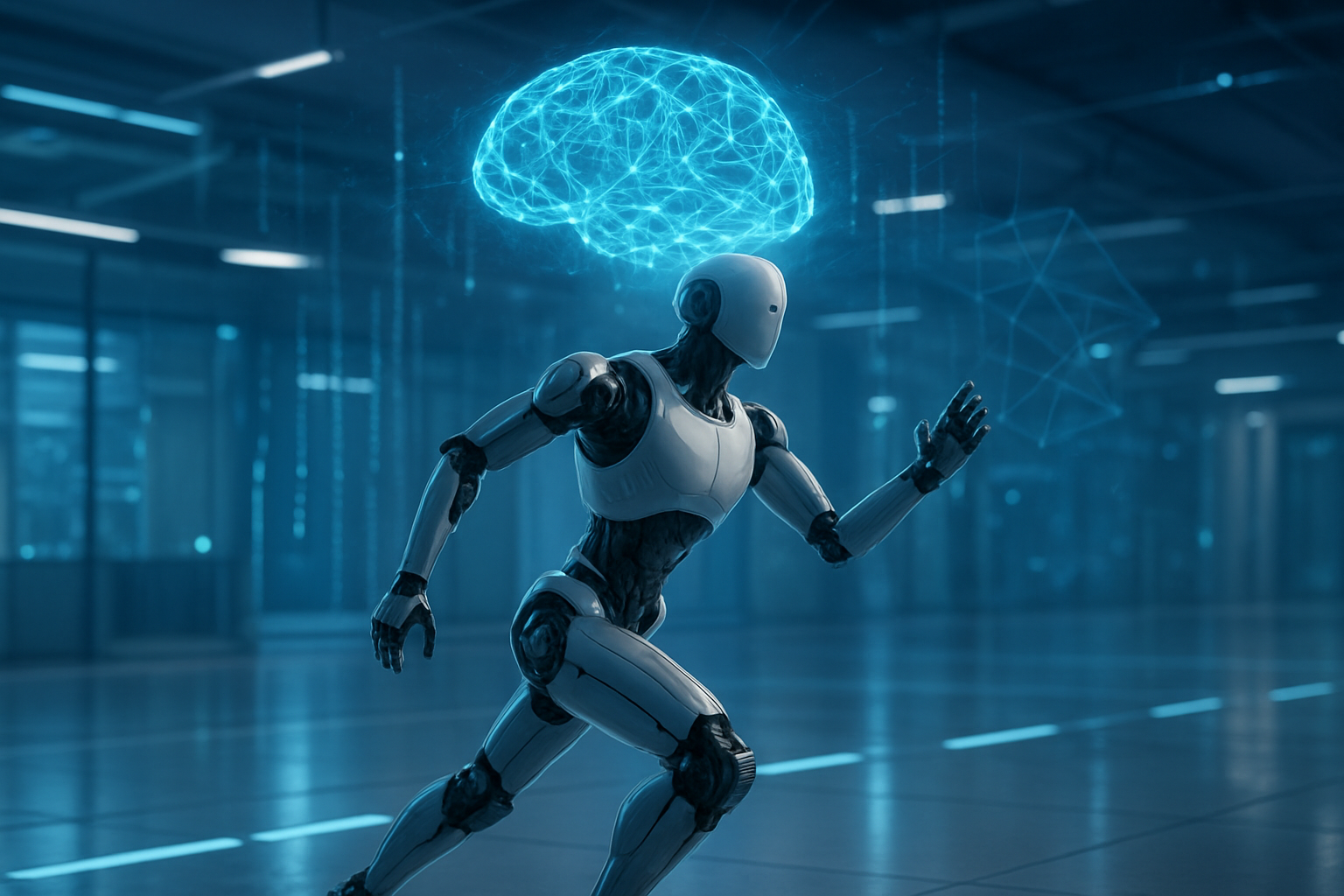
    In a move that marks a definitive turning point for the field of embodied artificial intelligence, Google DeepMind and Boston Dynamics have officially announced the full-scale integration of the Gemini 3 foundation model into the all-electric Atlas humanoid robot. Unveiled this week at CES 2026, the collaboration represents a fusion of the world’s most advanced "brain"—a multimodal, trillion-parameter reasoning engine—with the world’s most capable "body." This integration effectively ends the era of pre-programmed robotic routines, replacing them with a system capable of understanding complex verbal instructions and navigating unpredictable human environments in real-time.

    The significance of this announcement cannot be overstated. For decades, humanoid robots were limited by their inability to reason about the physical world; they could perform backflips in controlled settings but struggled to identify a specific tool in a cluttered workshop. By embedding Gemini 3 directly into the Atlas hardware, Alphabet Inc. (NASDAQ: GOOGL) and Boston Dynamics, a subsidiary of Hyundai Motor Company (OTCMKTS: HYMTF), have created a machine that doesn't just move—it perceives, plans, and adapts. This "brain-body" synthesis allows the 2026 Atlas to function as an autonomous agent capable of high-level cognitive tasks, potentially disrupting industries ranging from automotive manufacturing to logistics and disaster response.

    Embodied Reasoning: The Technical Architecture of Gemini-Atlas

    At the heart of this breakthrough is the Gemini 3 architecture, released by Google DeepMind in late 2025. Unlike its predecessors, Gemini 3 utilizes a Sparse Mixture-of-Experts (MoE) design optimized for robotics, featuring a massive 1-million-token context window. This allows the robot to "remember" the entire layout of a factory floor or a multi-step assembly process without losing focus. The model’s "Deep Think Mode" provides a reasoning layer where the robot can pause for milliseconds to simulate various physical outcomes before committing to a movement. This is powered by the onboard NVIDIA Corporation (NASDAQ: NVDA) Jetson Thor module, which provides over 2,000 TFLOPS of AI performance, allowing the robot to process real-time video, audio, and tactile sensor data simultaneously.

    The physical hardware of the electric Atlas has been equally transformed. The 2026 production model features 56 active joints, many of which offer 360-degree rotation, exceeding the range of motion of any human. To bridge the gap between high-level AI reasoning and low-level motor control, DeepMind developed a proprietary "Action Decoder" running at 50Hz. This acts as a digital cerebellum, translating Gemini 3’s abstract goals—such as "pick up the fragile glass"—into precise torque commands for Atlas’s electric actuators. This architecture solves the latency issues that plagued previous humanoid attempts, ensuring that the robot can react to a falling object or a human walking into its path within 20 milliseconds.

    Initial reactions from the AI research community have been overwhelmingly positive. Dr. Aris Xanthos, a leading robotics researcher, noted that the ability of Atlas to understand open-ended verbal commands like "Clean up the spill and find a way to warn others" is a "GPT-3 moment for robotics." Unlike previous systems that required thousands of hours of reinforcement learning for a single task, the Gemini-Atlas system can learn new industrial workflows with as few as 50 human demonstrations. This "few-shot" learning capability is expected to drastically reduce the time and cost of deploying humanoid fleets in dynamic environments.

    A New Power Dynamic in the AI and Robotics Industry

    The collaboration places Alphabet Inc. and Hyundai Motor Company in a dominant position within the burgeoning humanoid market, creating a formidable challenge for competitors. Tesla, Inc. (NASDAQ: TSLA), which has been aggressively developing its Optimus robot, now faces a rival that possesses a significantly more mature software stack. While Optimus has made strides in mechanical design, the integration of Gemini 3 gives Atlas a superior "world model" and linguistic understanding that Tesla’s current FSD-based (Full Self-Driving) architecture may struggle to match in the near term.

    Furthermore, this partnership signals a shift in how AI companies approach the market. Rather than competing solely on chatbots or digital assistants, tech giants are now racing to give their AI a physical presence. Startups like Figure AI and Agility Robotics, while innovative, may find it difficult to compete with the combined R&D budgets and data moats of Google and Boston Dynamics. The strategic advantage here lies in the data loop: every hour Atlas spends on a factory floor provides multimodal data that further trains Gemini 3, creating a self-reinforcing cycle of improvement that is difficult for smaller players to replicate.

    The market positioning is clear: Hyundai intends to use the Gemini-powered Atlas to fully automate its "Metaplants," starting with the RMAC facility in early 2026. This move is expected to drive down manufacturing costs and set a new standard for industrial efficiency. For Alphabet, the integration serves as a premier showcase for Gemini 3’s versatility, proving that their foundation models are not just for search engines and coding, but are the essential operating systems for the physical world.

    The Societal Impact of the "Robotic Awakening"

    The broader significance of the Gemini-Atlas integration lies in its potential to redefine the human-robot relationship. We are moving away from "automation," where robots perform repetitive tasks in cages, toward "collaboration," where robots work alongside humans as intelligent peers. The ability of Atlas to navigate complex environments in real-time means it can be deployed in "fenceless" environments—hospitals, construction sites, and eventually, retail spaces. This transition marks the arrival of the "General Purpose Robot," a concept that has been the holy grail of science fiction for nearly a century.

    However, this breakthrough also brings significant concerns to the forefront. The prospect of robots capable of understanding and executing complex verbal commands raises questions about safety and job displacement. While the 2026 Atlas includes "Safety-First" protocols—hardcoded overrides that prevent the robot from exerting force near human vitals—the ethical implications of autonomous decision-making in high-stakes environments remain a topic of intense debate. Critics argue that the rapid deployment of such capable machines could outpace our ability to regulate them, particularly regarding data privacy and the security of the "brain-body" link.

    Comparatively, this milestone is being viewed as the physical manifestation of the LLM revolution. Just as ChatGPT transformed how we interact with information, the Gemini-Atlas integration is transforming how we interact with the physical world. It represents a shift from "Narrow AI" to "Embodied General AI," where the intelligence is no longer trapped behind a screen but is capable of manipulating the environment to achieve goals. This is the first time a foundation model has been successfully used to control a high-degree-of-freedom humanoid in a non-deterministic, real-world setting.

    The Road Ahead: From Factories to Front Doors

    Looking toward the near future, the next 18 to 24 months will likely see the first large-scale deployments of Gemini-powered Atlas units across Hyundai’s global manufacturing network. Experts predict that by late 2027, the technology will have matured enough to move beyond the factory floor into more specialized sectors such as hazardous waste removal and search-and-rescue. The "Deep Think" capabilities of Gemini 3 will be particularly useful in disaster zones where the robot must navigate rubble and make split-second decisions without constant human oversight.

    Long-term, the goal remains a consumer-grade humanoid robot. While the current 2026 Atlas is priced for industrial use—estimated at $150,000 per unit—advancements in mass production and the continued optimization of the Gemini architecture could see prices drop significantly by the end of the decade. Challenges remain, particularly regarding battery life; although the 2026 model features a 4-hour swappable battery, achieving a full day of autonomous operation without intervention is still a hurdle. Furthermore, the "Action Decoder" must be refined to handle even more delicate tasks, such as elder care or food preparation, which require a level of tactile sensitivity that is still in the early stages of development.

    A Landmark Moment in the History of AI

    The integration of Gemini 3 into the Boston Dynamics Atlas is more than just a technical achievement; it is a historical landmark. It represents the successful marriage of two previously distinct fields: large-scale language modeling and high-performance robotics. By giving Atlas a "brain" capable of reasoning, Google DeepMind and Boston Dynamics have fundamentally changed the trajectory of human technology. The key takeaway from this week’s announcement is that the barrier between digital intelligence and physical action has finally been breached.

    As we move through 2026, the tech industry will be watching closely to see how the Gemini-Atlas system performs in real-world industrial settings. The success of this collaboration will likely trigger a wave of similar partnerships, as other AI labs seek to find "bodies" for their models. For now, the world has its first true glimpse of a future where robots are not just tools, but intelligent partners capable of understanding our words and navigating our world.


    This content is intended for informational purposes only and represents analysis of current AI developments.

    TokenRing AI delivers enterprise-grade solutions for multi-agent AI workflow orchestration, AI-powered development tools, and seamless remote collaboration platforms.
    For more information, visit https://www.tokenring.ai/.
  • Gemini 3 Flash: Reclaiming the Search Throne with Multimodal Speed

    Gemini 3 Flash: Reclaiming the Search Throne with Multimodal Speed

    In a move that marks the definitive end of the "ten blue links" era, Alphabet Inc. (NASDAQ: GOOGL) has officially completed the global rollout of Gemini 3 Flash as the default engine for Google Search’s "AI Mode." Launched in late December 2025 and reaching full scale as of January 5, 2026, the new model represents a fundamental pivot for the world’s most dominant gateway to information. By prioritizing "multimodal speed" and complex reasoning, Google is attempting to silence critics who argued the company had grown too slow to compete with the rapid-fire releases from Silicon Valley’s more agile AI labs.

    The immediate significance of Gemini 3 Flash lies in its unique balance of efficiency and "frontier-class" intelligence. Unlike its predecessors, which often forced users to choose between the speed of a lightweight model and the depth of a massive one, Gemini 3 Flash utilizes a new "Dynamic Thinking" architecture to deliver near-instantaneous synthesis of live web data. This transition marks the most aggressive change to Google’s core product since its inception, effectively turning the search engine into a real-time reasoning agent capable of answering PhD-level queries in the blink of an eye.

    Technical Coverage: The "Dynamic Thinking" Architecture

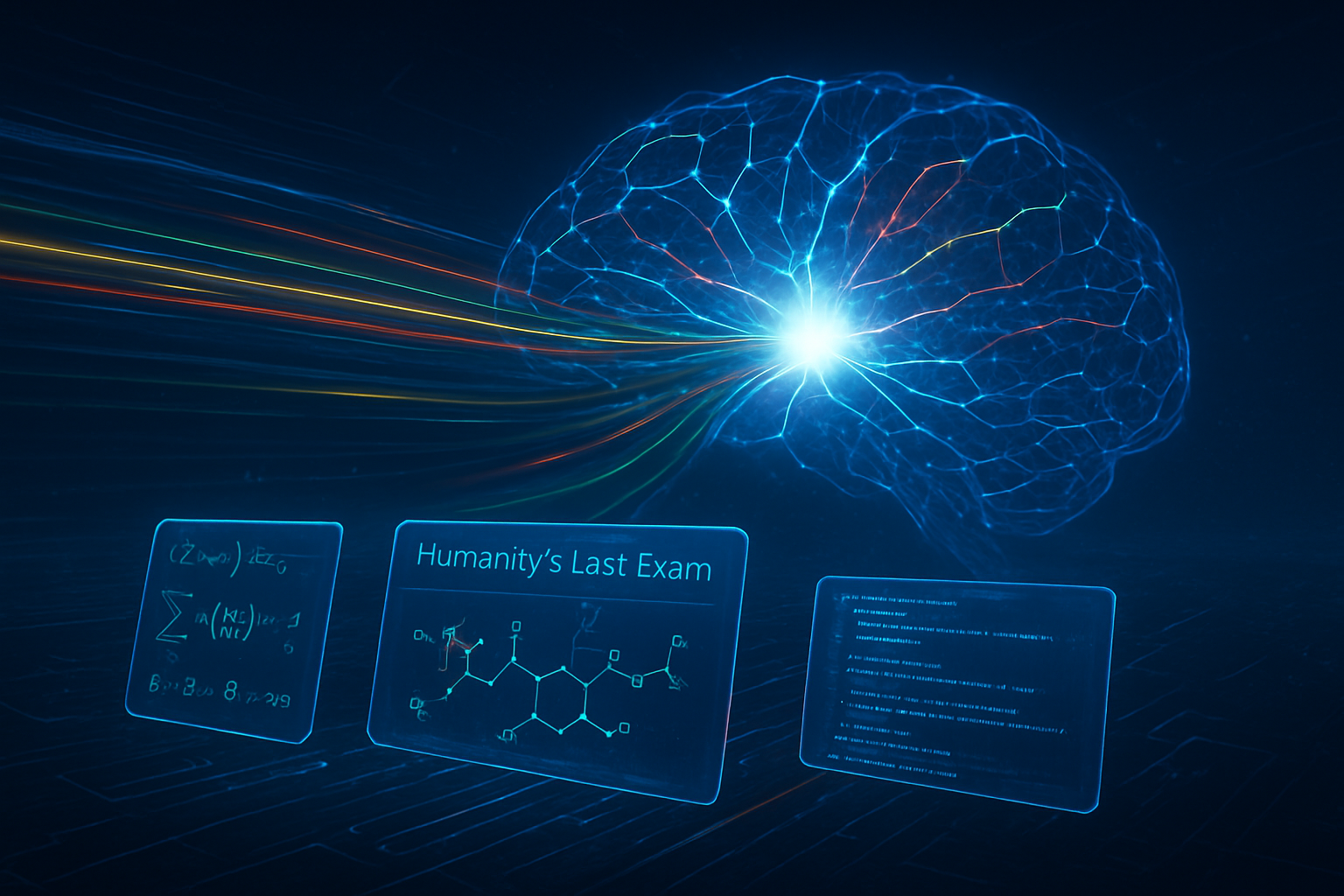
    Technically, Gemini 3 Flash is a departure from the traditional transformer-based scaling laws that defined the previous year of AI development. The model’s "Dynamic Thinking" architecture allows it to modulate its internal reasoning cycles based on the complexity of the prompt. For a simple weather query, the model responds with minimal latency; however, when faced with complex logic, it generates hidden "thinking tokens" to verify its own reasoning before outputting a final answer. This capability has allowed Gemini 3 Flash to achieve a staggering 33.7% on the "Humanity’s Last Exam" (HLE) benchmark without tools, and 43.5% when integrated with its search and code execution modules.

    This performance on HLE—a benchmark designed by the Center for AI Safety (CAIS) to be virtually unsolvable by models that rely on simple pattern matching—places Gemini 3 Flash in direct competition with much larger "frontier" models like GPT-5.2. While previous iterations of the Flash series struggled to break the 11% barrier on HLE, the version 3 release triples that capability. Furthermore, the model boasts a 1-million-token context window and can process up to 8.4 hours of audio or massive video files in a single prompt, allowing for multimodal search queries that were technically impossible just twelve months ago.

    Initial reactions from the AI research community have been largely positive, particularly regarding the model’s efficiency. Experts note that Gemini 3 Flash is roughly 3x faster than the Gemini 2.5 Pro while utilizing 30% fewer tokens for everyday tasks. This efficiency is not just a technical win but a financial one, as Google has priced the model at a competitive $0.50 per 1 million input tokens for developers. However, some researchers caution that the "synthesis" approach still faces hurdles with "low-data-density" queries, where the model occasionally hallucinates connections in niche subjects like hyper-local history or specialized culinary recipes.

    Market Impact: The End of the Blue Link Era

    The shift to Gemini 3 Flash as a default synthesis engine has sent shockwaves through the competitive landscape. For Alphabet Inc., this is a high-stakes gamble to protect its search monopoly against the rising tide of "answer engines" like Perplexity and the AI-enhanced Bing from Microsoft (NASDAQ: MSFT). By integrating its most advanced reasoning capabilities directly into the search bar, Google is leveraging its massive distribution advantage to preempt the user churn that analysts predicted would decimate traditional search traffic.

    This development is particularly disruptive to the SEO and digital advertising industry. As Google moves from a directory of links to a synthesis engine that provides direct, cited answers, the traditional flow of traffic to third-party websites is under threat. Gartner has already projected a 25% decline in traditional search volume by the end of 2026. Companies that rely on "top-of-funnel" informational clicks are being forced to pivot toward "agent-optimized" content, as Gemini 3 Flash increasingly acts as the primary consumer of web information, distilling it for the end user.

    For startups and smaller AI labs, the launch of Gemini 3 Flash raises the barrier to entry significantly. The model’s high performance on the SWE-bench (78.0%), which measures agentic coding tasks, suggests that Google is moving beyond search and into the territory of AI-powered development tools. This puts pressure on specialized coding assistants and agentic platforms, as Google’s "Antigravity" development platform—powered by Gemini 3 Flash—aims to provide a seamless, integrated environment for building autonomous AI agents at a fraction of the previous cost.

    Wider Significance: A Milestone on the Path to AGI

    Beyond the corporate horse race, the emergence of Gemini 3 Flash and its performance on Humanity's Last Exam signals a broader shift in the AGI (Artificial General Intelligence) trajectory. HLE was specifically designed to be "the final yardstick" for academic and reasoning-based knowledge. The fact that a "Flash" or mid-tier model is now scoring in the 40th percentile—nearing the 90%+ scores of human PhDs—suggests that the window for "expert-level" reasoning is closing faster than many anticipated. We are moving out of the era of "stochastic parrots" and into the era of "expert synthesizers."

    However, this transition brings significant concerns regarding the "atrophy of thinking." As synthesis engines become the default mode of information retrieval, there is a risk that users will stop engaging with source material altogether. The "AI-Frankenstein" effect, where the model synthesizes disparate and sometimes contradictory facts into a cohesive but incorrect narrative, remains a persistent challenge. While Google’s SynthID watermarking and grounding techniques aim to mitigate these risks, the sheer speed and persuasiveness of Gemini 3 Flash may make it harder for the average user to spot subtle inaccuracies.

    Comparatively, this milestone is being viewed by some as the "AlphaGo moment" for search. Just as AlphaGo proved that machines could master intuition-based games, Gemini 3 Flash is proving that machines can master the synthesis of the entire sum of human knowledge. The shift from "retrieval" to "reasoning" is no longer a theoretical goal; it is a live product being used by billions of people daily, fundamentally changing how humanity interacts with the digital world.

    Future Outlook: From Synthesis to Agency

    Looking ahead, the near-term focus for Google will likely be the refinement of "agentic search." With the infrastructure of Gemini 3 Flash in place, the next step is the transition from an engine that tells you things to an engine that does things for you. Experts predict that by late 2026, Gemini will not just synthesize a travel itinerary but will autonomously book the flights, handle the cancellations, and negotiate refunds using its multimodal reasoning capabilities.

    The primary challenge remaining is the "reasoning wall"—the gap between the 43% score on HLE and the 90%+ score required for true human-level expertise across all domains. Addressing this will likely require the launch of Gemini 4, which is rumored to incorporate "System 2" thinking even more deeply into its core architecture. Furthermore, as the cost of these models continues to drop, we can expect to see Gemini 3 Flash-class intelligence embedded in everything from wearable glasses to autonomous vehicles, providing real-time multimodal synthesis of the physical world.

    Conclusion: A New Standard for Information Retrieval

    The launch of Gemini 3 Flash is more than just a model update; it is a declaration of intent from Google. By reclaiming the search throne with a model that prioritizes both speed and PhD-level reasoning, Alphabet Inc. has reasserted its dominance in an increasingly crowded field. The key takeaways from this release are clear: the "blue link" search engine is dead, replaced by a synthesis engine that reasons as it retrieves. The high scores on the HLE benchmark prove that even "lightweight" models are now capable of handling the most difficult questions humanity can devise.

    In the coming weeks and months, the industry will be watching closely to see how OpenAI and Microsoft respond. With GPT-5.2 and Gemini 3 Flash now locked in a dead heat on reasoning benchmarks, the next frontier will likely be "reliability." The winner of the AI race will not just be the company with the fastest model, but the one whose synthesized answers can be trusted implicitly. For now, Google has regained the lead, turning the "search" for information into a conversation with a global expert.


    This content is intended for informational purposes only and represents analysis of current AI developments.

    TokenRing AI delivers enterprise-grade solutions for multi-agent AI workflow orchestration, AI-powered development tools, and seamless remote collaboration platforms.
    For more information, visit https://www.tokenring.ai/.
  • The Jarvis Revolution: How Google’s Leaked AI Agent Redefined the Web by 2026

    The Jarvis Revolution: How Google’s Leaked AI Agent Redefined the Web by 2026

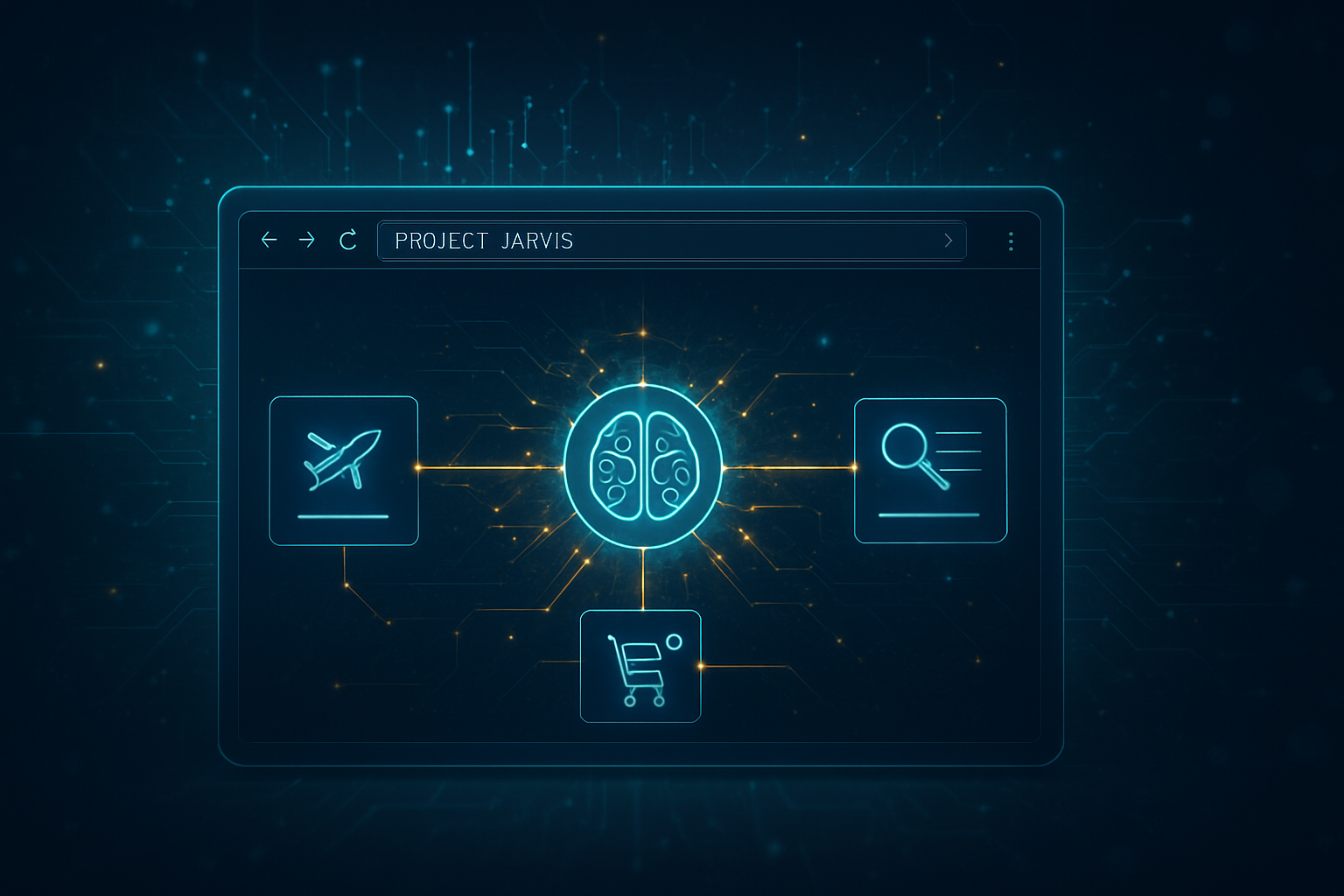
    In late 2024, a brief technical slip-up on the Chrome Web Store offered the world its first glimpse into the future of the internet. A prototype extension titled "Project Jarvis" was accidentally published by Google, describing itself as a "helpful companion that surfs the web with you." While the extension was quickly pulled, the leak confirmed what many had suspected: Alphabet Inc. (NASDAQ: GOOGL) was moving beyond simple chatbots and into the realm of "Computer-Using Agents" (CUAs) capable of taking over the browser to perform complex, multi-step tasks on behalf of the user.

    Fast forward to today, January 1, 2026, and that accidental leak is now recognized as the opening salvo in a war for the "AI-first" browser. What began as a experimental extension has evolved into a foundational layer of the Chrome ecosystem, fundamentally altering how billions of people interact with the web. By moving from a model of "Search and Click" to "Command and Complete," Google has effectively turned the world's most popular browser into an autonomous agent that handles everything from grocery shopping to deep-dive academic research without the user ever needing to touch a scroll bar.

    The Vision-Action Loop: Inside the Jarvis Architecture

    Technically, Project Jarvis represented a departure from the "API-first" approach of early AI integrations. Instead of relying on specific back-end connections to websites, Jarvis was built on a "vision-action loop" powered by the Gemini 2.0 and later Gemini 3.0 multimodal models. This allowed the AI to "see" the browser window exactly as a human does. By taking frequent screenshots and processing them through Gemini’s vision capabilities, the agent could identify buttons, interpret text fields, and navigate complex UI elements like drop-down menus and calendars. This approach allowed Jarvis to work on virtually any website, regardless of whether that site had built-in AI support.

    The capability of Jarvis—now largely integrated into the "Gemini in Chrome" suite—is defined by its massive context window, which by mid-2025 reached upwards of 2 million tokens. This enables the agent to maintain "persistent intent" across dozens of tabs. For example, a user can command the agent to "Find a flight to Tokyo under $900 in March, cross-reference it with my Google Calendar for conflicts, and find a hotel near Shibuya with a gym." The agent then navigates Expedia, Google Calendar, and TripAdvisor simultaneously, synthesizing the data and presenting a final recommendation or even completing the booking after a single biometric confirmation from the user.

    Initial reactions from the AI research community in early 2025 were a mix of awe and apprehension. Experts noted that while the vision-based approach bypassed the need for fragile web scrapers, it introduced significant latency and compute costs. However, Google’s optimization of "distilled" Gemini models specifically for browser tasks significantly reduced these hurdles by the end of 2025. The introduction of "Project Mariner"—the high-performance evolution of Jarvis—saw success rates on the WebVoyager benchmark jump to over 83%, a milestone that signaled the end of the "experimental" phase for agentic AI.

    The Agentic Arms Race: Market Positioning and Disruption

    The emergence of Project Jarvis forced a rapid realignment among tech giants. Alphabet Inc. (NASDAQ: GOOGL) found itself in a direct "Computer-Using Agent" (CUA) battle with Anthropic and Microsoft (NASDAQ: MSFT)-backed OpenAI. While Anthropic’s "Computer Use" feature for Claude 3.5 Sonnet focused on a platform-agnostic approach—allowing the AI to control the entire operating system—Google doubled down on the browser. This strategic focus leveraged Chrome's 65% market share, turning the browser into a defensive moat against the rise of "Answer Engines" like Perplexity.

    This shift has significantly disrupted the traditional search-ad model. As agents began to "consume" the web on behalf of users, the traditional "blue link" economy faced an existential crisis. In response, Google pivoted toward "Agentic Commerce." By late 2025, Google began monetizing the actions performed by Jarvis, taking small commissions on transactions completed through the agent, such as flight bookings or retail purchases. This move allowed Google to maintain its revenue streams even as traditional search volume began to fluctuate in the face of AI-driven automation.

    Furthermore, the integration of Jarvis into the Chrome architecture served as a regulatory defense. Following various antitrust rulings regarding search defaults, Google’s transition to an "AI-first browser" allowed it to offer a vertically integrated experience that competitors could not easily replicate. By embedding the agent directly into the browser's "Omnibox" (the address bar), Google ensured that Gemini remained the primary interface for the "Action Web," making the choice of a default search engine increasingly irrelevant to the end-user experience.

    The Death of the Blue Link: Ethical and Societal Implications

    The wider significance of Project Jarvis lies in the transition from the "Information Age" to the "Action Age." For decades, the internet was a library where users had to find and synthesize information themselves. With the mainstreaming of agentic AI throughout 2025, the internet has become a service economy where the browser acts as a digital concierge. This fits into a broader trend of "Invisible Computing," where the UI begins to disappear, replaced by natural language intent.

    However, this shift has not been without controversy. Privacy advocates have raised significant concerns regarding the "vision-based" nature of Jarvis. For the agent to function, it must effectively "watch" everything the user does within the browser, leading to fears of unprecedented data harvesting. Google addressed this in late 2025 by introducing "On-Device Agentic Processing," which keeps the visual screenshots of a user's session within the local hardware's secure enclave, only sending anonymized metadata to the cloud for complex reasoning.

    Comparatively, the launch of Jarvis is being viewed by historians as a milestone on par with the release of the first graphical web browser, Mosaic. While Mosaic allowed us to see the web, Jarvis allowed us to put the web to work. The "Agentic Web" also poses challenges for web developers and small businesses; if an AI agent is the one visiting a site, traditional metrics like "time on page" or "ad impressions" become obsolete, forcing a total rethink of how digital value is measured and captured.

    Beyond the Browser: The Future of Autonomous Workflows

    Looking ahead, the evolution of Project Jarvis is expected to move toward "Multi-Agent Swarms." In these scenarios, a Jarvis-style browser agent will not work in isolation but will coordinate with other specialized agents. For instance, a "Research Agent" might gather data in Chrome, while a "Creative Agent" drafts a report in Google Docs, and a "Communication Agent" schedules a meeting to discuss the findings—all orchestrated through a single user prompt.

    In late 2025, Google teased "Antigravity," an agent-first development environment that uses the Jarvis backbone to allow AI to autonomously plan, code, and test software directly within a browser window. This suggests that the next frontier for Jarvis is not just consumer shopping, but professional-grade software engineering and data science. Experts predict that by 2027, the distinction between "using a computer" and "directing an AI" will have effectively vanished for most office tasks.

    The primary challenge remaining is "hallucination in action." While a chatbot hallucinating a fact is a minor nuisance, an agent hallucinating a purchase or a flight booking can have real-world financial consequences. Google is currently working on "Verification Loops," where the agent must provide visual proof of its intended action before the final execution, a feature expected to become standard across all CUA platforms by the end of 2026.

    A New Chapter in Computing History

    Project Jarvis began as a leaked extension, but it has ended up as the blueprint for the next decade of human-computer interaction. By successfully integrating Gemini into the very fabric of the Chrome browser, Alphabet Inc. has successfully navigated the transition from a search company to an agent company. The significance of this development cannot be overstated; it represents the first time that AI has moved from being a "consultant" we talk to, to a "worker" that acts on our behalf.

    As we enter 2026, the key takeaways are clear: the browser is no longer a passive window, but an active participant in our digital lives. The "AI-first" strategy has redefined the competitive landscape, placing a premium on "action" over "information." For users, this means a future with less friction and more productivity, though it comes at the cost of increased reliance on a few dominant AI ecosystems.

    In the coming months, watch for the expansion of Jarvis-style agents into mobile operating systems and the potential for "Cross-Platform Agents" that can jump between your phone, your laptop, and your smart home. The era of the autonomous agent is no longer a leak or a rumor—it is the new reality of the internet.


    This content is intended for informational purposes only and represents analysis of current AI developments.

    TokenRing AI delivers enterprise-grade solutions for multi-agent AI workflow orchestration, AI-powered development tools, and seamless remote collaboration platforms. For more information, visit https://www.tokenring.ai/.

  • Google Breaks Hardware Barriers: Gemini-Powered Live Translation Now Available for Any Headphones

    Google Breaks Hardware Barriers: Gemini-Powered Live Translation Now Available for Any Headphones

    In a move that signals the end of hardware-gated AI features, Alphabet Inc. (NASDAQ: GOOGL) has officially begun the global rollout of its next-generation live translation service. Powered by the newly unveiled Gemini 2.5 Flash Native Audio model, the feature allows users to experience near-instantaneous, speech-to-speech translation using any pair of headphones, effectively democratizing a technology that was previously a primary selling point for the company’s proprietary Pixel Buds.

    This development marks a pivotal shift in Google’s AI strategy, prioritizing the ubiquity of the Gemini ecosystem over hardware sales. By leveraging a native audio-to-audio architecture, the service achieves sub-second latency and introduces a groundbreaking "Style Transfer" capability that preserves the original speaker's tone, emotion, and cadence. The result is a communication experience that feels less like a robotic relay and more like a natural, fluid conversation across linguistic barriers.

    The Technical Leap: From Cascaded Logic to Native Audio

    The backbone of this rollout is the Gemini 2.5 Flash Native Audio model, a technical marvel that departs from the traditional "cascaded" approach to translation. Historically, real-time translation required three distinct steps: speech-to-text (STT), machine translation (MT), and text-to-speech (TTS). This chain-link process was inherently slow, often resulting in a 3-to-5-second delay that disrupted the natural flow of human interaction. Gemini 2.5 Flash bypasses this bottleneck by processing raw acoustic signals directly in an end-to-end multimodal architecture.

    By operating natively on audio, the model achieves sub-second latency, making "active listening" translation possible for the first time. This means that as a person speaks, the listener hears the translated version almost simultaneously, similar to the experience of a professional UN interpreter but delivered via a smartphone and a pair of earbuds. The model features a 128K context window, allowing it to maintain the thread of long, complex discussions or academic lectures without losing the semantic "big picture."

    Perhaps the most impressive technical feat is the introduction of "Style Transfer." Unlike previous systems that stripped away vocal nuances to produce a flat, synthesized voice, Gemini 2.5 Flash captures the subtle acoustic signatures of the speaker—including pitch, rhythm, and emotional inflection. If a speaker is excited, hesitant, or authoritative, the translated output mirrors those qualities. This "Affective Dialogue" capability ensures that the intent behind the words is not lost in translation, a breakthrough that has been met with high praise from the AI research community for its human-centric design.

    Market Disruption: The End of the Hardware Moat

    Google’s decision to open this feature to all headphones—including those from competitors like Apple Inc. (NASDAQ: AAPL), Sony Group Corp (NYSE: SONY), and Bose—represents a calculated risk. For years, the "Live Translate" feature was a "moat" intended to drive consumers toward Pixel hardware. By dismantling this gate, Google is signaling that its true product is no longer just the device, but the Gemini AI layer that sits on top of any hardware. This move positions Google to dominate the "AI as a Service" (AIaaS) market, potentially capturing a massive user base that prefers third-party audio gear.

    This shift puts immediate pressure on competitors. Apple, which has historically kept its most advanced Siri and translation features locked within its ecosystem, may find itself forced to accelerate its own on-device AI capabilities to match Google’s cross-platform accessibility. Similarly, specialized translation hardware startups may find their market share evaporating as a free or low-cost software update to the Google Translate app now provides superior performance on consumer-grade hardware.

    Strategic analysts suggest that Google is playing a "platform game." By making Gemini the default translation engine for hundreds of millions of Android and eventually iOS users, the company is gathering invaluable real-world data to further refine its models. This ubiquity creates a powerful network effect; as more people use Gemini for daily communication, the model’s "Noise Robustness" and dialect-specific accuracy improve, widening the gap between Google and its rivals in the generative audio space.

    A New Era for Global Communication and Accessibility

    The wider significance of sub-second, style-preserving translation cannot be overstated. We are witnessing the first real-world application of "invisible AI"—technology that works so seamlessly it disappears into the background of human activity. For the estimated 1.5 billion people currently learning a second language, or the millions of travelers and expatriates navigating foreign environments, this tool fundamentally alters the social landscape. It reduces the cognitive load of cross-cultural interaction, fostering empathy by ensuring that the way something is said is preserved alongside what is said.

    However, the rollout also raises significant concerns regarding "audio identity" and security. To address the potential for deepfake misuse, Google has integrated SynthID watermarking into every translated audio stream. This digital watermark is imperceptible to the human ear but allows other AI systems to identify the audio as synthetic. Despite these safeguards, the ability of an AI to perfectly mimic a person’s tone and cadence in another language opens up new frontiers for social engineering and privacy debates, particularly regarding who owns the "rights" to a person's vocal style.

    In the broader context of AI history, this milestone is being compared to the transition from dial-up to broadband internet. Just as the removal of latency transformed the web from a static repository of text into a dynamic medium for video and real-time collaboration, the removal of latency in translation transforms AI from a "search tool" into a "communication partner." It marks a move toward "Ambient Intelligence," where the barriers between different languages become as thin as the air between two people talking.

    The Horizon: From Headphones to Augmented Reality

    Looking ahead, the Gemini 2.5 Flash Native Audio model is expected to serve as the foundation for even more ambitious projects. Industry experts predict that the next logical step is the integration of this technology into Augmented Reality (AR) glasses. In that scenario, users wouldn't just hear a translation; they could see translated text overlaid on the speaker’s face or even see the speaker’s lip movements digitally altered to match the translated audio in real-time.

    Near-term developments will likely focus on expanding the current 70-language roster and refining "Automatic Language Detection." Currently, the system can identify multiple speakers in a room and toggle between languages without manual input, but Google is reportedly working on "Whisper Mode," which would allow the AI to translate even low-volume, confidential side-conversations. The challenge remains maintaining this level of performance in extremely noisy environments or with rare dialects that have less training data available.

    A Turning Point in Human Connection

    The rollout of Gemini-powered live translation for any pair of headphones is more than just a software update; it is a declaration of intent. By prioritizing sub-second latency and emotional fidelity, Google has moved the needle from "functional translation" to "meaningful communication." The technical achievement of the Gemini 2.5 Flash Native Audio model sets a new industry standard that focuses on the human element—the tone, the pause, and the rhythm—that makes speech unique.

    As we move into 2026, the tech industry will be watching closely to see how Apple and other rivals respond to this open-ecosystem strategy. For now, the takeaway is clear: the "Universal Translator" is no longer a trope of science fiction. It is a reality that fits in your pocket and works with the headphones you already own. The long-term impact will likely be measured not in stock prices or hardware units sold, but in the millions of conversations that would have never happened without it.


    This content is intended for informational purposes only and represents analysis of current AI developments.

    TokenRing AI delivers enterprise-grade solutions for multi-agent AI workflow orchestration, AI-powered development tools, and seamless remote collaboration platforms.
    For more information, visit https://www.tokenring.ai/.