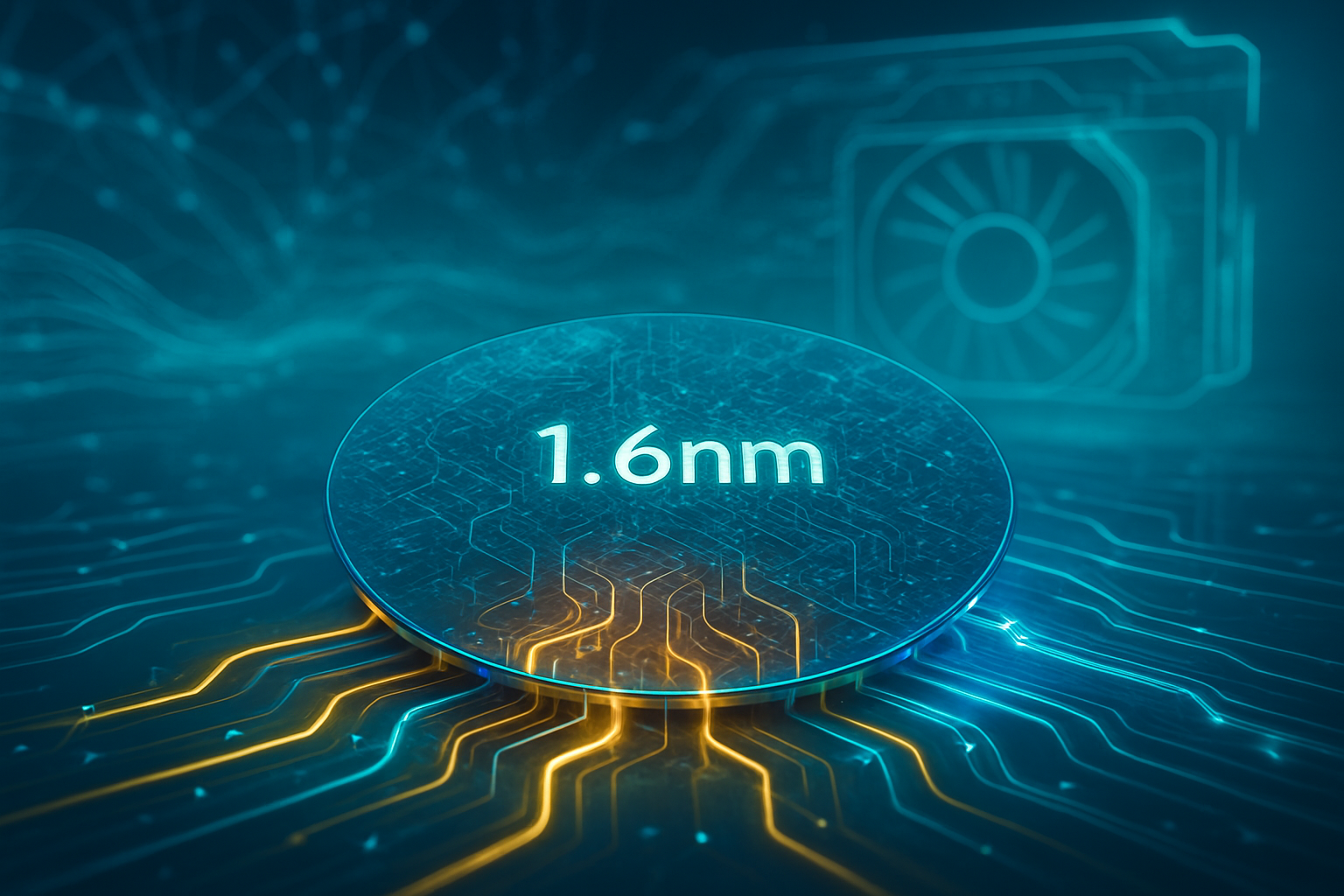
Tag: Angstrom Era

  • TSMC Officially Enters High-Volume Manufacturing for 2nm (N2) Process

    TSMC Officially Enters High-Volume Manufacturing for 2nm (N2) Process

    In a landmark moment for the global semiconductor industry, Taiwan Semiconductor Manufacturing Company (NYSE: TSM) has officially transitioned into high-volume manufacturing (HVM) for its 2-nanometer (N2) process technology as of January 2026. This milestone signals the dawn of the "Angstrom Era," moving beyond the limits of current 3nm nodes and providing the foundational hardware necessary to power the next generation of generative AI and hyperscale computing.

    The transition to N2 represents more than just a reduction in size; it marks the most significant architectural shift for the foundry in over a decade. By moving from the traditional FinFET (Fin Field-Effect Transistor) structure to a sophisticated Nanosheet Gate-All-Around (GAAFET) design, TSMC has unlocked unprecedented levels of energy efficiency and performance. For the AI industry, which is currently grappling with skyrocketing energy demands in data centers, the arrival of 2nm silicon is being hailed as a critical lifeline for sustainable scaling.

    Technical Mastery: The Shift to Nanosheet GAAFET

    The technical core of the N2 node is the move to GAAFET architecture, where the gate wraps around all four sides of the channel (nanosheet). This differs from the FinFET design used since the 16nm era, which only covered three sides. The superior electrostatic control provided by GAAFET drastically reduces current leakage, a major hurdle in shrinking transistors further. TSMC’s implementation also features "NanoFlex" technology, allowing chip designers to adjust the width of individual nanosheets to prioritize either peak performance or ultra-low power consumption on a single die.

    The specifications for the N2 process are formidable. Compared to the previous N3E (3nm) node, the 2nm process offers a 10% to 15% increase in speed at the same power level, or a substantial 25% to 30% reduction in power consumption at the same clock frequency. Furthermore, chip density has increased by approximately 1.15x. While the density jump is more iterative than previous "full-node" leaps, the efficiency gains are the real headline, especially for AI accelerators that run at high thermal envelopes. Early reports from the production lines in Taiwan suggest that TSMC has already cleared the "yield wall," with logic test chip yields stabilizing between 70% and 80%—a remarkably high figure for a new transistor architecture at this stage.

    The Global Power Play: Impact on Tech Giants and Competitors

    The primary beneficiaries of this HVM milestone are expected to be Apple (NASDAQ: AAPL) and NVIDIA (NASDAQ: NVDA). Apple, traditionally TSMC’s lead customer, is reportedly utilizing the N2 node for its upcoming A20 and M5 series chips, which will likely debut later this year. For NVIDIA, the transition to 2nm is vital for its next-generation AI GPU architectures, code-named "Rubin," which require massive throughput and efficiency to maintain dominance in the training and inference market. Other major players like Advanced Micro Devices (NASDAQ: AMD) and MediaTek are also in the queue to leverage the N2 capacity for their flagship 2026 products.

    The competitive landscape is more intense than ever. Intel (NASDAQ: INTC) is currently ramping its 18A (1.8nm) node, which features its own "RibbonFET" and "PowerVia" backside power delivery. While Intel aims to challenge TSMC on performance, TSMC’s N2 retains a clear lead in transistor density and manufacturing maturity. Meanwhile, Samsung (KRX: 005930) continues to refine its SF2 process. Although Samsung was the first to adopt GAA at the 3nm stage, its yields have reportedly lagged behind TSMC’s, giving the Taiwanese giant a significant strategic advantage in securing the largest, most profitable contracts for the 2026-2027 product cycles.

    A Crucial Turn in the AI Landscape

    The arrival of 2nm HVM arrives at a pivotal moment for the AI industry. As large language models (LLMs) grow in complexity, the hardware bottleneck has shifted from raw compute to power efficiency and thermal management. The 30% power reduction offered by N2 will allow data center operators to pack more compute density into existing facilities without exceeding power grid limits. This shift is essential for the continued evolution of "Agentic AI" and real-time multimodal models that require constant, low-latency processing.

    Beyond technical metrics, this milestone reinforces the geopolitical importance of the "Silicon Shield." Production is currently concentrated in TSMC’s Baoshan (Hsinchu) and Kaohsiung facilities. Baoshan, designated as the "mother fab" for 2nm, is already running at a capacity of 30,000 wafers per month, with the Kaohsiung facility rapidly scaling to meet overflow demand. This concentration of the world’s most advanced manufacturing capability in Taiwan continues to make the island the indispensable hub of the global digital economy, even as TSMC expands its international footprint in Arizona and Japan.

    The Road Ahead: From N2 to the A16 Milestone

    Looking forward, the N2 node is just the beginning of the Angstrom Era. TSMC has already laid out a roadmap that leads to the A16 (1.6nm) node, scheduled for high-volume manufacturing in late 2026. The A16 node will introduce the "Super Power Rail" (SPR), TSMC’s version of backside power delivery, which moves power routing to the rear of the wafer. This innovation is expected to provide an additional 10% boost in speed by reducing voltage drop and clearing space for signal routing on the front of the chip.

    Experts predict that the next eighteen months will see a flurry of announcements as AI companies optimize their software to take advantage of the new 2nm hardware. Challenges remain, particularly regarding the escalating costs of EUV (Extreme Ultraviolet) lithography and the complex packaging required for "chiplet" designs. However, the successful HVM of N2 proves that Moore’s Law—while certainly becoming more expensive to maintain—is far from dead.

    Summary: A New Foundation for Intelligence

    TSMC’s successful launch of 2nm HVM marks a definitive transition into a new epoch of computing. By mastering the Nanosheet GAAFET architecture and scaling production at Baoshan and Kaohsiung, the company has secured its position at the apex of the semiconductor industry for the foreseeable future. The performance and efficiency gains provided by the N2 node will be the primary engine driving the next wave of AI breakthroughs, from more capable consumer devices to more efficient global data centers.

    As we move through 2026, the focus will shift toward how quickly lead customers can integrate these chips into the market and how competitors like Intel and Samsung respond. For now, the "Angstrom Era" has officially arrived, and with it, the promise of a more powerful and energy-efficient future for artificial intelligence.


    This content is intended for informational purposes only and represents analysis of current AI developments.

    TokenRing AI delivers enterprise-grade solutions for multi-agent AI workflow orchestration, AI-powered development tools, and seamless remote collaboration platforms.
    For more information, visit https://www.tokenring.ai/.
  • The 2nm Revolution: TSMC Ramps Volume Production of N2 Silicon to Fuel the AI Decade

    The 2nm Revolution: TSMC Ramps Volume Production of N2 Silicon to Fuel the AI Decade

    As of January 26, 2026, the semiconductor industry has officially entered a new epoch known as the "Angstrom Era." Taiwan Semiconductor Manufacturing Company (TSM: NYSE) has confirmed that its next-generation 2-nanometer (N2) process technology has successfully moved into high-volume manufacturing, marking a critical milestone for the global technology landscape. With mass production ramping up at the newly completed Hsinchu and Kaohsiung gigafabs, the industry is witnessing the most significant architectural shift in over a decade.

    This transition is not merely a routine shrink in transistor size; it represents a fundamental re-engineering of the silicon that powers everything from the smartphones in our pockets to the massive data centers training the next generation of artificial intelligence. With demand for AI compute reaching a fever pitch, TSMC’s N2 node is expected to be the exclusive engine for the world’s most advanced hardware, though industry analysts warn that a massive supply-demand imbalance will likely trigger shortages lasting well into 2027.

    The Architecture of the Future: Transitioning to GAA Nanosheets

    The technical centerpiece of the N2 node is the transition from FinFET (Fin Field-Effect Transistor) architecture to Gate-All-Around (GAA) nanosheet transistors. For the past decade, FinFETs provided the necessary performance gains by using a 3D "fin" structure to control electrical current. However, as transistors approached the physical limits of atomic scales, FinFETs began to suffer from excessive power leakage and diminished efficiency. The new GAA nanosheet design solves this by wrapping the transistor gate entirely around the channel on all four sides, providing superior electrical control and drastically reducing current leakage.

    The performance metrics for N2 are formidable. Compared to the previous N3E (3-nanometer) node, the 2nm process offers a 10% to 15% increase in speed at the same power level, or a staggering 25% to 30% reduction in power consumption at the same performance level. Furthermore, the node provides a 15% to 20% increase in logic density. Initial reports from TSMC’s Jan. 15, 2026, earnings call indicate that logic test chip yields for the GAA process have already stabilized between 70% and 80%—a remarkably high figure for a new architecture that suggests TSMC has successfully navigated the "yield valley" that often plagues new process transitions.

    Initial reactions from the semiconductor research community have been overwhelmingly positive, with experts noting that the flexibility of nanosheet widths allows designers to optimize specific parts of a chip for either high performance or low power. This level of granular customization was nearly impossible with the fixed-fin heights of the FinFET era, giving chip architects at companies like Apple (AAPL: NASDAQ) and Nvidia (NVDA: NASDAQ) an unprecedented toolkit for the 2026-2027 hardware cycle.

    A High-Stakes Race for First-Mover Advantage

    The race to secure 2nm capacity has created a strategic divide in the tech industry. Apple remains TSMC’s "alpha" customer, having reportedly booked the lion's share of initial N2 capacity for its upcoming A20 series chips destined for the 2026 iPhone 18 Pro. By being the first to market with GAA-based consumer silicon, Apple aims to maintain its lead in on-device AI and battery efficiency, potentially forcing competitors to wait for second-tier allocations.

    Meanwhile, the high-performance computing (HPC) sector is driving even more intense competition. Nvidia’s next-generation "Rubin" (R100) AI architecture is in full production as of early 2026, leveraging N2 to meet the insatiable appetite for Large Language Model (LLM) training. Nvidia has secured over 60% of TSMC’s advanced packaging capacity to support these chips, effectively creating a "moat" that limits the speed at which rivals can scale. Other major players, including Advanced Micro Devices (AMD: NASDAQ) with its Zen 6 architecture and Broadcom (AVGO: NASDAQ), are also in line, though they are grappling with the reality of $30,000-per-wafer price tags—a 50% premium over the 3nm node.

    This pricing power solidifies TSMC’s dominance over competitors like Samsung (SSNLF: OTC) and Intel (INTC: NASDAQ). While Intel has made significant strides with its Intel 18A node, TSMC’s proven track record of high-yield volume production has kept the world’s most valuable tech companies within its ecosystem. The sheer cost of 2nm development means that many smaller AI startups may find themselves priced out of the leading edge, potentially leading to a consolidation of AI power among a few "silicon-rich" giants.

    The Global Impact: Shortages and the AI Capex Supercycle

    The broader significance of the 2nm ramp-up lies in its role as the backbone of the "AI economy." As global data center capacity continues to expand, the efficiency gains of the N2 node are no longer a luxury but a necessity for sustainability. A 30% reduction in power consumption across millions of AI accelerators translates to gigawatts of energy saved, a factor that is becoming increasingly critical as power grids worldwide struggle to support the AI boom.

    However, the supply outlook remains precarious. Analysts project that demand for sub-5nm nodes will exceed global capacity by 25% to 30% throughout 2026. This "supply choke" has prompted TSMC to raise its 2026 capital expenditure to a record-breaking $56 billion, specifically to accelerate the expansion of its Baoshan and Kaohsiung facilities. The persistent shortage of 2nm silicon could lead to elongated replacement cycles for smartphones and higher costs for cloud compute services, as the industry enters a period where "performance-per-watt" is the ultimate currency.

    The current situation mirrors the semiconductor crunch of 2021, but with a crucial difference: the bottleneck today is not a lack of old-node chips for cars, but a lack of the most advanced silicon for the "brains" of the global economy. This shift underscores a broader trend of technological nationalism, as countries scramble to secure access to the limited 2nm wafers that will dictate the pace of AI innovation for the next three years.

    Looking Ahead: The Roadmap to 1.6nm and Backside Power

    The N2 node is just the beginning of a multi-year roadmap that TSMC has laid out through 2028. Following the base N2 ramp, the company is preparing for N2P (an enhanced version) and N2X (optimized for extreme performance) to launch in late 2026 and early 2027. The most anticipated advancement, however, is the A16 node—a 1.6nm process scheduled for volume production in late 2026.

    A16 will introduce the "Super Power Rail" (SPR), TSMC’s implementation of Backside Power Delivery (BSPDN). By moving the power delivery network to the back of the wafer, designers can free up more space on the front for signal routing, further boosting clock speeds and reducing voltage drop. This technology is expected to be the "holy grail" for AI accelerators, allowing them to push even higher thermal design points without sacrificing stability.

    The challenges ahead are primarily thermal and economic. As transistors shrink, managing heat density becomes an existential threat to chip longevity. Experts predict that the move toward 2nm and beyond will necessitate a total rethink of liquid cooling and advanced 3D packaging, which will add further layers of complexity and cost to an already expensive manufacturing process.

    Summary of the Angstrom Era

    TSMC’s successful ramp of the 2nm N2 node marks a definitive victory in the semiconductor arms race. By successfully transitioning to Gate-All-Around nanosheets and maintaining high yields, the company has secured its position as the indispensable foundry for the AI revolution. Key takeaways from this launch include the massive performance-per-watt gains that will redefine mobile and data center efficiency, and the harsh reality of a "fully booked" supply chain that will keep silicon prices at historic highs.

    In the coming months, the industry will be watching for the first 2nm benchmarks from Apple’s A20 and Nvidia’s Rubin architectures. These results will confirm whether the "Angstrom Era" can deliver on its promise to maintain the pace of Moore’s Law or if the physical and economic costs of miniaturization are finally reaching a breaking point. For now, the world’s most advanced AI is being forged in the cleanrooms of Taiwan, and the race to own that silicon has never been more intense.


    This content is intended for informational purposes only and represents analysis of current AI developments.

    TokenRing AI delivers enterprise-grade solutions for multi-agent AI workflow orchestration, AI-powered development tools, and seamless remote collaboration platforms.
    For more information, visit https://www.tokenring.ai/.

  • The Angstrom Ascendancy: Intel and TSMC Locked in a Sub-2nm Duel for AI Supremacy

    The Angstrom Ascendancy: Intel and TSMC Locked in a Sub-2nm Duel for AI Supremacy

    The semiconductor industry has officially crossed the threshold into the "Angstrom Era," a pivotal transition where the measurement of transistor features has shifted from nanometers to angstroms. As of early 2026, the battle for foundry leadership has narrowed to a high-stakes race between Taiwan Semiconductor Manufacturing Company (NYSE: TSM) and Intel (NASDAQ: INTC). With the demand for generative AI and high-performance computing (HPC) reaching a fever pitch, the hardware that powers these models is undergoing its most radical architectural redesign in over a decade.

    The current landscape sees Intel aggressively pushing its 18A (1.8nm) process into high-volume manufacturing, while TSMC prepares its highly anticipated A16 (1.6nm) node for a late-2026 rollout. This competition is not merely a branding exercise; it represents a fundamental shift in how silicon is built, featuring the commercial debut of backside power delivery and gate-all-around (GAA) transistor structures. For the first time in nearly a decade, the "process leadership" crown is legitimately up for grabs, with profound implications for the world’s most valuable technology companies.

    Technical Warfare: RibbonFETs and the Power Delivery Revolution

    At the heart of the Angstrom Era are two major technical shifts: the transition to GAA transistors and the implementation of Backside Power Delivery (BSPD). Intel has taken an early lead in this department with its 18A process, which utilizes "RibbonFET" architecture and "PowerVia" technology. RibbonFET allows Intel to stack multiple horizontal nanoribbons to form the transistor channel, providing better electrostatic control and reducing power leakage compared to the older FinFET designs. Intel’s PowerVia is particularly significant as it moves the power delivery network to the underside of the wafer, decoupling it from the signal wires. This reduces "voltage droop" and allows for more efficient power distribution, which is critical for the power-hungry H100 and B200 successors from Nvidia (NASDAQ: NVDA).

    TSMC, meanwhile, is countering with its A16 node, which introduces the "Super PowerRail" architecture. While TSMC’s 2nm (N2) node also uses nanosheet GAA transistors, the A16 process takes the technology a step further. Unlike Intel’s PowerVia, which uses through-silicon vias to bridge the gap, TSMC’s Super PowerRail connects power directly to the source and drain of the transistor. This approach is more manufacturing-intensive but is expected to offer a 10% speed boost or a 20% power reduction over the standard 2nm process. Industry experts suggest that TSMC’s A16 will be the "gold standard" for AI silicon due to its superior density, though Intel’s 18A is currently the first to ship at scale.

    The lithography strategy also highlights a major divergence between the two giants. Intel has fully committed to ASML’s (NASDAQ: ASML) High-NA (Numerical Aperture) EUV machines for its upcoming 14A (1.4nm) process, betting that the $380 million units will be necessary to achieve the resolution required for future scaling. TSMC, in a display of manufacturing pragmatism, has opted to skip High-NA EUV for its A16 and potentially its A14 nodes, relying instead on existing Low-NA EUV multi-patterning techniques. This move allows TSMC to keep its capital expenditures lower and offer more competitive pricing to cost-sensitive customers like Apple (NASDAQ: AAPL).

    The AI Foundry Gold Rush: Securing the Future of Compute

    The strategic advantage of these nodes is being felt across the entire AI ecosystem. Microsoft (NASDAQ: MSFT) was one of the first major tech giants to commit to Intel’s 18A process for its custom Maia AI accelerators, seeking to diversify its supply chain and reduce its dependence on TSMC’s capacity. Intel’s positioning as a "Western alternative" has become a powerful selling point, especially as geopolitical tensions in the Taiwan Strait remain a persistent concern for Silicon Valley boardrooms. By early 2026, Intel has successfully leveraged this "national champion" status to secure massive contracts from the U.S. Department of Defense and several hyperscale cloud providers.

    However, TSMC remains the undisputed king of high-end AI production. Nvidia has reportedly secured the majority of TSMC’s initial A16 capacity for its next-generation "Feynman" GPU architecture. For Nvidia, the decision to stick with TSMC is driven by the foundry’s peerless yield rates and its advanced packaging ecosystem, specifically CoWoS (Chip-on-Wafer-on-Substrate). While Intel is making strides with its "Foveros" packaging, TSMC’s ability to integrate logic chips with high-bandwidth memory (HBM) at scale remains the bottleneck for the entire AI industry, giving the Taiwanese firm a formidable moat.

    Apple’s role in this race continues to be the industry’s most closely watched subplot. While Apple has long been TSMC’s largest customer, recent reports indicate that the Cupertino giant has engaged Intel’s foundry services for specific components of its M-series and A-series chips. This shift suggests that the "process lead" is no longer a winner-take-all scenario. Instead, we are entering an era of "multi-foundry" strategies, where tech giants split their orders between TSMC and Intel to mitigate risks and capitalize on specific technical strengths—Intel for early backside power and TSMC for high-volume efficiency.

    Geopolitics and the End of Moore’s Law

    The competition between the A16 and 18A nodes fits into a broader global trend of "silicon nationalism." The U.S. CHIPS and Science Act has provided the tailwinds necessary for Intel to build its Fab 52 in Arizona, which is now the primary site for 18A production. This development marks the first time in over a decade that the most advanced semiconductor manufacturing has occurred on American soil. For the AI landscape, this means that the availability of cutting-edge training hardware is increasingly tied to government policy and domestic manufacturing stability rather than just raw technical innovation.

    This "Angstrom Era" also signals a definitive shift in the debate surrounding Moore’s Law. As the physical limits of silicon are reached, the industry is moving away from simple transistor shrinking toward complex 3D architectures and "system-level" scaling. The A16 and 14A processes represent the pinnacle of what is possible with traditional materials. The move to backside power delivery is essentially a 3D structural change that allows the industry to keep performance gains moving upward even as horizontal shrinking slows down.

    Concerns remain, however, regarding the astronomical costs of these new nodes. With High-NA EUV machines costing nearly double their predecessors and the complexity of backside power adding significant steps to the manufacturing process, the price-per-transistor is no longer falling as it once did. This could lead to a widening gap between the "AI elite"—companies like Google (NASDAQ: GOOGL) and Meta (NASDAQ: META) that can afford billion-dollar silicon runs—and smaller startups that may be priced out of the most advanced hardware, potentially centralizing AI power even further.

    The Horizon: 14A, A14, and the Road to 1nm

    Looking toward the end of the decade, the roadmap is already becoming clear. Intel’s 14A process is slated for risk production in late 2026, aiming to be the first node to fully utilize High-NA EUV lithography for every critical layer. Intel’s goal is to reach its "10A" (1nm) node by 2028, effectively completing its "five nodes in four years" recovery plan. If successful, Intel could theoretically leapfrog TSMC in density by the turn of the decade, provided it can maintain the yields necessary for commercial viability.

    TSMC is not sitting still, with its A14 (1.4nm) process already in the development pipeline. The company is expected to eventually adopt High-NA EUV once the technology matures and the cost-to-benefit ratio improves. The next frontier for both companies will be the integration of new materials beyond silicon, such as two-dimensional (2D) semiconductors like molybdenum disulfide (MoS2) and carbon nanotubes. These materials could allow for even thinner channels and faster switching speeds, potentially extending the Angstrom Era into the 2030s.

    The biggest challenge facing both foundries will be energy consumption. As AI models grow, the power required to manufacture and run these chips is becoming a sustainability crisis. The focus for the next generation of nodes will likely shift from pure performance to "performance-per-watt," with innovations like optical interconnects and on-chip liquid cooling becoming standard features of the A14 and 14A generations.

    A Two-Horse Race for the History Books

    The duel between TSMC’s A16 and Intel’s 18A represents a historic moment in the semiconductor industry. For the first time in the 21st century, the path to the most advanced silicon is not a solitary one. TSMC’s operational excellence and "Super PowerRail" efficiency are being challenged by Intel’s "PowerVia" first-mover advantage and aggressive high-NA adoption. For the AI industry, this competition is an unmitigated win, as it drives innovation faster and provides much-needed supply chain redundancy.

    As we move through 2026, the key metrics to watch will be Intel's 18A yield rates and TSMC's ability to transition its major customers to A16 without the pricing shocks associated with new architectures. The "Angstrom Era" is no longer a theoretical roadmap; it is a physical reality currently being etched into silicon across the globe. Whether the crown remains in Hsinchu or returns to Santa Clara, the real winner is the global AI economy, which now has the hardware foundation to support the next leap in machine intelligence.


    This content is intended for informational purposes only and represents analysis of current AI developments.

    TokenRing AI delivers enterprise-grade solutions for multi-agent AI workflow orchestration, AI-powered development tools, and seamless remote collaboration platforms.
    For more information, visit https://www.tokenring.ai/.
  • The Angstrom Era: The High-Stakes Race to 1.4nm Dominance in the AI Age

    The Angstrom Era: The High-Stakes Race to 1.4nm Dominance in the AI Age

    As we enter the first weeks of 2026, the global semiconductor industry has officially crossed the threshold into the "Angstrom Era." While 2nm production (N2) is currently ramping up in Taiwan and the United States, the strategic focus of the world's most powerful foundries has already shifted toward the 1.4nm node. This milestone, designated as A14 by TSMC and 14A by Intel, represents a final frontier for traditional silicon-based computing, where the laws of classical physics begin to collapse and are replaced by the complex realities of quantum mechanics.

    The immediate significance of the 1.4nm roadmap cannot be overstated. As artificial intelligence models scale toward quadrillions of parameters, the hardware required to train and run them is hitting a "thermal and power wall." The 1.4nm node is being engineered as the antidote to this crisis, promising to deliver a 20-30% reduction in power consumption and a nearly 1.3x increase in transistor density compared to the 2nm nodes currently entering the market. For the giants of the AI industry, this roadmap is not just a technical benchmark—it is the lifeline that will allow the next generation of generative AI to exist.

    The Physics of the Sub-2nm Frontier: High-NA EUV and BSPDN

    At the heart of the 1.4nm breakthrough are three transformative technologies: High-NA Extreme Ultraviolet (EUV) lithography, Backside Power Delivery (BSPDN), and second-generation Gate-All-Around (GAA) transistors. Intel (NASDAQ: INTC) has taken an aggressive lead in the adoption of High-NA EUV, having already installed the industry’s first ASML (NASDAQ: ASML) TWINSCAN EXE:5200 scanners. These $380 million machines use a higher numerical aperture (0.55 NA) to print features with 1.7x more precision than previous generations, potentially allowing Intel to print 1.4nm features in a single pass rather than through complex, yield-killing multi-patterning steps.

    While Intel is betting on expensive hardware, TSMC (NYSE: TSM) has taken a more conservative "cost-first" approach for its initial A14 node. TSMC’s engineers plan to push existing Low-NA (0.33 NA) EUV machines to their absolute limits using advanced multi-patterning before transitioning to High-NA for their enhanced A14P node in 2028. This divergence in strategy has sparked a fierce debate among industry experts: Intel is prioritizing technical supremacy and process simplification, while TSMC is betting that its refined manufacturing recipes can deliver 1.4nm performance at a lower cost-per-wafer, which is currently estimated to exceed $45,000 for these advanced nodes.

    Perhaps the most radical shift in the 1.4nm era is the implementation of Backside Power Delivery. For decades, power and signal wires were crammed onto the front of the chip, leading to "IR drop" (voltage sag) and signal interference. Intel’s "PowerDirect" and TSMC’s "Super Power Rail" move the power delivery network to the bottom of the silicon wafer. This decoupling allows for nearly 90% cell utilization, solving the wiring congestion that has haunted chip designers for a decade. However, this comes with extreme thermal challenges; by stacking power and logic so closely, the "Self-Heating Effect" (SHE) can cause transistors to degrade prematurely if not mitigated by groundbreaking liquid-to-chip cooling solutions.

    Geopolitical Maneuvering and the Foundry Supremacy War

    The 1.4nm race is also a battle for the soul of the foundry market. Intel’s "Five Nodes in Four Years" strategy has culminated in the 18A node, and the company is now positioning 14A as its "comeback node" to reclaim the crown it lost a decade ago. Intel is opening its 14A Process Design Kits (PDKs) to external customers earlier than ever, specifically targeting major AI lab spinoffs and hyperscalers. By leveraging the U.S. CHIPS Act to build "Giga-fabs" in Ohio and Arizona, Intel is marketing 14A as the only secure, Western-based supply chain for Angstrom-level AI silicon.

    TSMC, however, remains the undisputed king of capacity and ecosystem. Most major AI players, including NVIDIA (NASDAQ: NVDA) and AMD (NASDAQ: AMD), have already aligned their long-term roadmaps with TSMC’s A14. NVIDIA’s rumored "Feynman" architecture, the successor to the upcoming Rubin series, is expected to be the anchor tenant for TSMC’s A14 production in late 2027. For NVIDIA, the 1.4nm node is critical for maintaining its dominance, as it will allow for GPUs that can handle 1,000W of power while maintaining the efficiency needed for massive data centers.

    Samsung (KRX: 005930) is the "wild card" in this race. Having been the first to move to GAA transistors with its 3nm node, Samsung is aiming to leapfrog both Intel and TSMC by moving directly to its SF1.4 (1.4nm) node by late 2027. Samsung’s strategic advantage lies in its vertical integration; it is the only company capable of producing 1.4nm logic and the HBM5 (High Bandwidth Memory) that must be paired with it under one roof. This could lead to a disruption in the market if Samsung can solve the yield issues that have plagued its previous 3nm and 4nm nodes.

    The Scaling Laws and the Ghost of Quantum Tunneling

    The broader significance of the 1.4nm roadmap lies in its impact on the "Scaling Laws" of AI. Currently, AI performance is roughly proportional to the amount of compute and data used for training. However, we are reaching a point where scaling compute requires more electricity than many regional grids can provide. The 1.4nm node represents the industry’s most potent weapon against this energy crisis. By delivering significantly more "FLOPS per watt," the Angstrom era will determine whether we can reach the next milestones of Artificial General Intelligence (AGI) or if progress will stall due to infrastructure limits.

    However, the move to 1.4nm brings us face-to-face with the "Ghost of Quantum Tunneling." At this scale, the insulating layers of a transistor are only about 3 to 5 atoms thick. At such extreme dimensions, electrons can simply "leak" through the barriers, turning binary 1s into 0s and causing massive static power loss. To combat this, foundries are exploring "high-k" dielectrics and 2D materials like molybdenum disulfide. This is a far cry from the silicon breakthroughs of the 1990s; we are now effectively building machines that must account for the probabilistic nature of subatomic particles to perform a simple addition.

    Comparatively, the jump to 1.4nm is more significant than the transition from FinFET to GAA. It marks the first time that the entire "system" of the chip—power, memory, and logic—must be redesigned in 3D. While previous milestones focused on shrinking the transistor, the Angstrom Era is about rebuilding the chip's architecture to survive a world where silicon is no longer a perfect insulator.

    Future Horizons: Beyond 1.4nm and the Rise of CFET

    Looking ahead toward 2028 and 2029, the industry is already preparing for the successor to GAA: the Complementary FET (CFET). While current 1.4nm designs stack nanosheets of the same type, CFET will stack n-type and p-type transistors vertically on top of each other. This will effectively double the transistor density once again, potentially leading us to the A10 (1nm) node by the turn of the decade. The 1.4nm node is the bridge to this vertical future, serving as the proving ground for the backside power and 3D stacking techniques that CFET will require.

    In the near term, we should expect a surge in "domain-specific" 1.4nm chips. Rather than general-purpose CPUs, we will likely see silicon specifically optimized for transformer architectures or neural-symbolic reasoning. The challenge remains yield; at 1.4nm, even a single stray atom or a microscopic thermal hotspot can ruin an entire wafer. Experts predict that while risk production will begin in 2027, "golden yields" (over 60%) may not be achieved until late 2028, leading to a period of high prices and limited supply for the most advanced AI hardware.

    A New Chapter in Computing History

    The transition to 1.4nm is a watershed moment for the technology industry. It represents the successful navigation of the "Angstrom Era," a period many predicted would never arrive due to the insurmountable walls of physics. By the end of 2027, the first 14A and A14 chips will likely be powering the most advanced autonomous systems, real-time global translation devices, and scientific simulations that were previously impossible.

    The key takeaways from this roadmap are clear: Intel is back in the fight for leadership, TSMC is prioritizing industrial-scale reliability, and the cost of staying at the leading edge is skyrocketing. As we move closer to the production dates of 2027-2028, the industry will be watching for the first "tape-outs" of 1.4nm AI chips. In the coming months, keep a close eye on ASML’s shipping manifests and the quarterly capital expenditure reports from the big three foundries—those figures will tell the true story of who is winning the race to the bottom of the atomic scale.


    This content is intended for informational purposes only and represents analysis of current AI developments.

    TokenRing AI delivers enterprise-grade solutions for multi-agent AI workflow orchestration, AI-powered development tools, and seamless remote collaboration platforms.
    For more information, visit https://www.tokenring.ai/.

  • The Angstrom Frontier: TSMC and Intel Reveal 1.4nm Roadmaps to Power the Next Decade of AI

    The Angstrom Frontier: TSMC and Intel Reveal 1.4nm Roadmaps to Power the Next Decade of AI

    As of January 13, 2026, the global semiconductor industry has officially entered a high-stakes sprint toward the "Angstrom Era," a move that promises to redefine the limits of silicon physics. Within the last several months, the industry's two primary titans, Taiwan Semiconductor Manufacturing Company Limited (NYSE: TSM) and Intel Corporation (NASDAQ: INTC), have solidified their long-term roadmaps for the 1.4nm node—designated as A14 and Intel 14A, respectively. This shift is not merely an incremental update; it represents a desperate race to provide the computational density required by upcoming generative AI models that are expected to be orders of magnitude larger than those of 2025.

    The move to 1.4nm, targeted for high-volume manufacturing between late 2027 and 2028, marks the point where the semiconductor industry must confront the "1nm wall." At these scales, the thickness of transistor gates is measured in just a handful of atoms, and traditional manufacturing techniques fail to prevent electrons from "leaking" through supposedly solid barriers. The significance of this milestone cannot be overstated: the success of these 1.4nm nodes will determine whether the current AI boom can sustain its exponential growth or if it will be throttled by a literal "power wall" in global data centers.

    Engineering the Impossible: The Physics of 14 Angstroms

    The transition to 1.4nm requires a fundamental reimagining of transistor architecture and lithography. While the previous 2nm nodes introduced Gate-All-Around (GAA) transistors—where the gate surrounds the channel on all four sides to minimize current leakage—the 1.4nm era refines this with second-generation GAA designs. Intel’s "14A" node will utilize its evolved RibbonFET 2 architecture, while TSMC’s "A14" will deploy its own advanced nanosheet technology. The goal is to achieve a 15–20% performance-per-watt improvement over the 2nm generation, a necessity as AI chips like those from NVIDIA Corporation (NASDAQ: NVDA) push thermal envelopes to their breaking points.

    A major technical schism has emerged regarding High-Numerical Aperture (High-NA) Extreme Ultraviolet (EUV) lithography. Intel has taken a "vanguard" approach, becoming the first to install ASML Holding’s (NASDAQ: ASML) massive $400 million High-NA machines. These tools allow for much finer resolution, enabling Intel to print 1.4nm features in a single pass. Conversely, TSMC has opted for a "fast-follower" strategy, announcing it will initially bypass High-NA EUV for its A14 node in favor of advanced multi-patterning using existing Low-NA EUV tools. TSMC argues that its mature toolset will offer higher yields and lower costs for customers like Apple Inc. (NASDAQ: AAPL), even if the process is more complex to execute.

    Beyond lithography, both companies are tackling the "interconnect bottleneck." As wires shrink to atomic widths, traditional copper becomes highly resistive, generating excessive heat. To combat this, 1.4nm nodes are expected to incorporate exotic materials such as Ruthenium or Cobalt-Ruthenium binary liners. Furthermore, "Backside Power Delivery"—a technique that moves the power-delivery circuitry to the bottom of the silicon wafer to free up the top for signal routing—will become standard. Intel’s PowerDirect and TSMC’s Super Power Rail are the primary weapons in this fight against voltage sag and thermal throttling.

    The Foundry War: TSMC's Dominance vs. Intel's Ambition

    The 1.4nm roadmap has ignited a fierce strategic battle for market share in the AI accelerator space. For years, TSMC has held a near-monopoly on high-end AI silicon, but Intel’s aggressive "five nodes in four years" strategy has finally brought it within striking distance. Intel is marketing its 14A node as part of its "AI System Foundry" model, which integrates advanced 1.4nm logic with proprietary 3D packaging technologies like Foveros. By offering a "one-stop-shop" that includes the latest High-NA manufacturing and cutting-edge packaging, Intel hopes to lure major clients away from the Taiwanese giant.

    For NVIDIA Corporation and Advanced Micro Devices, Inc. (NASDAQ: AMD), the 1.4nm era offers a crucial second-sourcing opportunity. Industry insiders suggest that NVIDIA is closely evaluating Intel’s 14A process for its post-2027 "Feynman" architecture as a hedge against geopolitical instability in the Taiwan Strait and capacity constraints at TSMC. If Intel can prove its 1.4nm yields are stable, it could break TSMC’s stranglehold on the AI GPU market, leading to a more competitive pricing environment for the hardware that powers the world's LLMs.

    TSMC, however, remains the incumbent favorite due to its peerless execution history. Its "NanoFlex Pro" technology, which allows chip designers to mix different transistor heights on a single die, offers a level of customization that is highly attractive to hyper-scalers like Amazon and Google who are designing their own bespoke AI chips. By focusing on manufacturing reliability and yield over "first-to-market" bragging rights with High-NA EUV, TSMC aims to remain the primary foundry for the world's most valuable technology companies.

    Scaling Laws and the AI Power Wall

    The shift to 1.4nm fits into a broader narrative of "AI Scaling Laws," which suggest that increasing the amount of compute and data leads to predictable improvements in model intelligence. However, these laws are currently hitting a physical barrier: the "Power Wall." Current data centers are reaching the limits of available electrical grids. The 30% power reduction promised by the A14 and 14A nodes is seen by many researchers as the only way to keep scaling model parameters without requiring dedicated nuclear power plants for every new training cluster.

    There are significant concerns, however, regarding Quantum Tunneling. At 1.4nm, the insulating layers within a transistor are so thin that electrons can simply "jump" across them due to quantum effects, leading to massive energy waste. While GAA and new materials mitigate this, some physicists argue we are approaching the "Red Line" of silicon-based computing. This has led to comparisons with the end of the "Dennard Scaling" era in the mid-2000s; just as we moved to multi-core processors then, the 1.4nm era may force a shift toward entirely new computing paradigms, such as optical computing or neuromorphic chips.

    Despite these hurdles, the industry's consensus is that the Angstrom Era is the final frontier for traditional silicon. The 1.4nm milestone is viewed with the same reverence as the 7nm "breakthrough" of 2018, which enabled the current generation of mobile and cloud computing. It represents a "survival node"—if the industry cannot successfully navigate the physics of 14 Angstroms, the pace of AI advancement could decelerate for the first time in a decade.

    Beyond 1.4nm: What Lies on the Horizon?

    As we look past 2028, the roadmap becomes increasingly speculative but no less ambitious. Both TSMC and Intel have already begun early research into the 1nm (10 Angstrom) node, which is expected to arrive around 2030. These future developments will likely require the transition from silicon to 2D materials like molybdenum disulfide (MoS2) or carbon nanotubes, which offer better electron mobility at atomic thicknesses. The packaging of these chips will also evolve, moving toward "monolithic 3D integration" where layers of logic are grown directly on top of each other.

    In the near term, the industry will be watching the "risk production" phases of 1.4nm in late 2026 and early 2027. The first indicators of success will not be raw speed, but rather the defect density and yield rates of these incredibly complex chips. Experts predict that the first 1.4nm chips to hit the market will likely be high-end mobile processors for a future "iPhone 19" or enterprise-grade AI accelerators designed for the training of "GPT-6" class models.

    The primary challenge remains economic. With High-NA EUV machines costing nearly half a billion dollars each, the cost of designing a single 1.4nm chip is projected to exceed $1 billion. This suggests a future where only a handful of the world's largest companies can afford to play at the leading edge, potentially centralizing AI power even further among a small group of tech titans.

    Closing the Angstrom Gap

    The emergence of the 1.4nm roadmap signals that the semiconductor industry is unwilling to let the laws of physics stall the momentum of artificial intelligence. By committing to the "Angstrom Era," TSMC and Intel are placing a multi-billion dollar bet that they can engineer their way through quantum-scale barriers. The key takeaways are clear: the next three years will be defined by a transition to 1.4nm, the adoption of High-NA EUV, and a shift toward backside power delivery.

    In the history of AI, this development will likely be remembered as the moment when hardware became the ultimate arbiter of intelligence. As we move closer to the 2027–2028 window, the industry will be watching for the first "silicon success" reports from Intel's Oregon facility and TSMC's Hsinchu Science Park. The long-term impact will be a world where AI is more pervasive, but also more dependent than ever on a fragile and incredibly expensive supply chain of atomic-scale machines.


    This content is intended for informational purposes only and represents analysis of current AI developments.

    TokenRing AI delivers enterprise-grade solutions for multi-agent AI workflow orchestration, AI-powered development tools, and seamless remote collaboration platforms.
    For more information, visit https://www.tokenring.ai/.

  • The Race to 1.8nm and 1.6nm: Intel 18A vs. TSMC A16—Evaluating the Next Frontier of Transistor Scaling

    The Race to 1.8nm and 1.6nm: Intel 18A vs. TSMC A16—Evaluating the Next Frontier of Transistor Scaling

    As of January 6, 2026, the semiconductor industry has officially crossed the threshold into the "Angstrom Era," a pivotal transition where transistor dimensions are now measured in units smaller than a single nanometer. This milestone is marked by a high-stakes showdown between Intel (NASDAQ: INTC) and Taiwan Semiconductor Manufacturing Company (NYSE: TSM), as both giants race to provide the foundational silicon for the next generation of artificial intelligence. While Intel has aggressively pushed its 18A (1.8nm-class) process into high-volume manufacturing to reclaim its "process leadership" crown, TSMC is readying its A16 (1.6nm) node, promising a more refined, albeit slightly later, alternative for the world’s most demanding AI workloads.

    The immediate significance of this race cannot be overstated. For the first time in over a decade, Intel appears to have a credible chance of matching or exceeding TSMC’s transistor density and power efficiency. With the global demand for AI compute continuing to skyrocket, the winner of this technical duel will not only secure billions in foundry revenue but will also dictate the performance ceiling for the large language models and autonomous systems of the late 2020s.

    The Technical Frontier: RibbonFET, PowerVia, and the High-NA Gamble

    The shift to 1.8nm and 1.6nm represents the most radical architectural change in semiconductor design since the introduction of FinFET in 2011. Intel’s 18A node relies on two breakthrough technologies: RibbonFET and PowerVia. RibbonFET is Intel’s implementation of Gate-All-Around (GAA) transistors, which wrap the gate around all four sides of the channel to minimize current leakage and maximize performance. However, the true "secret sauce" for Intel in 2026 is PowerVia, the industry’s first commercial implementation of backside power delivery. By moving power routing to the back of the wafer, Intel has decoupled power and signal lines, significantly reducing interference and allowing for a much denser, more efficient chip layout.

    In contrast, TSMC’s A16 node, currently in the final stages of risk production before its late-2026 mass-market debut, introduces "Super PowerRail." While similar in concept to PowerVia, Super PowerRail is technically more complex, connecting the power network directly to the transistor’s source and drain. This approach is expected to offer superior scaling for high-performance computing (HPC) but has required a more cautious rollout. Furthermore, a major rift has emerged in lithography strategy: Intel has fully embraced ASML (NASDAQ: ASML) High-NA EUV (Extreme Ultraviolet) machines, deploying the Twinscan EXE:5200 to simplify manufacturing. TSMC, citing the $400 million per-unit cost, has opted to stick with Low-NA EUV multi-patterning for A16, betting that their process maturity will outweigh Intel’s new-machine advantage.

    Initial reactions from the research community have been cautiously optimistic for Intel. Analysts at TechInsights recently noted that Intel 18A’s normalized performance-per-transistor metrics are currently tracking slightly ahead of TSMC’s 2nm (N2) node, which is TSMC's primary high-volume offering as of early 2026. However, industry experts remain focused on "yield"—the percentage of functional chips per wafer. While Intel’s 18A is in high-volume manufacturing at Fab 52 in Arizona, TSMC’s legendary yield consistency remains the benchmark that Intel must meet to truly displace the incumbent leader.

    Market Disruption: A New Foundry Landscape

    The competitive landscape for AI companies is shifting as Intel Foundry gains momentum. Microsoft (NASDAQ: MSFT) has emerged as the anchor customer for Intel 18A, utilizing the node for its "Maia 2" AI accelerators. Perhaps more shocking to the industry was the early 2026 announcement that Nvidia (NASDAQ: NVDA) had taken a $5 billion strategic stake in Intel’s manufacturing capabilities to secure U.S.-based capacity for its future "Rubin" and "Feynman" GPU architectures. This move signals that even TSMC’s most loyal customers are looking to diversify their supply chains to mitigate geopolitical risks and meet the insatiable demand for AI silicon.

    TSMC, however, remains the dominant force, controlling over 70% of the foundry market. Apple (NASDAQ: AAPL) continues to be TSMC’s most vital partner, though reports suggest Apple may skip the A16 node in favor of a direct jump to the 1.4nm (A14) node in 2027. This leaves a potential opening for companies like Broadcom (NASDAQ: AVGO) and MediaTek to leverage Intel 18A for high-performance networking and mobile chips, potentially disrupting the long-standing "TSMC-first" hierarchy. The availability of 18A as a "sovereign silicon" option—manufactured on U.S. soil—provides a strategic advantage for Western tech giants facing increasing regulatory pressure to secure domestic supply chains.

    The Geopolitical and Energy Stakes of the Angstrom Era

    This race fits into a broader trend of "computational sovereignty." As AI becomes a core component of national security and economic productivity, the ability to manufacture the world’s most advanced chips is no longer just a business goal; it is a geopolitical imperative. The U.S. CHIPS Act has played a visible role in fueling Intel’s resurgence, providing the subsidies necessary for the massive capital expenditure required for High-NA EUV and 18A production. The success of 18A is seen by many as a litmus test for whether the United States can return to the forefront of leading-edge semiconductor manufacturing.

    Furthermore, the energy efficiency gains of the 1.8nm and 1.6nm nodes are critical for the sustainability of the AI boom. With data centers consuming an ever-increasing share of global electricity, the 30-40% power reduction promised by 18A and A16 over previous generations is the only viable path forward for scaling large-scale AI models. Concerns remain, however, regarding the complexity of these designs. The transition to backside power delivery and GAA transistors increases the risk of manufacturing defects, and any significant yield issues could lead to supply shortages that would stall AI development across the entire industry.

    Looking Ahead: The Road to 1.4nm and Beyond

    In the near term, all eyes are on the retail launch of Intel’s "Panther Lake" CPUs and "Clearwater Forest" Xeon processors, which will be the first mass-market products to showcase 18A’s capabilities. If these chips deliver on their promised 50% performance-per-watt improvements, Intel will have successfully closed the gap that opened during its 10nm delays years ago. Meanwhile, TSMC is expected to accelerate its A16 production timeline to counter Intel’s momentum, potentially pulling forward its 2026 H2 targets.

    The long-term horizon is already coming into focus with the 1.4nm (14A for Intel, A14 for TSMC) node. Experts predict that the use of High-NA EUV will become mandatory at these scales, potentially giving Intel a "learning curve" advantage since they are already using the technology today. The challenges ahead are formidable, including the need for new materials like carbon nanotubes or 2D semiconductors to replace silicon channels as we approach the physical limits of atomic scaling.

    Conclusion: A Turning Point in Silicon History

    The race to 1.8nm and 1.6nm marks a definitive turning point in the history of computing. Intel’s successful execution of its 18A roadmap has shattered the perception of TSMC’s invincibility, creating a true duopoly at the leading edge. For the AI industry, this competition is a windfall, driving faster innovation, better energy efficiency, and more resilient supply chains. The key takeaway from early 2026 is that the "Angstrom Era" is not just a marketing term—it is a tangible shift in how the world’s most powerful machines are built.

    In the coming weeks and months, the industry will be watching for the first independent benchmarks of Intel’s 18A hardware and for TSMC’s quarterly updates on A16 risk production yields. The fight for process leadership is far from over, but for the first time in a generation, the crown is truly up for grabs.


    This content is intended for informational purposes only and represents analysis of current AI developments.

    TokenRing AI delivers enterprise-grade solutions for multi-agent AI workflow orchestration, AI-powered development tools, and seamless remote collaboration platforms.
    For more information, visit https://www.tokenring.ai/.

  • Intel’s Angstrom Era Arrives: How the 18A Node is Redefining the AI Silicon Landscape

    Intel’s Angstrom Era Arrives: How the 18A Node is Redefining the AI Silicon Landscape

    As of January 1, 2026, the global semiconductor landscape has undergone its most significant shift in over a decade. Intel Corporation (NASDAQ: INTC) has officially entered high-volume manufacturing (HVM) for its 18A (1.8nm) process node, marking the dawn of the "Angstrom Era." This milestone represents the successful completion of CEO Pat Gelsinger’s ambitious "five nodes in four years" strategy, a roadmap once viewed with skepticism by industry analysts but now realized as the foundation of Intel’s manufacturing resurgence.

    The 18A node is not merely a generational shrink in transistor size; it is a fundamental architectural pivot that introduces two "world-first" technologies to mass production: RibbonFET and PowerVia. By reaching this stage ahead of its primary competitors in key architectural metrics, Intel has positioned itself as a formidable "System Foundry," aiming to decouple its manufacturing prowess from its internal product design and challenge the long-standing dominance of Taiwan Semiconductor Manufacturing Company (NYSE: TSM).

    The Technical Backbone: RibbonFET and PowerVia

    The transition to the 18A node marks the end of the FinFET (Fin Field-Effect Transistor) era that has governed chip design since 2011. At the heart of 18A is RibbonFET, Intel’s implementation of a Gate-All-Around (GAA) transistor. Unlike FinFETs, where the gate covers the channel on three sides, RibbonFET surrounds the channel entirely with the gate. This configuration provides superior electrostatic control, drastically reducing power leakage—a critical requirement as transistors shrink toward atomic scales. Intel reports a 15% improvement in performance-per-watt over its previous Intel 3 node, allowing for more compute-intensive tasks without a proportional increase in thermal output.

    Even more significant is the debut of PowerVia, Intel’s proprietary backside power delivery technology. Historically, chips have been manufactured like a layered cake where both signal wires and power delivery lines are crowded onto the top "front" layers. PowerVia moves the power delivery to the backside of the wafer, decoupling it from the signal routing. This "world-first" implementation reduces voltage droop to less than 1%, down from the 6–7% seen in traditional designs, and improves cell utilization by up to 10%. By clearing the congestion on the front of the chip, Intel can drive higher clock speeds and achieve better thermal management, a massive advantage for the power-hungry processors required for modern AI workloads.

    Initial reactions from the semiconductor research community have been cautiously optimistic. While TSMC’s N2 (2nm) node, also ramping in early 2026, maintains a slight lead in raw transistor density, Intel’s 12-to-18-month head start in backside power delivery is seen as a strategic masterstroke. Experts note that for AI accelerators and high-performance computing (HPC) chips, the efficiency gains from PowerVia may outweigh the density advantages of competitors, making 18A the preferred choice for the next generation of data center silicon.

    A New Power Dynamic for AI Giants and Startups

    The success of 18A has immediate and profound implications for the world’s largest technology companies. Microsoft (NASDAQ: MSFT) has emerged as the lead external customer for Intel Foundry, utilizing the 18A node for its custom "Maia 2" and "Braga" AI accelerators. By partnering with Intel, Microsoft reduces its reliance on third-party silicon providers and gains access to a domestic supply chain, a move that significantly strengthens its competitive position against Google (NASDAQ: GOOGL) and Meta (NASDAQ: META).

    Amazon (NASDAQ: AMZN) has also committed to the 18A node for its AWS Trainium3 chips and custom AI networking fabric. For Amazon, the efficiency gains of PowerVia translate directly into lower operational costs for its massive data center footprint. Meanwhile, the broader Arm (NASDAQ: ARM) ecosystem is gaining a foothold on Intel’s manufacturing lines through partnerships with Faraday Technology, signaling that Intel is finally serious about becoming a neutral "System Foundry" capable of producing chips for any architecture, not just x86.

    This development creates a high-stakes competitive environment for NVIDIA (NASDAQ: NVDA). While NVIDIA has traditionally relied on TSMC for its cutting-edge GPUs, the arrival of a viable 18A node provides NVIDIA with critical leverage in price negotiations and a potential "Plan B" for domestic manufacturing. The market positioning of Intel Foundry as a "Western-based alternative" to TSMC is already disrupting the strategic roadmaps of startups and established giants alike, as they weigh the benefits of Intel’s new architecture against the proven scale of the Taiwanese giant.

    Geopolitics and the Broader AI Landscape

    The launch of 18A is more than a corporate victory; it is a cornerstone of the broader effort to re-shore advanced semiconductor manufacturing to the United States. Supported by the CHIPS and Science Act, Intel’s Fab 52 in Arizona is now the most advanced logic manufacturing facility in the Western Hemisphere. In an era where AI compute is increasingly viewed as a matter of national security, the ability to produce 1.8nm chips domestically provides a buffer against potential supply chain disruptions in the Taiwan Strait.

    Within the AI landscape, the "Angstrom Era" addresses the most pressing bottleneck: the energy crisis of the data center. As Large Language Models (LLMs) continue to scale, the power required to train and run them has become a limiting factor. The 18A node’s focus on performance-per-watt is a direct response to this trend. By enabling more efficient AI accelerators, Intel is helping to sustain the current pace of AI breakthroughs, which might otherwise have been slowed by the physical limits of power and cooling.

    However, concerns remain regarding Intel’s ability to maintain high yields. As of early 2026, reports suggest 18A yields are hovering between 60% and 65%. While sufficient for commercial production, this is lower than the 75%+ threshold typically associated with high-margin profitability. The industry is watching closely to see if Intel can refine the process quickly enough to satisfy the massive volume demands of customers like Microsoft and the U.S. Department of Defense.

    The Road to 14A and Beyond

    Looking ahead, the 18A node is just the beginning of the Angstrom Era. Intel has already begun the installation of High-NA (Numerical Aperture) EUV lithography machines—the most expensive and complex tools in human history—to prepare for the Intel 14A (1.4nm) node. Slated for risk production in 2027, 14A is expected to provide another 15% leap in performance, further cementing Intel’s goal of undisputed process leadership by the end of the decade.

    The immediate next steps involve the retail rollout of Panther Lake (Core Ultra Series 3) and the data center launch of Clearwater Forest (Xeon). These internal products will serve as the "canaries in the coal mine" for the 18A process. If these chips deliver the promised performance gains in real-world consumer and enterprise environments over the next six months, it will likely trigger a wave of new foundry customers who have been waiting for proof of Intel’s manufacturing stability.

    Experts predict that the next two years will see an "architecture war" where the physical design of the transistor (GAA vs. FinFET) and the method of power delivery (Backside vs. Frontside) become as important as the nanometer label itself. As TSMC prepares its own backside power solution (A16) for late 2026, Intel’s ability to capitalize on its current lead will determine whether it can truly reclaim the crown it lost a decade ago.

    Summary of the Angstrom Era Transition

    The arrival of Intel 18A marks a historic turning point in the semiconductor industry. By successfully delivering RibbonFET and PowerVia, Intel has not only met its technical goals but has also fundamentally changed the competitive dynamics of the AI era. The node provides a crucial domestic alternative for AI giants like Microsoft and Amazon, while offering a technological edge in power efficiency that is essential for the next generation of high-performance computing.

    The significance of this development in AI history cannot be overstated. We are moving from a period of "AI at any cost" to an era of "sustainable AI compute," where the efficiency of the underlying silicon is the primary driver of innovation. Intel’s 18A node is the first major step into this new reality, proving that Moore's Law—though increasingly difficult to maintain—is still alive and well in the Angstrom Era.

    In the coming months, the industry should watch for yield improvements at Fab 52 and the first independent benchmarks of Panther Lake. These metrics will be the ultimate judge of whether Intel’s "5 nodes in 4 years" was a successful gamble or a temporary surge. For now, the "Angstrom Era" has officially begun, and the world of AI silicon will never be the same.


    This content is intended for informational purposes only and represents analysis of current AI developments.

    TokenRing AI delivers enterprise-grade solutions for multi-agent AI workflow orchestration, AI-powered development tools, and seamless remote collaboration platforms.
    For more information, visit https://www.tokenring.ai/.

  • TSMC’s A16 Roadmap: The Angstrom Era and the Breakthrough of Super Power Rail Technology

    TSMC’s A16 Roadmap: The Angstrom Era and the Breakthrough of Super Power Rail Technology

    As the global race for artificial intelligence supremacy accelerates, the physical limits of silicon have long been viewed as the ultimate finish line. However, Taiwan Semiconductor Manufacturing Company (NYSE:TSM) has just moved that line significantly further. In a landmark announcement detailing its roadmap for the "Angstrom Era," TSMC has unveiled the A16 process node—a 1.6nm-class technology scheduled for mass production in the second half of 2026. This development marks a pivotal shift in semiconductor architecture, moving beyond simple transistor shrinking to a fundamental redesign of how chips are powered and cooled.

    The significance of the A16 node lies in its departure from traditional manufacturing paradigms. By introducing the "Super Power Rail" (SPR) technology, TSMC is addressing the "power wall" that has threatened to stall the progress of next-generation AI accelerators. As of December 31, 2025, the industry is already seeing a massive shift in demand, with AI giants and hyperscalers pivoting their long-term hardware strategies to align with this 1.6nm milestone. The A16 node is not just a marginal improvement; it is the foundation upon which the next decade of generative AI and high-performance computing (HPC) will be built.

    The Technical Leap: Super Power Rail and the 1.6nm Frontier

    The A16 process represents TSMC’s first foray into the Angstrom-scale nomenclature, utilizing a refined version of the Gate-All-Around (GAA) nanosheet transistor architecture. While the 2nm (N2) node, currently entering high-volume production, laid the groundwork for GAAFETs, A16 introduces the revolutionary Super Power Rail. This is a sophisticated backside power delivery network (BSPDN) that relocates the power distribution circuitry from the top of the silicon wafer to the bottom. Unlike earlier iterations of backside power, such as Intel’s (NASDAQ:INTC) PowerVia, TSMC’s SPR connects the power network directly to the source and drain of the transistors.

    This direct-contact approach is significantly more complex to manufacture but yields substantial electrical benefits. By separating signal routing on the front side from power delivery on the backside, SPR eliminates the "routing congestion" that often plagues high-density AI chips. The results are quantifiable: A16 promises an 8-10% improvement in clock speeds at the same voltage and a staggering 15-20% reduction in power consumption compared to the N2P (2nm enhanced) node. Furthermore, the node offers a 1.1x increase in logic density, allowing chip designers to pack more processing cores into the same physical footprint.

    Initial reactions from the semiconductor research community have been overwhelmingly positive, though some experts note the immense manufacturing hurdles. Moving power to the backside requires advanced wafer-bonding and thinning techniques that must be executed with atomic-level precision. However, TSMC’s decision to stick with existing Extreme Ultraviolet (EUV) lithography tools for the initial A16 ramp—rather than immediately jumping to the more expensive "High-NA" EUV machines—suggests a calculated strategy to maintain high yields while delivering cutting-edge performance.

    The AI Gold Rush: Nvidia, OpenAI, and the Battle for Capacity

    The announcement of the A16 roadmap has triggered a "foundry gold rush" among the world’s most powerful tech companies. Nvidia (NASDAQ:NVDA), which currently holds a dominant position in the AI data center market, has reportedly secured exclusive early access to A16 capacity for its 2027 "Feynman" GPU architecture. For Nvidia, the 20% power reduction offered by A16 is a critical competitive advantage, as data center operators struggle to manage the heat and electricity demands of massive H100 and Blackwell clusters.

    In a surprising strategic shift, OpenAI has also emerged as a key stakeholder in the A16 era. Working alongside partners like Broadcom (NASDAQ:AVGO) and Marvell (NASDAQ:MRVL), OpenAI is reportedly developing its own custom silicon—an "eXtreme Processing Unit" (XPU)—optimized specifically for its GPT-5 and Sora models. By leveraging TSMC’s A16 node, OpenAI aims to achieve a level of vertical integration that could eventually reduce its reliance on off-the-shelf hardware. Meanwhile, Apple (NASDAQ:AAPL), traditionally TSMC’s largest customer, is expected to utilize A16 for its 2027 "M6" and "A21" chips, ensuring that its edge-AI capabilities remain ahead of the competition.

    The competitive implications extend beyond chip designers to other foundries. Intel, which has been vocal about its "five nodes in four years" strategy, is currently shipping its 18A (1.8nm) node with PowerVia technology. While Intel reached the market first with backside power, TSMC’s A16 is widely viewed as a more refined and efficient implementation. Samsung (KRX:005930) has also faced challenges, with reports indicating that its 2nm GAA yields have trailed behind TSMC’s, leading some customers to migrate their 2026 and 2027 orders to the Taiwanese giant.

    Wider Significance: Energy, Geopolitics, and the Scaling Laws

    The transition to A16 and the Angstrom era carries profound implications for the broader AI landscape. As of late 2025, AI data centers are projected to consume nearly 50% of global data center electricity. The efficiency gains provided by Super Power Rail technology are therefore not just a technical luxury but an economic and environmental necessity. For hyperscalers like Microsoft (NASDAQ:MSFT) and Meta (NASDAQ:META), adopting A16-based silicon could translate into billions of dollars in annual operational savings by reducing cooling requirements and electricity overhead.

    This development also reinforces the geopolitical importance of the semiconductor supply chain. TSMC’s market capitalization reached a historic $1.5 trillion in late 2025, reflecting its status as the "foundry utility" of the global economy. However, the concentration of such critical technology in Taiwan remains a point of strategic concern. In response, TSMC has accelerated the installation of advanced equipment at its Arizona and Japan facilities, with plans to bring A16-class production to U.S. soil by 2028 to satisfy the security requirements of domestic AI labs.

    When compared to previous milestones, such as the transition from FinFET to GAAFET, the move to A16 represents a shift in focus from "smaller" to "smarter." The industry is moving away from the simple pursuit of Moore’s Law—doubling transistor counts—and toward "System-on-Wafer" scaling. In this new paradigm, the way a chip is integrated, powered, and interconnected is just as important as the size of the transistors themselves.

    The Road to Sub-1nm: What Lies Beyond A16

    Looking ahead, the A16 node is merely the first chapter in the Angstrom Era. TSMC has already begun preliminary research into the A14 (1.4nm) and A10 (1nm) nodes, which are expected to arrive in the late 2020s. These future nodes will likely incorporate even more exotic materials, such as two-dimensional (2D) semiconductors like molybdenum disulfide (MoS2), to replace silicon in the transistor channel. The goal is to continue the scaling trajectory even as silicon reaches its atomic limits.

    In the near term, the industry will be watching the ramp-up of TSMC’s N2 (2nm) node in 2025 as a bellwether for A16’s success. If TSMC can maintain its historical yield rates with GAAFETs, the transition to A16 and Super Power Rail in 2026 will likely be seamless. However, challenges remain, particularly in the realm of packaging. As chips become more complex, advanced 3D packaging technologies like CoWoS (Chip on Wafer on Substrate) will be required to connect A16 dies to high-bandwidth memory (HBM4), creating a potential bottleneck in the supply chain.

    Experts predict that the success of A16 will trigger a new wave of AI applications that were previously computationally "too expensive." This includes real-time, high-fidelity video generation and autonomous agents capable of complex, multi-step reasoning. As the hardware becomes more efficient, the cost of "inference"—running an AI model—will drop, leading to the widespread integration of advanced AI into every aspect of consumer electronics and industrial automation.

    Summary and Final Thoughts

    TSMC’s A16 roadmap and the introduction of Super Power Rail technology represent a defining moment in the history of computing. By moving power delivery to the backside of the wafer and achieving the 1.6nm threshold, TSMC has provided the AI industry with the thermal and electrical headroom needed to continue its exponential growth. With mass production slated for the second half of 2026, the A16 node is positioned to be the engine of the next AI supercycle.

    The takeaway for investors and industry observers is clear: the semiconductor industry has entered a new era where architectural innovation is the primary driver of value. While competitors like Intel and Samsung are making significant strides, TSMC’s ability to execute on its Angstrom roadmap has solidified its position as the indispensable partner for the world’s leading AI companies. In the coming months, all eyes will be on the initial yield reports from the 2nm ramp-up, which will serve as the ultimate validation of TSMC’s path toward the A16 future.


    This content is intended for informational purposes only and represents analysis of current AI developments.

    TokenRing AI delivers enterprise-grade solutions for multi-agent AI workflow orchestration, AI-powered development tools, and seamless remote collaboration platforms.
    For more information, visit https://www.tokenring.ai/.
  • The Angstrom Era Arrives: How ASML’s $400 Million High-NA Tools Are Forging the Future of AI

    The Angstrom Era Arrives: How ASML’s $400 Million High-NA Tools Are Forging the Future of AI

    As of late 2025, the semiconductor industry has officially crossed the threshold into the "Angstrom Era," a pivotal transition that marks the end of the nanometer-scale naming convention and the beginning of atomic-scale precision. This shift is being driven by the deployment of High-Numerical Aperture (High-NA) Extreme Ultraviolet (EUV) lithography, a technological feat centered around ASML (NASDAQ: ASML) and its massive TWINSCAN EXE:5200B scanners. These machines, which now command a staggering price tag of nearly $400 million each, are the essential "printing presses" for the next generation of 1.8nm and 1.4nm chips that will power the increasingly demanding AI models of the late 2020s.

    The immediate significance of this development cannot be overstated. While the previous generation of EUV tools allowed the industry to reach the 3nm threshold, the move to 1.8nm (Intel 18A) and beyond requires a level of resolution that standard EUV simply cannot provide without extreme complexity. By increasing the numerical aperture from 0.33 to 0.55, ASML has enabled chipmakers to print features as small as 8nm in a single pass. This breakthrough is the cornerstone of Intel’s (NASDAQ: INTC) aggressive strategy to reclaim the process leadership crown, signaling a massive shift in the competitive landscape between the United States, Taiwan, and South Korea.

    The Technical Leap: From 0.33 to 0.55 NA

    The transition to High-NA EUV represents the most significant change in lithography since the introduction of EUV itself. At the heart of the ASML TWINSCAN EXE:5200B is a completely redesigned optical system. Standard EUV tools use a 0.33 NA lens, which, while revolutionary, hit a physical limit when trying to print features for nodes below 2nm. To achieve the necessary density, manufacturers were forced to use "multi-patterning"—essentially printing a single layer multiple times to create finer lines—which increased production time, lowered yields, and spiked costs. High-NA EUV solves this by using a 0.55 NA system, allowing for a nearly threefold increase in transistor density and reducing the number of critical mask steps from over 40 to single digits.

    However, this leap comes with immense technical challenges. High-NA scanners utilize an "anamorphic" lens design, which means they magnify the image differently in the horizontal and vertical directions. This results in a "half-field" exposure, where the scanner only prints half the area of a standard mask at once. To overcome this, the industry has had to master "mask stitching," a process where two exposures are perfectly aligned to create a single large chip. This required a massive overhaul of Electronic Design Automation (EDA) tools from companies like Synopsys (NASDAQ: SNPS) and Cadence (NASDAQ: CDNS), which now use AI-driven algorithms to ensure layouts are "stitching-aware."

    The technical specifications of the EXE:5200B are equally daunting. The machine weighs over 150 tons and requires two Boeing 747s to transport. Despite its size, it maintains a throughput of 175 to 200 wafers per hour, a critical metric for high-volume manufacturing (HVM). Furthermore, because the 8nm resolution requires incredibly thin photoresists, the industry has shifted toward Metal Oxide Resists (MOR) and dry-resist technology, pioneered by companies like Applied Materials (NASDAQ: AMAT), to prevent the collapse of the tiny transistor structures during the etching process.

    A Divided Industry: Strategic Bets on the Angstrom Era

    The adoption of High-NA EUV has created a fascinating strategic divide among the world's top chipmakers. Intel has taken the most aggressive stance, positioning itself as the "first-mover" in the High-NA space. By late 2025, Intel has successfully integrated High-NA tools into its 18A (1.8nm) production line to optimize critical layers and is using the technology as the foundation for its upcoming 14A (1.4nm) node. This "all-in" bet is designed to leapfrog TSMC (NYSE: TSM) and prove that Intel's RibbonFET (Gate-All-Around) and PowerVia (backside power delivery) architectures are superior when paired with the world's most advanced lithography.

    In contrast, TSMC has adopted a more cautious, "prudent" path. The Taiwanese giant has opted to skip High-NA for its A16 (1.6nm) and A14 (1.4nm) nodes, instead relying on "hyper-multi-patterning" with standard 0.33 NA EUV tools. TSMC’s leadership argues that the cost and complexity of High-NA do not yet justify the benefits for their current customer base, which includes Apple and Nvidia. TSMC expects to wait until the A10 (1nm) node, likely around 2028, to fully embrace High-NA. This creates a high-stakes experiment: can Intel’s technological edge overcome TSMC’s massive scale and proven manufacturing efficiency?

    Samsung Electronics (KRX: 005930) has taken a middle-ground approach. While it took delivery of an R&D High-NA tool (the EXE:5000) in early 2025, it is focusing its commercial High-NA efforts on its SF1.4 (1.4nm) node, slated for 2027. This phased adoption allows Samsung to learn from the early challenges faced by Intel while ensuring it doesn't fall as far behind as TSMC might if Intel’s bet pays off. For AI startups and fabless giants, this split means choosing between the "bleeding edge" performance of Intel’s High-NA nodes or the "mature reliability" of TSMC’s standard EUV nodes.

    The Broader AI Landscape: Why Density Matters

    The transition to the Angstrom Era is fundamentally an AI story. As large language models (LLMs) and generative AI applications become more complex, the demand for compute power and energy efficiency is growing exponentially. High-NA EUV is the only path toward creating the ultra-dense GPUs and specialized AI accelerators (NPUs) required to train the next generation of models. By packing more transistors into a smaller area, chipmakers can reduce the physical distance data must travel, which significantly lowers power consumption—a critical factor for the massive data centers powering AI.

    Furthermore, the introduction of "Backside Power Delivery" (like Intel’s PowerVia), which is being refined alongside High-NA lithography, is a game-changer for AI chips. By moving the power delivery wires to the back of the wafer, engineers can dedicate the front side entirely to data signals, reducing "voltage droop" and allowing chips to run at higher frequencies without overheating. This synergy between lithography and architecture is what will enable the 10x performance gains expected in AI hardware over the next three years.

    However, the "Angstrom Era" also brings concerns regarding the concentration of power and wealth. With High-NA mask sets now costing upwards of $20 million per design, only the largest tech giants—the "Magnificent Seven"—will be able to afford custom silicon at these nodes. This could potentially stifle innovation among smaller AI startups who cannot afford the entry price of 1.8nm or 1.4nm manufacturing. Additionally, the geopolitical significance of these tools has never been higher; High-NA EUV is now treated as a national strategic asset, with strict export controls ensuring that the technology remains concentrated in the hands of a few allied nations.

    The Horizon: 1nm and Beyond

    Looking ahead, the road beyond 1.4nm is already being paved. ASML is already discussing the roadmap for "Hyper-NA" lithography, which would push the numerical aperture even higher than 0.55. In the near term, the focus will be on perfecting the 1.4nm process and beginning risk production for 1nm (A10) nodes by 2027-2028. Experts predict that the next major challenge will not be the lithography itself, but the materials science required to prevent "quantum tunneling" as transistor gates become only a few atoms wide.

    We also expect to see a surge in "chiplet" architectures that mix and match nodes. A company might use a High-NA 1.4nm chiplet for the core AI logic while using a more cost-effective 5nm or 3nm chiplet for I/O and memory controllers. This "heterogeneous integration" will be essential for managing the skyrocketing costs of Angstrom-era manufacturing. Challenges such as thermal management and the environmental impact of these massive fabrication plants will also take center stage as the industry scales up.

    Final Thoughts: A New Chapter in Silicon History

    The successful deployment of High-NA EUV in late 2025 marks a definitive new chapter in the history of computing. It represents the triumph of engineering over the physical limits of light and the start of a decade where "Angstrom" replaces "Nanometer" as the metric of progress. For Intel, this is a "do-or-die" moment that could restore its status as the world’s premier chipmaker. For the AI industry, it is the fuel that will allow the current AI boom to continue its trajectory toward artificial general intelligence.

    The key takeaways are clear: the cost of staying at the cutting edge has doubled, the technical complexity has tripled, and the geopolitical stakes have never been higher. In the coming months, the industry will be watching Intel’s 18A yield rates and TSMC’s response very closely. If Intel can maintain its lead and deliver stable yields on its High-NA lines, we may be witnessing the most significant reshuffling of the semiconductor hierarchy in thirty years.


    This content is intended for informational purposes only and represents analysis of current AI developments.

    TokenRing AI delivers enterprise-grade solutions for multi-agent AI workflow orchestration, AI-powered development tools, and seamless remote collaboration platforms.
    For more information, visit https://www.tokenring.ai/.
  • The Angstrom Era Arrives: Intel and ASML Solidify Lead in High-NA EUV Commercialization

    The Angstrom Era Arrives: Intel and ASML Solidify Lead in High-NA EUV Commercialization

    As of December 18, 2025, the semiconductor industry has reached a historic inflection point. Intel Corporation (NASDAQ: INTC) has officially confirmed the successful acceptance testing and validation of the ASML Holding N.V. (NASDAQ: ASML) Twinscan EXE:5200B, the world’s first high-volume production High-NA Extreme Ultraviolet (EUV) lithography system. This milestone signals the formal beginning of the "Angstrom Era" for commercial silicon, as Intel moves its 14A (1.4nm-class) process node into the final stages of pre-production readiness.

    The partnership between Intel and ASML represents a multi-billion dollar gamble that is now beginning to pay dividends. By becoming the first mover in High-NA technology, Intel aims to reclaim its "process leadership" crown, which it lost to rivals over the last decade. The immediate significance of this development cannot be overstated: it provides the physical foundation for the next generation of AI accelerators and high-performance computing (HPC) chips that will power the increasingly complex Large Language Models (LLMs) of the late 2020s.

    Technical Mastery: 0.55 NA and the End of Multi-Patterning

    The transition from standard (Low-NA) EUV to High-NA EUV is the most significant leap in lithography in over twenty years. At the heart of this shift is the increase in the Numerical Aperture (NA) from 0.33 to 0.55. This change allows for a 1.7x increase in resolution, enabling the printing of features so small they are measured in Angstroms rather than nanometers. While standard EUV tools had begun to hit a physical limit, requiring "double-patterning" or even "quad-patterning" to achieve 2nm-class densities, the EXE:5200B allows Intel to print these critical layers in a single pass.

    Technically, the EXE:5200B is a marvel of engineering, capable of a throughput of 175 to 200 wafers per hour. It features an overlay accuracy of 0.7nm, a precision level necessary to align the dozens of microscopic layers that comprise a modern 1.4nm transistor. This reduction in patterning complexity is not just a matter of elegance; it drastically reduces manufacturing cycle times and eliminates the "stochastic" defects that often plague multi-patterning processes. Initial data from Intel’s D1X facility in Oregon suggests that the 14A node is already showing superior yield curves compared to the previous 18A node at a similar point in its development cycle.

    The industry’s reaction has been one of cautious awe. While skeptics initially pointed to the $400 million price tag per machine as a potential financial burden, the technical community has praised Intel’s "stitching" techniques. Because High-NA tools have a smaller exposure field—effectively half the size of standard EUV—Intel had to develop proprietary software and hardware solutions to "stitch" two halves of a chip design together seamlessly. By late 2025, these techniques have been proven stable, clearing the path for the mass production of massive AI "super-chips" that exceed traditional reticle limits.

    Shifting the Competitive Chessboard

    The commercialization of High-NA EUV has created a stark divergence in the strategies of the world’s leading foundries. While Intel has gone "all-in" on the new tools, Taiwan Semiconductor Manufacturing Company (NYSE: TSM), or TSMC, has taken a more conservative path. TSMC’s A14 node, scheduled for a similar timeframe, continues to rely on Low-NA EUV with advanced multi-patterning. TSMC’s leadership has argued that the cost-per-transistor remains lower with mature tools, but Intel’s early adoption of High-NA has effectively built a two-year "operational moat" in managing the complex optics and photoresist chemistries required for the 1.4nm era.

    This strategic lead is already attracting "AI-first" fabless companies. With the release of the Intel 14A PDK 0.5 (Process Design Kit) in late 2025, several major cloud service providers and AI chip startups have reportedly begun exploring Intel Foundry as a secondary or even primary source for their 2027 silicon. The ability to achieve 15% better performance-per-watt and a 20% increase in transistor density over 18A-P makes the 14A node an attractive target for those building the hardware for "Agentic AI" and trillion-parameter models.

    Samsung Electronics (KRX: 005930) finds itself in the middle ground, having recently received its first EXE:5200B modules to support its SF1.4 process. However, Intel’s head start in the Hillsboro R&D center means that Intel engineers have already spent two years "learning" the quirks of the High-NA light source and anamorphic lenses. This experience is critical; in the semiconductor world, knowing how to fix a tool when it goes down is as important as owning the tool itself. Intel’s deep integration with ASML has essentially turned the Oregon D1X fab into a co-development site for the future of lithography.

    The Broader Significance for the AI Revolution

    The move to High-NA EUV is not merely a corporate milestone; it is a vital necessity for the continued survival of Moore’s Law. As AI models grow in complexity, the demand for "compute density"—the amount of processing power packed into a square millimeter of silicon—has become the primary bottleneck for the industry. The 14A node represents the first time the industry has moved beyond the "nanometer" nomenclature into the "Angstrom" era, providing the physical density required to keep pace with the exponential growth of AI training requirements.

    This development also has significant geopolitical implications. The successful commercialization of High-NA tools within the United States (at Intel’s Oregon and upcoming Ohio sites) strengthens the domestic semiconductor supply chain. As AI becomes a core component of national security and economic infrastructure, the ability to manufacture the world’s most advanced chips on home soil using the latest lithography techniques is a major strategic advantage for the Western tech ecosystem.

    However, the transition is not without its concerns. The extreme cost of High-NA tools could lead to a further consolidation of the semiconductor industry, as only a handful of companies can afford the $400 million-per-machine entry fee. This "billionaire’s club" of chipmaking risks creating a monopoly on the most advanced AI hardware, potentially slowing down innovation in smaller labs that cannot afford the premium for 1.4nm wafers. Comparisons are already being drawn to the early days of EUV, where the high barrier to entry eventually forced several players out of the leading-edge race.

    The Road to 10A and Beyond

    Looking ahead, the roadmap for High-NA EUV is already extending into the next decade. Intel has already hinted at its "10A" node (1.0nm), which will likely utilize even more advanced versions of the High-NA platform. Experts predict that by 2028, the use of High-NA will expand beyond just the most critical metal layers to include a majority of the chip’s structure, further simplifying the manufacturing flow. We are also seeing the horizon for "Hyper-NA" lithography, which ASML is currently researching to push beyond the 0.75 NA mark in the 2030s.

    In the near term, the challenge for Intel and ASML will be scaling this technology from a few machines in Oregon to dozens of machines across Intel’s global "Smart Capital" network, including Fabs 52 and 62 in Arizona. Maintaining high yields while operating these incredibly sensitive machines in a high-volume environment will be the ultimate test of the partnership. Furthermore, the industry must develop new "High-NA ready" photoresists and masks that can withstand the higher energy density of the focused EUV light without degrading.

    A New Chapter in Computing History

    The successful acceptance of the ASML Twinscan EXE:5200B by Intel marks the end of the experimental phase for High-NA EUV and the beginning of its commercial life. It is a moment that will likely be remembered as the point when Intel reclaimed its technical momentum and redefined the limits of what is possible in silicon. The 14A node is more than just a process update; it is a statement of intent that the Angstrom era is here, and it is powered by the closest collaboration between a toolmaker and a manufacturer in the history of the industry.

    As we look toward 2026 and 2027, the focus will shift from tool installation to "wafer starts." The industry will be watching closely to see if Intel can translate its technical lead into market share gains against TSMC. For now, the message is clear: the path to the future of AI and high-performance computing runs through the High-NA lenses of ASML and the cleanrooms of Intel. The next eighteen months will be critical as the first 14A test chips begin to emerge, offering a glimpse into the hardware that will define the next decade of artificial intelligence.


    This content is intended for informational purposes only and represents analysis of current AI developments.

    TokenRing AI delivers enterprise-grade solutions for multi-agent AI workflow orchestration, AI-powered development tools, and seamless remote collaboration platforms.
    For more information, visit https://www.tokenring.ai/.