Tag: ARM Architecture

  • The Silicon Sovereignty War: How ARM Conquered the Data Center in the Age of AI

    The Silicon Sovereignty War: How ARM Conquered the Data Center in the Age of AI

    As of January 2026, the landscape of global computing has undergone a tectonic shift, moving away from the decades-long hegemony of traditional x86 architectures toward a new era of custom-built, high-efficiency silicon. This week, the release of comprehensive market data for late 2025 and the rollout of next-generation hardware from the world’s largest cloud providers confirm that ARM Holdings (NASDAQ: ARM) has officially transitioned from a mobile-first designer to the undisputed architect of the modern AI data center. With nearly 50% of all new cloud capacity now being deployed on ARM-based chips, the "silicon sovereignty" movement has reached its zenith, fundamentally altering the power dynamics of the technology industry.

    The immediate significance of this development lies in the massive divergence between general-purpose computing and specialized AI infrastructure. As enterprises scramble to deploy "Agentic AI" and trillion-parameter models, the efficiency and customization offered by the ARM architecture have become indispensable. Major hyperscalers, including Amazon (NASDAQ: AMZN), Google (NASDAQ: GOOGL), and Microsoft (NASDAQ: MSFT), are no longer merely customers of chipmakers; they have become their own primary suppliers. By tailoring their silicon to specific workloads—ranging from massive LLM inference to cost-optimized microservices—these giants are achieving price-performance gains that traditional off-the-shelf processors simply cannot match.

    Technical Dominance: A Trio of Custom Powerhouses

    The current generation of custom silicon represents a masterclass in architectural specialization. Amazon Web Services (AWS) recently reached general availability for its Graviton 5 processor, a 3nm-class powerhouse built on the ARM Neoverse V3 "Poseidon" core. Boasting a staggering 192 cores per package and a 180MB L3 cache, Graviton 5 delivers a 25% performance uplift over its predecessor. More critically for the AI era, it integrates advanced Scalable Matrix Extension 2 (SME2) instructions, which accelerate the mathematical operations central to large language model (LLM) inference. AWS has paired this with its Nitro 5 isolation engine, offloading networking and security tasks to specialized hardware and leaving the CPU free to handle pure computation.

    Microsoft has narrowed the gap with its Cobalt 200 processor, which entered wide customer availability this month. Built on a dual-chiplet 3nm design, the Cobalt 200 features 132 active cores and a sophisticated per-core Dynamic Voltage and Frequency Scaling (DVFS) system. This allows the chip to optimize power consumption at a granular level, making it the preferred choice for Azure’s internal services like Microsoft Teams and Azure SQL. Meanwhile, Google has bifurcated its Axion line to address two distinct market needs: the Axion C4A for high-performance analytics and the newly released Axion N4A, which focuses on "Cloud Native AI." The N4A is designed to be the ultimate "head node" for Google’s Trillium (TPU v6) clusters, managing the complex orchestration required for multi-agent AI systems.

    These advancements differ from previous approaches by abandoning the "one-size-fits-all" philosophy of the x86 era. While Intel (NASDAQ: INTC) and AMD (NASDAQ: AMD) have historically designed chips to perform reasonably well across all tasks, ARM’s licensing model allows cloud providers to strip away legacy instructions and optimize for the specific memory and bandwidth requirements of the AI age. This technical shift has been met with acclaim from the research community, particularly regarding the native support for low-precision data formats like FP4 and MXFP4, which allow for "local" CPU inference of 8B-parameter models with minimal latency.

    Competitive Implications: The New Power Players

    The move toward custom ARM silicon is creating a winner-takes-all environment for the hyperscalers while placing traditional chipmakers under unprecedented pressure. Amazon, Google, and Microsoft stand to benefit the most, as their in-house silicon allows them to capture the margins previously paid to external vendors. By offering these custom instances at a 20-40% lower cost than x86 alternatives, they are effectively locking customers into their respective ecosystems. This "vertically integrated" stack—from the silicon to the AI model to the application—provides a strategic advantage that is difficult for smaller cloud providers to replicate.

    For Intel and AMD, the implications are disruptive. While they still maintain a strong foothold in the legacy enterprise data center and specialized high-performance computing (HPC) markets, their share of the lucrative "new growth" cloud market is shrinking. Intel’s pivot toward its foundry business is a direct response to this trend, as it seeks to manufacture the very ARM chips that are replacing its own Xeon processors. Conversely, NVIDIA (NASDAQ: NVDA) has successfully navigated this transition by embracing ARM for its Vera Rubin architecture. The Vera CPU, announced at the start of 2026, utilizes custom ARMv9.2 cores to act as a high-speed traffic controller for its GPUs, ensuring that NVIDIA remains the central nervous system of the AI factory.

    The market has also seen significant consolidation among independent ARM players. SoftBank’s 2025 acquisition of Ampere Computing for $6.5 billion has consolidated the "independent ARM" market, positioning the 256-core AmpereOne processor as the primary alternative for cloud providers who do not wish to design their own silicon. This creates a tiered market: the "Big Three" with their sovereign silicon, and a second tier of providers powered by Ampere and NVIDIA, all of whom are moving away from the x86 status quo.

    The Wider Significance: Efficiency in the Age of Scarcity

    The expansion of ARM into the data center is more than a technical milestone; it is a necessary evolution in the face of global energy constraints and the "stalling" of Moore’s Law. As AI workloads consume an ever-increasing percentage of the world’s electricity, the performance-per-watt advantage of ARM has become a matter of national and corporate policy. In 2026, "Sovereign AI"—the concept of nations and corporations owning their own compute stacks to ensure data privacy and energy security—is the dominant trend. Custom silicon allows for the implementation of Confidential Computing (CCA) at the hardware level, ensuring that sensitive enterprise data remains encrypted even during active processing.

    This shift mirrors previous breakthroughs in the industry, such as the transition from mainframes to client-server architecture or the rise of virtualization. However, the speed of the ARM takeover is unprecedented. It represents a fundamental decoupling of software from specific hardware vendors; as long as the code runs on ARM, it can be migrated across any of the major clouds or on-premises ARM servers. This "architectural fluidity" is a key driver for the adoption of multi-cloud strategies among Fortune 500 companies.

    There are, however, potential concerns. The concentration of silicon design power within three or four global giants raises questions about long-term innovation and market competition. If the most efficient hardware is only available within the walled gardens of AWS, Azure, or Google Cloud, smaller AI startups may find it increasingly difficult to compete on cost. Furthermore, the reliance on a single architecture (ARM) creates a centralized point of failure in the global supply chain, a risk that geopolitical tensions continue to exacerbate.

    Future Horizons: The 2nm Frontier and Beyond

    Looking ahead to late 2026 and 2027, the industry is already eyeing the transition to 2nm manufacturing processes. Experts predict that the next generation of ARM designs will move toward "disaggregated chiplets," where different components of the CPU are manufactured on different nodes and stitched together using advanced packaging. This would allow for even greater customization, enabling providers to swap out generic compute cores for specialized "AI accelerators" depending on the customer's needs.

    The next frontier for ARM in the data center is the integration of "Near-Memory Processing." As AI models grow, the bottleneck is often not the speed of the processor, but the speed at which data can move from memory to the chip. Future iterations of Graviton and Cobalt are expected to incorporate HBM (High Bandwidth Memory) directly into the CPU package, similar to how Apple (NASDAQ: AAPL) handles its M-series chips for consumers. This would effectively turn the CPU into a mini-supercomputer, capable of handling complex reasoning tasks that currently require a dedicated GPU.

    The challenge remains the software ecosystem. While most cloud-native applications have migrated to ARM with ease, legacy enterprise software—much of it written decades ago—still requires x86 emulation, which comes with a performance penalty. Addressing this "legacy tail" will be a primary focus for ARM and its partners over the next two years as they seek to move from 25% to 50% of the total global server market.

    Conclusion: The New Foundation of Intelligence

    The ascension of ARM in the data center, spearheaded by the custom silicon of Amazon, Google, and Microsoft, marks the end of the general-purpose computing era. As of early 2026, the industry has accepted a new reality: the most efficient way to process information is to design the chip around the data, not the data around the chip. This development will be remembered as a pivotal moment in AI history, the point where the infrastructure finally caught up to the ambitions of the software.

    The key takeaways for the coming months are clear: watch for the continued rollout of Graviton 5 and Cobalt 200 instances, as their adoption rates will serve as a bellwether for the broader economy’s AI maturity. Additionally, keep an eye on the burgeoning partnership between ARM and NVIDIA, as their integrated "Superchips" define the high-end of the market. For now, the silicon wars have moved from the laboratory to the rack, and ARM is currently winning the battle for the heart of the data center.


    This content is intended for informational purposes only and represents analysis of current AI developments.

    TokenRing AI delivers enterprise-grade solutions for multi-agent AI workflow orchestration, AI-powered development tools, and seamless remote collaboration platforms.
    For more information, visit https://www.tokenring.ai/.
  • SoftBank’s $6.5 Billion Ampere Acquisition: The Dawn of the AI Silicon Trinity

    SoftBank’s $6.5 Billion Ampere Acquisition: The Dawn of the AI Silicon Trinity

    The global landscape of artificial intelligence infrastructure shifted decisively this week as SoftBank Group Corp. (OTC: SFTBY) finalized its $6.5 billion acquisition of Ampere Computing. The deal, which officially closed on November 25, 2025, represents the latest and perhaps most critical piece in Masayoshi Son’s ambitious "Artificial Super Intelligence" (ASI) roadmap. By bringing the world’s leading independent ARM-based server chip designer under its roof, SoftBank has effectively transitioned from a venture capital powerhouse into a vertically integrated industrial giant capable of controlling the hardware that will power the next decade of AI evolution.

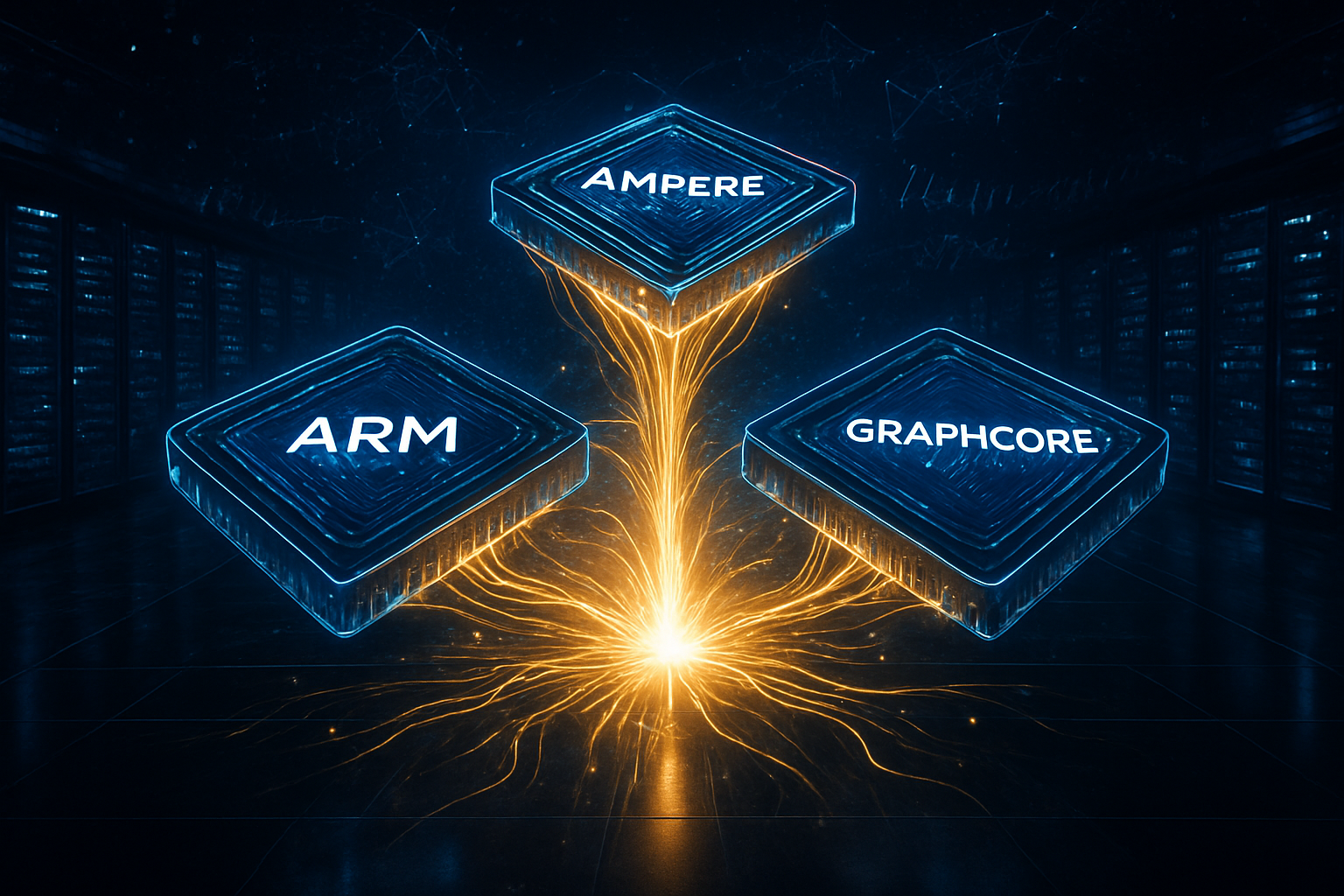
    The acquisition marks a strategic pivot for SoftBank, which has spent the last year consolidating its grip on the semiconductor supply chain. With the addition of Ampere, SoftBank now owns a formidable "Silicon Trinity" consisting of Arm Holdings plc (Nasdaq: ARM) for architecture, the recently acquired Graphcore for AI acceleration, and Ampere for server-side processing. This integration is designed to solve the massive power and efficiency bottlenecks currently plaguing hyperscale data centers as they struggle to meet the insatiable compute demands of generative AI and emerging autonomous systems.

    The Technical Edge: 512 Cores and the Death of x86 Dominance

    At the heart of this acquisition is Ampere’s revolutionary "cloud-native" processor architecture. Unlike traditional incumbents like Intel Corporation (Nasdaq: INTC) and Advanced Micro Devices, Inc. (Nasdaq: AMD), which have spent decades refining the x86 architecture for general-purpose computing, Ampere built its chips from the ground up using the ARM instruction set. The technical crowning jewel of the deal is the "AmpereOne Aurora," a massive 512-core processor slated for widespread deployment in 2026. This chip utilizes custom-designed cores that prioritize predictable performance and high-density throughput, allowing data centers to pack more processing power into a smaller physical footprint.

    The technical distinction lies in Ampere’s ability to handle "AI inference" workloads—the process of running trained AI models—with significantly higher efficiency than traditional CPUs. While NVIDIA Corporation (Nasdaq: NVDA) GPUs remain the gold standard for training large language models, those GPUs require powerful, energy-efficient CPUs to act as "host" processors to manage data flow. Ampere’s ARM-based designs eliminate the "IO bottleneck" often found in x86 systems, ensuring that expensive AI accelerators aren't left idling while waiting for data.

    Industry experts have noted that the AmpereOne Aurora’s performance-per-watt is nearly double that of current-generation x86 server chips. In an era where power availability has become the primary constraint for AI expansion, this efficiency is not just a cost-saving measure but a fundamental requirement for scaling. The AI research community has largely reacted with optimism, noting that a standardized ARM-based server platform could simplify software development for AI researchers who are increasingly moving away from hardware-specific optimizations.

    A Strategic Masterstroke in the AI Arms Race

    The market implications of this deal are profound, particularly for the major cloud service providers. Oracle Corporation (NYSE: ORCL), an early backer of Ampere, has already integrated these chips deeply into its cloud infrastructure, and the acquisition ensures a stable, SoftBank-backed roadmap for other giants like Microsoft Corporation (Nasdaq: MSFT) and Alphabet Inc. (Nasdaq: GOOGL). By controlling Ampere, SoftBank can now offer a unified hardware-software stack that bridges the gap between the mobile-centric ARM ecosystem and the high-performance computing required for AI.

    For competitors like Intel and AMD, the SoftBank-Ampere alliance represents a direct existential threat in the data center market. For years, x86 was the undisputed king of the server room, but the AI boom has exposed its limitations in power efficiency and multi-core scalability. SoftBank’s ownership of Arm Holdings allows for "deep taping out" synergies, where the architectural roadmap of ARM can be co-developed with Ampere’s physical chip implementations. This creates a feedback loop that could allow SoftBank to bring AI-optimized silicon to market months or even years faster than traditional competitors.

    Furthermore, the acquisition positions SoftBank as a key player in "Project Stargate," the rumored $500 billion infrastructure initiative aimed at building the world's largest AI supercomputers. With Ampere chips serving as the primary compute host, SoftBank is no longer just a supplier of intellectual property; it is the architect of the physical infrastructure upon which the future of AI will be built. This strategic positioning gives Masayoshi Son immense leverage over the direction of the entire AI industry.

    Energy, Sovereignty, and the Broader AI Landscape

    Beyond the balance sheets, the SoftBank-Ampere deal addresses the growing global concern over energy consumption in the AI era. As AI models grow in complexity, the carbon footprint of the data centers that house them has come under intense scrutiny. Ampere’s "Sustainable Compute" philosophy aligns with a broader industry trend toward "Green AI." By reducing the power required for inference, SoftBank is positioning itself as the "responsible" choice for governments and corporations under pressure to meet ESG (Environmental, Social, and Governance) targets.

    This acquisition also touches on the sensitive issue of "technological sovereignty." As nations race to build their own domestic AI capabilities, the ability to access high-performance, non-x86 hardware becomes a matter of national security. SoftBank’s global footprint and its base in Japan provide a neutral alternative to the US-centric dominance of Intel and NVIDIA, potentially opening doors for massive infrastructure projects in Europe, the Middle East, and Asia.

    However, the consolidation of such critical technology under one roof has raised eyebrows among antitrust advocates. With SoftBank owning the architecture (ARM), the server chips (Ampere), and the accelerators (Graphcore), there are concerns about a "walled garden" effect. Critics argue that this level of vertical integration could stifle innovation from smaller chip startups that rely on ARM licenses but now find themselves competing directly with their licensor’s parent company.

    The Horizon: From Inference to Autonomy

    Looking ahead, the integration of Ampere into the SoftBank ecosystem is expected to accelerate the development of "Edge AI"—bringing powerful AI capabilities out of the data center and into robots, autonomous vehicles, and industrial IoT devices. The near-term focus will be on the 2026 rollout of the 512-core Aurora chips, but the long-term vision involves a seamless compute fabric where a single architecture scales from a smartwatch to a massive AI supercluster.

    The biggest challenge facing SoftBank will be the execution of this integration. Merging the corporate cultures of a British IP firm (ARM), a British AI startup (Graphcore), and a Silicon Valley chip designer (Ampere) under a Japanese conglomerate is a monumental task. Furthermore, the industry is watching closely to see how SoftBank manages its relationship with other ARM licensees who may now view the company as a direct competitor rather than a neutral partner.

    A New Era for AI Hardware

    The acquisition of Ampere Computing for $6.5 billion is more than just a line item in SoftBank’s portfolio; it is a declaration of intent. It marks the end of the "software-first" era of AI and the beginning of the "infrastructure-first" era. By securing the most efficient server technology on the market, SoftBank has insured itself against the volatility of the AI software market and anchored its future in the physical reality of silicon and power.

    As we move into 2026, the industry will be watching for the first "Trinity" systems—servers that combine ARM architecture, Ampere CPUs, and Graphcore accelerators into a single, optimized unit. If Masayoshi Son’s gamble pays off, the "Silicon Trinity" could become the standard blueprint for the AI age, fundamentally altering the power dynamics of the technology world for decades to come.


    This content is intended for informational purposes only and represents analysis of current AI developments.

    TokenRing AI delivers enterprise-grade solutions for multi-agent AI workflow orchestration, AI-powered development tools, and seamless remote collaboration platforms.
    For more information, visit https://www.tokenring.ai/.

  • The RISC-V Revolution: Qualcomm’s Acquisition of Ventana Micro Systems Signals the End of the ARM-x86 Duopoly

    The RISC-V Revolution: Qualcomm’s Acquisition of Ventana Micro Systems Signals the End of the ARM-x86 Duopoly

    In a move that has sent shockwaves through the semiconductor industry, Qualcomm (NASDAQ: QCOM) officially announced its acquisition of Ventana Micro Systems on December 10, 2025. This strategic buyout, valued between $200 million and $600 million, marks a decisive pivot for the mobile chip giant as it seeks to break free from its long-standing architectural dependence on ARM (NASDAQ: ARM). By absorbing Ventana’s elite engineering team and its high-performance RISC-V processor designs, Qualcomm is positioning itself at the vanguard of the open-source hardware movement, fundamentally altering the competitive landscape of AI and data center computing.

    The acquisition is more than just a corporate merger; it is a declaration of independence. For years, Qualcomm has faced escalating legal and licensing friction with ARM, particularly following its acquisition of Nuvia and the subsequent development of the Oryon core. By shifting its weight toward RISC-V—an open-standard instruction set architecture (ISA)—Qualcomm is securing a "sovereign" CPU roadmap. This transition allows the company to bypass the restrictive licensing fees and design limitations of proprietary architectures, providing a clear path to integrate highly customized, AI-optimized cores across its entire product stack, from flagship smartphones to massive cloud-scale servers.

    Technical Prowess: The Veyron V2 and the Rise of "Brawny" RISC-V

    The centerpiece of this acquisition is Ventana’s Veyron V2 platform, a technology that has successfully transitioned RISC-V from simple microcontrollers to high-performance, "brawny" data-center-class processors. The Veyron V2 features a modular chiplet architecture, utilizing the Universal Chiplet Interconnect Express (UCIe) standard. This allows for up to 32 cores per chiplet, with clock speeds reaching a blistering 3.85 GHz. Each core is equipped with a 1.5MB L2 cache and access to a massive 128MB shared L3 cache, putting it on par with the most advanced server chips from Intel (NASDAQ: INTC) and AMD (NASDAQ: AMD).

    What sets the Veyron V2 apart is its native optimization for artificial intelligence. The architecture integrates a 512-bit vector unit (RVV 1.0) and a custom matrix math accelerator, delivering approximately 0.5 TOPS (INT8) of performance per GHz per core. This specialized hardware allows for significantly more efficient AI inference and training workloads compared to general-purpose x86 or ARM cores. By integrating these designs, Qualcomm can now combine its industry-leading Neural Processing Units (NPUs) and Adreno GPUs with high-performance RISC-V CPUs on a single package, creating a highly efficient, domain-specific AI engine.

    Initial reactions from the AI research community have been overwhelmingly positive. Experts note that the ability to add custom instructions to the RISC-V ISA—something strictly forbidden or heavily gated in x86 and ARM ecosystems—enables a level of hardware-software co-design previously reserved for the largest hyperscalers. "We are seeing the democratization of high-performance silicon," noted one industry analyst. "Qualcomm is no longer just a licensee; they are now the architects of their own destiny, with the power to tune their hardware specifically for the next generation of generative AI models."

    A Seismic Shift for Tech Giants and the AI Ecosystem

    The implications of this deal for the broader tech industry are profound. For ARM, the loss of one of its largest and most influential customers to an open-source rival is a significant blow. While ARM remains dominant in the mobile space for now, Qualcomm’s move provides a blueprint for other manufacturers to follow. If Qualcomm can successfully deploy RISC-V at scale, it could trigger a mass exodus of other chipmakers looking to reduce royalty costs and gain greater design flexibility. This puts immense pressure on ARM to rethink its licensing models and innovate faster to maintain its market share.

    For the data center and cloud markets, the Qualcomm-Ventana union introduces a formidable new competitor. Companies like Amazon (NASDAQ: AMZN) and Google (NASDAQ: GOOGL) have already begun developing their own custom silicon to handle AI workloads. Qualcomm’s acquisition allows it to offer a standardized, high-performance RISC-V platform that these cloud providers can adopt or customize, potentially disrupting the dominance of Intel and AMD in the server room. Startups in the AI space also stand to benefit, as the proliferation of RISC-V designs lowers the barrier to entry for creating specialized hardware for niche AI applications.

    Furthermore, the strategic advantage for Qualcomm lies in its ability to scale this technology across multiple sectors. Beyond mobile and data centers, the company is already a key player in the automotive industry through its Snapdragon Digital Chassis. By leveraging RISC-V, Qualcomm can provide automotive manufacturers with highly customizable, long-lifecycle chips that aren't subject to the shifting corporate whims of a proprietary ISA owner. This move strengthens the Quintauris joint venture—a collaboration between Qualcomm, Bosch, Infineon (OTC: IFNNY), Nordic, and NXP (NASDAQ: NXPI)—which aims to make RISC-V the standard for the next generation of software-defined vehicles.

    Geopolitics, Sovereignty, and the "Linux of Hardware"

    On a wider scale, the rapid adoption of RISC-V represents a shift toward technological sovereignty. In an era of increasing trade tensions and export controls, nations in Europe and Asia are looking to RISC-V as a way to ensure their tech industries remain resilient. Because RISC-V is an open standard maintained by a neutral foundation in Switzerland, it is not subject to the same geopolitical pressures as American-owned x86 or UK-based ARM. Qualcomm’s embrace of the architecture lends immense credibility to this movement, signaling that RISC-V is ready for the most demanding commercial applications.

    The comparison to the rise of Linux in the 1990s is frequently cited by industry observers. Just as Linux broke the monopoly of proprietary operating systems and became the backbone of the modern internet, RISC-V is poised to become the "Linux of hardware." This shift from general-purpose compute to domain-specific AI acceleration is the primary driver. In the "AI Era," the most efficient way to run a Large Language Model (LLM) is not on a chip designed for general office tasks, but on a chip designed specifically for matrix multiplication and high-bandwidth memory access. RISC-V’s open nature makes this level of specialization possible for everyone, not just the tech elite.

    However, challenges remain. While the hardware is maturing rapidly, the software ecosystem is still catching up. The RISC-V Software Ecosystem (RISE) project, backed by industry heavyweights, has made significant strides in ensuring that the Linux kernel, compilers, and AI frameworks like PyTorch and TensorFlow run seamlessly on RISC-V. But achieving the same level of "plug-and-play" compatibility that x86 has enjoyed for decades will take time. There are also concerns about fragmentation; with everyone able to add custom instructions, the industry must work hard to ensure that software remains portable across different RISC-V implementations.

    The Road Ahead: 2026 and Beyond

    Looking toward the near future, the roadmap for Qualcomm and Ventana is ambitious. Following the integration of the Veyron V2, the industry is already anticipating the Veyron V3, slated for a late 2026 or early 2027 release. This next-generation core is expected to push clock speeds beyond 4.2 GHz and introduce native support for FP8 data types, a critical requirement for the next wave of generative AI training. We can also expect to see the first RISC-V-based cloud instances from major providers by the end of 2026, offering a cost-effective alternative for AI inference at scale.

    In the consumer space, the first mass-produced vehicles featuring RISC-V central computers are projected to hit the road in 2026. These vehicles will benefit from the high efficiency and customization that the Qualcomm-Ventana technology provides, handling everything from advanced driver-assistance systems (ADAS) to in-cabin infotainment. As the software ecosystem matures, we may even see the first RISC-V-powered laptops and tablets, challenging the established order in the personal computing market.

    The ultimate goal is a seamless, AI-native compute fabric that spans from the smallest sensor to the largest data center. The challenges of software fragmentation and ecosystem maturity are significant, but the momentum behind RISC-V appears unstoppable. As more companies realize the benefits of architectural freedom, the "RISC-V era" is no longer a distant possibility—it is the current reality of the semiconductor industry.

    A New Era for Silicon

    The acquisition of Ventana Micro Systems by Qualcomm will likely be remembered as a watershed moment in the history of computing. It marks the point where open-source hardware moved from the fringes of the industry to the very center of the AI revolution. By choosing RISC-V, Qualcomm has not only solved its immediate licensing problems but has also positioned itself to lead a global shift toward more efficient, customizable, and sovereign silicon.

    As we move through 2026, the key metrics to watch will be the performance of the first Qualcomm-branded RISC-V chips in real-world benchmarks and the speed at which the software ecosystem continues to expand. The duopoly of ARM and x86, which has defined the tech industry for over thirty years, is finally facing a credible, open-source challenger. For developers, manufacturers, and consumers alike, this competition promises to accelerate innovation and lower costs, ushering in a new age of AI-driven technological advancement.


    This content is intended for informational purposes only and represents analysis of current AI developments.

    TokenRing AI delivers enterprise-grade solutions for multi-agent AI workflow orchestration, AI-powered development tools, and seamless remote collaboration platforms.
    For more information, visit https://www.tokenring.ai/.
  • Oracle’s ARM Revolution: How A4 Instances and AmpereOne Are Redefining the AI Cloud

    Oracle’s ARM Revolution: How A4 Instances and AmpereOne Are Redefining the AI Cloud

    In a decisive move to reshape the economics of the generative AI era, Oracle (NYSE: ORCL) has officially launched its OCI Ampere A4 Compute instances. Powered by the high-density AmpereOne M processors, these instances represent a massive bet on ARM architecture as the primary engine for sustainable, cost-effective AI inferencing. By decoupling performance from the skyrocketing power demands of traditional x86 silicon, Oracle is positioning itself as the premier destination for enterprises looking to scale AI workloads without the "GPU tax" or the environmental overhead of legacy data centers.

    The arrival of the A4 instances marks a strategic pivot in the cloud wars of late 2025. As organizations move beyond the initial hype of training massive models toward the practical reality of daily inferencing, the need for high-throughput, low-latency compute has never been greater. Oracle’s rollout, which initially spans key global regions including Ashburn, Frankfurt, and London, offers a blueprint for how "silicon neutrality" and open-market ARM designs can challenge the proprietary dominance of hyperscale competitors.

    The Engineering of Efficiency: Inside the AmpereOne M Architecture

    At the heart of the A4 instances lies the AmpereOne M processor, a custom-designed ARM chip that prioritizes core density and predictable performance. Unlike traditional x86 processors from Intel (NASDAQ: INTC) or AMD (NASDAQ: AMD) that rely on simultaneous multithreading (SMT), AmpereOne utilizes single-threaded cores. This design choice eliminates the "noisy neighbor" effect, ensuring that each of the 96 physical cores in a Bare Metal A4 instance delivers consistent, isolated performance. With clock speeds locked at a steady 3.6 GHz—a 20% jump over the previous generation—the A4 is built for the high-concurrency demands of modern cloud-native applications.

    The technical specifications of the A4 are tailored for memory-intensive AI tasks. The architecture features a 12-channel DDR5 memory subsystem, providing a staggering 143 GB/s of bandwidth. This is complemented by 2 MB of private L2 cache per core and a 64 MB system-level cache, significantly reducing the latency bottlenecks that often plague large-scale AI models. For networking, the instances support up to 100 Gbps, making them ideal for distributed inference clusters and high-performance computing (HPC) simulations.

    The industry reaction has been overwhelmingly positive, particularly regarding the A4’s ability to handle CPU-based AI inferencing. Initial benchmarks shared by Oracle and independent researchers show that for models like Llama 3.1 8B, the A4 instances offer an 80% to 83% price-performance advantage over NVIDIA (NASDAQ: NVDA) A10 GPU-based setups. This shift allows developers to run sophisticated AI agents and chatbots on general-purpose compute, freeing up expensive H100 or B200 GPUs for more intensive training tasks.

    Shifting Alliances and the New Cloud Hierarchy

    Oracle’s strategy with the A4 instances is unique among the "Big Three" cloud providers. While Amazon (NASDAQ: AMZN) and Alphabet (NASDAQ: GOOGL) have focused on vertically integrated, proprietary ARM chips like Graviton and Axion, Oracle has embraced a model of "silicon neutrality." Earlier in 2025, Oracle sold its significant minority stake in Ampere Computing to SoftBank Group (TYO: 9984) for $6.5 billion. This divestiture allows Oracle to maintain a diverse hardware ecosystem, offering customers the best of NVIDIA, AMD, Intel, and Ampere without the conflict of interest inherent in owning the silicon designer.

    This neutrality provides a strategic advantage for startups and enterprise heavyweights alike. Companies like Uber have already migrated over 20% of their OCI capacity to Ampere instances, citing a 30% reduction in power consumption and substantial cost savings. By providing a high-performance ARM option that is also available on the open market to other OEMs, Oracle is fostering a more competitive and flexible semiconductor landscape. This contrasts sharply with the "walled garden" approach of AWS, where Graviton performance is locked exclusively to their own cloud.

    The competitive implications are profound. As AWS prepares to scale its Graviton5 instances and Google pushes its Axion chips, Oracle is competing on pure density and price. At $0.0138 per OCPU-hour, the A4 instances are positioned to undercut traditional x86 cloud pricing by nearly 50%. This aggressive pricing is a direct challenge to the market share of legacy chipmakers, signaling a transition where ARM is no longer a niche alternative but the standard for the modern data center.

    The Broader Landscape: Solving the AI Energy Crisis

    The launch of the A4 instances arrives at a critical juncture for the global energy grid. By late 2025, data center power consumption has become a primary bottleneck for AI expansion, with the industry consuming an estimated 460 TWh annually. The AmpereOne architecture addresses this "AI energy crisis" by delivering 50% to 60% better performance-per-watt than equivalent x86 chips. This efficiency is not just an environmental win; it is a prerequisite for the next phase of AI scaling, where power availability often dictates where and how fast a cloud region can grow.

    This development mirrors previous milestones in the semiconductor industry, such as the shift from mainframes to x86 or the mobile revolution led by ARM. However, the stakes are higher in the AI era. The A4 instances represent the democratization of high-performance compute, moving away from the "black box" of proprietary accelerators toward a more transparent, programmable, and efficient architecture. By optimizing the entire software stack through the Ampere AI Optimizer (AIO), Oracle is proving that ARM can match the "ease of use" that has long kept developers tethered to x86.

    However, the shift is not without its concerns. The rapid transition to ARM requires a significant investment in software recompilation and optimization. While tools like OCI AI Blueprints have simplified this process, some legacy enterprise applications remain stubborn. Furthermore, as the world becomes increasingly dependent on ARM-based designs, the geopolitical stability of the semiconductor supply chain—particularly the licensing of ARM IP—remains a point of long-term strategic anxiety for the industry.

    The Road Ahead: 192 Cores and Beyond

    Looking toward 2026, the trajectory for Oracle and Ampere is one of continued scaling. While the current A4 Bare Metal instances top out at 96 cores, the underlying AmpereOne M silicon is capable of supporting up to 192 cores in a single-socket configuration. Future iterations of OCI instances are expected to unlock this full density, potentially doubling the throughput of a single rack and further driving down the cost of AI inferencing.

    We also expect to see tighter integration between ARM CPUs and specialized AI accelerators. The future of the data center is likely a "heterogeneous" one, where Ampere CPUs handle the complex logic and data orchestration while interconnected GPUs or TPUs handle the heavy tensor math. Experts predict that the next two years will see a surge in "ARM-first" software development, where the performance-per-watt benefits become so undeniable that x86 is relegated to legacy maintenance roles.

    A Final Assessment of the ARM Ascent

    The launch of Oracle’s A4 instances is more than just a product update; it is a declaration of independence from the power-hungry paradigms of the past. By leveraging the AmpereOne M architecture, Oracle (NYSE: ORCL) has delivered a platform that balances the raw power needed for generative AI with the fiscal and environmental responsibility required by the modern enterprise. The success of early adopters like Uber and Oracle Red Bull Racing serves as a powerful proof of concept for the ARM-based cloud.

    As we look toward the final weeks of 2025 and into the new year, the industry will be watching the adoption rates of the A4 instances closely. If Oracle can maintain its price-performance lead while expanding its "silicon neutral" ecosystem, it may well force a fundamental realignment of the cloud market. For now, the message is clear: the future of AI is not just about how much data you can process, but how efficiently you can do it.


    This content is intended for informational purposes only and represents analysis of current AI developments.

    TokenRing AI delivers enterprise-grade solutions for multi-agent AI workflow orchestration, AI-powered development tools, and seamless remote collaboration platforms.
    For more information, visit https://www.tokenring.ai/.
  • Silicon Sovereignty: China’s Strategic Pivot to RISC-V Accelerates Amid US Tech Blockades

    Silicon Sovereignty: China’s Strategic Pivot to RISC-V Accelerates Amid US Tech Blockades

    As of late 2025, the global semiconductor landscape has reached a definitive tipping point. Driven by increasingly stringent US export controls that have severed access to high-end proprietary architectures, China has executed a massive, state-backed migration to RISC-V. This open-standard instruction set architecture (ISA) has transformed from a niche academic project into the backbone of China’s "Silicon Sovereignty" strategy, providing a critical loophole in the Western containment of Chinese AI and high-performance computing.

    The immediate significance of this shift cannot be overstated. By leveraging RISC-V, Chinese tech giants are no longer beholden to the licensing whims of Western firms or the jurisdictional reach of US export laws. This pivot has not only insulated the Chinese domestic market from further sanctions but has also sparked a rapid evolution in AI hardware design, where hardware-software co-optimization is now being used to bridge the performance gap left by the absence of top-tier Western GPUs.

    Technical Milestones and the Rise of High-Performance RISC-V

    The technical maturation of RISC-V in 2025 is headlined by Alibaba (NYSE: BABA) and its chip-design subsidiary, T-Head. In March 2025, the company unveiled the XuanTie C930, a server-grade 64-bit multi-core processor that represents a quantum leap for the architecture. Unlike its predecessors, the C930 is fully compatible with the RVA23 profile and features dual 512-bit vector units and an integrated 8 TOPS Matrix engine specifically designed for AI workloads. This allows the chip to compete directly with mid-range server offerings from Intel (NASDAQ: INTC) and Advanced Micro Devices (NASDAQ: AMD), achieving performance levels previously thought impossible for an open-source ISA.

    Parallel to private sector efforts, the Chinese Academy of Sciences (CAS) has reached a major milestone with Project XiangShan. The 2025 release of the "Kunminghu" architecture—often described as the "Linux of processors"—targets clock speeds of 3GHz. The Kunminghu core is designed to match the performance of the ARM (NASDAQ: ARM) Neoverse N2, providing a high-performance, royalty-free alternative for data centers and cloud infrastructure. This development is crucial because it proves that open-source hardware can achieve the same IPC (instructions per cycle) efficiency as the most advanced proprietary designs.

    What sets this new generation of RISC-V chips apart is their native support for emerging AI data formats. Following the breakthrough success of models like DeepSeek-V3 earlier this year, Chinese designers have integrated support for formats like UE8M0 FP8 directly into the silicon. This level of hardware-software synergy allows for highly efficient AI inference on domestic hardware, effectively bypassing the need for restricted NVIDIA (NASDAQ: NVDA) H100 or H200 accelerators. Industry experts have noted that while individual RISC-V cores may still lag behind the absolute peak of US silicon, the ability to customize instructions for specific AI kernels gives Chinese firms a unique "tailor-made" advantage.

    Initial reactions from the global research community have been a mix of awe and anxiety. While proponents of open-source technology celebrate the rapid advancement of the RISC-V ecosystem, industry analysts warn that the fragmentation of the hardware world is accelerating. The move of RISC-V International to Switzerland in 2020 has proven to be a masterstroke of jurisdictional engineering, ensuring that the core specifications remain beyond the reach of the US Department of Commerce, even as Chinese contributions to the standard now account for nearly 50% of the organization’s premier membership.

    Disrupting the Global Semiconductor Hierarchy

    The strategic expansion of RISC-V is sending shockwaves through the established tech hierarchy. ARM Holdings (NASDAQ: ARM) is perhaps the most vulnerable, as its primary revenue engine—licensing high-performance IP—is being directly cannibalized in one of its largest markets. With the US tightening controls on ARM’s Neoverse V-series cores due to their US-origin technology, Chinese firms like Tencent (HKG: 0700) and Baidu (NASDAQ: BIDU) are shifting their cloud-native development to RISC-V to ensure long-term supply chain security. This represents a permanent loss of market share for Western IP providers that may never be recovered.

    For the "Big Three" of US silicon—NVIDIA (NASDAQ: NVDA), Intel (NASDAQ: INTC), and AMD (NASDAQ: AMD)—the rise of RISC-V creates a two-front challenge. First, it accelerates the development of domestic Chinese AI accelerators that serve as "good enough" substitutes for export-restricted GPUs. Second, it creates a competitive pressure in the Internet of Things (IoT) and automotive sectors, where RISC-V’s modularity and lack of licensing fees make it an incredibly attractive option for global manufacturers. Companies like Qualcomm (NASDAQ: QCOM) and Western Digital (NASDAQ: WDC) are now forced to balance their participation in the open RISC-V ecosystem with the shifting political landscape in Washington.

    The disruption extends beyond hardware to the entire software stack. The aggressive optimization of the openEuler and OpenHarmony operating systems for RISC-V architecture has created a robust domestic ecosystem. As Chinese tech giants migrate their LLMs, such as Baidu’s Ernie Bot, to run on massive RISC-V clusters, the strategic advantage once held by NVIDIA’s CUDA platform is being challenged by a "software-defined hardware" approach. This allows Chinese startups to innovate at the compiler and kernel levels, potentially creating a parallel AI economy that is entirely independent of Western proprietary standards.

    Market positioning is also shifting as RISC-V becomes a symbol of "neutral" technology for the Global South. By championing an open standard, China is positioning itself as a leader in a more democratic hardware landscape, contrasting its approach with the "walled gardens" of US tech. This has significant implications for market expansion in regions like Southeast Asia and the Middle East, where countries are increasingly wary of becoming collateral damage in the US-China tech war and are seeking hardware platforms that cannot be deactivated by a foreign power.

    Geopolitics and the "Open-Source Loophole"

    The wider significance of China’s RISC-V surge lies in its challenge to the effectiveness of modern export controls. For decades, the US has controlled the tech landscape by bottlenecking key proprietary technologies. However, RISC-V represents a new paradigm: a globally collaborative, open-source standard that no single nation can truly "own" or restrict. This has led to a heated debate in Washington over the so-called "open-source loophole," where lawmakers argue that US participation in RISC-V International is inadvertently providing China with the blueprints for advanced military and AI capabilities.

    This development fits into a broader trend of "technological decoupling," where the world is splitting into two distinct hardware and software ecosystems—a "splinternet" of silicon. The concern among global tech leaders is that if the US moves to sanction the RISC-V standard itself, it would destroy the very concept of open-source collaboration, forcing a total fracture of the global semiconductor industry. Such a move would likely backfire, as it would isolate US companies from the rapid innovations occurring within the Chinese RISC-V community while failing to stop China’s progress.

    Comparisons are being drawn to previous milestones like the rise of Linux in the 1990s. Just as Linux broke the monopoly of proprietary operating systems, RISC-V is poised to break the duopoly of x86 and ARM. However, the stakes are significantly higher in 2025, as the architecture is being used to power the next generation of autonomous weapons, surveillance systems, and frontier AI models. The tension between the benefits of open innovation and the requirements of national security has never been more acute.

    Furthermore, the environmental and economic impacts of this shift are starting to emerge. RISC-V’s modular nature allows for more energy-efficient, application-specific designs. As China builds out massive "Green AI" data centers powered by custom RISC-V silicon, the global industry may be forced to adopt these open standards simply to remain competitive in power efficiency. The irony is that US export controls, intended to slow China down, may have instead forced the creation of a leaner, more efficient, and more resilient Chinese tech sector.

    The Horizon: SAFE Act and the Future of Open Silicon

    Looking ahead, the primary challenge for the RISC-V ecosystem will be the legislative response from the West. In December 2025, the US introduced the Secure and Feasible Export of Chips (SAFE) Act, which specifically targets high-performance extensions to the RISC-V standard. If passed, the act could restrict US companies from contributing advanced vector or matrix-multiplication instructions to the global standard if those contributions are deemed to benefit "adversary" nations. This could lead to a "forking" of the RISC-V ISA, with one version used in the West and another, more AI-optimized version developed in China.

    In the near term, expect to see the first wave of RISC-V-powered consumer laptops and high-end automotive cockpits hitting the Chinese market. These devices will serve as a proof-of-concept for the architecture’s versatility beyond the data center. The long-term goal for Chinese planners is clear: total vertical integration. From the instruction set up to the application layer, China aims to eliminate every single point of failure that could be exploited by foreign sanctions. The success of this endeavor depends on whether the global developer community continues to support RISC-V as a neutral, universal standard.

    Experts predict that the next major battleground will be the "software gap." While the hardware is catching up, the maturity of libraries, debuggers, and optimization tools for RISC-V still lags behind ARM and x86. However, with thousands of Chinese engineers now dedicated to the RISC-V ecosystem, this gap is closing faster than anticipated. The next 12 to 18 months will be critical in determining if RISC-V can achieve the "critical mass" necessary to become the world’s third major computing platform, potentially relegated only by the severity of future geopolitical interventions.

    A New Era of Global Computing

    The strategic expansion of RISC-V in China marks a definitive chapter in AI history. What began as an academic exercise at UC Berkeley has become the centerpiece of a geopolitical struggle for technological dominance. China’s successful pivot to RISC-V demonstrates that in an era of global connectivity, proprietary blockades are increasingly difficult to maintain. The development of the XuanTie C930 and the XiangShan project are not just technical achievements; they are declarations of independence from a Western-centric hardware order.

    The key takeaway for the industry is that the "open-source genie" is out of the bottle. Efforts to restrict RISC-V may only serve to accelerate its development in regions outside of US control, ultimately weakening the influence of American technology standards. As we move into 2026, the significance of this development will be measured by how many other nations follow China’s lead in adopting RISC-V to safeguard their own digital futures.

    In the coming weeks and months, all eyes will be on the US Congress and the final language of the SAFE Act. Simultaneously, the industry will be watching for the first benchmarks of DeepSeek’s next-generation models running natively on RISC-V clusters. These results will tell us whether the "Silicon Sovereignty" China seeks is a distant dream or a present reality. The era of the proprietary hardware monopoly is ending, and the age of open silicon has truly begun.


    This content is intended for informational purposes only and represents analysis of current AI developments.

    TokenRing AI delivers enterprise-grade solutions for multi-agent AI workflow orchestration, AI-powered development tools, and seamless remote collaboration platforms.
    For more information, visit https://www.tokenring.ai/.