The year 2025 marks a profound inflection point where Artificial Intelligence (AI) has transcended its traditional role in software development to become an indispensable, transformative force across the entire spectrum of Science, Technology, Engineering, and Mathematics (STEM). No longer merely a tool for automating programming tasks, AI is now a co-investigator, a co-partner, and a foundational element embedded in the very processes of scientific discovery, design, and operational efficiencies. This paradigm shift is accelerating innovation at an unprecedented rate, promising breakthroughs in fields from materials science to personalized medicine, and fundamentally redefining the landscape of research and development.
This transformation is characterized by AI's ability to not only process and analyze vast datasets but also to generate novel hypotheses, design complex experiments, and even create entirely new materials and molecules. The immediate significance lies in the drastic reduction of discovery timelines and costs, turning processes that once took years or decades into mere weeks or days. This widespread integration of AI is not just enhancing existing methods; it is fundamentally reshaping the scientific method itself, ushering in an era of accelerated progress and unprecedented problem-solving capabilities across all major STEM disciplines.
AI's Technical Spearhead: Driving Innovation Across Scientific Frontiers
The technical advancements propelling AI's impact in STEM are sophisticated and diverse, pushing the boundaries of what's scientifically possible. These capabilities represent a significant departure from previous, often laborious, approaches and are met with a mixture of excitement and cautious optimism from the global research community.
In materials science, generative AI models like Microsoft's (NASDAQ: MSFT) MatterGen and technologies from Google DeepMind (NASDAQ: GOOGL) are at the forefront, capable of designing novel materials with predefined properties such as specific chemical compositions, mechanical strengths, or electronic characteristics. These diffusion transformer architectures can explore a significantly larger design space than traditional screening methods. Furthermore, Explainable AI (XAI) is being integrated to help researchers understand how different elemental compositions influence material properties, providing crucial scientific insights beyond mere predictions. The advent of "self-driving labs," such as Polybot at Argonne National Laboratory and the A-Lab at Lawrence Livermore National Lab, combines robotics with AI to autonomously design, execute, and analyze experiments, drastically accelerating discovery cycles by at least a factor of ten.
Biology, particularly drug discovery and genomics, has been revolutionized by AI. DeepMind and Isomorphic Labs' (NASDAQ: GOOGL) AlphaFold 3 (AF3), released in May 2024, is a Diffusion Transformer model that predicts the 3D structures and interactions of proteins with DNA, RNA, small molecules, and other biomolecules with unprecedented accuracy. This capability extends to modeling complex molecular systems beyond single proteins, significantly outperforming traditional docking methods. AI-based generative models like Variational Autoencoders (VAEs) and Recurrent Neural Networks (RNNs) are now central to de novo drug design, inventing entirely new drug molecules from scratch by learning complex structure-property patterns. This shifts the paradigm from screening existing compounds to designing candidates with desired properties, reducing development from years to months.
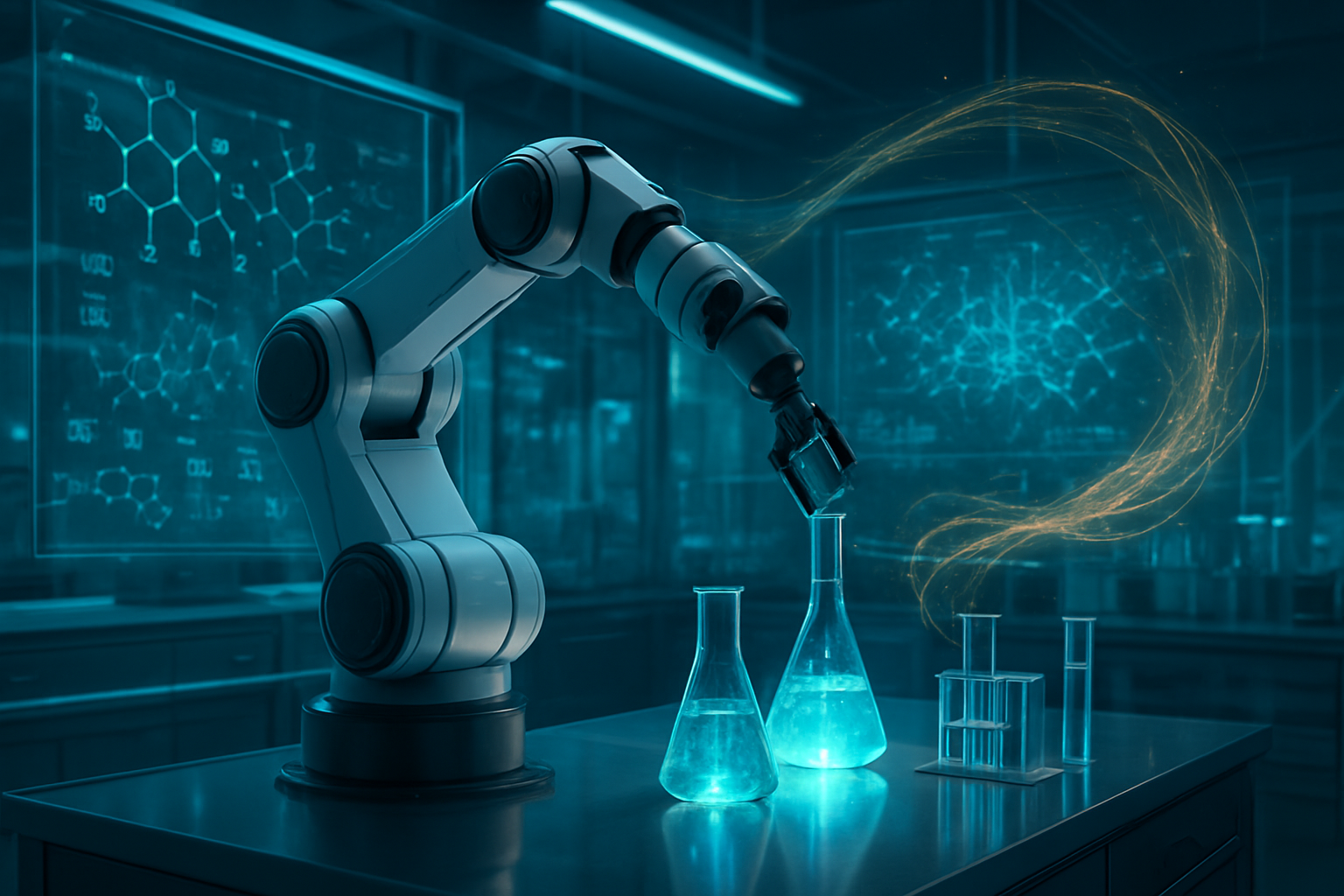
In chemistry, AI-driven robotic platforms are functioning as both the "brains" for experiment design and reaction prediction, and the "hands" for executing high-precision chemical operations. These platforms integrate flow chemistry automation and machine learning-driven optimization to dynamically adjust reaction conditions in real-time. Generative AI models are proposing novel and complex chemical reaction pathways, as exemplified by Deep Principle's ReactGen, enabling efficient and innovative synthesis route discovery. These advancements differ from previous empirical, trial-and-error methods by automating complex tasks, enhancing reproducibility, and enabling data-driven decisions that dramatically accelerate chemical space exploration, leading to improved yields and reduced waste.
For engineering, AI-powered generative design allows engineers to provide design criteria and constraints, and AI algorithms autonomously explore vast design spaces, generating optimized designs in minutes rather than months. Tools like Autodesk's (NASDAQ: ADSK) Fusion 360 leverage this to produce highly optimized geometries for performance, cost, and manufacturability. AI-based simulations accurately forecast product behavior under various real-world conditions before physical prototypes are built, while digital twins integrated with predictive AI analyze real-time data to predict failures and optimize operations. These methods replace sequential, manual iterations and costly physical prototyping with agile, AI-driven solutions, transforming maintenance from reactive to proactive. The initial reaction from the AI research community is one of overwhelming excitement, tempered by concerns about data quality, interpretability, and the ethical implications of such powerful generative capabilities.
Corporate Chessboard: AI's Strategic Impact on Tech Giants and Startups
The integration of AI into STEM is fundamentally reshaping the competitive landscape, creating immense opportunities for specialized AI companies and startups, while solidifying the strategic advantages of tech giants.
Specialized AI companies are at the vanguard, developing core AI technologies and specialized applications. Firms like OpenAI and Anthropic continue to lead in large language models and responsible AI development, providing foundational technologies that permeate scientific research. Cradle specializes in AI-powered protein design for drug discovery, leveraging advanced algorithms to accelerate therapeutic development. Citrine Informatics is a key player in materials informatics, using active learning strategies to propose materials for experimental validation. These companies benefit from high demand for their innovative solutions, attracting significant venture capital and driving the "AI-native" approach to scientific discovery.
Tech giants are making massive investments to maintain their market leadership. NVIDIA (NASDAQ: NVDA) remains indispensable, providing the GPUs and CUDA platform essential for deep learning and complex simulations across all STEM industries. Alphabet (NASDAQ: GOOGL), through DeepMind and its AlphaFold breakthroughs in protein folding and GNoME for materials exploration, integrates AI deeply into its Google Cloud services. Microsoft (NASDAQ: MSFT) is a frontrunner, leveraging its partnership with OpenAI and embedding AI into Azure AI, GitHub Copilot, and Microsoft 365 Copilot, aiming to reshape enterprise AI solutions across engineering and scientific domains. Amazon (NASDAQ: AMZN) integrates AI into AWS for scientific computing and its retail operations for supply chain optimization. These giants benefit from their extensive resources, cloud infrastructure, and ability to acquire promising startups, further concentrating value at the top of the tech market.
A new wave of startups is emerging, addressing niche but high-impact problems within STEM. Gaia AI is leveraging AI and lidar for forestry management, speeding up tree measurement and wildfire risk mitigation. Displaid uses AI and wireless sensors for bridge monitoring, identifying structural anomalies 70% cheaper and three times more efficiently than existing methods. Eva is developing a digital twin platform to shorten AI model training times. These startups thrive by being agile, focusing on specific pain points, and often leveraging open-source AI models to lower barriers to entry. However, they face intense competition from tech giants and require substantial funding to scale their innovations. The potential for disruption to existing products and services is significant, as AI automates routine tasks, accelerates R&D, and enables the creation of entirely new materials and biological systems, challenging companies reliant on slower, conventional methods. Strategic advantages are gained by adopting "AI-native" architectures, focusing on innovation, prioritizing data quality, and forming strategic partnerships.
A New Scientific Epoch: Broader Significance and Ethical Imperatives
AI's profound transformation of STEM in 2025 marks a new epoch, fitting seamlessly into the broader AI landscape defined by generative AI, multimodal capabilities, and the maturation of AI as core infrastructure. This shift is not merely an incremental improvement but a fundamental redefinition of how scientific research is conducted, how knowledge is generated, and how technological advancements are achieved.
The broader impacts are overwhelmingly positive, promising an accelerated era of discovery and innovation. AI drastically speeds up data processing, pattern recognition, and decision-making, leading to faster breakthroughs in drug discovery, materials innovation, and fundamental scientific understanding. It enables personalized solutions, from medicine tailored to individual genetic makeup to customized educational experiences. AI also enhances efficiency and productivity by automating tedious tasks in research and lab work, freeing human scientists to focus on higher-order thinking and creative hypothesis generation. Crucially, AI plays a vital role in addressing global challenges, from combating climate change and optimizing energy consumption to developing sustainable practices and advancing space exploration.
However, this transformative power comes with potential concerns. Ethically, issues of algorithmic bias, lack of transparency in "black box" models, data privacy, and accountability in autonomous systems are paramount. The powerful capabilities of generative AI also raise questions about intellectual property and the potential for misuse, such as designing harmful molecules. Societally, job displacement due to automation and the reinforcement of power asymmetries, where AI development concentrates power in the hands of wealthy corporations, are significant worries. Economically, the substantial energy consumption of AI and the need for massive investment in infrastructure and specialized talent create barriers.
Compared to previous AI milestones, such as early expert systems or even the breakthroughs in image recognition and natural language processing of the past decade, AI in 2025 represents a shift from augmentation to partnership. Earlier AI largely supported human tasks; today's AI is an active collaborator, capable of generating novel hypotheses and driving autonomous experimentation. This move "beyond prediction to generation" means AI is directly designing new materials and molecules, rather than just analyzing existing ones. The maturation of the conversation around AI in STEM signifies that its implementation is no longer a question of "if," but "how fast" and "how effectively" it can deliver real value. This integration into core infrastructure, rather than being an experimental phase, fundamentally reshapes the scientific method itself.
The Horizon: Anticipating AI's Next Frontiers in STEM
Looking ahead from 2025, the trajectory of AI in STEM points towards an even deeper integration, with near-term developments solidifying its role as a foundational scientific infrastructure and long-term prospects hinting at AI becoming a true, autonomous scientific partner.
In the near term (2025-2030), we can expect the widespread adoption of generative AI for materials design, significantly cutting research timelines by up to 80% through the rapid design of novel molecules and reaction pathways. "Self-driving labs," combining AI and robotics for high-throughput experimentation, will become increasingly common, generating scientific data at unprecedented scales. In biology, digital twins of biological systems will be practical tools for simulating cellular behavior and drug responses, while AI continues to drastically reduce drug development costs and timelines. In chemistry, automated synthesis and reaction optimization using AI-powered retrosynthesis analysis will greatly speed up chemical production. For engineering, "AI-native software engineering" will see AI performing autonomous or semi-autonomous tasks across the software development lifecycle, and generative design will streamline CAD optimization. The global AI in chemistry market is predicted to reach $28 billion by 2025, and the AI-native drug discovery market is projected to reach $1.7 billion in 2025, signaling robust growth.
Long-term developments (beyond 2030) envision AI evolving into a comprehensive "AI Scientific Partner" capable of complex reasoning and hypothesis generation by analyzing vast, disparate datasets. Generative physical models, trained on fundamental scientific laws, will be able to create novel molecular structures and materials from scratch, inverting the traditional scientific method from hypothesis-and-experiment to goal-setting-and-generation. Embodied AI and autonomous systems will gain agency in the physical world through robotics, leading to highly intelligent systems capable of interacting with complex, unpredictable realities. Potential applications span accelerated discovery of new materials and drugs, highly personalized medicine, sustainable solutions for climate change and energy, and advanced engineering systems.
However, significant challenges remain. Data privacy and security, algorithmic bias, and the ethical implications of AI's potential misuse (e.g., designing bioweapons) require robust frameworks. The "black box" nature of many AI algorithms necessitates the development of Explainable AI (XAI) for scientific integrity. Workforce transformation and training are critical, as many routine STEM jobs will be automated, requiring new skills focused on human-AI collaboration. Experts predict that AI will transition from a tool to a fundamental co-worker, automating repetitive tasks and accelerating testing cycles. STEM professionals will need to integrate AI fluently, with hybrid careers blending traditional science with emerging tech. The most impactful AI professionals will combine deep technical expertise with broad systems-level thinking and a strong sense of purpose.
The Dawn of Autonomous Science: A Comprehensive Wrap-Up
The year 2025 definitively marks a new chapter in AI's history, where its influence extends far "beyond coding" to become an embedded, autonomous participant in the scientific process itself. The key takeaway is clear: AI has transitioned from being a mere computational tool to an indispensable co-creator, accelerating scientific discovery, revolutionizing research methodologies, and reshaping educational paradigms across STEM. This era is characterized by AI's ability to not only process and analyze vast datasets but also to generate novel hypotheses, design complex experiments, and even create entirely new materials and molecules, drastically reducing discovery timelines and costs.
This development is profoundly significant in AI history, representing a paradigm shift from AI merely augmenting human capabilities to becoming an indispensable collaborator and even a "co-creator" in scientific discovery. It signifies the culmination of breakthroughs in machine learning, natural language processing, and automated reasoning, fundamentally altering the operational landscape of STEM. The long-term impact promises an exponential acceleration in scientific and technological innovation, empowering us to tackle pressing global challenges more effectively. Human roles in STEM will evolve, shifting towards higher-level strategic thinking, complex problem-solving, and the sophisticated management of AI systems, with "prompt engineering" and understanding AI's limitations becoming core competencies.
In the coming weeks and months, watch for the further deployment of advanced multimodal AI systems, leading to more sophisticated applications across various STEM fields. Pay close attention to the increasing adoption and refinement of smaller, more specialized, and customizable AI models tailored for niche industry applications. The maturation of "agentic AI" models—autonomous systems designed to manage workflows and execute complex tasks—will be a defining trend. Observe new and transformative applications of AI in cutting-edge scientific research, including advanced materials discovery, fusion energy research, and engineering biology. Finally, monitor how educational institutions worldwide revise their STEM curricula to integrate AI ethics, responsible AI use, data literacy, and entrepreneurial skills, as well as the ongoing discussions and emerging regulatory frameworks concerning data privacy and intellectual property rights for AI-generated content.
This content is intended for informational purposes only and represents analysis of current AI developments.
TokenRing AI delivers enterprise-grade solutions for multi-agent AI workflow orchestration, AI-powered development tools, and seamless remote collaboration platforms.
For more information, visit https://www.tokenring.ai/.