As the global race for artificial intelligence supremacy accelerates, the underlying infrastructure supporting these "AI factories" has become the primary target for sophisticated cyber threats. In a significant move to fortify this infrastructure, Silicon Valley semiconductor pioneer Axiado has announced it has secured over $100 million in a Series C+ funding round. This massive injection of capital, led by Maverick Silicon and supported by a consortium of global investors including Prosperity7 Ventures—an affiliate of SoftBank Group (OTC: SFTBY)—and Samsung Electronics (KRX: 005930) via its Catalyst Fund, marks a pivotal moment in the transition from software-reliant security to proactive, hardware-anchored defense systems.
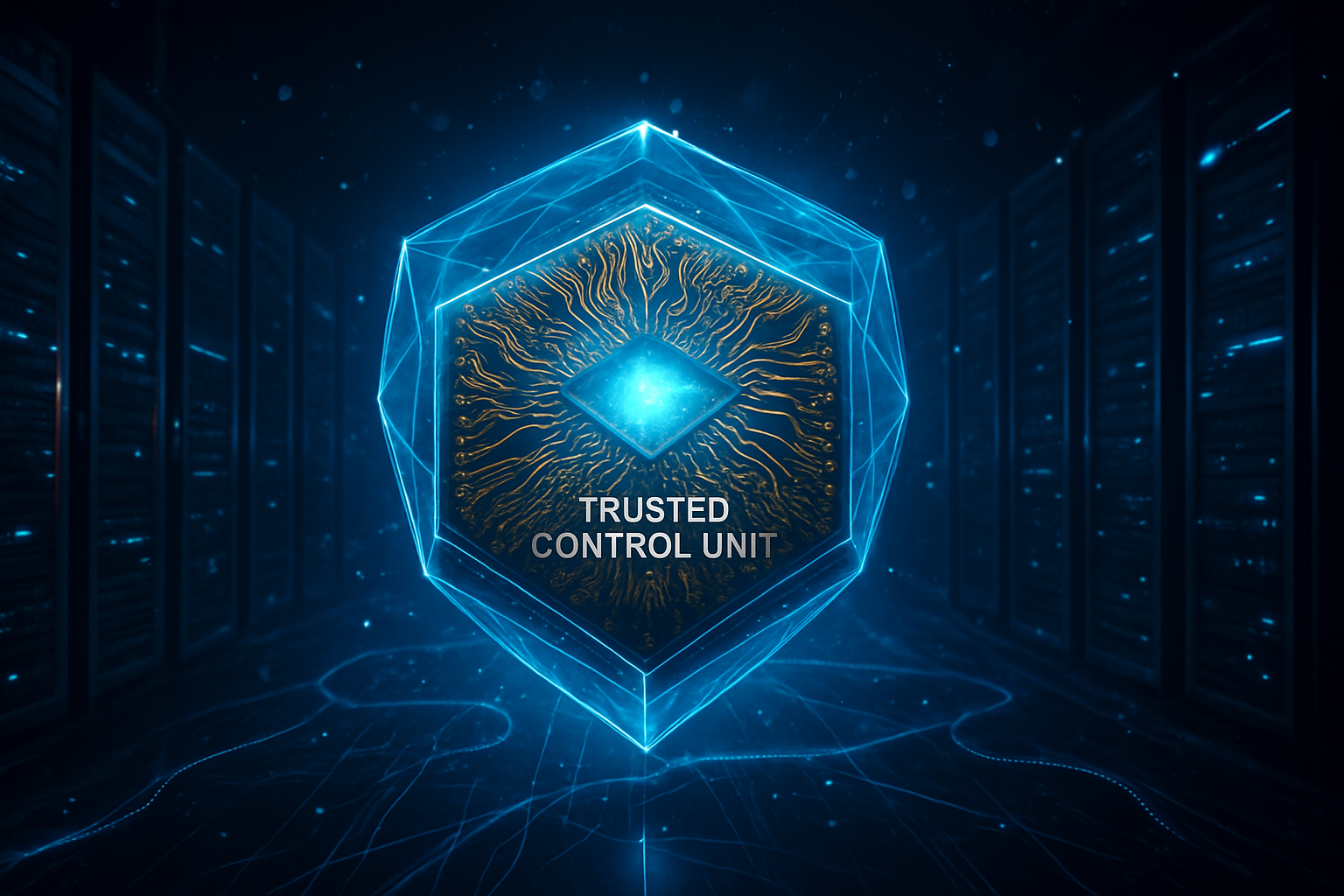
The significance of this development cannot be overstated. With trillions of dollars flowing into AI data centers, the industry has reached a breaking point where traditional security measures—often reactive and fragmented—are no longer sufficient to stop "machine-speed" attacks. Axiado’s latest funding round is a clear signal that the market is shifting toward a "Zero-Trust" hardware architecture, where security is not just an added layer of software but is baked directly into the silicon that manages the servers. This funding will scale the mass production of Axiado’s flagship Trusted Control/Compute Unit (TCU), aimed at securing the next generation of AI servers from the ground up.
The Evolution of the TCU: From Management to Proactive Defense
At the heart of Axiado’s technological breakthrough is the AX3080, the industry’s first "forensic-enabled" cybersecurity processor. For decades, server management was handled by a Baseboard Management Controller (BMC), often supplied by vendors like ASPEED Technology (TPE: 5274). These traditional BMCs were designed for remote monitoring, not for high-stakes security. Axiado’s TCU completely reimagines this role by consolidating the functions of a BMC, a Trusted Platform Module (TPM), a Hardware Root of Trust (HRoT), and a Smart NIC into a single 25x25mm system-on-a-chip (SoC). This integration drastically reduces the attack surface, eliminating the vulnerabilities inherent in the multi-chip communication paths of older architectures.
What truly sets the AX3080 apart is its "Secure AI" engine. Unlike traditional security chips that rely on signatures to identify known malware, the TCU utilizes four integrated neural network processors (NNPs) to perform real-time behavioral analysis. This allows the system to detect anomalies—such as ransomware-as-a-service (RaaS) or side-channel attacks like voltage glitching—at "machine speed." Initial reactions from the research community have been overwhelmingly positive, with experts noting that Axiado is the first to successfully apply on-chip AI to monitor the very hardware it resides on, effectively creating a self-aware security perimeter that operates even before the host operating system boots.
Reshaping the Competitive Landscape of AI Infrastructure
The influx of $100 million into Axiado’s coffers creates a ripple effect across the semiconductor and cloud service industries. While tech giants like NVIDIA (NASDAQ: NVDA), Intel (NASDAQ: INTC), and AMD (NASDAQ: AMD) have their own internal security measures—such as NVIDIA’s Cerberus or Intel’s Platform Firmware Resilience (PFR)—Axiado offers a platform-agnostic, consolidated solution that fills a critical gap. By being compliant with the Open Compute Project (OCP) DC-SCM 2.0 standard, Axiado’s TCU can be integrated into "white box" servers manufactured by Original Design Manufacturers (ODMs) like Supermicro (NASDAQ: SMCI), GIGABYTE (TPE: 2376), and Pegatron (TPE: 4938).
This positioning gives hyperscalers like Amazon, Google, and Microsoft a way to standardize security across their diverse fleets of Intel, AMD, and NVIDIA-based systems. For these cloud titans, the TCU’s value proposition extends beyond security into operational efficiency. Axiado’s AI agents can handle dynamic thermal management and voltage scaling, which the company claims can save up to 50% in cooling energy and $15,000 per rack annually in high-density environments like NVIDIA’s Blackwell NVL72 racks. This dual-purpose role as a security anchor and an efficiency optimizer gives Axiado a strategic advantage that traditional BMC or security vendors find difficult to replicate.
Addressing the Growing Vulnerabilities of the AI Landscape
The broader significance of Axiado's funding reflects a growing realization that AI models themselves are only as secure as the hardware they run on. As the AI landscape moves toward 2026, the industry is bracing for more sophisticated "adversarial AI" attacks where one AI is used to find vulnerabilities in another's infrastructure. Axiado's approach fits perfectly into this trend by providing a "hardened vault" that protects the firmware and cryptographic keys necessary for secure AI training and inference.
Furthermore, Axiado is one of the first semiconductor firms to address the looming threat of quantum computing. The AX3080 is "Post-Quantum Cryptography (PQC) ready," meaning it is designed to withstand future quantum-based decryption attempts. This forward-looking architecture is essential as national security concerns and the protection of proprietary LLMs (Large Language Models) become top priorities for both governments and private enterprises. This milestone echoes the shift seen in the mobile industry a decade ago when hardware-level security became the standard for protecting consumer data; now, that same shift is happening in the data center at an HP scale.
The Future of AI Data Centers: Autonomous Security Agents
Looking ahead, the successful deployment of Axiado’s TCU technology could pave the way for fully autonomous data center management. In the near term, we can expect to see Axiado-powered management modules integrated into the next generation of liquid-cooled AI racks, where precise thermal control is critical. As the technology matures, these on-chip AI agents will likely evolve from simple anomaly detection to autonomous "self-healing" systems that can isolate compromised nodes and re-route workloads without human intervention, ensuring zero-downtime for critical AI services.
However, challenges remain. The industry must navigate a complex supply chain and convince major cloud providers to move away from deeply entrenched legacy management systems. Experts predict that the next 18 to 24 months will be a "proving ground" for Axiado as they scale production in their India and Taiwan hubs. If the AX3080 delivers on its promise of 50% cooling savings and real-time threat mitigation, it could become the de facto standard for every AI server rack globally by the end of the decade.
A New Benchmark for Digital Resilience
Axiado’s $100 million funding round is more than just a financial milestone; it is a declaration that the era of "good enough" software security in the data center is over. By unifying management, security, and AI-driven efficiency into a single piece of silicon, Axiado has established a new benchmark for what it means to build a resilient AI infrastructure. The key takeaway for the industry is clear: as AI workloads become more complex and valuable, the hardware that hosts them must become more intelligent and self-protective.
As we move through 2026, the industry should keep a close eye on the adoption rates of OCP DC-SCM 2.0-compliant modules featuring Axiado technology. The collaboration between Axiado and the world’s leading ODMs will likely determine the security posture of the next wave of "Gigawatt-scale" data centers. For an industry that has spent years focused on the "brain" of the AI (the GPUs), Axiado is a timely reminder that the "nervous system" (the management and security hardware) is just as vital for survival in an increasingly hostile digital world.
This content is intended for informational purposes only and represents analysis of current AI developments.
TokenRing AI delivers enterprise-grade solutions for multi-agent AI workflow orchestration, AI-powered development tools, and seamless remote collaboration platforms.
For more information, visit https://www.tokenring.ai/.