Tag: California AI Law

  • The Great AI Divide: California and Texas Laws Take Effect as Federal Showdown Looms

    The Great AI Divide: California and Texas Laws Take Effect as Federal Showdown Looms

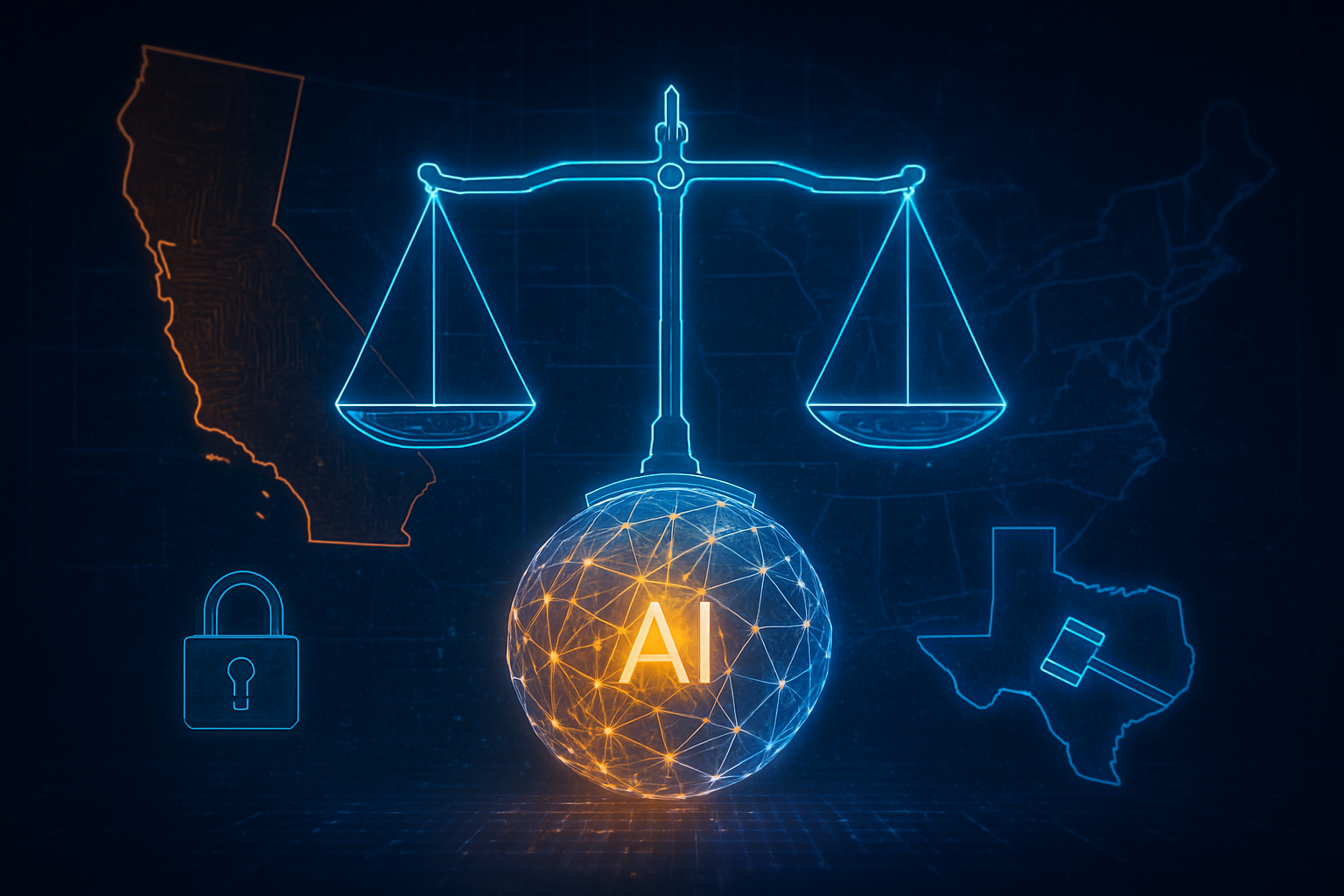
    SAN FRANCISCO & AUSTIN – January 1, 2026, marks a historic shift in the American technological landscape as two of the nation’s most influential states officially implement landmark artificial intelligence regulations. California’s Transparency in Frontier Artificial Intelligence Act (TFAIA) and Texas’s Responsible Artificial Intelligence Governance Act (RAIGA) both went into effect at midnight, creating a dual-pillar regulatory environment that forces the world’s leading AI labs to navigate a complex web of safety, transparency, and consumer protection mandates.

    The simultaneous activation of these laws represents the first major attempt by states to rein in "frontier" AI models—systems with unprecedented computing power and capabilities. While California focuses on preventing "catastrophic risks" like cyberattacks and biological weaponization, Texas has taken an intent-based approach, targeting AI-driven discrimination and ensuring human oversight in critical sectors like healthcare. However, the immediate significance of these laws is shadowed by a looming constitutional crisis, as the federal government prepares to challenge state authority in what is becoming the most significant legal battle over technology since the dawn of the internet.

    Technical Mandates and the "Frontier" Threshold

    California’s TFAIA, codified as SB 53, introduces the most rigorous technical requirements ever imposed on AI developers. The law specifically targets "frontier models," defined as those trained using more than 10^26 floating-point operations (FLOPs)—a threshold that encompasses the latest iterations of models from Alphabet Inc. (NASDAQ: GOOGL), Microsoft Corp. (NASDAQ: MSFT), and OpenAI. Under this act, developers with annual revenues exceeding $500 million must now publish a "Frontier AI Framework." This document is not merely a summary but a detailed technical blueprint outlining how the company identifies and mitigates risks such as model "escape" or the autonomous execution of high-level cyberwarfare.

    In addition to the framework, California now requires a "kill switch" capability for these massive models and mandates that "critical safety incidents" be reported to the California Office of Emergency Services (OES) within 15 days of discovery. This differs from previous voluntary commitments by introducing civil penalties of up to $1 million per violation. Meanwhile, a companion law (AB 2013) requires developers to post high-level summaries of the data used to train these models, a move aimed at addressing long-standing concerns regarding copyright and data provenance in generative AI.

    Texas’s RAIGA (HB 149) takes a different technical path, prioritizing "interaction transparency" over compute thresholds. The Texas law mandates that any AI system used in a governmental or healthcare capacity must provide a "clear and conspicuous" notice to users that they are interacting with an automated system. Technically, this requires developers to implement metadata tagging and user-interface modifications that were previously optional. Furthermore, Texas has established a 36-month "Regulatory Sandbox," allowing companies to test innovative systems with limited liability, provided they adhere to the NIST AI Risk Management Framework, effectively making the federal voluntary standard a "Safe Harbor" requirement within state lines.

    Big Tech and the Cost of Compliance

    The implementation of these laws has sent ripples through Silicon Valley and the burgeoning AI hubs of Austin. For Meta Platforms Inc. (NASDAQ: META), which has championed an open-source approach to AI, California’s safety mandates pose a unique challenge. The requirement to ensure that a model cannot be used for catastrophic harm is difficult to guarantee once a model’s weights are released publicly. Meta has been among the most vocal critics, arguing that state-level mandates stifle the very transparency they claim to promote by discouraging open-source distribution.

    Amazon.com Inc. (NASDAQ: AMZN) and Nvidia Corp. (NASDAQ: NVDA) are also feeling the pressure, albeit in different ways. Amazon’s AWS division must now ensure that its cloud infrastructure provides the necessary telemetry for its clients to comply with California’s incident reporting rules. Nvidia, the primary provider of the H100 and B200 chips used to cross the 10^26 FLOP threshold, faces a shifting market where developers may begin optimizing for "sub-frontier" models to avoid the heaviest regulatory burdens.

    The competitive landscape is also shifting toward specialized compliance. Startups that can offer "Compliance-as-a-Service"—tools that automate the generation of California’s transparency reports or Texas’s healthcare reviews—are seeing a surge in venture interest. Conversely, established AI labs are finding their strategic advantages under fire; the "move fast and break things" era has been replaced by a "verify then deploy" mandate that could slow the release of new features in the U.S. market compared to less-regulated regions.

    A Patchwork of Laws and the Federal Counter-Strike

    The broader significance of January 1, 2026, lies in the "patchwork" problem. With California and Texas setting vastly different priorities, AI developers are forced into a "dual-compliance" mode that critics argue creates an interstate commerce nightmare. This fragmentation was the primary catalyst for the "Ensuring a National Policy Framework for Artificial Intelligence" Executive Order signed by the Trump administration in late 2025. The federal government argues that AI is a matter of national security and international competitiveness, asserting that state laws like TFAIA are an unconstitutional overreach.

    Legal experts point to two primary battlegrounds: the First Amendment and the Commerce Clause. The Department of Justice (DOJ) AI Litigation Task Force has already signaled its intent to sue California, arguing that the state's transparency reports constitute "compelled speech." In Texas, the conflict is more nuanced; while the federal government generally supports the "Regulatory Sandbox" concept, it opposes Texas’s ability to regulate out-of-state developers whose models merely "conduct business" within the state. This tension echoes the historic battles over California’s vehicle emission standards, but with the added complexity of a technology that moves at the speed of light.

    Compared to previous AI milestones, such as the release of GPT-4 or the first AI Act in Europe, the events of today represent a shift from what AI can do to how it is allowed to exist within a democratic society. The clash between state-led safety mandates and federal deregulatory goals suggests that the future of AI in America will be decided in the courts as much as in the laboratories.

    The Road Ahead: 2026 and Beyond

    Looking forward, the next six months will be a period of "regulatory discovery." The first "Frontier AI Frameworks" are expected to be filed in California by March, providing the public with its first deep look into the safety protocols of companies like OpenAI. Experts predict that these filings will be heavily redacted, leading to a second wave of litigation over what constitutes a "trade secret" versus a "public safety disclosure."

    In the near term, we may see a "geographic bifurcation" of AI services. Some companies have already hinted at "geofencing" certain high-power features, making them unavailable to users in California or Texas to avoid the associated liability. However, given the economic weight of these two states—representing the 1st and 2nd largest state economies in the U.S.—most major players will likely choose to comply while they fight the laws in court. The long-term challenge remains the creation of a unified federal law that can satisfy both the safety concerns of California and the pro-innovation stance of the federal government.

    Conclusion: A New Era of Accountability

    The activation of TFAIA and RAIGA on this first day of 2026 marks the end of the "Wild West" era for artificial intelligence in the United States. Whether these laws survive the inevitable federal challenges or are eventually preempted by a national standard, they have already succeeded in forcing a level of transparency and safety-first thinking that was previously absent from the industry.

    The key takeaway for the coming months is the "dual-track" reality: developers will be filing safety reports with state regulators in Sacramento and Austin while their legal teams are in Washington D.C. arguing for those same regulations to be struck down. As the first "critical safety incidents" are reported and the first "Regulatory Sandboxes" are populated, the world will be watching to see if this state-led experiment leads to a safer AI future or a stifled technological landscape.


    This content is intended for informational purposes only and represents analysis of current AI developments.

    TokenRing AI delivers enterprise-grade solutions for multi-agent AI workflow orchestration, AI-powered development tools, and seamless remote collaboration platforms.
    For more information, visit https://www.tokenring.ai/.

  • AI Regulation at a Crossroads: Global Frameworks Evolve, FTC Shifts Stance on Open Source, and Calls for ‘Common Sense’ Intensify

    AI Regulation at a Crossroads: Global Frameworks Evolve, FTC Shifts Stance on Open Source, and Calls for ‘Common Sense’ Intensify

    October 2025 has emerged as a landmark period for the future of artificial intelligence, witnessing a confluence of legislative advancements, heightened regulatory scrutiny, and a palpable tension between fostering innovation and safeguarding public interests. As governments worldwide grapple with the profound implications of AI, the U.S. Federal Trade Commission (FTC) has taken decisive steps to address AI-related risks, particularly concerning consumer protection and children's safety. Concurrently, a significant, albeit controversial, shift in the FTC's approach to open-source AI models under the current administration has sparked debate, even as calls for "common-sense" regulatory frameworks resonate across various sectors. This month's developments underscore a global push towards responsible AI, even as the path to comprehensive and coherent regulation remains complex and contested.

    Regulatory Tides Turn: From Global Acts to Shifting Domestic Stances

    The regulatory landscape for artificial intelligence is rapidly taking shape, marked by both comprehensive legislative efforts and specific agency actions. Internationally, the European Union's pioneering AI Act continues to set a global benchmark, with its rules governing General-Purpose AI (GPAI) having come into effect in August 2025. This risk-based framework mandates stringent transparency requirements and emphasizes human oversight for high-risk AI applications, influencing legislative discussions in numerous other nations. Indeed, over 50% of countries globally have now adopted some form of AI regulation, largely guided by the principles laid out by the OECD.

    In the United States, the absence of a unified federal AI law has prompted a patchwork of state-level initiatives. California's "Transparency in Frontier Artificial Intelligence Act" (TFAIA), enacted on September 29, 2025, and set for implementation on January 1, 2026, requires developers of advanced AI models to make public safety disclosures. The state also established CalCompute to foster ethical AI research. Furthermore, California Governor Gavin Newsom signed SB 243, mandating regular warnings from chatbot companies and protocols to prevent self-harm content generation. However, Newsom notably vetoed AB 1064, which aimed for stricter chatbot access restrictions for minors, citing concerns about overly broad limitations. Other states, including North Carolina, Rhode Island, Virginia, and Washington, are actively formulating their own AI strategies, while Arkansas has legislated on AI-generated content ownership, and Montana introduced a "Right to Compute" law. New York has moved to inventory state agencies' automated decision-making tools and bolster worker protections against AI-driven displacement.

    Amidst these legislative currents, the U.S. Federal Trade Commission has been particularly active in addressing AI-related consumer risks. In September 2025, the FTC launched a significant probe into AI chatbot privacy and safety, demanding detailed information from major tech players like Google-parent Alphabet (NASDAQ: GOOGL), Meta Platforms (NASDAQ: META), and OpenAI regarding their chatbot products, safety protocols, data handling, and compliance with the Children's Online Privacy Protection Act (COPPA). This scrutiny followed earlier reports of inappropriate chatbot behavior, prompting Meta to introduce new parental controls in October 2025, allowing parents to disable one-on-one AI chats, block specific AI characters, and monitor chat topics. Meta also updated its AI chatbot policies in August to prevent discussions on self-harm and other sensitive content, defaulting teen accounts to PG-13 content. OpenAI has implemented similar safeguards and is developing age estimation technology. The FTC also initiated "Operation AI Comply," targeting deceptive or unfair practices leveraging AI hype, such as using AI tools for fake reviews or misleading investment schemes. However, a controversial development saw the current administration quietly remove several blog posts by former FTC Chair Lina Khan, which had advocated for a more permissive approach to open-weight AI models. These deletions, including a July 2024 post titled "On Open-Weights Foundation Models," contradict the Trump administration's own July 2025 "AI Action Plan," which explicitly supports open models for innovation, raising questions about regulatory coherence and compliance with the Federal Records Act.

    Corporate Crossroads: Navigating New Rules and Shifting Competitive Landscapes

    The evolving AI regulatory environment presents a mixed bag of opportunities and challenges for AI companies, tech giants, and startups. Major players like Google-parent Alphabet (NASDAQ: GOOGL), Meta Platforms (NASDAQ: META), and OpenAI find themselves under direct regulatory scrutiny, particularly concerning data privacy and the safety of their AI chatbot offerings. The FTC's probes and subsequent actions, such as Meta's implementation of new parental controls, demonstrate that these companies must now prioritize robust safety features and transparent data handling to avoid regulatory penalties and maintain consumer trust. While this adds to their operational overhead, it also offers an opportunity to build more responsible AI products, potentially setting industry standards and differentiating themselves in a competitive market.

    The shift in the FTC's stance on open-source AI models, however, introduces a layer of uncertainty. While the Trump administration's "AI Action Plan" theoretically supports open models, the removal of former FTC Chair Lina Khan's pro-open-source blog posts suggests a potential divergence in practical application or internal policy. This ambiguity could impact startups and smaller AI labs that heavily rely on open-source frameworks for innovation, potentially creating a less predictable environment for their development and deployment strategies. Conversely, larger tech companies with proprietary AI systems might see this as an opportunity to reinforce their market position if open-source alternatives face increased regulatory hurdles or uncertainty.

    The burgeoning state-level regulations, such as California's TFAIA and SB 243, necessitate a more localized compliance strategy for companies operating across the U.S. This fragmented regulatory landscape could pose a significant burden for startups with limited legal resources, potentially favoring larger entities that can more easily absorb the costs of navigating diverse state laws. Companies that proactively embed ethical AI design principles and robust safety mechanisms into their development pipelines stand to benefit, as these measures will likely align with future regulatory requirements. The emphasis on transparency and public safety disclosures, particularly for advanced AI models, will compel developers to invest more in explainability and risk assessment, impacting product development cycles and go-to-market strategies.

    The Broader Canvas: AI Regulation's Impact on Society and Innovation

    The current wave of AI regulation and policy developments signifies a critical juncture in the broader AI landscape, reflecting a global recognition of AI's transformative power and its accompanying societal risks. The emphasis on "common-sense" regulation, particularly concerning children's safety and ethical AI deployment, highlights a growing public and political demand for accountability from technology developers. This aligns with broader trends advocating for responsible innovation, where technological advancement is balanced with societal well-being. The push for modernized healthcare laws to leverage AI's potential, as urged by HealthFORCE and its partners, demonstrates a desire to harness AI for public good, albeit within a secure and regulated framework.

    However, the rapid pace of AI development continues to outstrip the speed of legislative processes, leading to a complex and often reactive regulatory environment. Concerns about the potential for AI-driven harms, such as privacy violations, algorithmic bias, and the spread of misinformation, are driving many of these regulatory efforts. The debate at Stanford, proposing "crash test ratings" for AI systems, underscores a desire for tangible safety standards akin to those in other critical industries. The veto of California's AB 1064, despite calls for stronger protections for minors, suggests significant lobbying influence from major tech companies, raising questions about the balance of power in shaping AI policy.

    The FTC's shifting stance on open-source AI models is particularly significant. While open-source AI has been lauded for fostering innovation, democratizing access to powerful tools, and enabling smaller players to compete, any regulatory uncertainty or perceived hostility towards it could stifle this vibrant ecosystem. This move, contrasting with the administration's stated support for open models, could inadvertently concentrate AI development in the hands of a few large corporations, hindering broader participation and potentially slowing the pace of diverse innovation. This tension between fostering open innovation and mitigating potential risks mirrors past debates in software regulation, but with the added complexity and societal impact of AI. The global trend towards comprehensive regulation, exemplified by the EU AI Act, sets a precedent for a future where AI systems are not just technically advanced but also ethically sound and socially responsible.

    The Road Ahead: Anticipating Future AI Regulatory Pathways

    Looking ahead, the landscape of AI regulation is poised for continued evolution, driven by both technological advancements and growing societal demands. In the near term, we can expect a further proliferation of state-level AI regulations in the U.S., attempting to fill the void left by the absence of a comprehensive federal framework. This will likely lead to increased compliance challenges for companies operating nationwide, potentially prompting calls for greater federal harmonization to streamline regulatory processes. Internationally, the EU AI Act will serve as a critical test case, with its implementation and enforcement providing valuable lessons for other jurisdictions developing their own frameworks. We may see more countries, like Vietnam and the Cherokee Nation, finalize and implement their AI laws, contributing to a diverse global regulatory tapestry.

    Longer term, experts predict a move towards more granular and sector-specific AI regulations, tailored to the unique risks and opportunities presented by AI in fields such as healthcare, finance, and transportation. The push for modernizing healthcare laws to integrate AI effectively, as advocated by HealthFORCE, is a prime example of this trend. There will also be a continued focus on establishing international standards and norms for AI governance, aiming to address cross-border issues like data flow, algorithmic bias, and the responsible development of frontier AI models. Challenges will include achieving a delicate balance between fostering innovation and ensuring robust safety and ethical safeguards, avoiding regulatory capture by powerful industry players, and adapting regulations to the fast-changing capabilities of AI.

    Experts anticipate that the debate around open-source AI will intensify, with continued pressure on regulators to clarify their stance and provide a stable environment for its development. The call for "crash test ratings" for AI systems could materialize into standardized auditing and certification processes, akin to those in other safety-critical industries. Furthermore, the focus on protecting vulnerable populations, especially children, from AI-related harms will remain a top priority, leading to more stringent requirements for age-appropriate content, privacy, and parental controls in AI applications. The coming months will likely see further enforcement actions by bodies like the FTC, signaling a hardening stance against deceptive AI practices and a commitment to consumer protection.

    Charting the Course: A New Era of Accountable AI

    The developments in AI regulation and policy during October 2025 mark a significant turning point in the trajectory of artificial intelligence. The global embrace of risk-based regulatory frameworks, exemplified by the EU AI Act, signals a collective commitment to responsible AI development. Simultaneously, the proactive, albeit sometimes contentious, actions of the FTC highlight a growing determination to hold tech giants accountable for the safety and ethical implications of their AI products, particularly concerning vulnerable populations. The intensified calls for "common-sense" regulation underscore a societal demand for AI that not only innovates but also operates within clear ethical boundaries and safeguards public welfare.

    This period will be remembered for its dual emphasis: on the one hand, a push towards comprehensive, multi-layered governance; and on the other, the emergence of complex challenges, such as navigating fragmented state-level laws and the controversial shifts in policy regarding open-source AI. The tension between fostering open innovation and mitigating potential harms remains a central theme, with the outcome significantly shaping the competitive landscape and the accessibility of advanced AI technologies. Companies that proactively integrate ethical AI design, transparency, and robust safety measures into their core strategies are best positioned to thrive in this new regulatory environment.

    As we move forward, the coming weeks and months will be crucial. Watch for further enforcement actions from regulatory bodies, continued legislative efforts at both federal and state levels in the U.S., and the ongoing international dialogue aimed at harmonizing AI governance. The public discourse around AI's benefits and risks will undoubtedly intensify, pushing policymakers to refine and adapt regulations to keep pace with technological advancements. The ultimate goal remains to cultivate an AI ecosystem that is not only groundbreaking but also trustworthy, equitable, and aligned with societal values, ensuring that the transformative power of AI serves humanity's best interests.


    This content is intended for informational purposes only and represents analysis of current AI developments.

    TokenRing AI delivers enterprise-grade solutions for multi-agent AI workflow orchestration, AI-powered development tools, and seamless remote collaboration platforms.
    For more information, visit https://www.tokenring.ai/.