Tag: Celestial AI

  • Light-Speed AI: Marvell’s $5.5B Bet on Celestial AI Signals the End of the “Memory Wall”

    Light-Speed AI: Marvell’s $5.5B Bet on Celestial AI Signals the End of the “Memory Wall”

    In a move that signals a fundamental shift in the architecture of artificial intelligence, Marvell Technology (NASDAQ: MRVL) has announced the definitive acquisition of Celestial AI, a leader in optical interconnect technology. The deal, valued at up to $5.5 billion, represents the most significant attempt to date to replace traditional copper-based electrical signals with light-based photonic communication within the data center. By integrating Celestial AI’s "Photonic Fabric" into its portfolio, Marvell is positioning itself at the center of the industry’s desperate push to solve the "memory wall"—the bottleneck where the speed of processors outpaces the ability to move data from memory.

    The acquisition comes at a critical juncture for the semiconductor industry. As of January 22, 2026, the demand for massive AI models has pushed existing hardware to its physical limits. Traditional electrical interconnects, which rely on copper traces to move data between GPUs and High-Bandwidth Memory (HBM), are struggling with heat, power consumption, and physical distance constraints. Marvell’s absorption of Celestial AI, combined with its recent $540 million purchase of XConn Technologies, suggests that the future of AI scaling will not be built on faster electrons, but on the seamless integration of silicon photonics and memory disaggregation.

    The Photonic Fabric: Technical Mastery Over the Memory Bottleneck

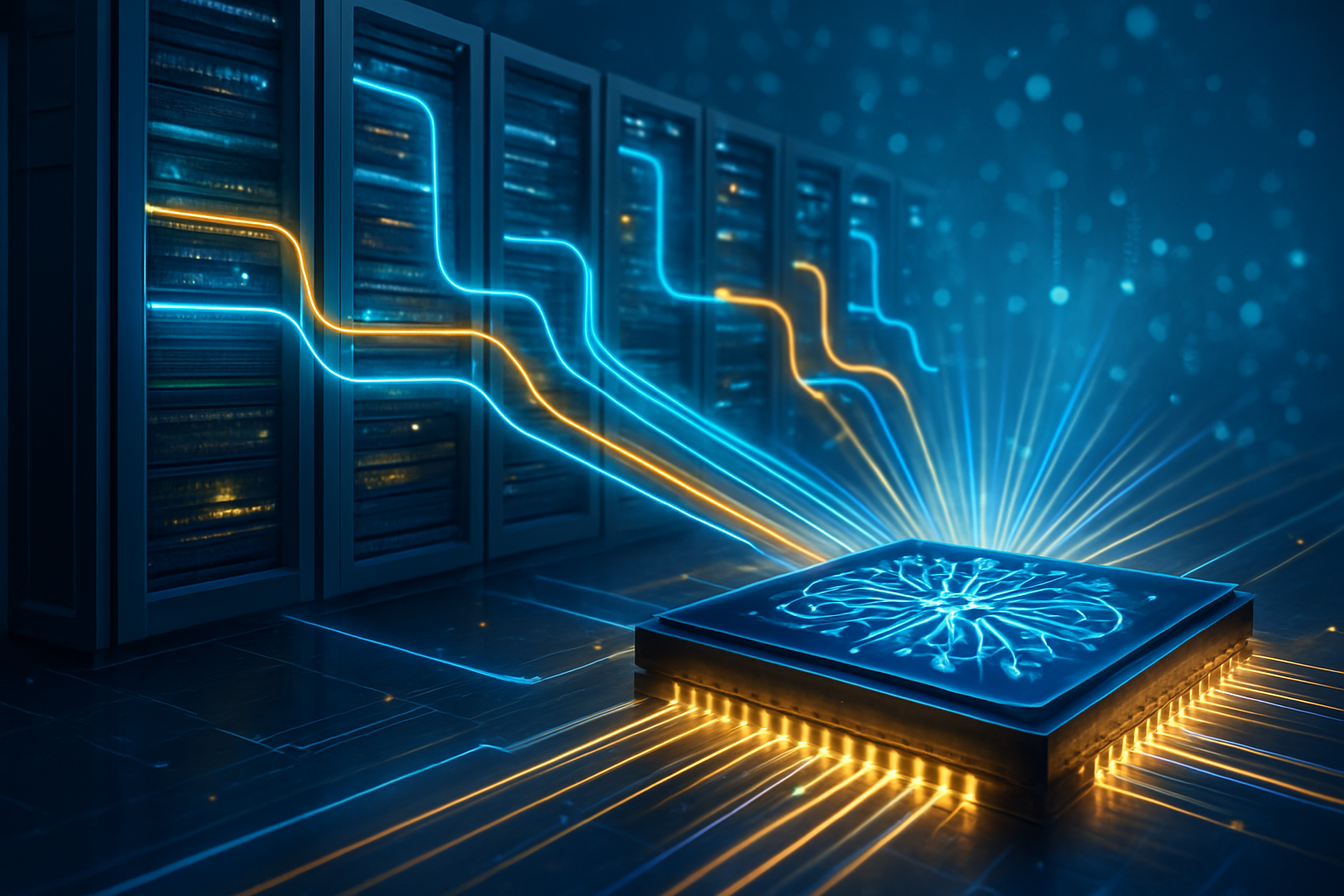
    The centerpiece of this acquisition is Celestial AI’s proprietary Photonic Fabric™, an optical interconnect platform that achieves what was previously thought impossible: 3D-stacked optical I/O directly on the compute die. Unlike traditional silicon photonics that use temperature-sensitive ring modulators, Celestial AI utilizes Electro-Absorption Modulators (EAMs). These components are remarkably thermally stable, allowing photonic chiplets to be co-packaged alongside high-power AI accelerators (XPUs) that can generate several kilowatts of heat. This technical leap allows for a 10x increase in bandwidth density, with first-generation chiplets delivering a staggering 16 terabits per second (Tbps) of throughput.

    Perhaps the most disruptive aspect of the Photonic Fabric is its "DSP-free" analog-equalized linear-drive architecture. By eliminating the need for complex Digital Signal Processors (DSPs) to clean up electrical signals, the system reduces power consumption by an estimated 4 to 5 times compared to copper-based solutions. This efficiency enables a new architectural paradigm known as memory disaggregation. In this setup, High-Bandwidth Memory (HBM) no longer needs to be soldered within millimeters of the processor. Marvell’s roadmap now includes "Photonic Fabric Appliances" (PFAs) capable of pooling up to 32 terabytes of HBM3E or HBM4 memory, accessible to hundreds of XPUs across a distance of up to 50 meters with nanosecond-class latency.

    The industry reaction has been one of cautious optimism followed by rapid alignment. Experts in the AI research community note that moving I/O from the "beachfront" (the edges) of a chip to the center of the die via 3D stacking frees up valuable perimeter space for even more HBM stacks. This effectively triples the on-chip memory capacity available to the processor. "We are moving from a world where we build bigger chips to a world where we build bigger systems connected by light," noted one lead architect at a major hyperscaler. The design win announced by Celestial AI just prior to the acquisition closure confirms that at least one Tier-1 cloud provider is already integrating this technology into its 2027 silicon roadmap.

    Reshaping the Competitive Landscape: Marvell, Broadcom, and the UALink War

    The acquisition sets up a titanic clash between Marvell (NASDAQ: MRVL) and Broadcom (NASDAQ: AVGO). While Broadcom has dominated the networking space with its Tomahawk and Jericho switch series, it has doubled down on "Scale-Up Ethernet" (SUE) and its "Davisson" 102.4 Tbps switch as the primary solution for AI clusters. Broadcom’s strategy emphasizes the maturity and reliability of Ethernet. In contrast, Marvell is betting on a more radical architectural shift. By combining Celestial AI’s optical physical layer with XConn’s CXL (Compute Express Link) and PCIe switching logic, Marvell is providing the "plumbing" for the newly finalized Ultra Accelerator Link (UALink) 1.0 specification.

    This puts Marvell in direct competition with NVIDIA (NASDAQ: NVDA). Currently, NVIDIA’s proprietary NVLink is the gold standard for high-speed GPU-to-GPU communication, but it remains a "walled garden." The UALink Consortium, which includes heavyweights like Advanced Micro Devices (NASDAQ: AMD), Intel (NASDAQ: INTC), Meta Platforms (NASDAQ: META), and Microsoft (NASDAQ: MSFT), is positioning Marvell’s new photonic capabilities as the "open" alternative to NVLink. For hyperscalers like Alphabet (NASDAQ: GOOGL) and Amazon (NASDAQ: AMZN), Marvell’s technology offers a path to build massive, multi-rack AI clusters that aren't beholden to NVIDIA’s full-stack pricing and hardware constraints.

    The market positioning here is strategic: Broadcom is the incumbent of "reliable connectivity," while Marvell is positioning itself as the architect of the "optical future." The acquisition of Celestial AI effectively gives Marvell a two-year lead in the commercialization of 3D-stacked optical I/O. If Marvell can successfully integrate these photonic chiplets into the UALink ecosystem by 2027, it could potentially displace Broadcom in the highest-performance tiers of the AI data center, especially as power delivery to traditional copper-based switches becomes an insurmountable engineering hurdle.

    A Post-Moore’s Law Reality: The Significance of Optical Scaling

    Beyond the corporate maneuvering, this breakthrough represents a pivotal moment in the broader AI landscape. We are witnessing the twilight of Moore’s Law as defined by transistor density, and the dawn of a new era defined by "system-level scaling." As AI models like GPT-5 and its successors demand trillions of parameters, the energy required to move data between a processor and its memory has become the primary limit on intelligence. Marvell’s move to light-based interconnects addresses the energy crisis of the data center head-on, offering a way to keep scaling AI performance without requiring a dedicated nuclear power plant for every new cluster.

    Comparisons are already being made to previous milestones like the introduction of HBM or the first multi-chip module (MCM) designs. However, the shift to photons is arguably more fundamental. It represents the first time the "memory wall" has been physically dismantled rather than just temporarily bypassed. By allowing for "any-to-any" memory access across a fabric of light, researchers can begin to design AI architectures that are not constrained by the physical size of a single silicon wafer. This could lead to more efficient "sparse" AI models that leverage massive memory pools more effectively than the dense, compute-heavy models of today.

    However, concerns remain regarding the manufacturability and yield of 3D-stacked optical components. Integrating laser sources and modulators onto silicon at scale is a feat of extreme precision. Critics also point out that while the latency is "nanosecond-class," it is still higher than local on-chip SRAM. The industry will need to develop new software and compilers capable of managing these massive, disaggregated memory pools—a task that companies like Cisco (NASDAQ: CSCO) and HP Enterprise (NYSE: HPE) are already beginning to address through new software-defined networking standards.

    The Road Ahead: 2026 and Beyond

    In the near term, expect to see the first silicon "tape-outs" featuring Celestial AI’s technology by the end of 2026, with early-access samples reaching major cloud providers in early 2027. The immediate application will be "Memory Expansion Modules"—pluggable units that allow a single AI server to access terabytes of external memory at local speeds. Looking further out, the 2028-2029 timeframe will likely see the rise of the "Optical Rack," where the entire data center rack functions as a single, giant computer, with hundreds of GPUs sharing a unified memory space over a photonic backplane.

    The challenges ahead are largely related to the ecosystem. For Marvell to succeed, the UALink standard must gain universal adoption among chipmakers like Samsung (KRX: 005930) and SK Hynix, who will need to produce "optical-ready" HBM modules. Furthermore, the industry must solve the "laser problem"—deciding whether to integrate the light source directly into the chip (higher efficiency) or use external laser sources (higher reliability and easier replacement). Experts predict that the move toward external, field-replaceable laser modules will win out in the first generation to ensure data center uptime.

    Final Thoughts: A Luminous Horizon for AI

    The acquisition of Celestial AI by Marvell is more than just a business transaction; it is a declaration that the era of the "all-electrical" data center is coming to an end. As we look back from the perspective of early 2026, this event may well be remembered as the moment the industry finally broke the memory wall, paving the way for the next order of magnitude in artificial intelligence development.

    The long-term impact will be measured in the democratization of high-end AI compute. By providing an open, optical alternative to proprietary fabrics, Marvell is ensuring that the race for AGI remains a multi-player competition rather than a single-company monopoly. In the coming weeks, keep a close eye on the closing of the deal and any subsequent announcements from the UALink Consortium. The first successful demonstration of a 32TB photonic memory pool will be the signal that the age of light-speed computing has truly arrived.


    This content is intended for informational purposes only and represents analysis of current AI developments.

    TokenRing AI delivers enterprise-grade solutions for multi-agent AI workflow orchestration, AI-powered development tools, and seamless remote collaboration platforms.
    For more information, visit https://www.tokenring.ai/.


    Authored by: Expert Technology Journalist for TokenRing AI
    Current Date: January 22, 2026


    Note: Public companies mentioned include Marvell Technology (NASDAQ: MRVL), NVIDIA (NASDAQ: NVDA), Broadcom (NASDAQ: AVGO), Advanced Micro Devices (NASDAQ: AMD), Intel (NASDAQ: INTC), Meta Platforms (NASDAQ: META), Microsoft (NASDAQ: MSFT), Alphabet (NASDAQ: GOOGL), Amazon (NASDAQ: AMZN), Cisco (NASDAQ: CSCO), HP Enterprise (NYSE: HPE), and Samsung (KRX: 005930).

  • The Speed of Light: Marvell’s Acquisition of Celestial AI Signals the End of the Copper Era in AI Computing

    The Speed of Light: Marvell’s Acquisition of Celestial AI Signals the End of the Copper Era in AI Computing

    In a move that marks a fundamental shift in the architecture of artificial intelligence, Marvell Technology (NASDAQ: MRVL) announced on December 2, 2025, a definitive agreement to acquire the silicon photonics trailblazer Celestial AI for a total potential value of over $5.5 billion. This acquisition, expected to close in the first quarter of 2026, represents the most significant bet yet on the transition from copper-based electrical signals to light-based optical interconnects within the heart of the data center. By integrating Celestial AI’s "Photonic Fabric" technology, Marvell is positioning itself to dismantle the "Memory Wall" and "Power Wall" that have threatened to stall the progress of large-scale AI models.

    The immediate significance of this deal cannot be overstated. As AI clusters scale toward a million GPUs, the physical limitations of copper—the "Copper Cliff"—have become the primary bottleneck for performance and energy efficiency. Conventional copper wires generate excessive heat and suffer from signal degradation over short distances, forcing engineers to use power-hungry chips to boost signals. Marvell’s absorption of Celestial AI’s technology effectively replaces these electrons with photons, allowing for nearly instantaneous data transfer between processors and memory at a fraction of the power, fundamentally changing how AI hardware is designed and deployed.

    Breaking the Copper Wall: The Photonic Fabric Breakthrough

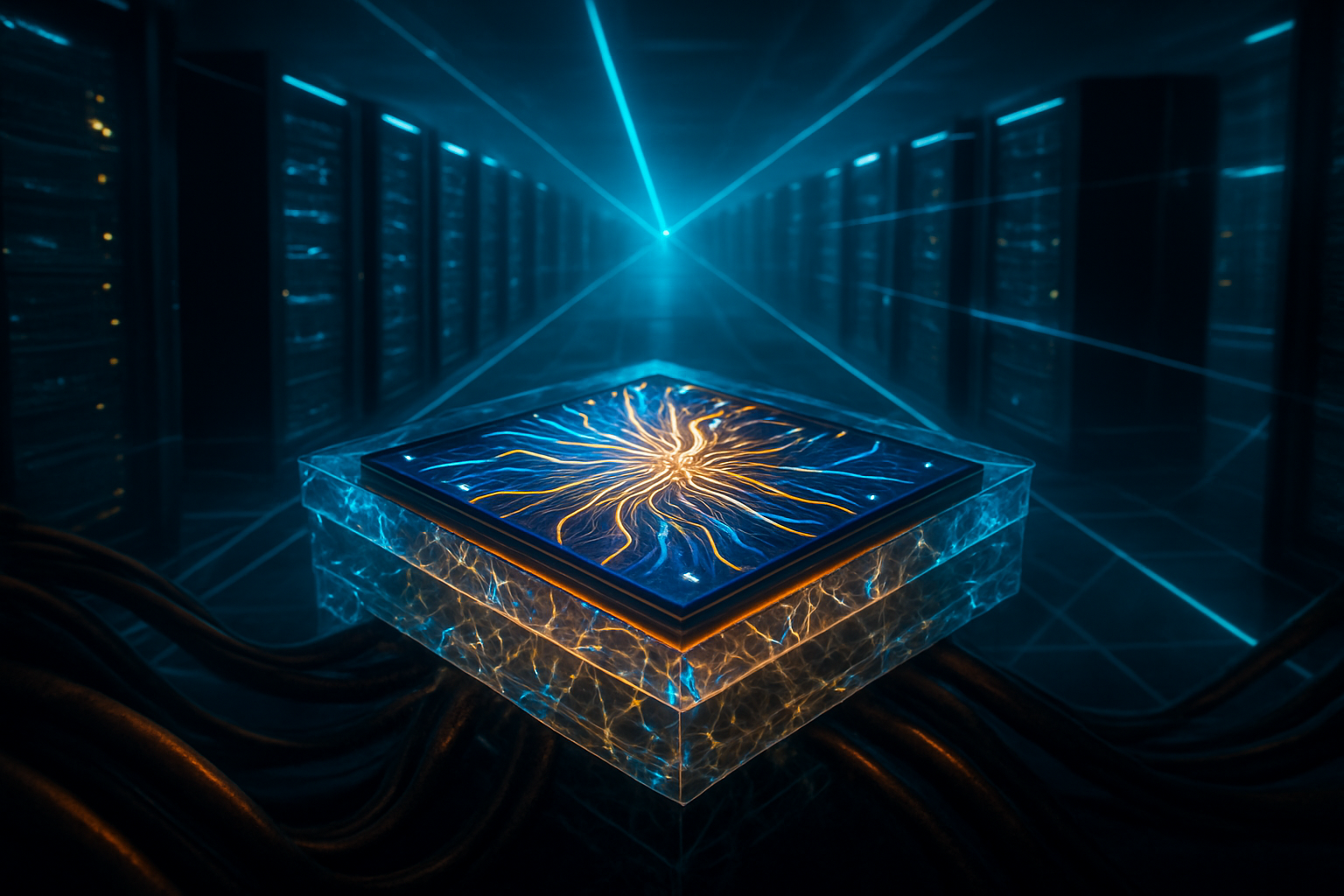
    At the technical core of this development is Celestial AI’s proprietary Photonic Fabric™, an architecture that moves optical I/O (Input/Output) from the edge of the circuit board directly into the silicon package. Traditionally, optical components were "pluggable" modules located at the periphery, requiring long electrical traces to reach the processor. Celestial AI’s Optical Multi-Chip Interconnect Bridge (OMIB) utilizes 3D optical co-packaging, allowing light-based data paths to sit directly atop the compute die. This "in-package" optics approach frees up the valuable "beachfront property" on the edges of the chip, which can now be dedicated entirely to High Bandwidth Memory (HBM).

    This shift differs from previous approaches by eliminating the need for power-hungry Digital Signal Processors (DSPs) traditionally required for optical-to-electrical conversion. The Photonic Fabric utilizes a "linear-drive" method, achieving nanosecond-class latency and reducing interconnect power consumption by over 80%. While copper interconnects typically consume 50–55 picojoules per bit (pJ/bit) at scale, Marvell’s new photonic architecture operates at approximately 2.4 pJ/bit. This efficiency is critical as the industry moves toward 2nm process nodes, where every milliwatt of power saved in data transfer can be redirected toward actual computation.

    Initial reactions from the AI research community and industry experts have been overwhelmingly positive, with many describing the move as the "missing link" for the next generation of AI supercomputing. Dr. Arati Prabhakar, an industry analyst specializing in semiconductor physics, noted that "moving optics into the package is no longer a luxury; it is a physical necessity for the post-GPT-5 era." By supporting emerging standards like UALink (Ultra Accelerator Link) and CXL 3.1, Marvell is providing an open-standard alternative to proprietary interconnects, a move that has been met with enthusiasm by researchers looking for more flexible cluster architectures.

    A New Battleground: Marvell vs. the Proprietary Giants

    The acquisition places Marvell Technology (NASDAQ: MRVL) in a direct competitive collision with NVIDIA (NASDAQ: NVDA), whose proprietary NVLink technology has long been the gold standard for high-speed GPU interconnectivity. By offering an optical fabric that is compatible with industry-standard protocols, Marvell is giving hyperscalers like Amazon (NASDAQ: AMZN) and Alphabet (NASDAQ: GOOGL) a way to build massive AI clusters without being "locked in" to a single vendor’s ecosystem. This strategic positioning allows Marvell to act as the primary architect for the connectivity layer of the AI stack, potentially disrupting the dominance of integrated hardware providers.

    Other major players in the networking space, such as Broadcom (NASDAQ: AVGO), are also feeling the heat. While Broadcom has led in traditional Ethernet switching, Marvell’s integration of Celestial AI’s 3D-stacked optics gives them a head start in "Scale-Up" networking—the ultra-fast connections between individual GPUs and memory pools. This capability is essential for "disaggregated" computing, where memory and compute are no longer tethered to the same physical board but can be pooled across a rack via light, allowing for much more efficient resource utilization in the data center.

    For AI startups and smaller chip designers, this breakthrough lowers the barrier to entry for high-performance computing. By utilizing Marvell’s custom ASIC (Application-Specific Integrated Circuit) platforms integrated with Photonic Fabric chiplets, smaller firms can design specialized AI accelerators that rival the performance of industry giants. This democratization of high-speed interconnects could lead to a surge in specialized "Super XPUs" tailored for specific tasks like real-time video synthesis or complex biological modeling, further diversifying the AI hardware landscape.

    The Wider Significance: Sustainability and the Scaling Limit

    Beyond the competitive maneuvering, the shift to silicon photonics addresses the growing societal concern over the environmental impact of AI. Data centers are currently on a trajectory to consume a massive percentage of the world’s electricity, with a significant portion of that energy wasted as heat generated by electrical resistance in copper wires. By slashing interconnect power by 80%, the Marvell-Celestial AI breakthrough offers a rare "green" win in the AI arms race. This reduction in heat also simplifies cooling requirements, potentially allowing for denser, more powerful data centers in urban areas where power and space are at a premium.

    This milestone is being compared to the transition from vacuum tubes to transistors in the mid-20th century. Just as the transistor allowed for a leap in miniaturization and efficiency, the move to silicon photonics allows for a leap in "cluster-scale" computing. We are moving away from the "box-centric" model, where a single server is the unit of compute, toward a "fabric-centric" model where the entire data center functions as one giant, light-speed brain. This shift is essential for training the next generation of foundation models, which are expected to require hundreds of trillions of parameters—a scale that copper simply cannot support.

    However, the transition is not without its concerns. The complexity of manufacturing 3D-stacked optical components is significantly higher than traditional silicon, raising questions about yield rates and supply chain stability. There is also the challenge of laser reliability; unlike transistors, lasers can degrade over time, and integrating them directly into the processor package makes them difficult to replace. The industry will need to develop new testing and maintenance protocols to ensure that these light-driven supercomputers can operate reliably for years at a time.

    Looking Ahead: The Era of the Super XPU

    In the near term, the industry can expect to see the first "Super XPUs" featuring integrated optical I/O hitting the market by early 2027. These chips will likely debut in the custom silicon projects of major hyperscalers before becoming more widely available. The long-term development will likely focus on "Co-Packaged Optics" (CPO) becoming the standard for all high-performance silicon, eventually trickling down from AI data centers to high-end workstations and perhaps even consumer-grade edge devices as the technology matures and costs decrease.

    The next major challenge for Marvell and its competitors will be the integration of these optical fabrics with "optical computing" itself—using light not just to move data, but to perform calculations. While still in the experimental phase, the marriage of optical interconnects and optical processing could lead to a thousand-fold increase in AI efficiency. Experts predict that the next five years will be defined by this "Photonic Revolution," as the industry works to replace every remaining electrical bottleneck with a light-based alternative.

    Conclusion: A Luminous Path Forward

    The acquisition of Celestial AI by Marvell Technology (NASDAQ: MRVL) is more than just a corporate merger; it is a declaration that the era of copper in high-performance computing is drawing to a close. By successfully integrating photons into the silicon package, Marvell has provided the roadmap for scaling AI beyond the physical limits of electricity. The key takeaways are clear: latency is being measured in nanoseconds, power consumption is being slashed by orders of magnitude, and the very architecture of the data center is being rewritten in light.

    This development will be remembered as a pivotal moment in AI history, the point where hardware finally caught up with the soaring ambitions of software. As we move into 2026 and beyond, the industry will be watching closely to see how quickly Marvell can scale this technology and how its competitors respond. For now, the path to artificial general intelligence looks increasingly luminous, powered by a fabric of light that promises to connect the world's most powerful minds—both human and synthetic—at the speed of thought.


    This content is intended for informational purposes only and represents analysis of current AI developments.

    TokenRing AI delivers enterprise-grade solutions for multi-agent AI workflow orchestration, AI-powered development tools, and seamless remote collaboration platforms.
    For more information, visit https://www.tokenring.ai/.

  • Marvell Bets on Light: The $3.25 Billion Acquisition of Celestial AI and the Future of Optical Fabrics

    Marvell Bets on Light: The $3.25 Billion Acquisition of Celestial AI and the Future of Optical Fabrics

    In a move that signals the definitive end of the "copper era" for high-performance computing, Marvell Technology (NASDAQ: MRVL) has announced the acquisition of photonic interconnect pioneer Celestial AI for $3.25 billion. The deal, finalized in late 2025, centers on Celestial AI’s revolutionary "Photonic Fabric" technology, a breakthrough that allows AI accelerators to communicate via light directly from the silicon die. As global demand for AI training capacity pushes data centers toward million-GPU clusters, the acquisition positions Marvell as the primary architect of the optical nervous system required to sustain the next generation of generative AI.

    The significance of this acquisition cannot be overstated. By integrating Celestial AI’s optical chiplets and interposers into its existing portfolio of high-speed networking silicon, Marvell is addressing the "Memory Wall" and the "Power Wall"—the two greatest physical barriers currently facing the semiconductor industry. As traditional copper-based electrical links reach their physical limits at 224G per lane, the transition to optical fabrics is no longer an elective upgrade; it is a fundamental requirement for the survival of the AI scaling laws.

    The End of the Copper Cliff: Technical Breakdown of the Photonic Fabric

    At the heart of the acquisition is Celestial AI’s Photonic Fabric, a technology that replaces traditional electrical "beachfront" I/O with high-density optical signals. While current data centers rely on Active Electrical Cables (AECs) or pluggable optical transceivers, these methods introduce significant latency and power overhead. Celestial AI’s PFLink™ chiplets provide a staggering 14.4 to 16 Terabits per second (Tbps) of optical bandwidth per chiplet—roughly 25 times the bandwidth density of current copper-based solutions. This allows for "scale-up" interconnects that treat an entire rack of GPUs as a single, massive compute node.

    Furthermore, the Photonic Fabric utilizes an Optical Multi-Die Interposer (OMIB™), which enables the disaggregation of compute and memory. In traditional architectures, High Bandwidth Memory (HBM) must be placed in immediate proximity to the GPU to maintain speed, limiting total memory capacity. With Celestial AI’s technology, Marvell can now offer architectures where a single XPU can access a pool of up to 32TB of shared HBM3E or DDR5 memory at nanosecond-class latencies (approximately 250–300 ns). This "optical memory pooling" effectively shatters the memory bottlenecks that have plagued LLM training.

    The efficiency gains are equally transformative. Operating at approximately 2.4 picojoules per bit (pJ/bit), the Photonic Fabric offers a 10x reduction in power consumption compared to the energy-intensive SerDes (Serializer/Deserializer) processes required to drive signals through copper. This reduction is critical as data centers face increasingly stringent thermal and power constraints. Initial reactions from the research community suggest that this shift could reduce the total cost of ownership for AI clusters by as much as 30%, primarily through energy savings and simplified thermal management.

    Shifting the Balance of Power: Market and Competitive Implications

    The acquisition places Marvell in a formidable position against its primary rival, Broadcom (NASDAQ: AVGO), which has dominated the high-end switch and custom ASIC market for years. While Broadcom has focused on Co-Packaged Optics (CPO) and its Tomahawk switch series, Marvell’s integration of the Photonic Fabric provides a more holistic "die-to-die" and "rack-to-rack" optical solution. This deal allows Marvell to offer hyperscalers like Amazon (NASDAQ: AMZN) and Meta (NASDAQ: META) a complete, vertically integrated stack—from the 1.6T Ara optical DSPs to the Teralynx 10 switch silicon and now the Photonic Fabric interconnects.

    For AI giants like NVIDIA (NASDAQ: NVDA), the move is both a challenge and an opportunity. While NVIDIA’s NVLink has been the gold standard for GPU-to-GPU communication, it remains largely proprietary and electrical at the board level. Marvell’s new technology offers an open-standard alternative (via CXL and UCIe) that could allow other chipmakers, such as AMD (NASDAQ: AMD) or Intel (NASDAQ: INTC), to build competitive multi-chip clusters that rival NVIDIA’s performance. This democratization of high-speed interconnects could potentially erode NVIDIA’s "moat" by allowing a broader ecosystem of hardware to perform at the same scale.

    Industry analysts suggest that the $3.25 billion price tag is a steal given the strategic importance of the intellectual property involved. Celestial AI had previously secured backing from heavyweights like Samsung (KRX: 005930) and AMD Ventures, indicating that the industry was already coalescing around its "optical-first" vision. By bringing this technology in-house, Marvell ensures that it is no longer just a component supplier but a platform provider for the entire AI infrastructure layer.

    The Broader Significance: Navigating the Energy Crisis of AI

    Beyond the immediate corporate rivalry, the Marvell-Celestial AI deal addresses a looming crisis in the AI landscape: sustainability. The current trajectory of AI training consumes vast amounts of electricity, with a significant portion of that energy wasted as heat generated by electrical resistance in copper wiring. As we move toward 1.6T and 3.2T networking speeds, the "Copper Cliff" becomes a physical wall; signal attenuation at these frequencies is so high that copper traces can only travel a few inches before the data becomes unreadable.

    By transitioning to an all-optical fabric, the industry can extend the reach of high-speed signals from centimeters to meters—and even kilometers—without significant signal degradation or heat buildup. This allows for the creation of "geographically distributed clusters," where different parts of a single AI training job can be spread across multiple buildings or even cities, linked by Marvell’s COLORZ 800G coherent optics and the new Photonic Fabric.

    This milestone is being compared to the transition from vacuum tubes to transistors or the shift from spinning hard drives to SSDs. It represents a fundamental change in the medium of computation. Just as the internet was revolutionized by the move from copper phone lines to fiber optics, the internal architecture of the computer is now undergoing the same transformation. The "Optical Era" of computing has officially arrived, and it is powered by silicon photonics.

    Looking Ahead: The Roadmap to 2030

    In the near term, expect Marvell to integrate Photonic Fabric chiplets into its 3nm and 2nm custom ASIC roadmaps. We are likely to see the first "Super XPUs"—processors with integrated optical I/O—hitting the market by early 2027. These chips will enable the first true million-GPU clusters, capable of training models with tens of trillions of parameters in a fraction of the time currently required.

    The next frontier will be the integration of optical computing itself. While the Photonic Fabric currently focuses on moving data via light, companies are already researching how to perform mathematical operations using light (optical matrix multiplication). Marvell’s acquisition of Celestial AI provides the foundational packaging and interconnect technology that will eventually support these future optical compute engines. The primary challenge remains the manufacturing yield of complex silicon photonics at scale, but with Marvell’s manufacturing expertise and TSMC’s (NYSE: TSM) advanced packaging capabilities, these hurdles are expected to be cleared within the next 24 months.

    A New Foundation for Artificial Intelligence

    The acquisition of Celestial AI by Marvell Technology marks a historic pivot in the evolution of AI infrastructure. It is a $3.25 billion bet that the future of intelligence is light-based. By solving the dual bottlenecks of bandwidth and power, Marvell is not just building faster chips; it is enabling the physical architecture that will support the next decade of AI breakthroughs.

    As we look toward 2026, the industry will be watching closely to see how quickly Marvell can productize the Photonic Fabric and whether competitors like Broadcom will respond with their own major acquisitions. For now, the message is clear: the era of the copper-bound data center is over, and the race to build the first truly optical AI supercomputer has begun.


    This content is intended for informational purposes only and represents analysis of current AI developments.

    TokenRing AI delivers enterprise-grade solutions for multi-agent AI workflow orchestration, AI-powered development tools, and seamless remote collaboration platforms.
    For more information, visit https://www.tokenring.ai/.

  • Marvell Shatters the “Memory Wall” with $5.5 Billion Acquisition of Celestial AI

    Marvell Shatters the “Memory Wall” with $5.5 Billion Acquisition of Celestial AI

    In a definitive move to dominate the next era of artificial intelligence infrastructure, Marvell Technology (NASDAQ: MRVL) has announced the acquisition of Celestial AI in a deal valued at up to $5.5 billion. The transaction, which includes a $3.25 billion base consideration and up to $2.25 billion in performance-based earn-outs, marks a historic pivot from traditional copper-based electronics to silicon photonics. By integrating Celestial AI’s revolutionary "Photonic Fabric" technology, Marvell aims to eliminate the physical bottlenecks that currently restrict the scaling of massive Large Language Models (LLMs).

    The deal is underscored by a strategic partnership with Amazon (NASDAQ: AMZN), which has received warrants to acquire over one million shares of Marvell stock. This arrangement, which vests as Amazon Web Services (AWS) integrates the Photonic Fabric into its data centers, signals a massive industry shift. As AI models grow in complexity, the industry is hitting a "copper wall," where traditional electrical wiring can no longer handle the heat or bandwidth required for high-speed data transfer. Marvell’s acquisition positions it as the primary architect for the optical data centers of the future, effectively betting that the future of AI will be powered by light, not electricity.

    The Photonic Fabric: Replacing Electrons with Photons

    At the heart of this acquisition is Celestial AI’s proprietary Photonic Fabric™, an optical interconnect platform that fundamentally changes how chips communicate. Unlike existing optical solutions that sit at the edge of a circuit board, the Photonic Fabric utilizes an Optical Multi-Chip Interconnect Bridge (OMIB). This allows for 3D packaging where optical links are placed directly on the silicon substrate, sitting alongside AI accelerators and High Bandwidth Memory (HBM). This proximity allows for a staggering 25x increase in bandwidth while reducing power consumption and latency by up to 10x compared to traditional copper interconnects.

    The technical suite includes PFLink™, a set of UCIe-compliant optical chiplets capable of delivering 14.4 Tbps of connectivity, and PFSwitch™, a low-latency scale-up switch. These components allow hyperscalers to move beyond the limitations of "scale-out" networking, where servers are connected via standard Ethernet. Instead, the Photonic Fabric enables a "scale-up" architecture where thousands of individual GPUs or custom accelerators can function as a single, massive virtual processor. This is a radical departure from previous methods that relied on complex, heat-intensive copper arrays that lose signal integrity over distances greater than a few meters.

    Industry experts have reacted with overwhelming support for the move, noting that the industry has reached a point of diminishing returns with electrical signaling. While previous generations of data centers could rely on iterative improvements in copper shielding and signal processing, the sheer density of modern AI clusters has made those solutions thermally and physically unviable. The Photonic Fabric represents a "clean sheet" approach to data movement, allowing for nanosecond-level latency across distances of up to 50 meters, effectively turning an entire data center rack into a single unified compute node.

    A New Front in the Silicon Wars: Marvell vs. Broadcom

    This acquisition significantly alters the competitive landscape of the semiconductor industry, placing Marvell in direct contention with Broadcom (NASDAQ: AVGO) for the title of the world’s leading AI connectivity provider. While Broadcom has long dominated the custom AI silicon and high-end Ethernet switch market, Marvell’s ownership of the Photonic Fabric gives it a unique vertical advantage. By controlling the optical "glue" that binds AI chips together, Marvell can offer a comprehensive connectivity platform that includes digital signal processors (DSPs), Ethernet switches, and now, the underlying optical fabric.

    Hyperscalers like Amazon, Google (NASDAQ: GOOGL), and Meta (NASDAQ: META) stand to benefit most from this development. These companies are currently engaged in a frantic arms race to build larger AI clusters, but they are increasingly hampered by the "Memory Wall"—the gap between how fast a processor can compute and how fast it can access data from memory. By utilizing Celestial AI’s technology, these giants can implement "Disaggregated Memory," where GPUs can access massive external pools of HBM at speeds previously only possible for on-chip data. This allows for the training of models with trillions of parameters without the prohibitive costs of placing massive amounts of memory on every single chip.

    The inclusion of Amazon in the deal structure is particularly telling. The warrants granted to AWS serve as a "customer-as-partner" model, ensuring that Marvell has a guaranteed pipeline for its new technology while giving Amazon a vested interest in the platform’s success. This strategic alignment may force other chipmakers to accelerate their own photonics roadmaps or risk being locked out of the next generation of AWS-designed AI instances, such as future iterations of Trainium and Inferentia.

    Shattering the Memory Wall and the End of the Copper Era

    The broader significance of this acquisition lies in its solution to the "Memory Wall," a problem that has plagued computer architecture for decades. As AI compute power has grown by approximately 60,000x over the last twenty years, memory bandwidth has only increased by about 100x. This disparity means that even the most advanced GPUs spend a significant portion of their time idling, waiting for data to arrive. Marvell’s new optical fabric effectively shatters this wall by making remote, off-chip memory feel as fast and accessible as local memory, enabling a level of efficiency that was previously thought to be physically impossible.

    This move also signals the beginning of the end for the "Copper Era" in high-performance computing. Copper has been the backbone of electronics since the dawn of the industry, but its physical properties—resistance and heat generation—have become a liability in the age of AI. As data centers begin to consume hundreds of kilowatts per rack, the energy required just to push electrons through copper wires has become a major sustainability and cost concern. Transitioning to light-based communication reduces the energy footprint of data movement, fitting into the broader industry trend of "Green AI" and sustainable scaling.

    Furthermore, this milestone mirrors previous breakthroughs like the introduction of High Bandwidth Memory (HBM) or the shift to FinFET transistors. It represents a fundamental change in the "physics" of the data center. By moving the bottleneck from the wire to the speed of light, Marvell is providing the industry with a roadmap that can sustain AI growth for the next decade, potentially enabling the transition from Large Language Models to more complex, multi-modal Artificial General Intelligence (AGI) systems that require even more massive data throughput.

    The Roadmap to 2030: What Comes Next?

    In the near term, the industry can expect a rigorous integration phase as Marvell incorporates Celestial AI’s team into its optical business unit. The company expects the Photonic Fabric to begin contributing to revenue significantly in the second half of fiscal 2028, with a target of a $1 billion annualized revenue run rate by the end of fiscal 2029. Initial applications will likely focus on high-end AI training clusters for hyperscalers, but as the technology matures and costs decrease, we may see optical interconnects trickling down into enterprise-grade servers and even specialized edge computing devices.

    One of the primary challenges that remains is the standardization of optical interfaces. While Celestial AI’s technology is UCIe-compliant, the industry will need to establish broader protocols to ensure interoperability between different vendors' chips and optical fabrics. Additionally, the manufacturing of silicon photonics at scale remains more complex than traditional CMOS fabrication, requiring Marvell to work closely with foundry partners like TSMC (NYSE: TSM) to refine high-volume production techniques for these delicate optical-electronic hybrid systems.

    Predicting the long-term impact, experts suggest that this acquisition will lead to a complete redesign of data center architecture. We are moving toward a "disaggregated" future where compute, memory, and storage are no longer confined to a single box but are instead pooled across a rack and linked by a web of light. This flexibility will allow cloud providers to dynamically allocate resources based on the specific needs of an AI workload, drastically improving hardware utilization rates and reducing the total cost of ownership for AI services.

    Conclusion: A New Foundation for the AI Century

    Marvell’s acquisition of Celestial AI is more than just a corporate merger; it is a declaration that the physical limits of traditional computing have been reached and that a new foundation is required for the AI century. By spending up to $5.5 billion to acquire the Photonic Fabric, Marvell has secured a critical piece of the puzzle that will allow AI to continue its exponential growth. The deal effectively solves the "Memory Wall" and "Copper Wall" in one stroke, providing a path forward for hyperscalers who are currently struggling with the thermal and bandwidth constraints of electrical signaling.

    The significance of this development cannot be overstated. It marks the moment when silicon photonics transitioned from a promising laboratory experiment to the essential backbone of global AI infrastructure. With the backing of Amazon and a clear technological lead over its competitors, Marvell is now positioned at the center of the AI ecosystem. In the coming weeks and months, the industry will be watching closely for the first performance benchmarks of Photonic Fabric-equipped systems, as these results will likely set the pace for the next five years of AI development.


    This content is intended for informational purposes only and represents analysis of current AI developments.

    TokenRing AI delivers enterprise-grade solutions for multi-agent AI workflow orchestration, AI-powered development tools, and seamless remote collaboration platforms.
    For more information, visit https://www.tokenring.ai/.

  • The Optical Revolution: Marvell’s $3.25B Celestial AI Acquisition and TSMC’s COUPE Bridge the AI Interconnect Gap

    The Optical Revolution: Marvell’s $3.25B Celestial AI Acquisition and TSMC’s COUPE Bridge the AI Interconnect Gap

    As the artificial intelligence industry grapples with the diminishing returns of traditional copper-based networking, a seismic shift toward silicon photonics has officially begun. In a landmark move on December 2, 2025, Marvell Technology (NASDAQ:MRVL) announced its definitive agreement to acquire Celestial AI for an upfront value of $3.25 billion. This acquisition, paired with the rapid commercialization of Taiwan Semiconductor Manufacturing Company’s (NYSE:TSM) Compact Universal Photonic Engine (COUPE) technology, marks the dawn of the "Optical Revolution" in AI hardware—a transition that replaces electrical signals with light to shatter the interconnect bottleneck.

    The immediate significance of these developments cannot be overstated. For years, the scaling of Large Language Models (LLMs) has been limited not just by raw compute power, but by the "Memory Wall" and the physical constraints of moving data between chips using copper wires. By integrating Celestial AI’s Photonic Fabric with TSMC’s advanced 3D packaging, the industry is moving toward a disaggregated architecture where memory and compute can be scaled independently. This shift is expected to reduce power consumption by over 50% while providing a 10x increase in bandwidth, effectively clearing the path for the next generation of models featuring tens of trillions of parameters.

    Breaking the Copper Ceiling: The Orion Platform and COUPE Integration

    At the heart of Marvell’s multi-billion dollar bet is Celestial AI’s Orion platform and its proprietary Photonic Fabric. Unlike traditional "scale-out" networking protocols like Ethernet or InfiniBand, which are designed for chip-to-chip communication over relatively long distances, the Photonic Fabric is a "scale-up" technology. It allows hundreds of XPUs—GPUs, CPUs, and custom accelerators—to be interconnected in multi-rack configurations with full memory coherence. This means that an entire data center rack can effectively function as a single, massive super-processor, with light-speed interconnects providing up to 16 terabits per second (Tbps) of bandwidth per link.

    TSMC’s COUPE technology provides the physical manufacturing vehicle for this optical future. COUPE utilizes TSMC’s SoIC-X (System on Integrated Chips) technology to stack an Electronic Integrated Circuit (EIC) directly on top of a Photonic Integrated Circuit (PIC) using "bumpless" copper-to-copper hybrid bonding. As of late 2025, TSMC has achieved a 6μm bond pitch, which drastically reduces electrical impedance and eliminates the need for power-hungry Digital Signal Processors (DSPs) to drive optical signals. This level of integration allows optical modulators to be placed directly on the 3nm silicon die, bypassing the "beachfront" limitations of traditional High-Bandwidth Memory (HBM).

    This approach differs fundamentally from previous pluggable optical transceivers. By bringing the optics "in-package"—a concept known as Co-Packaged Optics (CPO)—Marvell and TSMC are eliminating the energy-intensive step of converting signals from electrical to optical at the edge of the board. Initial reactions from the AI research community have been overwhelmingly positive, with experts noting that this architecture finally solves the "Stranded Memory" problem, where GPUs sit idle because they cannot access data fast enough from neighboring nodes.

    A New Competitive Landscape for AI Titans

    The acquisition of Celestial AI positions Marvell as a formidable challenger to Broadcom (NASDAQ:AVGO) and NVIDIA (NASDAQ:NVDA) in the high-stakes race for AI infrastructure dominance. By owning the full stack of optical interconnect IP, Marvell can now offer hyperscalers like Amazon (NASDAQ:AMZN) and Google a complete blueprint for next-generation AI factories. This move is particularly disruptive to the status quo because it offers a "memory-first" architecture that could potentially reduce the reliance on NVIDIA’s proprietary NVLink, giving cloud providers more flexibility in how they build their clusters.

    For NVIDIA, the pressure is on to integrate similar silicon photonics capabilities into its upcoming "Rubin" architecture. While NVIDIA remains the king of GPU compute, the battle is shifting toward who controls the "fabric" that connects those GPUs. TSMC’s COUPE technology serves as a neutral ground where major players, including Broadcom and Alchip (TWSE:3661), are already racing to validate their own 1.6T and 3.2T optical engines. The strategic advantage now lies with companies that can minimize the "energy-per-bit" cost of data movement, as power availability has become the primary bottleneck for data center expansion.

    Startups in the silicon photonics space are also seeing a massive valuation lift following the $3.25 billion Celestial AI deal. The market is signaling that "optical I/O" is no longer a research project but a production requirement. Companies that have spent the last decade perfecting micro-ring modulators and laser integration are now being courted by traditional semiconductor firms looking to avoid being left behind in the transition from electrons to photons.

    The Wider Significance: Scaling Toward the 100-Trillion Parameter Era

    The "Optical Revolution" fits into a broader trend of architectural disaggregation. For the past decade, AI scaling followed "Moore’s Law for Transistors," but we have now entered the era of "Moore’s Law for Interconnects." As models grow toward 100 trillion parameters, the energy required to move data across a data center using copper would exceed the power capacity of most municipal grids. Silicon photonics is the only viable path to maintaining the current trajectory of AI advancement without an exponential increase in carbon footprint.

    Comparing this to previous milestones, the shift to optical interconnects is as significant as the transition from CPUs to GPUs for deep learning. It represents a fundamental change in the physics of computing. However, this transition is not without concerns. The industry must now solve the challenge of "laser reliability," as thousands of external laser sources are required to power these optical fabrics. If a single laser fails, it could potentially take down an entire compute node, necessitating new redundancy protocols that the industry is still working to standardize.

    Furthermore, this development solidifies the role of advanced packaging as the new frontier of semiconductor innovation. The ability to stack optical engines directly onto logic chips means that the "foundry" is no longer just a place that etches transistors; it is a sophisticated assembly house where disparate materials and technologies are fused together. This reinforces the geopolitical importance of leaders like TSMC, whose COUPE and CoWoS-L platforms are now the bedrock of global AI progress.

    The Road Ahead: 12.8 Tbps and Beyond

    Looking toward the near-term, the first generation of COUPE-enabled 1.6 Tbps pluggable devices is expected to enter mass production in the second half of 2026. However, the true potential will be realized in 2027 and 2028 with the third generation of optical engines, which aim for a staggering 12.8 Tbps per engine. This will enable "Any-to-Any" memory access across thousands of GPUs with latencies low enough to treat remote HBM as if it were local to the processor.

    The potential applications extend beyond just training LLMs. Real-time AI video generation, complex climate modeling, and autonomous drug discovery all require the massive, low-latency memory pools that the Celestial AI acquisition makes possible. Experts predict that by 2030, the very concept of a "standalone server" will vanish, replaced by "Software-Defined Data Centers" where compute, memory, and storage are fluid resources connected by a persistent web of light.

    A Watershed Moment in AI History

    Marvell’s acquisition of Celestial AI and the arrival of TSMC’s COUPE technology will likely be remembered as the moment the "Copper Wall" was finally breached. By successfully replacing electrical signals with light at the chip level, the industry has secured a roadmap for AI scaling that can last through the end of the decade. This development isn't just an incremental improvement; it is a foundational shift in how we build the machines that think.

    As we move into 2026, the key metrics to watch will be the yield rates of TSMC’s bumpless bonding and the first real-world benchmarks of Marvell’s Orion-powered clusters. If these technologies deliver on their promise of 50% power savings, the "Optical Revolution" will not just be a technical triumph, but a critical component in making the AI-driven future economically and environmentally sustainable.


    This content is intended for informational purposes only and represents analysis of current AI developments.

    TokenRing AI delivers enterprise-grade solutions for multi-agent AI workflow orchestration, AI-powered development tools, and seamless remote collaboration platforms.
    For more information, visit https://www.tokenring.ai/.