Tag: CES 2026

  • The Great Memory Wall Falls: SK Hynix Shatters Records with 16-Layer HBM4 at CES 2026

    The Great Memory Wall Falls: SK Hynix Shatters Records with 16-Layer HBM4 at CES 2026

    The artificial intelligence arms race has entered a transformative new phase following the conclusion of CES 2026, where the "memory wall"—the long-standing bottleneck in AI processing—was decisively breached. SK Hynix (KRX: 000660) took center stage to demonstrate its 16-layer High Bandwidth Memory 4 (HBM4) package, a technological marvel designed specifically to power NVIDIA’s (NASDAQ: NVDA) upcoming Rubin GPU architecture. This announcement marks the official start of the "HBM4 Supercycle," a structural shift in the semiconductor industry where memory is no longer a peripheral component but the primary driver of AI scaling.

    The immediate significance of this development cannot be overstated. As large language models (LLMs) and multi-modal AI systems grow in complexity, the speed at which data moves between the processor and memory has become more critical than the raw compute power of the chip itself. By delivering an unprecedented 2TB/s of bandwidth, SK Hynix has provided the necessary "fuel" for the next generation of generative AI, effectively enabling the training of models ten times larger than GPT-5 with significantly lower energy overhead.

    Doubling the Pipe: The Technical Architecture of HBM4

    The demonstration at CES 2026 showcased a fundamental departure from the HBM standards of the last decade. The most jarring technical specification is the transition to a 2048-bit interface, doubling the 1024-bit width that has been the industry standard since the original HBM. This "wider pipe" allows for massive data throughput without the need for extreme clock speeds, which helps keep the thermal profile of AI data centers manageable. Each 16-layer stack now achieves a bandwidth of 2TB/s, nearly 2.5 times the performance of the current HBM3e standard used in Blackwell-class systems.

    To achieve this 16-layer density, SK Hynix utilized its proprietary Advanced MR-MUF (Mass Reflow Molded Underfill) technology. The process involves thinning DRAM wafers to approximately 30μm—about a third the thickness of a human hair—to fit 16 layers within the JEDEC-standard 775μm height limit. This provides a staggering 48GB of capacity per stack. When integrated into NVIDIA’s Rubin platform, which utilizes eight such stacks, a single GPU will have access to 384GB of high-speed memory and an aggregate bandwidth exceeding 22TB/s.

    Initial reactions from the AI research community have been electric. Dr. Aris Xanthos, a senior hardware analyst, noted that "the shift to a 2048-bit interface is the single most important hardware milestone of 2026." Unlike previous generations, where memory was a "passive" storage bin, HBM4 introduces a "logic die" manufactured on advanced nodes. Through a strategic partnership with TSMC (NYSE: TSM), SK Hynix is using TSMC’s 12nm and 5nm logic processes for the base die. This allows for the integration of custom control logic directly into the memory stack, essentially turning the HBM into an active co-processor that can pre-process data before it even reaches the GPU.

    Strategic Alliances and the Death of Commodity Memory

    This development has profound implications for the competitive landscape of Silicon Valley. The "Foundry-Memory Alliance" between SK Hynix and TSMC has created a formidable moat that challenges the traditional business models of integrated giants like Samsung Electronics (KRX: 005930). By outsourcing the logic die to TSMC, SK Hynix has ensured that its memory is perfectly tuned for NVIDIA’s CoWoS-L (Chip on Wafer on Substrate) packaging, which is the backbone of the Vera Rubin systems. This "triad" of NVIDIA, TSMC, and SK Hynix currently dominates the high-end AI hardware market, leaving competitors scrambling to catch up.

    The economic reality of 2026 is defined by a "Sold Out" sign. Both SK Hynix and Micron Technology (NASDAQ: MU) have confirmed that their entire HBM4 production capacity for the 2026 calendar year is already pre-sold to major hyperscalers like Microsoft, Google, and Meta. This has effectively ended the traditional "boom-and-bust" cycle of the memory industry. HBM is no longer a commodity; it is a custom-designed infrastructure component with high margins and multi-year supply contracts.

    However, this supercycle has a sting in its tail for the broader tech industry. As the big three memory makers pivot their production lines to high-margin HBM4, the supply of standard DDR5 for PCs and smartphones has begun to dry up. Market analysts expect a 15-20% increase in consumer electronics prices by mid-2026 as manufacturers prioritize the insatiable demand from AI data centers. Companies like Dell and HP are already reportedly lobbying for guaranteed DRAM allocations to prevent a repeat of the 2021 chip shortage.

    Scaling Laws and the Memory Wall

    The wider significance of HBM4 lies in its role in sustaining "AI Scaling Laws." For years, skeptics argued that AI progress would plateau because of the energy costs associated with moving data. HBM4’s 2048-bit interface directly addresses this by significantly reducing the energy-per-bit transferred. This breakthrough suggests that the path to Artificial General Intelligence (AGI) may not be blocked by hardware limits as soon as previously feared. We are moving away from general-purpose computing and into an era of "heterogeneous integration," where the lines between memory and logic are permanently blurred.

    Comparisons are already being drawn to the 2017 introduction of the Tensor Core, which catalyzed the first modern AI boom. If the Tensor Core was the engine, HBM4 is the high-octane fuel and the widened fuel line combined. However, the reliance on such specialized and expensive hardware raises concerns about the "AI Divide." Only the wealthiest tech giants can afford the multibillion-dollar clusters required to house Rubin GPUs and HBM4 memory, potentially consolidating AI power into fewer hands than ever before.

    Furthermore, the environmental impact remains a pressing concern. While HBM4 is more efficient per bit, the sheer scale of the 2026 data center build-outs—driven by the Rubin platform—is expected to increase global data center power consumption by another 25% by 2027. The industry is effectively using efficiency gains to fuel even larger, more power-hungry deployments.

    The Horizon: 20-Layer Stacks and Hybrid Bonding

    Looking ahead, the HBM4 roadmap is already stretching into 2027 and 2028. While 16-layer stacks are the current gold standard, Samsung is already signaling a move toward 20-layer HBM4 using "hybrid bonding" (copper-to-copper) technology. This would bypass the need for traditional solder bumps, allowing for even tighter vertical integration and potentially 64GB per stack. Experts predict that by 2027, we will see the first "HBM4E" (Extended) specifications, which could push bandwidth toward 3TB/s per stack.

    The next major challenge for the industry is "Processing-in-Memory" (PIM). While HBM4 introduces a logic die for control, the long-term goal is to move actual AI calculation units into the memory itself. This would eliminate data movement entirely for certain operations. SK Hynix and NVIDIA are rumored to be testing "PIM-enabled Rubin" prototypes in secret labs, which could represent the next leap in 2028.

    In the near term, the industry will be watching the "Rubin Ultra" launch scheduled for late 2026. This variant is expected to fully utilize the 48GB capacity of the 16-layer stacks, providing a massive 448GB of HBM4 per GPU. The bottleneck will then shift from memory bandwidth to the physical power delivery systems required to keep these 1000W+ GPUs running.

    A New Chapter in Silicon History

    The demonstration of 16-layer HBM4 at CES 2026 is more than just a spec bump; it is a declaration that the hardware industry has solved the most pressing constraint of the AI era. SK Hynix has successfully transitioned from a memory vendor to a specialized logic partner, cementing its role in the foundation of the global AI infrastructure. The 2TB/s bandwidth and 2048-bit interface will be remembered as the specifications that allowed AI to transition from digital assistants to autonomous agents capable of complex reasoning.

    As we move through 2026, the key takeaways are clear: the HBM4 supercycle is real, it is structural, and it is expensive. The alliance between SK Hynix, TSMC, and NVIDIA has set a high bar for the rest of the industry, and the "sold out" status of these components suggests that the AI boom is nowhere near its peak.

    In the coming months, keep a close eye on the yield rates of Samsung’s hybrid bonding and the official benchmarking of the Rubin platform. If the real-world performance matches the CES 2026 demonstrations, the world’s compute capacity is about to undergo a vertical shift unlike anything seen in the history of the semiconductor.


    This content is intended for informational purposes only and represents analysis of current AI developments.

    TokenRing AI delivers enterprise-grade solutions for multi-agent AI workflow orchestration, AI-powered development tools, and seamless remote collaboration platforms.
    For more information, visit https://www.tokenring.ai/.
  • The Brain for the Physical World: NVIDIA Cosmos 2.0 and the Dawn of Physical AI Reasoning

    The Brain for the Physical World: NVIDIA Cosmos 2.0 and the Dawn of Physical AI Reasoning

    LAS VEGAS — As the tech world gathered for CES 2026, NVIDIA (NASDAQ:NVDA) solidified its transition from a dominant chipmaker to the architect of the "Physical AI" era. The centerpiece of this transformation is NVIDIA Cosmos, a comprehensive platform of World Foundation Models (WFMs) that has fundamentally changed how machines understand, predict, and interact with the physical world. While Large Language Models (LLMs) taught machines to speak, Cosmos is teaching them the laws of physics, causal reasoning, and spatial awareness, effectively providing the "prefrontal cortex" for a new generation of autonomous systems.

    The immediate significance of the Cosmos 2.0 announcement lies in its ability to bridge the "sim-to-real" gap that has long plagued the robotics industry. By enabling robots to simulate millions of hours of physical interaction within a digitally imagined environment—before ever moving a mechanical joint—NVIDIA has effectively commoditized complex physical reasoning. This move positions the company not just as a hardware vendor, but as the foundational operating system for every autonomous entity, from humanoid factory workers to self-driving delivery fleets.

    The Technical Core: Tokens, Time, and Tensors

    At the heart of the latest update is Cosmos Reason 2, a vision-language-action (VLA) model that has redefined the Physical AI Bench standards. Unlike previous robotic controllers that relied on rigid, pre-programmed heuristics, Cosmos Reason 2 employs a "Chain-of-Thought" planning mechanism for physical tasks. When a robot is told to "clean up a spill," the model doesn't just execute a grab command; it reasons through the physics of the liquid, the absorbency of the cloth, and the sequence of movements required to prevent further spreading. This represents a shift from reactive robotics to proactive, deliberate planning.

    Technical specifications for Cosmos 2.5, released alongside the reasoning engine, include a breakthrough visual tokenizer that offers 8x higher compression and 12x faster processing than the industry standards of 2024. This allows the AI to process high-resolution video streams in real-time, "seeing" the world in a way that respects temporal consistency. The platform consists of three primary model tiers: Cosmos Nano, designed for low-latency inference on edge devices; Cosmos Super, the workhorse for general industrial robotics; and Cosmos Ultra, a 14-billion-plus parameter giant used to generate high-fidelity synthetic data.

    The system's predictive capabilities, housed in Cosmos Predict 2.5, can now forecast up to 30 seconds of physically plausible future states. By "imagining" what will happen if a specific action is taken—such as how a fragile object might react to a certain grip pressure—the AI can refine its movements in a mental simulator before executing them. This differs from previous approaches that relied on massive, real-world trial-and-error, which was often slow, expensive, and physically destructive.

    Initial reactions from the AI research community have been largely celebratory, though tempered by the sheer compute requirements. Experts at Stanford and MIT have noted that NVIDIA's tokenizer is the first to truly solve the problem of "object permanence" in AI vision, ensuring that the model understands an object still exists even when it is briefly obscured from view. However, some researchers have raised questions about the "black box" nature of these world models, suggesting that understanding why a model predicts a certain physical outcome remains a significant challenge.

    Market Disruption: The Operating System for Robotics

    NVIDIA's strategic positioning with Cosmos 2.0 is a direct challenge to the vertical integration strategies of companies like Tesla (NASDAQ:TSLA). While Tesla relies on its proprietary FSD (Full Self-Driving) data and the Dojo supercomputer to train its Optimus humanoid, NVIDIA is providing an "open" alternative for the rest of the industry. Companies like Figure AI and 1X have already integrated Cosmos into their stacks, allowing them to match or exceed the reasoning capabilities of Optimus without needing Tesla’s multi-billion-mile driving dataset.

    This development creates a clear divide in the market. On one side are the vertically integrated giants like Tesla, aiming to be the "Apple of Robotics." On the other is the NVIDIA ecosystem, which functions more like Android, providing the underlying intelligence layer for dozens of hardware manufacturers. Major players like Uber (NYSE:UBER) have already leveraged Cosmos to simulate "long-tail" edge cases for their robotaxi services—scenarios like a child chasing a ball into a street—that are too dangerous to test in reality.

    The competitive implications are also being felt by traditional AI labs. OpenAI, which recently issued a massive Request for Proposals (RFP) to secure its own robotics supply chain, now finds itself in a "co-opetition" with NVIDIA. While OpenAI provides the high-level cognitive reasoning through its GPT series, NVIDIA's Cosmos is winning the battle for the "low-level" physical intuition required for fine motor skills and spatial navigation. This has forced major venture capital firms, including Goldman Sachs (NYSE:GS), to re-evaluate the valuation of robotics startups based on their "Cosmos-readiness."

    For startups, Cosmos represents a massive reduction in the barrier to entry. A small robotics firm no longer needs a massive data collection fleet to train a capable robot; they can instead use Cosmos Ultra to generate high-quality synthetic training data tailored to their specific use case. This shift is expected to trigger a wave of "niche humanoids" designed for specific environments like hospitals, high-security laboratories, and underwater maintenance.

    Broader Significance: The World Model Milestone

    The rise of NVIDIA Cosmos marks a pivot in the broader AI landscape from "Information AI" to "Physical AI." For the past decade, the focus has been on processing text and images—data that exists in a two-dimensional digital realm. Cosmos represents the first successful large-scale effort to codify the three-dimensional, gravity-bound reality we inhabit. It moves AI beyond mere pattern recognition and into the realm of "world modeling," where the machine possesses a functional internal representation of reality.

    However, this breakthrough has not been without controversy. In late 2024 and throughout 2025, reports surfaced that NVIDIA had trained Cosmos by scraping millions of hours of video from platforms like YouTube and Netflix. This has led to ongoing legal challenges from content creator collectives who argue that their "human lifetimes of video" were ingested without compensation to teach robots how to move and behave. The outcome of these lawsuits could define the fair-use boundaries for physical AI training for the next decade.

    Comparisons are already being drawn between the release of Cosmos and the "ImageNet moment" of 2012 or the "ChatGPT moment" of 2022. Just as those milestones unlocked computer vision and natural language processing, Cosmos is seen as the catalyst that will finally make robots useful in unstructured environments. Unlike a factory arm that moves in a fixed path, a Cosmos-powered robot can navigate a messy kitchen or a crowded construction site because it understands the "why" behind physical interactions, not just the "how."

    Future Outlook: From Simulation to Autonomy

    Looking ahead, the next 24 months are expected to see a surge in "general-purpose" robotics. With the hardware architectures like NVIDIA’s Rubin (slated for late 2026) providing even more specialized compute for world models, the latency between "thought" and "action" in robots will continue to shrink. Experts predict that by 2027, the cost of a highly capable humanoid powered by the Cosmos stack could drop below $40,000, making them viable for small-scale manufacturing and high-end consumer roles.

    The near-term focus will likely be on "multi-modal physical reasoning," where a robot can simultaneously listen to a complex verbal instruction, observe a physical demonstration, and then execute the task in a completely different environment. Challenges remain, particularly in the realm of energy efficiency; running high-parameter world models on a battery-powered humanoid remains a significant engineering hurdle.

    Furthermore, the industry is watching closely for the emergence of "federated world models," where robots from different manufacturers could contribute to a shared understanding of physical laws while keeping their specific task-data private. If NVIDIA succeeds in establishing Cosmos as the standard for this data exchange, it will have secured its place as the central nervous system of the 21st-century economy.

    A New Chapter in AI History

    NVIDIA Cosmos represents more than just a software update; it is a fundamental shift in how artificial intelligence interacts with the human world. By providing a platform that can reason through the complexities of physics and time, NVIDIA has removed the single greatest obstacle to the mass adoption of robotics. The days of robots being confined to safety cages in factories are rapidly coming to an end.

    As we move through 2026, the key metric for AI success will no longer be how well a model can write an essay, but how safely and efficiently it can navigate a crowded room or assist in a complex surgery. The significance of this development in AI history cannot be overstated; we have moved from machines that can think about the world to machines that can act within it.

    In the coming months, keep a close eye on the deployment of "Cosmos-certified" humanoids in pilot programs across the logistics and healthcare sectors. The success of these trials will determine how quickly the "Physical AI" revolution moves from the lab to our living rooms.


    This content is intended for informational purposes only and represents analysis of current AI developments.

    TokenRing AI delivers enterprise-grade solutions for multi-agent AI workflow orchestration, AI-powered development tools, and seamless remote collaboration platforms.
    For more information, visit https://www.tokenring.ai/.
  • The Blackwell Era: NVIDIA’s 208-Billion Transistor Powerhouse Redefines the AI Frontier at CES 2026

    The Blackwell Era: NVIDIA’s 208-Billion Transistor Powerhouse Redefines the AI Frontier at CES 2026

    As the world’s leading technology innovators gathered in Las Vegas for CES 2026, one name continued to dominate the conversation: NVIDIA (NASDAQ: NVDA). While the event traditionally highlights consumer gadgets, the spotlight this year remained firmly on the Blackwell B200 architecture, a silicon marvel that has fundamentally reshaped the trajectory of artificial intelligence over the past eighteen months. With a staggering 208 billion transistors and a theoretical 30x performance leap in inference tasks over the previous Hopper generation, Blackwell has transitioned from a high-tech promise into the indispensable backbone of the global AI economy.

    The showcase at CES 2026 underscored a pivotal moment in the industry. As hyperscalers scramble to secure every available unit, NVIDIA CEO Jensen Huang confirmed that the Blackwell architecture is effectively sold out through mid-2026. This unprecedented demand highlights a shift in the tech landscape where compute power has become the most valuable commodity on Earth, fueling the transition from basic generative AI to advanced, "agentic" systems capable of complex reasoning and autonomous decision-making.

    The Silicon Architecture of the Trillion-Parameter Era

    At the heart of the Blackwell B200’s dominance is its radical "chiplet" design, a departure from the monolithic structures of the past. Manufactured on a custom 4NP process by TSMC (NYSE: TSM), the B200 integrates two reticle-limited dies into a single, unified processor via a 10 TB/s high-speed interconnect. This design allows the 208 billion transistors to function with the seamlessness of a single chip, overcoming the physical limitations that have historically slowed down large-scale AI processing. The result is a chip that doesn’t just iterate on its predecessor, the H100, but rather leaps over it, offering up to 20 Petaflops of AI performance in its peak configuration.

    Technically, the most significant breakthrough within the Blackwell architecture is the introduction of the second-generation Transformer Engine and support for FP4 (4-bit floating point) precision. By utilizing 4-bit weights, the B200 can double its compute throughput while significantly reducing the memory footprint required for massive models. This is the primary driver behind the "30x inference" claim; for trillion-parameter models like the rumored GPT-5 or Llama 4, Blackwell can process requests at speeds that make real-time, human-like reasoning finally feasible at scale.

    Furthermore, the integration of NVLink 5.0 provides 1.8 TB/s of bidirectional bandwidth per GPU. In the massive "GB200 NVL72" rack configurations showcased at CES, 72 Blackwell GPUs act as a single massive unit with 130 TB/s of aggregate bandwidth. This level of interconnectivity allows AI researchers to treat an entire data center rack as a single GPU, a feat that industry experts suggest has shortened the training time for frontier models from months to mere weeks. Initial reactions from the research community have been overwhelmingly positive, with many noting that Blackwell has effectively "removed the memory wall" that previously hindered the development of truly multi-modal AI systems.

    Hyperscalers and the High-Stakes Arms Race

    The market dynamics surrounding Blackwell have created a clear divide between the "compute-rich" and the "compute-poor." Major hyperscalers, including Microsoft (NASDAQ: MSFT), Meta (NASDAQ: META), Alphabet (NASDAQ: GOOGL), and Amazon (NASDAQ: AMZN), have moved aggressively to monopolize the supply chain. Microsoft remains a lead customer, integrating the GB200 systems into its Azure infrastructure to power the next generation of OpenAI’s reasoning models. Meanwhile, Meta has confirmed the deployment of hundreds of thousands of Blackwell units to train Llama 4, citing the 1.8 TB/s NVLink as a non-negotiable requirement for synchronizing the massive clusters needed for their open-source ambitions.

    For these tech giants, the B200 represents more than just a speed upgrade; it is a strategic moat. By securing vast quantities of Blackwell silicon, these companies can offer AI services at a lower cost-per-query than competitors still reliant on older Hopper or Ampere hardware. This competitive advantage is particularly visible in the startup ecosystem, where new AI labs are finding it increasingly difficult to compete without access to Blackwell-based cloud instances. The sheer efficiency of the B200—which is 25x more energy-efficient than the H100 in certain inference tasks—allows these giants to scale their AI operations without being immediately throttled by the power constraints of existing electrical grids.

    A Milestone in the Broader AI Landscape

    When viewed through the lens of AI history, the Blackwell generation marks the moment where "Scaling Laws"—the principle that more data and more compute lead to better models—found their ultimate hardware partner. We are moving past the era of simple chatbots and into an era of "physical AI" and autonomous agents. The 30x inference leap means that complex AI "reasoning" steps, which might have taken 30 seconds on a Hopper chip, now happen in one second on Blackwell. This creates a qualitative shift in how users interact with AI, enabling it to function as a real-time assistant rather than a delayed search tool.

    There are, however, significant concerns regarding the concentration of power. As NVIDIA’s Blackwell architecture becomes the "operating system" of the AI world, questions about supply chain resilience and energy consumption have moved to the forefront of geopolitical discussions. While the B200 is more efficient on a per-task basis, the sheer scale of the clusters being built is driving global demand for electricity to record highs. Critics point out that the race for Blackwell-level compute is also a race for rare earth minerals and specialized manufacturing capacity, potentially creating new bottlenecks in the global economy.

    Comparisons to previous milestones, such as the introduction of the first CUDA-capable GPUs or the launch of the original Transformer model, are common among industry analysts. However, Blackwell is unique because it represents the first time hardware has been specifically co-designed with the mathematical requirements of Large Language Models in mind. By optimizing specifically for the Transformer architecture, NVIDIA has created a self-reinforcing loop where the hardware dictates the direction of AI research, and AI research in turn justifies the massive investment in next-generation silicon.

    The Road Ahead: From Blackwell to Vera Rubin

    Looking toward the near future, the CES 2026 showcase provided a tantalizing glimpse of what follows Blackwell. NVIDIA has already begun detailing the "Blackwell Ultra" (B300) variant, which features 288GB of HBM3e memory—a 50% increase that will further push the boundaries of long-context AI processing. But the true headline of the event was the formal introduction of the "Vera Rubin" architecture (R100). Scheduled for a late 2026 rollout, Rubin is projected to feature 336 billion transistors and a move to HBM4 memory, offering a staggering 22 TB/s of bandwidth.

    In the long term, the applications for Blackwell and its successors extend far beyond text and image generation. Jensen Huang showcased "Alpamayo," a family of "chain-of-thought" reasoning models specifically designed for autonomous vehicles, which will debut in the 2026 Mercedes-Benz fleet. These models require the high-throughput, low-latency processing that only Blackwell-class hardware can provide. Experts predict that the next two years will see a massive shift toward "Edge Blackwell" chips, bringing this level of intelligence directly into robotics, surgical tools, and industrial automation.

    The primary challenge ahead remains one of sustainability and distribution. As models continue to grow, the industry will eventually hit a "power wall" that even the most efficient chips cannot overcome. Engineers are already looking toward optical interconnects and even more exotic 3D-stacking techniques to keep the performance gains coming. For now, the focus is on maximizing the potential of the current Blackwell fleet as it enters its most productive phase.

    Final Reflections on the Blackwell Revolution

    The NVIDIA Blackwell B200 architecture has proved to be the defining technological achievement of the mid-2020s. By delivering a 30x inference performance leap and packing 208 billion transistors into a unified design, NVIDIA has provided the necessary "oxygen" for the AI fire to continue burning. The demand from hyperscalers like Microsoft and Meta is a testament to the chip's transformative power, turning compute capacity into the new currency of global business.

    As we look back at the CES 2026 announcements, it is clear that Blackwell was not an endpoint but a bridge to an even more ambitious future. Its legacy will be measured not just in transistor counts or flops, but in the millions of autonomous agents and the scientific breakthroughs it has enabled. In the coming months, the industry will be watching closely as the first Blackwell Ultra units begin to ship and as the race to build the first "million-GPU cluster" reaches its inevitable conclusion. For now, NVIDIA remains the undisputed architect of the intelligence age.


    This content is intended for informational purposes only and represents analysis of current AI developments.

    TokenRing AI delivers enterprise-grade solutions for multi-agent AI workflow orchestration, AI-powered development tools, and seamless remote collaboration platforms.
    For more information, visit https://www.tokenring.ai/.
  • The Screen That Sees: Samsung’s Vision AI Companion Redefines the Living Room at CES 2026

    The Screen That Sees: Samsung’s Vision AI Companion Redefines the Living Room at CES 2026

    The traditional role of the television as a passive display has officially come to an end. At CES 2026, Samsung Electronics Co., Ltd. (KRX: 005930) unveiled its most ambitious artificial intelligence project to date: the Vision AI Companion (VAC). Launched under the banner "Your Companion to AI Living," the VAC is a comprehensive software-and-hardware ecosystem that uses real-time computer vision to transform how users interact with their entertainment and their homes. By "seeing" exactly what is on the screen, the VAC can provide contextual suggestions, automate smart home routines, and bridge the gap between digital content and physical reality.

    The immediate significance of the VAC lies in its shift toward "agentic" AI—systems that don't just wait for commands but understand the environment and act on behalf of the user. In an era where AI fatigue has begun to set in due to repetitive chatbots, Samsung’s move to integrate vision-based intelligence directly into the television processor represents a major leap forward. It positions the TV not just as an entertainment hub, but as the central nervous system of the modern smart home, capable of identifying products, recognizing human behavior, and orchestrating a fleet of IoT devices with unprecedented precision.

    The Technical Core: Beyond Passive Recognition

    Technically, the Vision AI Companion is a departure from the Automatic Content Recognition (ACR) technologies of the past. While older systems relied on audio fingerprints or metadata tags provided by streaming services, the VAC performs high-speed visual analysis of every frame in real-time. Powering this is the new Micro RGB AI Engine Pro, a custom chipset featuring a dedicated Neural Processing Unit (NPU) capable of handling trillions of operations per second locally. This on-device processing ensures that visual data never leaves the home, addressing the significant privacy concerns that have historically plagued camera-equipped living room devices.

    The VAC’s primary capability is its granular object identification. During the keynote demo, Samsung showcased the system identifying specific kitchenware in a cooking show and instantly retrieving the product details for purchase. More impressively, the AI can "extract" information across modalities; if a viewer is watching a travel vlog, the VAC can identify the specific hotel in the background, check flight prices via an integrated Perplexity AI agent, and even coordinate with a Samsung Bespoke AI refrigerator to see if the ingredients for a local dish featured in the show are in stock.

    Another standout technical achievement is the "AI Soccer Mode Pro." In this mode, the VAC identifies individual players, ball trajectories, and game situations in real-time. It allows users to manipulate the broadcast audio through the AI Sound Controller Pro, giving them the ability to, for instance, mute specific commentators while boosting the volume of the stadium crowd to simulate a live experience. This level of granular control—enabled by the VAC’s ability to distinguish between different audio-visual elements—surpasses anything previously available in consumer electronics.

    Strategic Maneuvers in the AI Arms Race

    The launch of the VAC places Samsung in a unique strategic position relative to its competitors. By adopting an "Open AI Agent" approach, Samsung is not trying to compete directly with every AI lab. Instead, the VAC allows users to toggle between Microsoft (NASDAQ: MSFT) Copilot for productivity tasks and Perplexity for web search, while the revamped "Agentic Bixby" handles internal device orchestration. This ecosystem-first approach makes Samsung’s hardware a "must-have" container for the world’s leading AI models, potentially creating a new revenue stream through integrated AI service partnerships.

    The competitive implications for other tech giants are stark. While LG Electronics (KRX: 066570) used CES 2026 to focus on "ReliefAI" for healthcare and its Tandem OLED 2.0 panels, Samsung has doubled down on the software-integrated lifestyle. Sony Group Corporation (NYSE: SONY), on the other hand, continues to prioritize "creator intent" and cinematic fidelity, leaving the mass-market AI utility space largely to Samsung. Meanwhile, budget-tier rivals like TCL Technology (SZSE: 000100) and Hisense are finding it increasingly difficult to compete on software ecosystems, even as they narrow the gap in panel specifications like peak brightness and size.

    Furthermore, the VAC threatens to disrupt the traditional advertising and e-commerce markets. By integrating "Click to Cart" features directly into the visual stream of a movie or show, Samsung is bypassing the traditional "second screen" (the smartphone) and capturing consumer intent at the moment of inspiration. If successful, this could turn the TV into the world’s most powerful point-of-sale terminal, shifting the balance of power away from traditional retail platforms and toward hardware manufacturers who control the visual interface.

    A New Era of Ambient Intelligence

    In the broader context of the AI landscape, the Vision AI Companion represents the maturation of ambient intelligence. We are moving away from "The Age of the Prompt," where users must learn how to talk to machines, and into "The Age of the Agent," where machines understand the context of human life. The VAC’s "Home Insights" feature is a prime example: if the TV’s sensors detect a family member falling asleep on the sofa, it doesn't wait for a "Goodnight" command. It proactively dims the lights, adjusts the HVAC, and lowers the volume—a level of seamless integration that has been promised for decades but rarely delivered.

    However, this breakthrough does not come without concerns. The primary criticism from the AI research community involves the potential for "AI hallucinations" in product identification and the ethical implications of real-time monitoring. While Samsung has emphasized its "7 years of OS software upgrades" and on-device privacy, the sheer amount of data being processed within the home remains a point of contention. Critics argue that even if data is processed locally, the metadata of a user's life—their habits, their belongings, and their physical presence—could still be leveraged for highly targeted, intrusive marketing.

    Comparisons are already being drawn between the VAC and the launch of the first iPhone or the original Amazon Alexa. Like those milestones, the VAC isn't just a new product; it's a new way of interacting with technology. It shifts the TV from a window into another world to a mirror that understands our own. By making the screen "see," Samsung has effectively eliminated the friction between watching and doing, a change that could redefine consumer behavior for the next decade.

    The Horizon: From Companion to Household Brain

    Looking ahead, the evolution of the Vision AI Companion is expected to move beyond the living room. Industry experts predict that the VAC’s visual intelligence will eventually be decoupled from the TV and integrated into smaller, more mobile devices—including the next generation of Samsung’s "Ballie" rolling robot. In the near term, we can expect "Multi-Room Vision Sync," where the VAC in the living room shares its contextual awareness with the AI in the kitchen, ensuring that the "agentic" experience is consistent throughout the home.

    The challenges remaining are significant, particularly in the realm of cross-brand compatibility. While the VAC works seamlessly with Samsung’s SmartThings, the "walled garden" effect could frustrate users with devices from competing ecosystems. For the VAC to truly reach its potential as a universal companion, Samsung will need to lead the way in establishing open standards for vision-based AI communication between different manufacturers. Experts will be watching closely to see if the VAC can maintain its accuracy as more complex, crowded home environments are introduced to the system.

    The Final Take: The TV Has Finally Woken Up

    Samsung’s Vision AI Companion is more than just a software update; it is a fundamental reimagining of what a display can be. By successfully merging real-time computer vision with a multi-agent AI platform, Samsung has provided a compelling answer to the question of what "AI in the home" actually looks like. The key takeaways from CES 2026 are clear: the era of passive viewing is over, and the era of the proactive, visual agent has begun.

    The significance of this development in AI history cannot be overstated. It marks one of the first times that high-level computer vision has been packaged as a consumer-facing utility rather than a security or industrial tool. In the coming weeks and months, the industry will be watching for the first consumer reviews and the rollout of third-party "Vision Apps" that could expand the VAC’s capabilities even further. For now, Samsung has set a high bar, challenging the rest of the tech world to stop talking to their devices and start letting their devices see them.


    This content is intended for informational purposes only and represents analysis of current AI developments.

    TokenRing AI delivers enterprise-grade solutions for multi-agent AI workflow orchestration, AI-powered development tools, and seamless remote collaboration platforms.
    For more information, visit https://www.tokenring.ai/.
  • The Rubin Revolution: NVIDIA’s CES 2026 Unveiling Accelerates the AI Arms Race

    The Rubin Revolution: NVIDIA’s CES 2026 Unveiling Accelerates the AI Arms Race

    In a landmark presentation at CES 2026 that has sent shockwaves through the global technology sector, NVIDIA (NASDAQ: NVDA) CEO Jensen Huang officially unveiled the "Vera Rubin" architecture. Named after the pioneering astronomer who provided the first evidence for dark matter, the Rubin platform represents more than just an incremental upgrade; it is a fundamental reconfiguration of the AI data center designed to power the next generation of autonomous "agentic" AI and trillion-parameter models.

    The announcement, delivered to a capacity crowd in Las Vegas, signals a definitive end to the traditional two-year silicon cycle. By committing to a yearly release cadence, NVIDIA is forcing a relentless pace of innovation that threatens to leave competitors scrambling. With a staggering 5x increase in raw performance over the previous Blackwell generation and a 10x reduction in inference costs, the Rubin architecture aims to make advanced artificial intelligence not just more capable, but economically ubiquitous across every major industry.

    Technical Mastery: 336 Billion Transistors and the Dawn of HBM4

    The Vera Rubin architecture is built on Taiwan Semiconductor Manufacturing Company’s (NYSE: TSM) cutting-edge 3nm process, allowing for an unprecedented 336 billion transistors on a single Rubin GPU—a 1.6x density increase over the Blackwell series. At its core, the platform introduces the Vera CPU, featuring 88 custom "Olympus" cores based on the Arm v9 architecture. This new CPU delivers three times the memory capacity of its predecessor, the Grace CPU, ensuring that data bottlenecks do not stifle the GPU’s massive computational potential.

    The most critical technical breakthrough, however, is the integration of HBM4 (High Bandwidth Memory 4). By partnering with the "HBM Troika" of SK Hynix, Samsung, and Micron (NASDAQ: MU), NVIDIA has outfitted each Rubin GPU with up to 288GB of HBM4, utilizing a 2048-bit interface. This nearly triples the memory bandwidth of early HBM3 devices, providing the massive throughput required for real-time reasoning in models with hundreds of billions of parameters. Furthermore, the new NVLink 6 interconnect offers 3.6 TB/s of bidirectional bandwidth, effectively doubling the scale-up capacity of previous systems and allowing thousands of GPUs to function as a single, cohesive supercomputer.

    Industry experts have expressed awe at the inference metrics released during the keynote. By leveraging a 3rd-Generation Transformer Engine and a specialized "Inference Context Memory Storage" platform, NVIDIA has achieved a 10x reduction in the cost per token. This optimization is specifically tuned for Mixture-of-Experts (MoE) models, which have become the industry standard for efficiency. Initial reactions from the AI research community suggest that Rubin will be the first architecture capable of running sophisticated, multi-step agentic reasoning without the prohibitive latency and cost barriers that have plagued the 2024-2025 era.

    A Competitive Chasm: Market Impact and Strategic Positioning

    The strategic implications for the "Magnificent Seven" and the broader tech ecosystem are profound. Major cloud service providers, including Microsoft (NASDAQ: MSFT), Alphabet (NASDAQ: GOOGL), and Amazon (NASDAQ: AMZN), have already announced plans to deploy Rubin-based "AI Factories" by the second half of 2026. For these giants, the 10x reduction in inference costs is a game-changer, potentially turning money-losing AI services into highly profitable core business units.

    For NVIDIA’s direct competitors, such as Advanced Micro Devices (NASDAQ: AMD) and Intel (NASDAQ: INTC), the move to a yearly release cycle creates an immense engineering and capital hurdle. While AMD’s MI series has made significant gains in memory capacity, NVIDIA’s "full-stack" approach—integrating custom CPUs, DPUs, and proprietary interconnects—solidifies its moat. Startups focused on specialized AI hardware may find it increasingly difficult to compete with a moving target that refreshes every twelve months, likely leading to a wave of consolidation in the AI chip space.

    Furthermore, server manufacturers like Dell Technologies (NYSE: DELL) and Super Micro Computer (NASDAQ: SMCI) are already pivoting to accommodate the Rubin architecture's requirements. The sheer power density of the Vera Rubin NVL72 racks means that liquid cooling is no longer an exotic option but an absolute enterprise standard. This shift is creating a secondary boom for industrial cooling and data center infrastructure companies as the world races to retrofit legacy facilities for the Rubin era.

    Beyond the Silicon: The Broader AI Landscape

    The unveiling of Vera Rubin marks a pivot from "Chatbot AI" to "Physical and Agentic AI." The architecture’s focus on power efficiency and long-context reasoning addresses the primary criticisms of the 2024 AI boom: energy consumption and "hallucination" in complex tasks. By providing dedicated hardware for "inference context," NVIDIA is enabling AI agents to maintain memory over long-duration tasks, a prerequisite for autonomous research assistants, complex coding agents, and advanced robotics.

    However, the rapid-fire release cycle raises significant concerns regarding the environmental footprint of the AI industry. Despite a 4x improvement in training efficiency for MoE models, the sheer volume of Rubin chips expected to hit the market in late 2026 will put unprecedented strain on global power grids. NVIDIA’s focus on "performance per watt" is a necessary defense against mounting regulatory scrutiny, yet the aggregate energy demand of the "AI Industrial Revolution" remains a contentious topic among climate advocates and policymakers.

    Comparing this milestone to previous breakthroughs, Vera Rubin feels less like the transition from the A100 to the H100 and more like the move from mainframe computers to distributed networking. It is the architectural realization of "AI as a Utility." By lowering the barrier to entry for high-end inference, NVIDIA is effectively democratizing the ability to run trillion-parameter models, potentially shifting the center of gravity from a few elite AI labs to a broader range of enterprise and mid-market players.

    The Road to 2027: Future Developments and Challenges

    Looking ahead, the shift to a yearly cadence means that the "Rubin Ultra" is likely already being finalized for a 2027 release. Experts predict that the next phase of development will focus even more heavily on "on-device" integration and the "edge," bringing Rubin-class reasoning to local workstations and autonomous vehicles. The integration of BlueField-4 DPUs in the Rubin platform suggests that NVIDIA is preparing for a world where the network itself is as intelligent as the compute nodes it connects.

    The primary challenges remaining are geopolitical and logistical. The reliance on TSMC’s 3nm nodes and the "HBM Troika" leaves NVIDIA vulnerable to supply chain disruptions and shifting trade policies. Moreover, as the complexity of these systems grows, the software stack—specifically CUDA and the new NIM (NVIDIA Inference Microservices)—must evolve to ensure that developers can actually harness the 5x performance gains without a corresponding 5x increase in development complexity.

    Closing the Chapter on the Old Guard

    The unveiling of the Vera Rubin architecture at CES 2026 will likely be remembered as the moment NVIDIA consolidated its status not just as a chipmaker, but as the primary architect of the world’s digital infrastructure. The metrics—5x performance, 10x cost reduction—are spectacular, but the true significance lies in the acceleration of the innovation cycle itself.

    As we move into the second half of 2026, the industry will be watching for the first volume shipments of Rubin GPUs. The question is no longer whether AI can scale, but how quickly society can adapt to the sudden surplus of cheap, high-performance intelligence. NVIDIA has set the pace; now, the rest of the world must figure out how to keep up.


    This content is intended for informational purposes only and represents analysis of current AI developments.

    TokenRing AI delivers enterprise-grade solutions for multi-agent AI workflow orchestration, AI-powered development tools, and seamless remote collaboration platforms.
    For more information, visit https://www.tokenring.ai/.
  • Silicon Sovereignty: CES 2026 Solidifies the Era of the Agentic AI PC and Native Smartphones

    Silicon Sovereignty: CES 2026 Solidifies the Era of the Agentic AI PC and Native Smartphones

    The tech industry has officially crossed the Rubicon. Following the conclusion of CES 2026 in Las Vegas, the narrative surrounding artificial intelligence has shifted from experimental cloud-based chatbots to "Silicon Sovereignty"—the ability for personal devices to execute complex, multi-step "Agentic AI" tasks without ever sending data to a remote server. This transition marks the end of the AI prototype era and the beginning of large-scale, edge-native deployment, where the operating system itself is no longer just a file manager, but a proactive digital agent.

    The significance of this shift cannot be overstated. For the past two years, AI was largely something you visited via a browser or a specialized app. As of January 2026, AI is something your hardware is. With the introduction of standardized Neural Processing Units (NPUs) delivering upwards of 50 to 80 TOPS (Trillion Operations Per Second), the "AI PC" and the "AI-native smartphone" have moved from marketing buzzwords to essential hardware requirements for the modern workforce and consumer.

    The 50 TOPS Threshold: A New Baseline for Local Intelligence

    At the heart of this revolution is a massive leap in specialized silicon. Intel (NASDAQ: INTC) dominated the CES stage with the official launch of its Core Ultra Series 3 processors, codenamed "Panther Lake." Built on the cutting-edge Intel 18A process node, these chips feature the NPU 5, which delivers a dedicated 50 TOPS. When combined with the integrated Arc B390 graphics, the platform's total AI throughput reaches a staggering 180 TOPS. This allows for the local execution of large language models (LLMs) with billions of parameters, such as a specialized version of Mistral or Meta’s (NASDAQ: META) Llama 4-mini, with near-zero latency.

    AMD (NASDAQ: AMD) countered with its Ryzen AI 400 Series, "Gorgon Point," which pushes the NPU envelope even further to 60 TOPS using its second-generation XDNA 2 architecture. Not to be outdone in the mobile and efficiency space, Qualcomm (NASDAQ: QCOM) unveiled the Snapdragon X2 Plus for PCs and the Snapdragon 8 Elite Gen 5 for smartphones. The X2 Plus sets a new efficiency record with 80 NPU TOPS, specifically optimized for "Local Fine-Tuning," a feature that allows the device to learn a user’s writing style and preferences entirely on-device. Meanwhile, NVIDIA (NASDAQ: NVDA) reinforced its dominance in the high-end enthusiast market with the GeForce RTX 50 Series "Blackwell" laptop GPUs, providing over 3,300 TOPS for local model training and professional generative workflows.

    The technical community has noted that this shift differs fundamentally from the "AI-enhanced" laptops of 2024. Those earlier devices primarily used NPUs for simple tasks like background blur in video calls. The 2026 generation uses the NPU as the primary engine for "Agentic AI"—systems that can autonomously manage files, draft complex responses based on local context, and orchestrate workflows across different applications. Industry experts are calling this the "death of the NPU idle state," as these units are now consistently active, powering a persistent "AI Shell" that sits between the user and the operating system.

    The Disruption of the Subscription Model and the Rise of the Edge

    This hardware surge is sending shockwaves through the business models of the world’s leading AI labs. For the last several years, the $20-per-month subscription model for premium chatbots was the industry standard. However, the emergence of powerful local hardware is making these subscriptions harder to justify for the average user. At CES 2026, Samsung (KRX: 005930) and Lenovo (HKG: 0992) both announced that their core "Agentic" features would be bundled with the hardware at no additional cost. When your laptop can summarize a 100-page PDF or edit a video via voice command locally, the need for a cloud-based GPT or Claude subscription diminishes.

    Cloud hyperscalers like Microsoft (NASDAQ: MSFT), Alphabet (NASDAQ: GOOGL), and Amazon (NASDAQ: AMZN) are being forced to pivot. While their cloud infrastructure remains vital for training massive models like GPT-5.2 or Claude 4, they are seeing a "hollowing out" of low-complexity inference revenue. Microsoft’s response, the "Windows AI Foundry," effectively standardizes how Windows 12 offloads tasks between local NPUs and the Azure cloud. This creates a hybrid model where the cloud is reserved only for "heavy reasoning" tasks that exceed the local 50-80 TOPS threshold.

    Smaller, more agile AI startups are finding new life in this edge-native world. Mistral has repositioned itself as the "on-device default," partnering with Qualcomm and Intel to optimize its "Ministral" models for specific NPU architectures. Similarly, Perplexity is moving from being a standalone search engine to the "world knowledge layer" for local agents like Lenovo’s new "Qira" assistant. In this new landscape, the strategic advantage has shifted from who has the largest server farm to who has the most efficient model that can fit into a smartphone's thermal envelope.

    Privacy, Personal Knowledge Graphs, and the Broader AI Landscape

    The move to local AI is also a response to growing consumer anxiety over data privacy. A central theme at CES 2026 was the "Personal Knowledge Graph" (PKG). Unlike cloud AI, which sees only what you type into a chat box, these new AI-native devices index everything—emails, calendar invites, local files, and even screen activity—to create a "perfect context" for the user. While this enables a level of helpfulness never before seen, it also creates significant security concerns.

    Privacy advocates at the show raised alarms about "Privilege Escalation" and "Metadata Leaks." If a local agent has access to your entire financial history to help you with taxes, a malicious prompt or a security flaw could theoretically allow that data to be exported. To mitigate this, manufacturers are implementing hardware-isolated vaults, such as Samsung’s "Knox Matrix," which requires biometric authentication before an AI agent can access sensitive parts of the PKG. This "Trust-by-Design" architecture is becoming a major selling point for enterprise buyers who are wary of cloud-based data leaks.

    This development fits into a broader trend of "de-centralization" in AI. Just as the PC liberated computing from the mainframe in the 1980s, the AI PC is liberating intelligence from the data center. However, this shift is not without its challenges. The EU AI Act, now fully in effect, and new California privacy amendments are forcing companies to include "Emergency Kill Switches" for local agents. The landscape is becoming a complex map of high-performance silicon, local privacy vaults, and stringent regulatory oversight.

    The Future: From Apps to Agents

    Looking toward the latter half of 2026 and into 2027, experts predict the total disappearance of the "app" as we know it. We are entering the "Post-App Era," where users interact with a single agentic interface that pulls functionality from various services in the background. Instead of opening a travel app, a banking app, and a calendar app to book a trip, a user will simply tell their AI-native phone to "Organize my trip to Tokyo," and the local agent will coordinate the entire process using its access to the user's PKG and secure payment tokens.

    The next frontier will be "Ambient Intelligence"—the ability for your AI agents to follow you seamlessly from your phone to your PC to your smart car. Lenovo’s "Qira" system already demonstrates this, allowing a user to start a task on a Motorola smartphone and finish it on a ThinkPad with full contextual continuity. The challenge remaining is interoperability; currently, Samsung’s agents don’t talk to Apple’s (NASDAQ: AAPL) agents, creating new digital silos that may require industry-wide standards to resolve.

    A New Chapter in Computing History

    The emergence of AI PCs and AI-native smartphones at CES 2026 will likely be remembered as the moment AI became invisible. Much like the transition from dial-up to broadband, the shift from cloud-laggy chatbots to instantaneous, local agentic intelligence changes the fundamental way we interact with technology. The hardware is finally catching up to the software’s promises, and the 50 TOPS NPU is the engine of this change.

    As we move forward into 2026, the tech industry will be watching the adoption rates of these new devices closely. With the "Windows AI Foundry" and new Android AI shells becoming the standard, the pressure is now on developers to build "Agentic-first" software. For consumers, the message is clear: the most powerful AI in the world is no longer in a distant data center—it’s in your pocket and on your desk.


    This content is intended for informational purposes only and represents analysis of current AI developments.

    TokenRing AI delivers enterprise-grade solutions for multi-agent AI workflow orchestration, AI-powered development tools, and seamless remote collaboration platforms.
    For more information, visit https://www.tokenring.ai/.
  • Intel’s 18A Era: Panther Lake Debuts at CES 2026 as Apple Joins the Intel Foundry Fold

    Intel’s 18A Era: Panther Lake Debuts at CES 2026 as Apple Joins the Intel Foundry Fold

    In a watershed moment for the global semiconductor industry, Intel (NASDAQ: INTC) has officially launched its highly anticipated "Panther Lake" processors at CES 2026, marking the first commercial arrival of the Intel 18A process node. While the launch itself represents a technical triumph for the Santa Clara-based chipmaker, the shockwaves were amplified by the mid-January confirmation of a landmark foundry agreement with Apple (NASDAQ: AAPL). This partnership will see Intel’s U.S.-based facilities produce future 18A silicon for Apple’s entry-level Mac and iPad lineups, signaling a dramatic shift in the "Apple Silicon" supply chain.

    The dual announcement signals that Intel’s "Five Nodes in Four Years" strategy has successfully reached its climax, potentially reclaiming the manufacturing crown from rivals. By securing Apple—long the crown jewel of TSMC (TPE: 2330)—as an "anchor tenant" for its Intel Foundry services, Intel has not only validated its 1.8nm-class manufacturing capabilities but has also reshaped the geopolitical landscape of high-end chip production. For the AI industry, these developments provide a massive influx of local compute power, as Panther Lake sets a new high-water mark for "AI PC" performance.

    The "Panther Lake" lineup, officially branded as the Core Ultra Series 3, represents a radical departure from its predecessors. Built on the Intel 18A node, the processors introduce two foundational innovations: RibbonFET (Gate-All-Around) transistors and PowerVia (backside power delivery). RibbonFET replaces the long-standing FinFET architecture, wrapping the gate around the channel on all sides to significantly reduce power leakage and increase switching speeds. Meanwhile, PowerVia decouples signal and power lines, moving the latter to the back of the wafer to improve thermal management and transistor density.

    From an AI perspective, Panther Lake features the new NPU 5, a dedicated neural processing engine delivering 50 TOPS (Trillion Operations Per Second). When integrated with the new Xe3 "Celestial" graphics architecture and updated "Cougar Cove" performance cores, the total platform AI throughput reaches a staggering 180 TOPS. This capacity is specifically designed to handle "on-device" Large Language Models (LLMs) and generative AI agents without the latency or privacy concerns associated with cloud-based processing. Industry experts have noted that the 50 TOPS NPU comfortably exceeds Microsoft’s (NASDAQ: MSFT) updated "Copilot+" requirements, establishing a new standard for Windows-based AI hardware.

    Compared to previous generations like Lunar Lake and Arrow Lake, Panther Lake offers a 35% improvement in multi-threaded efficiency and a 77% boost in gaming performance through its Celestial GPU. Initial reactions from the research community have been overwhelmingly positive, with many analysts highlighting that Intel has successfully closed the "performance-per-watt" gap with Apple and Qualcomm (NASDAQ: QCOM). The use of the 18A node is the critical differentiator here, providing the density and efficiency gains necessary to support sophisticated AI workloads in thin-and-light laptop form factors.

    The implications for the broader tech sector are profound, particularly regarding the Apple-Intel foundry deal. For years, Apple has been the exclusive partner for TSMC’s most advanced nodes. By diversifying its production to Intel’s Arizona-based Fab 52, Apple is hedging its bets against geopolitical instability in the Taiwan Strait while benefiting from U.S. government incentives under the CHIPS Act. This move does not yet replace TSMC for Apple’s flagship iPhone chips, but it creates a competitive bidding environment that could drive down costs for Apple’s mid-range silicon.

    For Intel’s foundry rivals, the deal is a shots-fired moment. While TSMC remains the industry leader in volume, Intel’s ability to stabilize 18A yields at over 60%—a figure leaked by KeyBanc analysts—proves that it can compete at the sub-2nm level. This creates a strategic advantage for AI startups and tech giants alike, such as NVIDIA (NASDAQ: NVDA) and AMD (NASDAQ: AMD), who may now look toward Intel as a viable second source for high-performance AI accelerators. The "Intel Foundry" brand, once viewed with skepticism, now possesses the ultimate credential: the Apple seal of approval.

    Furthermore, this development disrupts the established order of the "AI PC" market. By integrating such high AI compute directly into its mainstream processors, Intel is forcing competitors like Qualcomm and AMD to accelerate their own roadmaps. As Panther Lake machines hit shelves in Q1 2026, the barrier to entry for local AI development is dropping, potentially reducing the reliance of software developers on expensive NVIDIA-based cloud instances for everyday productivity tools.

    Beyond the immediate technical and corporate wins, the Panther Lake launch fits into a broader trend of "AI Sovereignty." As nations and corporations seek to secure their AI supply chains, Intel’s resurgence provides a Western alternative to East Asian manufacturing dominance. This fits perfectly with the 2026 industry theme of localized AI—where the "intelligence" of a device is determined by its internal silicon rather than its internet connection.

    The comparison to previous milestones is striking. Just as the transition to 64-bit computing or multi-core processors redefined the 2000s, the move to 18A and dedicated NPUs marks the transition to the "Agentic Era" of computing. However, this progress brings potential concerns, notably the environmental impact of manufacturing such dense chips and the widening digital divide between users who can afford "AI-native" hardware and those who cannot. Unlike previous breakthroughs that focused on raw speed, the Panther Lake era is about the autonomy of the machine.

    Intel’s success with "5N4Y" (Five Nodes in Four Years) will likely be remembered as one of the greatest corporate turnarounds in tech history. In 2023, many predicted Intel would eventually exit the manufacturing business. By January 2026, Intel has not only stayed the course but has positioned itself as the only company in the world capable of both designing and manufacturing world-class AI processors on domestic soil.

    Looking ahead, the roadmap for Intel and its partners is already taking shape. Near-term, we expect to see the first Apple-designed chips rolling off Intel’s production lines by early 2027, likely powering a refreshed MacBook Air or iPad Pro. Intel is also already teasing its 14A (1.4nm) node, which is slated for development in late 2027. This next step will be crucial for maintaining the momentum generated by the 18A success and could potentially lead to Apple moving its high-volume iPhone production to Intel fabs by the end of the decade.

    The next frontier for Panther Lake will be the software ecosystem. While the hardware can now support 180 TOPS, the challenge remains for developers to create applications that utilize this power effectively. We expect to see a surge in "private" AI assistants and real-time local video synthesis tools throughout 2026. Experts predict that by CES 2027, the conversation will shift from "how many TOPS" a chip has to "how many agents" it can run simultaneously in the background.

    The launch of Panther Lake at CES 2026 and the subsequent Apple foundry deal mark a definitive end to Intel’s era of uncertainty. Intel has successfully delivered on its technical promises, bringing the 18A node to life and securing the world’s most demanding customer in Apple. The Core Ultra Series 3 represents more than just a faster processor; it is the foundation for a new generation of AI-enabled devices that promise to make local, private, and powerful artificial intelligence accessible to the masses.

    As we move further into 2026, the key metrics to watch will be the real-world battery life of Panther Lake laptops and the speed at which the Intel Foundry scales its 18A production. The semiconductor industry has officially entered a new competitive era—one where Intel is no longer chasing the leaders, but is once again setting the pace for the future of silicon.


    This content is intended for informational purposes only and represents analysis of current AI developments.

    TokenRing AI delivers enterprise-grade solutions for multi-agent AI workflow orchestration, AI-powered development tools, and seamless remote collaboration platforms.
    For more information, visit https://www.tokenring.ai/.

  • Intel Launches Panther Lake: The 18A ‘AI PC’ Era Officially Arrives at CES 2026

    Intel Launches Panther Lake: The 18A ‘AI PC’ Era Officially Arrives at CES 2026

    At the 2026 Consumer Electronics Show (CES) in Las Vegas, Intel CEO Lip-Bu Tan stood before a packed audience to unveil "Panther Lake," the company's most ambitious processor launch in a decade. Marketed as the Core Ultra Series 3, these chips represent more than just a seasonal refresh; they are the first high-volume consumer products built on the Intel 18A manufacturing process. This milestone signals the official arrival of the 18A era, a technological frontier Intel (NASDAQ: INTC) believes will reclaim its crown as the world’s leading semiconductor manufacturer.

    The significance of Panther Lake extends far beyond raw speed. By achieving a 60% performance-per-watt improvement over its predecessors, Intel is addressing the two biggest hurdles of the modern mobile era: battery life and heat. With major partners like Dell (NYSE: DELL) announcing that Panther Lake-powered hardware will begin shipping by late January 2026, the industry is witnessing a rapid shift toward "Local AI" devices that promise to handle complex workloads entirely on-device, fundamentally changing how consumers interact with their PCs.

    The Silicon Revolution: RibbonFET and PowerVia Meet 18A

    The technical foundation of Panther Lake is the Intel 18A node, which introduces two revolutionary structural changes to semiconductor design: RibbonFET and PowerVia. RibbonFET is Intel’s implementation of Gate-All-Around (GAA) transistors, replacing the FinFET architecture that has dominated the industry for over a decade. By wrapping the gate around all four sides of the channel, RibbonFET allows for precise control of the electrical current, significantly reducing leakage and enabling the transistors to operate at higher speeds while consuming less power.

    Complementing RibbonFET is PowerVia, the industry's first implementation of backside power delivery in consumer hardware. Traditionally, power and signal lines are bundled together above the transistor layer, creating electrical "noise" and congestion. PowerVia moves the power delivery to the underside of the silicon wafer, decoupling it from the data signals. This innovation reduces "voltage droop" and allows for a 10% increase in cell utilization, which directly translates to the massive efficiency gains Intel reported at the keynote.

    Under the hood, the flagship Panther Lake mobile processors feature a sophisticated 16-core hybrid architecture, combining "Cougar Cove" Performance-cores (P-cores) with "Darkmont" Efficiency-cores (E-cores). To meet the growing demands of generative AI, Intel has integrated its fifth-generation Neural Processing Unit (NPU 5), capable of delivering 50 TOPS (Trillions of Operations Per Second). Initial reactions from the research community have been overwhelmingly positive, with analysts noting that Intel has finally closed the "efficiency gap" that previously gave ARM-based competitors a perceived advantage in the thin-and-light laptop market.

    A High-Stakes Battle for the AI PC Market

    The launch of Panther Lake places immediate pressure on Intel’s chief rivals, AMD (NASDAQ: AMD) and Qualcomm (NASDAQ: QCOM). While AMD’s Ryzen AI 400 series currently offers competitive NPU performance, Intel’s move to the 18A node provides a manufacturing advantage that could lead to better margins and more consistent supply. Qualcomm, which saw significant gains in 2024 and 2025 with its Snapdragon X series, now faces an Intel that has successfully matched the power-sipping characteristics of ARM architecture with the broad software compatibility of x86.

    For tech giants like Microsoft (NASDAQ: MSFT), Panther Lake serves as the ideal vehicle for the next generation of Windows AI features. The 50 TOPS NPU meets the new, more stringent "Copilot+" requirements for 2026, enabling real-time video translation, advanced local coding assistants, and generative image editing without the latency or privacy concerns of the cloud. This shift is likely to disrupt existing SaaS models that rely on cloud-based AI, as more computing power moves to the "edge"—directly into the hands of the user.

    Furthermore, the success of the 18A process is a massive win for Intel Foundry. By proving that 18A can handle high-volume consumer silicon, Intel is sending a strong signal to potential customers like NVIDIA (NASDAQ: NVDA) and Apple (NASDAQ: AAPL). If Intel can maintain this lead, it may begin to siphon off high-end business from TSMC (NYSE: TSM), potentially altering the geopolitical and economic landscape of global chip production.

    Redefining the Broader AI Landscape

    The arrival of Panther Lake marks a pivotal moment in the transition from "AI as a service" to "AI as an interface." In the broader landscape, this development validates the industry's trend toward Small Language Models (SLMs) and on-device processing. As these processors become ubiquitous, the reliance on massive, energy-hungry data centers for basic AI tasks will diminish, potentially easing the strain on global energy grids and reducing the carbon footprint of the AI revolution.

    However, the rapid advancement of on-device AI also raises significant concerns regarding security and digital literacy. With Panther Lake making it easier than ever to run sophisticated deepfake and generative tools locally, the potential for misinformation grows. Experts have noted that while the hardware is ready, the legal and ethical frameworks for local AI are still in their infancy. This milestone mirrors previous breakthroughs like the transition to multi-core processing or the mobile internet revolution, where the technology arrived well before society fully understood its long-term implications.

    Compared to previous milestones, Panther Lake is being viewed as Intel’s "Ryzen moment"—a necessary and successful pivot that saves the company from irrelevance. By integrating RibbonFET and PowerVia simultaneously, Intel has leaped over several incremental steps that its competitors are still navigating. This technical "leapfrogging" is rare in the semiconductor world and suggests that the 18A node will be the benchmark against which all 2026 and 2027 hardware is measured.

    The Road Ahead: 14A and the Future of Computing

    Looking toward the future, Intel is already teasing the next step in its roadmap: the 14A node. While Panther Lake is the star of 2026, the company expects to begin initial "Clearwater Forest" production for data centers later this year, using an even more refined version of the 18A process. The ultimate goal is to achieve "system-on-wafer" designs where multiple chips are stacked and interconnected in ways that current manufacturing methods cannot support.

    Near-term developments will likely focus on software optimization. Now that the hardware can support 50+ TOPS, the challenge shifts to developers to create applications that justify that power. We expect to see a surge in specialized AI agents for creative professionals, researchers, and developers that can operate entirely offline. Experts predict that by 2027, the concept of a "Non-AI PC" will be as obsolete as a PC without an internet connection is today.

    Challenges remain, particularly regarding the global supply chain and the rising cost of advanced memory modules required to feed these high-speed processors. Intel will need to ensure that its foundry yields remain high to keep costs down for partners like Dell and HP. If they succeed, the 18A process will not just be a win for Intel, but a foundational technology for the next decade of personal computing.

    Conclusion: A New Chapter in Silicon History

    The launch of Panther Lake at CES 2026 is a definitive statement that Intel has returned to the forefront of semiconductor innovation. By successfully deploying 18A, RibbonFET, and PowerVia in a high-volume consumer product, Intel has silenced critics who doubted its "5 nodes in 4 years" strategy. The Core Ultra Series 3 is more than a processor; it is the cornerstone of a new era where AI is not an optional feature, but a fundamental component of the silicon itself.

    As we move into the first quarter of 2026, the industry will be watching the retail launch of Panther Lake laptops closely. The success of these devices will determine whether Intel can regain its dominant market share or if the competition from ARM and AMD has created a permanently fragmented PC market. Regardless of the outcome, the technological breakthroughs introduced today have set a new high-water mark for what is possible in mobile computing.

    For consumers and enterprises alike, the message is clear: the AI PC has evolved from a marketing buzzword into a powerful, efficient reality. With hardware shipping in just weeks, the 18A era has officially begun, and the world of computing will never be the same.


    This content is intended for informational purposes only and represents analysis of current AI developments.

    TokenRing AI delivers enterprise-grade solutions for multi-agent AI workflow orchestration, AI-powered development tools, and seamless remote collaboration platforms.
    For more information, visit https://www.tokenring.ai/.
  • The Rubin Revolution: NVIDIA Unveils Vera Rubin Architecture at CES 2026, Cementing Annual Silicon Dominance

    The Rubin Revolution: NVIDIA Unveils Vera Rubin Architecture at CES 2026, Cementing Annual Silicon Dominance

    In a landmark keynote at the 2026 Consumer Electronics Show (CES) in Las Vegas, NVIDIA (NASDAQ: NVDA) CEO Jensen Huang officially introduced the "Vera Rubin" architecture, a comprehensive platform redesign that signals the most aggressive expansion of AI compute power in the company’s history. Named after the pioneering astronomer who confirmed the existence of dark matter, the Rubin platform is not merely a component upgrade but a full-stack architectural overhaul designed to power the next generation of "agentic AI" and trillion-parameter models.

    The announcement marks a historic shift for the semiconductor industry as NVIDIA formalizes its transition to a yearly release cadence. By moving from a multi-year cycle to an annual "Blackwell-to-Rubin" pace, NVIDIA is effectively challenging the rest of the industry to match its blistering speed of innovation. With the Vera Rubin platform slated for full production in the second half of 2026, the tech giant is positioning itself to remain the indispensable backbone of the global AI economy.

    Breaking the Memory Wall: Technical Specifications of the Rubin Platform

    The heart of the new architecture lies in the Rubin GPU, a massive 336-billion transistor processor built on a cutting-edge 3nm process from TSMC (NYSE: TSM). For the first time, NVIDIA is utilizing a dual-die "reticle-sized" package that functions as a single unified accelerator, delivering an astonishing 50 PFLOPS of inference performance at NVFP4 precision. This represents a five-fold increase over the Blackwell architecture released just two years prior. Central to this leap is the transition to HBM4 memory, with each Rubin GPU sporting up to 288GB of high-bandwidth memory. By utilizing a 2048-bit interface, Rubin achieves an aggregate bandwidth of 22 TB/s per GPU, a crucial advancement for overcoming the "memory wall" that has previously bottlenecked large-scale Mixture-of-Experts (MoE) models.

    Complementing the GPU is the newly unveiled Vera CPU, which replaces the previous Grace architecture with custom-designed "Olympus" Arm (NASDAQ: ARM) cores. The Vera CPU features 88 high-performance cores with Spatial Multi-Threading (SMT) support, doubling the L2 cache per core compared to its predecessor. This custom silicon is specifically optimized for data orchestration and managing the complex workflows required by autonomous AI agents. The connection between the Vera CPU and Rubin GPU is facilitated by the second-generation NVLink-C2C, providing a 1.8 TB/s coherent memory space that allows the two chips to function as a singular, highly efficient super-processor.

    The technical community has responded with a mixture of awe and strategic concern. Industry experts at the show highlighted the "token-to-power" efficiency of the Rubin platform, noting that the third-generation Transformer Engine's hardware-accelerated adaptive compression will be vital for making 100-trillion-parameter models economically viable. However, researchers also point out that the sheer density of the Rubin architecture necessitates a total move toward liquid-cooled data centers, as the power requirements per rack continue to climb into the hundreds of kilowatts.

    Strategic Disruption and the Annual Release Paradigm

    NVIDIA’s shift to a yearly release cadence—moving from Hopper (2022) to Blackwell (2024), Blackwell Ultra (2025), and now Rubin (2026)—is a strategic masterstroke that places immense pressure on competitors like AMD (NASDAQ: AMD) and Intel (NASDAQ: INTC). By shortening the lifecycle of its flagship products, NVIDIA is forcing cloud service providers (CSPs) and enterprise customers into a continuous upgrade cycle. This "perpetual innovation" strategy ensures that the latest frontier models are always developed on NVIDIA hardware, making it increasingly difficult for startups or rival labs to gain a foothold with alternative silicon.

    Major infrastructure partners, including Dell Technologies (NYSE: DELL) and Super Micro Computer (NASDAQ: SMCI), are already pivoting to support the Rubin NVL72 rack-scale systems. These 100% liquid-cooled racks are designed to be "cableless" and modular, with NVIDIA claiming that deployment times for a full cluster have dropped from several hours to just five minutes. This focus on "the rack as the unit of compute" allows NVIDIA to capture a larger share of the data center value chain, effectively selling entire supercomputers rather than just individual chips.

    The move also creates a supply chain "arms race." Memory giants such as SK Hynix (KRX: 000660) and Micron (NASDAQ: MU) are now operating on accelerated R&D schedules to meet NVIDIA’s annual demands for HBM4. While this benefits the semiconductor ecosystem's revenue, it raises concerns about "buyer's remorse" for enterprises that invested heavily in Blackwell systems only to see them surpassed within 12 months. Nevertheless, for major AI labs like OpenAI and Anthropic, the Rubin platform's ability to handle the next generation of reasoning-heavy AI agents is a competitive necessity that outweighs the rapid depreciation of older hardware.

    The Broader AI Landscape: From Chatbots to Autonomous Agents

    The Vera Rubin architecture arrives at a pivotal moment in the AI trajectory, as the industry moves away from simple generative chatbots toward "Agentic AI"—systems capable of multi-step reasoning, tool use, and autonomous problem-solving. These agents require massive amounts of "Inference Context Memory," a challenge NVIDIA is addressing with the BlueField-4 DPU. By offloading KV cache data and managing infrastructure tasks at the chip level, the Rubin platform enables agents to maintain much larger context windows, allowing them to remember and process complex project histories without a performance penalty.

    This development mirrors previous industry milestones, such as the introduction of the CUDA platform or the launch of the H100, but at a significantly larger scale. The Rubin platform is essentially the hardware manifestation of the "Scaling Laws," proving that NVIDIA believes more compute and more bandwidth remain the primary paths to Artificial General Intelligence (AGI). By integrating ConnectX-9 SuperNICs and Spectrum-6 Ethernet Switches into the platform, NVIDIA is also solving the "scale-out" problem, allowing thousands of Rubin GPUs to communicate with the low latency required for real-time collaborative AI.

    However, the wider significance of the Rubin launch also brings environmental and accessibility concerns to the forefront. The power density of the NVL72 racks means that only the most modern, liquid-cooled data centers can house these systems, potentially widening the gap between "compute-rich" tech giants and "compute-poor" academic institutions or smaller nations. As NVIDIA cements its role as the gatekeeper of high-end AI compute, the debate over the centralization of AI power is expected to intensify throughout 2026.

    Future Horizons: The Path Beyond Rubin

    Looking ahead, NVIDIA’s roadmap suggests that the Rubin architecture is just the beginning of a new era of "Physical AI." During the CES keynote, Huang teased future iterations, likely to be dubbed "Rubin Ultra," which will further refine the 3nm process and explore even more advanced packaging techniques. The long-term goal appears to be the creation of a "World Engine"—a computing platform capable of simulating the physical world in real-time to train autonomous robots and self-driving vehicles in high-fidelity digital twins.

    The challenges remaining are primarily physical and economic. As chips approach the limits of Moore’s Law, NVIDIA is increasingly relying on "system-level" scaling. This means the future of AI will depend as much on innovations in liquid cooling and power delivery as it does on transistor density. Experts predict that the next two years will see a massive surge in the construction of specialized "AI factories"—data centers built from the ground up specifically to house Rubin-class hardware—as enterprises move from experimental AI to full-scale autonomous operations.

    Conclusion: A New Standard for the AI Era

    The launch of the Vera Rubin architecture at CES 2026 represents a definitive moment in the history of computing. By delivering a 5x leap in inference performance and introducing the first true HBM4-powered platform, NVIDIA has not only raised the bar for technical excellence but has also redefined the speed at which the industry must operate. The transition to an annual release cadence ensures that NVIDIA remains at the center of the AI universe, providing the essential infrastructure for the transition from generative models to autonomous agents.

    Key takeaways from the announcement include the critical role of the Vera CPU in managing agentic workflows, the staggering 22 TB/s memory bandwidth of the Rubin GPU, and the shift toward liquid-cooled, rack-scale units as the standard for enterprise AI. As the first Rubin systems begin shipping later this year, the tech world will be watching closely to see how these advancements translate into real-world breakthroughs in scientific research, autonomous systems, and the quest for AGI. For now, one thing is clear: the Rubin era has arrived, and the pace of AI development is only getting faster.


    This content is intended for informational purposes only and represents analysis of current AI developments.

    TokenRing AI delivers enterprise-grade solutions for multi-agent AI workflow orchestration, AI-powered development tools, and seamless remote collaboration platforms.
    For more information, visit https://www.tokenring.ai/.
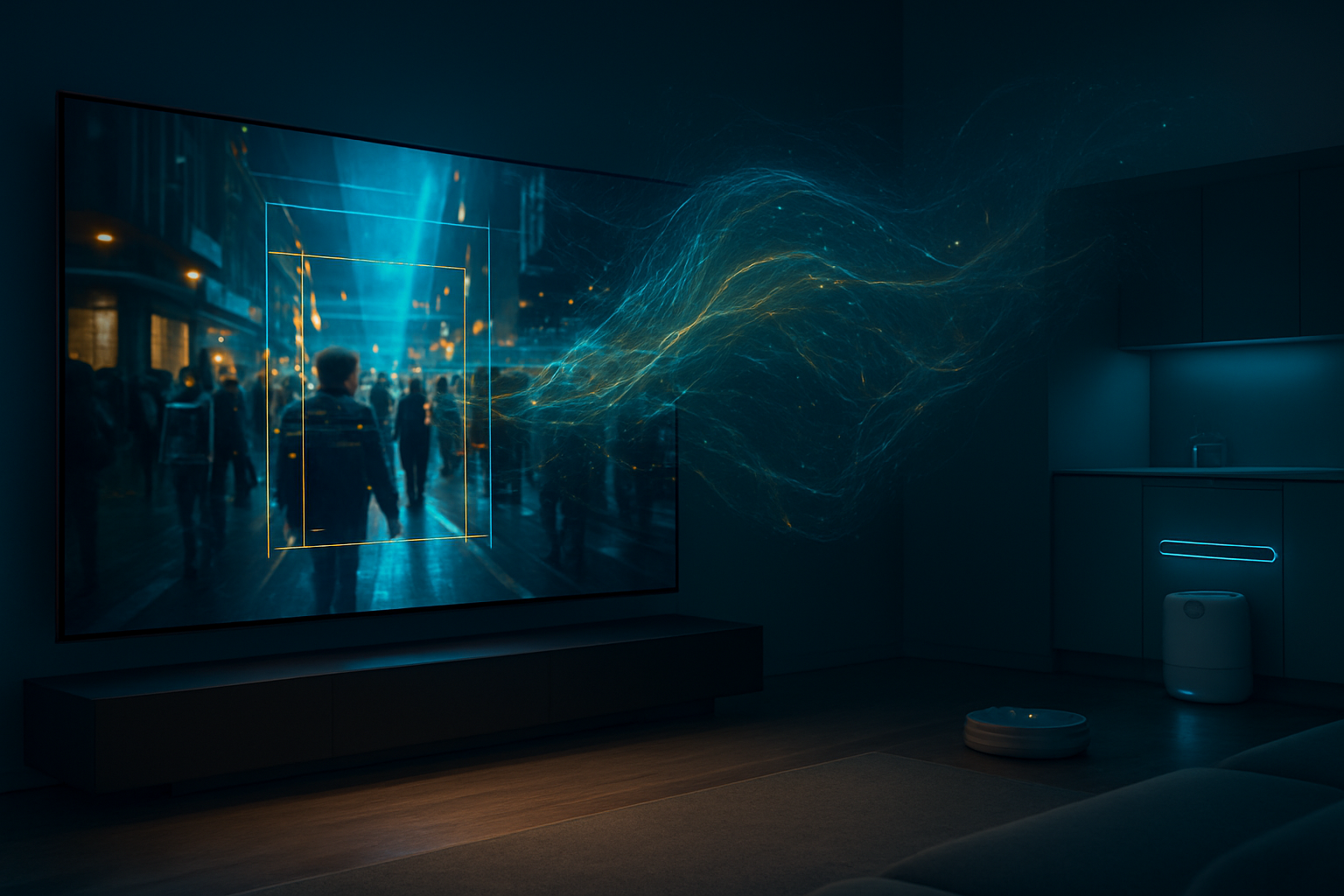
  • The 300-Layer Era Begins: SK Hynix Unveils 321-Layer 2Tb QLC NAND to Power Trillion-Parameter AI

    The 300-Layer Era Begins: SK Hynix Unveils 321-Layer 2Tb QLC NAND to Power Trillion-Parameter AI

    At the 2026 Consumer Electronics Show (CES) in Las Vegas, the "storage wall" in artificial intelligence architecture met its most formidable challenger yet. SK Hynix (KRX: 000660) took center stage to showcase the industry’s first finalized 321-layer 2-Terabit (2Tb) Quad-Level Cell (QLC) NAND product. This milestone isn't just a win for hardware enthusiasts; it represents a critical pivot point for the AI industry, which has struggled to find storage solutions that can keep pace with the massive data requirements of multi-trillion-parameter large language models (LLMs).

    The immediate significance of this development lies in its ability to double storage density while simultaneously slashing power consumption—a rare "holy grail" in semiconductor engineering. As AI training clusters scale to hundreds of thousands of GPUs, the bottleneck has shifted from raw compute power to the efficiency of moving and saving massive datasets. By commercializing 300-plus layer technology, SK Hynix is enabling the creation of ultra-high-capacity Enterprise SSDs (eSSDs) that can house entire multi-petabyte training sets in a fraction of the physical space previously required, effectively accelerating the timeline for the next generation of generative AI.

    The Engineering of the "3-Plug" Breakthrough

    The technical leap from the previous 238-layer generation to 321 layers required a fundamental shift in how NAND flash memory is constructed. SK Hynix’s 321-layer NAND utilizes a proprietary "3-Plug" process technology. This approach involves building three separate vertical stacks of memory cells and electrically connecting them with a high-precision etching process. This overcomes the physical limitations of "single-stack" etching, which becomes increasingly difficult as the aspect ratio of the holes becomes too deep for current chemical processes to maintain uniformity.

    Beyond the layer count, the shift to a 2Tb die capacity—double that of the industry-standard 1Tb die—is powered by a move to a 6-plane architecture. Traditional NAND designs typically use 4 planes, which are independent operating units within the chip. By increasing this to 6 planes, SK Hynix allows for greater parallel processing. This design choice mitigates the historical performance lag associated with QLC (Quad-Level Cell) memory, which stores four bits per cell but often suffers from slower speeds compared to Triple-Level Cell (TLC) memory. The result is a 56% improvement in sequential write performance and an 18% boost in sequential read performance compared to the previous generation.

    Perhaps most critically for the modern data center, the 321-layer product delivers a 23% improvement in write power efficiency. Industry experts at CES noted that this efficiency is achieved through optimized circuitry and the reduced physical footprint of the memory cells. Initial reactions from the AI research community have been overwhelmingly positive, with engineers noting that the increased write speed will drastically reduce "checkpointing" time—the period when an AI training run must pause to save its progress to disk.

    A New Arms Race for AI Storage Dominance

    The announcement has sent ripples through the competitive landscape of the memory market. While Samsung Electronics (KRX: 005930) also teased its 10th-generation V-NAND (V10) at CES 2026, which aims for over 400 layers, SK Hynix’s product is entering mass production significantly earlier. This gives SK Hynix a strategic window to capture the high-density eSSD market for AI hyperscalers like Microsoft (NASDAQ: MSFT) and Alphabet (NASDAQ: GOOGL). Meanwhile, Micron Technology (NASDAQ: MU) showcased its G9 QLC technology, but SK Hynix currently holds the edge in total die density for the 2026 product cycle.

    The strategic advantage extends to the burgeoning market for 61TB and 244TB eSSDs. High-capacity drives allow tech giants to consolidate their server racks, reducing the total cost of ownership (TCO) by minimizing the number of physical servers needed to host large datasets. This development is expected to disrupt the legacy hard disk drive (HDD) market even further, as the energy and space savings of 321-layer QLC now make all-flash data centers economically viable for "warm" and even "cold" data storage.

    Breaking the Storage Wall for Trillion-Parameter Models

    The broader significance of this breakthrough lies in its impact on the scale of AI. Training a multi-trillion-parameter model is not just a compute problem; it is a data orchestration problem. These models require training sets that span tens of petabytes. If the storage system cannot feed data to the GPUs fast enough, the GPUs—often expensive chips from NVIDIA (NASDAQ: NVDA)—sit idle, wasting millions of dollars in electricity and capital. The 321-layer NAND ensures that storage is no longer the laggard in the AI stack.

    Furthermore, this advancement addresses the growing global concern over AI's energy footprint. By reducing storage power consumption by up to 40% when compared to older HDD-based systems or lower-density SSDs, SK Hynix is providing a path for sustainable AI growth. This fits into the broader trend of "AI-native hardware," where every component of the server—from the HBM3E memory used in GPUs to the NAND in the storage drives—is being redesigned specifically for the high-concurrency, high-throughput demands of machine learning workloads.

    The Path to 400 Layers and Beyond

    Looking ahead, the industry is already eyeing the 400-layer and 500-layer milestones. SK Hynix’s success with the "3-Plug" method suggests that stacking can continue for several more generations before a radical new material or architecture is required. In the near term, expect to see 488TB eSSDs becoming the standard for top-tier AI training clusters by 2027. These drives will likely integrate more closely with the system's processing units, potentially using "Computational Storage" techniques where some AI preprocessing happens directly on the SSD.

    The primary challenge remaining is the endurance of QLC memory. While SK Hynix has improved performance, the physical wear and tear on cells that store four bits of data remains higher than in TLC. Experts predict that sophisticated wear-leveling algorithms and new error-correction (ECC) technologies will be the next frontier of innovation to ensure these massive 244TB drives can survive the rigorous read/write cycles of AI inference and training over a five-year lifespan.

    Summary of the AI Storage Revolution

    The unveiling of SK Hynix’s 321-layer 2Tb QLC NAND marks the official beginning of the "High-Density AI Storage" era. By successfully navigating the complexities of triple-stacking and 6-plane architecture, the company has delivered a product that doubles the capacity of its predecessor while enhancing speed and power efficiency. This development is a crucial "enabling technology" that allows the AI industry to continue its trajectory toward even larger, more capable models.

    In the coming months, the industry will be watching for the first deployment reports from major data centers as they integrate these 321-layer drives into their clusters. With Samsung and Micron racing to catch up, the competitive pressure will likely accelerate the transition to all-flash AI infrastructure. For now, SK Hynix has solidified its position as a "Full Stack AI Memory Provider," proving that in the race for AI supremacy, the speed and scale of memory are just as important as the logic of the processor.


    This content is intended for informational purposes only and represents analysis of current AI developments.

    TokenRing AI delivers enterprise-grade solutions for multi-agent AI workflow orchestration, AI-powered development tools, and seamless remote collaboration platforms.
    For more information, visit https://www.tokenring.ai/.