Tokyo, Japan – November 14, 2025 – A revolutionary breakthrough in Brain-Computer Interface (BCI) technology, coupled with advanced Artificial Intelligence, is poised to redefine human communication. Researchers have successfully developed a "mind-captioning" technique that translates complex brain activity associated with mental imagery directly into coherent, descriptive language. This monumental achievement, led by cognitive neuroscientist Dr. Tomoyasu Horikawa and his team, and published in Science Advances, represents a pivotal leap beyond previous BCI limitations, offering unprecedented hope for individuals with severe communication impairments and opening new frontiers in understanding the human mind.
The immediate significance of this development cannot be overstated. For millions suffering from conditions like aphasia, locked-in syndrome, or paralysis, this technology offers a potential pathway to restore their voice by bypassing damaged physiological and neurological mechanisms. Instead of relying on physical movements or even inner speech, individuals could soon communicate by merely visualizing thoughts, memories, or desired actions. This breakthrough also provides profound new insights into the neural encoding of perception, imagination, and memory, suggesting a more layered and distributed construction of meaning within the brain than previously understood.
Decoding the Inner World: How AI Transforms Thought into Text
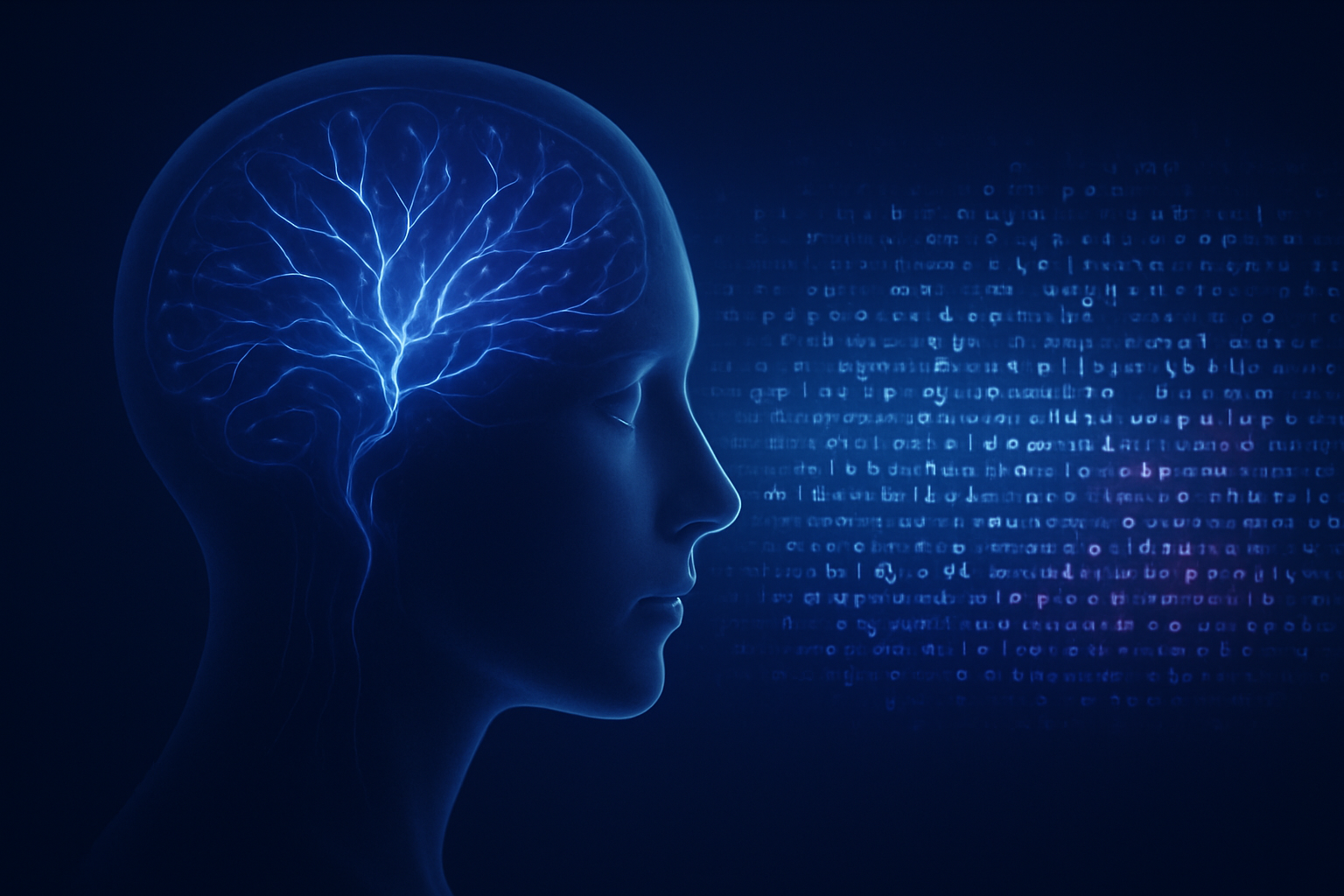
The "mind-captioning" system developed by Dr. Horikawa's team operates through a sophisticated two-stage AI process, primarily utilizing functional magnetic resonance imaging (fMRI) to capture intricate brain activity. Unlike earlier BCI systems that could only identify individual objects or spoken words, this new approach deciphers the holistic patterns of brain activity corresponding to full scenes, events, and relationships a person is mentally experiencing or recalling.
The first stage involves decoding brain signals, where advanced AI models process fMRI data related to visual perception and mental content. These models employ linear techniques to extract semantic features from the neural patterns. The second stage then employs a separate AI model, trained through masked language modeling, to transform these decoded semantic features into natural, structured language. This iterative process generates candidate sentences, continually refining them until their meaning precisely aligns with the semantic characteristics derived from the brain data. Remarkably, the system achieved up to 50% accuracy in describing scenes participants were actively watching and approximately 40% accuracy for recalled memories, significantly exceeding random chance. A particularly striking finding was the system's ability to produce robust descriptions even when traditional language processing regions of the brain were excluded from the analysis, suggesting that the core meaning of mental images is distributed across broader cortical areas.
This innovative method stands apart from previous BCI approaches that often relied on invasive implants or were limited to decoding specific motor intentions or rudimentary word selections. While other recent advancements, such as the decoding of "inner speech" with high accuracy (around 74% in a Cell study from August 2025) and non-invasive EEG-based systems like the University of Technology Sydney's (UTS) DeWave, have pushed the boundaries of thought-to-text communication, Horikawa's work uniquely focuses on the translation of mental imagery into descriptive prose. Furthermore, the "Generative Language Reconstruction" (BrainLLM) system, published in Communications Biology in March 2025, also integrates fMRI with large language models to generate open-ended text, but Horikawa's focus on visual mental content provides a distinct and complementary pathway for communication. Initial reactions from the AI research community have been overwhelmingly positive, hailing the work as a significant step towards more natural and comprehensive brain-computer interaction.
Reshaping the AI Landscape: Industry Implications and Competitive Edge
The ramifications of this "mind-captioning" breakthrough are profound for the AI industry, promising to reshape product development, competitive strategies, and market positioning for tech giants and nimble startups alike. Companies specializing in assistive technologies, healthcare AI, and advanced human-computer interaction stand to benefit immensely from this development.
Major tech companies like Google (NASDAQ: GOOGL), Microsoft (NASDAQ: MSFT), and Meta Platforms (NASDAQ: META), with their extensive investments in AI research and BCI, are likely to accelerate their efforts in this domain. They possess the resources and infrastructure to integrate such sophisticated mind-captioning capabilities into future products, from enhanced accessibility tools to entirely new forms of immersive computing and virtual reality interfaces. Startups focused on neurotechnology and personalized AI solutions could also find fertile ground for innovation, potentially developing niche applications for specific patient populations or creative industries. The competitive landscape for major AI labs will intensify as the race to perfect and commercialize thought-to-text technologies heats up, with each vying for leadership in a market that could eventually encompass billions.
This technology has the potential to disrupt existing products and services across various sectors. For instance, current speech-to-text and text-to-speech technologies, while powerful, might find new complements or even challenges from direct thought-to-text communication, particularly for users unable to vocalize. The market for augmentative and alternative communication (AAC) devices could be revolutionized, offering more intuitive and less physically demanding methods of expression. Companies that can swiftly adapt their AI frameworks to incorporate advanced neural decoding and language generation will gain significant strategic advantages, positioning themselves at the forefront of the next wave of human-machine interaction. The ability to directly translate mental imagery into text could also open up entirely new markets in creative content generation, education, and even advanced forms of mental wellness and therapy.
Beyond Communication: Wider Significance and Ethical Frontiers
This breakthrough in mind-captioning extends far beyond mere communication, fitting seamlessly into the broader AI landscape as a testament to the accelerating convergence of neuroscience and artificial intelligence. It underscores the trend towards more intuitive and deeply integrated human-AI interfaces, pushing the boundaries of what was once considered science fiction into tangible reality. The development aligns with the broader push for AI that understands and interacts with human cognition at a fundamental level, moving beyond pattern recognition to semantic interpretation of internal states.
The impacts are multifaceted. On one hand, it heralds a new era of accessibility, potentially empowering millions who have been marginalized by communication barriers. On the other, it raises significant ethical and privacy concerns. The ability to "read" mental images, even with consent, brings forth questions about mental privacy, data security, and the potential for misuse. Who owns the data generated from one's thoughts? How can we ensure that such technology is used solely for beneficial purposes and not for surveillance or manipulation? These are critical questions that the AI community, policymakers, and society at large must address proactively. Comparisons to previous AI milestones, such as the development of large language models (LLMs) like GPT-3 and GPT-4, are apt; just as LLMs revolutionized text generation, mind-captioning could revolutionize text input directly from the source of thought, marking a similar paradigm shift in human-computer interaction.
The Horizon of Thought: Future Developments and Challenges
The future trajectory of BCI and mind-captioning technology is poised for rapid evolution. In the near term, experts predict further refinements in accuracy, speed, and the complexity of mental content that can be translated. Research will likely focus on reducing the reliance on fMRI, which is expensive and cumbersome, by exploring more portable and less invasive neural sensing technologies, such as advanced EEG or fNIRS (functional near-infrared spectroscopy) systems. The integration of these brain-derived signals with ever more powerful large language models will continue, leading to more natural and nuanced textual outputs.
Potential applications on the horizon are vast and transformative. Beyond assistive communication, mind-captioning could enable novel forms of creative expression, allowing artists to manifest visual ideas directly into descriptions or even code. It could revolutionize education by providing new ways for students to articulate understanding or for educators to gauge comprehension. In the long term, we might see thought-driven interfaces for controlling complex machinery, navigating virtual environments with unparalleled intuition, or even enhancing cognitive processes. However, significant challenges remain. Miniaturization and cost reduction of BCI hardware are crucial for widespread adoption. The ethical framework for mental privacy and data governance needs to be robustly established. Furthermore, the inherent variability of human brain activity requires highly personalized AI models, posing a challenge for generalizable solutions. Experts predict a future where brain-computer interfaces become as commonplace as smartphones, but the journey there will require careful navigation of both technological hurdles and societal implications.
A New Era of Cognitive Connection: A Wrap-Up
The recent breakthroughs in Brain-Computer Interface technology and AI-powered mind-captioning represent a watershed moment in artificial intelligence history. Dr. Tomoyasu Horikawa's team's ability to translate complex mental imagery into descriptive text is not merely an incremental improvement; it is a fundamental shift in how humans can potentially interact with the digital world and express their innermost thoughts. This development, alongside advancements in decoding inner speech and non-invasive brain-to-text systems, underscores a powerful trend: AI is rapidly moving towards understanding and facilitating direct communication from the human mind.
The key takeaways are clear: we are entering an era where communication barriers for the severely impaired could be significantly reduced, and our understanding of human cognition will be profoundly enhanced. While the immediate excitement is palpable, the long-term impact will hinge on our ability to responsibly develop these technologies, ensuring accessibility, privacy, and ethical guidelines are paramount. As we move into the coming weeks and months, the world will be watching for further refinements in accuracy, the development of more portable and less invasive BCI solutions, and critical discussions around the societal implications of directly interpreting the mind's eye. The journey towards a truly cognitive connection between humans and machines has just begun.
This content is intended for informational purposes only and represents analysis of current AI developments.
TokenRing AI delivers enterprise-grade solutions for multi-agent AI workflow orchestration, AI-powered development tools, and seamless remote collaboration platforms.
For more information, visit https://www.tokenring.ai/.