Tag: Custom Silicon

  • The Great Silicon Divorce: How Cloud Giants Are Breaking Nvidia’s Iron Grip on AI

    The Great Silicon Divorce: How Cloud Giants Are Breaking Nvidia’s Iron Grip on AI

    As we enter 2026, the artificial intelligence industry is witnessing a tectonic shift in its power dynamics. For years, Nvidia (NASDAQ: NVDA) has enjoyed a near-monopoly on the high-performance hardware required to train and deploy large language models. However, the era of "Silicon Sovereignty" has arrived. The world’s largest cloud hyperscalers—Amazon (NASDAQ: AMZN), Google (NASDAQ: GOOGL), and Microsoft (NASDAQ: MSFT)—are no longer content being Nvidia's largest customers; they have become its most formidable architectural rivals. By developing custom AI silicon like Trainium, TPU v7, and Maia, these tech titans are systematically reducing their reliance on the GPU giant to slash costs and optimize performance for their proprietary models.

    The immediate significance of this shift is most visible in the bottom line. With AI infrastructure spending reaching record highs—Microsoft’s CAPEX alone hit a staggering $80 billion last year—the "Nvidia Tax" has become a burden too heavy to bear. By designing their own chips, hyperscalers are achieving a "Sovereignty Dividend," reporting a 30% to 40% reduction in total cost of ownership (TCO). This transition marks the end of the general-purpose GPU’s absolute reign and the beginning of a fragmented, specialized hardware landscape where the software and the silicon are co-engineered for maximum efficiency.

    The Rise of Custom Architectures: TPU v7, Trainium3, and Maia 200

    The technical specifications of the latest custom silicon reveal a narrowing gap between specialized ASICs (Application-Specific Integrated Circuits) and Nvidia’s flagship GPUs. Google’s TPU v7, codenamed "Ironwood," has emerged as a powerhouse in early 2026. Built on a cutting-edge 3nm process, the TPU v7 matches Nvidia’s Blackwell B200 in raw FP8 compute performance, delivering 4.6 PFLOPS. Google has integrated these chips into massive "pods" of 9,216 units, utilizing an Optical Circuit Switch (OCS) that allows the entire cluster to function as a single 42-exaflop supercomputer. Google now reports that over 75% of its Gemini model computations are handled by its internal TPU fleet, a move that has significantly insulated the company from supply chain volatility.

    Amazon Web Services (AWS) has followed suit with the general availability of Trainium3, announced at re:Invent 2025. Trainium3 offers a 2x performance boost over its predecessor and is 4x more energy-efficient, serving as the backbone for "Project Rainier," a massive compute cluster dedicated to Anthropic. Meanwhile, Microsoft is ramping up production of its Maia 200 (Braga) chip. While Maia has faced production delays and currently trails Nvidia’s raw power, Microsoft is leveraging its "MX" data format and advanced liquid-cooled infrastructure to optimize the chip for Azure’s specific AI workloads. These custom chips differ from traditional GPUs by stripping away legacy graphics-processing circuitry, focusing entirely on the dense matrix multiplication required for transformer-based models.

    Strategic Realignment: Winners, Losers, and the Shadow Giants

    This shift toward vertical integration is fundamentally altering the competitive landscape. For the hyperscalers, the strategic advantage is clear: they can now offer AI compute at prices that Nvidia-based competitors cannot match. In early 2026, AWS implemented a 45% price cut on its Nvidia-based instances, a move widely interpreted as a defensive strategy to keep customers within its ecosystem while it scales up its Trainium and Inferentia offerings. This pricing pressure forces a difficult choice for startups and AI labs: pay a premium for the flexibility of Nvidia’s CUDA ecosystem or migrate to custom silicon for significantly lower operational costs.

    While Nvidia remains the dominant force with roughly 90% of the data center GPU market, the "shadow winners" of this transition are the silicon design partners. Broadcom (NASDAQ: AVGO) and Marvell (NASDAQ: MRVL) have become the primary enablers of the custom chip revolution. Broadcom’s AI revenue is projected to reach $46 billion in 2026, driven largely by its role in co-designing Google’s TPUs and Meta’s (NASDAQ: META) MTIA chips. These companies provide the essential intellectual property and design expertise that allow software giants to become hardware manufacturers overnight, effectively commoditizing the silicon layer of the AI stack.

    The Great Inference Shift and the Sovereignty Dividend

    The broader AI landscape is currently defined by a pivot from training to inference. In 2026, an estimated 70% of all AI workloads are inference-related—the process of running a pre-trained model to generate responses. This is where custom silicon truly shines. While training a frontier model still often requires the raw, flexible power of an Nvidia cluster, the repetitive, high-volume nature of inference is perfectly suited for cost-optimized ASICs. Chips like AWS Inferentia and Meta’s MTIA are designed to maximize "tokens per watt," a metric that has become more important than raw FLOPS for companies operating at a global scale.

    This development mirrors previous milestones in computing history, such as the transition from mainframes to distributed cloud computing. Just as the cloud allowed companies to move away from expensive, proprietary hardware toward scalable, utility-based services, custom AI silicon is democratizing access to high-scale inference. However, this trend also raises concerns about "ecosystem lock-in." As hyperscalers optimize their software stacks for their own silicon, moving a model from Google Cloud to Azure or AWS becomes increasingly complex, potentially stifling the interoperability that the open-source AI community has fought to maintain.

    The Future of Silicon: Nvidia’s Rubin and Hybrid Ecosystems

    Looking ahead, the battle for silicon supremacy is only intensifying. In response to the custom chip threat, Nvidia used CES 2026 to launch its "Vera Rubin" architecture. Named after the pioneering astronomer, the Rubin platform utilizes HBM4 memory and a 3nm process to deliver unprecedented efficiency. Nvidia’s strategy is to make its general-purpose GPUs so efficient that the marginal cost savings of custom silicon become negligible for third-party developers. Furthermore, the upcoming Trainium4 from AWS suggests a future of "hybrid environments," featuring support for Nvidia NVLink Fusion. This will allow custom silicon to sit directly inside Nvidia-designed racks, enabling a mix-and-match approach to compute.

    Experts predict that the next two years will see a "tiering" of the AI hardware market. High-end frontier model training will likely remain the domain of Nvidia’s most advanced GPUs, while the vast majority of mid-tier training and global inference will migrate to custom ASICs. The challenge for hyperscalers will be to build software ecosystems that can rival Nvidia’s CUDA, which remains the industry standard for AI development. If the cloud giants can simplify the developer experience for their custom chips, Nvidia’s iron grip on the market may finally be loosened.

    Conclusion: A New Era of AI Infrastructure

    The rise of custom AI silicon represents one of the most significant shifts in the history of computing. We have moved beyond the "gold rush" phase where any available GPU was a precious commodity, into a sophisticated era of specialized, cost-effective infrastructure. The aggressive moves by Amazon, Google, and Microsoft to build their own chips are not just about saving money; they are about securing their future in an AI-driven world where compute is the most valuable resource.

    In the coming months, the industry will be watching the deployment of Nvidia’s Rubin architecture and the performance benchmarks of Microsoft’s Maia 200. As the "Silicon Sovereignty" movement matures, the ultimate winners will be the enterprises and developers who can leverage this new diversity of hardware to build more powerful, efficient, and accessible AI applications. The great silicon divorce is underway, and the AI landscape will never be the same.


    This content is intended for informational purposes only and represents analysis of current AI developments.

    TokenRing AI delivers enterprise-grade solutions for multi-agent AI workflow orchestration, AI-powered development tools, and seamless remote collaboration platforms.
    For more information, visit https://www.tokenring.ai/.

  • The $2,000 Vehicle: Rivian’s RAP1 AI Chip and the Era of Custom Automotive Silicon

    The $2,000 Vehicle: Rivian’s RAP1 AI Chip and the Era of Custom Automotive Silicon

    In a move that solidifies its position as a frontrunner in the "Silicon Sovereignty" movement, Rivian Automotive, Inc. (NASDAQ: RIVN) recently unveiled its first proprietary AI processor, the Rivian Autonomy Processor 1 (RAP1). Announced during the company’s Autonomy & AI Day in late 2025, the RAP1 marks a decisive departure from third-party hardware providers. By designing its own silicon, Rivian is not just building a car; it is building a specialized supercomputer on wheels, optimized for the unique demands of "physical AI" and real-world sensor fusion.

    The announcement centers on a strategic shift toward vertical integration that aims to drastically reduce the cost of autonomous driving technology. Dubbed by some industry insiders as the push toward the "$2,000 Vehicle" hardware stack, Rivian’s custom silicon strategy targets a 30% reduction in the bill of materials (BOM) for its autonomy systems. This efficiency allows Rivian to offer advanced driver-assistance features at a fraction of the price of its competitors, effectively democratizing high-level autonomy for the mass market.

    Technical Prowess: The RAP1 and ACM3 Architecture

    The RAP1 is a technical marvel fabricated on the 5nm process from Taiwan Semiconductor Manufacturing Company (NYSE: TSM). Built using the Armv9 architecture from Arm Holdings plc (NASDAQ: ARM), the chip features 14 Cortex-A720AE cores specifically designed for automotive safety and ASIL-D compliance. What sets the RAP1 apart is its raw AI throughput; a single chip delivers between 1,600 and 1,800 sparse INT8 TOPS (Trillion Operations Per Second). In its flagship Autonomy Compute Module 3 (ACM3), Rivian utilizes dual RAP1 chips, allowing the vehicle to process over 5 billion pixels per second with unprecedented low latency.

    Unlike general-purpose chips from NVIDIA Corporation (NASDAQ: NVDA) or Qualcomm Incorporated (NASDAQ: QCOM), the RAP1 is architected specifically for "Large Driving Models" (LDM). These end-to-end neural networks require massive data bandwidth to handle simultaneous inputs from cameras, Radar, and LiDAR. Rivian’s custom "RivLink" interconnect enables these dual chips to function as a single, cohesive unit, providing linear scaling for future software updates. This hardware-level optimization allows the RAP1 to be 2.5 times more power-efficient than previous-generation setups while delivering four times the performance.

    The research community has noted that Rivian’s approach differs significantly from Tesla, Inc. (NASDAQ: TSLA), which has famously eschewed LiDAR in favor of a vision-only system. The RAP1 includes dedicated hardware acceleration for "unstructured point cloud" data, making it uniquely capable of processing LiDAR information natively. This hybrid approach—combining the depth perception of LiDAR with the semantic understanding of high-resolution cameras—is seen by many experts as a more robust path to true Level 4 autonomous driving in complex urban environments.

    Disrupting the Silicon Status Quo

    The introduction of the RAP1 creates a significant shift in the competitive landscape of both the automotive and semiconductor industries. For years, NVIDIA and Qualcomm have dominated the "brains" of the modern EV. However, as companies like Rivian, Nio Inc. (NYSE: NIO), and XPeng Inc. (NYSE: XPEV) follow Tesla’s lead in designing custom silicon, the market for general-purpose automotive chips is facing a "hollowing out" at the high end. Rivian’s move suggests that for a premium EV maker to survive, it must own its compute stack to avoid the "vendor margin" that inflates vehicle prices.

    Strategically, this vertical integration gives Rivian a massive advantage in pricing power. By cutting out the middleman, Rivian has priced its "Autonomy+" package at a one-time fee of $2,500—significantly lower than Tesla’s Full Self-Driving (FSD) suite. This aggressive pricing is intended to drive high take-rates for the upcoming R2 and R3 platforms, creating a recurring revenue stream through software services that would be impossible if the hardware costs remained prohibitively high.

    Furthermore, this development puts pressure on traditional "Legacy" automakers who still rely on Tier 1 suppliers for their electronics. While companies like Ford or GM may struggle to transition to in-house chip design, Rivian’s success with the RAP1 demonstrates that a smaller, more agile tech-focused automaker can successfully compete with silicon giants. The strategic advantage of having hardware that is perfectly "right-sized" for the software it runs cannot be overstated, as it leads to better thermal management, lower power consumption, and longer battery range.

    The Broader Significance: Physical AI and Safety

    The RAP1 announcement is more than just a hardware update; it represents a milestone in the evolution of "Physical AI." While generative AI has dominated headlines with large language models, physical AI requires real-time interaction with a dynamic, unpredictable environment. Rivian’s silicon is designed to bridge the gap between digital intelligence and physical safety. By embedding safety protocols directly into the silicon architecture, Rivian is addressing one of the primary concerns of autonomous driving: reliability in edge cases where software-only solutions might fail.

    This trend toward custom automotive silicon mirrors the evolution of the smartphone industry. Just as Apple’s transition to its own A-series and M-series chips allowed for tighter integration of hardware and software, automakers are realizing that the vehicle's "operating system" cannot be optimized without control over the underlying transistors. This shift marks the end of the era where a car was defined by its engine and the beginning of an era where it is defined by its inference capabilities.

    However, this transition is not without its risks. The massive capital expenditure required for chip design and the reliance on a few key foundries like TSMC create new vulnerabilities in the global supply chain. Additionally, as vehicles become more reliant on proprietary AI, questions regarding data privacy and the "right to repair" become more urgent. If the core functionality of a vehicle is locked behind a custom, encrypted AI chip, the relationship between the owner and the manufacturer changes fundamentally.

    Looking Ahead: The Road to R2 and Beyond

    In the near term, the industry is closely watching the production ramp of the Rivian R2, which will be the first vehicle to ship with the RAP1-powered ACM3 module in late 2026. Experts predict that the success of this platform will determine whether other mid-sized EV players will be forced to develop their own silicon or if they will continue to rely on standardized platforms. We can also expect to see "Version 2" of these chips appearing as early as 2028, likely moving to 3nm processes to further increase efficiency.

    The next frontier for the RAP1 architecture may lie beyond personal transportation. Rivian has hinted that its custom silicon could eventually power autonomous delivery fleets and even industrial robotics, where the same "physical AI" requirements for sensor fusion and real-time navigation apply. The challenge will be maintaining the pace of innovation; as AI models evolve from traditional neural networks to more complex architectures like Transformers, the hardware must remain flexible enough to adapt without requiring a physical recall.

    A New Chapter in Automotive History

    The unveiling of the Rivian RAP1 AI chip is a watershed moment that signals the maturity of the electric vehicle industry. It proves that the "software-defined vehicle" is no longer a marketing buzzword but a technical reality underpinned by custom-engineered silicon. By achieving a 30% reduction in autonomy costs, Rivian is paving the way for a future where advanced safety and self-driving features are standard rather than luxury add-ons.

    As we move further into 2026, the primary metric for automotive excellence will shift from horsepower and torque to TOPS and tokens per second. The RAP1 is a bold statement that Rivian intends to be a leader in this new paradigm. Investors and tech enthusiasts alike should watch for the first real-world performance benchmarks of the R2 platform later this year, as they will provide the first true test of whether Rivian’s "Silicon Sovereignty" can deliver on its promise of a safer, more affordable autonomous future.


    This content is intended for informational purposes only and represents analysis of current AI developments.

    TokenRing AI delivers enterprise-grade solutions for multi-agent AI workflow orchestration, AI-powered development tools, and seamless remote collaboration platforms.
    For more information, visit https://www.tokenring.ai/.

  • OpenAI’s Strategic Shift to Amazon Trainium: Analyzing the $10 Billion Talks and the Move Toward Custom Silicon

    OpenAI’s Strategic Shift to Amazon Trainium: Analyzing the $10 Billion Talks and the Move Toward Custom Silicon

    In a move that has sent shockwaves through the semiconductor and cloud computing industries, OpenAI has reportedly entered advanced negotiations with Amazon (NASDAQ: AMZN) for a landmark $10 billion "chips-for-equity" deal. This strategic pivot, finalized in early 2026, centers on OpenAI’s commitment to migrate a massive portion of its training and inference workloads to Amazon’s proprietary Trainium silicon. The deal effectively ends OpenAI’s exclusive reliance on NVIDIA (NASDAQ: NVDA) hardware and marks a significant cooling of its once-monolithic relationship with Microsoft (NASDAQ: MSFT).

    The agreement is the cornerstone of OpenAI’s new "multi-vendor" infrastructure strategy, designed to insulate the AI giant from the supply chain bottlenecks and "NVIDIA tax" that have defined the last three years of the AI boom. By integrating Amazon’s next-generation Trainium 3 architecture into its core stack, OpenAI is not just diversifying its cloud providers—it is fundamentally rewriting the economics of large language model (LLM) development. This $10 billion investment is paired with a staggering $38 billion, seven-year cloud services agreement with Amazon Web Services (AWS), positioning Amazon as a primary engine for OpenAI’s future frontier models.

    The Technical Leap: Trainium 3 and the NKI Breakthrough

    At the heart of this transition is the Trainium 3 accelerator, unveiled by Amazon at the end of 2025. Built on a cutting-edge 3nm process node, Trainium 3 delivers a staggering 2.52 PFLOPs of FP8 compute performance, representing a more than twofold increase over its predecessor. More critically, the chip boasts a 4x improvement in energy efficiency, a vital metric as OpenAI’s power requirements begin to rival those of small nations. With 144GB of HBM3e memory and bandwidth reaching up to 9 TB/s via PCIe Gen 6, Trainium 3 is the first custom ASIC (Application-Specific Integrated Circuit) to credibly challenge NVIDIA’s Blackwell and upcoming Rubin architectures in high-end training performance.

    The technical catalyst that made this migration possible is the Neuron Kernel Interface (NKI). Historically, AI labs were "locked in" to NVIDIA’s CUDA ecosystem because custom silicon lacked the software flexibility required for complex, evolving model architectures. NKI changes this by allowing OpenAI’s performance engineers to write custom kernels directly for the Trainium hardware. This level of low-level optimization is essential for "Project Strawberry"—OpenAI’s suite of reasoning-heavy models—which require highly efficient memory-to-compute ratios that standard GPUs struggle to maintain at scale.

    Initial reactions from the AI research community have been one of cautious validation. Experts note that while NVIDIA remains the "gold standard" for raw flexibility and peak performance in frontier research, the specialized nature of Trainium 3 allows for a 40% better price-performance ratio for the high-volume inference tasks that power ChatGPT. By moving inference to Trainium, OpenAI can significantly lower its "cost-per-token," a move that is seen as essential for the company's long-term financial sustainability.

    Reshaping the Cloud Wars: Amazon’s Ascent and Microsoft’s New Reality

    This deal fundamentally alters the competitive landscape of the "Big Three" cloud providers. For years, Microsoft (NASDAQ: MSFT) enjoyed a privileged position as the exclusive cloud provider for OpenAI. However, in late 2025, Microsoft officially waived its "right of first refusal," signaling a transition to a more open, competitive relationship. While Microsoft remains a 27% shareholder in OpenAI, the AI lab is now spreading roughly $600 billion in compute commitments across Microsoft Azure, AWS, and Oracle (NYSE: ORCL) through 2030.

    Amazon stands as the primary beneficiary of this shift. By securing OpenAI as an anchor tenant for Trainium 3, AWS has validated its custom silicon strategy in a way that Google’s (NASDAQ: GOOGL) TPU has yet to achieve with external partners. This move positions AWS not just as a provider of generic compute, but as a specialized AI foundry. For NVIDIA (NASDAQ: NVDA), the news is a sobering reminder that its largest customers are also becoming its most formidable competitors. While NVIDIA’s stock has shown resilience due to the sheer volume of global demand, the loss of total dominance over OpenAI’s hardware stack marks the beginning of the "de-NVIDIA-fication" of the AI industry.

    Other AI startups are likely to follow OpenAI’s lead. The "roadmap for hardware sovereignty" established by this deal provides a blueprint for labs like Anthropic and Mistral to reduce their hardware overhead. As OpenAI migrates its workloads, the availability of Trainium instances on AWS is expected to surge, creating a more diverse and price-competitive market for AI compute that could lower the barrier to entry for smaller players.

    The Wider Significance: Hardware Sovereignty and the $1.4 Trillion Bill

    The move toward custom silicon is a response to a looming economic crisis in the AI sector. With OpenAI facing a projected $1.4 trillion compute bill over the next decade, the "NVIDIA Tax"—the high margins commanded by general-purpose GPUs—has become an existential threat. By moving to Trainium 3 and co-developing its own proprietary "XPU" with Broadcom (NASDAQ: AVGO) and TSMC (NYSE: TSM), OpenAI is pursuing "hardware sovereignty." This is a strategic shift comparable to Apple’s transition to its own M-series chips, prioritizing vertical integration to optimize both performance and profit margins.

    This development fits into a broader trend of "AI Nationalism" and infrastructure consolidation. As AI models become more integrated into the global economy, the control of the underlying silicon becomes a matter of national and corporate security. The shift away from a single hardware monoculture (CUDA/NVIDIA) toward a multi-polar hardware environment (Trainium, TPU, XPU) will likely lead to more specialized AI models that are "hardware-aware," designed from the ground up to run on specific architectures.

    However, this transition is not without concerns. The fragmentation of the AI hardware landscape could lead to a "software tax," where developers must maintain multiple versions of their code for different chips. There are also questions about whether Amazon and OpenAI can maintain the pace of innovation required to keep up with NVIDIA’s annual release cycle. If Trainium 3 falls behind the next generation of NVIDIA’s Rubin chips, OpenAI could find itself locked into inferior hardware, potentially stalling its progress toward Artificial General Intelligence (AGI).

    The Road Ahead: Proprietary XPUs and the Rubin Era

    Looking forward, the Amazon deal is only the first phase of OpenAI’s silicon ambitions. The company is reportedly working on its own internal inference chip, codenamed "XPU," in partnership with Broadcom (NASDAQ: AVGO). While Trainium will handle the bulk of training and high-scale inference in the near term, the XPU is expected to ship in late 2026 or early 2027, focusing specifically on ultra-low-latency inference for real-time applications like voice and video synthesis.

    In the near term, the industry will be watching the first "frontier" model trained entirely on Trainium 3. If OpenAI can demonstrate that its next-generation GPT-5 or "Orion" models perform identically or better on Amazon silicon compared to NVIDIA hardware, it will trigger a mass migration of enterprise AI workloads to AWS. Challenges remain, particularly in the scaling of "UltraServers"—clusters of 144 Trainium chips—which must maintain perfectly synchronized communication to train the world's largest models.

    Experts predict that by 2027, the AI hardware market will be split into two distinct tiers: NVIDIA will remain the leader for "frontier training," where absolute performance is the only metric that matters, while custom ASICs like Trainium and OpenAI’s XPU will dominate the "inference economy." This bifurcation will allow for more sustainable growth in the AI sector, as the cost of running AI models begins to drop faster than the models themselves are growing.

    Conclusion: A New Chapter in the AI Industrial Revolution

    OpenAI’s $10 billion pivot to Amazon Trainium 3 is more than a simple vendor change; it is a declaration of independence. By diversifying its hardware stack and investing heavily in custom silicon, OpenAI is attempting to break the bottlenecks that have constrained AI development since the release of GPT-4. The significance of this move in AI history cannot be overstated—it marks the end of the GPU monoculture and the beginning of a specialized, vertically integrated AI industry.

    The key takeaways for the coming months are clear: watch for the performance benchmarks of OpenAI models on AWS, the progress of the Broadcom-designed XPU, and NVIDIA’s strategic response to the erosion of its moat. As the "Silicon Divorce" between OpenAI and its singular reliance on NVIDIA and Microsoft matures, the entire tech industry will have to adapt to a world where the software and the silicon are once again inextricably linked.


    This content is intended for informational purposes only and represents analysis of current AI developments.

    TokenRing AI delivers enterprise-grade solutions for multi-agent AI workflow orchestration, AI-powered development tools, and seamless remote collaboration platforms.
    For more information, visit https://www.tokenring.ai/.
  • The Great Decoupling: Hyperscalers Accelerate Custom Silicon to Break NVIDIA’s AI Stranglehold

    The Great Decoupling: Hyperscalers Accelerate Custom Silicon to Break NVIDIA’s AI Stranglehold

    MOUNTAIN VIEW, CA — As we enter 2026, the artificial intelligence industry is witnessing a seismic shift in its underlying infrastructure. For years, the dominance of NVIDIA Corporation (NASDAQ:NVDA) was considered an unbreakable monopoly, with its H100 and Blackwell GPUs serving as the "gold standard" for training large language models. However, a "Great Decoupling" is now underway. Leading hyperscalers, including Alphabet Inc. (NASDAQ:GOOGL), Amazon.com Inc. (NASDAQ:AMZN), and Microsoft Corp (NASDAQ:MSFT), have moved beyond experimental phases to deploy massive fleets of custom-designed AI silicon, signaling a new era of hardware vertical integration.

    This transition is driven by a dual necessity: the crushing "NVIDIA tax" that eats into cloud margins and the physical limits of power delivery in modern data centers. By tailoring chips specifically for the transformer architectures that power today’s generative AI, these tech giants are achieving performance-per-watt and cost-to-train metrics that general-purpose GPUs struggle to match. The result is a fragmented hardware landscape where the choice of cloud provider now dictates the very architecture of the AI models being built.

    The technical specifications of the 2026 silicon crop represent a peak in application-specific integrated circuit (ASIC) design. Leading the charge is Google’s TPU v7 "Ironwood," which entered general availability in early 2026. Built on a refined 3nm process from Taiwan Semiconductor Manufacturing Co. (NYSE:TSM), the TPU v7 delivers a staggering 4.6 PFLOPS of dense FP8 compute per chip. Unlike NVIDIA’s Blackwell architecture, which must maintain legacy support for a wide range of CUDA-based applications, the Ironwood chip is a "lean" processor optimized exclusively for the "Age of Inference" and massive scale-out sharding. Google has already deployed "Superpods" of 9,216 chips, capable of an aggregate 42.5 ExaFLOPS, specifically to support the training of Gemini 2.5 and beyond.

    Amazon has followed a similar trajectory with its Trainium 3 and Inferentia 3 accelerators. The Trainium 3, also leveraging 3nm lithography, introduces "NeuronLink," a proprietary interconnect that reduces inter-chip latency to sub-10 microseconds. This hardware-level optimization is designed to compete directly with NVIDIA’s NVLink 5.0. Meanwhile, Microsoft, despite early production delays with its Maia 100 series, has finally reached mass production with Maia 200 "Braga." This chip is uniquely focused on "Microscaling" (MX) data formats, which allow for higher precision at lower bit-widths, a critical advancement for the next generation of reasoning-heavy models like GPT-5.

    Industry experts and researchers have reacted with a mix of awe and pragmatism. "The era of the 'one-size-fits-all' GPU is ending," says Dr. Elena Rossi, a lead hardware analyst at TokenRing AI. "Researchers are now optimizing their codebases—moving from CUDA to JAX or PyTorch 2.5—to take advantage of the deterministic performance of TPUs and Trainium. The initial feedback from labs like Anthropic suggests that while NVIDIA still holds the crown for peak theoretical throughput, the 'Model FLOP Utilization' (MFU) on custom silicon is often 20-30% higher because the hardware is stripped of unnecessary graphics-related transistors."

    The market implications of this shift are profound, particularly for the competitive positioning of major cloud providers. By eliminating NVIDIA’s 75% gross margins, hyperscalers can offer AI compute as a "loss leader" to capture long-term enterprise loyalty. For instance, reports indicate that the Total Cost of Ownership (TCO) for training on a Google TPU v7 cluster is now roughly 44% lower than on an equivalent NVIDIA Blackwell cluster. This creates an economic moat that pure-play GPU cloud providers, who lack their own silicon, are finding increasingly difficult to cross.

    The strategic advantage extends to major AI labs. Anthropic, for example, has solidified its partnership with Google and Amazon, securing a 1-gigawatt capacity agreement that will see it utilizing over 5 million custom chips by 2027. This vertical integration allows these labs to co-design hardware and software, leading to breakthroughs in "agentic AI" that require massive, low-cost inference. Conversely, Meta Platforms Inc. (NASDAQ:META) continues to use its MTIA (Meta Training and Inference Accelerator) internally to power its recommendation engines, aiming to migrate 100% of its internal inference traffic to in-house silicon by 2027 to insulate itself from supply chain shocks.

    NVIDIA is not standing still, however. The company has accelerated its roadmap to an annual cadence, with the Rubin (R100) architecture slated for late 2026. Rubin will introduce HBM4 memory and the "Vera" ARM-based CPU, aiming to maintain its lead in the "frontier" training market. Yet, the pressure from custom silicon is forcing NVIDIA to diversify. We are seeing NVIDIA transition from being a chip vendor to a full-stack platform provider, emphasizing its CUDA software ecosystem as the "sticky" component that keeps developers from migrating to the more affordable, but less flexible, custom alternatives.

    Beyond the corporate balance sheets, the rise of custom silicon has significant implications for the global AI landscape. One of the most critical factors is "Intelligence per Watt." As data centers hit the limits of national power grids, the energy efficiency of custom ASICs—which can be up to 3x more efficient than general-purpose GPUs—is becoming a matter of survival. This shift is essential for meeting the sustainability goals of tech giants who are simultaneously scaling their energy consumption to unprecedented levels.

    Geopolitically, the race for custom silicon has turned into a battle for "Silicon Sovereignty." The reliance on a single vendor like NVIDIA was seen as a systemic risk to the U.S. economy and national security. By diversifying the hardware base, the tech industry is creating a more resilient supply chain. However, this has also intensified the competition for TSMC’s advanced nodes. With Apple Inc. (NASDAQ:AAPL) reportedly pre-booking over 50% of initial 2nm capacity for its future devices, hyperscalers and NVIDIA are locked in a high-stakes bidding war for the remaining wafers, often leaving smaller startups and secondary players in the cold.

    Furthermore, the emergence of the Ultra Ethernet Consortium (UEC) and UALink (backed by Broadcom Inc. (NASDAQ:AVGO), Advanced Micro Devices Inc. (NASDAQ:AMD), and Intel Corp (NASDAQ:INTC)) represents a collective effort to break NVIDIA’s proprietary networking standards. By standardizing how chips communicate across massive clusters, the industry is moving toward a modular future where an enterprise might mix NVIDIA GPUs for training with Amazon Inferentia chips for deployment, all within the same networking fabric.

    Looking ahead, the next 24 months will likely see the transition to 2nm and 1.4nm process nodes, where the physical limits of silicon will necessitate even more radical designs. We expect to see the rise of optical interconnects, where data is moved between chips using light rather than electricity, further slashing latency and power consumption. Experts also predict the emergence of "AI-designed AI chips," where existing models are used to optimize the floorplans of future accelerators, creating a recursive loop of hardware-software improvement.

    The primary challenge remaining is the "software wall." While the hardware is ready, the developer ecosystem remains heavily tilted toward NVIDIA’s CUDA. Overcoming this will require hyperscalers to continue investing heavily in compilers and open-source frameworks like Triton. If they succeed, the hardware underlying AI will become a commoditized utility—much like electricity or storage—where the only thing that matters is the cost per token and the intelligence of the model itself.

    The acceleration of custom silicon by Google, Microsoft, and Amazon marks the end of the first era of the AI boom—the era of the general-purpose GPU. As we move into 2026, the industry is maturing into a specialized, vertically integrated ecosystem where hardware is as much a part of the secret sauce as the data used for training. The "Great Decoupling" from NVIDIA does not mean the king has been dethroned, but it does mean the kingdom is now shared.

    In the coming months, watch for the first benchmarks of the NVIDIA Rubin and the official debut of OpenAI’s rumored proprietary chip. The success of these custom silicon initiatives will determine which tech giants can survive the high-cost "inference wars" and which will be forced to scale back their AI ambitions. For now, the message is clear: in the race for AI supremacy, owning the stack from the silicon up is no longer an option—it is a requirement.


    This content is intended for informational purposes only and represents analysis of current AI developments.

    TokenRing AI delivers enterprise-grade solutions for multi-agent AI workflow orchestration, AI-powered development tools, and seamless remote collaboration platforms.
    For more information, visit https://www.tokenring.ai/.
  • The Great Decoupling: How Hyperscaler Custom Silicon is Ending NVIDIA’s AI Monopoly

    The Great Decoupling: How Hyperscaler Custom Silicon is Ending NVIDIA’s AI Monopoly

    The artificial intelligence industry has reached a historic inflection point as of early 2026, marking the beginning of what analysts call the "Great Decoupling." For years, the tech world was beholden to the supply chains and pricing power of NVIDIA Corporation (NASDAQ: NVDA), whose H100 and Blackwell GPUs became the de facto currency of the generative AI era. However, the tide has turned. As the industry shifts its focus from training massive foundation models to the high-volume, cost-sensitive world of inference, the world’s largest hyperscalers—Google, Amazon, and Meta—have finally unleashed their secret weapons: custom-built AI accelerators designed to bypass the "NVIDIA tax."

    Leading this charge is the general availability of Alphabet Inc.’s (NASDAQ: GOOGL) TPU v7, codenamed "Ironwood." Alongside the deployment of Amazon.com, Inc.’s (NASDAQ: AMZN) Trainium 3 and Meta Platforms, Inc.’s (NASDAQ: META) MTIA v3, these chips represent a fundamental shift in the AI power dynamic. No longer content to be just NVIDIA’s biggest customers, these tech giants are vertically integrating their hardware and software stacks to achieve "silicon sovereignty," promising to slash AI operating costs and redefine the competitive landscape for the next decade.

    The Ironwood Era: Inside Google’s TPU v7 Breakthrough

    Google’s TPU v7 "Ironwood," which entered general availability in late 2025, represents the most significant architectural overhaul in the Tensor Processing Unit's decade-long history. Built on a cutting-edge 3nm process node, Ironwood delivers a staggering 4.6 PFLOPS of dense FP8 compute per chip—an 11x increase over the TPU v5p. More importantly, it features 192GB of HBM3e memory with a bandwidth of 7.4 TB/s, specifically engineered to handle the massive KV-caches required for the latest trillion-parameter frontier models like Gemini 2.0 and the upcoming Gemini 3.0.

    What truly sets Ironwood apart from NVIDIA’s Blackwell architecture is its networking philosophy. While NVIDIA relies on NVLink to cluster GPUs in relatively small pods, Google has refined its proprietary Optical Circuit Switch (OCS) and 3D Torus topology. A single Ironwood "Superpod" can connect 9,216 chips into a unified compute domain, providing an aggregate of 42.5 ExaFLOPS of FP8 compute. This allows Google to treat thousands of chips as a single "brain," drastically reducing the latency and networking overhead that typically plagues large-scale distributed inference.

    Initial reactions from the AI research community have been overwhelmingly positive, particularly regarding the TPU’s energy efficiency. Experts at the AI Hardware Summit noted that while NVIDIA’s B200 remains a powerhouse for raw training, Ironwood offers nearly double the performance-per-watt for inference tasks. This efficiency is a direct result of Google’s ASIC approach: by stripping away the legacy graphics circuitry found in general-purpose GPUs, Google has created a "lean and mean" machine dedicated solely to the matrix multiplications that power modern transformers.

    The Cloud Counter-Strike: AWS and Meta’s Silicon Sovereignty

    Not to be outdone, Amazon.com, Inc. (NASDAQ: AMZN) has accelerated its custom silicon roadmap with the full deployment of Trainium 3 (Trn3) in early 2026. Manufactured on TSMC’s 3nm node, Trn3 marks a strategic pivot for AWS: the convergence of its training and inference lines. Amazon has realized that the "thinking" models of 2026, such as Anthropic’s Claude 4 and Amazon’s own Nova series, require the massive memory and FLOPS previously reserved for training. Trn3 delivers 2.52 PFLOPS of FP8 compute, offering a 50% better price-performance ratio than the equivalent NVIDIA H100 or B200 instances currently available on the market.

    Meta Platforms, Inc. (NASDAQ: META) is also making massive strides with its MTIA v3 (Meta Training and Inference Accelerator). While Meta remains one of NVIDIA’s largest customers for the raw training of its Llama family, the company has begun migrating its massive recommendation engines—the heart of Facebook and Instagram—to its own silicon. MTIA v3 features a significant upgrade to HBM3e memory, allowing Meta to serve Llama 4 models to billions of users with a fraction of the power consumption required by off-the-shelf GPUs. This move toward infrastructure autonomy is expected to save Meta billions in capital expenditures over the next three years.

    Even Microsoft Corporation (NASDAQ: MSFT) has joined the fray with the volume rollout of its Maia 200 (Braga) chips. Designed to reduce the "Copilot tax" for Azure OpenAI services, Maia 200 is now powering a significant portion of ChatGPT’s inference workloads. This collective push by the hyperscalers has created a multi-polar hardware ecosystem where the choice of chip is increasingly dictated by the specific model architecture and the desired cost-per-token, rather than brand loyalty to NVIDIA.

    Breaking the CUDA Moat: The Software Revolution

    The primary barrier to decoupling has always been NVIDIA’s proprietary CUDA software ecosystem. However, in 2026, that moat is being bridged by a maturing open-source software stack. OpenAI’s Triton has emerged as the industry’s primary "off-ramp," allowing developers to write high-performance kernels in Python that are hardware-agnostic. Triton now features mature backends for Google’s TPU, AWS Trainium, and even AMD’s MI350 series, effectively neutralizing the software advantage that once made NVIDIA GPUs indispensable.

    Furthermore, the integration of PyTorch 2.x and the upcoming 3.0 release has solidified torch.compile as the standard for AI development. By using the OpenXLA (Accelerated Linear Algebra) compiler and the PJRT interface, PyTorch can now automatically optimize models for different hardware backends with minimal performance loss. This means a developer can train a model on an NVIDIA-based workstation and deploy it to a Google TPU v7 or an AWS Trainium 3 cluster with just a few lines of code.

    This software abstraction has profound implications for the market. It allows AI labs and startups to build "Agentlakes"—composable architectures that can dynamically shift workloads between different cloud providers based on real-time pricing and availability. The "NVIDIA tax"—the 70-80% margins the company once commanded—is being eroded as hyperscalers use their own silicon to offer AI services at lower price points, forcing a competitive race to the bottom in the inference market.

    The Future of Distributed Compute: 2nm and Beyond

    Looking ahead to late 2026 and 2027, the battle for silicon supremacy will move to the 2nm process node. Industry insiders predict that the next generation of chips will focus heavily on "Interconnect Fusion." NVIDIA is already fighting back with its NVLink Fusion technology, which aims to open its high-speed interconnects to third-party ASICs, attempting to move the lock-in from the chip level to the network level. Meanwhile, Google is rumored to be working on TPU v8, which may feature integrated photonic interconnects directly on the die to eliminate electronic bottlenecks entirely.

    The next frontier will also involve "Edge-to-Cloud" continuity. As models become more modular through techniques like Mixture-of-Experts (MoE), we expect to see hybrid inference strategies where the "base" of a model runs on energy-efficient custom silicon in the cloud, while specialized "expert" modules run locally on 2nm-powered mobile devices and PCs. This would create a truly distributed AI fabric, further reducing the reliance on massive centralized GPU clusters.

    However, challenges remain. The fragmentation of the hardware landscape could lead to a "optimization tax," where developers spend more time tuning models for different architectures than they do on actual research. Additionally, the massive capital requirements for 2nm fabrication mean that only the largest hyperscalers can afford to play this game, potentially leading to a new form of "Cloud Oligarchy" where smaller players are priced out of the custom silicon race.

    Conclusion: A New Era of AI Economics

    The "Great Decoupling" of 2026 marks the end of the monolithic GPU era and the birth of a more diverse, efficient, and competitive AI hardware ecosystem. While NVIDIA remains a dominant force in high-end research and frontier model training, the rise of Google’s TPU v7 Ironwood, AWS Trainium 3, and Meta’s MTIA v3 has proven that the world’s biggest tech companies are no longer willing to outsource their infrastructure's future.

    The key takeaway for the industry is that AI is transitioning from a scarcity-driven "gold rush" to a cost-driven "utility phase." In this new world, "Silicon Sovereignty" is the ultimate strategic advantage. As we move into the second half of 2026, the industry will be watching closely to see how NVIDIA responds to this erosion of its moat and whether the open-source software stack can truly maintain parity across such a diverse range of hardware. One thing is certain: the era of the $40,000 general-purpose GPU as the only path to AI success is officially over.


    This content is intended for informational purposes only and represents analysis of current AI developments.

    TokenRing AI delivers enterprise-grade solutions for multi-agent AI workflow orchestration, AI-powered development tools, and seamless remote collaboration platforms.
    For more information, visit https://www.tokenring.ai/.
  • The Great Decoupling: How Hyperscaler Silicon Is Redrawing the AI Power Map in 2025

    The Great Decoupling: How Hyperscaler Silicon Is Redrawing the AI Power Map in 2025

    As of late 2025, the artificial intelligence industry has reached a pivotal inflection point: the era of "Silicon Sovereignty." For years, the world’s largest cloud providers were beholden to a single gatekeeper for the compute power necessary to fuel the generative AI revolution. Today, that dynamic has fundamentally shifted. Microsoft, Amazon, and Google have successfully transitioned from being NVIDIA's largest customers to becoming its most formidable architectural competitors, deploying a new generation of custom-designed Application-Specific Integrated Circuits (ASICs) that are now handling a massive portion of the world's AI workloads.

    This strategic pivot is not merely about cost-cutting; it is about vertical integration. By designing chips like the Maia 200, Trainium 3, and TPU v7 (Ironwood) specifically for their own proprietary models—such as GPT-4, Claude, and Gemini—these hyperscalers are achieving performance-per-watt efficiencies that general-purpose hardware cannot match. This "great decoupling" has seen internal silicon capture a projected 15-20% of the total AI accelerator market share this year, signaling a permanent end to the era of hardware monoculture in the data center.

    The Technical Vanguard: Maia, Trainium, and Ironwood

    The technical landscape of late 2025 is defined by a fierce arms race in 3nm and 5nm process technologies. Alphabet Inc. (NASDAQ: GOOGL) has maintained its lead in silicon longevity with the general availability of TPU v7, codenamed Ironwood. Released in November 2025, Ironwood is Google’s first TPU explicitly architected for massive-scale inference. It boasts a staggering 4.6 PFLOPS of FP8 compute per chip, nearly reaching parity with the peak performance of the high-end Blackwell chips from NVIDIA (NASDAQ: NVDA). With 192GB of HBM3e memory and a bandwidth of 7.2 TB/s, Ironwood is designed to run the largest iterations of Gemini with a 40% reduction in latency compared to the previous Trillium (v6) generation.

    Amazon (NASDAQ: AMZN) has similarly accelerated its roadmap, unveiling Trainium 3 at the recent re:Invent 2025 conference. Built on a cutting-edge 3nm process, Trainium 3 delivers a 2x performance leap over its predecessor. The chip is the cornerstone of AWS’s "Project Rainier," a massive cluster of over one million Trainium chips designed in collaboration with Anthropic. This cluster allows for the training of "frontier" models with a price-performance advantage that AWS claims is 50% better than comparable NVIDIA-based instances. Meanwhile, Microsoft (NASDAQ: MSFT) has solidified its first-generation Maia 100 deployment, which now powers the bulk of Azure OpenAI Service's inference traffic. While the successor Maia 200 (codenamed Braga) has faced some engineering delays and is now slated for a 2026 volume rollout, the Maia 100 remains a critical component in Microsoft’s strategy to lower the "Copilot tax" by optimizing the hardware specifically for the Transformer architectures used by OpenAI.

    Breaking the NVIDIA Tax: Strategic Implications for the Giants

    The move toward custom silicon is a direct assault on the multi-billion dollar "NVIDIA tax" that has squeezed the margins of cloud providers since 2023. By moving 15-20% of their internal workloads to their own ASICs, hyperscalers are reclaiming billions in capital expenditure that would have otherwise flowed to NVIDIA's bottom line. This shift allows tech giants to offer AI services at lower price points, creating a competitive moat against smaller cloud providers who remain entirely dependent on third-party hardware. For companies like Microsoft and Amazon, the goal is not to replace NVIDIA entirely—especially for the most demanding "frontier" training tasks—but to provide a high-performance, lower-cost alternative for the high-volume inference market.

    This strategic positioning also fundamentally changes the relationship between cloud providers and AI labs. Anthropic’s deep integration with Amazon’s Trainium and OpenAI’s collaboration on Microsoft’s Maia designs suggest that the future of AI development is "co-designed." In this model, the software (the LLM) and the hardware (the ASIC) are developed in tandem. This vertical integration provides a massive advantage: when a model’s specific attention mechanism or memory requirements are baked into the silicon, the resulting efficiency gains can disrupt the competitive standing of labs that rely on generic hardware.

    The Broader AI Landscape: Efficiency, Energy, and Economics

    Beyond the corporate balance sheets, the rise of custom silicon addresses the most pressing bottleneck in the AI era: energy consumption. General-purpose GPUs are designed to be versatile, which inherently leads to wasted energy when performing specific AI tasks. In contrast, the current generation of ASICs, like Google’s Ironwood, are stripped of unnecessary features, focusing entirely on tensor operations and high-bandwidth memory access. This has led to a 30-50% improvement in energy efficiency across hyperscale data centers, a critical factor as power grids struggle to keep up with AI demand.

    This trend mirrors the historical evolution of other computing sectors, such as the transition from general CPUs to specialized mobile processors in the smartphone era. However, the scale of the AI transition is unprecedented. The shift to 15-20% market share for internal silicon represents a seismic move in the semiconductor industry, challenging the dominance of the x86 and general GPU architectures that have defined the last two decades. While concerns remain regarding the "walled garden" effect—where models optimized for one cloud's silicon cannot easily be moved to another—the economic reality of lower Total Cost of Ownership (TCO) is currently outweighing these portability concerns.

    The Road to 2nm: What Lies Ahead

    Looking toward 2026 and 2027, the focus will shift from 3nm to 2nm process technologies and the implementation of advanced "chiplet" designs. Industry experts predict that the next generation of custom silicon will move toward even more modular architectures, allowing hyperscalers to swap out memory or compute components based on whether they are targeting training or inference. We also expect to see the "democratization" of ASIC design tools, potentially allowing Tier-2 cloud providers or even large enterprises to begin designing their own niche accelerators using the foundry services of Taiwan Semiconductor Manufacturing Company (NYSE: TSM).

    The primary challenge moving forward will be the software stack. NVIDIA’s CUDA remains a formidable barrier to entry, but the maturation of open-source compilers like Triton and the development of robust software layers for Trainium and TPU are rapidly closing the gap. As these software ecosystems become more developer-friendly, the friction of moving away from NVIDIA hardware will continue to decrease, further accelerating the adoption of custom silicon.

    Summary: A New Era of Compute

    The developments of 2025 have confirmed that the future of AI is custom. Microsoft’s Maia, Amazon’s Trainium, and Google’s Ironwood are no longer "science projects"; they are the industrial backbone of the modern economy. By capturing a significant slice of the AI accelerator market, the hyperscalers have successfully mitigated their reliance on a single hardware vendor and paved the way for a more sustainable, efficient, and cost-competitive AI ecosystem.

    In the coming months, the industry will be watching for the first results of "Project Rainier" and the initial benchmarks of Microsoft’s Maia 200 prototypes. As the market share for internal silicon continues its upward trajectory toward the 25% mark, the central question is no longer whether custom silicon can compete with NVIDIA, but how NVIDIA will evolve its business model to survive in a world where its biggest customers are also its most capable rivals.


    This content is intended for informational purposes only and represents analysis of current AI developments.

    TokenRing AI delivers enterprise-grade solutions for multi-agent AI workflow orchestration, AI-powered development tools, and seamless remote collaboration platforms.
    For more information, visit https://www.tokenring.ai/.
  • Broadcom’s AI Nervous System: Record $18B Revenue and a $73B Backlog Redefine the Infrastructure Race

    Broadcom’s AI Nervous System: Record $18B Revenue and a $73B Backlog Redefine the Infrastructure Race

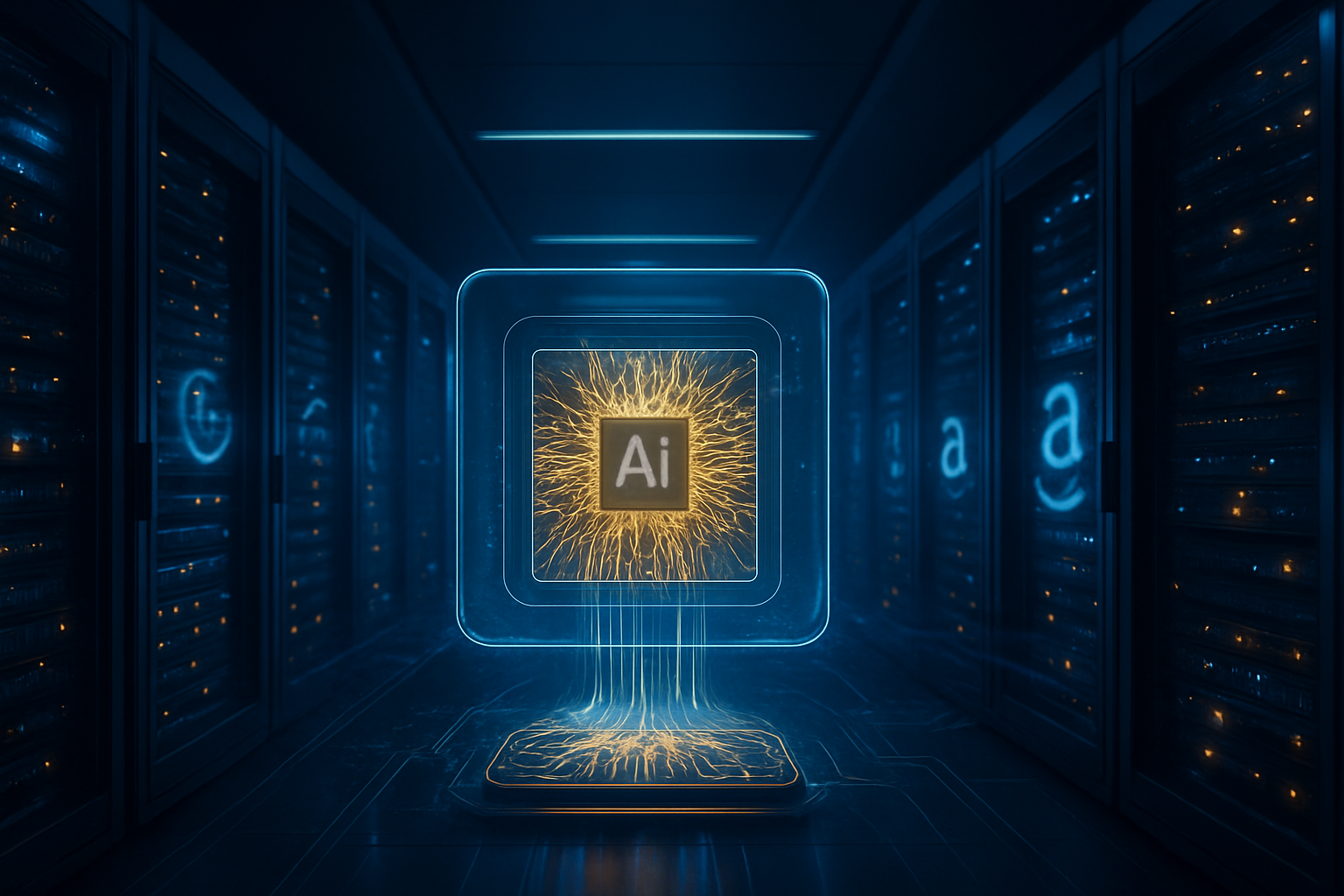
    Broadcom Inc. (NASDAQ:AVGO) has solidified its position as the indispensable architect of the generative AI era, reporting record-breaking fiscal fourth-quarter 2025 results that underscore a massive shift in data center architecture. On December 11, 2025, the semiconductor giant announced quarterly revenue of $18.02 billion—a 28.2% year-over-year increase—driven primarily by an "inflection point" in AI networking demand and custom silicon accelerators. As hyperscalers race to build massive AI clusters, Broadcom has emerged as the primary provider of the "nervous system" connecting these digital brains, boasting a staggering $73 billion AI-related order backlog that stretches well into 2027.

    The significance of these results extends beyond mere revenue growth; they represent a fundamental transition in how AI infrastructure is built. With AI semiconductor revenue surging 74% to $6.5 billion in the quarter alone, Broadcom is no longer just a component supplier but a systems-level partner for the world’s largest tech entities. The company’s ability to secure a $10 billion order from OpenAI for its "Titan" inference chips and an $11 billion follow-on commitment from Anthropic highlights a growing trend: the world’s most advanced AI labs are moving away from off-the-shelf solutions in favor of bespoke silicon designed in tandem with Broadcom’s engineering teams.

    The 3nm Frontier: Tomahawk 6 and the Rise of Custom XPUs

    At the heart of Broadcom’s technical dominance is its aggressive transition to the 3nm process node, which has birthed a new generation of networking and compute silicon. The standout announcement was the volume production of the Tomahawk 6 (TH6) switch, the world’s first 102.4 Terabits per second (Tbps) switching ASIC. Utilizing 200G PAM4 SerDes technology, the TH6 doubles the bandwidth of its predecessor while reducing power consumption per bit by 40%. This allows hyperscalers to scale AI clusters to over one million accelerators (XPUs) within a single Ethernet fabric—a feat previously thought impossible with traditional networking standards.

    Complementing the switching power is the Jericho 4 router, which introduces "HyperPort" technology. This innovation allows for 3.2 Tbps logical ports, enabling lossless data transfer across distances of up to 60 miles. This is critical for the modern AI landscape, where power constraints often force companies to split massive training clusters across multiple physical data centers. By using Jericho 4, companies can link these disparate sites as if they were a single logical unit. On the compute side, Broadcom’s partnership with Alphabet Inc. (NASDAQ:GOOGL) has yielded the 7th-generation "Ironwood" TPU, while work with Meta Platforms, Inc. (NASDAQ:META) on the "Santa Barbara" ASIC project focuses on high-power, liquid-cooled designs capable of handling the next generation of Llama models.

    The Ethernet Rebellion: Disrupting the InfiniBand Monopoly

    Broadcom’s record results signal a major shift in the competitive landscape of AI networking, posing a direct challenge to the dominance of Nvidia Corporation (NASDAQ:NVDA) and its proprietary InfiniBand technology. For years, InfiniBand was the gold standard for AI due to its low latency, but as clusters grow to hundreds of thousands of GPUs, the industry is pivoting toward open Ethernet standards. Broadcom’s Tomahawk and Jericho series are the primary beneficiaries of this "Ethernet Rebellion," offering a more scalable and cost-effective alternative that integrates seamlessly with existing data center management tools.

    This strategic positioning has made Broadcom the "premier arms dealer" for the hyperscale elite. By providing the underlying fabric for Google’s TPUs and Meta’s MTIA chips, Broadcom is enabling these giants to reduce their reliance on external GPU vendors. The recent $10 billion commitment from OpenAI for its custom "Titan" silicon further illustrates this shift; as AI labs seek to optimize for specific workloads like inference, Broadcom’s custom XPU (AI accelerator) business provides the specialized hardware that generic GPUs cannot match. This creates a powerful moat: Broadcom is not just selling chips; it is selling the ability for tech giants to maintain their own competitive sovereignty.

    The Margin Debate: Revenue Volume vs. the "HBM Tax"

    Despite the stellar revenue figures, Broadcom’s report introduced a point of contention for investors: a projected 100-basis-point sequential decline in gross margins for the first quarter of 2026. This margin compression is a direct result of the company’s success in "AI systems" integration. As Broadcom moves from selling standalone ASICs to delivering full-rack solutions, it must incorporate third-party components like High Bandwidth Memory (HBM) from suppliers like SK Hynix or Samsung Electronics (KRX:005930). These components are essentially "passed through" to the customer at cost, which inflates total revenue (the top line) but dilutes the gross margin percentage.

    Analysts from firms like Goldman Sachs Group Inc. (NYSE:GS) and JPMorgan Chase & Co. (NYSE:JPM) have characterized this as a "margin reset" rather than a structural weakness. While a 77.9% gross margin is expected to dip toward 76.9% in the near term, the sheer volume of the $73 billion backlog suggests that absolute profit dollars will continue to climb. Furthermore, Broadcom’s software division, bolstered by the integration of VMware, continues to provide a high-margin buffer. The company reported that VMware’s transition to a subscription-based model is ahead of schedule, contributing significantly to the $63.9 billion in total fiscal 2025 revenue and ensuring that overall EBITDA margins remain resilient at approximately 67%.

    Looking Ahead: 1.6T Networking and the Fifth Customer

    The future for Broadcom appears anchored in the rapid adoption of 1.6T Ethernet networking, which is expected to become the industry standard by late 2026. The company is already sampling its next-generation optical interconnects, which replace copper wiring with light-based data transfer to overcome the physical limits of electrical signaling at high speeds. This will be essential as AI models continue to grow in complexity, requiring even faster communication between the thousands of chips working in parallel.

    Perhaps the most intriguing development for 2026 is the addition of a "fifth major custom XPU customer." While Broadcom has not officially named the entity, the company confirmed a $1 billion initial order for delivery in late 2026. Industry speculation points toward a major consumer electronics or cloud provider looking to follow the lead of Google and Meta. As this mystery partner ramps up, Broadcom’s custom silicon business is expected to represent an even larger share of its semiconductor solutions, potentially reaching 50% of the segment's revenue within the next two years.

    Conclusion: The Foundation of the AI Economy

    Broadcom’s fiscal Q4 2025 results mark a definitive moment in the history of the semiconductor industry. By delivering $18 billion in quarterly revenue and securing a $73 billion backlog, the company has proven that it is the foundational bedrock upon which the AI economy is being built. While the market may grapple with the short-term implications of margin compression due to the shift toward integrated systems, the long-term trajectory is clear: the demand for high-speed, scalable, and custom-tailored AI infrastructure shows no signs of slowing down.

    As we move into 2026, the tech industry will be watching Broadcom’s ability to execute on its massive backlog and its success in onboarding its fifth major custom silicon partner. With the Tomahawk 6 and Jericho 4 chips setting new benchmarks for what is possible in data center networking, Broadcom has successfully positioned itself at the center of the AI universe. For investors and industry observers alike, the message from Broadcom’s headquarters is unmistakable: the AI revolution will be networked, and that network will run on Broadcom silicon.


    This content is intended for informational purposes only and represents analysis of current AI developments.

    TokenRing AI delivers enterprise-grade solutions for multi-agent AI workflow orchestration, AI-powered development tools, and seamless remote collaboration platforms.
    For more information, visit https://www.tokenring.ai/.

  • Hyperscalers Accelerate Custom Silicon Deployment to Challenge NVIDIA’s AI Dominance

    Hyperscalers Accelerate Custom Silicon Deployment to Challenge NVIDIA’s AI Dominance

    The artificial intelligence hardware landscape is undergoing a seismic shift, characterized by industry analysts as the "Great Decoupling." As of late 2025, the world’s largest cloud providers—Alphabet Inc. (NASDAQ: GOOGL), Amazon.com Inc. (NASDAQ: AMZN), and Meta Platforms Inc. (NASDAQ: META)—have reached a critical mass in their efforts to reduce reliance on NVIDIA (NASDAQ: NVDA). This movement is no longer a series of experimental projects but a full-scale industrial pivot toward custom Application-Specific Integrated Circuits (ASICs) designed to optimize performance and bypass the high premiums associated with third-party hardware.

    The immediate significance of this shift is most visible in the high-volume inference market, where custom silicon now captures nearly 40% of all workloads. By deploying their own chips, these hyperscalers are effectively avoiding the "NVIDIA tax"—the 70% to 80% gross margins commanded by the market leader—while simultaneously tailoring their hardware to the specific needs of their massive software ecosystems. While NVIDIA remains the undisputed champion of frontier model training, the rise of specialized silicon for inference marks a new era of cost-efficiency and architectural sovereignty for the tech giants.

    Silicon Sovereignty: The Specs Behind the Shift

    The technical vanguard of this movement is led by Google’s seventh-generation Tensor Processing Unit, codenamed TPU v7 'Ironwood.' Unveiled with staggering specifications, Ironwood claims a performance of 4.6 PetaFLOPS of dense FP8 compute per chip. This puts it in a dead heat with NVIDIA’s Blackwell B200 architecture. Beyond raw speed, Google has optimized Ironwood for massive scale, utilizing an Optical Circuit Switch (OCS) fabric that allows the company to link 9,216 chips into a single "Superpod" with nearly 2 Petabytes of shared memory. This architecture is specifically designed to handle the trillion-parameter models that define the current state of generative AI.

    Not to be outdone, Amazon has scaled its Trainium3 and Inferentia lines, moving to a unified 3nm process for its latest silicon. The Trainium3 UltraServer integrates 144 chips per rack to aggregate 362 FP8 PetaFLOPS, offering a 30% to 40% price-performance advantage over general-purpose GPUs for AWS customers. Meanwhile, Meta’s MTIA v2 (Artemis) has seen broad deployment across its global data center footprint. Unlike its competitors, Meta has prioritized a massive SRAM hierarchy over expensive High Bandwidth Memory (HBM) for its specific recommendation and ranking workloads, resulting in a 44% lower Total Cost of Ownership (TCO) compared to commercial alternatives.

    Industry experts note that this differs fundamentally from previous hardware cycles. In the past, general-purpose GPUs were necessary because AI algorithms were changing too rapidly for fixed-function ASICs to keep up. However, the maturation of the Transformer architecture and the standardization of data types like FP8 have allowed hyperscalers to "freeze" certain hardware requirements into silicon without the risk of immediate obsolescence.

    Competitive Implications for the AI Ecosystem

    The "Great Decoupling" is creating a bifurcated market that benefits the hyperscalers while forcing NVIDIA to accelerate its own innovation cycle. For Alphabet, Amazon, and Meta, the primary benefit is margin expansion. By "paying cost" for their own silicon rather than market prices, these companies can offer AI services at a price point that is difficult for smaller cloud competitors to match. This strategic advantage allows them to subsidize their AI research and development through hardware savings, creating a virtuous cycle of reinvestment.

    For NVIDIA, the challenge is significant but not yet existential. The company still maintains a 90% share of the frontier model training market, where flexibility and absolute peak performance are paramount. However, as inference—the process of running a trained model for users—becomes the dominant share of AI compute spending, NVIDIA is being pushed into a "premium tier" where it must justify its costs through superior software and networking. The erosion of the "CUDA Moat," driven by the rise of open-source compilers like OpenAI’s Triton and PyTorch 2.x, has made it significantly easier for developers to port their models to Google’s TPUs or Amazon’s Trainium without a massive engineering overhead.

    Startups and smaller AI labs stand to benefit from this competition as well. The availability of diversified hardware options in the cloud means that the "compute crunch" of 2023 and 2024 has largely eased. Companies can now choose hardware based on their specific needs: NVIDIA for cutting-edge research, and custom ASICs for cost-effective, large-scale deployment.

    The Economic and Strategic Significance

    The wider significance of this shift lies in the democratization of high-performance compute at the infrastructure level. We are moving away from a monolithic hardware era toward a specialized one. This fits into the broader trend of "vertical integration," where the software, the model, and the silicon are co-designed. When a company like Meta designs a chip specifically for its recommendation algorithms, it achieves efficiencies that a general-purpose chip simply cannot match, regardless of its raw power.

    However, this transition is not without concerns. The reliance on custom silicon could lead to "vendor lock-in" at the hardware level, where a model optimized for Google’s TPU v7 may not perform as well on Amazon’s Trainium3. Furthermore, the massive capital expenditure required to design and manufacture 3nm chips means that only the wealthiest companies can participate in this decoupling. This could potentially centralize AI power even further among the "Magnificent Seven" tech giants, as the cost of entry for custom silicon is measured in billions of dollars.

    Comparatively, this milestone is being likened to the transition from general-purpose CPUs to GPUs in the early 2010s. Just as the GPU unlocked the potential of deep learning, the custom ASIC is unlocking the potential of "AI at scale," making it economically viable to serve generative AI to billions of users simultaneously.

    Future Horizons: Beyond the 3nm Era

    Looking ahead, the next 24 to 36 months will see an even more aggressive roadmap. NVIDIA is already preparing its Rubin architecture, which is expected to debut in late 2026 with HBM4 memory and "Vera" CPUs, aiming to reclaim the performance lead. In response, hyperscalers are already in the design phase for their next-generation chips, focusing on "chiplet" architectures that allow for even more modular and scalable designs.

    We can expect to see more specialized use cases on the horizon, such as "edge ASICs" designed for local inference on mobile devices and IoT hardware, further extending the reach of these custom stacks. The primary challenge remains the supply chain; as everyone moves to 3nm and 2nm processes, the competition for manufacturing capacity at foundries like TSMC will be the ultimate bottleneck. Experts predict that the next phase of the hardware wars will not just be about who has the best design, but who has the most secure access to the world’s most advanced fabrication plants.

    A New Chapter in AI History

    In summary, the deployment of custom silicon by hyperscalers represents a maturing of the AI industry. The transition from a single-provider market to a diversified ecosystem of custom ASICs is a clear signal that AI has moved from the research lab to the core of global infrastructure. Key takeaways include the impressive 4.6 PetaFLOPS performance of Google’s Ironwood, the significant TCO advantages of Meta’s MTIA v2, and the strategic necessity for cloud giants to escape the "NVIDIA tax."

    As we move into 2026, the industry will be watching for the first large-scale frontier models trained entirely on non-NVIDIA hardware. If a company like Google or Meta can produce a GPT-5 class model using only internal silicon, it will mark the final stage of the Great Decoupling. For now, the hardware wars are heating up, and the ultimate winners will be the users who benefit from more powerful, more efficient, and more accessible artificial intelligence.


    This content is intended for informational purposes only and represents analysis of current AI developments.

    TokenRing AI delivers enterprise-grade solutions for multi-agent AI workflow orchestration, AI-powered development tools, and seamless remote collaboration platforms.
    For more information, visit https://www.tokenring.ai/.

  • Amazon’s AI Power Play: Peter DeSantis to Lead Unified AI and Silicon Group as Rohit Prasad Exits

    Amazon’s AI Power Play: Peter DeSantis to Lead Unified AI and Silicon Group as Rohit Prasad Exits

    In a sweeping structural overhaul designed to reclaim its position at the forefront of the generative AI race, Amazon.com, Inc. (NASDAQ: AMZN) has announced the creation of a unified Artificial Intelligence and Silicon organization. The new group, which centralizes the company’s most ambitious software and hardware initiatives, will be led by Peter DeSantis, a 27-year Amazon veteran and the architect of much of the company’s foundational cloud infrastructure. This reorganization marks a pivot toward deep vertical integration, merging the teams responsible for frontier AI models with the engineers designing the custom chips that power them.

    The announcement comes alongside the news that Rohit Prasad, Amazon’s Senior Vice President and Head Scientist for Artificial General Intelligence (AGI), will exit the company at the end of 2025. Prasad, who spent over a decade at the helm of Alexa’s development before being tapped to lead Amazon’s AGI reboot in 2023, is reportedly leaving to pursue new ventures. His departure signals the end of an era for Amazon’s consumer-facing AI and the beginning of a more infrastructure-centric, "full-stack" approach under DeSantis.

    The Era of Co-Design: Nova 2 and Trainium 3

    The centerpiece of this reorganization is the philosophy of "Co-Design"—the simultaneous development of AI models and the silicon they run on. By housing the AGI team and the Custom Silicon group under DeSantis, Amazon aims to eliminate the traditional bottlenecks between software research and hardware constraints. This synergy was on full display with the unveiling of the Nova 2 family of models, which were developed in tandem with the new Trainium 3 chips.

    Technically, the Nova 2 family represents a significant leap over its predecessors. The flagship Nova 2 Pro features advanced multi-step reasoning and long-range planning capabilities, specifically optimized for agentic coding and complex software engineering tasks. Meanwhile, the Nova 2 Omni serves as a native multimodal "any-to-any" model, capable of processing and generating text, images, video, and audio within a single architecture. These models boast a massive 1-million-token context window, allowing enterprises to ingest entire codebases or hours of video for analysis.

    On the hardware side, the integration with Trainium 3—Amazon’s first chip built on Taiwan Semiconductor Manufacturing Company's (NYSE: TSM) 3nm process—is critical. Trainium 3 delivers a staggering 2.52 PFLOPs of FP8 compute, a 4.4x performance increase over the previous generation. By optimizing the Nova 2 models specifically for the architecture of Trainium 3, Amazon claims it can offer 50% lower training costs compared to equivalent instances using hardware from NVIDIA Corporation (NASDAQ: NVDA). This technical tight-coupling is further bolstered by the leadership of Pieter Abbeel, the renowned robotics expert who now leads the Frontier Model Research team, focusing on the intersection of generative AI and physical automation.

    Shifting the Cloud Competitive Landscape

    This reorganization is a direct challenge to the current hierarchy of the AI industry. For the past two years, Amazon Web Services (AWS) has largely been viewed as a high-end "distributor" of AI, hosting third-party models from partners like Anthropic through its Bedrock service. By unifying its AI and Silicon divisions, Amazon is signaling its intent to become a primary "developer" of foundational technology, reducing its reliance on external partners and third-party hardware.

    The move places Amazon in a more aggressive competitive stance against Microsoft Corp. (NASDAQ: MSFT) and Alphabet Inc. (NASDAQ: GOOGL). While Microsoft has leaned heavily on its partnership with OpenAI, Amazon is betting that its internal control over the entire stack—from the 3nm silicon to the reasoning models—will provide a superior price-to-performance ratio that enterprise customers crave. Furthermore, by moving the majority of inference for its flagship models to Trainium and Inferentia chips, Amazon is attempting to insulate itself from the supply chain volatility and high margins associated with the broader GPU market.

    For startups and third-party AI labs, the message is clear: Amazon is no longer content just providing the "pipes" for AI; it wants to provide the "brain" as well. This could lead to a consolidation of the market where cloud providers favor their own internal models, potentially disrupting the growth of independent model-as-a-service providers who rely on AWS for distribution.

    Vertical Integration and the End of the Model-Only Era

    The restructuring reflects a broader trend in the AI landscape: the realization that software breakthroughs alone are no longer enough to maintain a competitive edge. As the cost of training frontier models climbs into the billions of dollars, vertical integration has become a strategic necessity rather than a luxury. Amazon’s move mirrors similar efforts by Google with its TPU (Tensor Processing Unit) program, but with a more explicit focus on merging the organizational cultures of infrastructure and research.

    However, the departure of Rohit Prasad raises questions about the future of Amazon’s consumer AI ambitions. Prasad was the primary champion of the "Ambient Intelligence" vision that defined the Alexa era. His exit, coupled with the elevation of DeSantis—a leader known for his focus on efficiency and infrastructure—suggests that Amazon may be prioritizing B2B and enterprise-grade AI over the broad consumer "digital assistant" market. While a rebooted, "Smarter Alexa" powered by Nova models is still expected, the focus has clearly shifted toward the "AI Factory" model of high-scale industrial and enterprise compute.

    The wider significance also touches on the "sovereign AI" movement. By offering "Nova Forge," a service that allows enterprises to inject proprietary data early in the training process for a high annual fee, Amazon is leveraging its infrastructure to offer a level of model customization that is difficult to achieve on generic hardware. This marks a shift from fine-tuning to "Open Training," a new milestone in how corporate entities interact with foundational AI.

    Future Horizons: Trainium 4 and AI Factories

    Looking ahead, the DeSantis-led group has already laid out a roadmap that extends well into 2027. The near-term focus will be the deployment of EC2 UltraClusters 3.0, which are designed to connect up to 1 million Trainium chips in a single, massive cluster. This scale is intended to support the training of "Project Rainier," a collaboration with Anthropic that aims to produce the next generation of frontier models with unprecedented reasoning capabilities.

    In the long term, Amazon has already teased Trainium 4, which is expected to feature "NVIDIA NVLink Fusion." This upcoming technology would allow Amazon’s custom silicon to interconnect directly with NVIDIA GPUs, creating a heterogeneous computing environment. Such a development would address one of the biggest challenges in the industry: the "lock-in" effect of NVIDIA’s software ecosystem. If Amazon can successfully allow developers to mix and match Trainium and H100/B200 chips seamlessly, it could fundamentally alter the economics of the data center.

    A Decisive Pivot for the Retail and Cloud Giant

    Amazon’s decision to unify AI and Silicon under Peter DeSantis is perhaps the most significant organizational change in the company’s history since the inception of AWS. By consolidating its resources and parting ways with the leadership that defined its early AI efforts, Amazon is admitting that the previous siloed approach was insufficient for the scale of the generative AI era.

    The success of this move will be measured by whether the Nova 2 models can truly gain market share against established giants like GPT-5 and Gemini 3, and whether Trainium 3 can finally break the industry's dependence on external silicon. As Rohit Prasad prepares for his final day on December 31, 2025, the company he leaves behind is no longer just an e-commerce or cloud provider—it is a vertically integrated AI powerhouse. Investors and industry analysts will be watching closely in the coming months to see if this structural gamble translates into the "inflection point" of growth that CEO Andy Jassy has promised.


    This content is intended for informational purposes only and represents analysis of current AI developments.

    TokenRing AI delivers enterprise-grade solutions for multi-agent AI workflow orchestration, AI-powered development tools, and seamless remote collaboration platforms. For more information, visit https://www.tokenring.ai/.

  • The Silicon Schism: NVIDIA’s Blackwell Faces a $50 Billion Custom Chip Insurgence

    The Silicon Schism: NVIDIA’s Blackwell Faces a $50 Billion Custom Chip Insurgence

    As 2025 draws to a close, the undisputed reign of NVIDIA (NASDAQ: NVDA) in the AI data center is facing its most significant structural challenge yet. While NVIDIA’s Blackwell architecture remains the gold standard for frontier model training, a parallel economy of "custom silicon" has reached a fever pitch. This week, industry reports and financial disclosures from Broadcom (NASDAQ: AVGO) have sent shockwaves through the semiconductor sector, revealing a staggering $50 billion pipeline for custom AI accelerators (XPUs) destined for the world’s largest hyperscalers.

    This shift represents a fundamental "Silicon Schism" in the AI industry. On one side stands NVIDIA’s general-purpose, high-margin GPU dominance, and on the other, a growing coalition of tech giants like Google (NASDAQ: GOOGL), Microsoft (NASDAQ: MSFT), and Meta (NASDAQ: META) who are increasingly designing their own chips to bypass the "NVIDIA tax." With Broadcom acting as the primary architect for these bespoke solutions, the competitive tension between the "Swiss Army Knife" of Blackwell and the "Precision Scalpels" of custom ASICs has become the defining battle of the generative AI era.

    The Technical Tug-of-War: Blackwell Ultra vs. The Rise of the XPU

    At the heart of this rivalry is the technical divergence between flexibility and efficiency. NVIDIA’s current flagship, the Blackwell Ultra (B300), which entered mass production in the second half of 2025, is a marvel of engineering. Boasting 288GB of HBM3E memory and delivering 15 PFLOPS of dense FP4 compute, it is designed to handle any AI workload thrown at it. However, this versatility comes at a cost—both in terms of power consumption and price. The Blackwell architecture is built to be everything to everyone, a necessity for researchers experimenting with new model architectures that haven't yet been standardized.

    In contrast, the custom Application-Specific Integrated Circuits (ASICs), or XPUs, being co-developed by Broadcom and hyperscalers, are stripped-down powerhouses. By late 2025, Google’s TPU v7 and Meta’s MTIA 3 have demonstrated that for specific, high-volume tasks—particularly inference and stable Transformer-based training—custom silicon can deliver up to a 50% improvement in power efficiency (TFLOPs per Watt) compared to Blackwell. These chips eliminate the "dark silicon" or unused features of a general-purpose GPU, focusing entirely on the tensor operations that drive modern Large Language Models (LLMs).

    Furthermore, the networking layer has become a critical technical battleground. NVIDIA relies on its proprietary NVLink interconnect to maintain its "moat," creating a tightly coupled ecosystem that is difficult to leave. Broadcom, however, has championed an open-standard approach, leveraging its Tomahawk 6 switching silicon to enable massive clusters of 1 million or more XPUs via high-performance Ethernet. This architectural split means that while NVIDIA offers a superior integrated "black box" solution, the custom XPU route offers hyperscalers the ability to scale their infrastructure horizontally with far more granular control over their thermal and budgetary envelopes.

    The $50 Billion Shift: Strategic Implications for Big Tech

    The financial gravity of this trend was underscored by Broadcom’s recent revelation of an AI-specific backlog exceeding $73 billion, with annual custom silicon revenue projected to hit $50 billion by 2026. This is not just a rounding error; it represents a massive redirection of capital expenditure (CapEx) away from NVIDIA. For companies like Google and Microsoft, the move to custom silicon is a strategic necessity to protect their margins. As AI moves from the "R&D phase" to the "deployment phase," the cost of running inference for billions of users makes the $35,000+ price tag of a Blackwell GPU increasingly untenable.

    The competitive implications are particularly stark for Broadcom, which has positioned itself as the "Kingmaker" of the custom silicon era. By providing the intellectual property and physical design services for chips like Google's TPU and Anthropic’s new $21 billion custom cluster, Broadcom is capturing the value that previously flowed almost exclusively to NVIDIA. This has created a bifurcated market: NVIDIA remains the essential partner for the most advanced "frontier" research—where the next generation of reasoning models is being birthed—while Broadcom and its partners are winning the war for "production-scale" AI.

    For startups and smaller AI labs, this development is a double-edged sword. While the rise of custom silicon may eventually lower the cost of cloud compute, these bespoke chips are currently reserved for the "Big Five" hyperscalers. This creates a potential "compute divide," where the owners of custom silicon enjoy a significantly lower Total Cost of Ownership (TCO) than those relying on public cloud instances of NVIDIA GPUs. As a result, we are seeing a trend where major model builders, such as Anthropic, are seeking direct partnerships with silicon designers to secure their own long-term hardware independence.

    A New Era of Efficiency: The Wider Significance of Custom Silicon

    The rise of custom ASICs marks a pivotal transition in the AI landscape, mirroring the historical evolution of other computing paradigms. Just as the early days of the internet saw a transition from general-purpose CPUs to specialized networking hardware, the AI industry is realizing that the sheer energy demands of Blackwell-class clusters are unsustainable. In a world where data center power is the ultimate constraint, a 40% reduction in TCO and power consumption—offered by custom XPUs—is not just a financial preference; it is a requirement for continued scaling.

    This shift also highlights the growing importance of the software compiler layer. One of NVIDIA’s strongest defenses has been CUDA, the software platform that has become the industry standard for AI development. However, the $50 billion investment in custom silicon is finally funding a viable alternative. Open-source initiatives like OpenAI’s Triton and Google’s OpenXLA are maturing, allowing developers to write code that can run on both NVIDIA GPUs and custom ASICs with minimal friction. As the software barrier to entry for custom silicon lowers, NVIDIA’s "software moat" begins to look less like a fortress and more like a hurdle.

    There are, however, concerns regarding the fragmentation of the AI hardware ecosystem. If every major hyperscaler develops its own proprietary chip, the "write once, run anywhere" dream of AI development could become more difficult. We are seeing a divergence where the "Inference Era" is dominated by specialized, efficient hardware, while the "Innovation Era" remains tethered to the flexibility of NVIDIA. This could lead to a two-tier AI economy, where the most efficient models are those locked behind the proprietary hardware of a few dominant cloud providers.

    The Road to Rubin: Future Developments and the Next Frontier

    Looking ahead to 2026, the battle is expected to intensify as NVIDIA prepares to launch its Rubin architecture (R100). Taped out on TSMC’s (NYSE: TSM) 3nm process, Rubin will feature HBM4 memory and a new 4x reticle chiplet design, aiming to reclaim the efficiency lead that custom ASICs have recently carved out. NVIDIA is also diversifying its own lineup, introducing "inference-first" GPUs like the Rubin CPX, which are designed to compete directly with custom XPUs on cost and power.

    On the custom side, the next horizon is the "10-gigawatt chip" project. Reports suggest that major players like OpenAI are working with Broadcom on massive, multi-year silicon roadmaps that integrate power management and liquid cooling directly into the chip architecture. These "AI Super-ASICs" will be designed not just for today’s Transformers, but for the "test-time scaling" and agentic workflows that are expected to dominate the AI landscape in 2026 and beyond.

    The ultimate challenge for both camps will be the physical limits of silicon. As we move toward 2nm and beyond, the gains from traditional Moore’s Law are diminishing. The next phase of competition will likely move beyond the chip itself and into the realm of "System-on-a-Wafer" and advanced 3D packaging. Experts predict that the winner of the next decade won't just be the company with the fastest chip, but the one that can most effectively manage the "Power-Performance-Area" (PPA) triad at a planetary scale.

    Summary: The Bifurcation of AI Compute

    The emergence of a $50 billion custom silicon market marks the end of the "GPU Monoculture." While NVIDIA’s Blackwell architecture remains a monumental achievement and the preferred tool for pushing the boundaries of what is possible, the economic and thermal realities of 2025 have forced a diversification of the hardware stack. Broadcom’s massive backlog and the aggressive chip roadmaps of Google, Microsoft, and Meta signal that the future of AI infrastructure is bespoke.

    In the coming months, the industry will be watching the initial benchmarks of the Blackwell Ultra against the first wave of 3nm custom XPUs. If the efficiency gap continues to widen, NVIDIA may find itself in the position of a high-end boutique—essential for the most complex tasks but increasingly bypassed for the high-volume work that powers the global AI economy. For now, the silicon war is far from over, but the era of the universal GPU is clearly being challenged by a new generation of precision-engineered silicon.


    This content is intended for informational purposes only and represents analysis of current AI developments.

    TokenRing AI delivers enterprise-grade solutions for multi-agent AI workflow orchestration, AI-powered development tools, and seamless remote collaboration platforms.
    For more information, visit https://www.tokenring.ai/.