
Tag: Databricks

  • The Autonomous Pivot: Databricks Reports 40% of Enterprise Customers Have Graduated to Agentic AI

    The Autonomous Pivot: Databricks Reports 40% of Enterprise Customers Have Graduated to Agentic AI

    In a definitive signal that the era of the "simple chatbot" is drawing to a close, Databricks has unveiled data showing a massive structural shift in how corporations deploy artificial intelligence. According to the company's "2026 State of AI Agents" report, released yesterday, over 40% of its enterprise customers have moved beyond basic retrieval-augmented generation (RAG) and conversational interfaces to deploy fully autonomous agentic systems. These systems do not merely answer questions; they execute complex, multi-step workflows that span disparate data sources and software applications without human intervention.

    The move marks a critical maturation point for generative AI. While 2024 and 2025 were defined by the hype of Large Language Models (LLMs) and the race to implement basic "Ask My Data" tools, 2026 has become the year of the "Compound AI System." By leveraging the Databricks Data Intelligence Platform, organizations are now treating LLMs as the "reasoning engine" within a much larger architecture designed for task execution, leading to a reported 327% surge in multi-agent workflow adoption in just the last six months.

    From Chatbots to Supervisors: The Rise of the Compound AI System

    The technical foundation of this shift lies in the transition from single-prompt models to modular, agentic architectures. Databricks’ Mosaic AI has evolved into a comprehensive orchestration environment, moving away from just model training to managing what engineers call "Supervisor Agents." Currently the leading architectural pattern—accounting for 37% of new agentic deployments—a Supervisor Agent acts as a central manager that decomposes a complex user goal into sub-tasks. These tasks are then delegated to specialized "worker" agents, such as SQL agents for data retrieval, document parsers for unstructured text, or API agents for interacting with third-party tools like Salesforce or Jira.

    Crucial to this evolution is the introduction of Lakebase, a managed, Postgres-compatible transactional database engine launched by Databricks in late 2025. Unlike traditional databases, Lakebase is optimized for "agentic state management," allowing AI agents to maintain memory and context over long-running workflows that might take minutes or hours to complete. Furthermore, the release of MLflow 3.0 has provided the industry with "agent observability," a set of tools that allow developers to trace the specific "reasoning chains" of an agent. This enables engineers to debug where an autonomous system might have gone off-track, addressing the "black box" problem that previously hindered enterprise-wide adoption.

    Industry experts note that this "modular" approach is fundamentally different from the monolithic LLM approach of the past. Instead of asking a single model like GPT-5 to handle everything, companies are using the Mosaic AI Gateway to route specific tasks to the most cost-effective model. A complex reasoning task might go to a frontier model, while a simple data formatting task is handled by a smaller, faster model like Llama 3 or a fine-tuned DBRX variant. This optimization has reportedly reduced operational costs for agentic workflows by nearly 50% compared to early 2025 benchmarks.

    The Battle for the Data Intelligence Stack: Microsoft and Snowflake Respond

    The rapid adoption of agentic AI on Databricks has intensified the competition among cloud and data giants. Microsoft (NASDAQ: MSFT) has responded by rebranding its AI development suite as Microsoft Foundry, focusing heavily on the "Model Context Protocol" (MCP) to ensure that its own "Agent Mode" for M365 Copilot can interoperate with third-party data platforms. The "co-opetition" between Microsoft and Databricks remains complex; while they compete for the orchestration layer, a deepening integration between Databricks' Unity Catalog and Microsoft Fabric allows enterprises to govern their data in Databricks while utilizing Microsoft's autonomous agents.

    Meanwhile, Snowflake (NYSE: SNOW) has doubled down on a "Managed AI" strategy to capture the segment of the market that prefers ease of use over deep customization. With the launch of Snowflake Cortex and the acquisition of the observability firm Observe in early 2026, Snowflake is positioning its platform as the fastest way for a business analyst to trigger an agentic workflow via natural language (AISQL). While Databricks appeals to the "AI Engineer" building custom architectures, Snowflake is targeting the "Data Citizen" who wants autonomous agents embedded directly into their BI dashboards.

    The strategic advantage currently appears to lie with platforms that offer robust governance. Databricks’ telemetry indicates that organizations using centralized governance tools like Unity Catalog are deploying AI projects to production 12 times more frequently than those without. This suggests that the "moat" in the AI age is not the model itself, but the underlying data quality and the governance framework that allows an autonomous agent to access that data safely.

    The Production Gap and the Era of 'Vibe Coding'

    Despite the impressive 40% adoption rate for agentic workflows, the "State of AI" report highlights a persistent "production gap." While 60% of the Fortune 500 are building agentic architectures, only about 19% have successfully deployed them at full enterprise scale. The primary bottlenecks remain security and "agent drift"—the tendency for autonomous systems to become less accurate as the underlying data or APIs change. However, for those who have bridged this gap, the impact is transformative. Databricks reports that agents are now responsible for creating 97% of testing and development environments within its ecosystem, a phenomenon recently dubbed "Vibe Coding," where developers orchestrate high-level intent while agents handle the boilerplate execution.

    The broader significance of this shift is a move toward "Intent-Based Computing." In this new paradigm, the user provides a desired outcome (e.g., "Analyze our Q4 churn and implement a personalized discount email campaign for high-risk customers") rather than a series of instructions. This mimics the shift from manual to autonomous driving; the human remains the navigator, but the AI handles the mechanical operations of the "vehicle." Concerns remain, however, regarding the "hallucination of actions"—where an agent might mistakenly delete data or execute an unauthorized transaction—prompting a renewed focus on human-in-the-loop (HITL) safeguards.

    Looking Ahead: The Road to 2027

    As we move deeper into 2026, the industry is bracing for the next wave of agentic capabilities. Gartner has already predicted that by 2027, 40% of enterprise finance departments will have deployed autonomous agents for auditing and compliance. We expect to see "Agent-to-Agent" (A2A) commerce become a reality, where a procurement agent from one company negotiates directly with a sales agent from another, using standardized protocols to settle terms.

    The next major technical hurdle will be "long-term reasoning." Current agents are excellent at multi-step tasks that can be completed in a single session, but "persistent agents" that can manage a project over weeks—checking in on status updates and adjusting goals—are still in the experimental phase. Companies like Amazon (NASDAQ: AMZN) and Google parent Alphabet (NASDAQ: GOOGL) are reportedly working on "world-model" agents that can simulate the outcomes of their actions before executing them, which would significantly reduce the risk of autonomous errors.

    A New Chapter in AI History

    Databricks' latest data confirms that we have moved past the initial excitement of generative AI and into a more functional, albeit more complex, era of autonomous operations. The transition from 40% of customers using simple chatbots to 40% using autonomous agents represents a fundamental change in the relationship between humans and software. We are no longer just using tools; we are managing digital employees.

    The key takeaway for 2026 is that the "Data Intelligence" stack has become the most important piece of real estate in the tech world. As agents become the primary interface for software, the platform that holds the data—and the governance over that data—will hold the power. In the coming months, watch for more aggressive moves into agentic "memory" and "observability" as the industry seeks to make these autonomous systems as reliable as the legacy databases they are quickly replacing.


    This content is intended for informational purposes only and represents analysis of current AI developments.

    TokenRing AI delivers enterprise-grade solutions for multi-agent AI workflow orchestration, AI-powered development tools, and seamless remote collaboration platforms.
    For more information, visit https://www.tokenring.ai/.
  • The Agentic Revolution: Databricks Report Reveals 327% Surge in Autonomous AI Systems for 2026

    The Agentic Revolution: Databricks Report Reveals 327% Surge in Autonomous AI Systems for 2026

    In a landmark report released today, January 27, 2026, data and AI powerhouse Databricks has detailed a tectonic shift in the enterprise landscape: the rapid transition from simple generative chatbots to fully autonomous "agentic" systems. The company’s "2026 State of AI Agents" report highlights a staggering 327% increase in multi-agent workflow adoption over the latter half of 2025, signaling that the era of passive AI assistants is over, replaced by a new generation of software capable of independent planning, tool usage, and task execution.

    The findings underscore a pivotal moment for global business workflows. While 2024 and 2025 were characterized by experimentation with Retrieval-Augmented Generation (RAG) and basic text generation, 2026 is emerging as the year of the "Compound AI System." According to the report, enterprises are no longer satisfied with AI that merely answers questions; they are now deploying agents that manage databases, orchestrate supply chains, and automate complex regulatory reporting with minimal human intervention.

    From Chatbots to Compound AI: The Technical Evolution

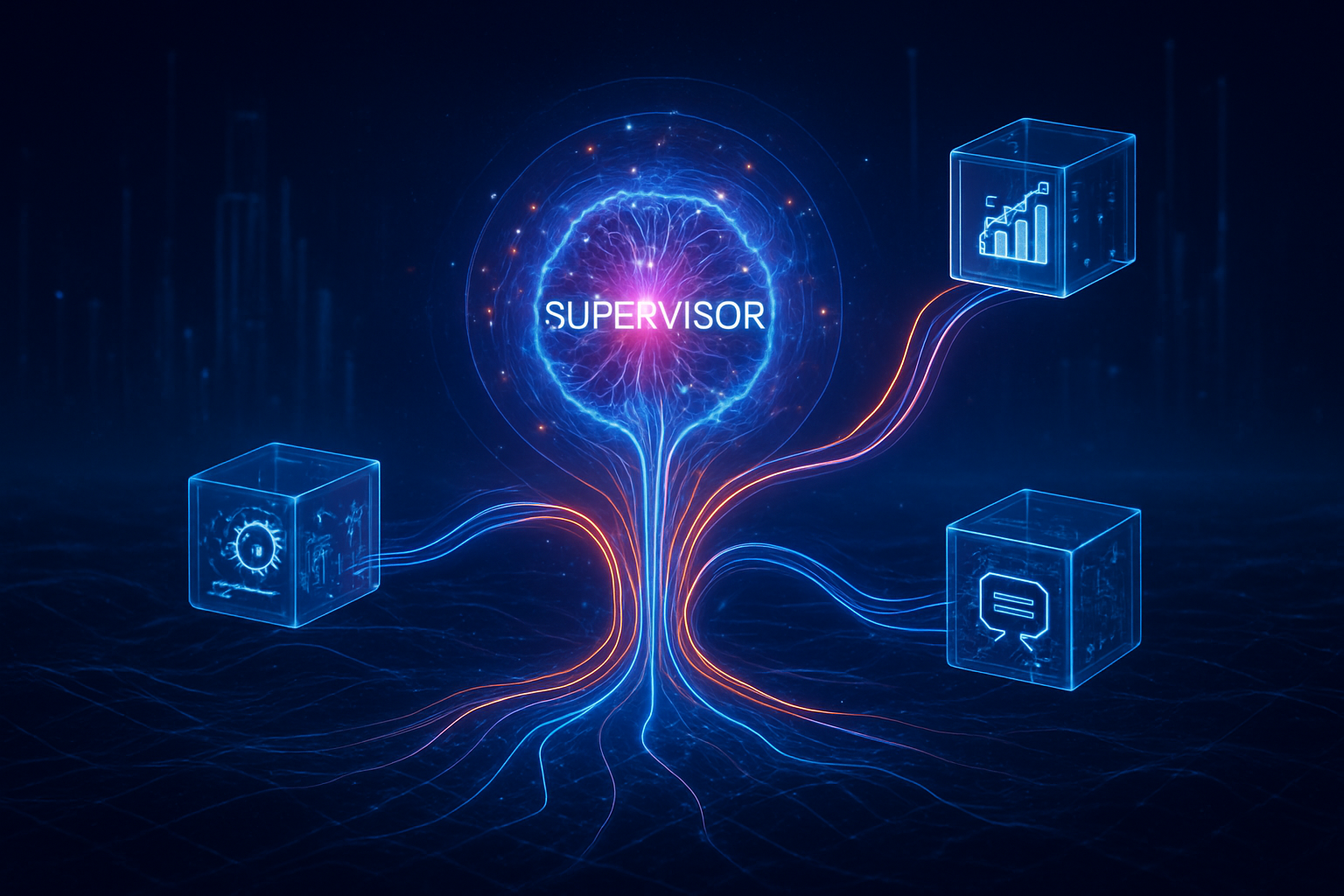
    The Databricks report identifies a clear architectural departure from the "single-prompt" models of the past. The technical focus has shifted toward Compound AI Systems, which leverage multiple models, specialized tools, and external data retrievers working in concert. A leading design pattern identified in the research is the "Supervisor Agent" architecture, which now accounts for 37% of enterprise agent deployments. In this model, a central "manager" agent decomposes complex business objectives into sub-tasks, delegating them to specialized sub-agents—such as those dedicated to SQL execution or document parsing—before synthesizing the final output.

    To support this shift, Databricks has integrated several advanced capabilities into its Mosaic AI ecosystem. Key among these is the launch of Lakebase, a managed, Postgres-compatible database designed specifically as a "short-term memory" layer for AI agents. Lakebase allows agents to branch their logic, checkpoint their state, and "rewind" to a previous step if a chosen path proves unsuccessful. This persistence allows agents to learn from failures in real-time, a capability that was largely absent in the stateless interactions of earlier LLM implementations. Furthermore, the report notes that 80% of new databases within the Databricks environment are now being generated and managed by these autonomous agents through "natural language development" or "vibe coding."

    Industry experts are calling this the "industrialization of AI." By utilizing upgraded SQL-native AI Functions that are now 3x faster and 4x cheaper than previous versions, developers can embed agentic logic directly into the data layer. This minimizes the latency and security risks associated with moving sensitive enterprise data to external model providers. Initial reactions from the research community suggest that this "data-centric" approach to agents provides a significant advantage over "model-centric" approaches, as the agents have direct, governed access to the organization's "source of truth."

    The Competitive Landscape: Databricks vs. The Tech Giants

    The shift toward agentic systems is redrawing the competitive lines between Databricks and its primary rivals, including Snowflake (NYSE: SNOW), Microsoft (NASDAQ: MSFT), and Salesforce (NYSE: CRM). While Salesforce has pivoted heavily toward its "Agentforce" platform, Databricks is positioning its Unity Catalog and Mosaic AI Gateway as the essential "control towers" for the agentic era. The report reveals a "Governance Multiplier": organizations utilizing unified governance tools are deploying 12 times more AI projects to production than those struggling with fragmented data silos.

    This development poses a significant challenge to traditional SaaS providers. As autonomous agents become capable of performing tasks across multiple applications—such as updating a CRM, drafting an invoice in an ERP, and notifying a team via Slack—the value may shift from the application layer to the orchestration layer. Alphabet (NASDAQ: GOOGL) and Amazon (NASDAQ: AMZN) are also racing to provide the underlying infrastructure for these agents, but Databricks’ tight integration with the "Data Lakehouse" gives it a strategic advantage in serving industries like financial services and healthcare, where data residency and auditability are non-negotiable.

    The Broader Significance: Governance as the New Moat

    The Databricks findings highlight a critical bottleneck in the AI revolution: the "Production Gap." While nearly every enterprise is experimenting with agents, only 19% have successfully deployed them at scale. The primary hurdles are not technical capacity, but rather governance, safety, and quality. The report emphasizes that as agents gain more autonomy—such as the ability to execute code or move funds—the need for rigorous guardrails becomes paramount. This has turned data governance from a back-office compliance task into a competitive "moat" that determines which companies can actually put AI to work.

    Furthermore, the "vibe coding" trend—where agents generate code and manage environments based on high-level natural language instructions—suggests a fundamental shift in the labor market for software engineering and data science. We are seeing a transition from "writing code" to "orchestrating systems." While this raises concerns regarding autonomous errors and the potential displacement of entry-level technical roles, the productivity gains are undeniable. Databricks reports that organizations using agentic workflows have seen a 60–80% reduction in processing time for routine transactions and a 40% boost in overall data team productivity.

    The Road Ahead: Specialized Models and the "Action Web"

    Looking toward the remainder of 2026 and into 2027, Databricks predicts the rise of specialized, smaller models optimized for specific agentic tasks. Rather than relying on a single "frontier" model from a provider like NVIDIA (NASDAQ: NVDA) or OpenAI, enterprises will likely use a "mixture of agents" where small, highly efficient models handle routine tasks like data extraction, while larger models are reserved for complex reasoning and planning. This "Action Web" of interconnected agents will eventually operate across company boundaries, allowing for automated B2B negotiations and supply chain adjustments.

    The next major challenge for the industry will be the "Agentic Handshake"—standardizing how agents from different organizations communicate and verify each other's identity and authority. Experts predict that the next eighteen months will see a flurry of activity in establishing these standards, alongside the development of more sophisticated "evaluators" that can automatically grade the performance of an agent in a production environment.

    A New Chapter in Enterprise Intelligence

    Databricks’ "2026 State of AI Agents" report makes it clear that we have entered a new chapter in the history of computing. The shift from "searching for information" to "delegating objectives" represents the most significant change in business workflows since the introduction of the internet. By moving beyond the chatbot and into the realm of autonomous, tool-using agents, enterprises are finally beginning to realize the full ROI of their AI investments.

    As we move forward into 2026, the key indicators of success will no longer be the number of models an organization has trained, but the robustness of its data governance and the reliability of its agentic orchestrators. Investors and industry watchers should keep a close eye on the adoption rates of "Agent Bricks" and the Mosaic AI Agent Framework, as these tools are likely to become the standard operating systems for the autonomous enterprise.


    This content is intended for informational purposes only and represents analysis of current AI developments.

    TokenRing AI delivers enterprise-grade solutions for multi-agent AI workflow orchestration, AI-powered development tools, and seamless remote collaboration platforms.
    For more information, visit https://www.tokenring.ai/.

  • Databricks Unveils ‘Instructed Retriever’ to Solve the AI Accuracy Crisis, Threatening Traditional RAG

    Databricks Unveils ‘Instructed Retriever’ to Solve the AI Accuracy Crisis, Threatening Traditional RAG

    On January 6, 2026, Databricks officially unveiled its "Instructed Retriever" technology, a breakthrough in retrieval architecture designed to move enterprise AI beyond the limitations of "naive" Retrieval-Augmented Generation (RAG). By integrating a specialized 4-billion parameter model that interprets complex system-level instructions, Databricks aims to provide a "reasoning engine" for AI agents that can navigate enterprise data with unprecedented precision.

    The announcement marks a pivotal shift in how businesses interact with their internal knowledge bases. While traditional RAG systems often struggle with hallucinations and irrelevant data retrieval, the Instructed Retriever allows AI to respect hard constraints—such as specific date ranges, business rules, and data schemas—ensuring that the information fed into large language models (LLMs) is both contextually accurate and compliant with enterprise governance.

    The Architecture of Precision: Inside the InstructedRetriever-4B

    At the heart of this advancement is the InstructedRetriever-4B, a specialized model developed by Databricks Mosaic AI Research. Unlike standard retrieval systems that rely solely on probabilistic similarity (matching text based on how "similar" it looks), the Instructed Retriever uses a hybrid approach. It employs an LLM to interpret a user’s natural language prompt alongside complex system specifications, generating a sophisticated "search plan." This plan combines deterministic filters—such as SQL-like metadata queries—with traditional vector embeddings to pinpoint the exact data required.

    Technically, the InstructedRetriever-4B was optimized using Test-time Adaptive Optimization (TAO) and Offline Reinforcement Learning (RL). By utilizing verifiable rewards (RLVR) based on retrieval recall, Databricks "taught" the model to follow complex instructions with a level of precision typically reserved for much larger frontier models like GPT-5 or Claude 4.5. This allows the system to differentiate between semantically similar but factually distinct data points, such as distinguishing a 2024 sales report from a 2025 one based on explicit metadata constraints rather than just text overlap.

    Initial benchmarks are striking. Databricks reports that the Instructed Retriever provides a 35–50% gain in retrieval recall on instruction-following benchmarks and a 70% improvement in end-to-end answer quality compared to standard RAG architectures. By solving the "accuracy crisis" that has plagued early enterprise AI deployments, Databricks is positioning this technology as the essential foundation for production-grade Agentic AI.

    A Strategic Blow to the Data Warehouse Giants

    The release of the Instructed Retriever is a direct challenge to major competitors in the data intelligence space, most notably Snowflake (NYSE: SNOW). While Snowflake has been aggressive in its AI acquisitions and the development of its "Cortex" AI layer, Databricks is leveraging its deep integration with the Unity Catalog to provide a more seamless, governed retrieval experience. By embedding the retrieval logic directly into the data governance layer, Databricks makes it significantly harder for rivals to match its accuracy without similar unified data architectures.

    Tech giants like Microsoft (NASDAQ: MSFT) and Amazon (NASDAQ: AMZN) find themselves in a complex position. While both are major partners of Databricks through Azure and AWS, they also offer competing services like Microsoft Fabric and Amazon Bedrock. The Instructed Retriever sets a new bar for these platforms, forcing them to evolve their own "agentic reasoning" capabilities. For startups and smaller AI labs, the availability of a high-performance 4B parameter model for retrieval could disrupt the market for expensive, proprietary reranking services, as Databricks offers a more integrated and efficient alternative.

    Furthermore, strategic partners like NVIDIA (NASDAQ: NVDA) and Salesforce (NYSE: CRM) are expected to benefit from this development. NVIDIA’s hardware powers the intensive RL training required for these models, while Salesforce can leverage the Instructed Retriever to enhance the accuracy of its "Agentforce" autonomous agents, providing their enterprise customers with more reliable data-driven insights.

    Navigating the Shift Toward Agentic AI

    The broader significance of the Instructed Retriever lies in its role as a bridge between natural language and deterministic data. For years, the AI industry has struggled with the "black box" nature of vector search. The Instructed Retriever introduces a layer of transparency and control, allowing developers to see exactly how instructions are translated into data filters. This fits into the wider trend of Agentic RAG, where AI is not just a chatbot but a system capable of executing multi-step reasoning tasks across heterogeneous data sources.

    However, this advancement also highlights a growing divide in the AI landscape: the "data maturity" gap. For the Instructed Retriever to work effectively, an enterprise's data must be well-organized and richly tagged with metadata. Companies with messy, unstructured data silos may find themselves unable to fully capitalize on these gains, potentially widening the competitive gap between data-forward organizations and laggards.

    Compared to previous milestones, such as the initial popularization of RAG in 2023, the Instructed Retriever represents the "professionalization" of AI retrieval. It moves the conversation away from "can the AI talk?" to "can the AI be trusted with mission-critical business data?" This focus on reliability is essential for high-stakes industries like financial services, legal discovery, and supply chain management, where even a 5% error rate can be catastrophic.

    The Future of "Instructed" Systems

    Looking ahead, experts predict that "instruction-tuning" will expand beyond retrieval into every facet of the AI stack. In the near term, we can expect Databricks to integrate this technology deeper into its Agent Bricks suite, potentially allowing for "Instructed Synthesis"—where the model follows specific stylistic or structural guidelines when generating the final answer based on retrieved data.

    The long-term potential for this technology includes the creation of autonomous "Knowledge Assistants" that can manage entire corporate wikis, automatically updating and filtering information based on evolving business policies. The primary challenge remaining is the computational overhead of running even a 4B model for every retrieval step, though optimizations in inference hardware from companies like Alphabet (NASDAQ: GOOGL) and NVIDIA are likely to mitigate these costs over time.

    As AI agents become more autonomous, the ability to give them "guardrails" through technology like the Instructed Retriever will be paramount. Industry analysts expect a wave of similar "instructed" models to emerge from other labs as the industry moves away from generic LLMs toward specialized, task-oriented architectures that prioritize accuracy over broad-spectrum creativity.

    A New Benchmark for Enterprise Intelligence

    Databricks' Instructed Retriever is more than just a technical upgrade; it is a fundamental rethinking of how AI interacts with the structured and unstructured data that powers the modern economy. By successfully merging the flexibility of natural language with the rigor of deterministic data filtering, Databricks has set a new standard for what "enterprise-grade" AI actually looks like.

    The key takeaway for the industry is that the era of "naive" RAG is coming to an end. As businesses demand higher ROI and lower risk from their AI investments, the focus will shift toward architectures that offer granular control and verifiable accuracy. In the coming months, all eyes will be on how Snowflake and the major cloud providers respond to this move, and whether they can close the "accuracy gap" that Databricks has so aggressively highlighted.

    For now, the Instructed Retriever stands as a significant milestone in AI history—a clear signal that the future of the field lies in the intelligent, instructed orchestration of data.


    This content is intended for informational purposes only and represents analysis of current AI developments.

    TokenRing AI delivers enterprise-grade solutions for multi-agent AI workflow orchestration, AI-powered development tools, and seamless remote collaboration platforms.
    For more information, visit https://www.tokenring.ai/.
  • Beyond the Vector: Databricks Unveils ‘Instructed Retrieval’ to Solve the Enterprise RAG Accuracy Crisis

    Beyond the Vector: Databricks Unveils ‘Instructed Retrieval’ to Solve the Enterprise RAG Accuracy Crisis

    In a move that signals a major shift in how businesses interact with their proprietary data, Databricks has officially unveiled its "Instructed Retrieval" architecture. This new framework aims to move beyond the limitations of traditional Retrieval-Augmented Generation (RAG) by fundamentally changing how AI agents search for information. By integrating deterministic database logic directly into the probabilistic world of large language models (LLMs), Databricks claims to have solved the "hallucination and hearsay" problem that has plagued enterprise AI deployments for the last two years.

    The announcement, made early this week, introduces a paradigm where system-level instructions—such as business rules, date constraints, and security permissions—are no longer just suggestions for the final LLM to follow. Instead, these instructions are baked into the retrieval process itself. This ensures that the AI doesn't just find information that "looks like" what the user asked for, but information that is mathematically and logically correct according to the company’s specific data constraints.

    The Technical Core: Marrying SQL Determinism with Vector Probability

    At the heart of the Instructed Retrieval architecture is a three-tiered declarative system designed to replace the simplistic "query-to-vector" pipeline. Traditional RAG systems often fail in enterprise settings because they rely almost exclusively on vector similarity search—a probabilistic method that identifies semantically related text but struggles with hard constraints. For instance, if a user asks for "sales reports from Q3 2025," a traditional RAG system might return a highly relevant report from Q2 because the language is similar. Databricks’ new architecture prevents this by utilizing Instructed Query Generation. In this first stage, an LLM interprets the user’s prompt and system instructions to create a structured "search plan" that includes specific metadata filters.

    The second stage, Multi-Step Retrieval, executes this plan by combining deterministic SQL-like filters with probabilistic similarity scores. Leveraging the Databricks Unity Catalog for schema awareness, the system can translate natural language into precise executable filters (e.g., WHERE date >= '2025-07-01'). This ensures the search space is narrowed down to a logically correct subset before any similarity ranking occurs. Finally, the Instruction-Aware Generation phase passes both the retrieved data and the original constraints to the LLM, ensuring the final output adheres to the requested format and business logic.

    To validate this approach, Databricks Mosaic Research released the StaRK-Instruct dataset, an extension of the Semi-Structured Retrieval Benchmark. Their findings indicate a staggering 35–50% gain in retrieval recall compared to standard RAG. Perhaps most significantly, the company demonstrated that by using offline reinforcement learning, smaller 4-billion parameter models could be optimized to perform this complex reasoning at a level comparable to frontier models like GPT-4, drastically reducing the latency and cost of high-accuracy enterprise agents.

    Shifting the Competitive Landscape: Data-Heavy Giants vs. Vector Startups

    This development places Databricks in a commanding position relative to competitors like Snowflake (NYSE: SNOW), which has also been racing to integrate AI more deeply into its Data Cloud. While Snowflake has focused heavily on making LLMs easier to run next to data, Databricks is betting that the "logic of retrieval" is where the real value lies. By making the retrieval process "instruction-aware," Databricks is effectively turning its Lakehouse into a reasoning engine, rather than just a storage bin.

    The move also poses a strategic challenge to major cloud providers like Microsoft (NASDAQ: MSFT) and Alphabet (NASDAQ: GOOGL). While these giants offer robust RAG tooling through Azure AI and Vertex AI, Databricks' deep integration with the Unity Catalog provides a level of "data-context" that is difficult to replicate without owning the underlying data governance layer. Furthermore, the ability to achieve high performance with smaller, cheaper models could disrupt the revenue models of companies like OpenAI, which rely on the heavy consumption of massive, expensive API-driven models for complex reasoning tasks.

    For the burgeoning ecosystem of RAG-focused startups, the "Instructed Retrieval" announcement is a warning shot. Many of these companies have built their value propositions on "fixing" RAG through middleware. Databricks' approach suggests that the fix shouldn't happen in the middleware, but at the intersection of the database and the model. As enterprises look for "out-of-the-box" accuracy, they may increasingly prefer integrated platforms over fragmented, multi-vendor AI stacks.

    The Broader AI Evolution: From Chatbots to Compound AI Systems

    Instructed Retrieval is more than just a technical patch; it represents the industry's broader transition toward "Compound AI Systems." In 2023 and 2024, the focus was on the "Model"—making the LLM smarter and larger. In 2026, the focus has shifted to the "System"—how the model interacts with tools, databases, and logic gates. This architecture treats the LLM as one component of a larger machine, rather than the machine itself.

    This shift addresses a growing concern in the AI landscape: the reliability gap. As the "hype" phase of generative AI matures into the "implementation" phase, enterprises have found that 80% accuracy is not enough for financial reporting, legal discovery, or supply chain management. By reintroducing deterministic elements into the AI workflow, Databricks is providing a blueprint for "Reliable AI" that aligns with the rigorous standards of traditional software engineering.

    However, this transition is not without its challenges. The complexity of managing "instruction-aware" pipelines requires a higher degree of data maturity. Companies with messy, unorganized data or poor metadata management will find it difficult to leverage these advancements. It highlights a recurring theme in the AI era: your AI is only as good as your data governance. Comparisons are already being made to the early days of the Relational Database, where the move from flat files to SQL changed the world; many experts believe the move from "Raw RAG" to "Instructed Retrieval" is a similar milestone for the age of agents.

    The Horizon: Multi-Modal Integration and Real-Time Reasoning

    Looking ahead, Databricks plans to extend the Instructed Retrieval architecture to multi-modal data. The near-term goal is to allow AI agents to apply the same deterministic-probabilistic hybrid search to images, video, and sensor data. Imagine an AI agent for a manufacturing firm that can search through thousands of hours of factory floor footage to find a specific safety violation, filtered by a deterministic timestamp and a specific machine ID, while using probabilistic search to identify the visual "similarity" of the incident.

    Experts predict that the next evolution will involve "Real-Time Instructed Retrieval," where the search plan is constantly updated based on streaming data. This would allow for AI agents that don't just look at historical data, but can reason across live telemetry. The challenge will be maintaining low latency as the "reasoning" step of the retrieval process becomes more computationally expensive. However, with the optimization of small, specialized models, Databricks seems confident that these "reasoning retrievers" will become the standard for all enterprise AI within the next 18 months.

    A New Standard for Enterprise Intelligence

    Databricks' Instructed Retrieval marks a definitive end to the era of "naive RAG." By proving that instructions must propagate through the entire data pipeline—not just the final prompt—the company has set a new benchmark for what "enterprise-grade" AI looks like. The integration of the Unity Catalog's governance with Mosaic AI's reasoning capabilities offers a compelling vision of the "Data Intelligence Platform" that Databricks has been promising for years.

    The key takeaway for the industry is that accuracy in AI is not just a linguistic problem; it is a data architecture problem. As we move into the middle of 2026, the success of AI initiatives will likely be measured by how well companies can bridge the gap between their structured business logic and their unstructured data. For now, Databricks has taken a significant lead in providing the bridge. Watch for a flurry of "instruction-aware" updates from other major data players in the coming weeks as the industry scrambles to match this new standard of precision.


    This content is intended for informational purposes only and represents analysis of current AI developments.

    TokenRing AI delivers enterprise-grade solutions for multi-agent AI workflow orchestration, AI-powered development tools, and seamless remote collaboration platforms.
    For more information, visit https://www.tokenring.ai/.