Tag: DGX Spark

  • The Silicon Backbone: How Semiconductor Innovation Fuels the AI Revolution

    The Silicon Backbone: How Semiconductor Innovation Fuels the AI Revolution

    The relentless march of artificial intelligence into every facet of technology and society is underpinned by a less visible, yet utterly critical, force: semiconductor innovation. These tiny chips, the foundational building blocks of all digital computation, are not merely components but the very accelerators of the AI revolution. As AI models grow exponentially in complexity and data demands, the pressure on semiconductor manufacturers to deliver faster, more efficient, and more specialized processing units intensifies, creating a symbiotic relationship where breakthroughs in one field directly propel the other.

    This dynamic interplay has never been more evident than in the current landscape, where the burgeoning demand for AI, particularly generative AI and large language models, is driving an unprecedented boom in the semiconductor market. Companies are pouring vast resources into developing next-generation chips tailored for AI workloads, optimizing for parallel processing, energy efficiency, and high-bandwidth memory. The immediate significance of this innovation is profound, leading to an acceleration of AI capabilities across industries, from scientific discovery and autonomous systems to healthcare and finance. Without the continuous evolution of semiconductor technology, the ambitious visions for AI would remain largely theoretical, highlighting the silicon backbone's indispensable role in transforming AI from a specialized technology into a foundational pillar of the global economy.

    Powering the Future: NVTS-Nvidia and the DGX Spark Initiative

    The intricate dance between semiconductor innovation and AI advancement is perfectly exemplified by strategic partnerships and pioneering hardware initiatives. A prime illustration of this synergy is the collaboration between Navitas Semiconductor (NVTS) (NASDAQ: NVTS) and Nvidia (NASDAQ: NVDA), alongside Nvidia's groundbreaking DGX Spark program. These developments underscore how specialized power delivery and integrated, high-performance computing platforms are pushing the boundaries of what AI can achieve.

    The NVTS-Nvidia collaboration, while not a direct chip fabrication deal in the traditional sense, highlights the critical role of power management in high-performance AI systems. Navitas Semiconductor specializes in gallium nitride (GaN) and silicon carbide (SiC) power semiconductors. These advanced materials offer significantly higher efficiency and power density compared to traditional silicon-based power electronics. For AI data centers, which consume enormous amounts of electricity, integrating GaN and SiC power solutions means less energy waste, reduced cooling requirements, and ultimately, more compact and powerful server designs. This allows for greater computational density within the same footprint, directly supporting the deployment of more powerful AI accelerators like Nvidia's GPUs. This differs from previous approaches that relied heavily on less efficient silicon power components, leading to larger power supplies, more heat, and higher operational costs. Initial reactions from the AI research community and industry experts emphasize the importance of such efficiency gains, noting that sustainable scaling of AI infrastructure is impossible without innovations in power delivery.

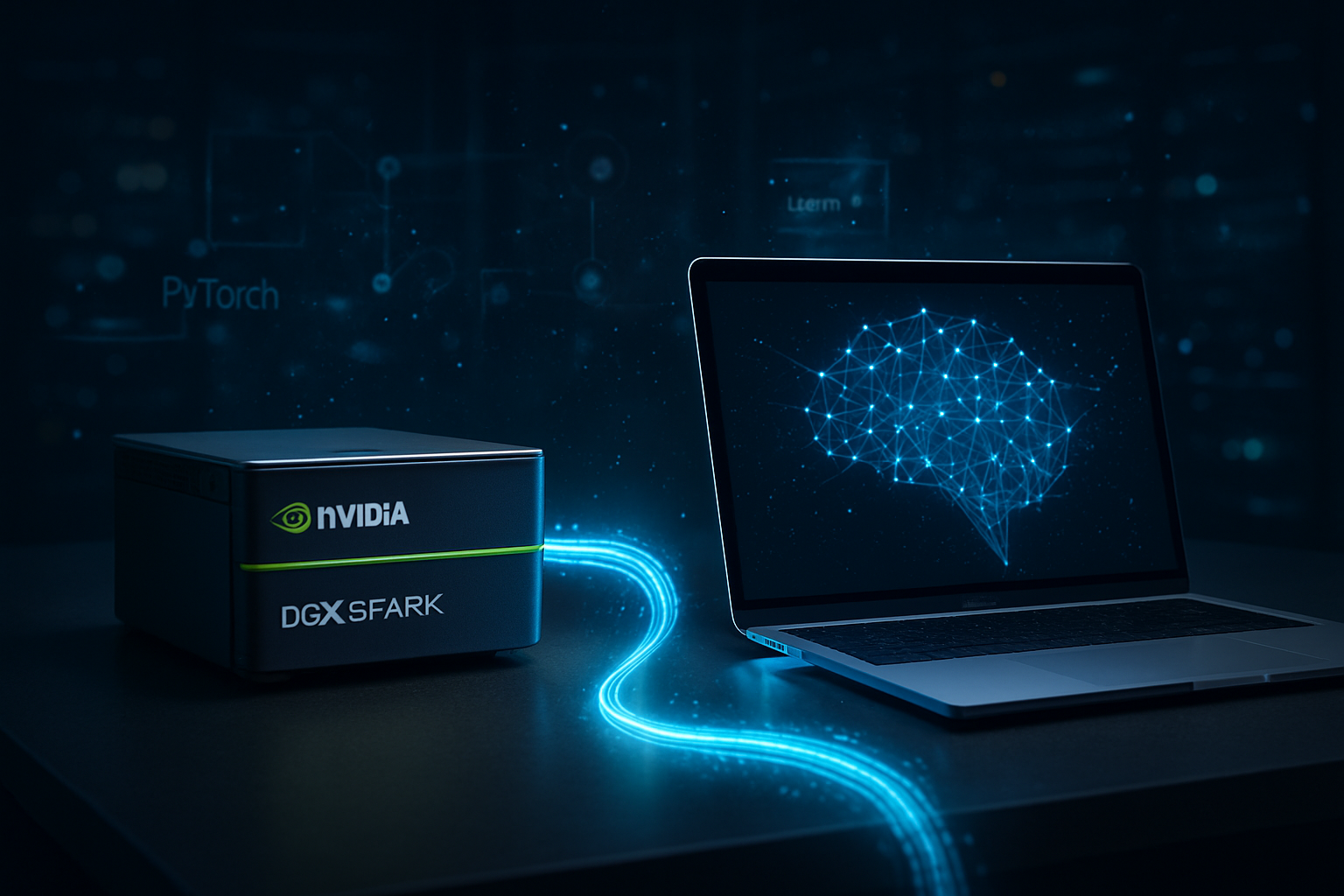
    Complementing this, Nvidia's DGX Spark program represents a significant leap in AI infrastructure. The DGX Spark is not a single product but an initiative to create fully integrated, enterprise-grade AI supercomputing solutions, often featuring Nvidia's most advanced GPUs (like the H100 or upcoming Blackwell series) interconnected with high-speed networking and sophisticated software stacks. The "Spark" aspect often refers to early access programs or specialized deployments designed to push the envelope of AI research and development. These systems are designed to handle the most demanding AI workloads, such as training colossal large language models (LLMs) with trillions of parameters or running complex scientific simulations. Technically, DGX systems integrate multiple GPUs, NVLink interconnects for ultra-fast GPU-to-GPU communication, and high-bandwidth memory, all optimized within a unified architecture. This integrated approach offers a stark contrast to assembling custom AI clusters from disparate components, providing a streamlined, high-performance, and scalable solution. Experts laud the DGX Spark initiative for democratizing access to supercomputing-level AI capabilities for enterprises and researchers, accelerating breakthroughs that would otherwise be hampered by infrastructure complexities.

    Reshaping the AI Landscape: Competitive Implications and Market Dynamics

    The innovations embodied by the NVTS-Nvidia synergy and the DGX Spark initiative are not merely technical feats; they are strategic maneuvers that profoundly reshape the competitive landscape for AI companies, tech giants, and startups alike. These advancements solidify the positions of certain players while simultaneously creating new opportunities and challenges across the industry.

    Nvidia (NASDAQ: NVDA) stands as the unequivocal primary beneficiary of these developments. Its dominance in the AI chip market is further entrenched by its ability to not only produce cutting-edge GPUs but also to build comprehensive, integrated AI platforms like the DGX series. By offering complete solutions that combine hardware, software (CUDA), and networking, Nvidia creates a powerful ecosystem that is difficult for competitors to penetrate. The DGX Spark program, in particular, strengthens Nvidia's ties with leading AI research institutions and enterprises, ensuring its hardware remains at the forefront of AI development. This strategic advantage allows Nvidia to dictate industry standards and capture a significant portion of the rapidly expanding AI infrastructure market.

    For other tech giants and AI labs, the implications are varied. Companies like Google (NASDAQ: GOOGL) and Amazon (NASDAQ: AMZN), which are heavily invested in their own custom AI accelerators (TPUs and Inferentia/Trainium, respectively), face continued pressure to match Nvidia's performance and ecosystem. While their internal chips offer optimization for their specific cloud services, Nvidia's broad market presence and continuous innovation force them to accelerate their own development cycles. Startups, on the other hand, often rely on readily available, powerful hardware to develop and deploy their AI solutions. The availability of highly optimized systems like DGX Spark, even through cloud providers, allows them to access supercomputing capabilities without the prohibitive cost and complexity of building their own from scratch, fostering innovation across the startup ecosystem. However, this also means many startups are inherently tied to Nvidia's ecosystem, creating a dependency that could have long-term implications for diversity in AI hardware.

    The potential disruption to existing products and services is significant. As AI capabilities become more powerful and accessible through optimized hardware, industries reliant on less sophisticated AI or traditional computing methods will need to adapt. For instance, enhanced generative AI capabilities powered by advanced semiconductors could disrupt content creation, drug discovery, and engineering design workflows. Companies that fail to leverage these new hardware capabilities to integrate cutting-edge AI into their offerings risk falling behind. Market positioning becomes crucial, with companies that can quickly adopt and integrate these new semiconductor-driven AI advancements gaining a strategic advantage. This creates a competitive imperative for continuous investment in AI infrastructure and talent, further intensifying the race to the top in the AI arms race.

    The Broader Canvas: AI's Trajectory and Societal Impacts

    The relentless evolution of semiconductor technology, epitomized by advancements like efficient power delivery for AI and integrated supercomputing platforms, paints a vivid picture of AI's broader trajectory. These developments are not isolated events but crucial milestones within the grand narrative of artificial intelligence, shaping its future and profoundly impacting society.

    These innovations fit squarely into the broader AI landscape's trend towards greater computational intensity and specialization. The ability to efficiently power and deploy massive AI models is directly enabling the continued scaling of large language models (LLMs), multimodal AI, and sophisticated autonomous systems. This pushes the boundaries of what AI can perceive, understand, and generate, moving us closer to truly intelligent machines. The focus on energy efficiency, driven by GaN and SiC power solutions, also aligns with a growing industry concern for sustainable AI, addressing the massive carbon footprint of training ever-larger models. Comparisons to previous AI milestones, such as the development of early neural networks or the ImageNet moment, reveal a consistent pattern: hardware breakthroughs have always been critical enablers of algorithmic advancements. Today's semiconductor innovations are fueling the "AI supercycle," accelerating progress at an unprecedented pace.

    The impacts are far-reaching. On the one hand, these advancements promise to unlock solutions to some of humanity's most pressing challenges, from accelerating drug discovery and climate modeling to revolutionizing education and accessibility. The enhanced capabilities of AI, powered by superior semiconductors, will drive unprecedented productivity gains and create entirely new industries and job categories. However, potential concerns also emerge. The immense computational power concentrated in a few hands raises questions about AI governance, ethical deployment, and the potential for misuse. The "AI divide" could widen, where nations or entities with access to cutting-edge semiconductor technology and AI expertise gain significant advantages over those without. Furthermore, the sheer energy consumption of AI, even with efficiency improvements, remains a significant environmental consideration, necessitating continuous innovation in both hardware and software optimization. The rapid pace of change also poses challenges for regulatory frameworks and societal adaptation, demanding proactive engagement from policymakers and ethicists.

    Glimpsing the Horizon: Future Developments and Expert Predictions

    Looking ahead, the symbiotic relationship between semiconductors and AI promises an even more dynamic and transformative future. Experts predict a continuous acceleration in both fields, with several key developments on the horizon.

    In the near term, we can expect continued advancements in specialized AI accelerators. Beyond current GPUs, the focus will intensify on custom ASICs (Application-Specific Integrated Circuits) designed for specific AI workloads, offering even greater efficiency and performance for tasks like inference at the edge. We will also see further integration of heterogeneous computing, where CPUs, GPUs, NPUs, and other specialized cores are seamlessly combined on a single chip or within a single system to optimize for diverse AI tasks. Memory innovation, particularly High Bandwidth Memory (HBM), will continue to evolve, with higher capacities and faster speeds becoming standard to feed the ever-hungry AI models. Long-term, the advent of novel computing paradigms like neuromorphic chips, which mimic the structure and function of the human brain for ultra-efficient processing, and potentially even quantum computing, could unlock AI capabilities far beyond what is currently imagined. Silicon photonics, using light instead of electrons for data transfer, is also on the horizon to address bandwidth bottlenecks.

    Potential applications and use cases are boundless. Enhanced AI, powered by these future semiconductors, will drive breakthroughs in personalized medicine, creating AI models that can analyze individual genomic data to tailor treatments. Autonomous systems, from self-driving cars to advanced robotics, will achieve unprecedented levels of perception and decision-making. Generative AI will become even more sophisticated, capable of creating entire virtual worlds, complex scientific simulations, and highly personalized educational content. Challenges, however, remain. The "memory wall" – the bottleneck between processing units and memory – will continue to be a significant hurdle. Power consumption, despite efficiency gains, will require ongoing innovation. The complexity of designing and manufacturing these advanced chips will also necessitate new AI-driven design tools and manufacturing processes. Experts predict that AI itself will play an increasingly critical role in designing the next generation of semiconductors, creating a virtuous cycle of innovation. The focus will also shift towards making AI more accessible and deployable at the edge, enabling intelligent devices to operate autonomously without constant cloud connectivity.

    The Unseen Engine: A Comprehensive Wrap-up of AI's Semiconductor Foundation

    The narrative of artificial intelligence in the 2020s is inextricably linked to the silent, yet powerful, revolution occurring within the semiconductor industry. The key takeaway from recent developments, such as the drive for efficient power solutions and integrated AI supercomputing platforms, is that hardware innovation is not merely supporting AI; it is actively defining its trajectory and potential. Without the continuous breakthroughs in chip design, materials science, and manufacturing processes, the ambitious visions for AI would remain largely theoretical.

    This development's significance in AI history cannot be overstated. We are witnessing a period where the foundational infrastructure for AI is being rapidly advanced, enabling the scaling of models and the deployment of capabilities that were unimaginable just a few years ago. The shift towards specialized accelerators, combined with a focus on energy efficiency, marks a mature phase in AI hardware development, moving beyond general-purpose computing to highly optimized solutions. This period will likely be remembered as the era when AI transitioned from a niche academic pursuit to a ubiquitous, transformative force, largely on the back of silicon's relentless progress.

    Looking ahead, the long-term impact of these advancements will be profound, shaping economies, societies, and even human capabilities. The continued democratization of powerful AI through accessible hardware will accelerate innovation across every sector. However, it also necessitates careful consideration of ethical implications, equitable access, and sustainable practices. What to watch for in the coming weeks and months includes further announcements of next-generation AI accelerators, strategic partnerships between chip manufacturers and AI developers, and the increasing adoption of AI-optimized hardware in cloud data centers and edge devices. The race for AI supremacy is, at its heart, a race for semiconductor superiority, and the finish line is nowhere in sight.


    This content is intended for informational purposes only and represents analysis of current AI developments.

    TokenRing AI delivers enterprise-grade solutions for multi-agent AI workflow orchestration, AI-powered development tools, and seamless remote collaboration platforms.
    For more information, visit https://www.tokenring.ai/.

  • Nvidia Unleashes DGX Spark: The World’s Smallest AI Supercomputer Ignites a New Era of Local AI

    Nvidia Unleashes DGX Spark: The World’s Smallest AI Supercomputer Ignites a New Era of Local AI

    REDMOND, WA – October 14, 2025 – In a move set to redefine the landscape of artificial intelligence development, Nvidia (NASDAQ: NVDA) has officially begun shipping its groundbreaking DGX Spark. Marketed as the "world's smallest AI supercomputer," this compact yet immensely powerful device, first announced in March 2025, is now making its way to developers and researchers, promising to democratize access to high-performance AI computing. The DGX Spark aims to bring data center-grade capabilities directly to the desktop, empowering individuals and small teams to tackle complex AI models previously confined to expansive cloud infrastructures or large-scale data centers.

    This launch marks a pivotal moment, as Nvidia continues its aggressive push to innovate across the AI hardware spectrum. By condensing petaFLOP-scale performance into a device roughly the size of a hardcover book, the DGX Spark is poised to accelerate the pace of AI innovation, enabling faster prototyping, local fine-tuning of large language models (LLMs), and enhanced privacy for sensitive AI workloads. Its arrival is anticipated to spark a new wave of creativity and efficiency among AI practitioners worldwide, fostering an environment where advanced AI development is no longer limited by physical space or prohibitive infrastructure costs.

    A Technical Marvel: Shrinking the Supercomputer

    The Nvidia DGX Spark is an engineering marvel, leveraging the cutting-edge NVIDIA GB10 Grace Blackwell Superchip architecture to deliver unprecedented power in a desktop form factor. At its core, the system boasts up to 1 petaFLOP of AI performance at FP4 precision with sparsity, a figure that rivals many full-sized data center servers from just a few years ago. This formidable processing power is complemented by a substantial 128 GB of LPDDR5x coherent unified system memory, a critical feature that allows the DGX Spark to effortlessly handle AI development and testing workloads with models up to 200 billion parameters. Crucially, this unified memory architecture enables fine-tuning of models up to 70 billion parameters locally without the typical quantization compromises often required on less capable hardware.

    Under the hood, the DGX Spark integrates a robust 20-core Arm CPU, featuring a combination of 10 Cortex-X925 performance cores and 10 Cortex-A725 efficiency cores, ensuring a balanced approach to compute-intensive tasks and general system operations. Storage is ample, with 4 TB of NVMe M.2 storage, complete with self-encryption for enhanced security. The system runs on NVIDIA DGX OS, a specialized version of Ubuntu, alongside Nvidia's comprehensive AI software stack, including essential CUDA libraries. For networking, it features NVIDIA ConnectX-7 Smart NIC, offering two QSFP ports with up to 200 Gbps, enabling developers to link two DGX Spark systems to work with even larger AI models, up to 405 billion parameters. This level of performance and memory in a device measuring just 150 x 150 x 50.5 mm and weighing 1.2 kg is a significant departure from previous approaches, which typically required rack-mounted servers or multi-GPU workstations, distinguishing it sharply from existing consumer-grade GPUs that often hit VRAM limitations with large models. Initial reactions from the AI research community have been overwhelmingly positive, highlighting the potential for increased experimentation and reduced dependency on costly cloud GPU instances.

    Reshaping the AI Industry: Beneficiaries and Battlefield

    The introduction of the Nvidia DGX Spark is poised to send ripples throughout the AI industry, creating new opportunities and intensifying competition. Startups and independent AI researchers stand to benefit immensely, as the DGX Spark provides an accessible entry point into serious AI development without the prohibitive upfront costs or ongoing operational expenses associated with cloud-based supercomputing. This could foster a new wave of innovation from smaller entities, allowing them to prototype, train, and fine-tune advanced models more rapidly and privately. Enterprises dealing with sensitive data, such as those in healthcare, finance, or defense, could leverage the DGX Spark for on-premise AI development, mitigating data privacy and security concerns inherent in cloud environments.

    For major AI labs and tech giants, the DGX Spark could serve as a powerful edge device for distributed AI training, local model deployment, and specialized research tasks. It may also influence their strategies for hybrid cloud deployments, enabling more workloads to be processed locally before scaling to larger cloud clusters. The competitive implications are significant; while cloud providers like Amazon (NASDAQ: AMZN) Web Services, Microsoft (NASDAQ: MSFT) Azure, and Google (NASDAQ: GOOGL) Cloud still offer unparalleled scalability, the DGX Spark presents a compelling alternative for specific use cases, potentially slowing the growth of certain cloud-based AI development segments. This could lead to a shift in how AI infrastructure is consumed, with a greater emphasis on local, powerful devices for initial development and experimentation. The $3,999.99 price point makes it an attractive proposition, positioning Nvidia to capture a segment of the market that seeks high-performance AI compute without the traditional data center footprint.

    Wider Significance: Democratizing AI and Addressing Challenges

    The DGX Spark's arrival fits squarely into the broader trend of democratizing AI, making advanced capabilities accessible to a wider audience. It represents a significant step towards enabling "AI at the edge" for development purposes, allowing sophisticated models to be built and refined closer to the data source. This has profound impacts on various sectors, from accelerating scientific discovery in academia to enabling more agile product development in commercial industries. The ability to run large models locally can reduce latency, improve data privacy, and potentially lower overall operational costs for many organizations.

    However, its introduction also raises potential concerns. While the initial price is competitive for its capabilities, it still represents a significant investment for individual developers or very small teams. The power consumption, though efficient for its performance, is still 240 watts, which might be a consideration for continuous, always-on operations in a home office setting. Compared to previous AI milestones, such as the introduction of CUDA-enabled GPUs or the first DGX systems, the DGX Spark signifies a miniaturization and decentralization of supercomputing power, pushing the boundaries of what's possible on a desktop. It moves beyond merely accelerating inference to enabling substantial local training and fine-tuning, a critical step for personalized and specialized AI applications.

    The Road Ahead: Applications and Expert Predictions

    Looking ahead, the DGX Spark is expected to catalyze a surge in innovative applications. Near-term developments will likely see its adoption by individual researchers and small development teams for rapid prototyping of generative AI models, drug discovery simulations, and advanced robotics control algorithms. In the long term, its capabilities could enable hyper-personalized AI experiences on local devices, supporting scenarios like on-device large language model inference for privacy-sensitive applications, or advanced computer vision systems that perform real-time analysis without cloud dependency. It could also become a staple in educational institutions, providing students with hands-on experience with supercomputing-level AI.

    However, challenges remain. The ecosystem of software tools and optimized models for such a compact yet powerful device will need to mature further. Ensuring seamless integration with existing AI workflows and providing robust support will be crucial for widespread adoption. Experts predict that the DGX Spark will accelerate the development of specialized, domain-specific AI models, as developers can iterate faster and more privately. It could also spur further miniaturization efforts from competitors, leading to an arms race in compact, high-performance AI hardware. The ability to run large models locally will also push the boundaries of what's considered "edge computing," blurring the lines between traditional data centers and personal workstations.

    A New Dawn for AI Development

    Nvidia's DGX Spark is more than just a new piece of hardware; it's a testament to the relentless pursuit of making advanced AI accessible and efficient. The key takeaway is the unprecedented convergence of supercomputing power, substantial unified memory, and a compact form factor, all at a price point that broadens its appeal significantly. This development's significance in AI history cannot be overstated, as it marks a clear shift towards empowering individual practitioners and smaller organizations with the tools necessary to innovate at the forefront of AI. It challenges the traditional reliance on massive cloud infrastructure for certain types of AI development, offering a powerful, local alternative.

    In the coming weeks and months, the tech world will be closely watching the initial adoption rates and the innovative projects that emerge from DGX Spark users. Its impact on fields requiring high data privacy, rapid iteration, and localized processing will be particularly telling. As AI continues its exponential growth, devices like the DGX Spark will play a crucial role in shaping its future, fostering a more distributed, diverse, and dynamic ecosystem of AI development.


    This content is intended for informational purposes only and represents analysis of current AI developments.

    TokenRing AI delivers enterprise-grade solutions for multi-agent AI workflow orchestration, AI-powered development tools, and seamless remote collaboration platforms.
    For more information, visit https://www.tokenring.ai/.