Tag: Digital Twin

  • The Rise of the Industrial AI OS: NVIDIA and Siemens Redefine the Factory Floor in Erlangen

    The Rise of the Industrial AI OS: NVIDIA and Siemens Redefine the Factory Floor in Erlangen

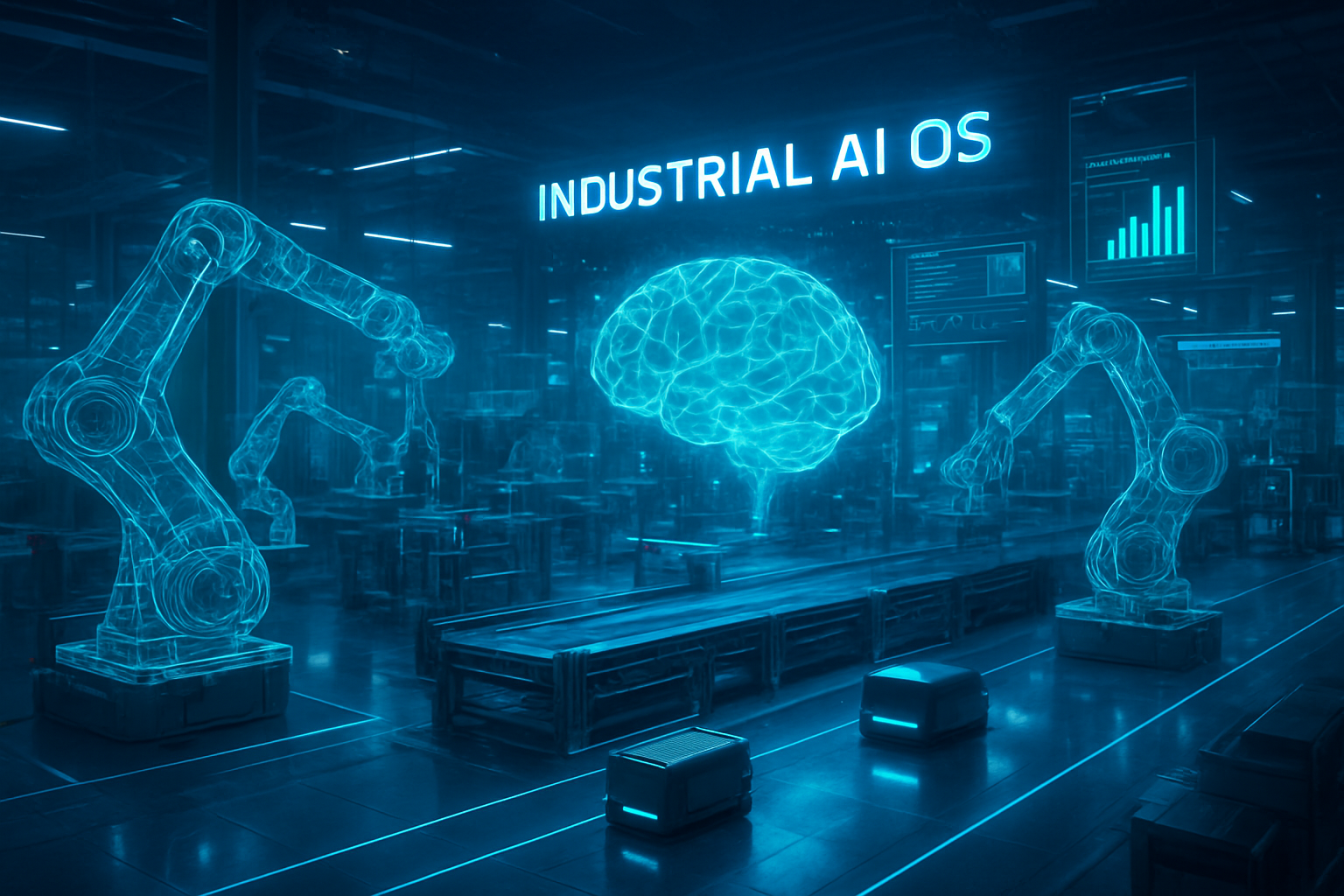
    In a move that signals the dawn of a new era in autonomous manufacturing, NVIDIA (NASDAQ: NVDA) and Siemens (ETR: SIE) have announced the formal launch of the world’s first "Industrial AI Operating System" (Industrial AI OS). Revealed at CES 2026 earlier this month, this strategic expansion of their long-standing partnership represents a fundamental shift in how factories are designed and operated. By moving beyond passive simulations to "active intelligence," the new system allows industrial environments to autonomously optimize their own operations, marking the most significant convergence of generative AI and physical automation to date.

    The immediate significance of this development lies in its ability to bridge the gap between virtual planning and physical reality. At the heart of this announcement is the transformation of the digital twin—once a mere 3D model—into a living, breathing software entity that can control the shop floor. For the manufacturing sector, this means the promise of the "Industrial Metaverse" has finally moved from a conceptual buzzword to a deployable, high-performance reality that is already delivering double-digit efficiency gains in real-world environments.

    The "AI Brain": Engineering the Future of Automation

    The core of the Industrial AI OS is a unified software-defined architecture that fuses Siemens’ Xcelerator platform with NVIDIA’s high-density AI infrastructure. At the center of this stack is what the companies call the "AI Brain"—a software-defined automation layer that leverages NVIDIA Blackwell GPUs and the Omniverse platform to analyze factory data in real-time. Unlike traditional manufacturing systems that rely on rigid, pre-programmed logic, the AI Brain uses "Physics-Based AI" and NVIDIA’s PhysicsNeMo generative models to simulate thousands of "what-if" scenarios every second, identifying the most efficient path forward and deploying those instructions directly to the production line.

    One of the most impressive technical breakthroughs is the integration of "software-in-the-loop" testing, which virtually eliminates the risk of downtime. By the time a new process or material flow is introduced to the physical machines, it has already been validated in a physics-accurate digital twin with nearly 100% accuracy. Siemens also teased the upcoming release of the "Digital Twin Composer" in mid-2026, a tool designed to allow non-experts to build photorealistic, physics-perfect 3D environments that link live IoT data from the factory floor directly into the simulation.

    Industry experts have reacted with overwhelming positivity, noting that this differentiates itself from previous approaches by its sheer scale and real-time capability. While earlier digital twins were often siloed or required massive manual updates, the Industrial AI OS is inherently dynamic. Researchers in the AI community have specifically praised the use of CUDA-X libraries to accelerate the complex thermodynamics and fluid dynamics simulations required for energy optimization, a task that previously took days but now occurs in milliseconds.

    Market Shifting: A New Standard for Industrial Tech

    This collaboration solidifies NVIDIA’s position as the indispensable backbone of industrial intelligence, while simultaneously repositioning Siemens as a software-first technology powerhouse. By moving their simulation portfolio onto NVIDIA’s generative AI stack, Siemens is effectively future-proofing its Xcelerator ecosystem against competitors like PTC (NASDAQ: PTC) or Rockwell Automation (NYSE: ROK). The strategic advantage is clear: Siemens provides the domain expertise and operational technology (OT) data, while NVIDIA provides the massive compute power and AI models necessary to make that data actionable.

    The ripple effects will be felt across the tech giant landscape. Cloud providers like Microsoft (NASDAQ: MSFT) and Amazon (NASDAQ: AMZN) are now competing to host these massive "Industrial AI Clouds." In fact, Deutsche Telekom (FRA: DTE) has already jumped into the fray, recently launching a dedicated cloud facility in Munich specifically to support the compute-heavy requirements of the Industrial AI OS. This creates a new high-margin revenue stream for telcos and cloud providers who can offer the low-latency connectivity required for real-time factory synchronization.

    Furthermore, the "Industrial AI OS" threatens to disrupt traditional consulting and industrial engineering services. If a factory can autonomously optimize its own material flow and energy consumption, the need for periodic, expensive efficiency audits by third-party firms may diminish. Instead, the value is shifting toward the platforms that provide continuous, automated optimization. Early adopters like PepsiCo (NASDAQ: PEP) and Foxconn (TPE: 2317) have already begun evaluating the OS to optimize their global supply chains, signaling a move toward a standardized, AI-driven manufacturing template.

    The Erlangen Blueprint: Sustainability and Efficiency in Action

    The real-world proof of this technology is found at the Siemens Electronics Factory in Erlangen (GWE), Germany. Recognized by the World Economic Forum as a "Digital Lighthouse," the Erlangen facility serves as a living laboratory for the Industrial AI OS. The results are staggering: by using AI-driven digital twins to orchestrate its fleet of 30 Automated Guided Vehicles (AGVs), the factory has achieved a 40% reduction in material circulation. These vehicles, which collectively travel the equivalent of five times around the Earth every year, now operate with such precision that bottlenecks have been virtually eliminated.

    Sustainability is perhaps the most significant outcome of the Erlangen implementation. Using the digital twin to simulate and optimize the production hall’s ventilation and cooling systems has led to a 70% reduction in ventilation energy. Over the past four years, the factory has reported a 42% decrease in total energy consumption while simultaneously increasing productivity by 69%. This sets a new benchmark for "green manufacturing," proving that environmental goals and industrial growth are not mutually exclusive when managed by high-performance AI.

    This development fits into a broader trend of "sovereign AI" and localized manufacturing. As global supply chains face increasing volatility, the ability to run highly efficient, automated factories close to home becomes a matter of economic security. The Erlangen model demonstrates that AI can offset higher labor costs in regions like Europe and North America by delivering unprecedented levels of efficiency and resource management. This milestone is being compared to the introduction of the first programmable logic controllers (PLCs) in the 1960s—a shift from hardware-centric to software-augmented production.

    Future Horizons: From Single Factories to Global Networks

    Looking ahead, the near-term focus will be the global rollout of the Digital Twin Composer and the expansion of the Industrial AI OS to more diverse sectors, including automotive and pharmaceuticals. Experts predict that by 2027, "Self-Healing Factories" will become a reality, where the AI OS not only optimizes flow but also predicts mechanical failures and autonomously orders replacement parts or redirects production to avoid outages. The partnership is also expected to explore the use of humanoid robotics integrated with the AI OS, allowing for even more flexible and adaptive assembly lines.

    However, challenges remain. The transition to an AI-led operating system requires a massive upskilling of the industrial workforce and a significant initial investment in GPU-heavy infrastructure. There are also ongoing discussions regarding data privacy and the "black box" nature of generative AI in critical infrastructure. Experts suggest that the next few years will see a push for more "Explainable AI" (XAI) within the Industrial AI OS to ensure that human operators can understand and audit the decisions made by the autonomous "AI Brain."

    A New Era of Autonomous Production

    The collaboration between NVIDIA and Siemens marks a watershed moment in the history of industrial technology. By successfully deploying a functional Industrial AI OS at the Erlangen factory, the two companies have provided a roadmap for the future of global manufacturing. The key takeaways are clear: the digital twin is no longer just a model; it is a management system. Sustainability is no longer just a goal; it is a measurable byproduct of AI-driven optimization.

    This development will likely be remembered as the point where the "Industrial Metaverse" moved from marketing hype to a quantifiable industrial standard. As we move into the middle of 2026, the industry will be watching closely to see how quickly other global manufacturers can replicate the "Erlangen effect." For now, the message is clear: the factories of the future will not just be run by people or robots, but by an intelligent operating system that never stops learning.


    This content is intended for informational purposes only and represents analysis of current AI developments.

    TokenRing AI delivers enterprise-grade solutions for multi-agent AI workflow orchestration, AI-powered development tools, and seamless remote collaboration platforms.
    For more information, visit https://www.tokenring.ai/.

  • ESD Industry Soars to $5.1 Billion in Q2 2025, Fueling AI’s Hardware Revolution

    ESD Industry Soars to $5.1 Billion in Q2 2025, Fueling AI’s Hardware Revolution

    San Francisco, CA – October 6, 2025 – The Electronic System Design (ESD) industry has reported a robust and pivotal performance in the second quarter of 2025, achieving an impressive $5.1 billion in revenue. This significant figure represents an 8.6% increase compared to Q2 2024, signaling a period of sustained and accelerated growth for the foundational sector that underpins the entire semiconductor ecosystem. As the demand for increasingly complex and specialized chips for Artificial Intelligence (AI), 5G, and IoT applications intensifies, the ESD industry’s expansion is proving critical, directly fueling the innovation and advancement of semiconductor design tools and, by extension, the future of AI hardware.

    This strong financial showing, which saw the industry's four-quarter moving average revenue climb by 10.4%, underscores the indispensable role of Electronic Design Automation (EDA) tools in navigating the intricate challenges of modern chip development. The consistent upward trajectory in revenue reflects the global electronics industry's reliance on sophisticated software to design, verify, and manufacture the advanced integrated circuits (ICs) that power everything from data centers to autonomous vehicles. This growth is particularly significant as the industry moves beyond traditional scaling limits, with AI-powered EDA becoming the linchpin for continued innovation in semiconductor performance and efficiency.

    AI and Digital Twins Drive a New Era of Chip Design

    The core of the ESD industry's recent surge lies in the transformative integration of Artificial Intelligence (AI), Machine Learning (ML), and digital twin technologies into Electronic Design Automation (EDA) tools. This paradigm shift marks a fundamental departure from traditional, often manual, chip design methodologies, ushering in an era of unprecedented automation, optimization, and predictive capabilities across the entire design stack. Companies are no longer just automating tasks; they are empowering AI to actively participate in the design process itself.

    AI-driven tools are revolutionizing critical stages of chip development. In automated layout and floorplanning, reinforcement learning algorithms can evaluate millions of potential floorplans, identifying superior configurations that far surpass human-derived designs. For logic optimization and synthesis, ML models analyze Hardware Description Language (HDL) code to suggest improvements, leading to significant reductions in power consumption and boosts in performance. Furthermore, AI assists in rapid design space exploration, quickly identifying optimal microarchitectural configurations for complex systems-on-chips (SoCs). This enables significant improvements in power, performance, and area (PPA) optimization, with some AI-driven tools demonstrating up to a 40% reduction in power consumption and a three to five times increase in design productivity.

    The impact extends powerfully into verification and debugging, historically a major bottleneck in chip development. AI-driven verification automates test case generation, proactively detects design flaws, and predicts failure points before manufacturing, drastically reducing verification effort and improving bug detection rates. Digital twin technology, integrating continuously updated virtual representations of physical systems, allows designers to rigorously test chips against highly accurate simulations of entire subsystems and environments. This "shift left" in the design process enables earlier and more comprehensive validation, moving beyond static models to dynamic, self-learning systems that evolve with real-time data, ultimately leading to faster development cycles (months into weeks) and superior product quality.

    Competitive Landscape Reshaped: EDA Giants and Tech Titans Leverage AI

    The robust growth of the ESD industry, propelled by AI-powered EDA, is profoundly reshaping the competitive landscape for major AI companies, tech giants, and semiconductor startups alike. At the forefront are the leading EDA tool vendors, whose strategic integration of AI into their offerings is solidifying their market dominance and driving innovation.

    Synopsys, Inc. (NASDAQ: SNPS), a pioneer in full-stack AI-driven EDA, has cemented its leadership with its Synopsys.ai suite. This comprehensive platform, including DSO.ai for PPA optimization, VSO.ai for verification, and TSO.ai for test coverage, promises over three times productivity increases and up to 20% better quality of results. Synopsys is also expanding its generative AI (GenAI) capabilities with Synopsys.ai Copilot and developing AgentEngineer technology for autonomous decision-making in chip design. Similarly, Cadence Design Systems, Inc. (NASDAQ: CDNS) has adopted an "AI-first approach," with solutions like Cadence Cerebrus Intelligent Chip Explorer optimizing multiple blocks simultaneously, showing up to 20% improvements in PPA and 60% performance boosts on specific blocks. Cadence's vision of "Level 5 Autonomy" aims for AI to handle end-to-end chip design, accelerating cycles by as much as a month, with its AI-assisted platforms already used by over 1,000 customers. Siemens EDA, a division of Siemens AG (ETR: SIE), is also aggressively embedding AI into its core tools, with its EDA AI System offering secure, advanced generative and agentic AI capabilities. Its solutions, like Aprisa AI software, deliver significant productivity increases (10x), faster time to tapeout (3x), and better PPA (10%).

    Beyond the EDA specialists, major tech giants like Alphabet Inc. (NASDAQ: GOOGL), Amazon.com, Inc. (NASDAQ: AMZN), Microsoft Corporation (NASDAQ: MSFT), and Meta Platforms, Inc. (NASDAQ: META) are increasingly becoming their own chip architects. Leveraging AI-powered EDA, they design custom silicon, such as Google's Tensor Processing Units (TPUs), optimized for their proprietary AI workloads. This strategy enhances cloud services, reduces reliance on external vendors, and provides significant strategic advantages in cost efficiency and performance. For specialized AI hardware developers like NVIDIA Corporation (NASDAQ: NVDA) and Advanced Micro Devices, Inc. (NASDAQ: AMD), AI-powered EDA tools are indispensable for designing high-performance GPUs and AI-specific processors. Furthermore, the "democratization of design" facilitated by cloud-based, AI-amplified EDA solutions is lowering barriers to entry for semiconductor startups, enabling them to develop customized chips more efficiently and cost-effectively for emerging niche applications in edge computing and IoT.

    The Broader Significance: Fueling the AI Revolution and Extending Moore's Law

    The ESD industry's robust growth, driven by AI-powered EDA, represents a pivotal development within the broader AI landscape. It signifies a "virtuous cycle" where advanced AI-powered tools design better AI chips, which, in turn, accelerate further AI development. This symbiotic relationship is crucial as current AI trends, including the proliferation of generative AI, large language models (LLMs), and agentic AI, demand increasingly powerful and energy-efficient hardware. The AI hardware market is diversifying rapidly, moving from general-purpose computing to domain-specific architectures meticulously crafted for AI workloads, a trend directly supported by the capabilities of modern EDA.

    The societal and economic impacts are profound. AI-driven EDA tools significantly compress development timelines, enabling faster introduction of new technologies across diverse sectors, from smart homes and autonomous vehicles to advanced robotics and drug discovery. The AI chip market is projected to exceed $100 billion by 2030, with AI itself expected to contribute over $15.7 trillion to global GDP through enhanced productivity and new market creation. While AI automates repetitive tasks, it also transforms the job market, freeing engineers to focus on architectural innovation and high-level problem-solving, though it necessitates a workforce with new skills in AI and data science. Critically, AI-powered EDA is instrumental in extending the relevance of Moore's Law, pushing the boundaries of chip capabilities even as traditional transistor scaling faces physical and economic limits.

    However, this revolution is not without its concerns. The escalating complexity of chips, now containing billions or even trillions of transistors, poses new challenges for verification and validation of AI-generated designs. High implementation costs, the need for vast amounts of high-quality data, and ethical considerations surrounding AI explainability and potential biases in algorithms are significant hurdles. The surging demand for skilled engineers who understand both AI and semiconductor design is creating a global talent gap, while the immense computational resources required for training sophisticated AI models raise environmental sustainability concerns. Despite these challenges, the current era, often dubbed "EDA 4.0," marks a distinct evolutionary leap, moving beyond mere automation to generative and agentic AI that actively designs, optimizes, and even suggests novel solutions, fundamentally reshaping the future of technology.

    The Horizon: Autonomous Design and Pervasive AI

    Looking ahead, the ESD industry and AI-powered EDA tools are poised for even more transformative developments, promising a future of increasingly autonomous and intelligent chip design. In the near term, AI will continue to enhance existing workflows, automating tasks like layout generation and verification, and acting as an intelligent assistant for scripting and collateral generation. Cloud-based EDA solutions will further democratize access to high-performance computing for design and verification, fostering greater collaboration and enabling real-time design rule checking to catch errors earlier.

    The long-term vision points towards truly autonomous design flows and "AI-native" methodologies, where self-learning systems generate and optimize circuits with minimal human oversight. This will be critical for the shift towards multi-die assemblies and 3D-ICs, where AI will be indispensable for optimizing complex chiplet-based architectures, thermal management, and signal integrity. AI is expected to become pervasive, impacting every aspect of chip design, from initial specification to tape-out and beyond, blurring the lines between human creativity and machine intelligence. Experts predict that design cycles that once took months or years could shrink to weeks, driven by real-time analytics and AI-guided decisions. The industry is also moving towards autonomous semiconductor manufacturing, where AI, IoT, and digital twins will detect and resolve process issues with minimal human intervention.

    However, challenges remain. Effective data management, bridging the expertise gap between AI and semiconductor design, and building trust in "black box" AI algorithms through rigorous validation are paramount. Ethical considerations regarding job impact and potential "hallucinations" from generative AI systems also need careful navigation. Despite these hurdles, the consensus among experts is that AI will lead to an evolution rather than a complete disruption of EDA, making engineers more productive and helping to bridge the talent gap. The demand for more efficient AI accelerators will continue to drive innovation, with companies racing to create new architectures, including neuromorphic chips, optimized for specific AI workloads.

    A New Era for AI Hardware: The Road Ahead

    The Electronic System Design industry's impressive $5.1 billion revenue in Q2 2025 is far more than a financial milestone; it is a clear indicator of a profound paradigm shift in how electronic systems are conceived, designed, and manufactured. This robust growth, overwhelmingly driven by the integration of AI, machine learning, and digital twin technologies into EDA tools, underscores the industry's critical role as the bedrock for the ongoing AI revolution. The ability to design increasingly complex, high-performance, and energy-efficient chips with unprecedented speed and accuracy is directly enabling the next generation of AI advancements, from sophisticated generative models to pervasive intelligent edge devices.

    This development marks a significant chapter in AI history, moving beyond software-centric breakthroughs to a fundamental transformation of the underlying hardware infrastructure. The synergy between AI and EDA is not merely an incremental improvement but a foundational re-architecture of the design process, allowing for the extension of Moore's Law and the creation of entirely new categories of specialized AI hardware. The competitive race among EDA giants, tech titans, and nimble startups to harness AI for chip design will continue to accelerate, leading to faster innovation cycles and more powerful computing capabilities across all sectors.

    In the coming weeks and months, the industry will be watching for continued advancements in AI-driven design automation, particularly in areas like multi-die system optimization and autonomous design flows. The development of a workforce skilled in both AI and semiconductor engineering will be crucial, as will addressing the ethical and environmental implications of this rapidly evolving technology. As the ESD industry continues its trajectory of growth, it will remain a vital barometer for the health and future direction of both the semiconductor industry and the broader AI landscape, acting as the silent architect of our increasingly intelligent world.

    TokenRing AI delivers enterprise-grade solutions for multi-agent AI workflow orchestration, AI-powered development tools, and seamless remote collaboration platforms. For more information, visit https://www.tokenring.ai/.