
Tag: Economic Security

  • TSMC Shatters Spending Records with $56 Billion CapEx; Japan Becomes 3nm Hub in Historic Global Pivot

    TSMC Shatters Spending Records with $56 Billion CapEx; Japan Becomes 3nm Hub in Historic Global Pivot

    In a move that underscores the relentless demand for artificial intelligence and high-performance computing, Taiwan Semiconductor Manufacturing Company (NYSE: TSM) has announced a record-shattering capital expenditure budget of up to $56 billion for 2026. This massive financial commitment represents a nearly 40% increase over the previous year, signaling TSMC’s intent to cement its dominance as the world’s premier foundry at a time when silicon has become the most vital resource in the global economy.

    The crown jewel of this expansion is a dramatic $17 billion upgrade to the company’s second fabrication facility in Kumamoto, Japan. Following a high-level meeting between TSMC CEO C.C. Wei and Japanese Prime Minister Sanae Takaichi on February 5, 2026, the company confirmed that the facility—originally slated for mature nodes—will now produce cutting-edge 3-nanometer (3nm) chips. This pivot not only marks the first time TSMC has exported its most advanced mass-production technology to Japan but also serves as the cornerstone for Japan’s "semiconductor rebirth," securing the nation's position as a tier-1 manufacturing hub for the AI era.

    The 3nm Leap: Technical Sophistication and the Kumamoto Upgrade

    The decision to bring 3nm technology to the second Kumamoto facility, operated under the JASM (Japan Advanced Semiconductor Manufacturing) joint venture, represents a massive technological leap from initial plans. Originally envisioned to handle 6nm to 12nm "specialty" nodes for automotive and industrial sectors, the $17 billion investment (approximately ¥2.6 trillion) transforms the site into a world-class advanced logic powerhouse. The 3nm process, utilizing FinFET (Fin Field-Effect Transistor) architecture at its most refined stage, offers a 15% speed improvement at the same power or a 30% power reduction at the same speed compared to the 5nm generation, along with a 1.6x increase in logic density.

    The upgrade is a direct response to the "insatiable" demand for AI accelerators and next-generation mobile processors. By situating 3nm production in Japan, TSMC is effectively decentralizing its most advanced manufacturing capabilities away from Taiwan for the first time in history. The facility is expected to enter mass production by late 2027, utilizing the latest in Extreme Ultraviolet (EUV) lithography tools. This move is supported by a massive expansion in TSMC’s advanced packaging capacity, with 10% to 20% of the total $56 billion CapEx dedicated to CoWoS (Chip on Wafer on Substrate) and other "3D" packaging technologies, which are essential for the massive memory-and-logic sandwiches that power large language models.

    Initial reactions from the semiconductor research community suggest that TSMC’s aggressive spending is a preemptive strike against competitors. While Intel (NASDAQ: INTC) and Samsung (KRX: 005930) are racing to stabilize their own advanced nodes, TSMC’s ability to allocate over $50 billion in a single year—more than the total market capitalization of many mid-sized tech firms—creates a formidable "moat of capital" that is difficult for any rival to bridge.

    Strategic Advantage: Powering the AI Giants and Reshaping the Market

    This massive capital injection directly benefits the world’s leading technology companies, particularly those in the "Magnificent Seven" and the broader AI ecosystem. Companies like Nvidia (NASDAQ: NVDA), Apple (NASDAQ: AAPL), and Advanced Micro Devices (NASDAQ: AMD) are the primary consumers of TSMC’s advanced nodes. With the $56 billion CapEx, TSMC is effectively guaranteeing these giants that the capacity for their next-generation AI GPUs and custom silicon will be available, mitigating the supply chain bottlenecks that defined the 2023-2025 period.

    The investment in Japan provides a strategic hedge for global tech companies concerned about geopolitical stability in the Taiwan Strait. For Apple and Nvidia, having a 3nm source in a stable, high-infrastructure country like Japan provides a "Plan B" that was previously unavailable. This diversification is expected to disrupt the current market positioning of competitors; as TSMC solidifies its role as the de facto "Central Bank of Silicon," it puts immense pressure on Intel’s Foundry Services to deliver on their "18A" node promises or risk losing further market share in the premium AI segment.

    Furthermore, Japan’s automotive and robotics giants, such as Toyota (NYSE: TM) and Sony (NYSE: SONY), stand to gain significantly. By having a 3nm foundry in their backyard, these companies can integrate high-performance AI directly into their hardware with lower latency and more secure supply chains, potentially leading to a new generation of autonomous vehicles and sophisticated industrial robotics that were previously limited by chip availability.

    A "Silicon Island" Reborn: Global Economic Security and Geopolitics

    The significance of the Kumamoto expansion extends far beyond corporate balance sheets; it is a geopolitical masterstroke. CEO C.C. Wei’s visit to the Prime Minister’s office on February 5, 2026, highlighted a new era of "semiconductor diplomacy." Prime Minister Sanae Takaichi’s government has made the semiconductor industry a matter of national security, increasing the Ministry of Economy, Trade and Industry (METI) budget for chips and AI to a staggering ¥1.23 trillion for fiscal 2026.

    This "Semiconductor Rebirth Strategy" aims to restore Japan to the prominence it held in the 1980s. By hosting a 3nm facility, Kumamoto is being transformed into a "Silicon Island," attracting a cluster of chemical suppliers, equipment manufacturers, and top-tier engineering talent. This concentration of resources is a critical component of global economic security, creating a more resilient supply chain that is less dependent on any single geographic point of failure.

    However, the move is not without its concerns. Critics point to the immense subsidies required—Japan has already committed trillions of yen to attract TSMC—and question whether such "state-led growth" can be sustained. There are also environmental concerns regarding the massive water and electricity requirements of a 3nm facility. Nonetheless, compared to the risks of a "silicon drought," the Japanese government clearly views these costs as a necessary premium for national sovereignty in the digital age.

    The Road to 2nm: What Lies Ahead for TSMC and Japan

    Looking forward, the $56 billion CapEx is just the beginning of a multi-year roadmap that leads toward 2-nanometer (2nm) technology. While Kumamoto is being outfitted for 3nm, TSMC’s facilities in Hsinchu and Kaohsiung, Taiwan, are already preparing for the transition to 2nm and "GAA" (Gate-All-Around) transistor architectures. Experts predict that the lessons learned from the 3nm Kumamoto facility will eventually pave the way for a 2nm upgrade in Japan by the end of the decade.

    The next major challenge for TSMC and its partners will be the integration of "Next-Gen" domestic ventures. Japan’s state-backed Rapidus is still pursuing its goal of 2nm production in Hokkaido by 2027. While some see Rapidus and TSMC as competitors, the sheer volume of the AI market suggests a "co-opetition" model, where TSMC handles the massive commercial volume and Rapidus focuses on high-speed, specialized prototyping.

    The primary hurdle in the near term will be human capital. The demand for semiconductor engineers in Japan is expected to reach an all-time high by 2027, necessitating a massive overhaul of university curricula and an increase in international talent recruitment. How Japan and TSMC address this "talent gap" will determine whether the $17 billion Kumamoto facility reaches its full operational potential.

    Conclusion: A Watershed Moment for the Global Tech Order

    TSMC’s $56 billion capital expenditure plan and the $17 billion 3nm upgrade in Japan represent a watershed moment in the history of technology. It is a definitive statement that the AI revolution is not a temporary bubble but a fundamental shift in the global industrial landscape. By decentralizing its most advanced manufacturing and aligning itself with Japan's "semiconductor rebirth," TSMC is redrawing the map of the digital world.

    The key takeaways are clear: the barrier to entry for leading-edge chip manufacturing is now so high that only a handful of nations and companies can participate. For Japan, this is a return to form; for TSMC, it is a strategic expansion that balances growth with risk management; and for the global AI industry, it is the fuel needed for the next decade of innovation.

    In the coming months, watchers should look for the finalized subsidy packages from the Japanese government and the first shipments of EUV tools to Kumamoto. As construction begins on the 3nm extension, the "Silicon Island" of Kyūshū will be the most important construction site on the planet, determining the pace of progress for the entire AI-driven future.


    This content is intended for informational purposes only and represents analysis of current AI developments.

    TokenRing AI delivers enterprise-grade solutions for multi-agent AI workflow orchestration, AI-powered development tools, and seamless remote collaboration platforms.
    For more information, visit https://www.tokenring.ai/.
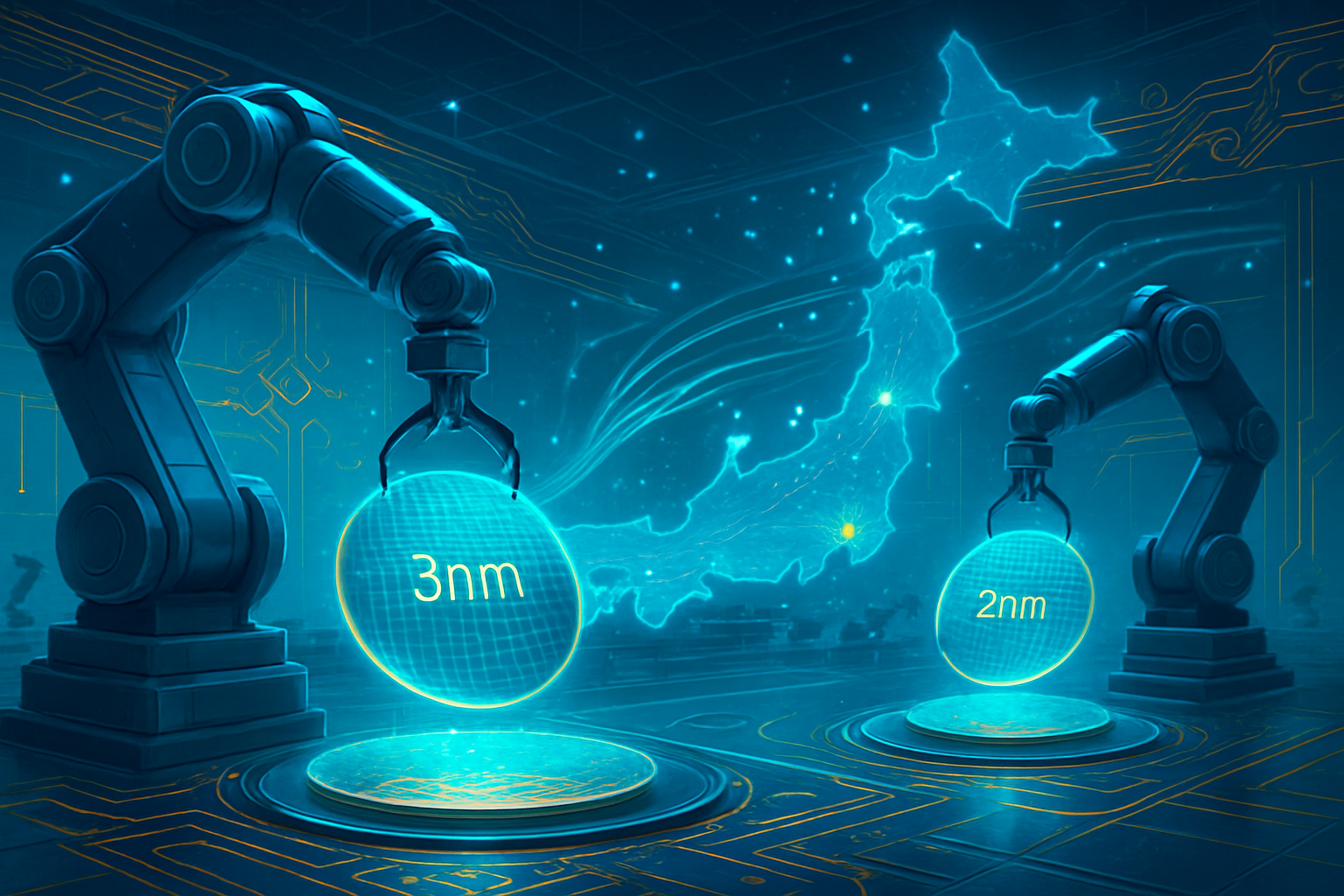
  • Japan’s Silicon Renaissance: TSMC’s 3nm Commitment and Rapidus’s 2nm Surge Redefine Global Chip Landscape

    Japan’s Silicon Renaissance: TSMC’s 3nm Commitment and Rapidus’s 2nm Surge Redefine Global Chip Landscape

    In a historic turning point for the global electronics industry, Japan has officially reclaimed its status as a top-tier semiconductor superpower. As of February 5, 2026, a series of strategic maneuvers by the Japanese government, anchored by massive subsidies and international partnerships, has successfully lured the world's most advanced manufacturing processes back to the archipelago. The crowning achievement of this "Silicon Renaissance" was confirmed today in Tokyo, as leadership from the Taiwan Semiconductor Manufacturing Company (TSMC) (NYSE: TSM) and the Japanese administration announced a radical upgrade to their joint venture in Kumamoto, securing the production of 3nm logic chips on Japanese soil.

    This development is more than just an industrial expansion; it is a foundational pillar of Japan’s revised economic security strategy. By securing 3nm production at TSMC’s second Kumamoto facility and providing unprecedented state support for the domestic champion Rapidus, Japan is effectively insulating itself from the geopolitical instabilities of the Taiwan Strait while positioning its economy at the heart of the generative AI revolution. The move signals a definitive end to Japan's "lost decades" in semiconductor leadership, transitioning the nation from a supplier of legacy automotive chips to a global hub for the high-performance silicon required for next-generation AI and supercomputing.

    Technical Milestones: From 12nm to 2nm Logic

    The technical specifications of Japan’s new semiconductor roadmap represent a quantum leap in domestic capabilities. The centerpiece of this transformation is the Japan Advanced Semiconductor Manufacturing (JASM) Fab 2 in Kumamoto. Initially conceived to produce 6nm and 12nm nodes, today’s announcement confirms that TSMC (NYSE: TSM) will instead deploy its ultra-advanced 3nm process technology at the site. This process utilizes FinFET (Fin Field-Effect Transistor) architecture refined to its absolute limit, offering significant improvements in power efficiency and transistor density over the 12nm to 28nm chips currently being produced at the adjacent Fab 1.

    Simultaneously, the state-backed venture Rapidus is making rapid strides in Hokkaido with its "short Turnaround Time" (TAT) manufacturing model. Having successfully operationalized its 2nm pilot line in April 2025, Rapidus is currently utilizing the world’s most advanced High-NA EUV (Extreme Ultraviolet) lithography machines to refine its 2nm Gate-All-Around (GAA) transistor prototypes. This architecture differs fundamentally from previous FinFET designs by surrounding the channel on all four sides, significantly reducing current leakage and enabling the performance levels required for the next decade of AI acceleration.

    The initial reactions from the global research community have been overwhelmingly positive, albeit marked by surprise at the speed of Japan's ascent. Analysts at major tech firms had previously doubted Rapidus’s ability to leapfrog multiple generations of technology, yet the delivery of the 2nm Process Design Kit (PDK) to early-access customers this month suggests the company is on track for its 2027 mass production goal. The shift in Kumamoto from 6nm to 3nm is being hailed by industry experts as a "strategic masterstroke" that provides Japan with immediate sovereign access to the chips powering the latest smartphones and data center GPUs.

    Market Implications: Securing the AI Supply Chain

    The implications for the global tech market are profound, creating a new competitive landscape for both established giants and emerging startups. Major Japanese corporations like Sony Group Corporation (NYSE: SONY) and Toyota Motor Corporation (NYSE: TM), both of which are investors in the Kumamoto project, stand to benefit immensely. For Sony, localized 3nm production ensures a stable supply of advanced logic for its world-leading image sensors and PlayStation ecosystem. For Toyota and its Tier-1 supplier Denso (TSE: 6902), the proximity of leading-edge logic is critical as vehicles transition into "computers on wheels" powered by autonomous driving AI.

    This development also creates a significant strategic advantage for international players looking to diversify their supply chains. International Business Machines Corporation (NYSE: IBM), which has been a primary technology partner for Rapidus, now has a reliable path to bring its 2nm designs to market outside of the traditional foundry hubs. Meanwhile, AI powerhouses like NVIDIA (NASDAQ: NVDA) and SoftBank Group Corp. (TSE: 9984) are reportedly eyeing Japan as a high-security alternative for chip fabrication, potentially disrupting the existing duopoly of Taiwan and South Korea.

    The disruption to the status quo is palpable. By offering massive subsidies—reaching nearly ¥10 trillion ($65 billion) through 2030—Japan is successfully competing with the U.S. CHIPS Act and European initiatives. This aggressive market positioning has forced a re-evaluation of global semiconductor logistics. Companies that once viewed Japan as a source for legacy parts are now re-tooling their long-term strategies to include Japanese "Giga-fabs" as primary nodes for their most sophisticated product lines.

    Global Context: Economic Security and Industrial Policy

    Looking at the wider significance, Japan’s strategy represents the most successful execution of industrial policy in the 21st century. It marks a shift from the era of globalized, cost-optimized supply chains to a "friend-shoring" model where economic security and regional stability dictate manufacturing locations. This fits into a broader trend of "techno-nationalism," where the ability to produce advanced silicon is viewed as essential to national sovereignty as energy or food security.

    The resurgence of the "Silicon Island" in Kyushu (where Kumamoto is located) and the emergence of a "Silicon Forest" in Hokkaido are revitalizing regional economies that had been stagnant for years. However, this rapid expansion is not without its concerns. The sheer scale of the Kumamoto and Hokkaido projects has put immense pressure on local infrastructure, leading to a shortage of specialized engineers and driving up land prices. Environmental critics have also raised questions about the massive water and energy requirements of 2nm and 3nm fabs, prompting the government to invest heavily in green energy solutions to power these facilities.

    Comparisons to previous milestones, such as Japan's dominance in the memory chip market in the 1980s, are inevitable. Unlike that era, however, the current revival is characterized by deep international integration rather than isolationist competition. The partnership with TSMC and the R&D collaboration with IBM demonstrate a collaborative approach to overcoming the physical limits of Moore’s Law, ensuring that Japan’s return to the top is sustainable and integrated into the global AI ecosystem.

    Future Outlook: The Road to 1.4nm

    As we look toward the future, the roadmap is clear. The next 18 to 24 months will be a period of intensive equipment installation and yield optimization. TSMC's Fab 2 in Kumamoto is expected to begin its equipment move-in phase later this year, with a target for mass production by late 2027. For Rapidus, the focus will be on the transition from its pilot line to the IIM-1 mass production facility in Chitose, with a parallel track for "Advanced Packaging" scheduled to begin trial production in April 2026.

    Potential applications on the horizon include "on-device AI" that operates with zero latency, advanced robotics for Japan’s aging workforce, and breakthroughs in quantum computing materials. Experts predict that if Rapidus successfully hits its 2027 targets, Japan could capture up to 20% of the global market for leading-edge logic by the early 2030s. The next major challenge will be the move toward the 1.4nm node, for which R&D is already underway in collaboration with European research hub Imec.

    A New Era for Japanese Silicon

    In summary, Japan has successfully orchestrated a stunning comeback in the semiconductor sector. By securing 3nm production with TSMC and aggressively pursuing 2nm independence via Rapidus, the nation has solved two problems at once: it has modernized its industrial base and secured its technological future. The strategy of using state capital to de-risk massive private investment has proven to be a blueprint for other nations to follow.

    This development will likely be remembered as a pivotal moment in AI history—the point when the "hardware bottleneck" was addressed through geographic diversification. In the coming months, the industry will be watching for the first 2nm test chips from Hokkaido and the groundbreaking ceremonies for the next phase of the Kumamoto expansion. Japan is no longer just a participant in the global chip race; it is once again setting the pace.


    This content is intended for informational purposes only and represents analysis of current AI developments.

    TokenRing AI delivers enterprise-grade solutions for multi-agent AI workflow orchestration, AI-powered development tools, and seamless remote collaboration platforms.
    For more information, visit https://www.tokenring.ai/.

  • The Rising Sun of Silicon: Japan’s $6 Billion Gambit to Reclaim the Semiconductor Throne

    The Rising Sun of Silicon: Japan’s $6 Billion Gambit to Reclaim the Semiconductor Throne

    In a decisive move to restore its status as a global technological powerhouse, the Japanese government has finalized a massive $6 billion (approximately 920 billion yen) investment into its home-grown semiconductor and AI ecosystem. This capital injection, spearheaded by the Ministry of Economy, Trade and Industry (METI), serves as the primary engine for Rapidus, a bold national venture aiming to leapfrog current manufacturing constraints and establish a domestic 2-nanometer (2nm) logic chip production line by 2027.

    The announcement marks a critical turning point for Japan, which once dominated the global chip market in the 1980s before losing ground to rivals in Taiwan and South Korea. By funding the development of cutting-edge AI hardware and advanced lithography, Japan is not merely seeking to participate in the current tech boom; it is positioning itself as a vital, independent pillar in the global supply chain, ensuring that the next generation of artificial intelligence is powered by Japanese-made silicon.

    Technical Leap: The 2nm GAA Frontier

    At the heart of this initiative is the Rapidus manufacturing facility in Chitose, Hokkaido, known as IIM-1. Unlike traditional foundries that have evolved incrementally, Rapidus is attempting a "generational leap" by moving directly into 2nm production using Gate-All-Around (GAA) transistor architecture. This technology is a significant departure from the FinFET (Fin Field-Effect Transistor) designs used in current 3nm and 5nm chips. GAA provides superior electrostatic control, significantly reducing power consumption while increasing processing speeds—a critical requirement for the massive computational demands of generative AI and autonomous systems.

    Technical execution is being bolstered by a "Triangle of Innovation" involving International Business Machines (NYSE: IBM), the European research hub imec, and Japan’s own Leading-edge Semiconductor Technology Center (LSTC). As of early 2026, Japanese engineers have completed intensive training at IBM’s Albany NanoTech Complex, and the IIM-1 facility has successfully demonstrated the operation of its first 2nm GAA prototype transistors. This collaboration allows Japan to bypass years of trial-and-error by licensing IBM’s foundational 2nm logic technology while utilizing imec’s expertise in Extreme Ultraviolet (EUV) lithography to achieve the precision required for such dense circuitry.

    Industry experts have reacted with a mixture of awe and skepticism, noting that while the technical roadmap is sound, the timeline is incredibly aggressive. Rapidus is essentially attempting to compress a decade of semiconductor evolution into less than five years. However, the integration of the LSTC as an R&D umbrella ensures that the project isn't just about manufacturing; it is also about designing the "Beyond 2nm" future, including advanced chiplet packaging and low-latency edge AI accelerators that could redefine how AI is deployed at the hardware level.

    Industry Impact: A New Power Dynamic

    The ripple effects of this $6 billion investment are being felt across the Tokyo Stock Exchange and Wall Street alike. SoftBank Group Corp. (TOKYO: 9984) has emerged as a primary beneficiary and advocate, viewing the domestic 2nm capability as essential for its vision of an AI-centric future. Similarly, Sony Group Corp. (NYSE: SONY) and Toyota Motor Corp. (NYSE: TM) are deeply integrated into the Rapidus consortium. For Sony, local 2nm production offers a pathway to more sophisticated AI-driven image sensors, while Toyota and its partner Denso Corp. (TOKYO: 6902) view the venture as a safeguard for the future of "Software Defined Vehicles" (SDVs) and autonomous driving.

    From a competitive standpoint, the emergence of Rapidus introduces a new dynamic for Taiwan Semiconductor Manufacturing Company (NYSE: TSM) and Intel Corp. (NASDAQ: INTC). While TSMC remains the undisputed leader in volume, Japan’s focus on a "high-mix, low-volume" specialized foundry model offers a strategic alternative for companies seeking to diversify their supply chains away from geopolitical flashpoints. This "Sovereign AI" strategy allows Japanese firms to develop proprietary AI chips without relying on foreign foundries, potentially disrupting the current market dominance held by major international players.

    Furthermore, the investment has catalyzed a private-sector surge. A consortium led by Mitsubishi UFJ Financial Group (NYSE: MUFG) has moved to provide trillions of yen in additional debt guarantees and loans, signaling that the financial industry views the semiconductor revival as a viable long-term bet. This public-private synergy provides Japan with a strategic advantage that few other nations can match: a unified industrial policy where the government, the banks, and the tech giants are all pulling in the same direction.

    Wider Significance: Geopolitical Resilience and AI Sovereignty

    Beyond the technical specifications, Japan’s $6 billion investment is a masterstroke of geopolitical positioning. In an era defined by the "chip wars" between the U.S. and China, Japan is carving out a role as a stable, high-tech sanctuary. By building the "Hokkaido Silicon Valley," the Japanese government is creating a self-sustaining ecosystem that attracts global suppliers of materials and equipment, such as Tokyo Electron and Shin-Etsu Chemical. This reduces the risk of supply chain shocks and ensures that Japan remains indispensable to the global economy.

    The broader AI landscape is currently grappling with a "compute crunch," where the demand for high-performance chips far outstrips supply. Japan’s entry into the 2nm space is a direct response to this trend. If successful, it will provide a much-needed release valve for the industry, offering a new source of the ultra-efficient chips required for the next wave of large language models (LLMs) and robotic process automation. It represents a shift from "AI software" dominance to "AI hardware" sovereignty, a move that mirrors previous milestones like the development of the first integrated circuits.

    However, the path is not without concerns. Critics point to the immense cost of maintaining EUV lithography machines and the potential for a talent shortage. To combat this, the LSTC has launched "Silicon Talent" initiatives across 15 universities, attempting to train a new generation of semiconductor engineers. The success of this human capital investment will be just as critical as the financial one, as the complexity of 2nm manufacturing requires a level of precision that leaves zero room for error.

    Future Developments: The Road to 1.4nm

    Looking ahead, the next 18 months will be the most critical in Japan’s technological history. The immediate goal is the launch of an advanced packaging pilot line at the Rapidus Chiplet Solutions center in April 2026. This facility will focus on "chiplets"—a method of stacking different types of processors together—which is widely considered the future of AI hardware design. By late 2026, the industry expects to see the first full-wafer runs from the Chitose plant, serving as a "litmus test" for the 2027 mass production deadline.

    In the long term, Japan is already looking past the 2nm horizon. Plans are reportedly in development for a second Hokkaido facility dedicated to 1.4nm production, with construction potentially beginning as early as 2027. Experts predict that if Japan can hit its 2nm targets, it will trigger a massive influx of global AI startups moving their hardware development to Japanese soil, drawn by the combination of cutting-edge manufacturing and a stable political environment.

    Closing Thoughts: A Historic Rebound

    Japan’s $6 billion investment is more than just a financial commitment; it is a declaration of intent. By backing Rapidus and the LSTC, the nation is betting that it can reclaim its role as the world’s premier high-tech workshop. The strategy is clear: secure the technology through global partnerships, fund the infrastructure with state capital, and drive the demand through a consortium of national champions like Toyota and Sony.

    The significance of this development in AI history cannot be overstated. We are witnessing the birth of a decentralized semiconductor map, where the ability to produce the world’s most advanced chips is no longer concentrated in just one or two regions. As we move toward the 2027 production goal, the world will be watching Hokkaido. The success of Rapidus would not only be a victory for Japan but a stabilizing force for the global AI industry, ensuring that the hardware of the future is as diverse and resilient as the software it supports.


    This content is intended for informational purposes only and represents analysis of current AI developments.

    TokenRing AI delivers enterprise-grade solutions for multi-agent AI workflow orchestration, AI-powered development tools, and seamless remote collaboration platforms.
    For more information, visit https://www.tokenring.ai/.