
Tag: Emerging Technologies

  • AI, Cyber, and Autonomous Systems: The Future Battleground Anticipated at the Northeast Indiana Defense Summit

    AI, Cyber, and Autonomous Systems: The Future Battleground Anticipated at the Northeast Indiana Defense Summit

    As the global geopolitical landscape continues to evolve with unprecedented speed, the role of cutting-edge technology in national security and defense has never been more critical. The upcoming 4th Annual Northeast Indiana Defense Summit, slated for November 11-12, 2025, is poised to be a pivotal forum where leaders, policymakers, and industry experts will delve into the transformative impact of emerging technologies, including Artificial Intelligence (AI), advanced cybersecurity, and sophisticated surveillance systems. This gathering is expected to underscore Indiana's growing significance in bolstering America's defense industrial base and shaping the future of warfare, particularly in the face of intense technological competition.

    The summit's agenda, building on themes from previous years, is expected to emphasize the strategic imperative for the United States to maintain its technological edge. Discussions will likely revolve around leveraging these innovations to enhance military readiness, streamline operations, and develop next-generation capabilities essential for national security. The focus will not merely be on incremental improvements but on foundational shifts driven by AI and its related domains, promising a new era of defense where data-driven insights and autonomous actions play a central role.

    The Technological Vanguard: AI, Cyber, and Advanced Surveillance Redefine Defense

    The advancements in AI, cybersecurity, and advanced surveillance represent a paradigm shift from traditional defense methodologies, offering capabilities that were once the realm of science fiction. These technologies empower defense agencies to operate with unparalleled speed, precision, and efficiency across multiple domains.

    Artificial Intelligence (AI) in Action: AI is rapidly reshaping intelligence gathering, autonomous operations, and strategic decision-making. In intelligence, AI algorithms now process exabytes of data—from satellite imagery and global communications to social media—at speeds unattainable by human analysts. This enables rapid pattern recognition, anomaly detection, and target identification, significantly enhancing situational awareness. Project Maven, for example, aims to integrate AI tools into intelligence systems for object recognition and tracking. Autonomous systems, from unmanned aerial vehicles (UAVs) and robotic ground vehicles to " loyal wingmen" and drone swarms, are performing reconnaissance, logistics, and even combat operations with reduced human intervention, especially in high-risk environments. Lethal Autonomous Weapon Systems (LAWS), while ethically debated, are already deployed in defensive capacities like the Iron Dome, and their offensive capabilities are rapidly advancing. For decision-making, AI augments human commanders by providing real-time, data-driven insights, optimizing mission planning, and predicting equipment failures, thereby accelerating the military decision-making process. Unlike previous static, rule-based systems, AI's ability to learn, adapt, and operate at scale marks a fundamental departure, enabling proactive defense against evolving threats.

    Cybersecurity's Evolving Shield: Modern cybersecurity has transcended simple perimeter defenses, embracing dynamic and predictive strategies. AI and Machine Learning (ML) are now foundational, powering platforms that analyze billions of data points in real-time to detect subtle threat patterns and anomalous behaviors, often identifying stealthy attacks missed by human analysts. Systems like Microsoft's (NASDAQ: MSFT) Security Copilot leverage Large Language Models (LLMs) to summarize incidents and generate response scripts, drastically reducing investigation times. The "Zero Trust Architecture" (ZTA) paradigm assumes no entity, inside or outside the network, is inherently trustworthy, requiring continuous verification and least privilege access. This contrasts sharply with older, perimeter-focused models and is vital for securing dispersed, cloud-based operations. Furthermore, Cyber Threat Intelligence (CTI) is moving beyond reactive analysis to provide early warnings and proactive defense by understanding adversary tactics, techniques, and procedures (TTPs). Looking ahead, Quantum Cryptography (QC) and Post-Quantum Cryptography (PQC) are emerging to "future-proof" sensitive communications against the existential threat posed by future quantum computers, a significant leap from current encryption methods vulnerable to quantum attacks.

    Advanced Surveillance Systems: Surveillance has evolved from static cameras and human observers to complex digital networks leveraging AI and advanced sensors. AI-powered systems provide real-time monitoring and anomaly detection across vast data streams from CCTV, drones, and satellites. Facial recognition and other biometric technologies (like gait recognition) rapidly identify individuals in diverse environments, crucial for border control and counter-terrorism. Autonomous drones and unmanned systems offer high-precision reconnaissance and intelligence gathering, even collaborating in swarms to cover large areas. This represents a massive leap from traditional, human-intensive surveillance, offering automated analysis and predictive capabilities that significantly increase coverage and efficiency while reducing human resource needs.

    Reshaping the Defense Industrial Complex

    These technological advancements carry profound implications for the defense industrial complex, influencing established giants, tech behemoths, and agile startups alike.

    Traditional defense contractors such as Lockheed Martin (NYSE: LMT), Raytheon Technologies (NYSE: RTX), and Northrop Grumman (NYSE: NOC) stand to benefit immensely, provided they effectively integrate these emerging technologies into their existing platforms and develop new solutions. Their long-standing relationships with defense agencies and expertise in complex systems position them well to become prime integrators of AI, cyber, and surveillance capabilities. The competitive landscape, however, is being reshaped by tech giants like Microsoft (NASDAQ: MSFT), IBM (NYSE: IBM), and Google (NASDAQ: GOOGL) (through its various government and defense initiatives), which bring deep expertise in AI, cloud computing, and cybersecurity. These companies are increasingly vying for lucrative defense contracts, offering advanced software and data analytics solutions that complement traditional hardware.

    This shift also creates significant opportunities for specialized AI and cybersecurity startups. These agile firms, often with groundbreaking intellectual property, can disrupt existing product lines by offering innovative solutions that are faster, more efficient, and more adaptable. Partnerships and acquisitions between large defense contractors and these smaller, innovative companies are becoming increasingly common, as larger entities seek to rapidly acquire cutting-edge capabilities. The market positioning will increasingly favor companies that can demonstrate robust, secure, and ethically sound AI and cyber solutions, leading to a race for talent and intellectual property in these critical areas.

    Broader Implications and Ethical Crossroads

    The integration of AI, advanced cybersecurity, and sophisticated surveillance systems into national defense extends far beyond technological upgrades; it signals a fundamental reorientation of military doctrine, geopolitical power dynamics, and societal norms.

    These developments fit into a broader AI landscape characterized by intense global competition, particularly between the U.S. and adversaries like China, to achieve AI supremacy. The ability to leverage these technologies effectively will determine future military advantage and influence global stability. The impacts are vast: from more precise and efficient military operations to potentially reducing human casualties in combat scenarios through autonomous systems. However, this also ushers in significant concerns. The ethical implications of Lethal Autonomous Weapon Systems (LAWS) are paramount, raising questions about accountability, the dehumanization of warfare, and the potential for unintended escalation. Advanced surveillance systems, while enhancing security, pose considerable risks to privacy and civil liberties through mass data collection, facial recognition, and potential for misuse or discriminatory practices. Cybersecurity ethics also come into play, balancing the need for robust defense with the protection of individual privacy and the complexities of offensive cyber operations. These developments demand robust policy frameworks, transparent governance, and international dialogue to ensure responsible and ethical deployment, aligning with democratic values and human rights.

    The Horizon: Anticipating Future Developments

    The trajectory of AI, cybersecurity, and advanced surveillance in national security points towards even more sophisticated and integrated systems in the near and long term.

    In the near term, we can expect deeper integration of AI across all military functions, leading to more autonomous decision support systems and highly resilient, self-healing cyber defenses. The maturation and widespread deployment of Zero Trust Architectures will continue, becoming the standard for securing critical infrastructure. Post-Quantum Cryptography will move from standardization to widespread implementation, securing data against future quantum threats. Long-term developments could include fully autonomous and adaptive swarms of air, land, and sea systems capable of complex collaborative missions; advanced human-machine teaming where AI acts as an intelligent co-pilot in every aspect of defense; and potentially even quantum internet for ultra-secure military communications.

    However, significant challenges remain. Ethical governance of AI, especially concerning LAWS and surveillance, will require continuous debate and international consensus. Addressing the talent gap in AI and cybersecurity expertise within defense agencies is crucial. Ensuring the security and integrity of complex supply chains, which are increasingly targeted by adversaries, will be paramount. Experts predict a continued acceleration of these technologies, emphasizing the need for continuous innovation, robust testing, and a focus on resilience to adapt to an ever-evolving threat landscape.

    A New Era of Defense: The Unfolding Story

    The discussions anticipated at the Northeast Indiana Defense Summit on November 11-12, 2025, underscore a pivotal moment in national security. The convergence of AI, advanced cybersecurity, and sophisticated surveillance systems is not merely enhancing existing capabilities; it is fundamentally redefining the nature of defense, intelligence, and warfare itself.

    The key takeaway is clear: technological supremacy in these domains is no longer an advantage but a necessity for national security. This development marks a new era, shifting the emphasis from hardware dominance to superiority in data, intelligence, and adaptive autonomous systems. The race for technological leadership is intense, demanding continuous adaptation, strategic investment, and a proactive approach to both innovation and ethical governance. What to watch for in the coming weeks and months includes further policy debates on AI ethics, new strategic partnerships between defense and tech sectors, breakthroughs in quantum computing and AI, and the practical implementation of these advanced systems in military exercises and deployments. The future of national security will be written by those who master these emerging technologies responsibly and effectively.


    This content is intended for informational purposes only and represents analysis of current AI developments.

    TokenRing AI delivers enterprise-grade solutions for multi-agent AI workflow orchestration, AI-powered development tools, and seamless remote collaboration platforms.
    For more information, visit https://www.tokenring.ai/.
  • AI’s Ubiquitous Rise: Transforming Industries Far Beyond Tech

    AI’s Ubiquitous Rise: Transforming Industries Far Beyond Tech

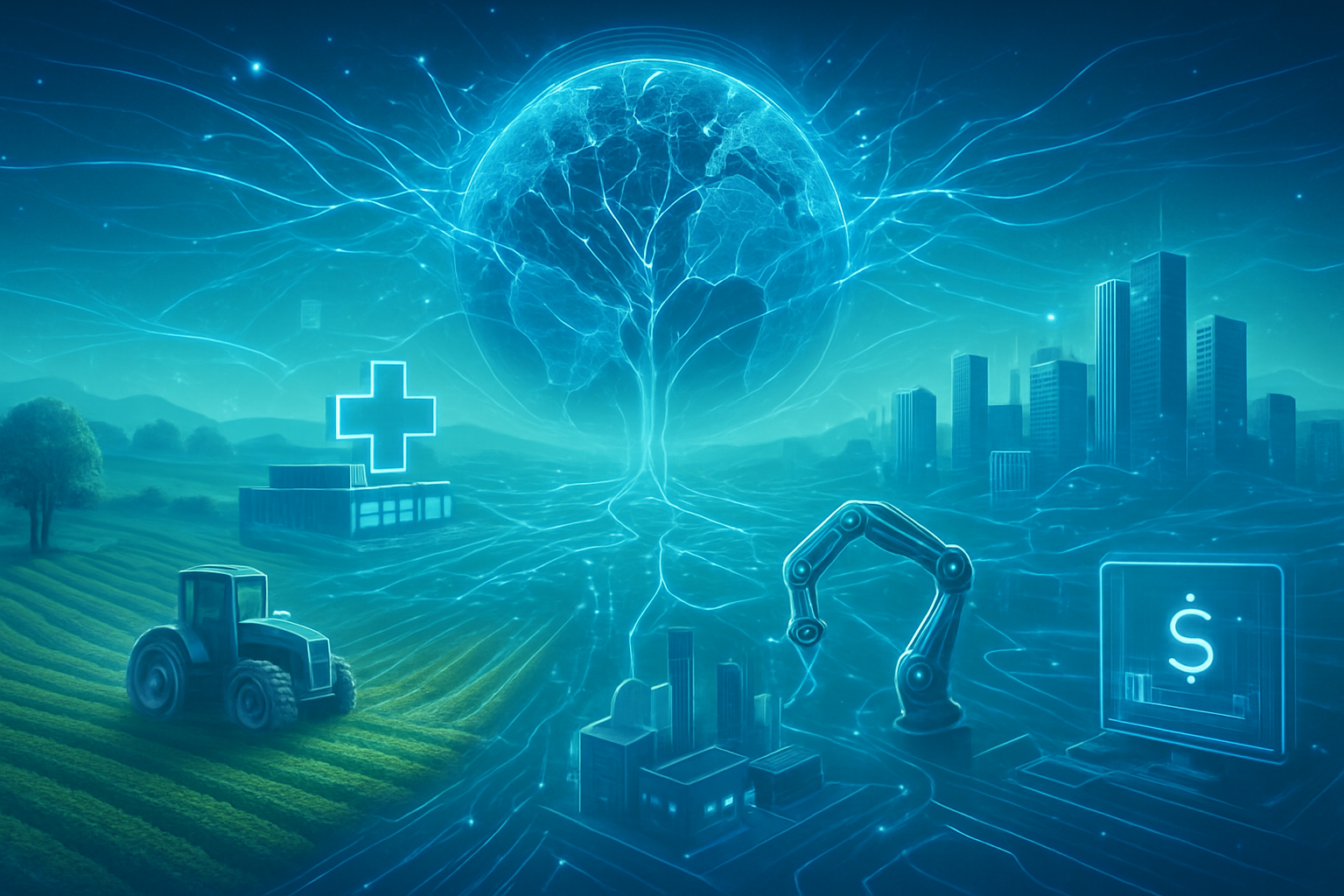
    Artificial intelligence (AI) is rapidly transcending its origins within the technology sector, becoming an indispensable force that is fundamentally reshaping traditional industries. From the intricacies of healthcare to the precision of manufacturing, the sustainability of agriculture, the dynamism of finance, and the complexity of logistics, AI is driving unprecedented levels of efficiency, innovation, and strategic advantage. This widespread integration signifies a pivotal moment in the evolution of AI, marking its transition from a specialized tool to a foundational technology that promises to redefine global economies and societies. The immediate significance lies in AI's capacity for advanced data analysis, predictive modeling, automation, and real-time decision-making, offering transformative benefits that were once unimaginable.

    The Technical Core: How AI is Redefining Industry Capabilities

    The current wave of AI applications in non-tech sectors is underpinned by sophisticated advancements in deep learning, machine learning, computer vision, natural language processing, and reinforcement learning. These technical capabilities allow AI systems to process vast, complex datasets, identify intricate patterns, and make highly accurate predictions or autonomous decisions, far surpassing previous rule-based or manual approaches.

    In healthcare, AI leverages deep learning networks (e.g., ResNet101) to achieve remarkable accuracy in medical image analysis, detecting diseases like cancer and Alzheimer's years in advance. Generative AI and Large Language Models (LLMs), built on transformer architectures, are streamlining clinical note-taking and aiding in drug discovery by simulating molecular interactions. This differs from older systems that relied on simpler algorithms and extensive human feature engineering, as modern AI directly processes unstructured data, extracting complex features automatically at exceptional speeds.

    Manufacturing is deploying AI-powered machine vision systems, combining high-resolution cameras and sensors with deep learning algorithms for anomaly detection. These systems provide predictive maintenance, anticipating equipment failures with unprecedented accuracy, and automating quality control with precision that far exceeds human capabilities. Collaborative robots (cobots) are becoming more sophisticated, guided by vision-language-action models. Historically, manufacturing relied on reactive maintenance and manual inspections; AI introduces proactive, predictive, and adaptable systems that learn from data, minimizing downtime and human error.

    For agriculture, AI-driven drones equipped with multispectral and hyperspectral sensors, alongside machine learning algorithms, collect real-time data on soil moisture, nutrient levels, and plant health with centimeter-level accuracy. This enables precision spraying, targeted irrigation, and early disease detection, optimizing resource use by 20-40% and increasing productivity by up to 20%. Traditional farming involved extensive manual labor and broad application of resources, whereas AI provides granular, real-time analytics and automated decision-making, leading to optimized resource management and sustainability.

    In finance, sophisticated machine learning (e.g., logistic regression, autoencoders) and deep learning models (e.g., CNNs, RNNs) are used for real-time fraud detection and algorithmic trading. Natural Language Processing (NLP) models analyze news sentiment and regulatory filings, while reinforcement learning agents adapt trading strategies. This moves beyond static, rule-based fraud detection and human analysis by offering adaptive models that process massive, diverse datasets, including unstructured data, enabling faster and more accurate decision-making in dynamic markets.

    Finally, logistics benefits from machine learning algorithms and AI optimization techniques that analyze real-time data from GPS, traffic cameras, and weather feeds. This facilitates dynamic route optimization, continuously adjusting delivery paths to reduce fuel consumption and delivery times. Warehouse automation uses AI-powered robots for picking, packing, and sorting. This is a significant leap from traditional static route planning and reactive problem-solving, providing highly adaptive, predictive, and autonomous capabilities that enhance efficiency and cost-effectiveness.

    Initial reactions from the AI research community and industry experts are largely optimistic, acknowledging AI's "transformative force" in enhancing efficiency and unlocking new opportunities. However, caution is also emphasized regarding ethical AI development, bias, transparency, data quality, high implementation costs, and the need for new skill sets. The urgent need for responsible AI governance and explainable AI (XAI) is a recurring theme to build trust and ensure compliance.

    Reshaping the Corporate Landscape: Who Benefits and Who Faces Disruption

    The pervasive integration of AI into non-tech sectors is profoundly impacting the competitive dynamics among AI companies, tech giants, and startups, creating both immense opportunities and significant disruptions.

    In healthcare, specialized AI firms like Aidoc and GNS are thriving by offering intelligent diagnostics and drug discovery platforms. Tech giants such as Microsoft (NASDAQ: MSFT), Google (NASDAQ: GOOGL), IBM (NYSE: IBM), NVIDIA (NASDAQ: NVDA), Philips (NYSE: PHG), and Siemens Healthineers (ETR: SHL) are leveraging their cloud infrastructure and broad AI capabilities to partner with healthcare providers, driving advancements in medical imaging and personalized medicine. Startups like Abridge and Viz.ai are disrupting with niche solutions, automating clinical notes or enhancing CT scan analysis, often becoming attractive acquisition targets. This market, projected to grow at a CAGR of 38.5% (2024-2030), emphasizes strategic partnerships and the need for explainable AI to overcome high initial costs and data privacy concerns.

    Manufacturing sees AI companies specializing in industrial automation and computer vision, such as those offering automated optical inspection (AOI) with up to 97% accuracy, experiencing high demand. Tech giants like IBM are providing "smart factory" solutions, integrating AI with IoT for real-time process optimization. Startups such as Vicarious and SparkCognition are innovating in predictive maintenance and production optimization. While high upfront investment is a barrier, AI offers manufacturers a significant competitive edge through improved operational efficiency and reduced waste, leading to a dynamic landscape where agile startups can disrupt and larger players consolidate.

    For agriculture, AI solution providers focusing on crop management software and predictive analytics are key beneficiaries. Microsoft's FarmVibes.AI tool offers advanced mapping and "what-if" analyses for growers. Startups like Blue River Technology (acquired by John Deere (NYSE: DE)) have pioneered AI for targeted weed and pest identification, reducing chemical use. The global AI in agriculture market is expected to reach USD 12.95 billion by 2033, driven by the need for precision farming and sustainability. AI is transforming farmers' roles, shifting them from manual laborers to overseers of smart agricultural systems.

    In finance, companies specializing in AI for fraud detection, credit risk management, and personalized advice are thriving. Tech giants like Google Cloud provide foundational AI technologies and cloud infrastructure for data analytics and customer servicing. Disruptive startups such as Betterment and Wealthfront offer AI-driven robo-advisors, while Darktrace and ZestFinance enhance fraud prevention and credit scoring. AI is shifting the market towards insights-driven lending, but also introduces risks like biased models and data breaches, necessitating regulatory adjustments and strong consumer protection.

    Finally, logistics sees growth for AI companies in route optimization, warehouse automation, and predictive supply chain analytics. Amazon (NASDAQ: AMZN), FedEx (NYSE: FDX), and UPS (NYSE: UPS) are integrating AI into their operations, influencing third-party logistics (3PLs). IBM, Intel (NASDAQ: INTC), Microsoft, and Oracle (NYSE: ORCL) are key players providing scalable infrastructure. Startups like OptimoRoute and Nuro are innovating in efficient delivery routes and autonomous last-mile delivery. With the AI in logistics market projected to reach USD 549 billion by 2033, AI offers a significant competitive edge through streamlined operations, reducing costs, and improving service, while autonomous technologies disrupt traditional manual labor.

    Overall, AI companies are the core innovators, benefiting from deep expertise but often needing partnerships to scale. Tech giants leverage their vast resources and cloud infrastructure to offer comprehensive platforms, positioning themselves as full-stack providers. Startups are crucial for disruption, addressing niche problems with agility and often becoming acquisition targets. The competitive landscape is dynamic, marked by collaborations, acquisitions, and a continuous race to deliver more efficient, intelligent, and personalized solutions.

    A Broader Lens: AI's Societal Canvas and Historical Parallels

    The widespread integration of AI into non-tech sectors represents a profound evolution in the broader AI landscape, signaling its maturation into a foundational, general-purpose technology. This current era is characterized by AI acting as an "amplifier" for other innovations, accelerating progress and unlocking new possibilities across diverse domains. The proliferation of "agentic AI," capable of autonomous multi-step workflows, and generative AI, which creates human-like content, are key trends driving this expansion.

    The economic impact is staggering, with AI projected to contribute an additional $15.7 trillion to the global economy by 2030. This growth stems from increased labor productivity, the creation of new products and services, and optimized operational efficiencies across industries. However, concerns persist regarding AI's potential to widen economic disparities and concentrate wealth within "super firms."

    Societally, AI is reshaping the job market. While it automates routine tasks, potentially leading to job displacement in some areas, it simultaneously creates new roles in data science, AI engineering, and design. More importantly, AI augments existing roles, enabling workers to focus on more creative and complex tasks. The "AI + human" model, where human oversight and critical thinking complement AI's analytical power, is proving to be the most valuable approach. AI's ability to solve complex problems, particularly in healthcare and personalized services, holds the potential to improve the overall quality of life.

    However, this transformative power comes with significant ethical and regulatory concerns. Algorithmic bias, embedded from training data, can lead to discriminatory outcomes in critical areas like hiring or medical diagnoses. The "black box" nature of many AI systems raises questions about transparency and accountability, especially in high-stakes domains. Data privacy and security remain paramount, with the reliance on vast datasets necessitating robust safeguards against breaches and unauthorized access. Job displacement, misinformation spread by AI, and intellectual property issues also demand careful consideration. Governments and regulatory bodies, exemplified by the EU AI Act and GDPR, are actively developing frameworks to promote transparency, fairness, human oversight, and accountability.

    Comparing this era to previous AI milestones highlights the monumental shift. Early AI, rooted in the 1950s with Alan Turing and the coining of "artificial intelligence," involved rule-based expert systems. The "AI boom" of the 1980s saw advancements but was limited by explicit programming. The current "Deep Learning era," commencing around the 2010s, represents a significant leap. Boosted by advancements in deep learning algorithms and "big data," AI systems have achieved breakthroughs in tasks previously considered intractable, such as outperforming humans in image recognition (by 2015), defeating world champions in complex games like Go (AlphaGo in 2016), and generating human-quality text and images (GPT-3, DALL-E, ChatGPT since 2020). Unlike earlier iterations, modern AI learns from data patterns without explicit instructions, making it far more versatile and adaptable across diverse non-tech sectors at an unprecedented pace.

    The Horizon: Charting AI's Future Trajectory

    The future of AI applications across non-tech sectors promises continued rapid evolution, driven by increasing sophistication, accessibility, and strategic integration. Experts predict a future where AI will not only augment human capabilities but also enable entirely new paradigms of operation and service delivery.

    In the near term, AI and generative AI (GenAI) will significantly enhance patient care in healthcare by automating administrative tasks, personalizing treatment plans, and accelerating drug discovery. In manufacturing, the focus will be on "smart factories" with AI-powered predictive maintenance, quality control, and supply chain optimization. Agriculture will see further advancements in precision farming, with AI-driven robotics and drones becoming more commonplace. Finance will expand GenAI applications for customer service, risk management, and hyper-personalized financial advice, while logistics will leverage AI for dynamic route optimization, warehouse automation, and real-time supply chain visibility.

    Long-term developments will see healthcare shift towards a "5P" model (Predictive, Proactive, Personalized, Participatory, and Precise), with AI enabling routine genomic sequencing and near-perfect diagnostic accuracy. Manufacturing will achieve mass customization and sustainable production through ubiquitous industrial AI. Agriculture will move towards "Agriculture 4.0," with autonomous livestock farming and AI-driven insights addressing global food security. Finance will embrace AI for comprehensive financial stability risk management and highly adaptive investment strategies. Logistics will feature widespread autonomous transportation networks and AI-powered supply chain resilience against global disruptions.

    However, several challenges need to be addressed. Across all sectors, data quality, security, and privacy remain paramount. Ethical concerns, particularly algorithmic bias and the need for transparency (explainable AI), are critical. The high initial costs of AI implementation and the integration with legacy systems pose significant hurdles, especially for smaller entities. A substantial skills gap in the workforce requires continuous reskilling and upskilling initiatives. Regulatory frameworks are still evolving, particularly for adaptive AI algorithms and generative AI, demanding a careful balance between innovation and consumer protection. Furthermore, resistance to adoption due to fear of job displacement or lack of understanding must be managed through clear communication and demonstrated benefits.

    Experts predict that AI will increasingly augment, rather than replace, human workers, allowing them to focus on more complex and creative tasks. The future will involve "platform thinking" in AI innovation, creating collaborative ecosystems across industries. The convergence of AI with other emerging technologies like 5G, edge computing, and quantum computing will unlock new possibilities. Addressing data fragmentation, ensuring ethical deployment, and fostering digital literacy will be crucial for equitable resource distribution and securing long-term viability across these transformed sectors.

    The AI Epoch: A Concluding Assessment

    The journey of AI into non-tech sectors represents a defining epoch in its history, marking a profound shift from a specialized technological domain to a ubiquitous, general-purpose utility. The key takeaway is AI's unparalleled ability to drive operational efficiency, generate substantial cost reductions, enable superior data-driven decision-making, and facilitate hyper-personalization across industries. From enhancing diagnostic accuracy in healthcare to optimizing supply chains in logistics, AI is not just improving existing processes but fundamentally redefining industry capabilities.

    This development's significance in AI history cannot be overstated. It signifies the maturation and democratization of AI, moving beyond the confines of "tech companies" to become an accessible amplifier for innovation across the global economy. The economic projections, estimating a $15.7 trillion contribution to global GDP by 2030, underscore its pivotal role. More importantly, it solidifies the "AI + human" model as the most valuable approach, where AI augments human intelligence and creativity, rather than solely automating it.

    The long-term impact will be a sustained boost in productivity, economic growth, and the creation of new, AI-augmented job roles. AI holds the potential to address some of humanity's most pressing challenges, from climate change to global health disparities. However, this future hinges on a vigilant focus on ethical AI development, robust regulatory frameworks, and proactive governance to ensure fairness, transparency, and equitable distribution of benefits. The increasing dependence on core AI infrastructure providers also signals a potential centralization of power in the digital economy.

    In the coming weeks and months, watch for intensifying discussions around ethical AI deployment and governance, particularly in sensitive areas like non-clinical healthcare. Evolving regulatory frameworks will be crucial, especially in heavily regulated sectors like finance. Efforts to bridge the "AI divide," ensuring access for small businesses and farmers, will gain prominence. The rapid advancement of "agentic AI" tools, acting as a new workforce, will be a key development to monitor, as will the continuous focus on data quality and standardization as the bedrock for effective AI. Finally, observe how AI continues to integrate with other emerging technologies like IoT, creating synergistic effects that drive further innovation and reshape our world.


    This content is intended for informational purposes only and represents analysis of current AI developments.

    TokenRing AI delivers enterprise-grade solutions for multi-agent AI workflow orchestration, AI-powered development tools, and seamless remote collaboration platforms.
    For more information, visit https://www.tokenring.ai/.