Tag: Fab 52

  • Intel’s $380 Million Gamble: High-NA EUV Deployment at Fab 52 Marks New Era in 1.4nm Race

    Intel’s $380 Million Gamble: High-NA EUV Deployment at Fab 52 Marks New Era in 1.4nm Race

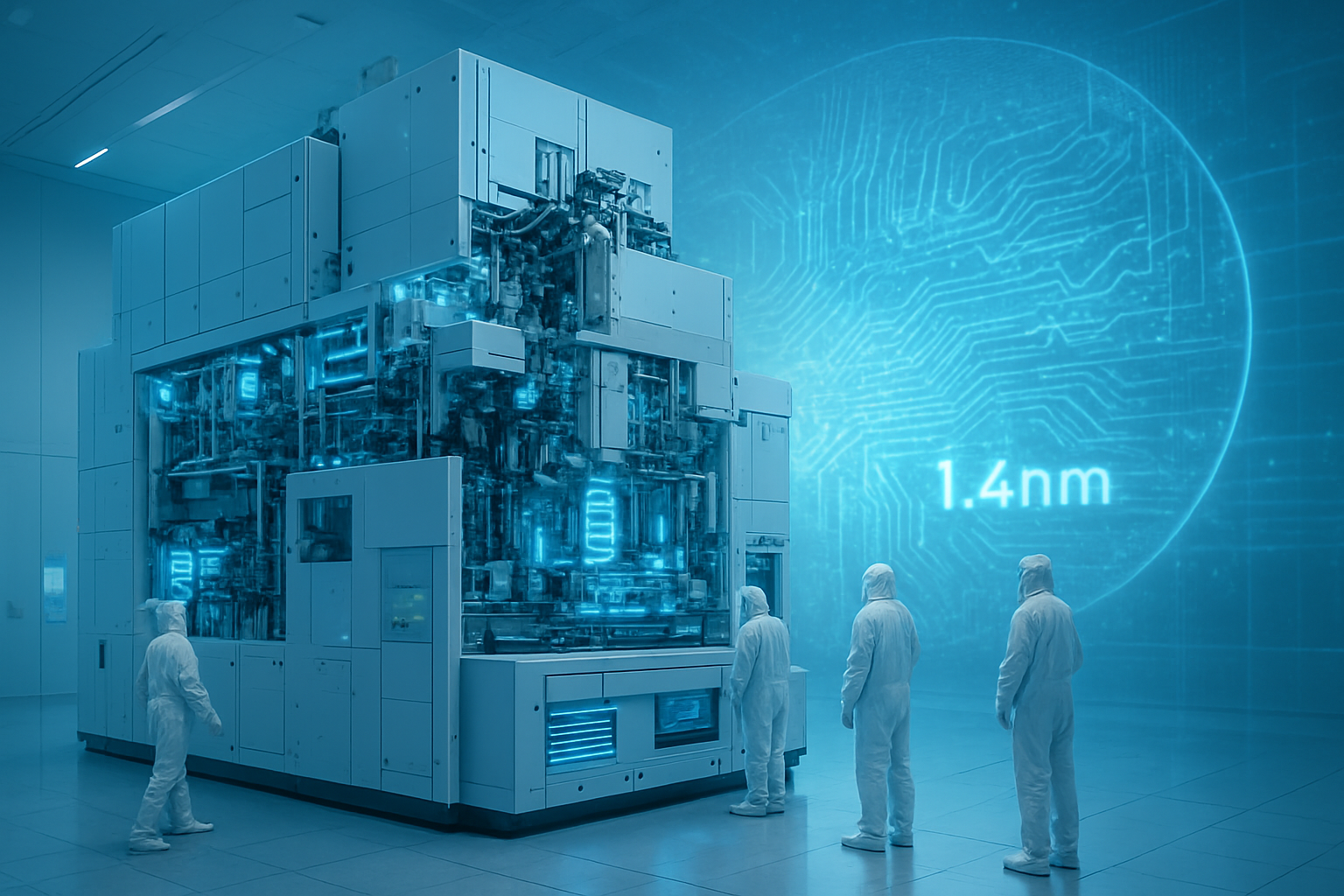
    As of late December 2025, the semiconductor industry has reached a pivotal turning point with Intel Corporation (NASDAQ: INTC) officially operationalizing the world’s first commercial-grade High-Numerical Aperture (High-NA) Extreme Ultraviolet (EUV) lithography systems. At the heart of this technological leap is Intel’s Fab 52 in Chandler, Arizona, where the deployment of ASML (NASDAQ: ASML) Twinscan EXE:5200B machines marks a high-stakes bet on reclaiming the crown of process leadership. This move signals the beginning of the "Angstrom Era," as Intel prepares to transition its 1.4nm (14A) node into risk production, a feat that could redefine the competitive hierarchy of the global chip market.

    The immediate significance of this deployment cannot be overstated. By successfully integrating these $380 million machines into its high-volume manufacturing (HVM) workflow, Intel is attempting to leapfrog its primary rival, Taiwan Semiconductor Manufacturing Company (NYSE: TSM), which has opted for a more conservative roadmap. This strategic divergence comes at a critical time when the demand for ultra-efficient AI accelerators and high-performance computing (HPC) silicon is at an all-time high, making the precision and density offered by High-NA EUV the new "gold standard" for the next generation of artificial intelligence.

    The ASML Twinscan EXE:5200B represents a massive technical evolution over the standard "Low-NA" EUV tools that have powered the industry for the last decade. While standard EUV systems utilize a numerical aperture of 0.33, the High-NA variant increases this to 0.55. This improvement allows for a resolution jump from 13.5nm down to 8nm, enabling the printing of features that are nearly twice as small. For Intel, the primary advantage is the reduction of "multi-patterning." In previous nodes, complex layers required multiple passes through a scanner to achieve the necessary density, a process that is both time-consuming and prone to defects. The EXE:5200B allows for "single-patterning" on critical layers, potentially reducing the number of process steps from 40 down to fewer than 10 for certain segments of the chip.

    Technical specifications for the EXE:5200B are staggering. The machine stands two stories tall and weighs as much as two Airbus A320s. In terms of productivity, the 5200B model has achieved a throughput of 175 to 200 wafers per hour, a significant increase over the 125 wafers per hour managed by the earlier EXE:5000 research modules. This productivity gain is essential for making the $380 million-per-unit investment economically viable in a high-volume environment like Fab 52. Furthermore, the system boasts a 0.7nm overlay accuracy, ensuring that the billions of transistors on a 1.4nm chip are aligned with atomic-level precision.

    The reaction from the research community has been a mix of awe and cautious optimism. Experts note that while the hardware is revolutionary, the ecosystem—including photoresists, masks, and metrology tools—must catch up to the 0.55 NA standard. Intel’s early adoption is seen as a "trial by fire" that will mature the entire supply chain. Industry analysts have praised Intel’s engineering teams at the D1X facility in Oregon for the rapid validation of the 5200B, which allowed the Arizona deployment to happen months ahead of the original 2026 schedule.

    Intel’s "de-risking" strategy is a bold departure from the industry’s typical "wait-and-see" approach. By acting as the lead customer for High-NA EUV, Intel is absorbing the early technical hurdles and high costs associated with the new technology. The strategic advantage here is twofold: first, Intel gains a 2-3 year head start in mastering the High-NA ecosystem; second, it has designed its 14A node to be "design-rule compatible" with standard EUV. This means if the High-NA yields are initially lower than expected, Intel can fall back on traditional multi-patterning without requiring its customers to redesign their chips. This safety net is a key component of CEO Pat Gelsinger’s plan to restore investor confidence.

    For TSMC, the decision to delay High-NA adoption until its A14 or even A10 nodes (likely 2028 or later) is rooted in economic pragmatism. TSMC argues that standard EUV, combined with advanced multi-patterning and "Hyper-NA" techniques, remains more cost-effective for its current customer base, which includes Apple (NASDAQ: AAPL) and Nvidia (NASDAQ: NVDA). However, this creates a window of opportunity for Intel Foundry. If Intel can prove that High-NA leads to superior power-performance-area (PPA) metrics for AI chips, it may lure high-profile "anchor" customers away from TSMC’s more mature, yet technically older, processes.

    The ripple effects will also be felt by AI startups and fabless giants. Companies designing the next generation of Large Language Model (LLM) trainers require maximum transistor density to fit more HBM (High Bandwidth Memory) and compute cores on a single die. Intel’s 14A node, powered by High-NA, promises a 2.9x increase in transistor density over current 3nm processes. This could make Intel the preferred foundry for specialized AI silicon, disrupting the current near-monopoly held by TSMC in the high-end accelerator market.

    The deployment at Fab 52 takes place against a backdrop of intensifying geopolitical competition. Just as Intel reached its High-NA milestone, reports surfaced from Shenzhen, China, regarding a domestic EUV prototype breakthrough. A Chinese research consortium has reportedly validated a working EUV light source using Laser-Induced Discharge Plasma (LDP) technology. While this prototype is currently less efficient than ASML’s systems and years away from high-volume manufacturing, it signals that China is successfully navigating around Western export controls to build a "parallel supply chain."

    This development underscores the fragility of the "Silicon Shield" and the urgency of Intel’s mission. The global AI landscape is increasingly tied to the ability to manufacture at the leading edge. If China can eventually bridge the EUV gap, the technological advantage currently held by the U.S. and its allies could erode. Intel’s aggressive push into High-NA is not just a corporate strategy; it is a critical component of the U.S. government’s goal to secure domestic semiconductor manufacturing through the CHIPS Act.

    Comparatively, this milestone is being likened to the transition from 193nm immersion lithography to EUV in the late 2010s. That transition saw several players, including GlobalFoundries, drop out of the leading-edge race due to the immense costs. The High-NA transition appears to be having a similar effect, narrowing the field of "Angstrom-era" manufacturers to a tiny elite. The stakes are higher than ever, as the winner of this race will essentially dictate the hardware limits of artificial intelligence for the next decade.

    Looking ahead, the next 12 to 24 months will be focused on yield optimization. While the machines are now in place at Fab 52, the challenge lies in reaching "golden" yield levels that make 1.4nm chips commercially profitable. Intel expects its 14A-E (an enhanced version of the 14A node) to begin development shortly after the initial 14A rollout, further refining the use of High-NA for even more complex architectures. Potential applications on the horizon include "monolithic 3D" transistors and advanced backside power delivery, which will be integrated with High-NA patterning.

    Experts predict that the industry will eventually see a "convergence" where TSMC and Samsung (OTC: SSNLF) are forced to adopt High-NA by 2027 to remain competitive. The primary challenge that remains is the "reticle limit"—High-NA machines have a smaller field size, meaning chip designers must use "stitching" to create large AI chips. Mastering this stitching process will be the next major hurdle for Intel’s engineers. If successful, we could see the first 1.4nm AI accelerators hitting the market by late 2027, offering performance leaps that were previously thought to be a decade away.

    Intel’s successful deployment of the ASML Twinscan EXE:5200B at Fab 52 is a landmark achievement in the history of semiconductor manufacturing. It represents a $380 million-per-unit gamble that Intel can out-innovate its rivals by embracing complexity rather than avoiding it. The key takeaways from this development are Intel’s early lead in the 1.4nm race, the stark strategic divide between Intel and TSMC, and the emerging domestic threat from China’s lithography breakthroughs.

    As we move into 2026, the industry will be watching Intel’s yield reports with bated breath. The long-term impact of this deployment could be the restoration of the "Tick-Tock" model of innovation that once made Intel the undisputed leader of the tech world. For now, the "Angstrom Era" has officially arrived in Arizona, and the race to define the future of AI hardware is more intense than ever.


    This content is intended for informational purposes only and represents analysis of current AI developments.

    TokenRing AI delivers enterprise-grade solutions for multi-agent AI workflow orchestration, AI-powered development tools, and seamless remote collaboration platforms.
    For more information, visit https://www.tokenring.ai/.

  • Intel’s Fab 52 Ignites US Chipmaking Renaissance with 18A Production

    Intel’s Fab 52 Ignites US Chipmaking Renaissance with 18A Production

    CHANDLER, AZ – October 9, 2025 – In a monumental stride towards fortifying national technological independence and bolstering supply chain resilience, Intel Corporation (NASDAQ: INTC) has announced that its cutting-edge Fab 52 in Chandler, Arizona, is now fully operational and ramping up for high-volume production of its revolutionary 18A chips. This pivotal development marks a significant milestone, not just for Intel, but for the entire United States semiconductor ecosystem, signaling a robust re-entry into the advanced logic manufacturing arena.

    The operationalization of Fab 52, a cornerstone of Intel's ambitious "IDM 2.0" strategy, is set to deliver the most advanced semiconductor node developed and manufactured domestically. This move is expected to drastically reduce the nation's reliance on overseas chip production, particularly from East Asia, which has long dominated the global supply of leading-edge semiconductors. As the world grapples with persistent supply chain vulnerabilities and escalating geopolitical tensions, Intel's commitment to onshore manufacturing is a strategic imperative that promises to reshape the future of American technology.

    The Angstrom Era Arrives: Unpacking Intel's 18A Technology

    Intel's 18A process technology represents a monumental leap in semiconductor design and manufacturing, positioning the company at the forefront of the "Angstrom era" of chipmaking. This 1.8-nanometer class node introduces two groundbreaking innovations: RibbonFET and PowerVia, which together promise unprecedented performance and power efficiency for the next generation of AI-driven computing.

    RibbonFET, Intel's first new transistor architecture in over a decade, is a Gate-All-Around (GAA) design that replaces traditional FinFETs. By fully wrapping the gate around the channel, RibbonFET enables more precise control of device parameters, greater scaling, and more efficient switching, leading to improved performance and energy efficiency. Complementing this is PowerVia, an industry-first backside power delivery network (BSPDN). PowerVia separates power delivery from signal routing, moving power lines to the backside of the wafer. This innovation dramatically reduces voltage drops by 10 times, simplifies signal wiring, improves standard cell utilization by 5-10%, and boosts ISO power performance by up to 4%, all while enhancing thermal conductivity. Together, these advancements contribute to a 15% improvement in performance per watt and a 30% increase in transistor density compared to Intel's preceding Intel 3 node.

    The first products to leverage this advanced process include the Panther Lake client CPUs, slated for broad market availability in January 2026, and the Clearwater Forest (Xeon 6+) server processors, expected in the first half of 2026. Panther Lake, designed for AI PCs, promises over 10% better single-threaded CPU performance and more than 50% better multi-threaded CPU performance than its predecessor, along with up to 180 Platform TOPS for AI acceleration. Clearwater Forest will feature up to 288 E-cores, delivering a 17% Instructions Per Cycle (IPC) uplift and significant gains in density, throughput, and power efficiency for data centers. These technical specifications underscore a fundamental shift in how chips are designed and powered, differentiating Intel's approach from previous generations and setting a new benchmark for the industry. Initial reactions from the AI research community and industry experts are cautiously optimistic, with major clients like Microsoft (NASDAQ: MSFT), Amazon (NASDAQ: AMZN), and the U.S. Department of Defense already committing to utilize the 18A process, signaling strong validation of Intel's advanced manufacturing capabilities.

    Reshaping the AI and Tech Landscape: A New Foundry Alternative

    The operationalization of Intel's Fab 52 for 18A chips is poised to significantly impact AI companies, tech giants, and startups by introducing a credible third-party foundry option in a market largely dominated by Taiwan Semiconductor Manufacturing Company (TSMC) (NYSE: TSM) and Samsung Electronics (KRX: 005930). This diversification of the global semiconductor supply chain is a critical development, offering companies a vital alternative to mitigate geopolitical risks and secure a stable supply of high-performance chips essential for AI innovation.

    Companies across the spectrum stand to benefit. Intel itself, through its internal product groups, will leverage 18A for its next-generation client and server CPUs, aiming to regain process technology leadership. Fabless AI chip designers, who historically relied heavily on TSMC, now have access to Intel Foundry Services (IFS), which offers not only leading-edge process technology but also advanced packaging solutions like EMIB and Foveros. This "systems foundry" approach, encompassing full-stack optimization from silicon to software, can streamline the development process for companies lacking extensive in-house manufacturing expertise, accelerating their time to market for complex AI hardware. Major cloud service providers, including Microsoft and Amazon, have already announced plans to utilize Intel's 18A technology for future chips and custom AI accelerators, highlighting the strategic importance of this new manufacturing capability. Furthermore, the U.S. government and defense contractors are key beneficiaries, as the domestic production of these advanced chips enhances national security and technological independence through programs like RAMP-C.

    The competitive implications are substantial. Intel's 18A directly challenges TSMC's N2 and Samsung's SF2 processes. Industry analysis suggests Intel's 18A currently holds a performance lead in the 2nm-class node, particularly due to its early implementation of backside power delivery (PowerVia), which is reportedly about a year ahead of TSMC's similar solutions. This could lead to a rebalancing of market share, as fabless customers seeking diversification or specific technological advantages might now consider Intel Foundry. The introduction of 18A-based Panther Lake processors will accelerate the "AI PC" era, disrupting the traditional PC market by setting new benchmarks for on-device AI capabilities and compelling competitors like Apple (NASDAQ: AAPL) and Qualcomm (NASDAQ: QCOM) to innovate rapidly. Similarly, the power and performance gains from 18A-based server chips like Clearwater Forest could lead to significant server consolidation in data centers, disrupting existing infrastructure models and driving demand for more efficient, high-density solutions.

    A Strategic Imperative: Reshaping Global Tech Dynamics

    The wider significance of Intel's Fab 52 becoming operational for 18A chips extends far beyond semiconductor manufacturing; it represents a strategic imperative for the United States in the global technology landscape. This development is deeply embedded within the broader AI landscape, where the insatiable demand for AI-optimized semiconductors continues to escalate, driven by the proliferation of generative AI, edge computing, and AI-integrated applications across every industry.

    The impacts are profound: 18A's enhanced performance per watt and transistor density will enable the creation of more powerful and energy-efficient AI chips, directly accelerating breakthroughs in AI research and applications. This translates to faster training and inference for complex AI models, a boon for both cloud-based AI and the burgeoning field of edge AI. The advent of "AI PCs" powered by 18A chips will boost on-device AI processing, reducing latency and enhancing privacy for consumers and businesses alike. For data centers, 18A-based server processors will deliver critical gains in density, throughput, and power efficiency, essential for scaling AI workloads while curbing energy consumption. Crucially, Intel's re-emergence as a leading-edge foundry fosters increased competition and strengthens supply chain resilience, a strategic priority for national security and economic stability.

    However, potential concerns temper this optimism. The sheer cost and complexity of building and operating advanced fabs like Fab 52 are immense. Early reports on 18A yield rates have raised eyebrows, though Intel disputes the lowest figures, acknowledging the need for continuous improvement. Achieving high and consistent yields is paramount for profitability and fulfilling customer commitments. Competition from TSMC, which continues to lead the global foundry market and is advancing with its N2 process, remains fierce. While Intel claims 18A offers superior performance, TSMC's established customer base and manufacturing prowess pose a formidable challenge. Furthermore, Intel's historical delays in delivering new nodes have led to some skepticism, making consistent execution crucial for rebuilding trust with external customers. This hardware milestone, while not an AI breakthrough in itself, is akin to the development of powerful GPUs that enabled deep learning or the robust server infrastructure that facilitated large language models. It provides the fundamental computational building blocks necessary for AI to continue its exponential growth, making it a critical enabler for the next wave of AI innovation.

    The Road Ahead: Innovation and Challenges on the Horizon

    Looking ahead, the operationalization of Fab 52 for 18A chips sets the stage for a dynamic period of innovation and strategic maneuvering for Intel and the wider tech industry. In the near term, the focus remains firmly on the successful ramp-up of high-volume manufacturing for 18A and the market introduction of its first products.

    The Panther Lake client CPUs, designed for AI PCs, are expected to begin shipping before the end of 2025, with broad availability by January 2026. These chips will drive new AI-powered software experiences directly on personal computers, enhancing productivity and creativity. The Clearwater Forest (Xeon 6+) server processors, slated for the first half of 2026, will revolutionize data center efficiency, enabling significant server consolidation and substantial gains in performance per watt for hyperscale cloud environments and AI workloads. Beyond these immediate launches, Intel anticipates 18A to be a "durable, long-lived node," forming the foundation for at least the next three generations of its internal client and server chips, including "Nova Lake" (late 2026) and "Razar Lake."

    Longer term, Intel's roadmap extends to 14A (1.4-nanometer class), expected around 2027, which will incorporate High-NA EUV lithography, a technology that could provide further differentiation against competitors. The potential applications and use cases for these advanced chips are vast, spanning AI PCs and edge AI devices, high-performance computing (HPC), and specialized industries like healthcare and defense. Intel's modular Foveros 3D advanced packaging technology will also enable flexible, scalable, multi-chiplet architectures, further expanding the possibilities for complex AI systems.

    However, significant challenges persist. Manufacturing yields for 18A remain a critical concern, and achieving profitable mass production will require continuous improvement. Intel also faces the formidable task of attracting widespread external foundry customers for IFS, competing directly with established giants like TSMC and Samsung. Experts predict that while a successful 18A ramp-up is crucial for Intel's comeback, the long-term profitability and sustained growth of IFS will be key indicators of true success. Some analysts suggest Intel may strategically pivot, prioritizing 18A for internal products while more aggressively marketing 14A to external foundry customers, highlighting the inherent risks and complexities of an aggressive technology roadmap. The success of Intel's "IDM 2.0" strategy hinges not only on technological prowess but also on consistent execution, robust customer relationships, and strategic agility in a rapidly evolving global market.

    A New Dawn for American Chipmaking

    The operationalization of Intel's Fab 52 for 18A chips is a defining moment, marking a new dawn for American semiconductor manufacturing. This development is not merely about producing smaller, faster, and more power-efficient chips; it is about reclaiming national technological sovereignty, bolstering economic security, and building a resilient supply chain in an increasingly interconnected and volatile world.

    The key takeaway is clear: Intel (NASDAQ: INTC) is aggressively executing its plan to regain process leadership and establish itself as a formidable foundry player. The 18A process, with its RibbonFET and PowerVia innovations, provides the foundational hardware necessary to fuel the next wave of AI innovation, from intelligent personal computers to hyperscale data centers. While challenges related to manufacturing yields, intense competition, and the complexities of advanced packaging persist, the strategic importance of this domestic manufacturing capability cannot be overstated. It represents a significant step towards reducing reliance on overseas production, mitigating supply chain risks, and securing a critical component of the nation's technological future.

    This development fits squarely into the broader trend of "chip nationalism" and the global race for semiconductor dominance. It underscores the vital role of government initiatives like the CHIPS and Science Act in catalyzing domestic investment and fostering a robust semiconductor ecosystem. As Intel's 18A chips begin to power next-generation AI applications, the coming weeks and months will be crucial for observing yield improvements, external customer adoption rates, and the broader competitive response from TSMC (NYSE: TSM) and Samsung Electronics (KRX: 005930). The success of Fab 52 will undoubtedly shape the trajectory of AI development and the future of global technology for years to come.


    This content is intended for informational purposes only and represents analysis of current AI developments.

    TokenRing AI delivers enterprise-grade solutions for multi-agent AI workflow orchestration, AI-powered development tools, and seamless remote collaboration platforms. For more information, visit https://www.tokenring.ai/.