Tag: FAIMM

  • NASA’s FAIMM Initiative: The Era of ‘Agentic’ Exploration Begins as AI Gains Scientific Autonomy

    NASA’s FAIMM Initiative: The Era of ‘Agentic’ Exploration Begins as AI Gains Scientific Autonomy

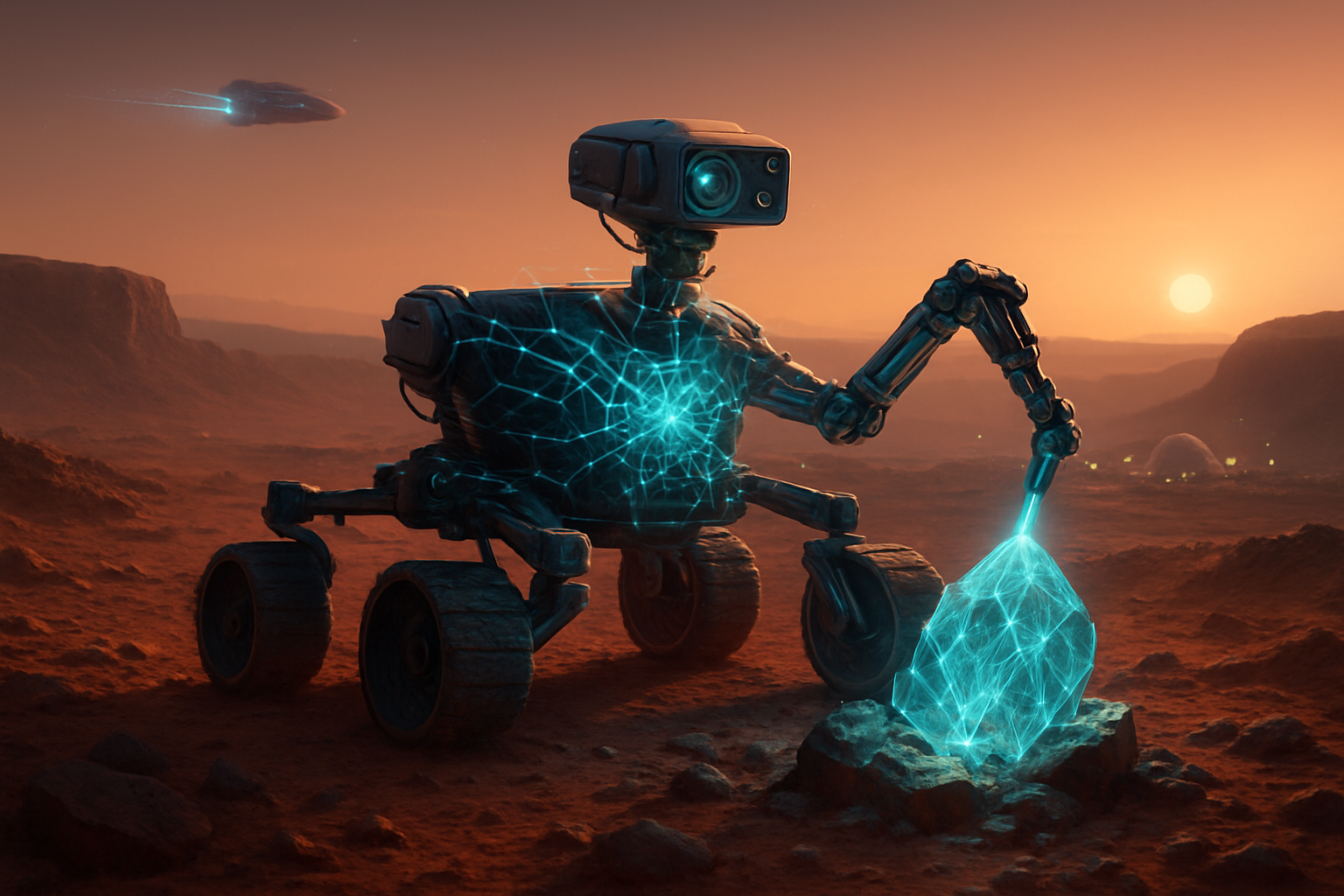
    In a landmark shift for deep-space exploration, NASA has officially transitioned its Foundational Artificial Intelligence for the Moon and Mars (FAIMM) initiative from experimental pilots to a centralized mission framework. As of January 2026, the program is poised to provide the next generation of planetary rovers and orbiters with what researchers call a "brain transplant"—moving away from reactive, pre-programmed automation toward "agentic" intelligence capable of making high-level scientific decisions without waiting for instructions from Earth.

    This development marks the end of the "joystick era" of space exploration. By addressing the critical communication latency between Earth and Mars—which can range from 4 to 24 minutes—FAIMM enables robotic explorers to identify "opportunistic science," such as transient atmospheric phenomena or rare mineral outcroppings, in real-time. This autonomous capability is expected to increase the scientific yield of future missions by orders of magnitude, transforming rovers from remote-controlled tools into independent laboratory assistants.

    A "5+1" Strategy for Physics-Aware Intelligence

    Technically, FAIMM represents a generational leap over previous systems like AEGIS (Autonomous Exploration for Gathering Increased Science), which has operated on the Perseverance rover. While AEGIS was a task-specific tool designed to find specific rock shapes for laser targeting, FAIMM utilizes a "5+1" architectural strategy. This consists of five specialized foundation models trained on massive datasets from NASA’s primary science divisions—Planetary Science, Earth Science, Heliophysics, Astrophysics, and Biological Sciences—all overseen by a central, cross-domain Large Language Model (LLM) that acts as the mission's "executive officer."

    Built on Vision Transformers (ViT-Large) and trained via Self-Supervised Learning (SSL), FAIMM has been "pre-educated" on petabytes of archival data from the Mars Reconnaissance Orbiter and other legacy missions. Unlike terrestrial AI, which can suffer from "hallucinations," NASA has mandated a "Gray-Box" requirement for FAIMM. This ensures that the AI’s decision-making is grounded in physics-based constraints. For instance, the AI cannot "decide" to investigate a creator if the proposed path violates known geological load-bearing limits or the rover's power safety margins.

    Initial reactions from the AI research community have been largely positive, with experts noting that FAIMM is one of the first major deployments of "embodied AI" in an environment where failure is not an option. By integrating physics directly into the neural weights, NASA is setting a new standard for high-stakes AI applications. However, some astrobiologists have voiced concerns regarding the "Astrobiology Gap," arguing that the current models are heavily optimized for mineralogy and navigation rather than the nuanced detection of biosignatures or the search for life.

    The Commercial Space Race: From Silicon Valley to the Lunar South Pole

    The launch of FAIMM has sent ripples through the private sector, creating a burgeoning "Space AI" market projected to reach $8 billion by the end of 2026. International Business Machines (NYSE: IBM) has been a foundational partner, co-developed the Prithvi geospatial models that served as the blueprint for FAIMM’s planetary logic. Meanwhile, NVIDIA (NASDAQ: NVDA) has secured its position as the primary hardware provider, with its Blackwell architecture currently powering the training of these massive foundation models at the Oak Ridge National Laboratory.

    The initiative has also catalyzed a new "Space Edge" computing sector. Microsoft (NASDAQ: MSFT), through its Azure Space division, is collaborating with Hewlett Packard Enterprise (NYSE: HPE) to deploy the Spaceborne Computer-3. This hardened edge-computing platform allows rovers to run inference on complex FAIMM models locally, rather than beaming raw data back to Earth-bound servers. Alphabet (NASDAQ: GOOGL) has also joined the fray through the Frontier Development Lab, focusing on refining the agentic reasoning components that allow the AI to set its own sub-goals during a mission.

    Major aerospace contractors are also pivoting to accommodate this new intelligence layer. Lockheed Martin (NYSE: LMT) recently introduced its STAR.OS™ system, designed to integrate FAIMM-based open-weight models into the Orion spacecraft and upcoming Artemis assets. This shift is creating a competitive dynamic between NASA’s "open-science" approach and the vertically integrated, proprietary AI stacks of companies like SpaceX. While SpaceX utilizes its own custom silicon for autonomous Starship landings, the FAIMM initiative provides a standardized, open-weight ecosystem that allows smaller startups to compete in the lunar economy.

    Implications for the Broader AI Landscape

    FAIMM is more than just a tool for space; it is a laboratory for the future of autonomous agents on Earth. The transition from "Narrow AI" to "Foundational Physical Agents" mirrors the broader industry trend of moving past simple chatbots toward AI that can interact with the physical world. By proving that a foundation model can safely navigate the hostile terrains of Mars, NASA is providing a blueprint for autonomous mining, deep-sea exploration, and disaster response systems here at home.

    However, the initiative raises significant questions about the role of human oversight. Comparing FAIMM to previous milestones like AlphaGo or the release of GPT-4, the stakes are vastly higher; a "hallucination" in deep space can result in the loss of a multi-billion-dollar asset. This has led to a rigorous debate over "meaningful human control." As rovers begin to choose their own scientific targets, the definition of a "scientist" is beginning to blur, shifting the human role from an active explorer to a curator of AI-generated discoveries.

    There are also geopolitical considerations. As NASA releases these models as "Open-Weight," it establishes a de facto global standard for space-faring AI. This move ensures that international partners in the Artemis Accords are working from the same technological baseline, potentially preventing a fragmented "wild west" of conflicting AI protocols on the lunar surface.

    The Horizon: Artemis III and the Mars Sample Return

    Looking ahead, the next 18 months will be critical for the FAIMM initiative. The first full-scale hardware testbeds are scheduled for the Artemis III mission, where AI will assist astronauts in identifying high-priority ice samples in the permanently shadowed regions of the lunar South Pole. Furthermore, NASA’s ESCAPADE Mars orbiter, slated for later in 2026, will utilize FAIMM to autonomously adjust its sensor arrays in response to solar wind events, providing unprecedented data on the Martian atmosphere.

    Experts predict that the long-term success of FAIMM will hinge on "federated learning" in space—a concept where multiple rovers and orbiters share their local "learnings" to improve the global foundation model without needing to send massive datasets back to Earth. The primary challenge remains the harsh radiation environment of deep space, which can cause "bit flips" in the sophisticated neural networks required for FAIMM. Addressing these hardware vulnerabilities is the next great frontier for the Spaceborne Computer initiative.

    A New Chapter in Exploration

    NASA’s FAIMM initiative represents a definitive pivot in the history of artificial intelligence and space exploration. By empowering machines with the ability to reason, predict, and discover, humanity is extending its scientific reach far beyond the limits of human reaction time. The transition to agentic AI ensures that our robotic precursors are no longer just our eyes and ears, but also our brains on the frontier.

    In the coming weeks, the industry will be watching closely as the ROSES-2025 proposal window closes in April, signaling which academic and private partners will lead the next phase of FAIMM's evolution. As we move closer to the 2030s, the legacy of FAIMM will likely be measured not just by the rocks it finds, but by how it redefined the partnership between human curiosity and machine intelligence.


    This content is intended for informational purposes only and represents analysis of current AI developments.

    TokenRing AI delivers enterprise-grade solutions for multi-agent AI workflow orchestration, AI-powered development tools, and seamless remote collaboration platforms.
    For more information, visit https://www.tokenring.ai/.
  • The Martian Brain: NASA and SpaceX Race to Deploy Foundation Models in Deep Space

    The Martian Brain: NASA and SpaceX Race to Deploy Foundation Models in Deep Space

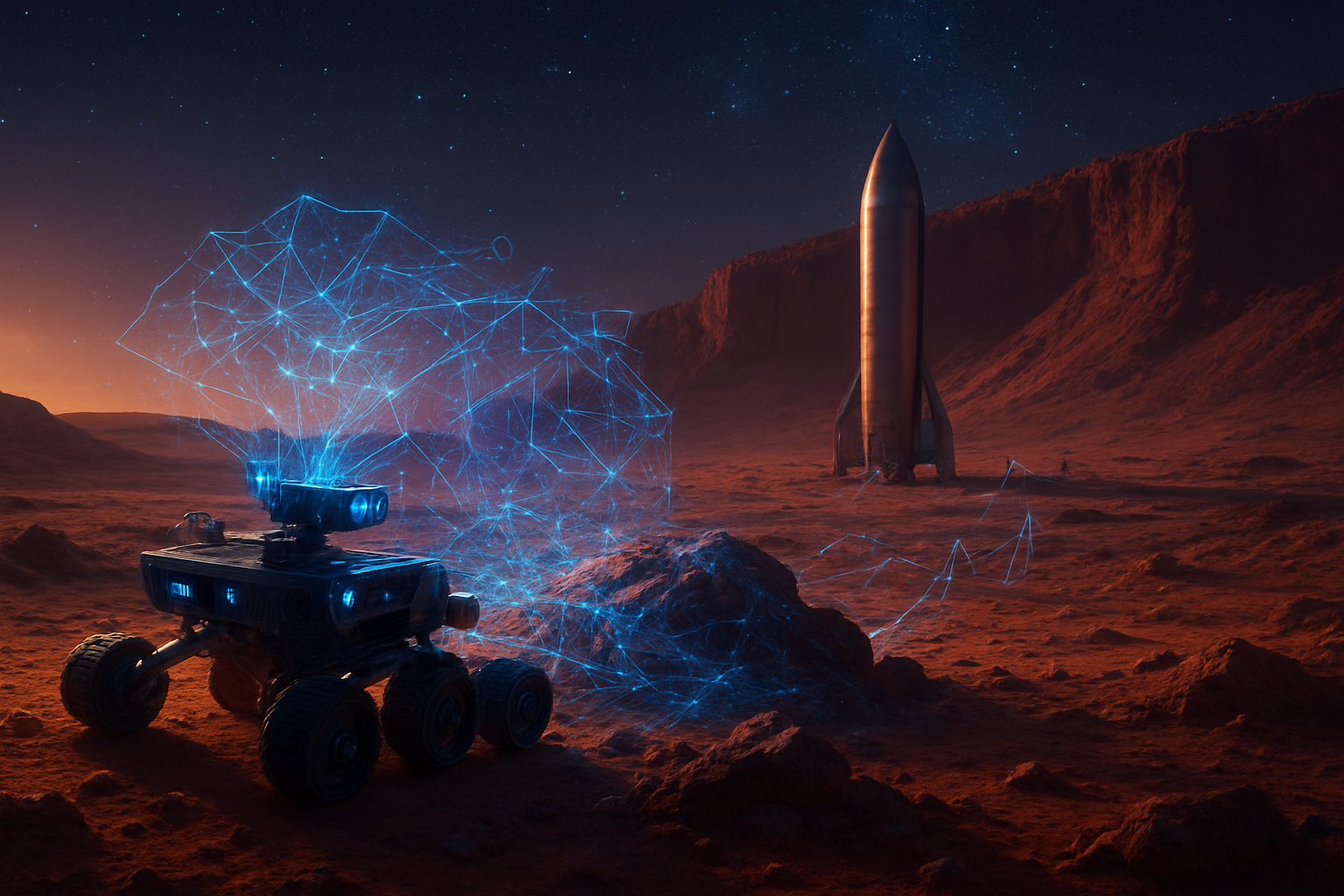
    As of January 19, 2026, the final frontier is no longer just a challenge of propulsion and life support—it has become a high-stakes arena for generative artificial intelligence. NASA’s Foundational Artificial Intelligence for the Moon and Mars (FAIMM) initiative has officially entered its most critical phase, transitioning from a series of experimental pilots to a centralized framework designed to give Martian rovers and orbiters the ability to "think" for themselves. This shift marks the end of the era of "task-specific" AI, where robots required human-labeled datasets for every single rock or crater they encountered, and the beginning of a new epoch where multi-modal foundation models enable autonomous scientific discovery.

    The immediate significance of the FAIMM initiative cannot be overstated. By utilizing the same transformer-based architectures that revolutionized terrestrial AI, NASA is attempting to solve the "communication latency" problem that has plagued Mars exploration for decades. With light-speed delays ranging from 4 to 24 minutes, real-time human control is impossible. FAIMM aims to deploy "Open-Weight" models that allow a rover to not only navigate treacherous terrain autonomously but also identify "opportunistic science"—such as transient dust devils or rare mineral deposits—without waiting for a command from Earth. This development is effectively a "brain transplant" for the next generation of planetary explorers, moving them from scripted machines to agentic explorers.

    Technical Specifications and the "5+1" Strategy

    The technical architecture of FAIMM is built on a "5+1" strategy: five specialized divisional models for different scientific domains, unified by one cross-domain large language model (LLM). Unlike previous mission software, which relied on rigid, hand-coded algorithms or basic convolutional neural networks, FAIMM leverages Vision Transformers (ViT-Large) and Self-Supervised Learning (SSL). These models have been pre-trained on petabytes of archival data from the Mars Reconnaissance Orbiter (MRO) and the Mars Global Surveyor (MGS), allowing them to understand the "context" of the Martian landscape. For instance, instead of just recognizing a rock, the AI can infer geological history by analyzing the surrounding terrain patterns, much like a human geologist would.

    This approach differs fundamentally from the "Autonav" system currently used by the Perseverance rover. While Autonav is roughly 88% autonomous in its pathfinding, it remains reactive. FAIMM-driven systems are predictive, utilizing "physics-aware" generative models to simulate environmental hazards—like a sudden dust storm—before they occur. Initial reactions from the AI research community have been largely positive, though some have voiced concerns over the "Gray-Box" requirement. NASA has mandated that these models must not be "black boxes"; they must incorporate explainable, physics-based constraints to prevent the AI from making hallucinatory decisions that could lead to a billion-dollar mission failure.

    Industry Implications and the Tech Giant Surge

    The race to colonize the Martian digital landscape has sparked a surge in activity among major tech players. NVIDIA (NASDAQ: NVDA) has emerged as a linchpin in this ecosystem, having recently signed a $77 million agreement to lead the Open Multimodal AI Infrastructure (OMAI). NVIDIA’s Blackwell architecture is currently being used at Oak Ridge National Laboratory to train the massive foundation models that FAIMM requires. Meanwhile, Microsoft (NASDAQ: MSFT) via its Azure Space division, is providing the "NASA Science Cloud" infrastructure, including the deployment of the Spaceborne Computer-3, which allows these heavy models to run at the "edge" on orbiting spacecraft.

    Alphabet Inc. (NASDAQ: GOOGL) is also a major contender, with its Google Cloud and Frontier Development Lab focusing on "Agentic AI." Their Gemini-based models are being adapted to help NASA engineers design optimized, 3D-printable spacecraft components for Martian environments. However, the most disruptive force remains Tesla (NASDAQ: TSLA) and its sister company xAI. While NASA follows a collaborative, academic path, SpaceX is preparing its uncrewed Starship mission for late 2026 using a vertically integrated AI stack. This includes xAI’s Grok 4 for high-level reasoning and Tesla’s AI5 custom silicon to power a fleet of autonomous Optimus robots. This creates a fascinating competitive dynamic: NASA’s "Open-Weight" science-focused models versus SpaceX’s proprietary, mission-critical autonomous stack.

    Wider Significance and the Search for Life

    The broader significance of FAIMM lies in the democratization of space-grade AI. By releasing these models as "Open-Weight," NASA is allowing startups and international researchers to fine-tune planetary-scale AI for their own missions, effectively lowering the barrier to entry for deep-space exploration. This mirrors the impact of the early internet or GPS—technologies born of government research that eventually fueled entire commercial industries. Experts predict the "AI in Space" market will reach nearly $8 billion by the end of 2026, driven by a 32% compound annual growth rate in autonomous robotics.

    However, the initiative is not without its critics. Some in the scientific community, notably at platforms like NASAWatch, have pointed out an "Astrobiology Gap," arguing that the FAIMM announcement prioritizes the technology of AI over the fundamental scientific goal of finding life. There is also the persistent concern of "silent bit flips"—errors caused by cosmic radiation that could cause an AI to malfunction in ways a human cannot easily diagnose. These risks place FAIMM in a different category than terrestrial AI milestones like GPT-4; in space, an AI "hallucination" isn't just a wrong answer—it's a mission-ending catastrophe.

    Future Developments and the 2027 Horizon

    Looking ahead, the next 24 months will be a gauntlet for the FAIMM initiative. The deadline for the first round of official proposals is set for April 28, 2026, with the first hardware testbeds expected to launch on the Artemis III mission and the ESCAPADE Mars orbiter in late 2027. In the near term, we can expect to see "foundation model" benchmarks specifically for planetary science, allowing researchers to compete for the highest accuracy in crater detection and mineral mapping.

    In the long term, these models will likely evolve into "Autonomous Mission Managers." Instead of a team of hundreds of scientists at JPL managing every move of a rover, a single scientist might oversee a fleet of a dozen AI-driven explorers, providing high-level goals while the AI handles the tactical execution. The ultimate challenge will be the integration of these models into human-crewed missions. When humans finally land on Mars—a goal China’s CNSA is aggressively pursuing for 2033—the AI won't just be a tool; it will be a mission partner, managing life support, navigation, and emergency response in real-time.

    Summary of Key Takeaways

    The NASA FAIMM initiative represents a pivotal moment in the history of artificial intelligence. It marks the point where AI moves from being a guest on spacecraft to being the pilot. By leveraging the power of foundation models, NASA is attempting to bridge the gap between the rigid automation of the past and the fluid, general-purpose intelligence required to survive on another planet. The project’s success will depend on its ability to balance the raw power of transformer architectures with the transparency and reliability required for the vacuum of space.

    As we move toward the April 2026 proposal deadline and the anticipated SpaceX Starship launch in late 2026, the tech industry should watch for the "convergence" of these two approaches. Whether the future of Mars is built on NASA’s open-science framework or SpaceX’s integrated robotic ecosystem, one thing is certain: the first footprints on Mars will be guided by an artificial mind.


    This content is intended for informational purposes only and represents analysis of current AI developments.

    TokenRing AI delivers enterprise-grade solutions for multi-agent AI workflow orchestration, AI-powered development tools, and seamless remote collaboration platforms.
    For more information, visit https://www.tokenring.ai/.