
Tag: Federal vs. State

  • The Regulatory Tug-of-War: Federal and State Governments Clash Over AI Governance

    The Regulatory Tug-of-War: Federal and State Governments Clash Over AI Governance

    Washington D.C. & Sacramento, CA – December 11, 2025 – The rapid evolution of artificial intelligence continues to outpace legislative efforts, creating a complex and often conflicting regulatory landscape across the United States. A critical battle is unfolding between federal ambitions for a unified AI policy and individual states’ proactive measures to safeguard their citizens. This tension is starkly highlighted by California's pioneering "Transparency in Frontier Artificial Intelligence Act" (SB 53) and a recent Presidential Executive Order, which together underscore the challenges of harmonizing AI governance in a rapidly advancing technological era.

    At the heart of this regulatory dilemma is the fundamental question of who holds the primary authority to shape the future of AI. While the federal government seeks to establish a singular, overarching framework to foster innovation and maintain global competitiveness, states like California are forging ahead with their own comprehensive laws, driven by a desire to address immediate concerns around safety, ethics, and accountability. This fragmented approach risks creating a "patchwork" of rules that could either stifle progress or leave critical gaps in consumer protection, setting the stage for ongoing legal and political friction.

    Divergent Paths: California's SB 53 Meets Federal Deregulation

    California's Senate Bill 53 (SB 53), also known as the Transparency in Frontier Artificial Intelligence Act (TFAIA), became law in September 2025, marking a significant milestone as the first U.S. state law specifically targeting "frontier AI" models. This legislation focuses on transparency, accountability, and the mitigation of catastrophic risks associated with the most advanced AI systems. Key provisions mandate that "large frontier developers" – defined as companies with over $500 million in gross revenues and developing models trained with more than 10^26 floating-point operations (FLOPS) – must create and publicly publish a "frontier AI framework." This framework details how they incorporate national and international standards to address risks like mass harm, large-scale property damage, or misuse in national security scenarios. The law also requires incident reporting to the California Office of Emergency Services (OES), strengthens whistleblower protections, and imposes civil penalties of up to $1,000,000 per violation. Notably, SB 53 includes a mechanism for federal deference, allowing compliance through equivalent federal standards if they are enacted, demonstrating a forward-looking approach to potential federal action.

    In stark contrast, the federal landscape shifted significantly in early 2025 with President Donald Trump's "Executive Order on Removing Barriers to American Leadership in AI." This order reportedly rescinded many of the detailed regulatory directives from President Biden's earlier Executive Order 14110 (October 30, 2023), which had aimed for a comprehensive approach to AI safety, civil rights, and national security. Trump's executive order, as reported, champions a "one rule" philosophy, seeking to establish a single, nationwide AI policy to prevent a "compliance nightmare" for companies and accelerate American AI leadership through deregulation. It is anticipated to challenge state-level AI laws, potentially directing the Justice Department to sue states with their own AI regulations or for federal agencies to withhold grants from states with rules deemed burdensome to AI development.

    The divergence is clear: California's SB 53 is a prescriptive, risk-focused state law targeting the most powerful AI, emphasizing specific metrics and reporting, while the recent federal executive order signals a move towards broad federal preemption and deregulation, prioritizing innovation and a unified, less restrictive environment. This creates a direct conflict, as California seeks to establish robust guardrails for advanced AI, while the federal government appears to be actively working to dismantle or preempt such state-level initiatives. Initial reactions from the AI research community and industry experts are mixed; some advocate for a unified federal approach to streamline compliance and foster innovation, while others express concern that preempting state laws could erode crucial safeguards in the absence of comprehensive federal legislation, potentially exposing citizens to unchecked AI risks.

    Navigating the Regulatory Minefield: Impacts on AI Companies

    The escalating regulatory friction between federal and state governments presents a significant challenge for AI companies, from nascent startups to established tech giants. The absence of a clear, unified national framework forces businesses to navigate a "patchwork" of disparate and potentially conflicting state laws, alongside shifting federal directives. This dramatically increases compliance costs, demanding that companies dedicate substantial resources to legal analysis, system audits, and localized operational adjustments. For a company operating nationwide, adhering to California's specific "frontier AI" definitions and reporting requirements, while simultaneously facing a federal push for deregulation and preemption, creates an almost untenable situation.

    Tech giants like Alphabet (NASDAQ: GOOGL), Microsoft (NASDAQ: MSFT), and Amazon (NASDAQ: AMZN), with their extensive legal and lobbying resources, may be better equipped to adapt to this complex environment. They can afford to invest in compliance teams, influence policy discussions, and potentially benefit from a federal framework that prioritizes deregulation if it aligns with their business models. However, even for these behemoths, the uncertainty can slow down product development and market entry for new AI applications. Smaller AI startups, on the other hand, are particularly vulnerable. The high cost of navigating varied state regulations can become an insurmountable barrier, stifling innovation and potentially driving them out of business or towards jurisdictions with more permissive rules.

    This competitive implication could lead to market consolidation, where only the largest players can absorb the compliance burden, further entrenching their dominance. It also risks disrupting existing products and services if they suddenly fall afoul of new state-specific requirements or if federal preemption invalidates previously compliant systems. Companies might strategically position themselves by prioritizing development in states with less stringent regulations, or by aggressively lobbying for federal preemption to create a more predictable operating environment. The current climate could also spur a "race to the bottom" in terms of safety standards, as companies seek the path of least resistance, or conversely, a "race to the top" if states compete to offer the most robust consumer protections, creating a highly volatile market for AI development and deployment.

    A Wider Lens: AI Governance in a Fragmented Nation

    This federal-state regulatory clash over AI is more than just a jurisdictional squabble; it reflects a fundamental challenge in governing rapidly evolving technologies within a diverse democratic system. It fits into a broader global landscape where nations are grappling with how to balance innovation with safety, ethics, and human rights. While the European Union has moved towards comprehensive, top-down AI regulation with its AI Act, the U.S. approach remains fragmented, mirroring earlier debates around internet privacy (e.g., California Consumer Privacy Act (CCPA) preceding any federal privacy law) and biotechnology regulation.

    The wider significance of this fragmentation is profound. On one hand, it could lead to inconsistent consumer protections, where citizens in one state might enjoy robust safeguards against algorithmic bias or data misuse, while those in another are left vulnerable. This regulatory arbitrage could incentivize companies to operate in jurisdictions with weaker oversight, potentially compromising ethical AI development. On the other hand, the "laboratories of democracy" argument suggests that states can innovate with different regulatory approaches, providing valuable lessons that could inform a future federal framework. However, this benefit is undermined if federal action seeks to preempt these state-level experiments without offering a robust national alternative.

    Potential concerns extend to the very nature of AI innovation. While a unified federal approach is often touted as a way to accelerate development by reducing compliance burdens, an overly deregulatory stance could lead to a lack of public trust, hindering adoption and potentially causing significant societal harm that outweighs any perceived gains in speed. Conversely, a patchwork of overly burdensome state regulations could indeed stifle innovation by making it too complex or costly for companies to deploy AI solutions across state lines. The debate also impacts critical areas like data privacy, where AI's reliance on vast datasets clashes with differing state-level consent and usage rules, and algorithmic bias, where inconsistent standards for fairness and accountability make it difficult to develop universally ethical AI systems. The current situation risks creating an environment where the most powerful AI systems operate in a regulatory gray area, with unclear lines of accountability for potential harms.

    The Road Ahead: Towards an Uncharted Regulatory Future

    Looking ahead, the immediate future of AI regulation in the U.S. is likely to be characterized by continued legal challenges and intense lobbying efforts. We can expect to see state attorneys general defending their AI laws against federal preemption attempts, and industry groups pushing for a single, less restrictive federal standard. Further executive actions from the federal government, or attempts at comprehensive federal legislation, are also anticipated, though the path to achieving bipartisan consensus on such a complex issue remains fraught with political polarization.

    In the near term, AI companies will need to adopt highly adaptive compliance strategies, potentially developing distinct versions of their AI systems or policies for different states. The legal battles over federal versus state authority will clarify the boundaries of AI governance, but this process could take years. Long-term, many experts predict that some form of federal framework will eventually emerge, driven by the sheer necessity of a unified approach for a technology with national and global implications. However, this framework is unlikely to completely erase state influence, as states will continue to advocate for specific protections tailored to their populations.

    Challenges that need to be addressed include defining "high-risk" AI, establishing clear metrics for bias and safety, and creating enforcement mechanisms that are both effective and proportionate. Experts predict that the current friction will necessitate a more collaborative approach between federal and state governments, perhaps through cooperative frameworks or federal minimum standards that allow states to implement more stringent protections. The ongoing dialogue will shape not only the regulatory environment but also the very trajectory of AI development in the United States, influencing its ethical foundations, innovative capacity, and global competitiveness.

    A Critical Juncture for AI Governance

    The ongoing struggle to harmonize AI regulations between federal and state governments represents a critical juncture in the history of artificial intelligence governance in the United States. The core tension between the federal government's ambition for a unified, innovation-focused approach and individual states' efforts to implement tailored protections against AI's risks defines the current landscape. California's SB 53 stands as a testament to state-level initiative, offering a specific framework for "frontier AI," while the recent Presidential Executive Order signals a strong federal push for deregulation and preemption.

    The significance of this development cannot be overstated. It will profoundly impact how AI companies operate, influencing their investment decisions, product development cycles, and market strategies. Without a clear path to harmonization, the industry faces increased compliance burdens and legal uncertainty, potentially stifling the very innovation both federal and state governments claim to champion. Moreover, the lack of a cohesive national strategy risks creating a fragmented patchwork of protections for citizens, raising concerns about equity, safety, and accountability across the nation.

    In the coming weeks and months, all eyes will be on the interplay between legislative proposals, executive actions, and potential legal challenges. The ability of federal and state leaders to bridge this divide, either through collaborative frameworks or a carefully crafted national standard that respects local needs, will determine whether the U.S. can effectively harness the transformative power of AI while safeguarding its society. The resolution of this regulatory tug-of-war will set a precedent for future technology governance and define America's role in the global AI race.


    This content is intended for informational purposes only and represents analysis of current AI developments.

    TokenRing AI delivers enterprise-grade solutions for multi-agent AI workflow orchestration, AI-powered development tools, and seamless remote collaboration platforms.
    For more information, visit https://www.tokenring.ai/.
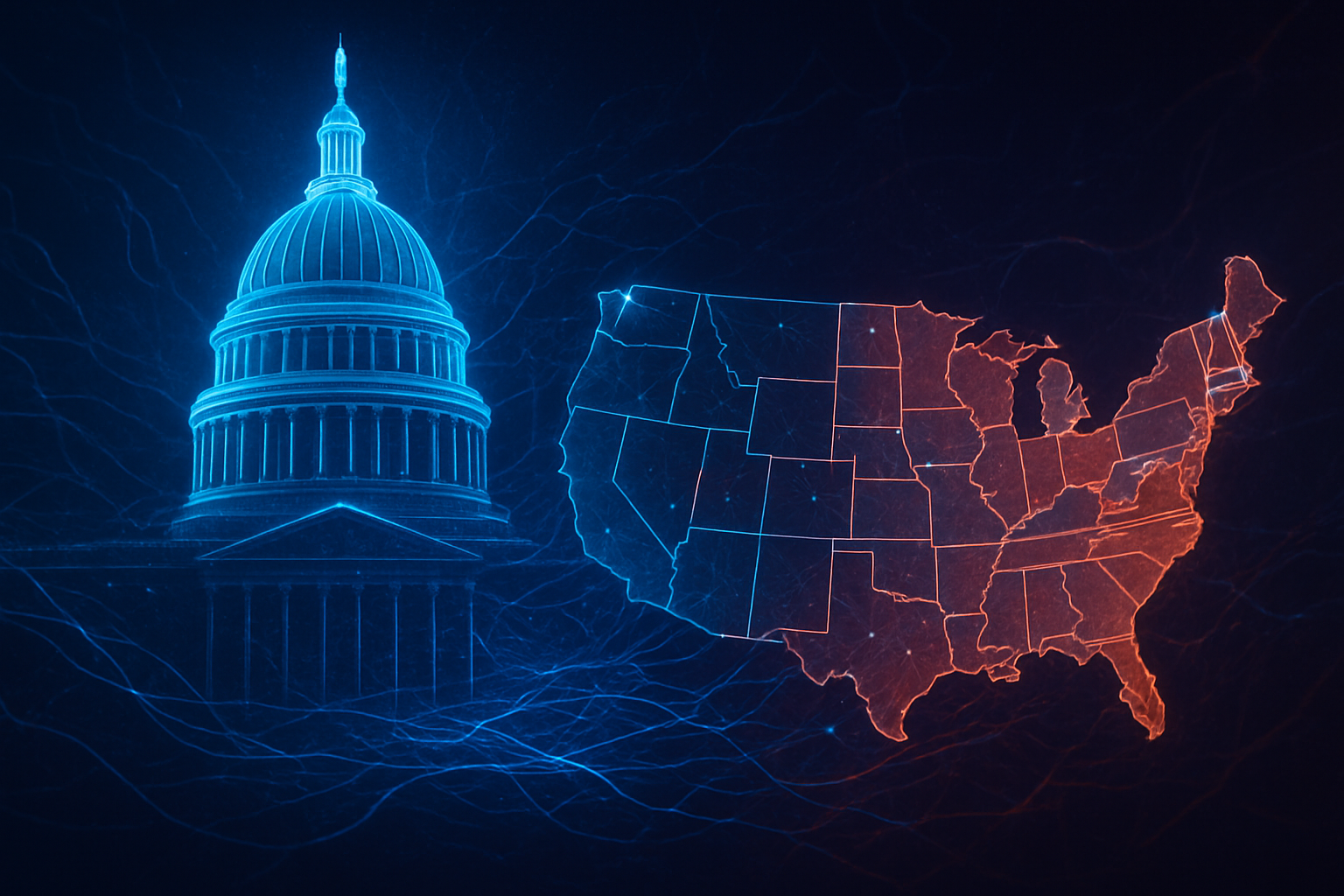
  • Federal Gauntlet Thrown: White House Moves to Block State AI Laws, Igniting Regulatory Showdown

    Federal Gauntlet Thrown: White House Moves to Block State AI Laws, Igniting Regulatory Showdown

    Washington D.C., November 19, 2025 – In a significant escalation of the ongoing debate surrounding artificial intelligence governance, the White House has reportedly finalized an executive order aimed at preempting state-level AI regulations. A draft of this assertive directive, confirmed to be in its final stages, signals the Trump administration's intent to centralize control over AI policy, effectively challenging the burgeoning patchwork of state laws across the nation. This move, poised to reshape the regulatory landscape for one of the most transformative technologies of our era, immediately sets the stage for a contentious legal and political battle between federal and state authorities, with profound implications for innovation, privacy, and public safety.

    The executive order, revealed on November 19, 2025, underscores a federal strategy to assert dominance in AI regulation, arguing that a unified national approach is critical for fostering innovation and maintaining global competitiveness. However, it simultaneously raises alarms among states and advocacy groups who fear that federal preemption could dismantle crucial safeguards already being implemented at the local level, leaving citizens vulnerable to the potential harms of unchecked AI development. The directive is a clear manifestation of the administration's consistent efforts throughout 2025 to streamline AI governance under federal purview, prioritizing what it views as a cohesive national strategy over fragmented state-by-state regulations.

    Federal Preemption Takes Center Stage: Unpacking the Executive Order's Mechanisms

    The leaked draft of the executive order, dated November 19, 2025, outlines several aggressive mechanisms designed to curtail state authority over AI. At its core is the establishment of an "AI Litigation Task Force," explicitly charged with challenging state AI laws. These challenges are anticipated to leverage constitutional arguments, particularly the "dormant Commerce Clause," contending that state regulations unduly burden interstate commerce and thus fall under federal jurisdiction. This approach mirrors arguments previously put forth by prominent venture capital firms, who have long advocated for a unified regulatory environment to prevent a "patchwork of 50 State Regulatory Regimes" from stifling innovation.

    Beyond direct legal challenges, the executive order proposes a powerful financial lever: federal funding. It directs the Secretary of Commerce to issue a policy notice that would deem states with "onerous" AI laws ineligible for specific non-deployment funds, including those from critical programs like the Broadband Equity Access and Deployment (BEAD) initiative. This unprecedented linkage of federal funding to state AI policy represents a significant escalation in the federal government's ability to influence local governance. Furthermore, the order directs the Federal Communications Commission (FCC) chairman and the White House AI czar to initiate proceedings to explore adopting a federal reporting and disclosure standard for AI models, explicitly designed to preempt conflicting state laws. The draft also specifically targets state laws that might compel AI developers or deployers to disclose information in a manner that could violate First Amendment or other constitutional provisions, citing California's SB 53 as an example of a "complex and burdensome disclosure and reporting law premised on purely speculative" concerns.

    This federal preemption strategy marks a stark departure from the previous administration's approach, which had focused on safety, security, and trustworthy AI through Executive Order 14179 in October 2023. The Trump administration, throughout 2025, has consistently championed an AI policy focused on promoting innovation free from "ideological bias or engineered social agendas." This was evident in President Trump's January 23, 2025, Executive Order 14179, which revoked the Biden administration's directive, and further solidified by "America's AI Action Plan" and three additional executive orders signed on July 23, 2025. These actions collectively emphasize removing restrictive regulations and withholding federal funding from states with "unduly burdensome" AI laws, culminating in the current executive order that seeks to definitively centralize AI governance under federal control.

    Corporate Implications: Winners, Losers, and Strategic Shifts in the AI Industry

    The White House's move to preempt state AI laws is poised to significantly impact the competitive landscape for AI companies, tech giants, and startups alike. Large technology companies and major AI labs, particularly those with extensive lobbying capabilities and a national or global presence, stand to benefit significantly from a unified federal regulatory framework. These entities have consistently argued that a fragmented regulatory environment, with differing rules across states, creates substantial compliance burdens, increases operational costs, and hinders the scaling of AI products and services. A single federal standard would simplify compliance, reduce legal overhead, and allow for more streamlined product development and deployment across the United States. Companies like Microsoft (NASDAQ: MSFT), Google (NASDAQ: GOOGL), and Amazon (NASDAQ: AMZN), which invest heavily in AI research and deployment, are likely to welcome this development as it could accelerate their market penetration and solidify their competitive advantages by removing potential state-level impediments.

    Conversely, startups and smaller AI firms that might have found niches in states with less stringent or uniquely tailored regulations could face new challenges. While a unified standard could simplify their path to market by reducing the complexity of navigating diverse state laws, it also means that the regulatory bar, once set federally, might be higher or more prescriptive than what they might have encountered in certain states. Furthermore, states that have been proactive in developing their own AI governance frameworks, often driven by specific local concerns around privacy, bias, or employment, may see their efforts undermined. This could lead to a chilling effect on local innovation where state-specific AI solutions were being cultivated. The competitive implications extend to the types of AI products that are prioritized; a federal standard, especially one focused on "innovation free from ideological bias," could inadvertently favor certain types of AI development over others, potentially impacting ethical AI research and deployment that often finds stronger advocacy at the state level.

    The potential disruption to existing products and services will depend heavily on the specifics of the federal standard that ultimately emerges. If the federal standard is perceived as lighter-touch or more industry-friendly than anticipated state laws, it could open up new markets or accelerate the deployment of certain AI applications that were previously stalled by regulatory uncertainty. However, if the federal standard incorporates elements that require significant redesign or re-evaluation of AI models, it could lead to temporary disruptions as companies adapt. For market positioning, companies that align early with the anticipated federal guidelines and actively participate in shaping the federal discourse will gain strategic advantages. This move also reinforces the trend of AI regulation becoming a central strategic concern for all tech companies, shifting the focus from individual state compliance to a broader federal lobbying and policy engagement strategy.

    Broader Implications: AI Governance at a Crossroads

    The White House's assertive move to preempt state AI laws marks a critical juncture in the broader AI landscape, highlighting the fundamental tension between fostering innovation and ensuring public safety and ethical deployment. This federal thrust fits into a global trend of nations grappling with how to govern rapidly evolving AI technologies. While some, like the European Union, have opted for comprehensive, proactive regulatory frameworks such as the AI Act, the United States appears to be leaning towards a more unified, federally controlled approach, with a strong emphasis on limiting what it perceives as burdensome state-level interventions. This strategy aims to prevent a fragmented regulatory environment, often referred to as a "patchwork," that could hinder the nation's global competitiveness against AI powerhouses like China.

    The impacts of this federal preemption are multifaceted. On the one hand, proponents argue that a single national standard will streamline development, reduce compliance costs for businesses, and accelerate the deployment of AI technologies, thereby boosting economic growth and maintaining American leadership in the field. It could also provide clearer guidelines for researchers and developers, fostering a more predictable environment for innovation. On the other hand, significant concerns have been raised by civil liberties groups, consumer advocates, and state legislators. They argue that federal preemption, particularly if it results in a less robust or slower-to-adapt regulatory framework, could dismantle crucial safeguards against AI harms, including algorithmic bias, privacy violations, and job displacement. Public Citizen, for instance, has voiced strong opposition, stating that federal preemption would allow "Big Tech to operate without accountability" in critical areas like civil rights and data privacy, effectively negating the proactive legislative efforts already undertaken by several states.

    This development can be compared to previous milestones in technology regulation, such as the early days of internet governance or telecommunications. In those instances, the debate between federal and state control often revolved around economic efficiency versus local control and consumer protection. The current AI debate mirrors this, but with the added complexity of AI's pervasive and rapidly evolving nature, impacting everything from healthcare and finance to national security. The potential for a federal standard to be less responsive to localized issues or to move too slowly compared to the pace of technological advancement is a significant concern. Conversely, a chaotic mix of 50 different state laws could indeed create an untenable environment for companies operating nationwide, potentially stifling the very innovation it seeks to regulate. The administration's focus on removing "woke" AI models from federal procurement, as outlined in earlier 2025 executive orders, also injects a unique ideological dimension into this regulatory push, suggesting a desire to shape the ethical guardrails of AI from a particular political viewpoint.

    The Road Ahead: Navigating Federal Supremacy and State Resistance

    Looking ahead, the immediate future will likely be characterized by intense legal challenges and political maneuvering as states and advocacy groups push back against the federal preemption. We can expect lawsuits to emerge, testing the constitutional limits of the executive order, particularly concerning the dormant Commerce Clause and states' Tenth Amendment rights. The "AI Litigation Task Force" established by the order will undoubtedly be active, setting precedents that will shape the legal interpretation of federal versus state authority in AI. In the near term, states with existing or pending AI legislation, such as California with its SB 53, will be closely watching how the federal government chooses to enforce its directive and whether they will be forced to roll back their efforts.

    In the long term, this executive order could serve as a powerful signal to Congress, potentially spurring the development of comprehensive federal AI legislation that includes explicit preemption clauses. Such legislation, if enacted, would supersede the executive order and provide a more enduring framework for national AI governance. Potential applications and use cases on the horizon will heavily depend on the nature of the federal standard that ultimately takes hold. A lighter-touch federal approach might accelerate the deployment of AI in areas like autonomous vehicles and advanced robotics, while a more robust framework could prioritize ethical AI development in sensitive sectors like healthcare and criminal justice.

    The primary challenge that needs to be addressed is striking a delicate balance between fostering innovation and ensuring robust protections for citizens. Experts predict that the debate will continue to be highly polarized, with industry advocating for minimal regulation and civil society groups pushing for strong safeguards. What happens next will hinge on the judiciary's interpretation of the executive order's legality, the willingness of Congress to legislate, and the ability of stakeholders to find common ground. The administration's focus on a unified federal approach, as evidenced by its actions throughout 2025, suggests a continued push for centralization, but the extent of its success will ultimately be determined by the resilience of state opposition and the evolving legal landscape.

    A Defining Moment for AI Governance: The Path Forward

    The White House's executive order to block state AI laws represents a defining moment in the history of artificial intelligence governance in the United States. It is a clear declaration of federal intent to establish a unified national standard for AI regulation, prioritizing what the administration views as innovation and national competitiveness over a decentralized, state-led approach. The key takeaways are the immediate establishment of an "AI Litigation Task Force," the leveraging of federal funding to influence state policies, and the explicit aim to preempt state laws deemed "onerous" or constitutionally problematic. This aggressive stance is a culmination of the Trump administration's consistent efforts throughout 2025 to centralize AI policy, moving away from previous administrations' more collaborative approaches.

    This development's significance in AI history cannot be overstated. It marks a decisive shift towards federal preemption, potentially setting a precedent for how future emerging technologies are regulated. While proponents argue it will foster innovation and prevent a chaotic regulatory environment, critics fear it could lead to a race to the bottom in terms of protections, leaving critical areas like civil rights, data privacy, and public safety vulnerable. The long-term impact will depend on the legal battles that ensue, the legislative response from Congress, and the ability of the federal framework to adapt to the rapid advancements of AI technology without stifling responsible development or neglecting societal concerns.

    In the coming weeks and months, all eyes will be on the courts as the "AI Litigation Task Force" begins its work, and on state legislatures to see how they respond to this federal challenge. The dialogue between federal and state governments, industry, and civil society will intensify, shaping not just the future of AI regulation in the U.S. but also influencing global approaches to this transformative technology. The ultimate outcome will determine whether the nation achieves a truly unified and effective AI governance strategy, or if the regulatory landscape remains a battleground of competing authorities.


    This content is intended for informational purposes only and represents analysis of current AI developments.

    TokenRing AI delivers enterprise-grade solutions for multi-agent AI workflow orchestration, AI-powered development tools, and seamless remote collaboration platforms.
    For more information, visit https://www.tokenring.ai/.