Tag: Foundry Strategy

  • Intel’s 1.8nm Breakthrough: The Silicon Giant Mounts a High-Stakes Comeback with AI and 18A Mastery

    Intel’s 1.8nm Breakthrough: The Silicon Giant Mounts a High-Stakes Comeback with AI and 18A Mastery

    As of February 6, 2026, the global semiconductor landscape is witnessing a seismic shift as Intel (NASDAQ: INTC) officially enters the high-volume manufacturing (HVM) phase of its ambitious 18A process node. Following a string of turbulent years, the company’s Q4 2025 earnings report, released late last month, signaled a definitive turning point. Intel beat analyst expectations with $13.7 billion in revenue, driven by a recovering data center market and the initial ramp-up of its next-generation AI processors. This financial stability, bolstered by a landmark $5 billion strategic investment from NVIDIA (NASDAQ: NVDA), suggests that Intel’s "five nodes in four years" roadmap has not only survived but is now actively reshaping the competitive dynamics of the AI era.

    The cornerstone of this resurgence is a dual-track strategy that separates Intel’s product design from its manufacturing arm, Intel Foundry. By achieving HVM status for the 18A (1.8nm-class) node, Intel has successfully leapfrogged its rivals in several key architectural transitions. At the heart of this victory is PowerVia, a revolutionary backside power delivery technology that gives Intel a technical edge in transistor efficiency. As the industry pivots toward power-hungry generative AI applications, Intel’s ability to manufacture more efficient, high-performance silicon at scale is positioning the company as the primary Western alternative to the dominant Taiwan Semiconductor Manufacturing Company (NYSE: TSM).

    The Engineering Triumph of 18A and PowerVia

    Intel’s 18A process node represents more than just a reduction in transistor size; it is a fundamental re-engineering of how chips are powered. The most significant advancement is PowerVia, Intel’s implementation of Backside Power Delivery (BSPDN). Traditionally, both data signals and power lines are routed through a complex web of metal layers on top of the transistors. This creates "wiring congestion" that can lead to interference and energy loss. PowerVia solves this by moving the power delivery network to the reverse side of the silicon wafer. This "cable management" at the atomic level has already demonstrated a 6% boost in clock frequency and a significant reduction in voltage drop in production silicon.

    The technical implications are profound. By separating power and data, Intel can pack transistors more densely without the thermal bottlenecks that plagued previous generations. This technology has enabled the successful launch of Panther Lake (Core Ultra Series 3) for the consumer AI PC market and Clearwater Forest (Xeon 6+) for high-density server environments. Initial yield reports for 18A are hovering between 55% and 65%—a healthy figure for a node in its first month of high-volume production. Industry experts note that Intel currently holds a 6-to-12-month lead in BSPDN technology over TSMC, whose equivalent "Super Power Rail" is not expected to reach volume production until late 2026 or 2027 with their A16 node.

    Furthermore, 18A introduces the RibbonFET gate-all-around (GAA) transistor architecture, which replaces the long-standing FinFET design. This change allows for finer control over the electrical current flowing through the transistor, further reducing leakage and boosting performance-per-watt. The combination of RibbonFET and PowerVia makes 18A the most advanced logic process ever developed on American soil, providing the technical foundation for Intel's transition from a struggling incumbent to a cutting-edge foundry service provider.

    Strategic Realignment and the NVIDIA Alliance

    Intel's success is increasingly tied to its "Foundry Independence" model. Under the leadership of CEO Lip-Bu Tan, the company has established a strict "firewall" between its manufacturing facilities and its internal product teams. This move was essential to win the trust of external customers who compete directly with Intel’s chip divisions. The strategy is already paying dividends; the 18A Process Design Kit (PDK) version 1.0 is now fully in the hands of external designers, with Microsoft (NASDAQ: MSFT) and potentially Apple (NASDAQ: AAPL) identified as early lead partners for future custom silicon.

    The most surprising development in the strategic landscape is the deepening alliance with NVIDIA. The $5 billion investment from the AI chip leader late in 2025 has created a unique "coopetition" dynamic. While Intel’s Gaudi 3 and upcoming Gaudi 4 accelerators compete with NVIDIA’s mid-range offerings, NVIDIA is increasingly looking to Intel Foundry to diversify its supply chain and reduce its over-reliance on a single geographic region for manufacturing. This partnership suggests that in the high-stakes world of AI, manufacturing capacity is the ultimate currency, and Intel is one of the few players capable of printing the "gold" that powers modern neural networks.

    However, the dual-track strategy also involves a heavy dose of pragmatism. Intel has confirmed that it will continue to use external foundries like TSMC for specific non-core components, such as GPU or I/O tiles, where it makes economic sense. This "disaggregated manufacturing" approach allows Intel to focus its internal 18A capacity on the most critical high-margin compute tiles, ensuring that factory floors in Arizona and Ohio are utilized for the most advanced technologies while maintaining a flexible supply chain.

    AI Everywhere: From the Data Center to the Desktop

    The broader significance of Intel’s 18A breakthrough lies in its "AI Everywhere" initiative. In the data center, the 18A-based Clearwater Forest chips are designed to handle the massive throughput required for large language model (LLM) inference. Meanwhile, Intel's Gaudi 3 accelerators are seeing wide deployment through partners like Dell (NYSE: DELL) and Cisco (NASDAQ: CSCO), offering a cost-effective alternative for enterprises that do not require the extreme performance of NVIDIA’s top-tier H-series or B-series Blackwell chips.

    On the consumer side, the launch of Panther Lake marks the arrival of the "Next-Gen AI PC." Featuring a Neural Processing Unit (NPU) capable of delivering over 50 TOPS (Trillions of Operations Per Second), these 18A chips allow for sophisticated on-device AI tasks—such as real-time video translation and local LLM execution—without relying on the cloud. This shift toward edge AI is critical for privacy-conscious enterprises and reflects a broader trend in the industry to move computation closer to the user to reduce latency and bandwidth costs.

    Comparatively, this milestone echoes Intel’s historic "Tick-Tock" model of the early 2010s, but with significantly higher stakes. If 18A continues to scale successfully, it will validate the U.S. government’s push for domestic semiconductor sovereignty. For the AI landscape, it means a more resilient supply chain and a return to fierce competition in transistor density, which historically has been the primary driver of the exponential gains in computing power defined by Moore's Law.

    The Road Ahead: 14A and Jaguar Shores

    Looking toward the late 2026 and 2027 horizon, Intel is already preparing its next act. The 14A node is currently in the late stages of development, with expectations that it will be the first process to utilize High-Numerical Aperture (High-NA) EUV lithography at scale. This will be essential for creating even smaller features required for the next generation of AI super-chips.

    In terms of product roadmap, all eyes are on Jaguar Shores, the successor to the Falcon Shores architecture. Jaguar Shores is expected to be a true "XPU," integrating high-performance CPU cores and specialized AI accelerator cores onto a single package using 18A technology. If successful, this could challenge the dominance of integrated solutions like NVIDIA’s Grace Hopper superchips. Additionally, the Nova Lake consumer architecture, slated for late 2026, aims to leverage the 14A node to deliver a 60% improvement in multi-threaded performance, potentially reclaiming the performance crown in the laptop and desktop markets.

    The primary challenges remaining for Intel are yield optimization and capital management. While 55-65% yields are a strong start, the company must reach the 70-80% range to achieve the margins necessary to sustain its massive R&D budget. Furthermore, Intel has pivoted to a more disciplined capital approach, slowing factory construction in Europe to focus on outfitting its domestic fabs with the necessary production equipment to alleviate lingering machine bottlenecks.

    A New Era for Intel

    Intel’s transition into a viable, leading-edge foundry for the AI era is no longer a theoretical goal—it is a production reality. The combination of the 18A node and PowerVia technology has given the company its most significant technical advantage in over a decade. By successfully navigating the "five nodes in four years" challenge, Intel has silenced many of its loudest skeptics and established a foundation for long-term growth.

    As we move through 2026, the key metrics to watch will be the acquisition of third-party foundry customers and the performance of the first 18A-based server chips in real-world workloads. If Intel can maintain its execution momentum, the 18A breakthrough will be remembered as the moment the company reclaimed its status as a pillar of the global technology ecosystem. The silicon giant is back, and it is powered by the very AI revolution it is now helping to build.


    This content is intended for informational purposes only and represents analysis of current AI developments.

    TokenRing AI delivers enterprise-grade solutions for multi-agent AI workflow orchestration, AI-powered development tools, and seamless remote collaboration platforms.
    For more information, visit https://www.tokenring.ai/.
  • Tesla Breaks the Foundry Monopoly: Dual-Sourcing AI5 Silicon Across TSMC and Samsung’s U.S. Fabs for 2026 Global Ramp

    Tesla Breaks the Foundry Monopoly: Dual-Sourcing AI5 Silicon Across TSMC and Samsung’s U.S. Fabs for 2026 Global Ramp

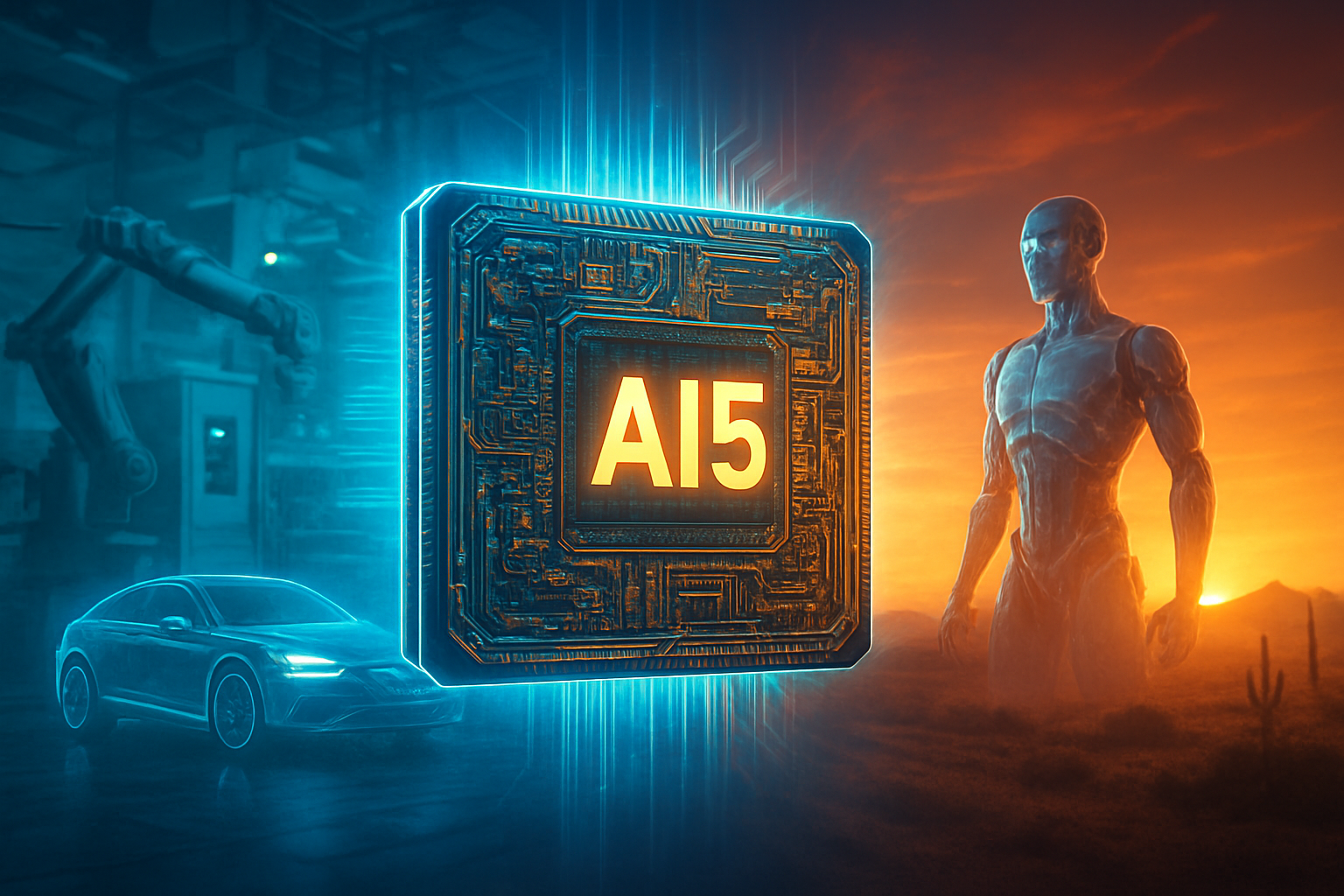
    As of January 2026, Tesla (NASDAQ: TSLA) has officially transitioned from a specialized automaker into a "sovereign silicon" powerhouse, solidifying its multi-foundry strategy for the rollout of the AI5 chip. In a move that observers are calling the most aggressive supply chain diversification in the history of the semiconductor industry, Tesla has split its high-volume 2026 production orders between Taiwan Semiconductor Manufacturing Co. (NYSE: TSM) and Samsung Electronics (KRX: 005930). Crucially, this manufacturing is being localized within the United States, utilizing TSMC’s Arizona complex and Samsung’s newly commissioned Taylor, Texas, facility.

    The immediate significance of this announcement cannot be overstated. By decoupling its most advanced AI hardware from a single geographic point of failure, Tesla has insulated its future Robotaxi and Optimus humanoid robotics programs from the mounting geopolitical tensions in the Taiwan Strait. This "foundry diversification" not only guarantees a massive volume of chips—essential for the 2026 ramp of the Cybercab—but also grants Tesla unprecedented leverage in the high-end silicon market, setting a new standard for how AI-first companies manage their hardware destiny.

    The Architecture of Autonomy: Inside the AI5 Breakthrough

    The AI5 silicon, formerly referred to internally as Hardware 5, represents an architectural clean break from its predecessor, Hardware 4 (AI4). While previous generations utilized off-the-shelf blocks for graphics and image processing, AI5 is a "pure AI" system-on-chip (SoC). Tesla engineers have stripped away legacy GPU and Image Signal Processor (ISP) components, dedicating nearly the entire die area to transformer-optimized neural processing units. The result is a staggering leap in performance: AI5 delivers between 2,000 and 2,500 TOPS (Tera Operations Per Second), representing a 4x to 5x increase over the 500 TOPS of HW4.

    Manufactured on a mix of 3nm and refined 4nm nodes, AI5 features an integrated memory architecture with bandwidth reaching 1.9 TB/s—nearly five times that of its predecessor. This massive throughput is designed specifically to handle the high-parameter "System 2" reasoning networks required for unsupervised Full Self-Driving (FSD). Initial reactions from the silicon research community highlight Tesla’s shift toward Samsung’s 3nm Gate-All-Around (GAA) architecture at the Taylor fab. Unlike the traditional FinFET structures used by TSMC, Samsung’s GAA process offers superior power efficiency, which is critical for the battery-constrained Optimus Gen 3 humanoid robots.

    Industry experts note that this dual-sourcing strategy allows Tesla to play the strengths of both giants against each other. TSMC serves as the primary high-volume "gold standard" for yield reliability in Arizona, while Samsung’s Texas facility provides a cutting-edge playground for the next-generation GAA transistors. By supporting both architectures simultaneously, Tesla has effectively built a software-defined hardware layer that can be compiled for either foundry's specific process, a feat of engineering that few companies outside of Apple (NASDAQ: AAPL) have ever attempted.

    Disruption in the Desert: Market Positioning and Competitive Edge

    The strategic shift to dual-sourcing creates a significant ripples across the tech ecosystem. For Samsung, the Tesla contract is a vital lifeline that validates its $17 billion investment in Taylor, Texas. Having struggled to capture the top-tier AI business dominated by NVIDIA (NASDAQ: NVDA) and TSMC, Samsung’s ability to secure Tesla’s AI5 and early AI6 prototypes signals a major comeback for the Korean giant in the foundry race. Conversely, while TSMC remains the market leader, Tesla’s willingness to move significant volume to Samsung serves as a warning that even the most "un-fireable" foundry can be challenged if the price and geographic security are right.

    For competitive AI labs and tech giants like Waymo or Amazon (NASDAQ: AMZN), Tesla’s move to "sovereign silicon" creates a daunting barrier to entry. While others rely on general-purpose AI chips from NVIDIA, Tesla’s vertically integrated, purpose-built silicon is tuned specifically for its own software stack. This enables Tesla to run neural networks with 10 times more parameters than current industry standards at a fraction of the power cost. This technical advantage translates directly into market positioning: Tesla can scale its Robotaxi fleet and Optimus deployments with lower per-unit costs and higher computational headroom than any competitor.

    Furthermore, the price negotiations stemming from this dual-foundry model have reportedly netted Tesla "sweetheart" pricing from Samsung. Seeking to regain market share, Samsung has offered aggressive terms that allow Tesla to maintain high margins even as it ramps the mass-market Cybercab. This financial flexibility, combined with the security of domestic US production, positions Tesla as a unique entity in the AI landscape—one that controls its AI models, its data, and now, the very factories that print its brains.

    Geopolitics and the Rise of Sovereign Silicon

    Tesla’s multi-foundry strategy fits into a broader global trend of "Sovereign AI," where companies and nations seek to control their own technological destiny. By localizing production in Texas and Arizona, Tesla is the first major AI player to fully align with the goals of the US CHIPS Act while maintaining a global supply chain footprint. This move mitigates the "Taiwan Risk" that has hung over the semiconductor industry for years. If a supply shock were to occur in the Pacific, Tesla’s US-based lines would remain operational, providing a level of business continuity that its rivals cannot match.

    This development marks a milestone in AI history comparable to the first custom-designed silicon for mobile phones. It represents the maturation of the "AI edge" where high-performance computing is no longer confined to the data center but is distributed across millions of mobile robots and vehicles. The shift from "general purpose" to "pure AI" silicon signifies the end of the era where automotive hardware was an afterthought to consumer electronics. In the 2026 landscape, the car and the robot are the primary drivers of semiconductor innovation.

    However, the move is not without concerns. Some industry analysts point to the immense complexity of maintaining two separate production lines for the same chip architecture. The risk of "divergent silicon," where chips from Samsung and TSMC perform slightly differently due to process variations, could lead to software optimization headaches. Tesla’s engineering team has countered this by implementing a unified hardware abstraction layer, but the long-term viability of this "parallel development" model will be a major test of the company's technical maturity.

    The Horizon: From AI5 to the 9-Month Design Cycle

    Looking ahead, the AI5 ramp is just the beginning. Reports indicate that Tesla is already moving toward an unprecedented 9-month design cycle for its next generations, AI6 and AI7. By 2027, the goal is for Tesla to refresh its silicon as quickly as AI researchers can iterate on new neural network architectures. This accelerated pace is only possible because the dual-foundry model provides the "hot-swappable" capacity needed to test new designs in one fab while maintaining high-volume production in another.

    Potential applications on the horizon go beyond FSD and Optimus. With the massive compute overhead of AI5, Tesla is expected to explore "Dojo-on-the-edge," allowing its vehicles to perform local training of neural networks based on their own unique driving experiences. This would move the AI training loop from the data center directly into the fleet, creating a self-improving system that learns in real-time. Challenges remain, particularly in the scaling of EUV (Extreme Ultraviolet) lithography at the Samsung Taylor plant, but experts predict that once these "teething issues" are resolved by mid-2026, Tesla’s production volume will reach record highs.

    Conclusion: A New Era for AI Manufacturing

    Tesla’s dual-foundry strategy for AI5 marks a definitive end to the era of single-source dependency in high-end AI silicon. By leveraging the competitive landscape of TSMC and Samsung and anchoring production in the United States, Tesla has secured its path toward global dominance in autonomous transport and humanoid robotics. The AI5 chip is more than just a piece of hardware; it is the physical manifestation of Tesla’s ambition to build the "unified brain" for the physical world.

    The key takeaways are clear: vertical integration is no longer enough—geographic and foundry diversification are the new prerequisites for AI leadership at scale. In the coming weeks and months, the tech world will be watching the first yields out of the Samsung Taylor facility and the integration of AI5 into the first production-run Cybercabs. This transition represents a shift in the balance of power in the semiconductor world, proving that for those with the engineering talent to manage it, the "foundry monopoly" is finally over.


    This content is intended for informational purposes only and represents analysis of current AI developments.

    TokenRing AI delivers enterprise-grade solutions for multi-agent AI workflow orchestration, AI-powered development tools, and seamless remote collaboration platforms.
    For more information, visit https://www.tokenring.ai/.