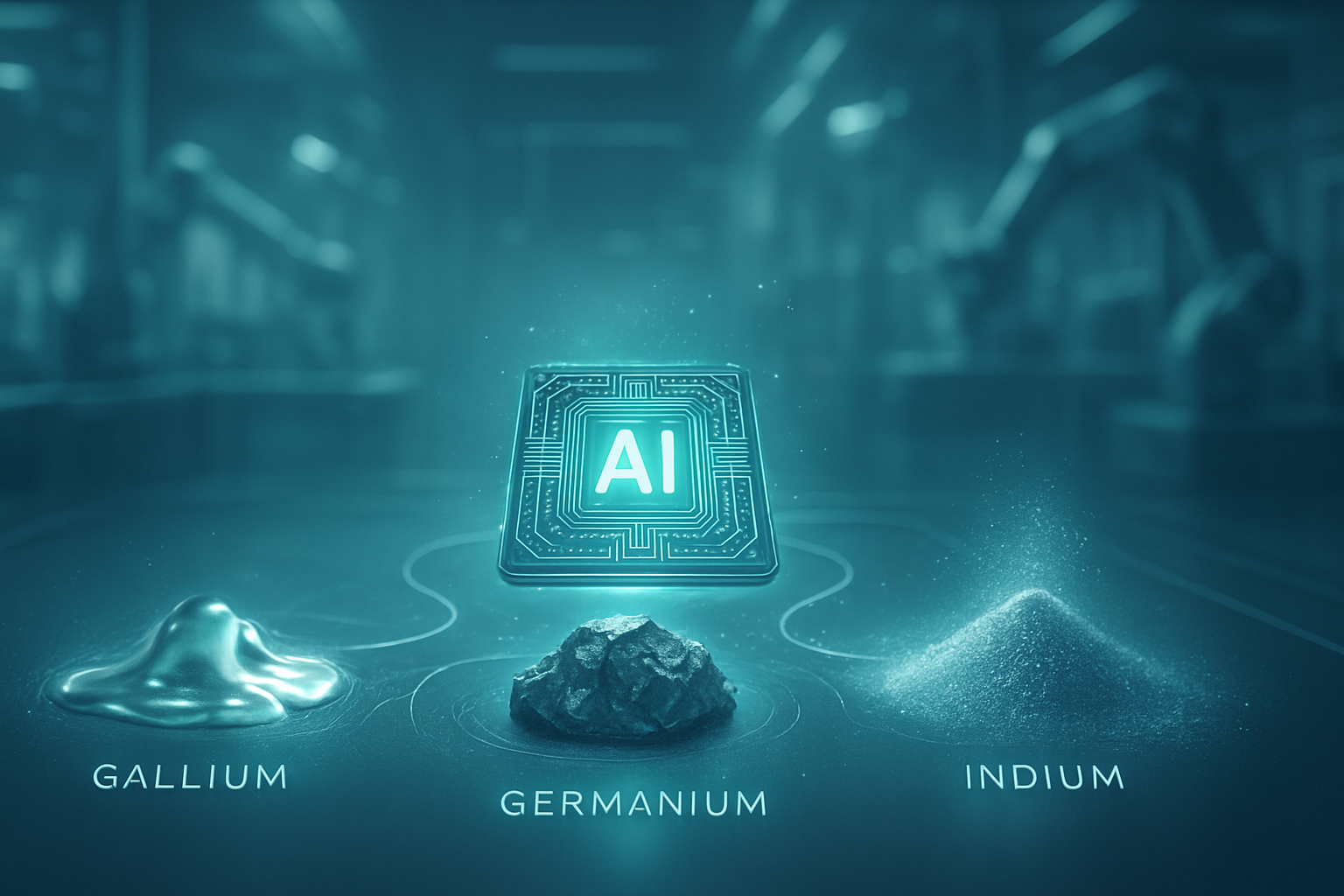
As the global race for Artificial Intelligence dominance intensifies, the spotlight often falls on groundbreaking algorithms, vast datasets, and ever-more powerful neural networks. However, beneath the surface of these digital marvels lies a physical reality: the indispensable role of highly specialized materials. In late 2025, the establishment of new processing facilities for critical minerals like gallium, germanium, and indium is emerging as a pivotal development, quietly underpinning the future of next-generation AI semiconductors. These often-overlooked elements are not merely components; they are the very building blocks enabling the speed, efficiency, and advanced capabilities required by the AI systems of tomorrow, with their secure supply now recognized as a strategic imperative for technological leadership.
The immediate significance of these facilities cannot be overstated. With AI demand soaring, the technological advancements it promises are directly tied to the availability and purity of these critical minerals. They are the key to unlocking the next leap in chip performance, ensuring that the relentless pace of AI innovation can continue unhindered by supply chain vulnerabilities or material limitations. From powering hyper-efficient data centers to enabling the intricate sensors of autonomous systems, the reliable supply of gallium, germanium, and indium is not just an economic concern, but a national security priority that will define the trajectory of AI development for decades to come.
The Microscopic Architects: Gallium, Germanium, and Indium's Role in AI's Future
The technical specifications and capabilities offered by gallium, germanium, and indium represent a significant departure from traditional silicon-centric approaches, pushing the boundaries of what AI semiconductors can achieve. Gallium, particularly in compounds like gallium nitride (GaN) and gallium arsenide (GaAs), is instrumental for high-performance computing. GaN chips deliver dramatically faster processing speeds, superior energy efficiency, and enhanced thermal management compared to their silicon counterparts. These attributes are critical for the power-hungry demands of advanced AI systems, vast data centers, and the next generation of Graphics Processing Units (GPUs) from companies like Nvidia (NASDAQ: NVDA) and AMD (NASDAQ: AMD). Beyond GaN, research into gallium oxide promises chips five times more conductive than silicon, leading to reduced energy loss and higher operational parameters crucial for future AI accelerators. Furthermore, liquid gallium alloys are finding their way into thermal interface materials (TIMs), efficiently dissipating the intense heat generated by high-density AI processors.
Germanium, on the other hand, is a cornerstone for high-speed data transmission within the sprawling infrastructure of AI. Germanium-based fiber optic cables are essential for the rapid, low-latency data transfer between processing units in large AI data centers, preventing bottlenecks that could cripple performance. Breakthroughs in germanium-on-silicon layers are enabling the creation of faster, cooler, and more energy-efficient chips, significantly boosting charge mobility for AI data centers, 5G/6G networks, and edge devices. Its compatibility with existing silicon technology allows for hybrid semiconductor approaches, offering a pathway to integrate new capabilities without a complete overhaul of manufacturing. Moreover, novel hybrid alloys incorporating germanium, carbon, silicon, and tin are under development for quantum computing and advanced microelectronics, designed to be compatible with current CMOS manufacturing processes.
Indium completes this trio of critical minerals, serving as a vital component in advanced displays, touchscreens, and high-frequency electronics. For AI, indium-containing compounds are crucial for high-performance processors demanding faster switching speeds, higher heat loads, and cleaner signal transmission. While indium tin oxide (ITO) is widely known for transparent conductive oxides in touchscreens, recent innovations leverage amorphous indium oxide for novel 3D stacking of transistors and memory within AI chips. This promises faster computing, reduced energy consumption, and significantly higher integration density. Indium selenide is also emerging as a "golden semiconductor" material, holding immense potential for next-generation, high-performance, low-power chips applicable across AI, autonomous driving, and smart terminals. The initial reactions from the AI research community and industry experts underscore a collective sigh of relief, acknowledging that securing these supply chains is as critical as the innovations themselves, recognizing the vulnerability posed by concentrated processing capacity, particularly from China's export controls on gallium and germanium first announced in 2023.
Reshaping the AI Landscape: Corporate Strategies and Competitive Edges
The secure and diversified supply of gallium, germanium, and indium through new processing facilities will profoundly affect AI companies, tech giants, and startups alike, reshaping competitive dynamics and strategic advantages. Semiconductor manufacturers like Intel (NASDAQ: INTC), Nvidia (NASDAQ: NVDA), AMD (NASDAQ: AMD), and Taiwan Semiconductor Manufacturing Company (TSMC) (NYSE: TSM) stand to benefit immensely from a stable and reliable source of these critical materials. Their ability to consistently produce cutting-edge AI chips, unhampered by supply disruptions, will directly translate into market leadership and sustained innovation. Companies heavily invested in AI hardware development, such as those building specialized AI accelerators or advanced data center infrastructure, will find their roadmaps significantly de-risked.
Conversely, companies that fail to secure access to these essential minerals could face significant competitive disadvantages. The reliance on a single source or volatile supply chains could lead to production delays, increased costs, and ultimately, a slowdown in their AI product development and deployment. This scenario could disrupt existing products or services, particularly those at the forefront of AI innovation that demand the highest performance and efficiency. For tech giants with vast AI operations, securing these materials is not just about profit, but about maintaining their competitive edge in cloud AI services, autonomous systems, and advanced consumer electronics. Startups, often agile but resource-constrained, might find opportunities in specialized niches, perhaps focusing on novel material applications or recycling technologies, but their success will still hinge on the broader availability of processed minerals. The strategic advantage will increasingly lie with nations and corporations that invest in domestic or allied processing capabilities, fostering resilience and independence in the critical AI supply chain.
A New Era of Material Geopolitics and AI's Broader Implications
The drive for new rare earths and critical minerals processing facilities for gallium, germanium, and indium fits squarely into the broader AI landscape and ongoing global trends, particularly those concerning geopolitical stability and national security. The concentration of critical mineral processing in a few regions, notably China, which controls a significant portion of gallium and germanium refining, has exposed profound supply chain vulnerabilities. China's past and recent export controls have served as a stark reminder of the potential for economic and technological leverage, pushing nations like the U.S. and its allies to prioritize supply chain diversification. This initiative is not merely about economic resilience; it's about securing technological sovereignty in an era where AI leadership is increasingly tied to national power.
The impacts extend beyond geopolitics to environmental considerations. The establishment of new processing facilities, especially those focused on sustainable extraction and recycling, can mitigate the environmental footprint often associated with mining and refining. Projects like MTM's Texas facility, aiming to recover critical metals from industrial waste and electronic scrap by late 2025, exemplify a push towards a more circular economy for these materials. However, potential concerns remain regarding the energy consumption and waste generation of new facilities, necessitating stringent environmental regulations and continuous innovation in green processing technologies. This shift also represents a significant comparison to previous AI milestones; while the early AI era was built on the foundation of readily available silicon, the next phase demands a more complex and diversified material palette, elevating the importance of these "exotic" elements from niche materials to strategic commodities. The U.S. Energy Department's funding initiatives for rare earth recovery and the use of AI in material discovery underscore these strategic priorities, highlighting how secure access to these materials is fundamental to the entire AI ecosystem, from data centers to "Physical AI" applications like robotics and defense systems.
The Horizon of Innovation: Future Developments in AI Materials
Looking ahead, the establishment of new critical mineral processing facilities promises to unlock a wave of near-term and long-term developments in AI. In the immediate future, we can expect accelerated research and development into novel semiconductor architectures that fully leverage the superior properties of gallium, germanium, and indium. This includes the widespread adoption of GaN transistors in high-power AI applications, the integration of germanium-on-silicon layers for enhanced chip performance, and the exploration of 3D stacked indium oxide memory for ultra-dense and efficient AI accelerators. The reliability of supply will foster greater investment in these advanced material sciences, moving them from laboratory curiosities to mainstream manufacturing.
Potential applications and use cases on the horizon are vast and transformative. Beyond powering more efficient data centers, these minerals are crucial for the advancement of "Physical AI," encompassing humanoid robots, autonomous vehicles, and sophisticated drone systems that require highly sensitive sensors, robust communication, and efficient onboard processing. Furthermore, these materials are foundational for emerging fields like quantum computing, where their unique electronic properties are essential for creating stable qubits and advanced quantum processors. The challenges that need to be addressed include scaling production to meet exponential AI demand, discovering new economically viable deposits, and perfecting recycling technologies to create a truly sustainable supply chain. Experts predict a future where material science and AI development become intrinsically linked, with AI itself being used to discover and optimize new materials, creating a virtuous cycle of innovation. Facilities like ElementUSA's planned Louisiana plant and Korea Zinc's Crucible Metals plant in Tennessee, supported by CHIPS incentives, are examples of efforts expected to bolster domestic production in the coming years.
Securing the Future of AI: A Strategic Imperative
In summary, the emergence of new processing facilities for essential minerals like gallium, germanium, and indium represents a critical inflection point in the history of Artificial Intelligence. These facilities are not merely about raw material extraction; they are about securing the foundational elements necessary for the next generation of AI semiconductors, ensuring the continued trajectory of technological progress. The key takeaways include the indispensable role of these minerals in enabling faster, more energy-efficient, and denser AI chips, the profound geopolitical implications of their supply chain security, and the urgent need for diversified and sustainable processing capabilities.
This development's significance in AI history is comparable to the discovery and widespread adoption of silicon itself, marking a transition to a more complex, specialized, and geopolitically sensitive material landscape. The long-term impact will be a more resilient, innovative, and potentially decentralized AI ecosystem, less vulnerable to single points of failure. What to watch for in the coming weeks and months are further announcements regarding new facility constructions, government incentives for critical mineral processing, and advancements in material science that leverage these elements. The global scramble for technological leadership in AI is now as much about what's beneath the ground as it is about what's in the cloud.
This content is intended for informational purposes only and represents analysis of current AI developments.
TokenRing AI delivers enterprise-grade solutions for multi-agent AI workflow orchestration, AI-powered development tools, and seamless remote collaboration platforms.
For more information, visit https://www.tokenring.ai/.