Tag: GitHub Copilot

  • The Autodev Revolution: How Devin and GitHub Copilot Workspace Redefined the Engineering Lifecycle

    The Autodev Revolution: How Devin and GitHub Copilot Workspace Redefined the Engineering Lifecycle

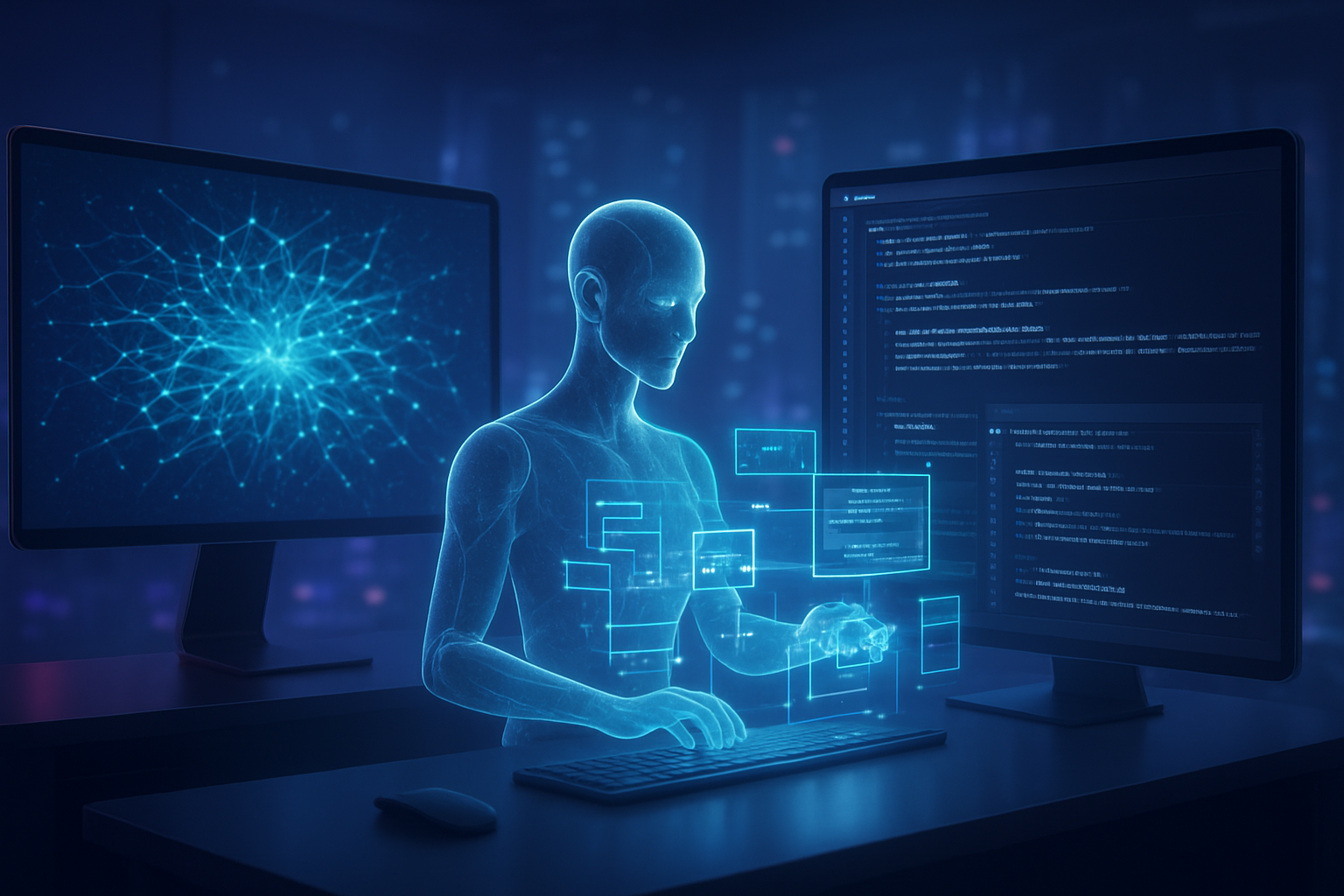
    As of early 2026, the software engineering landscape has undergone its most radical transformation since the invention of the high-level programming language. The "Autodev" revolution—a shift from AI that merely suggests code to AI that autonomously builds, tests, and deploys software—has moved from experimental beta tests to the core of the global tech stack. At the center of this shift are two divergent philosophies: the integrated agentic assistant, epitomized by GitHub Copilot Workspace, and the parallel autonomous engineer, pioneered by Cognition AI’s Devin.

    This evolution has fundamentally altered the role of the human developer. No longer relegated to syntax and boilerplate, engineers have transitioned into "Architects of Agents," orchestrating fleets of AI entities that handle the heavy lifting of legacy migrations, security patching, and feature implementation. As we enter the second week of January 2026, the data is clear: organizations that have embraced these autonomous workflows are reporting productivity gains that were once thought to be the stuff of science fiction.

    The Architectural Divide: Agents vs. Assistants

    The technical maturation of these tools in 2025 has solidified two distinct approaches to AI-assisted development. GitHub, owned by Microsoft (NASDAQ: MSFT), has evolved Copilot Workspace into a "Copilot-native" environment. Leveraging the GPT-5-Codex architecture, the 2026 version of Copilot Workspace features a dedicated "Agent Mode." This allows the AI to not only suggest lines of code but to navigate entire repositories, execute terminal commands, and fix its own compilation errors iteratively. Its integration with the Model Context Protocol (MCP) allows it to pull live data from Jira and Slack, ensuring that the code it writes is contextually aware of business requirements and team discussions.

    In contrast, Devin 2.0, the flagship product from Cognition AI, operates as a "virtual teammate" rather than an extension of the editor. Following its 2025 acquisition of the agentic IDE startup Windsurf, Devin now features "Interactive Planning," a system where the AI generates a multi-step technical roadmap for a complex task before writing a single line of code. While Copilot Workspace excels at the "Human-in-the-Loop" (HITL) model—where a developer guides the AI through a task—Devin is designed for "Goal-Oriented Autonomy." A developer can assign Devin a high-level goal, such as "Migrate this microservice from Python 3.8 to 3.12 and update all dependencies," and the agent will work independently in a cloud-based sandbox until the task is complete.

    The technical gap between these models is narrowing, but their use cases remain distinct. Copilot Workspace has become the standard for daily feature development, where its "Copilot Vision" feature—released in late 2025—can transform a UI mockup directly into a working frontend scaffold. Devin, meanwhile, has dominated the "maintenance chore" market. On the SWE-bench Verified leaderboard, Devin 2.0 recently achieved a 67% PR merge rate, a significant leap from the mid-30s seen in 2024, proving its capability to handle long-tail engineering tasks without constant human supervision.

    Initial reactions from the AI research community have been overwhelmingly positive, though cautious. Experts note that while the "Autodev" tools have solved the "blank page" problem, they have introduced a new challenge: "Architectural Drift." Without a human developer deeply understanding every line of code, some fear that codebases could become brittle over time. However, the efficiency gains—such as Nubank’s reported 12x faster code migration in late 2025—have made the adoption of these tools an economic imperative for most enterprises.

    The Corporate Arms Race and Market Disruption

    The rise of autonomous development has triggered a massive strategic realignment among tech giants. Microsoft (NASDAQ: MSFT) remains the market leader by volume, recently surpassing 20 million Copilot users. By deeply embedding Workspace into the GitHub ecosystem, Microsoft has created a "sticky" environment that makes it difficult for competitors to displace them. However, Alphabet (NASDAQ: GOOGL) has responded with "Antigravity," a specialized IDE within the Google Cloud ecosystem designed specifically for orchestrating multi-agent systems to build complex microservices.

    The competitive pressure has also forced Amazon (NASDAQ: AMZN) to pivot its AWS CodeWhisperer into "Amazon Q Developer Agents," focusing heavily on the DevOps and deployment pipeline. This has created a fragmented market where startups like Cognition AI and Augment Code are forced to compete on specialized "Architectural Intelligence." To stay competitive, Cognition AI slashed its pricing in mid-2025, bringing the entry-level Devin subscription down to $20/month, effectively democratizing access to autonomous engineering for small startups and individual contractors.

    This shift has significantly disrupted the traditional "Junior Developer" hiring pipeline. Many entry-level tasks, such as writing unit tests, documentation, and basic CRUD (Create, Read, Update, Delete) operations, are now handled entirely by AI. Startups that once required a team of ten engineers to build an MVP are now launching with just two senior developers and a fleet of Devin agents. This has forced educational institutions and coding bootcamps to radically overhaul their curricula, shifting focus from syntax and logic to system design, AI orchestration, and security auditing.

    Strategic advantages are now being measured by "Contextual Depth." Companies that can provide the AI with the most comprehensive view of their internal documentation, legacy code, and business logic are seeing the highest ROI. This has led to a surge in demand for enterprise-grade AI infrastructure that can safely index private data without leaking it to the underlying model providers, a niche that Augment Code and Anthropic’s "Claude Code" terminal agent have aggressively pursued throughout 2025.

    The Broader Significance of the Autodev Era

    The "Autodev" revolution is more than just a productivity tool; it represents a fundamental shift in the AI landscape toward "Agentic Workflows." Unlike the "Chatbot Era" of 2023-2024, where AI was a passive recipient of prompts, the tools of 2026 are proactive. They monitor repositories for bugs, suggest performance optimizations before a human even notices a slowdown, and can even "self-heal" broken CI/CD pipelines. This mirrors the transition in the automotive industry from driver-assist features to full self-driving capabilities.

    However, this rapid advancement has raised significant concerns regarding technical debt and security. As AI agents generate code at an unprecedented rate, the volume of code that needs to be maintained has exploded. There is a growing risk of "AI-generated spaghetti code," where the logic is technically correct but so complex or idiosyncratic that it becomes impossible for a human to audit. Furthermore, the "prompt injection" attacks of 2024 have evolved into "agent hijacking," where malicious actors attempt to trick autonomous developers into injecting backdoors into production codebases.

    Comparing this to previous milestones, the Autodev revolution is being viewed as the "GPT-3 moment" for software engineering. Just as GPT-3 proved that LLMs could handle general language tasks, Devin and Copilot Workspace have proven that AI can handle the full lifecycle of a software project. This has profound implications for the global economy, as the cost of building and maintaining software—the "tax" on innovation—is beginning to plummet. We are seeing a "Cambrian Explosion" of niche software products that were previously too expensive to develop.

    The impact on the workforce remains the most debated topic. While senior developers have become more powerful than ever, the "Junior Developer Gap" remains a looming crisis. If the next generation of engineers does not learn the fundamentals because AI handles them, the industry may face a talent shortage in the 2030s when the current senior architects retire. Organizations are now experimenting with "AI-Human Pairing" roles, where junior devs are tasked with auditing AI-generated plans as a way to learn the ropes.

    Future Horizons: Self-Healing Systems and AGI-Lite

    Looking toward the end of 2026 and into 2027, the next frontier for Autodev is "Self-Healing Infrastructure." We are already seeing early prototypes of systems that can detect a production outage, trace the bug to a specific commit, write a fix, test it in a staging environment, and deploy it—all within seconds and without human intervention. This "Closed-Loop Engineering" would effectively eliminate downtime for many web services, moving us closer to the ideal of 100% system availability.

    Another emerging trend is the "Personalized Developer Agent." Experts predict that within the next 18 months, developers will train their own local models that learn their specific coding style, preferred libraries, and architectural quirks. This would allow for a level of synergy between human and AI that goes beyond what is possible with generic models like GPT-5. We are also seeing the rise of "Prompt-to-App" platforms like Bolt.new and Lovable, which allow non-technical founders to build complex applications by simply describing them, potentially bypassing the traditional IDE entirely for many use cases.

    The primary challenge that remains is "Verification at Scale." As the volume of code grows, we need AI agents that are as good at formal verification and security auditing as they are at writing code. Researchers are currently focusing on "Red-Teaming Agents"—AI systems whose sole job is to find flaws in the code written by other AI agents. The winner of the Autodev race will likely be the company that can provide the highest "Trust Score" for its autonomous output.

    Conclusion: The New Baseline for Software Production

    The Autodev revolution has fundamentally reset the expectations for what a single developer, or a small team, can achieve. By January 2026, the distinction between a "programmer" and an "architect" has largely vanished; to be a developer today is to be a manager of intelligent agents. GitHub Copilot Workspace has successfully democratized agentic workflows for the masses, while Devin has pushed the boundaries of what autonomous systems can handle in the enterprise.

    This development will likely be remembered as the moment software engineering moved from a craft of manual labor to a discipline of high-level orchestration. The long-term impact is a world where software is more abundant, more reliable, and more tailored to individual needs than ever before. However, the responsibility for safety and architectural integrity has never been higher for the humans at the helm.

    In the coming weeks, keep a close eye on the "Open Source Autodev" movement. Projects like OpenHands (formerly OpenDevin) are gaining significant traction, promising to bring Devin-level autonomy to the open-source community without the proprietary lock-in of the major tech giants. As the barriers to entry continue to fall, the next great software breakthrough could come from a single person working with a fleet of autonomous agents in a garage, just as it did in the early days of the PC revolution.


    This content is intended for informational purposes only and represents analysis of current AI developments.

    TokenRing AI delivers enterprise-grade solutions for multi-agent AI workflow orchestration, AI-powered development tools, and seamless remote collaboration platforms. For more information, visit https://www.tokenring.ai/.
  • The World’s First Autonomous AI Software Engineer: Devin Now Produces 25% of Cognition’s Code

    The World’s First Autonomous AI Software Engineer: Devin Now Produces 25% of Cognition’s Code

    In a landmark shift for the software development industry, Cognition AI has revealed that its autonomous AI software engineer, Devin, is now responsible for producing 25% of the company’s own internal pull requests. This milestone marks a transition for the technology from a viral prototype to a functional, high-capacity digital employee. By late 2025, the "Devins" operating within Cognition are no longer just experimental tools; they are integrated teammates capable of planning, executing, and deploying complex software projects with minimal human oversight.

    The announcement comes as the AI industry moves beyond simple code-completion assistants toward fully autonomous agents. Cognition’s CEO, Scott Wu, recently confirmed that the company's 15-person engineering team now effectively manages a "fleet" of Devins, with the ambitious goal of having the AI handle 50% of all internal code production by the end of the year. This development has sent shockwaves through Silicon Valley, signaling a fundamental change in how software is built, maintained, and scaled in the age of generative intelligence.

    Technical Mastery: From Sandbox to Production

    Devin’s core technical advantage lies in its ability to reason over long horizons and execute thousands of sequential decisions. Unlike traditional LLM-based assistants that provide snippets of code, Devin operates within a secure, sandboxed environment equipped with its own shell, code editor, and web browser. This allows the agent to search for documentation, learn unfamiliar APIs, and debug its own errors in real-time. A key breakthrough in 2025 was the introduction of "Interactive Planning," a feature that allows human engineers to collaborate on a high-level roadmap before Devin begins the execution phase, ensuring that the AI’s logic aligns with architectural goals.

    On the industry-standard SWE-bench—a rigorous test of an AI’s ability to solve real-world GitHub issues—Devin’s performance has seen exponential growth. While its initial release in early 2024 stunned the community with a 13.86% unassisted success rate, the late 2025 iteration leverages the SWE-1.5 "Fast Agent Model." Powered by specialized hardware from Cerebras Systems, this model can process up to 950 tokens per second, allowing Devin to "think" and iterate 13 times faster than previous frontier models. This speed, combined with the integration of advanced reasoning models like Claude 3.7 Sonnet, has pushed the agent's problem-solving capabilities into a territory where it can resolve complex, multi-file bugs that previously required hours of human intervention.

    Industry experts have noted that Devin’s "Confidence Scores" have been a game-changer for enterprise adoption. By flagging its own tasks as Green, Yellow, or Red based on the likelihood of success, the AI allows human supervisors to focus only on the most complex edge cases. This "agent-native" approach differs fundamentally from the autocomplete models of the past, as Devin maintains a persistent state and a "DeepWiki" intelligence of the entire codebase, allowing it to understand how a change in one module might ripple through an entire microservices architecture.

    The Battle for the AI-Native IDE

    The success of Devin has ignited a fierce competitive landscape among tech giants and specialized startups. Cognition’s valuation recently soared to $10.2 billion following a $400 million Series C round led by Founders Fund, positioning it as the primary challenger to established players. The company’s strategic acquisition of the agentic IDE Windsurf in July 2025 further solidified its market position, doubling its annual recurring revenue (ARR) to over $150 million as it integrates autonomous capabilities directly into the developer's workflow.

    Major tech incumbents are responding with their own "agentic" pivots. Microsoft (NASDAQ: MSFT), which pioneered the space with GitHub Copilot, has launched Copilot Workspace to offer similar end-to-end autonomy. Meanwhile, Alphabet (NASDAQ: GOOGL) has introduced "Antigravity," a dedicated IDE designed specifically for autonomous agents, and Amazon (NASDAQ: AMZN) has deployed Amazon Transform to handle large-scale legacy migrations for AWS customers. The entry of Meta Platforms (NASDAQ: META) into the space—following its multi-billion dollar acquisition of Manus AI—suggests that the race to own the "AI Engineer" category is now a top priority for every major hyperscaler.

    Enterprise adoption is also scaling rapidly beyond the tech sector. Financial giants like Goldman Sachs (NYSE: GS) and Citigroup (NYSE: C) have begun rolling out Devin to their internal development teams. These institutions are using the AI to automate tedious ETL (Extract, Transform, Load) migrations and security patching, allowing their human engineers to focus on high-level system design and financial modeling. This shift is turning software development from a labor-intensive "bricklaying" process into an architectural discipline, where the human’s role is to direct and audit the work of AI agents.

    A Paradigm Shift in the Global AI Landscape

    The broader significance of Devin’s 25% pull request milestone cannot be overstated. It represents the first concrete proof that an AI-first company can significantly reduce its reliance on human labor for core technical tasks. This trend is part of a larger movement toward "agentic workflows," where AI is no longer a chatbot but a participant in the workforce. Comparisons are already being drawn to the "AlphaGo moment" for software engineering; just as AI mastered complex games, it is now mastering the complex, creative, and often messy world of production-grade code.

    However, this rapid advancement brings significant concerns regarding the future of the junior developer role. If an AI can handle 25% to 50% of a company’s pull requests, the traditional "entry-level" tasks used to train new engineers—such as bug fixes and small feature additions—may disappear. This creates a potential "seniority gap," where the industry struggles to cultivate the next generation of human architects. Furthermore, the ethical implications of autonomous code deployment remain a hot topic, with critics pointing to the risks of AI-generated vulnerabilities being introduced into critical infrastructure at machine speed.

    Despite these concerns, the efficiency gains are undeniable. The ability for a small 15-person team at Cognition to perform like a 100-person engineering department suggests a future where startups can remain lean for much longer, and where the "billion-dollar one-person company" becomes a statistical possibility. This democratization of high-end engineering capability could lead to an explosion of new software products and services that were previously too expensive or complex to build.

    The Road to 50% and Beyond

    Looking ahead, Cognition is focused on reaching its 50% internal PR target by the end of 2025. This will require Devin to move beyond routine tasks and into the realm of complex architectural decisions and system-wide refactoring. Near-term developments are expected to include "Multi-Agent Orchestration," where different Devins specialized in frontend, backend, and DevOps work together in a synchronized "squad" to build entire platforms from scratch without any human code input.

    The long-term vision for Cognition and its competitors is the creation of a "Self-Healing Codebase." In this scenario, AI agents would continuously monitor production environments, identify performance bottlenecks or security flaws, and autonomously write and deploy patches before a human is even aware of the issue. Challenges remain, particularly in the areas of "hallucination management" in large-scale systems and the high compute costs associated with running thousands of autonomous agents simultaneously. However, as hardware specialized for agentic reasoning—like that from Cerebras—becomes more accessible, these barriers are expected to fall.

    Experts predict that by 2027, the role of a "Software Engineer" will have evolved into that of an "AI Orchestrator." The focus will shift from syntax and logic to system requirements, security auditing, and ethical oversight. As Devin and its peers continue to climb the ladder of autonomy, the very definition of "writing code" is being rewritten.

    A New Era of Engineering

    The emergence of Devin as a productive member of the Cognition team marks a definitive turning point in the history of artificial intelligence. It is the moment where AI moved from assisting humans to acting on their behalf. The fact that a quarter of a leading AI company’s codebase is now authored by an agent is a testament to the technology’s maturity and its potential to redefine the global economy’s digital foundations.

    As we move into 2026, the industry will be watching closely to see if other enterprises can replicate Cognition’s success. The key takeaways from this development are clear: autonomy is the new frontier, the "agent-native" IDE is the new battlefield, and the speed of software innovation is about to accelerate by orders of magnitude. For the tech industry, the message is simple: the AI colleague has arrived, and it is already hard at work.


    This content is intended for informational purposes only and represents analysis of current AI developments.

    TokenRing AI delivers enterprise-grade solutions for multi-agent AI workflow orchestration, AI-powered development tools, and seamless remote collaboration platforms.
    For more information, visit https://www.tokenring.ai/.

  • GitHub Copilot Unleashed: The Dawn of the Multi-Model Agentic Assistant Reshapes Software Development

    GitHub Copilot Unleashed: The Dawn of the Multi-Model Agentic Assistant Reshapes Software Development

    GitHub Copilot, once a revolutionary code completion tool, has undergone a profound transformation, emerging as a faster, smarter, and profoundly more autonomous multi-model agentic assistant. This evolution, rapidly unfolding from late 2024 through mid-2025, marks a pivotal moment for software development, redefining developer workflows and promising an unprecedented surge in productivity. No longer content with mere suggestions, Copilot now acts as an intelligent peer, capable of understanding complex, multi-step tasks, iterating on its own solutions, and even autonomously identifying and rectifying errors. This paradigm shift, driven by advanced agentic capabilities and a flexible multi-model architecture, is set to fundamentally alter how code is conceived, written, and deployed.

    The Technical Leap: From Suggestion Engine to Autonomous Agent

    The core of GitHub Copilot's metamorphosis lies in its newly introduced Agent Mode and specialized Coding Agents, which became generally available by May 2025. In Agent Mode, Copilot can analyze high-level goals, break them down into actionable subtasks, generate or identify necessary files, suggest terminal commands, and even self-heal runtime errors. This enables it to proactively take action based on user prompts, moving beyond reactive assistance to become an autonomous problem-solver. The dedicated Coding Agent, sometimes referred to as "Project Padawan," operates within GitHub's (NASDAQ: MSFT) native control layer, powered by GitHub Actions. It can be assigned tasks such as performing code reviews, writing tests, fixing bugs, and implementing new features, working in secure development environments and pushing commits to draft pull requests for human oversight.

    Further enhancing its capabilities, Copilot Edits, generally available by February 2025, allows developers to use natural language to request changes across multiple files directly within their workspace. The evolution also includes Copilot Workspace, offering agentic features that streamline the journey from brainstorming to functional code through a system of collaborating sub-agents. Beyond traditional coding, a new Site Reliability Engineering (SRE) Agent was introduced in May 2025 to assist cloud developers in automating responses to production alerts, mitigating issues, and performing root cause analysis, thereby reducing operational costs. Copilot also gained capabilities for app modernization, assisting with code assessments, dependency updates, and remediation for legacy Java and .NET applications.

    Crucially, the "multi-model" aspect of Copilot's evolution is a game-changer. By February 2025, GitHub Copilot introduced a model picker, allowing developers to select from a diverse library of powerful Large Language Models (LLMs) based on the specific task's requirements for context, cost, latency, and reasoning complexity. This includes models from OpenAI (e.g., GPT-4.1, GPT-5, o3-mini, o4-mini), Google DeepMind (NASDAQ: GOOGL) (Gemini 2.0 Flash, Gemini 2.5 Pro), and Anthropic (Claude Sonnet 3.7 Thinking, Claude Opus 4.1, Claude 3.5 Sonnet). GPT-4.1 serves as the default for core features, with lighter models for basic tasks and more powerful ones for complex reasoning. This flexible architecture ensures Copilot adapts to diverse development needs, providing "smarter" responses and reducing hallucinations. The "faster" aspect is addressed through enhanced context understanding, allowing for more accurate decisions, and continuous performance improvements in token optimization and prompt caching. Initial reactions from the AI research community and industry experts highlight the shift from AI as a mere tool to a truly collaborative, autonomous agent, setting a new benchmark for developer productivity.

    Reshaping the AI Industry Landscape

    The evolution of GitHub Copilot into a multi-model agentic assistant has profound implications for the entire tech industry, fundamentally reshaping competitive landscapes by October 2025. Microsoft (NASDAQ: MSFT), as the owner of GitHub, stands as the primary beneficiary, solidifying its dominant position in developer tools by integrating cutting-edge AI directly into its extensive ecosystem, including VS Code and Azure AI. This move creates significant ecosystem lock-in, making it harder for developers to switch platforms. The open-sourcing of parts of Copilot’s VS Code extensions further fosters community-driven innovation, reinforcing its strategic advantage.

    For major AI labs like OpenAI, Anthropic, and Google DeepMind (NASDAQ: GOOGL), this development drives increased demand for their advanced LLMs, which form the core of Copilot's multi-model architecture. Competition among these labs shifts from solely developing powerful foundational models to ensuring seamless integration and optimal performance within agentic platforms like Copilot. Cloud providers such as Amazon (NASDAQ: AMZN) Web Services, Google Cloud (NASDAQ: GOOGL), and Microsoft Azure (NASDAQ: MSFT) also benefit from the increased computational demand required to run these advanced AI models and agents, fueling their infrastructure growth. These tech giants are also actively developing their own agentic solutions, such as Google Jules and Amazon’s Agents for Bedrock, to compete in this rapidly expanding market.

    Startups face a dual landscape of opportunities and challenges. While directly competing with comprehensive offerings from tech giants is difficult due to resource intensity, new niches are emerging. Startups can thrive by developing highly specialized AI agents for specific domains, programming languages, or unique development workflows not fully covered by Copilot. Opportunities also abound in building orchestration and management platforms for fleets of AI agents, as well as in AI observability, security, auditing, and explainability solutions, which are critical for autonomous workflows. However, the high computational and data resource requirements for developing and training large, multi-modal agentic AI systems pose a significant barrier to entry for smaller players. This evolution also disrupts existing products and services, potentially superseding specialized code generation tools, automating aspects of manual testing and debugging, and transforming traditional IDEs into command centers for supervising AI agents. The overarching competitive theme is a shift towards integrated, agentic solutions that amplify human capabilities across the entire software development lifecycle, with a strong emphasis on developer experience and enterprise-grade readiness.

    Broader AI Significance and Considerations

    GitHub Copilot's evolution into a faster, smarter, multi-model agentic assistant is a landmark achievement, embodying the cutting edge of AI development and aligning with several overarching trends in the broader AI landscape as of October 2025. This transformation signifies the rise of agentic AI, moving beyond reactive generative AI to proactive, goal-driven systems that can break down tasks, reason, act, and adapt with minimal human intervention. Deloitte predicts that by 2027, 50% of companies using generative AI will launch agentic AI pilots, underscoring this significant industry shift. Furthermore, it exemplifies the expansion of multi-modal AI, where systems process and understand multiple data types (text, code, soon images, and design files) simultaneously, leading to more holistic comprehension and human-like interactions. Gartner forecasts that by 2027, 40% of generative AI solutions will be multimodal, up from just 1% in 2023.

    The impacts are profound: accelerated software development (early studies showed Copilot users completing tasks 55% faster, a figure expected to increase significantly), increased productivity and efficiency by automating complex, multi-file changes and debugging, and a democratization of development by lowering the barrier to entry for programming. Developers' roles will evolve, shifting towards higher-level architecture, problem-solving, and managing AI agents, rather than being replaced. This also leads to enhanced code quality and consistency through automated enforcement of coding standards and integration checks.

    However, this advancement also brings potential concerns. Data protection and confidentiality risks are heightened as AI tools process more proprietary code; inadvertent exposure of sensitive information remains a significant threat. Loss of control and over-reliance on autonomous AI could degrade fundamental coding skills or lead to an inability to identify AI-generated errors or biases, necessitating robust human oversight. Security risks are amplified by AI's ability to access and modify multiple system parts, expanding the attack surface. Intellectual property and licensing issues become more complex as AI generates extensive code that might inadvertently mirror copyrighted work. Finally, bias in AI-generated solutions and challenges with reliability and accuracy for complex, novel problems remain critical areas for ongoing attention.

    Comparing this to previous AI milestones, agentic multi-model Copilot moves beyond expert systems and Robotic Process Automation (RPA) by offering unparalleled flexibility, reasoning, and adaptability. It significantly advances from the initial wave of generative AI (LLMs/chatbots) by applying generative outputs toward specific goals autonomously, acting on behalf of the user, and orchestrating multi-step workflows. While breakthroughs like AlphaGo (2016) demonstrated AI's superhuman capabilities in specific domains, Copilot's agentic evolution has a broader, more direct impact on daily work for millions, akin to how cloud computing and SaaS democratized powerful infrastructure, now democratizing advanced coding capabilities.

    The Road Ahead: Future Developments and Challenges

    The trajectory of GitHub Copilot as a multi-model agentic assistant points towards an increasingly autonomous, intelligent, and deeply integrated future for software development. In the near term, we can expect the continued refinement and widespread adoption of features like the Agent Mode and Coding Agent across more IDEs and development environments, with enhanced capabilities for self-healing and iterative code refinement. The multi-model support will likely expand, incorporating even more specialized and powerful LLMs from various providers, allowing for finer-grained control over model selection based on specific task demands and cost-performance trade-offs. Further enhancements to Copilot Edits and Next Edit Suggestions will make multi-file modifications and code refactoring even more seamless and intuitive. The integration of vision capabilities, allowing Copilot to generate UI code from mock-ups or screenshots, is also on the immediate horizon, moving towards truly multi-modal input beyond text and code.

    Looking further ahead, long-term developments envision Copilot agents collaborating with other agents to tackle increasingly complex development and production challenges, leading to autonomous multi-agent collaboration. We can anticipate enhanced Pull Request support, where Copilot not only suggests improvements but also autonomously manages aspects of the review process. The vision of self-optimizing AI codebases, where AI systems autonomously improve codebase performance over time, is a tangible goal. AI-driven project management, where agents assist in assigning and prioritizing coding tasks, could further automate development workflows. Advanced app modernization capabilities are expected to expand beyond current support to include mainframe modernization, addressing a significant industry need. Experts predict a shift from AI being an assistant to becoming a true "peer-programmer" or even providing individual developers with their "own team" of agents, freeing up human developers for more complex and creative work.

    However, several challenges need to be addressed for this future to fully materialize. Security and privacy remain paramount, requiring robust segmentation protocols, data anonymization, and comprehensive audit logs to prevent data leaks or malicious injections by autonomous agents. Current agent limitations, such as constraints on cross-repository changes or simultaneous pull requests, need to be overcome. Improving model reasoning and data quality is crucial for enhancing agent effectiveness, alongside tackling context limits and long-term memory issues inherent in current LLMs for complex, multi-step tasks. Multimodal data alignment and ensuring accurate integration of heterogeneous data types (text, images, audio, video) present foundational technical hurdles. Maintaining human control and understanding while increasing AI autonomy is a delicate balance, requiring continuous training and robust human-in-the-loop mechanisms. The need for standardized evaluation and benchmarking metrics for AI agents is also critical. Experts predict that while agents gain autonomy, the development process will remain collaborative, with developers reviewing agent-generated outputs and providing feedback for iterative improvements, ensuring a "human-led, tech-powered" approach.

    A New Era of Software Creation

    GitHub Copilot's transformation into a faster, smarter, multi-model agentic assistant represents a paradigm shift in the history of software development. The key takeaways from this evolution, rapidly unfolding in 2025, are the transition from reactive code completion to proactive, autonomous problem-solving through Agent Mode and Coding Agents, and the introduction of a multi-model architecture offering unparalleled flexibility and intelligence. This advancement promises unprecedented gains in developer productivity, accelerated delivery times, and enhanced code quality, fundamentally reshaping the developer experience.

    This development's significance in AI history cannot be overstated; it marks a pivotal moment where AI moves beyond mere assistance to becoming a genuine, collaborative partner capable of understanding complex intent and orchestrating multi-step actions. It democratizes advanced coding capabilities, much like cloud computing democratized infrastructure, bringing sophisticated AI tools to every developer. While the benefits are immense, the long-term impact hinges on effectively addressing critical concerns around data security, intellectual property, potential over-reliance, and the ethical deployment of autonomous AI.

    In the coming weeks and months, watch for further refinements in agentic capabilities, expanded multi-modal input beyond code (e.g., images, design files), and deeper integrations across the entire software development lifecycle, from planning to deployment and operations. The evolution of GitHub Copilot is not just about writing code faster; it's about reimagining the entire process of software creation, elevating human developers to roles of strategic oversight and creative innovation, and ushering in a new era of human-AI collaboration.


    This content is intended for informational purposes only and represents analysis of current AI developments.

    TokenRing AI delivers enterprise-grade solutions for multi-agent AI workflow orchestration, AI-powered development tools, and seamless remote collaboration platforms.
    For more information, visit https://www.tokenring.ai/.