
Tag: Google AI

  • The Sound of Intelligence: OpenAI and Google Battle for the Soul of the Voice AI Era

    The Sound of Intelligence: OpenAI and Google Battle for the Soul of the Voice AI Era

    As of January 2026, the long-predicted "Agentic Era" has arrived, moving the conversation from typing in text boxes to a world where we speak to our devices as naturally as we do to our friends. The primary battlefield for this revolution is the Advanced Voice Mode (AVM) from OpenAI and Gemini Live from Alphabet Inc. (NASDAQ:GOOGL). This month marks a pivotal moment in human-computer interaction, as both tech giants have transitioned their voice assistants from utilitarian tools into emotionally resonant, multimodal agents that process the world in real-time.

    The significance of this development cannot be overstated. We are no longer dealing with the "robotic" responses of the 2010s; the current iterations of GPT-5.2 and Gemini 3.0 have crossed the "uncanny valley" of voice interaction. By achieving sub-500ms latency—the speed of a natural human response—and integrating deep emotional intelligence, these models are redefining how information is consumed, tasks are managed, and digital companionship is formed.

    The Technical Edge: Paralanguage, Multimodality, and the Race to Zero Latency

    At the heart of OpenAI’s current dominance in the voice space is the GPT-5.2 series, released in late December 2025. Unlike previous generations that relied on a cumbersome speech-to-text-to-speech pipeline, OpenAI’s Advanced Voice Mode utilizes a native audio-to-audio architecture. This means the model processes raw audio signals directly, allowing it to interpret and replicate "paralanguage"—the subtle nuances of human speech such as sighs, laughter, and vocal inflections. In a January 2026 update, OpenAI introduced "Instructional Prosody," enabling the AI to change its vocal character mid-sentence, moving from a soothing narrator to an energetic coach based on the user's emotional state.

    Google has countered this with the integration of Project Astra into its Gemini Live platform. While OpenAI leads in conversational "magic," Google’s strength lies in its multimodal 60 FPS vision integration. Using Gemini 3.0 Flash, Google’s voice assistant can now "see" through a smartphone camera or smart glasses, identifying complex 3D objects and explaining their function in real-time. To close the emotional intelligence gap, Google famously "acqui-hired" the core engineering team from Hume AI earlier this month, a move designed to overhaul Gemini’s ability to analyze vocal timbre and mood, ensuring it responds with appropriate empathy.

    Technically, the two systems are separated by thin margins in latency. OpenAI’s AVM maintains a slight edge with response times averaging 230ms to 320ms, making it nearly indistinguishable from human conversational speed. Gemini Live, burdened by its deep integration into the Google Workspace ecosystem, typically ranges from 600ms to 1.5s. However, the AI research community has noted that Google’s ability to recall specific data from a user’s personal history—such as retrieving a quote from a Gmail thread via voice—gives it a "contextual intelligence" that pure conversational fluency cannot match.

    Market Dominance: The Distribution King vs. the Capability Leader

    The competitive landscape in 2026 is defined by a strategic divide between distribution and raw capability. Alphabet Inc. (NASDAQ:GOOGL) has secured a massive advantage by making Gemini the default "brain" for billions of users. In a landmark deal announced on January 12, 2026, Apple Inc. (NASDAQ:AAPL) confirmed it would use Gemini to power the next generation of Siri, launching in February. This partnership effectively places Google’s voice technology inside the world's most popular high-end hardware ecosystem, bypassing the need for a standalone app.

    OpenAI, supported by its deep partnership with Microsoft Corp. (NASDAQ:MSFT), is positioning itself as the premium, "capability-first" alternative. Microsoft has integrated OpenAI’s voice models into Copilot, enabling a "Brainstorming Mode" that allows corporate users to dictate and format complex Excel sheets or PowerPoint decks entirely through natural dialogue. OpenAI is also reportedly developing an "audio-first" wearable device in collaboration with Jony Ive’s firm, LoveFrom, aiming to bypass the smartphone entirely and create a screenless AI interface that lives in the user's ear.

    This dual-market approach is creating a tiering system: Google is becoming the "ambient" utility integrated into every OS, while OpenAI remains the choice for high-end creative and professional interaction. Industry analysts warn, however, that the cost of running these real-time multimodal models is astronomical. For the "AI Hype" to sustain its current market valuation, both companies must demonstrate that these voice agents can drive significant enterprise ROI beyond mere novelty.

    The Human Impact: Emotional Bonds and the "Her" Scenario

    The broader significance of Advanced Voice Mode lies in its profound impact on human psychology and social dynamics. We have entered the era of the "Her" scenario, named after the 2013 film, where users are developing genuine emotional attachments to AI entities. With GPT-5.2’s ability to mimic human empathy and Gemini’s omnipresence in personal data, the line between tool and companion is blurring.

    Concerns regarding social isolation are growing. Sociologists have noted that as AI voice agents become more accommodating and less demanding than human interlocutors, there is a risk of users retreating into "algorithmic echo chambers" of emotional validation. Furthermore, the privacy implications of "always-on" multimodal agents that can see and hear everything in a user's environment remain a point of intense regulatory debate in the EU and the United States.

    However, the benefits are equally transformative. For the visually impaired, Google’s Astra-powered Gemini Live serves as a real-time digital eye. For education, OpenAI’s AVM acts as a tireless, empathetic tutor that can adjust its teaching style based on a student’s frustration or excitement levels. These milestones represent the most significant shift in computing since the introduction of the Graphical User Interface (GUI), moving us toward a more inclusive, "Natural User Interface" (NUI).

    The Horizon: Wearables, Multi-Agent Orchestration, and "Campos"

    Looking forward to the remainder of 2026, the focus will shift from the cloud to the "edge." The next frontier is hardware that can support these low-latency models locally. While current voice modes rely on high-speed 5G or Wi-Fi to process data in the cloud, the goal is "On-Device Voice Intelligence." This would solve the primary privacy concerns and eliminate the last remaining milliseconds of latency.

    Experts predict that at Apple Inc.’s (NASDAQ:AAPL) WWDC 2026, the company will unveil its long-awaited "Campos" model, an in-house foundation model designed to run natively on the M-series and A-series chips. This could potentially disrupt Google's current foothold on Siri. Meanwhile, the integration of multi-agent orchestration will allow these voice assistants to not only talk but act. Imagine telling your AI, "Organize a dinner party for six," and having it vocally negotiate with a restaurant’s AI to secure a reservation while coordinating with your friends' calendars.

    The challenges remain daunting. Power consumption for real-time voice and video processing is high, and the "hallucination" problem—where an AI confidently speaks a lie—is more dangerous when delivered with a persuasive, emotionally resonant human voice. Addressing these issues will be the primary focus of AI labs in the coming months.

    A New Chapter in Human History

    In summary, the advancements in Advanced Voice Mode from OpenAI and Google in early 2026 represent a crowning achievement in artificial intelligence. By conquering the twin peaks of low latency and emotional intelligence, these companies have changed the nature of communication. We are no longer using computers; we are collaborating with them.

    The key takeaways from this month's developments are clear: OpenAI currently holds the crown for the most "human" and responsive conversational experience, while Google has won the battle for distribution through its Android and Apple partnerships. As we move further into 2026, the industry will be watching for the arrival of AI-native hardware and the impact of Apple’s own foundational models.

    This is more than a technical upgrade; it is a shift in the human experience. Whether this leads to a more connected world or a more isolated one remains to be seen, but one thing is certain: the era of the silent computer is over.


    This content is intended for informational purposes only and represents analysis of current AI developments.

    TokenRing AI delivers enterprise-grade solutions for multi-agent AI workflow orchestration, AI-powered development tools, and seamless remote collaboration platforms.
    For more information, visit https://www.tokenring.ai/.
  • Gemini 3 Flash Redefines the Developer Experience with Terminal-Native AI and Real-Time PR Automation

    Gemini 3 Flash Redefines the Developer Experience with Terminal-Native AI and Real-Time PR Automation

    Alphabet Inc. (NASDAQ: GOOGL) has officially ushered in a new era of developer productivity with the global rollout of Gemini 3 Flash. Announced in late 2025 and seeing its full release this January 2026, the model is designed to be the "frontier intelligence built for speed." By moving the AI interaction layer directly into the terminal, Google is attempting to eliminate the context-switching tax that has long plagued software engineers, enabling a workflow where code generation, testing, and pull request (PR) reviews happen in a single, unified environment.

    The immediate significance of Gemini 3 Flash lies in its radical optimization for low-latency, high-frequency tasks. Unlike its predecessors, which often felt like external assistants, Gemini 3 Flash is integrated into the core tools of the developer’s craft—the command-line interface (CLI) and the local shell. This allows for near-instantaneous responses that feel more like a local compiler than a remote cloud service, effectively turning the terminal into an intelligent partner capable of executing complex engineering tasks autonomously.

    The Power of Speed: Under the Hood of Gemini 3 Flash

    Technically, Gemini 3 Flash is a marvel of efficiency, boasting a context window of 1 million input tokens and 64k output tokens. However, its most impressive metric is its latency; first-token delivery ranges from a blistering 0.21 to 0.37 seconds, with sustained inference speeds of up to 200 tokens per second. This performance is supported by the new Gemini CLI (v0.21.1+), which introduces an interactive shell that maintains a persistent session over a developer’s entire codebase. This "terminal-native" approach allows the model to use the @ symbol to reference specific files and local context without manual copy-pasting, drastically reducing the friction of AI-assisted refactoring.

    Initial reactions from the AI research community have been overwhelmingly positive, particularly regarding the model’s performance on the SWE-bench Verified benchmark. Gemini 3 Flash achieved a 78% score, outperforming previous "Pro" models in agentic coding tasks. Experts note that Google’s decision to prioritize "agentic tool execution"—the ability for the model to natively run shell commands like ls, grep, and pytest—sets a new standard. By verifying its own code suggestions through automated testing before presenting them to the user, Gemini 3 Flash moves beyond simple text generation into the realm of verifiable engineering.

    Disrupting the Stack: Google's Strategic Play for the CLI

    This release represents a direct challenge to competitors like Microsoft (NASDAQ: MSFT), whose GitHub Copilot has dominated the AI-coding space. By focusing on the CLI and terminal-native workflows, Alphabet Inc. is targeting the "power user" segment of the developer market. The integration of Gemini 3 Flash into "Google Antigravity"—a new agentic development platform—allows for end-to-end task delegation. This strategic positioning suggests that Google is no longer content with being an "add-on" in an IDE like VS Code; instead, it wants to own the underlying workflow orchestration that connects the local environment to the cloud.

    The pricing model of Gemini 3 Flash—approximately $0.50 per 1 million input tokens—is also a aggressive move to undercut the market. By providing "frontier-level" intelligence at a fraction of the cost of GPT-4o or Claude 3.5, Google is encouraging startups and enterprise teams to embed AI deeply into their CI/CD pipelines. This disruption is already being felt by AI-first IDE startups like Cursor, which have quickly moved to integrate the Flash model to maintain their competitive edge in "vibe coding" and rapid prototyping.

    The Agentic Shift: From Coding to Orchestration

    Beyond simple code generation, Gemini 3 Flash marks a significant shift in the broader AI landscape toward "agentic workflows." The model’s ability to handle high-context PR reviews is a prime example. Through integrated GitHub Actions, Gemini 3 Flash can sift through threads of over 1,000 comments, identifying actionable feedback while filtering out trivial discussions. It can then autonomously suggest fixes or summarize the state of a PR, effectively acting as a junior engineer that never sleeps. This fits into the trend of AI transitioning from a "writer of code" to an "orchestrator of agents."

    However, this shift brings potential concerns regarding "ecosystem lock-in." As developers become more reliant on Google’s terminal-native tools and the Antigravity platform, the cost of switching to another provider increases. There are also ongoing discussions about the "black box" nature of autonomous security scans; while Gemini 3 Flash can identify SQL injections or SSRF vulnerabilities using its /security:analyze command, the industry remains cautious about the liability of AI-verified security. Nevertheless, compared to the initial release of LLM-based coding tools in 2023, Gemini 3 Flash represents a quantum leap in reliability and practical utility.

    Beyond the Terminal: The Future of Autonomous Engineering

    Looking ahead, the trajectory for Gemini 3 Flash involves even deeper integration with the hardware and operating system layers. Industry experts predict that the next iteration will include native "cross-device" agency, where the AI can manage development environments across local machines, cloud dev-boxes, and mobile testing suites simultaneously. We are also likely to see "multi-modal terminal" capabilities, where the AI can interpret UI screenshots from a headless browser and correlate them with terminal logs to fix front-end bugs in real-time.

    The primary challenge remains the "hallucination floor"—the point at which even the fastest model might still produce syntactically correct but logically flawed code. To address this, future developments are expected to focus on "formal verification" loops, where the AI doesn't just run tests, but uses mathematical proofs to guarantee code safety. As we move deeper into 2026, the focus will likely shift from how fast an AI can write code to how accurately it can manage the entire lifecycle of a complex, multi-repo software architecture.

    A New Benchmark for Development Velocity

    Gemini 3 Flash is more than just a faster LLM; it is a fundamental redesign of how humans and AI collaborate on technical tasks. By prioritizing the terminal and the CLI, Google has acknowledged that for professional developers, speed and context are the most valuable currencies. The ability to handle PR reviews and codebase edits without leaving the command line is a transformative feature that will likely become the industry standard for all major AI providers by the end of the year.

    As we watch the developer ecosystem evolve over the coming weeks, the success of Gemini 3 Flash will be measured by its adoption in enterprise CI/CD pipelines and its ability to reduce the "toil" of modern software engineering. For now, Alphabet Inc. has successfully placed itself at the center of the developer's world, proving that in the race for AI supremacy, the most powerful tool is the one that stays out of the way and gets the job done.


    This content is intended for informational purposes only and represents analysis of current AI developments.

    TokenRing AI delivers enterprise-grade solutions for multi-agent AI workflow orchestration, AI-powered development tools, and seamless remote collaboration platforms.
    For more information, visit https://www.tokenring.ai/.
  • The Death of the Checkout Button: How Google, Shopify, and Walmart’s New Protocol Handed the Credit Card to AI

    The Death of the Checkout Button: How Google, Shopify, and Walmart’s New Protocol Handed the Credit Card to AI

    The landscape of global retail has shifted overnight following the official launch of the Universal Commerce Protocol (UCP) at the 2026 National Retail Federation's "Retail’s Big Show." Led by a powerhouse coalition including Alphabet Inc. (NASDAQ: GOOGL), Shopify Inc. (NYSE: SHOP), and Walmart Inc. (NYSE: WMT), the new open standard represents the most significant evolution in digital trade since the introduction of SSL encryption. UCP effectively creates a standardized, machine-readable language that allows AI agents to navigate the web, negotiate prices, and execute financial transactions autonomously, signaling the beginning of the "agentic commerce" era.

    For consumers, this means the end of traditional "window shopping" and the friction of multi-step checkout pages. Instead of a human user manually searching for a product, comparing prices, and entering credit card details, a personal AI agent can now interpret a simple voice command—"find me the best deal on a high-performance blender and have it delivered by Friday"—and execute the entire lifecycle of the purchase across any UCP-compliant retailer. This development marks a transition from a web built for human clicks to a web built for autonomous API calls.

    The Mechanics of the Universal Commerce Protocol

    Technically, UCP is being hailed by developers as the "HTTP of Commerce." Released under the Apache 2.0 license, the protocol functions as an abstraction layer over existing retail infrastructure. At its core, UCP utilizes a specialized version of the Model Context Protocol (MCP), which allows Large Language Models (LLMs) to securely access real-time inventory, shipping tables, and personalized pricing data. Merchants participating in the ecosystem host a standardized manifest at a .well-known/ucp endpoint, which acts as a digital welcome mat for AI agents, detailing exactly what capabilities the storefront supports—from "negotiation" to "loyalty-linking."

    One of the most innovative technical specifications within UCP is the Agent Payments Protocol (AP2). To solve the "trust gap"—the fear that an AI might go on an unauthorized spending spree—AP2 introduces a cryptographic "Proof of Intent" system. Before a transaction can be finalized, the agent must generate a tokenized signature from the user’s secure wallet, which confirms the specific item and price ceiling for that individual purchase. This ensures that while the agent can browse and negotiate autonomously, it cannot deviate from the user’s explicit financial boundaries. Initial reactions from the AI research community have been overwhelmingly positive, with experts noting that UCP provides the first truly scalable framework for "AI-to-AI" negotiation, where a consumer's agent talks directly to a merchant's "Sales Agent" to settle terms in milliseconds.

    The Alliance Against the "Everything Store"

    Industry analysts view the collaboration between Google, Shopify, and Walmart as a coordinated strategic strike against the closed-loop dominance of Amazon.com, Inc. (NASDAQ: AMZN). By establishing an open standard, these companies are effectively creating a decentralized alternative to the Amazon ecosystem. Shopify has already integrated UCP across its entire merchant base, making millions of independent stores "agent-ready" instantly. This allows a small boutique to offer the same level of frictionless, AI-driven purchasing power as a tech giant, provided they adhere to the UCP standard.

    The competitive implications are profound. For Google, UCP transforms Google Gemini from a search engine into a powerful transaction engine, keeping users within their ecosystem while they shop. For Walmart and Target Corporation (NYSE: TGT), it ensures their inventory is at the "fingertips" of every major AI agent, regardless of whether that agent was built by OpenAI, Anthropic, or Apple. This move shifts the competitive advantage away from who has the best website interface and toward who has the most efficient supply chain and the most competitive real-time pricing APIs.

    The Social and Ethical Frontier of Agentic Commerce

    The broader significance of UCP extends into the very fabric of how our economy functions. We are witnessing the birth of "Headless Commerce," a trend where the frontend user interface is increasingly bypassed. While this offers unprecedented convenience, it also raises significant concerns regarding data privacy and "algorithmic price discrimination." Consumer advocacy groups have already begun questioning whether AI agents, in their quest to find the "best price," might inadvertently share too much personal data, or if merchants will use UCP to offer dynamic pricing that fluctuates based on an individual user's perceived "urgency" to buy.

    Furthermore, UCP represents a pivot point in the AI landscape. It moves AI from the realm of "content generation" to "economic agency." This shift mirrors previous milestones like the launch of the App Store or the migration to the cloud, but with a more autonomous twist. The concern remains that as we delegate our purchasing power to machines, the "serendipity" of shopping—discovering a product you didn't know you wanted—will be replaced by a sterile, hyper-optimized experience governed purely by parameters and protocols.

    The Road Ahead: From Assistants to Economic Actors

    In the near term, expect to see an explosion of "agent-first" shopping apps and browser extensions that leverage UCP to automate routine household purchases. We are also likely to see the emergence of "Bargain Agents"—AI specialized specifically in negotiating bulk discounts or finding hidden coupons across the UCP network. However, the road ahead is not without challenges; the industry must still solve the "returns and disputes" problem. If an AI agent buys the wrong item due to a misinterpreted prompt, who is legally liable—the user, the AI developer, or the merchant?

    Long-term, experts predict that UCP will lead to a "negotiation-based economy." Rather than static prices listed on a screen, prices could become fluid, determined by millisecond-long auctions between consumer agents and merchant agents. As this technology matures, the "purchase" may become just one part of a larger autonomous workflow, where your AI agent not only buys your groceries but also coordinates the drone delivery through a UCP-integrated logistics provider, all without a single human notification.

    A New Era for Global Trade

    The launch of the Universal Commerce Protocol marks a definitive end to the "search-and-click" era of the internet. By standardizing how AI interacts with the marketplace, Google, Shopify, and Walmart have laid the tracks for a future where commerce is invisible, ubiquitous, and entirely autonomous. The key takeaway from this launch is that the value in the retail chain has shifted from the "digital shelf" to the "digital agent."

    As we move into the coming months, the industry will be watching closely to see how quickly other major retailers and financial institutions adopt the UCP standard. The success of this protocol will depend on building a critical mass of "agent-ready" endpoints and maintaining a high level of consumer trust in the AP2 security layer. For now, the checkout button is still here—but it’s starting to look like a relic of a slower, more manual past.


    This content is intended for informational purposes only and represents analysis of current AI developments.

    TokenRing AI delivers enterprise-grade solutions for multi-agent AI workflow orchestration, AI-powered development tools, and seamless remote collaboration platforms.
    For more information, visit https://www.tokenring.ai/.
  • From Months to Minutes: Anthropic’s Claude Code Stuns Industry by Matching Year-Long Google Project in One Hour

    From Months to Minutes: Anthropic’s Claude Code Stuns Industry by Matching Year-Long Google Project in One Hour

    In the first weeks of 2026, the software engineering landscape has been rocked by a viral demonstration of artificial intelligence that many are calling a "Sputnik moment" for the coding profession. The event centered on Anthropic’s recently updated Claude Code—a terminal-native AI agent—which managed to architect a complex distributed system in just sixty minutes. Remarkably, the same project had previously occupied a senior engineering team at Alphabet Inc. (NASDAQ: GOOGL) for an entire calendar year, highlighting a staggering shift in the velocity of technological development.

    The revelation came from Jaana Dogan, a Principal Engineer at Google, who documented the experiment on social media. After providing Claude Code with a high-level three-paragraph description of a "distributed agent orchestrator," the AI produced a functional architectural prototype that mirrored the core design patterns her team had spent 2024 and 2025 validating. This event has instantly reframed the conversation around AI in the workplace, moving from "assistants that help write functions" to "agents that can replace months of architectural deliberation."

    The technical prowess behind this feat is rooted in Anthropic’s latest flagship model, Claude 4.5 Opus. Released in late 2025, the model became the first to break the 80% barrier on the SWE-bench Verified benchmark, a rigorous test of an AI’s ability to resolve real-world software issues. Unlike traditional IDE plugins that offer autocomplete suggestions, Claude Code is a terminal-native agent with "computer use" capabilities. This allows it to interact directly with the file system, execute shell commands, run test suites, and self-correct based on compiler errors without human intervention.

    Key to this advancement is the implementation of the Model Context Protocol (MCP) and a new feature known as SKILL.md. While previous iterations of AI coding tools struggled with project-specific conventions, Claude Code can now "ingest" a company's entire workflow logic from a single markdown file, allowing it to adhere to complex architectural standards instantly. Furthermore, the tool utilizes a sub-agent orchestration layer, where a "Lead Agent" spawns specialized "Worker Agents" to handle parallel tasks like unit testing or documentation, effectively simulating a full engineering pod within a single terminal session.

    The implications for the "Big Tech" status quo are profound. For years, companies like Microsoft Corp. (NASDAQ: MSFT) have dominated the space with GitHub Copilot, but the viral success of Claude Code has forced a strategic pivot. While Microsoft has integrated Claude 4.5 into its Copilot Workspace, the industry is seeing a clear divergence between "Integrated Development Environment (IDE)" tools and "Terminal Agents." Anthropic’s terminal-first approach is perceived as more powerful for senior architects who need to execute large-scale refactors across hundreds of files simultaneously.

    Google’s response has been the rapid deployment of Google Antigravity, an agent-first development environment powered by their Gemini 3 model. Antigravity attempts to counter Anthropic by offering a "Mission Control" view that allows human managers to oversee dozens of AI agents at once. However, the "one hour vs. one year" story suggests that the competitive advantage is shifting toward companies that can minimize the "bureaucracy trap." As AI agents begin to bypass the need for endless alignment meetings and design docs, the organizational structures of traditional tech giants may find themselves at a disadvantage compared to lean, AI-native startups.

    Beyond the corporate rivalry, this event signals the rise of what the community is calling "Vibe Coding." This paradigm shift suggests that the primary skill of a software engineer is moving from implementation (writing the code) to articulation (defining the architectural "vibe" and constraints). When an AI can collapse a year of human architectural debate into an hour of computation, the bottleneck of progress is no longer how fast we can build, but how clearly we can think.

    However, this breakthrough is not without its critics. AI researchers have raised concerns regarding the "Context Chasm"—a future where no single human fully understands the sprawling, AI-generated codebases they are tasked with maintaining. There are also significant security questions; giving an AI agent full terminal access and the ability to execute code locally creates a massive attack surface. Comparing this to previous milestones like the release of GPT-4 in 2023, the current era of "Agentic Coding" feels less like a tool and more like a workforce expansion, bringing both unprecedented productivity and existential risks to the engineering career path.

    In the near term, we expect to see "Self-Healing Code" become a standard feature in enterprise CI/CD pipelines. Instead of a build failing and waiting for a human to wake up, agents like Claude Code will likely be tasked with diagnosing the failure, writing a fix, and re-running the tests before the human developer even arrives at their desk. We may also see the emergence of "Legacy Bridge Agents" designed specifically to migrate decades-old COBOL or Java systems to modern architectures in a fraction of the time currently required.

    The challenge ahead lies in verification and trust. As these systems become more autonomous, the industry will need to develop new frameworks for "Agentic Governance." Experts predict that the next major breakthrough will involve Multi-Modal Verification, where an AI agent not only writes the code but also generates a video walkthrough of its logic and a formal mathematical proof of its security. The race is now on to build the platforms that will host these autonomous developers.

    The "one hour vs. one year" viral event will likely be remembered as a pivotal moment in the history of artificial intelligence. It serves as a stark reminder that the traditional metrics of human productivity—years of experience, months of planning, and weeks of coding—are being fundamentally rewritten by agentic systems. Claude Code has demonstrated that the "bureaucracy trap" of modern corporate engineering can be bypassed, potentially unlocking a level of innovation that was previously unimaginable.

    As we move through 2026, the tech world will be watching closely to see if this level of performance can be sustained across even more complex, mission-critical systems. For now, the message is clear: the era of the "AI Assistant" is over, and the era of the "AI Engineer" has officially begun. Developers should look toward mastering articulation and orchestration, as the ability to "steer" these powerful agents becomes the most valuable skill in the industry.


    This content is intended for informational purposes only and represents analysis of current AI developments.

    TokenRing AI delivers enterprise-grade solutions for multi-agent AI workflow orchestration, AI-powered development tools, and seamless remote collaboration platforms.
    For more information, visit https://www.tokenring.ai/.
  • Google Gemini 3 Pro Shatters Leaderboard Records: Reclaims #1 Spot with Historic Reasoning Leap

    Google Gemini 3 Pro Shatters Leaderboard Records: Reclaims #1 Spot with Historic Reasoning Leap

    In a seismic shift for the artificial intelligence landscape, Alphabet Inc. (NASDAQ:GOOGL) has officially reclaimed its position at the top of the frontier model hierarchy. The release of Gemini 3 Pro, which debuted in late November 2025, has sent shockwaves through the industry by becoming the first AI model to surpass the 1500 Elo barrier on the prestigious LMSYS Chatbot Arena (LMArena) leaderboard. This milestone marks a definitive turning point in the "AI arms race," as Google’s latest offering effectively leapfrogs its primary competitors, including OpenAI’s GPT-5 and Anthropic’s Claude 4.5, to claim the undisputed #1 global ranking.

    The significance of this development cannot be overstated. For much of 2024 and 2025, the industry witnessed a grueling battle for dominance where performance gains appeared to be plateauing. However, Gemini 3 Pro’s arrival has shattered that narrative, demonstrating a level of multimodal reasoning and "deep thinking" that was previously thought to be years away. By integrating its custom TPU v7 hardware with a radical new sparse architecture, Google has not only improved raw intelligence but has also optimized the model for the kind of agentic, long-form reasoning that is now defining the next era of enterprise and consumer AI.

    Gemini 3 Pro represents a departure from the "chatbot" paradigm, moving instead toward an "active agent" architecture. At its core, the model utilizes a Sparse Mixture of Experts (MoE) design with over 1 trillion parameters, though its efficiency is such that it only activates approximately 15–20 billion parameters per query. This allows for a blistering inference speed of 128 tokens per second, making it significantly faster than its predecessors despite its increased complexity. One of the most touted technical breakthroughs is the introduction of a native thinking_level parameter, which allows users to toggle between standard responses and a "Deep Think" mode. In this high-reasoning state, the model performs extended chain-of-thought processing, achieving a staggering 91.9% on the GPQA Diamond benchmark—a test designed to challenge PhD-level scientists.

    The model’s multimodal capabilities are equally groundbreaking. Unlike previous iterations that relied on separate encoders for different media types, Gemini 3 Pro was trained natively on a synchronized diet of text, images, video, audio, and code. This enables the model to "watch" up to 11 hours of video or analyze 900 images in a single prompt without losing context. Furthermore, Google has expanded the standard context window to 1 million tokens, with a specialized 10-million-token tier for enterprise applications. This allows developers to feed entire software repositories or decades of legal archives into the model, a feat that currently outclasses the 400K-token limit of its closest rival, GPT-5.

    Initial reactions from the AI research community have been a mix of awe and scrutiny. Analysts at Artificial Analysis have praised the model’s token efficiency, noting that Gemini 3 Pro often solves complex logic puzzles using 30% fewer tokens than Claude 4.5. However, some researchers have pointed out a phenomenon known as the "Temperature Trap," where the model’s reasoning degrades if the temperature setting is lowered below 1.0. This suggests that the model’s architecture is so finely tuned for probabilistic reasoning that traditional methods of "grounding" the output through lower randomness may actually hinder its cognitive performance.

    The market implications of Gemini 3 Pro’s dominance are already being felt across the tech sector. Google’s full-stack advantage—owning the chips, the data, and the distribution—has finally yielded a product that puts Microsoft (NASDAQ:MSFT) and its partner OpenAI on the defensive. Reports indicate that the release triggered a "Code Red" at OpenAI’s San Francisco headquarters, as the company scrambled to accelerate the rollout of GPT-5.2 to keep pace with Google’s reasoning benchmarks. Meanwhile, Salesforce (NYSE:CRM) CEO Marc Benioff recently made headlines by announcing a strategic pivot toward Gemini for their Agentforce platform, citing the model's superior ability to handle massive enterprise datasets as the primary motivator.

    For startups and smaller AI labs, the bar for "frontier" status has been raised to an intimidating height. The massive capital requirements to train a model of Gemini 3 Pro’s caliber suggest a further consolidation of power among the "Big Three"—Google, OpenAI, and Anthropic (backed by Amazon (NASDAQ:AMZN)). However, Google’s aggressive pricing for the Gemini 3 Pro API—which is nearly 40% cheaper than the initial launch price of GPT-4—indicates a strategic play to commoditize intelligence and capture the developer ecosystem before competitors can react.

    This development also poses a direct threat to specialized AI services. With Gemini 3 Pro’s native video understanding and massive context window, many "wrapper" companies that focused on video summarization or "Chat with your PDF" are finding their value propositions evaporated overnight. Google is already integrating these capabilities into the Android OS, effectively replacing the legacy Google Assistant with a reasoning-based agent that can see what is on a user’s screen and act across different apps autonomously.

    Looking at the broader AI landscape, Gemini 3 Pro’s #1 ranking on the LMArena leaderboard is a symbolic victory that validates the "scaling laws" while introducing new nuances. It proves that while raw compute still matters, the architectural shift toward sparse models and native multimodality is the true frontier. This milestone is being compared to the "GPT-4 moment" of 2023, representing a leap where the AI moves from being a helpful assistant to a reliable collaborator capable of autonomous scientific and mathematical discovery.

    However, this leap brings renewed concerns regarding AI safety and alignment. As models become more agentic and capable of processing 10 million tokens of data, the potential for "hallucination at scale" becomes a critical risk. If a model misinterprets a single line of code in a million-line repository, the downstream effects could be catastrophic for enterprise security. Furthermore, the model's success on "Humanity’s Last Exam"—a benchmark designed to be unsolveable by AI—suggests that we are rapidly approaching a point where human experts can no longer reliably grade the outputs of these systems, necessitating "AI-on-AI" oversight.

    The geopolitical significance is also noteworthy. As Google reclaims the lead, the focus on domestic chip production and energy infrastructure becomes even more acute. The success of the TPU v7 in powering Gemini 3 Pro highlights the competitive advantage of vertical integration, potentially prompting Meta (NASDAQ:META) and other rivals to double down on their own custom silicon efforts to avoid reliance on third-party hardware providers like Nvidia.

    The roadmap for the Gemini family is far from complete. In the near term, the industry is anticipating the release of "Gemini 3 Ultra," a larger, more compute-intensive version of the Pro model that is expected to push the LMArena Elo score even higher. Experts predict that the Ultra model will focus on "long-horizon autonomy," enabling the AI to execute multi-step tasks over several days or weeks without human intervention. We also expect to see the rollout of "Gemini Nano 3," bringing these advanced reasoning capabilities directly to mobile hardware for offline use.

    The next major frontier will likely be the integration of "World Models"—AI that understands the physical laws of the world through video training. This would allow Gemini to not only reason about text and images but to predict physical outcomes, a critical requirement for the next generation of robotics and autonomous systems. The challenge remains in addressing the "Temperature Trap" and ensuring that as these models become more powerful, they remain steerable and transparent to their human operators.

    In summary, the release of Google Gemini 3 Pro is a landmark event that has redefined the hierarchy of artificial intelligence in early 2026. By securing the #1 spot on the LMArena leaderboard and breaking the 1500 Elo barrier, Google has demonstrated that its deep investments in infrastructure and native multimodal research have paid off. The model’s ability to toggle between standard and "Deep Think" modes, combined with its massive 10-million-token context window, sets a new standard for what enterprise-grade AI can achieve.

    As we move forward, the focus will shift from raw benchmarks to real-world deployment. The coming weeks and months will be a critical test for Google as it integrates Gemini 3 Pro across its vast ecosystem of Search, Workspace, and Android. For the rest of the industry, the message is clear: the era of the generalist chatbot is over, and the era of the reasoning agent has begun. All eyes are now on OpenAI and Anthropic to see if they can reclaim the lead, or if Google’s full-stack dominance will prove insurmountable in this new phase of the AI revolution.


    This content is intended for informational purposes only and represents analysis of current AI developments.

    TokenRing AI delivers enterprise-grade solutions for multi-agent AI workflow orchestration, AI-powered development tools, and seamless remote collaboration platforms.
    For more information, visit https://www.tokenring.ai/.

  • NotebookLM’s Audio Overviews: Turning Documents into AI-Generated Podcasts

    NotebookLM’s Audio Overviews: Turning Documents into AI-Generated Podcasts

    In the span of just over a year, Google’s NotebookLM has transformed from a niche experimental tool into a cultural and technological phenomenon. Its standout feature, "Audio Overviews," has fundamentally changed how students, researchers, and professionals interact with dense information. By late 2024, the tool had already captured the public's imagination, but as of January 6, 2026, it has become an indispensable "cognitive prosthesis" for millions, turning static PDFs and messy research notes into engaging, high-fidelity podcast conversations that feel eerily—and delightfully—human.

    The immediate significance of this development lies in its ability to bridge the gap between raw data and human storytelling. Unlike traditional text-to-speech tools that drone on in a monotonous cadence, Audio Overviews leverages advanced generative AI to create a two-person banter-filled dialogue. This shift from "reading" to "listening to a discussion" has democratized complex subjects, allowing users to absorb the nuances of a 50-page white paper or a semester’s worth of lecture notes during a twenty-minute morning commute.

    The Technical Alchemy: From Gemini 1.5 Pro to Seamless Banter

    At the heart of NotebookLM’s success is its integration with Alphabet Inc. (NASDAQ: GOOGL) and its cutting-edge Gemini 1.5 Pro architecture. This model’s massive 1-million-plus token context window allows the AI to "read" and synthesize thousands of pages of disparate documents simultaneously. Unlike previous iterations of AI summaries that provided bullet points, Audio Overviews uses a sophisticated "social" synthesis layer. This layer doesn't just summarize; it scripts a narrative between two AI personas—typically a male and a female host—who interpret the data, highlight key themes, and even express simulated "excitement" over surprising findings.

    What truly sets this technology apart is the inclusion of "human-like" imperfections. The AI hosts are programmed to use natural intonations, rhythmic pauses, and filler words such as "um," "uh," and "right?" to mimic the flow of a genuine conversation. This design choice was a calculated move to overcome the "uncanny valley" effect. By making the AI sound relatable and informal, Google reduced the cognitive load on the listener, making the information feel less like a lecture and more like a shared discovery. Furthermore, the system is strictly "grounded" in the user’s uploaded sources, a technical safeguard that significantly minimizes the hallucinations often found in general-purpose chatbots.

    A New Battleground: Big Tech’s Race for the "Audio Ear"

    The viral success of NotebookLM sent shockwaves through the tech industry, forcing competitors to accelerate their own audio-first strategies. Meta Platforms, Inc. (NASDAQ: META) responded in late 2024 with "NotebookLlama," an open-source alternative that aimed to replicate the podcast format. While Meta’s entry offered more customization for developers, industry experts noted that it initially struggled to match the natural "vibe" and high-fidelity banter of Google’s proprietary models. Meanwhile, OpenAI, heavily backed by Microsoft (NASDAQ: MSFT), pivoted its Advanced Voice Mode to focus more on multi-host research discussions, though NotebookLM maintained its lead due to its superior integration with citation-heavy research workflows.

    Startups have also found themselves in the crosshairs. ElevenLabs, the leader in AI voice synthesis, launched "GenFM" in mid-2025 to compete directly in the audio-summary space. This competition has led to a rapid diversification of the market, with companies now competing on "personality profiles" and latency. For Google, NotebookLM has served as a strategic moat for its Workspace ecosystem. By offering "NotebookLM Business" with enterprise-grade privacy, Alphabet has ensured that corporate data remains secure while providing executives with a tool that turns internal quarterly reports into "on-the-go" audio briefings.

    The Broader AI Landscape: From Information Retrieval to Information Experience

    NotebookLM’s Audio Overviews represent a broader trend in the AI landscape: the shift from Retrieval-Augmented Generation (RAG) as a backend process to RAG as a front-end experience. It marks a milestone where AI is no longer just a tool for answering questions but a medium for creative synthesis. This transition has raised important discussions about "vibe-based" learning. Critics argue that the engaging nature of the podcasts might lead users to over-rely on the AI’s interpretation rather than engaging with the source material directly. However, proponents argue that for the "TL;DR" (Too Long; Didn't Read) generation, this is a vital gateway to deeper literacy.

    The ethical implications are also coming into focus. As the AI hosts become more indistinguishable from humans, the potential for misinformation—if the tool is fed biased or false documents—becomes more potent. Unlike a human podcast host who might have a track record of credibility, the AI host’s authority is purely synthetic. This has led to calls for clearer digital watermarking in AI-generated audio to ensure listeners are always aware when they are hearing a machine-generated synthesis of data.

    The Horizon: Agentic Research and Hyper-Personalization

    Looking forward, the next phase of NotebookLM is already beginning to take shape. Throughout 2025, Google introduced "Interactive Join Mode," allowing users to interrupt the AI hosts and steer the conversation in real-time. Experts predict that by the end of 2026, these audio overviews will evolve into fully "agentic" research assistants. Instead of just summarizing what you give them, the AI hosts will be able to suggest missing pieces of information, browse the web to find supporting evidence, and even interview the user to refine the research goals.

    Hyper-personalization is the next major frontier. We are moving toward a world where a user can choose the "personality" of their research hosts—perhaps a skeptical investigative journalist for a legal brief, or a simplified, "explain-it-like-I'm-five" duo for a complex scientific paper. As the underlying models like Gemini 2.0 continue to lower latency, these conversations will become indistinguishable from a live Zoom call with a team of experts, further blurring the lines between human and machine collaboration.

    Wrapping Up: A New Chapter in Human-AI Interaction

    Google’s NotebookLM has successfully turned the "lonely" act of research into a social experience. By late 2024, it was a viral hit; by early 2026, it is a standard-bearer for how generative AI can be applied to real-world productivity. The brilliance of Audio Overviews lies not just in its technical sophistication but in its psychological insight: humans are wired for stories and conversation, not just data points.

    As we move further into 2026, the key to NotebookLM’s continued dominance will be its ability to maintain trust through grounding while pushing the boundaries of creative synthesis. Whether it’s a student cramming for an exam or a CEO prepping for a board meeting, the "podcast in your pocket" has become the new gold standard for information consumption. The coming months will likely see even deeper integration into mobile devices and wearable tech, making the AI-generated podcast the ubiquitous soundtrack of the information age.


    This content is intended for informational purposes only and represents analysis of current AI developments.

    TokenRing AI delivers enterprise-grade solutions for multi-agent AI workflow orchestration, AI-powered development tools, and seamless remote collaboration platforms.
    For more information, visit https://www.tokenring.ai/.
  • The End of the Search Bar: How Google’s AI Agents are Rewriting the Rules of Commerce

    The End of the Search Bar: How Google’s AI Agents are Rewriting the Rules of Commerce

    As the 2025 holiday season draws to a close, the digital landscape has shifted from a world of "search-and-click" to one of "intent-and-delegate." Alphabet Inc. (NASDAQ: GOOGL) has fundamentally transformed the shopping experience with the wide-scale deployment of its AI shopping agents, marking a pivotal moment in the evolution of what industry experts are now calling "agentic commerce." This transition represents a departure from traditional search engines that provide lists of links, moving instead toward autonomous systems that can talk to merchants, track inventory in real-time, and execute complex transactions on behalf of the user.

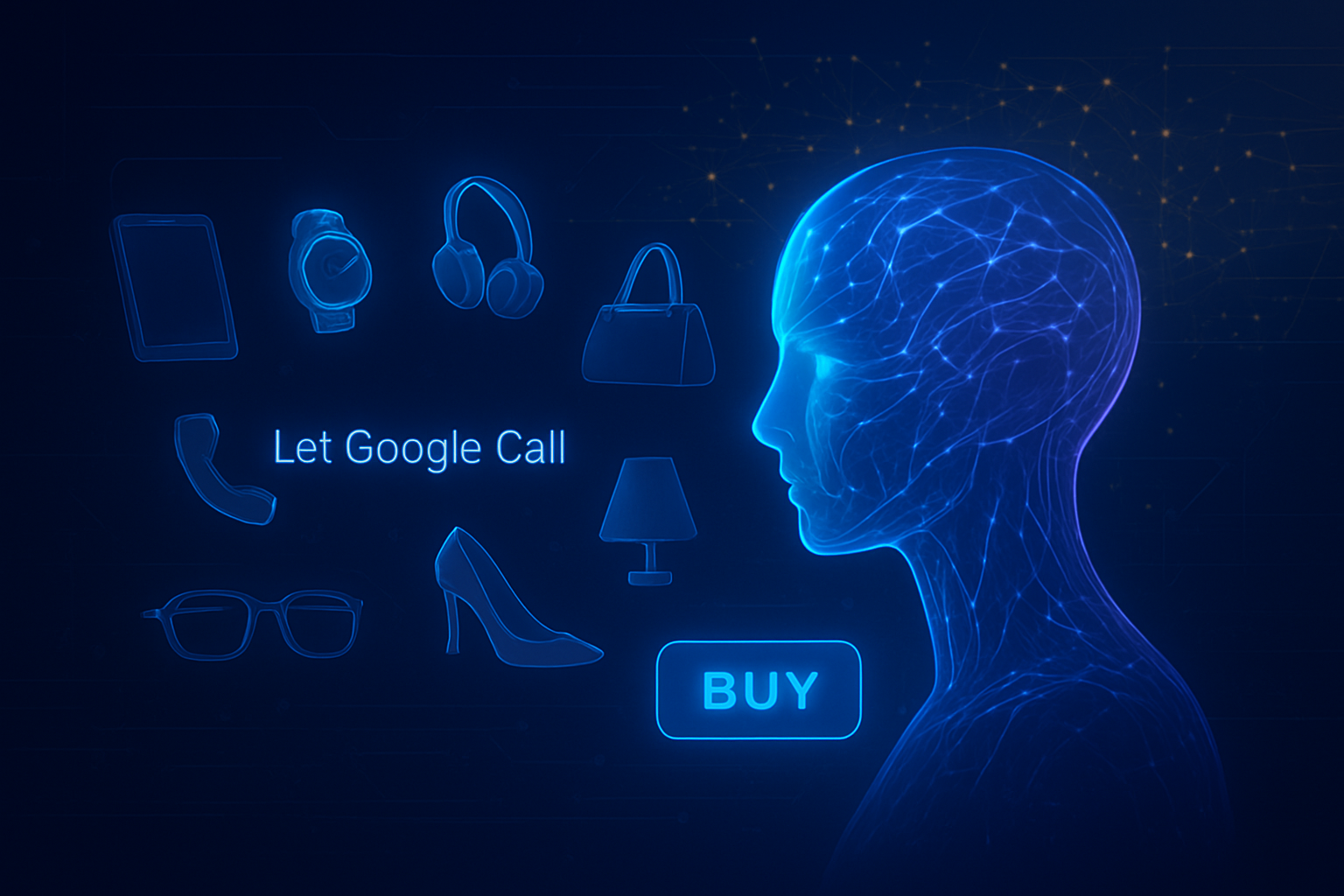
    The centerpiece of this transformation is the "Let Google Call" feature, which allows users to offload the tedious task of hunting for product availability to a Gemini-powered agent. This development is more than just a convenience; it is a structural shift in how consumers interact with the global marketplace. By integrating advanced reasoning with the massive scale of the Google Shopping Graph, the tech giant is positioning itself not just as a directory of the web, but as a proactive intermediary capable of navigating both the digital and physical worlds to fulfill consumer needs.

    The Technical Engine: From Duplex to Gemini-Powered Agency

    The technical foundation of Google’s new shopping ecosystem rests on the convergence of three major pillars: an upgraded Duplex voice engine, the multimodal Gemini reasoning model, and a significantly expanded Shopping Graph. The "Let Google Call" feature, which saw its first major rollout in late 2024 and reached full maturity in 2025, utilizes Duplex technology to bridge the gap between digital queries and physical inventory. When a user requests a specific item—such as a "Nintendo Switch OLED in stock near me"—the AI agent doesn't just display a map; it offers to call local stores. The agent identifies itself as an automated assistant, queries the merchant about specific stock levels and current promotions, and provides a summarized report to the user via text or email.

    This capability is supported by the Google Shopping Graph, which as of late 2025, indexes over 50 billion product listings with an staggering two billion updates per hour. This real-time data flow ensures that the AI agents are operating on the most current information possible. Furthermore, Google introduced "Agentic Checkout" in November 2025, allowing users to set "Price Mandates." For example, a shopper can instruct the agent to "Buy these linen sheets from Wayfair Inc. (NYSE: W) if the price drops below $80." The agent then monitors the price and, using the newly established Agent Payments Protocol (AP2), autonomously completes the checkout process using the user's Google Pay credentials.

    Unlike previous iterations of AI assistants that were limited to simple voice commands or web scraping, these agents are capable of multi-step reasoning. They can ask clarifying questions—such as preferred color or budget constraints—before initiating a task. The research community has noted that this shift toward "machine-to-machine" commerce is facilitated by the Model Context Protocol (MCP), which allows Google’s agents to communicate securely with a retailer's internal systems. This differs from traditional web-based shopping by removing the human from the "middle-man" role of data entry and navigation, effectively automating the entire sales funnel.

    The Competitive Battlefield: Google, Amazon, and the "Standards War"

    The rise of agentic commerce has ignited a fierce rivalry between the world's largest tech entities. While Google leverages its dominance in search and its vast Shopping Graph, Amazon.com, Inc. (NASDAQ: AMZN) has responded by deepening the integration of its own "Rufus" AI assistant into the Prime ecosystem. However, the most significant tension lies in the emerging "standards war" for AI payments. In late 2025, Google’s AP2 protocol began competing directly with OpenAI’s Agentic Commerce Protocol (ACP). While OpenAI has focused on a tight vertical integration with Shopify Inc. (NYSE: SHOP) and Stripe to enable one-tap buying within ChatGPT, Google has opted for a broader consortium approach, partnering with financial giants like Mastercard Incorporated (NYSE: MA) and PayPal Holdings, Inc. (NASDAQ: PYPL).

    This development has profound implications for retailers. Companies like Chewy, Inc. (NYSE: CHWY) and other early adopters of Google’s "Agentspace" are finding that they must optimize their data for machines rather than humans. This has led to the birth of Generative Experience Optimization (GXO), a successor to SEO. In this new era, the goal is not to rank first on a page of blue links, but to be the preferred choice of a Google AI agent. Retailers who fail to provide high-quality, machine-readable data risk becoming invisible to the autonomous agents that are increasingly making purchasing decisions for consumers.

    Market positioning has also shifted for startups. While the "Buy for Me" trend benefits established giants with large datasets, it creates a niche for specialized agents that can navigate high-stakes purchases like insurance or luxury goods. However, the strategic advantage currently lies with Google, whose integration of Google Pay and the Android ecosystem provides a seamless "last mile" for transactions that competitors struggle to replicate without significant friction.

    Wider Significance: The Societal Shift to Delegated Shopping

    The broader significance of agentic commerce extends beyond mere convenience; it represents a fundamental change in consumer behavior and the digital economy. For decades, the internet was a place where humans browsed; now, it is becoming a place where agents act. This fits into the larger trend of "The Agentic Web," where AI models are granted the agency to spend real money and make real-world commitments. The impact on the retail sector is dual-edged: while it can significantly reduce the 70% cart abandonment rate by removing checkout friction, it also raises concerns about "disintermediation."

    Retailers are increasingly worried that as Google’s agents become the primary interface for shopping, the direct relationship between the brand and the customer will erode. If a consumer simply tells their phone to "buy the best-rated organic dog food," the brand's individual identity may be subsumed by the agent's recommendation algorithm. There are also significant privacy and security concerns. The idea of an AI making phone calls and spending money requires a high level of trust, which Google is attempting to address through "cryptographic mandates"—digital contracts that prove a user authorized a specific expenditure.

    Comparisons are already being made to the launch of the iPhone or the original Google Search engine. Just as those technologies changed how we accessed information, AI shopping agents are changing how we acquire physical goods. This milestone marks the transition of AI from a "copilot" that assists with writing or coding to an "agent" that operates autonomously in the physical and financial world.

    The Horizon: Autonomous Personal Shoppers and A2A Communication

    Looking ahead, the near-term evolution of these agents will likely involve deeper integration with Augmented Reality (AR) and wearable devices. Imagine walking through a physical store and having your AI agent overlay real-time price comparisons from across the web, or even negotiating a discount with the store's own AI in real-time. This "Agent-to-Agent" (A2A) communication is expected to become a standard feature of the retail experience by 2027, as merchants deploy their own "branded agents" to interact with consumer-facing AI.

    However, several challenges remain. The legal framework for AI-led transactions is still in its infancy. Who is liable if an agent makes an unauthorized purchase or fails to find the best price? Addressing these "hallucination" risks in a financial context will be the primary focus of developers in 2026. Furthermore, the industry must solve the "robocall" stigma associated with features like "Let Google Call." While Google has provided opt-out tools for merchants, the friction between automated agents and human staff in physical stores remains a hurdle that requires more refined social intelligence in AI models.

    Experts predict that by the end of the decade, the concept of "going shopping" on a website will feel as antiquated as looking up a number in a physical phone book. Instead, our personal AI agents will maintain a continuous "commerce stream," managing our household inventory, predicting our needs, and executing purchases before we even realize we are low on a product.

    A New Chapter in the Digital Economy

    Google’s rollout of AI shopping agents and the "Let Google Call" feature marks a definitive end to the era of passive search. By combining the reasoning of Gemini with the transactional power of Google Pay and the vast data of the Shopping Graph, Alphabet has created a system that doesn't just find information—it acts on it. The key takeaway for 2025 is that agency is the new currency of the tech world. The ability of an AI to navigate the complexities of the real world, from phone calls to checkout screens, is the new benchmark for success.

    In the history of AI, this development will likely be viewed as the moment when "Generative AI" became "Actionable AI." It represents the maturation of large language models into useful, everyday tools that handle the "drudge work" of modern life. As we move into 2026, the industry will be watching closely to see how consumers balance the convenience of autonomous shopping with the need for privacy and control. One thing is certain: the search bar is no longer the destination; it is merely the starting point for an agentic journey.


    This content is intended for informational purposes only and represents analysis of current AI developments.

    TokenRing AI delivers enterprise-grade solutions for multi-agent AI workflow orchestration, AI-powered development tools, and seamless remote collaboration platforms.
    For more information, visit https://www.tokenring.ai/.
  • The AI Copyright Crucible: Artists and Writers Challenge Google’s Generative AI in Landmark Lawsuit

    The AI Copyright Crucible: Artists and Writers Challenge Google’s Generative AI in Landmark Lawsuit

    The rapidly evolving landscape of artificial intelligence has collided head-on with established intellectual property rights, culminating in a pivotal class-action lawsuit against Google (NASDAQ: GOOGL) by a coalition of artists and writers. This legal battle, which has been steadily progressing through the U.S. judicial system, alleges widespread copyright infringement, claiming that Google's generative AI models were trained on vast datasets of copyrighted creative works without permission or compensation. The outcome of In re Google Generative AI Copyright Litigation is poised to establish critical precedents, fundamentally reshaping how AI companies source and utilize data, and redefining the boundaries of intellectual property in the age of advanced machine learning.

    The Technical Underpinnings of Infringement Allegations

    At the heart of the lawsuit is the technical process by which large language models (LLMs) and text-to-image diffusion models are trained. Google's AI models, including Imagen, PaLM, GLaM, LaMDA, Bard, and Gemini, are built upon immense datasets that ingest and process billions of data points, including text, images, and other media scraped from the internet. The plaintiffs—prominent visual artists Jingna Zhang, Sarah Andersen, Hope Larson, Jessica Fink, and investigative journalist Jill Leovy—con tend that their copyrighted works were included in these training datasets. They argue that when an AI model learns from copyrighted material, it essentially creates a "derivative work" or, at the very least, makes unauthorized copies of the original works, thus infringing on their exclusive rights.

    This technical claim posits that the "weights" and "biases" within the AI model, which are adjusted during the training process to recognize patterns and generate new content, represent a transformation of the protected expression found in the training data. Therefore, the AI model itself, or the output it generates, becomes an infringing entity. This differs significantly from previous legal challenges concerning data aggregation, as the plaintiffs are not merely arguing about the storage of data, but about the fundamental learning process of AI and its direct relationship to their creative output. Initial reactions from the AI research community have been divided, with some emphasizing the transformative nature of AI learning as "fair use" for pattern recognition, while others acknowledge the ethical imperative to compensate creators whose work forms the bedrock of these powerful new technologies. The ongoing debate highlights a critical gap between current copyright law, designed for human-to-human creative output, and the emergent capabilities of machine intelligence.

    Competitive Implications for the AI Industry

    This lawsuit carries profound implications for AI companies, tech giants, and nascent startups alike. For Google, a favorable ruling for the plaintiffs could necessitate a radical overhaul of its data acquisition strategies, potentially leading to massive licensing costs or even a requirement to purge copyrighted works from existing models. This would undoubtedly impact its competitive standing against other major AI labs like OpenAI (backed by Microsoft (NASDAQ: MSFT)), Anthropic, and Meta Platforms (NASDAQ: META), which face similar lawsuits and operate under analogous data training paradigms.

    Companies that have already invested heavily in proprietary, licensed datasets, or those developing AI models with a focus on ethical data sourcing from the outset, might stand to benefit. Conversely, startups and smaller AI developers, who often rely on publicly available data due to resource constraints, could face significant barriers to entry if stringent licensing requirements become the norm. The legal outcome could disrupt existing product roadmaps, force re-evaluation of AI development methodologies, and create a new market for AI training data rights management. Strategic advantages will likely shift towards companies that can either afford extensive licensing or innovate in methods of training AI on non-copyrighted or ethically sourced data, potentially spurring research into synthetic data generation or more sophisticated fair use arguments. The market positioning of major players hinges on their ability to navigate this legal minefield while continuing to push the boundaries of AI innovation.

    Wider Significance in the AI Landscape

    The class-action lawsuit against Google AI is more than just a legal dispute; it is a critical inflection point in the broader AI landscape, embodying the tension between technological advancement and established societal norms, particularly intellectual property. This case, alongside similar lawsuits against other AI developers, represents a collective effort to define the ethical and legal boundaries of generative AI. It fits into a broader trend of increased scrutiny over AI's impact on creative industries, labor markets, and information integrity.

    The primary concern is the potential for AI models to devalue human creativity by generating content that mimics or displaces original works without proper attribution or compensation. Critics argue that allowing unrestricted use of copyrighted material for AI training could de-incentivize human creation, leading to a "race to the bottom" for content creators. This situation draws comparisons to earlier digital disruptions, such as the music industry's battle against file-sharing in the early 2000s, where new technologies challenged existing economic models and legal frameworks. The difference here is the "transformative" nature of AI, which complicates direct comparisons. The case highlights the urgent need for updated legal frameworks that can accommodate the nuances of AI technology, balancing innovation with the protection of creators' rights. The outcome will likely influence global discussions on AI regulation and responsible AI development, potentially setting a global precedent for how countries approach AI and copyright.

    Future Developments and Expert Predictions

    As of October 17, 2025, the lawsuit is progressing through key procedural stages, with the plaintiffs recently asking a California federal judge to grant class certification, a crucial step that would allow them to represent a broader group of creators. Experts predict that the legal battle will be protracted, potentially spanning several years and reaching appellate courts. Near-term developments will likely involve intense legal arguments around the definition of "fair use" in the context of AI training and output, as well as the technical feasibility of identifying and removing copyrighted works from existing AI models.

    In the long term, a ruling in favor of the plaintiffs could lead to the establishment of new licensing models for AI training data, potentially creating a new revenue stream for artists and writers. This might involve collective licensing organizations or blockchain-based solutions for tracking and compensating data usage. Conversely, if Google's fair use defense prevails, it could embolden AI developers to continue training models on publicly available data, albeit with increased scrutiny and potential calls for legislative intervention. Challenges that need to be addressed include the practicalities of implementing any court-mandated changes to AI training, the global nature of AI development, and the ongoing ethical debates surrounding AI's impact on human creativity. Experts anticipate a future where AI development is increasingly intertwined with legal and ethical considerations, pushing for greater transparency in data sourcing and potentially fostering a new era of "ethical AI" that prioritizes creator rights.

    A Defining Moment for AI and Creativity

    The class-action lawsuit against Google AI represents a defining moment in the history of artificial intelligence and intellectual property. It underscores the profound challenges and opportunities that arise when cutting-edge technology intersects with established legal and creative frameworks. The core takeaway is that the rapid advancement of generative AI has outpaced current legal definitions of copyright and fair use, necessitating a re-evaluation of how creative works are valued and protected in the digital age.

    The significance of this development cannot be overstated. It is not merely about a single company or a few artists; it is about setting a global precedent for the responsible development and deployment of AI. The outcome will likely influence investment in AI, shape regulatory efforts worldwide, and potentially usher in new business models for content creation and distribution. In the coming weeks and months, all eyes will be on the legal proceedings, particularly the decision on class certification, as this will significantly impact the scope and potential damages of the lawsuit. This case is a crucial benchmark for how society chooses to balance technological innovation with the fundamental rights of creators, ultimately shaping the future trajectory of AI and its relationship with human creativity.


    This content is intended for informational purposes only and represents analysis of current AI developments.

    TokenRing AI delivers enterprise-grade solutions for multi-agent AI workflow orchestration, AI-powered development tools, and seamless remote collaboration platforms.
    For more information, visit https://www.tokenring.ai/.