
Tag: Google TPU

  • The Great Decoupling: How Cloud Giants are Breaking the NVIDIA Monopoly with Custom 3nm Silicon

    The Great Decoupling: How Cloud Giants are Breaking the NVIDIA Monopoly with Custom 3nm Silicon

    As of January 2026, the artificial intelligence industry has reached a historic turning point dubbed "The Great Decoupling." For the last several years, the world’s largest cloud providers—Alphabet Inc. (NASDAQ: GOOGL), Amazon.com Inc. (NASDAQ: AMZN), and Microsoft Corp. (NASDAQ: MSFT)—were locked in a fierce bidding war for NVIDIA Corp. (NASDAQ: NVDA) hardware, effectively funding the GPU giant’s meteoric rise to a multi-trillion dollar valuation. However, new data from early 2026 reveals a structural shift: hyperscalers are no longer just buyers; they are now NVIDIA's most formidable architectural rivals.

    By vertically integrating their own hardware, these tech titans are successfully bypassing the "NVIDIA tax"—the massive 70-75% gross margins commanded by the Blackwell and subsequent Ruby GPU architectures. The deployment of custom Application-Specific Integrated Circuits (ASICs) like Google’s TPU v7, Amazon’s unified Trainium3, and Microsoft’s newly launched Maia 200 series has begun to reshape the economics of AI. This shift marks the end of the "Training Era," where general-purpose GPUs were king, and the beginning of the "Agentic Inference Era," where specialized, cost-efficient silicon is the prerequisite for scaling autonomous AI agents to billions of users.

    The 3nm Arms Race: TPU v7, Trainium3, and Maia 200

    The technical specifications of the 2026 silicon crop highlight a move toward extreme specialization. Google recently began the phased rollout of its TPU v7 series, specifically the v7E flagship, targeted at high-performance "reasoning" models. This follows the massive success of its TPU v6 (Trillium) chips, which reached a projected shipment volume of 1.6 million units this year. The v7 architecture integrates Google’s custom Axion ARM-based CPUs as "head nodes," creating a vertically optimized stack that Google claims offers 67% better energy efficiency than previous generations.

    Amazon has taken a different approach by consolidating its hardware roadmap. At re:Invent 2025, AWS unveiled Trainium3, its first chip built on a cutting-edge 3nm process. In a surprising strategic pivot, AWS has halted the standalone development of its Inferentia line, merging training and inference capabilities into the single Trainium3 architecture. This unified silicon delivers 4.4x the compute performance of its predecessor and powers "UltraServers" that house 144 chips, allowing for clusters that scale up to 1 million interconnected processors via the proprietary NeuronSwitch fabric.

    Microsoft, meanwhile, has hit its stride with the Maia 200, announced on January 26, 2026. Unlike the limited rollout of the first-generation Maia, the 200 series is already live in major data center hubs like US Central (Iowa). Built on TSMC 3nm technology with a staggering 216GB of HBM3e memory, the Maia 200 is specifically tuned for the FP4 and FP8 precision formats required by OpenAI’s latest GPT-5.2 models. Early benchmarks suggest the Maia 200 delivers 3x the FP4 throughput of Amazon’s Trainium3, positioning it as the most performant first-party inference chip in the cloud today.

    Bypassing the "NVIDIA Tax" and Reshaping the Market

    The strategic driver behind this silicon explosion is purely financial. An individual NVIDIA Blackwell (B200) card currently commands between $30,000 and $45,000, creating an unsustainable cost structure for cloud providers seeking to provide affordable AI at scale. By moving to in-house designs, hyperscalers report a 30% to 40% reduction in Total Cost of Ownership (TCO). Microsoft recently noted that Maia 200 provides 30% better performance-per-dollar than any commercial hardware currently available in the Azure fleet.

    This trend is causing a significant divergence in the semiconductor market. While NVIDIA still dominates the revenue share of the AI sector due to its high ASPs (Average Selling Prices), custom ASICs are winning the volume war. According to late 2025 reports from TrendForce, custom AI processor shipments grew by 44% over the past year, far outpacing the 16% growth seen in traditional GPUs. Google’s TPU ecosystem alone now accounts for over 52% of the global AI Server ASIC volume.

    For NVIDIA, the challenge is no longer just manufacturing enough chips, but defending its "moat." Hyperscalers are developing proprietary interconnects to avoid being locked into NVIDIA’s NVLink ecosystem. By controlling the silicon, the fabric, and the software stack (such as AWS’s Neuron SDK or Google’s JAX-optimized compilers), cloud giants are creating "walled garden" architectures where their own chips perform better for their specific internal workloads than NVIDIA's general-purpose alternatives.

    The Shift to the Agentic Inference Era

    The broader significance of this silicon shift lies in the changing nature of AI workloads. We are moving away from the era of "frontier training," which required the massive raw power of tens of thousands of GPUs linked together for months. We are now entering the Agentic Inference Era, where the primary cost and technical challenge is running millions of autonomous agents simultaneously. These agents require "fast" and "cheap" tokens, which favors the streamlined, low-latency architectures of ASICs over the more complex, power-hungry instruction sets of traditional GPUs.

    Even companies without their own public cloud, like Meta Platforms Inc. (NASDAQ: META), are following this playbook. Meta’s MTIA v2 is currently powering the massive ranking and recommendation engines for Facebook and Instagram. However, indicating how competitive the market has become, reports suggest Meta is negotiating to purchase Google TPUs by 2027 to further diversify its infrastructure. Meta remains NVIDIA’s largest customer with over 1.3 million GPUs, but the "hybrid" strategy of using custom silicon for high-volume tasks is becoming the industry standard.

    This movement toward sovereign silicon also addresses supply chain vulnerabilities. By designing their own chips, hyperscalers can secure direct long-term contracts with foundries like TSMC, bypassing the allocation bottlenecks that have plagued the industry since 2023. This "silicon sovereignty" allows for more predictable product cycles and the ability to customize hardware for emerging model architectures, such as State Space Models (SSMs) or Liquid Neural Networks, which may not run optimally on standard GPU hardware.

    The Road to 2nm and Beyond

    Looking ahead to 2027 and 2028, the battle for silicon supremacy will move to the 2nm process node. Experts predict that the next generation of custom chips will incorporate integrated optical interconnects, allowing for "optical TBU" (Tensor Processing Units) that use light instead of electricity for chip-to-chip communication, drastically reducing power consumption. This will be critical as data centers face increasing scrutiny over their massive energy footprints.

    We also expect to see these custom chips move "to the edge." As the need for privacy and low latency grows, cloud giants may begin licensing their silicon designs for use in on-premise hardware or specialized "AI appliances." The challenge remains the software; while NVIDIA’s CUDA remains the gold standard for developers, the massive investment by AWS and Google into making their compilers "transparent" is slowly eroding CUDA’s dominance. Analysts project that by 2028, custom ASIC shipments will surpass data center GPU shipments for the first time in history.

    A New Hierarchy in the AI Stack

    The trend of custom silicon marks the most significant architectural shift in computing since the transition from mainframe to client-server. The "Great Decoupling" of 2026 has proven that the world’s largest tech companies are no longer willing to outsource the most critical component of their infrastructure to a single vendor. By owning the silicon, Google, Amazon, and Microsoft have secured their margins and their futures.

    As we look toward the middle of the decade, the industry's focus will shift from "who has the most GPUs" to "who has the most efficient tokens." The winner of the AI race will likely be the company that can provide the highest "intelligence-per-watt," a metric that is now firmly in the hands of the custom silicon designers. In the coming months, keep a close eye on the performance benchmarks of the first GPT-5.2 models running on Maia 200—they will be the ultimate litmus test for whether proprietary hardware can truly outshine the industry’s favorite GPU.


    This content is intended for informational purposes only and represents analysis of current AI developments.

    TokenRing AI delivers enterprise-grade solutions for multi-agent AI workflow orchestration, AI-powered development tools, and seamless remote collaboration platforms.
    For more information, visit https://www.tokenring.ai/.
  • The Custom Silicon Gold Rush: How Broadcom and the ‘Cloud Titans’ are Challenging Nvidia’s AI Dominance

    The Custom Silicon Gold Rush: How Broadcom and the ‘Cloud Titans’ are Challenging Nvidia’s AI Dominance

    As of January 22, 2026, the artificial intelligence industry has reached a pivotal inflection point, shifting from a mad scramble for general-purpose hardware to a sophisticated era of architectural vertical integration. Broadcom (NASDAQ: AVGO), long the silent architect of the internet’s backbone, has emerged as the primary beneficiary of this transition. In its latest fiscal report, the company revealed a staggering $73 billion AI-specific order backlog, signaling that the world’s largest tech companies—Google (NASDAQ: GOOGL), Meta (NASDAQ: META), and now OpenAI—are increasingly bypassing traditional GPU vendors in favor of custom-tailored silicon.

    This surge in custom "XPUs" (AI accelerators) marks a fundamental change in the economics of the cloud. By partnering with Broadcom to design application-specific integrated circuits (ASICs), the "Cloud Titans" are achieving performance-per-dollar metrics that were previously unthinkable. This development not only threatens the absolute dominance of the general-purpose GPU but also suggests that the next phase of the AI race will be won by those who own their entire hardware and software stack.

    Custom XPUs: The Technical Blueprint of the Million-Accelerator Era

    The technical centerpiece of this shift is the arrival of seventh and eighth-generation custom accelerators. Google’s TPU v7, codenamed "Ironwood," which entered mass deployment in late 2025, has set a new benchmark for efficiency. By optimizing the silicon specifically for Google’s internal software frameworks like JAX and XLA, Broadcom and Google have achieved a 70% reduction in cost-per-token compared to the previous generation. This leap puts custom silicon at parity with, and in some specific training workloads, ahead of Nvidia’s (NASDAQ: NVDA) Blackwell architecture.

    Beyond the compute cores themselves, Broadcom is solving the "interconnect bottleneck" that has historically limited AI scaling. The introduction of the Tomahawk 6 (Davisson) switch—the industry’s first 102.4 Terabits per second (Tbps) single-chip Ethernet switch—allows for the creation of "flat" network topologies. This enables hyperscalers to link up to one million XPUs in a single, cohesive fabric. In early 2026, this "Million-XPU" cluster capability has become the new standard for training the next generation of Frontier Models, which now require compute power measured in gigawatts rather than megawatts.

    A critical technical differentiator for Broadcom is its 3rd-generation Co-Packaged Optics (CPO) technology. As AI power demands reach nearly 200kW per server rack, traditional pluggable optical modules have become a primary source of heat and energy waste. Broadcom’s CPO integrates optical interconnects directly onto the chip package, reducing power consumption for data movement by 30-40%. This integration is essential for the 3nm and upcoming 2nm production nodes, where thermal management is as much of a constraint as transistor density.

    Industry experts note that this move toward ASICs represents a "de-generalization" of AI hardware. While Nvidia’s H100 and B200 series are designed to run any model for any customer, custom silicon like Meta’s MTIA (Meta Training and Inference Accelerator) is stripped of unnecessary components. This leaner design allows for more area on the die to be dedicated to high-bandwidth memory (HBM3e and HBM4) and specialized matrix-math units, specifically tuned for the recommendation algorithms and Large Language Models (LLMs) that drive Meta’s core business.

    Market Shift: The Rise of the ASIC Alliances

    The financial implications of this shift are profound. Broadcom’s AI-related semiconductor revenue hit $6.5 billion in the final quarter of 2025, a 74% year-over-year increase, with guidance for Q1 2026 suggesting a jump to $8.2 billion. This trajectory has repositioned Broadcom not just as a component supplier, but as a strategic peer to the world's most valuable companies. The company’s shift toward selling complete "AI server racks"—inclusive of custom silicon, high-speed switches, and integrated optics—has increased the total dollar value of its customer engagements ten-fold.

    Meta has particularly leaned into this strategy through its "Project Santa Barbara" rollout in early 2026. By doubling its in-house chip capacity using Broadcom-designed silicon, Meta is significantly reducing its "Nvidia tax"—the premium paid for general-purpose flexibility. For Meta and Google, every dollar saved on hardware procurement is a dollar that can be reinvested into data acquisition and model training. This vertical integration provides a massive strategic advantage, allowing these giants to offer AI services at lower price points than competitors who rely solely on off-the-shelf components.

    Nvidia, while still the undisputed leader in the broader enterprise and startup markets due to its dominant CUDA software ecosystem, is facing a narrowing "moat" at the very top of the market. The "Big 5" hyperscalers, which account for a massive portion of Nvidia's revenue, are bifurcating their fleets: using Nvidia for third-party cloud customers who require the flexibility of CUDA, while shifting their own massive internal workloads to custom Broadcom-assisted silicon. This trend is further evidenced by Amazon (NASDAQ: AMZN), which continues to iterate on its Trainium and Inferentia lines, and Microsoft (NASDAQ: MSFT), which is now deploying its Maia 200 series across its Azure Copilot services.

    Perhaps the most disruptive announcement of the current cycle is the tripartite alliance between Broadcom, OpenAI, and various infrastructure partners to develop "Titan," a custom AI accelerator designed to power a 10-gigawatt computing initiative. This move by OpenAI signals that even the premier AI research labs now view custom silicon as a prerequisite for achieving Artificial General Intelligence (AGI). By moving away from general-purpose hardware, OpenAI aims to gain direct control over the hardware-software interface, optimizing for the unique inference requirements of its most advanced models.

    The Broader AI Landscape: Verticalization as the New Standard

    The boom in custom silicon reflects a broader trend in the AI landscape: the transition from the "exploration phase" to the "optimization phase." In 2023 and 2024, the goal was simply to acquire as much compute as possible, regardless of cost. In 2026, the focus has shifted to efficiency, sustainability, and total cost of ownership (TCO). This move toward verticalization mirrors the historical evolution of the smartphone industry, where Apple’s move to its own A-series and M-series silicon allowed it to outpace competitors who relied on generic chips.

    However, this trend also raises concerns about market fragmentation. As each tech giant develops its own proprietary hardware and optimized software stack (such as Google’s XLA or Meta’s PyTorch-on-MTIA), the AI ecosystem could become increasingly siloed. For developers, this means that a model optimized for AWS’s Trainium may not perform identically on Google’s TPU or Microsoft’s Maia, potentially complicating the landscape for multi-cloud AI deployments.

    Despite these concerns, the environmental impact of custom silicon cannot be overlooked. General-purpose GPUs are, by definition, less efficient than specialized ASICs for specific tasks. By stripping away the "dark silicon" that isn't used for AI training and inference, and by utilizing Broadcom's co-packaged optics, the industry is finding a path toward scaling AI without a linear increase in carbon footprint. The "performance-per-watt" metric has replaced raw TFLOPS as the most critical KPI for data center operators in 2026.

    This milestone also highlights the critical role of the semiconductor supply chain. While Broadcom designs the architecture, the entire ecosystem remains dependent on TSMC’s advanced nodes. The fierce competition for 3nm and 2nm capacity has turned the semiconductor foundry into the ultimate geopolitical and economic chokepoint. Broadcom’s success is largely due to its ability to secure massive capacity at TSMC, effectively acting as an aggregator of demand for the world’s largest tech companies.

    Future Horizons: The 2nm Era and Beyond

    Looking ahead, the roadmap for custom silicon is increasingly ambitious. Broadcom has already secured significant capacity for the 2nm production node, with initial designs for "TPU v9" and "Titan 2" expected to tape out in late 2026. These next-generation chips will likely integrate even more advanced memory technologies, such as HBM4, and move toward "chiplet" architectures that allow for even greater customization and yield efficiency.

    In the near term, we expect to see the "Million-XPU" clusters move from experimental projects to the backbone of global AI infrastructure. The challenge will shift from designing the chips to managing the staggering power and cooling requirements of these mega-facilities. Liquid cooling and on-chip thermal management will become standard features of any Broadcom-designed system by 2027. We may also see the rise of "Edge-ASICs," as companies like Meta and Google look to bring custom AI acceleration to consumer devices, further integrating Broadcom's IP into the daily lives of billions.

    Experts predict that the next major hurdle will be the "IO Wall"—the speed at which data can be moved between chips. While Tomahawk 6 and CPO have provided a temporary reprieve, the industry is already looking toward all-optical computing and neural-inspired architectures. Broadcom’s role as the intermediary between the hyperscalers and the foundries ensures it will remain at the center of these developments for the foreseeable future.

    Conclusion: The Era of the Silent Giant

    The current surge in Broadcom’s fortunes is more than just a successful earnings cycle; it is a testament to the company’s role as the indispensable architect of the AI age. By enabling Google, Meta, and OpenAI to build their own "digital brains," Broadcom has fundamentally altered the competitive dynamics of the technology sector. The company's $73 billion backlog serves as a leading indicator of a multi-year investment cycle that shows no signs of slowing.

    As we move through 2026, the key takeaway is that the AI revolution is moving "south" on the stack—away from the applications and toward the very atoms of the silicon itself. The success of this transition will determine which companies survive the high-cost "arms race" of AI and which are left behind. For now, the path to the future of AI is being paved by custom ASICs, with Broadcom holding the master blueprint.

    Watch for further announcements regarding the deployment of OpenAI’s "Titan" and the first production benchmarks of TPU v8 later this year. These milestones will likely confirm whether the ASIC-led strategy can truly displace the general-purpose GPU as the primary engine of intelligence.


    This content is intended for informational purposes only and represents analysis of current AI developments.

    TokenRing AI delivers enterprise-grade solutions for multi-agent AI workflow orchestration, AI-powered development tools, and seamless remote collaboration platforms.
    For more information, visit https://www.tokenring.ai/.
  • The Silicon Divorce: Why Tech Giants are Dumping GPUs for In-House ASICs

    The Silicon Divorce: Why Tech Giants are Dumping GPUs for In-House ASICs

    As of January 2026, the global technology landscape is undergoing a fundamental restructuring of its hardware foundation. For years, the artificial intelligence (AI) revolution was powered almost exclusively by general-purpose GPUs from vendors like NVIDIA Corp. (NASDAQ: NVDA). However, a new era of "The Silicon Divorce" has arrived. Hyperscale cloud providers and innovative automotive manufacturers are increasingly abandoning off-the-shelf commercial silicon in favor of custom-designed Application-Specific Integrated Circuits (ASICs). This shift is driven by a desperate need to bypass the high margins of third-party chipmakers while dramatically increasing the energy efficiency required to run the world's most complex AI models.

    The implications of this move are profound. By designing their own silicon, companies like Amazon.com Inc. (NASDAQ: AMZN), Alphabet Inc. (NASDAQ: GOOGL), and Microsoft Corp. (NASDAQ: MSFT) are gaining unprecedented control over their cost structures and performance benchmarks. In the automotive sector, Rivian Automotive, Inc. (NASDAQ: RIVN) is leading a similar charge, proving that the trend toward vertical integration is not limited to the data center. These custom chips are not just alternatives; they are specialized workhorses built to excel at the specific mathematical operations required by Transformer models and autonomous driving algorithms, marking a definitive end to the "one-size-fits-all" hardware era.

    Technical Superiority: The Rise of Trn3, Ironwood, and RAP1

    The technical specifications of the current crop of custom silicon demonstrate how far internal design teams have come. Leading the charge is Amazon’s Trainium 3 (Trn3), which reached full-scale deployment in early 2026. Built on a cutting-edge 3nm process from TSMC (NYSE: TSM), the Trn3 delivers a staggering 2.52 PFLOPS of FP8 compute per chip. When clustered into "UltraServer" racks of 144 chips, it produces 0.36 ExaFLOPS of performance—a density that rivals NVIDIA's most advanced Blackwell systems. Amazon has optimized the Trn3 for its Neuron SDK, resulting in a 40% improvement in energy efficiency over the previous generation and a 5x improvement in "tokens-per-megawatt," a metric that has become the gold standard for sustainability in AI.

    Google has countered with its seventh-generation TPU v7, codenamed "Ironwood." The Ironwood chip is a performance titan, delivering 4.6 PFLOPS of dense FP8 performance, effectively reaching parity with NVIDIA’s B200 series. Google’s unique advantage lies in its Optical Circuit Switching (OCS) technology, which allows it to interconnect up to 9,216 TPUs into a single "Superpod." Meanwhile, Microsoft has stabilized its silicon roadmap with the Maia 200 (Braga), focusing on system-wide integration and performance-per-dollar. Rather than chasing raw peak compute, the Maia 200 is designed to integrate seamlessly with Microsoft’s "Sidekicks" liquid-cooling infrastructure, allowing Azure to host massive AI workloads in existing data center footprints that would otherwise be overwhelmed by the heat of standard GPUs.

    In the automotive world, Rivian’s introduction of the Rivian Autonomy Processor 1 (RAP1) marks a historic shift for the industry. Moving away from the dual-NVIDIA Drive Orin configurations of the past, the RAP1 is a 5nm custom SoC using the Armv9 architecture. A dual-RAP1 setup in Rivian's latest Autonomy Compute Module (ACM3) delivers 1,600 sparse INT8 TOPS, capable of processing over 5 billion pixels per second from a suite of 11 high-resolution cameras and LiDAR. This isn't just about speed; RAP1 is 2.5x more power-efficient than the NVIDIA-based systems it replaces, which directly extends vehicle range—a critical competitive advantage in the EV market.

    Strategic Realignment: Breaking the "NVIDIA Tax"

    The economic rationale for custom silicon is as compelling as the technical one. For hyperscalers, the "NVIDIA tax"—the high premium paid for third-party GPUs—has been a major drag on margins. By developing internal chips, AWS and Google are now offering AI training and inference at 50% to 70% lower costs compared to equivalent NVIDIA-based instances. This allows them to undercut competitors on price while maintaining higher profit margins. Microsoft’s strategy with Maia 200 involves offloading "commodity" AI tasks, such as basic reasoning for Microsoft 365 Copilot, to its own silicon, while reserving its limited supply of NVIDIA GPUs for the most demanding "frontier" model training.

    This shift creates a new competitive dynamic in the cloud market. Startups and AI labs like Anthropic, which uses Google’s TPUs, are gaining a cost advantage over those tethered strictly to commercial GPUs. Furthermore, vertical integration provides these tech giants with supply chain independence. In a world where GPU lead times have historically stretched for months, having an in-house pipeline ensures that companies like Amazon and Microsoft can scale their infrastructure at their own pace, regardless of market volatility or geopolitical tensions affecting external suppliers.

    For Rivian, the move to RAP1 is about more than just performance; it is a vital cost-saving measure for a company focused on reaching profitability. CEO RJ Scaringe recently noted that moving to in-house silicon saves "hundreds of dollars per vehicle" by eliminating the margin stacking of Tier 1 suppliers. This vertical integration allows Rivian to optimize the hardware and software in tandem, ensuring that every watt of energy used by the compute platform contributes directly to safer, more efficient autonomous driving rather than being wasted on unneeded general-purpose features.

    The Broader AI Landscape: From General to Specific

    The transition to custom silicon represents a maturing of the AI industry. We are moving away from the "Brute Force" era, where scaling was achieved simply by throwing more general-purpose chips at a problem, toward the "Efficiency" era. This mirrors the history of computing, where specialized chips (like those in early gaming consoles or networking gear) eventually replaced general-purpose CPUs for specialized tasks. The rise of the ASIC is the ultimate realization of hardware-software co-design, where the architecture of the chip is dictated by the architecture of the neural network it is meant to run.

    However, this trend also raises concerns about fragmentation. As each major cloud provider develops its own unique silicon and software stack (e.g., AWS Neuron, Google’s JAX/TPU, Microsoft’s specialized kernels), the AI research community faces the challenge of "lock-in." A model optimized for Google’s TPU v7 may not perform as efficiently on Amazon’s Trainium 3 without significant re-engineering. While open-source frameworks like Triton are working to bridge this gap, the era of universal GPU compatibility is beginning to fade, potentially creating silos in the AI development ecosystem.

    Future Outlook: The 2nm Horizon and Physical AI

    Looking ahead to the remainder of 2026 and 2027, the roadmap for custom silicon is already shifting toward the 2nm and 1.8nm nodes. Experts predict that the next generation of chips will focus even more heavily on on-chip memory (HBM4) and advanced 3D packaging to overcome the "memory wall" that currently limits AI performance. We can expect hyperscalers to continue expanding their custom silicon to include not just AI accelerators, but also Arm-based CPUs (like Google’s Axion and Amazon’s Graviton series) to create a fully custom computing environment from top to bottom.

    In the automotive and robotics sectors, the success of Rivian’s RAP1 will likely trigger a wave of similar announcements from other manufacturers. As "Physical AI"—AI that interacts with the real world—becomes the next frontier, the need for low-latency, high-efficiency edge silicon will skyrocket. The challenges ahead remain significant, particularly regarding the astronomical R&D costs of chip design and the ongoing reliance on a handful of high-end foundries like TSMC. However, the momentum is undeniable: the world’s most powerful companies are no longer content to buy their brains from a third party; they are building their own.

    Summary: A New Foundation for Intelligence

    The rise of custom silicon among hyperscalers and automotive leaders is a watershed moment in the history of technology. By designing specialized ASICs like Trainium 3, TPU v7, and RAP1, these companies are successfully decoupling their futures from the constraints of the commercial GPU market. The move delivers massive gains in energy efficiency, significant reductions in operational costs, and a level of hardware-software optimization that was previously impossible.

    As we move further into 2026, the industry should watch for how NVIDIA responds to this eroding market share and whether second-tier cloud providers can keep up with the massive R&D spending required to play in the custom silicon space. For now, the message is clear: in the race for AI supremacy, the winners will be those who own the silicon.


    This content is intended for informational purposes only and represents analysis of current AI developments.

    TokenRing AI delivers enterprise-grade solutions for multi-agent AI workflow orchestration, AI-powered development tools, and seamless remote collaboration platforms.
    For more information, visit https://www.tokenring.ai/.
  • The Silicon Sovereignty: How Hyperscalers are Rewiring the AI Economy with Custom Chips

    The Silicon Sovereignty: How Hyperscalers are Rewiring the AI Economy with Custom Chips

    The era of the general-purpose AI chip is facing its first major existential challenge. As of January 2026, the world’s largest technology companies—Google, Microsoft, Meta, and Amazon—have moved beyond the "experimental" phase of hardware development, aggressively deploying custom-designed AI silicon to power the next generation of generative models and agentic services. This strategic pivot marks a fundamental shift in the AI supply chain, as hyperscalers attempt to break their near-total dependence on third-party hardware providers while tailoring chips to the specific mathematical demands of their proprietary software stacks.

    The immediate significance of this shift cannot be overstated. By moving high-volume workloads like inference and recommendation ranking to in-house Application-Specific Integrated Circuits (ASICs), these tech giants are significantly reducing their Total Cost of Ownership (TCO) and power consumption. While NVIDIA (NASDAQ: NVDA) remains the gold standard for frontier model training, the rise of specialized silicon from the likes of Alphabet (NASDAQ: GOOGL), Microsoft (NASDAQ: MSFT), Meta Platforms (NASDAQ: META), and Amazon (NASDAQ: AMZN) is creating a tiered hardware ecosystem where bespoke chips handle the "workhorse" tasks of the digital economy.

    The Technical Vanguard: TPU v7, Maia 200, and the 3nm Frontier

    At the forefront of this technical evolution is Google’s TPU v7 (Ironwood), which entered general availability in late 2025. Built on a cutting-edge 3nm process, the TPU v7 utilizes a dual-chiplet architecture specifically optimized for the Mixture of Experts (MoE) models that power the Gemini ecosystem. With compute performance reaching approximately 4.6 PFLOPS in FP8 dense math, the Ironwood chip is the first custom ASIC to achieve parity with Nvidia’s Blackwell architecture in raw throughput. Crucially, Google’s 3D torus interconnect technology allows for the seamless scaling of up to 9,216 chips in a single pod, creating a multi-exaflop environment that rivals the most advanced commercial clusters.

    Meanwhile, Microsoft has finally brought its Maia 200 (Braga) into mass production after a series of design revisions aimed at meeting the extreme requirements of OpenAI. Unlike Google’s broad-spectrum approach, the Maia 200 is a "precision instrument," focusing on high-speed tensor units and a specialized "Microscaling" (MX) data format designed to slash power consumption during massive inference runs for Azure OpenAI and Copilot. Similarly, Amazon Web Services (AWS) has unified its hardware roadmap with Trainium 3, its first 3nm chip. Trainium 3 has shifted from a niche training accelerator to a high-density compute engine, boasting 2.52 PFLOPS of FP8 performance and serving as the backbone for partners like Anthropic.

    Meta’s MTIA v3 represents a different philosophical approach. Rather than chasing peak FLOPs for training the world’s largest models, Meta has focused on the "Inference Tax"—the massive cost of running real-time recommendations for billions of users. The MTIA v3 prioritizes TOPS per Watt (efficiency) over raw power, utilizing a chiplet-based design that reportedly beats Nvidia's previous-generation H100 in energy efficiency by nearly 40%. This efficiency is critical for Meta’s pivot toward "Agentic AI," where thousands of small, specialized models must run simultaneously to power proactive digital assistants.

    The Kingmakers: Broadcom, Marvell, and the Designer Shift

    While the hyperscalers are the public faces of this silicon revolution, the real financial windfall is being captured by the specialized design firms that make these chips possible. Broadcom (NASDAQ: AVGO) has emerged as the undisputed "King of ASICs," securing its position as the primary co-design partner for Google, Meta, and reportedly, future iterations of Microsoft’s hardware. Broadcom’s role has evolved from providing simple networking IP to managing the entire physical design flow and high-speed interconnects (SerDes) necessary for 3nm production. Analysts project that Broadcom’s AI-related revenue will exceed $40 billion in fiscal 2026, driven almost entirely by these hyperscaler partnerships.

    Marvell Technology (NASDAQ: MRVL) occupies a more specialized, yet strategic, niche in this new landscape. Although Marvell faced a setback in early 2026 after losing a major contract with AWS to the Taiwanese firm Alchip, it remains a critical player in the AI networking space. Marvell’s focus has shifted toward optical Digital Signal Processors (DSPs) and custom Ethernet switches that allow thousands of custom chips to communicate with minimal latency. Marvell continues to support the "back-end" infrastructure for Meta and Microsoft, positioning itself as the "connective tissue" of the AI data center even as the primary compute dies move to different designers.

    This shift in design partnerships reveals a maturing market where hyperscalers are willing to swap vendors to achieve better yield or faster time-to-market. The competitive landscape is no longer just about who has the fastest chip, but who can deliver the most reliable 3nm design at scale. This has created a high-stakes environment where the "picks and shovels" providers—the design houses and the foundries like TSMC (NYSE: TSM)—hold as much leverage as the platform owners themselves.

    The Broader Landscape: TCO, Energy, and the End of Scarcity

    The transition to custom silicon fits into a larger trend of vertical integration within the tech industry. For years, the AI sector was defined by "GPU scarcity," where the speed of innovation was dictated by Nvidia’s supply chain. By January 2026, that scarcity has largely evaporated, replaced by a focus on "Economics and Electrons." Custom chips like the TPU v7 and Trainium 3 allow hyperscalers to bypass the high margins of third-party vendors, reducing the cost of an AI query by as much as 50% compared to general-purpose hardware.

    However, this silicon sovereignty comes with potential concerns. The fragmentation of the hardware landscape could lead to "vendor lock-in," where models optimized for Google’s TPUs cannot be easily migrated to Azure’s Maia or AWS’s Trainium. While software layers like Triton and various abstraction APIs are attempting to mitigate this, the deep architectural differences—such as the specific memory handling in the Ironwood chips—create natural moats for each cloud provider.

    Furthermore, the move to custom silicon is an environmental necessity. As AI data centers begin to consume a double-digit percentage of the world’s electricity, the efficiency gains provided by ASICs are the only way to sustain the current trajectory of model growth. The "efficiency first" philosophy seen in Meta’s MTIA v3 is likely to become the industry standard, as power availability, rather than chip supply, becomes the primary bottleneck for AI expansion.

    Future Horizons: 2nm, Liquid Cooling, and Chiplet Ecosystems

    Looking toward the late 2020s, the next frontier for custom AI silicon will be the transition to the 2nm process node and the widespread adoption of "System-in-Package" (SiP) designs. Experts predict that by 2027, the distinction between a "chip" and a "server" will continue to blur, as hyperscalers move toward liquid-cooled, rack-scale compute units where the interconnect is integrated directly into the silicon substrate.

    We are also likely to see the rise of "modular" AI silicon. Rather than designing a single monolithic chip, companies may begin to mix and match "chiplets" from different vendors—using a Broadcom compute die with a Marvell networking tile and a third-party memory controller—all tied together with universal interconnect standards. This would allow hyperscalers to iterate even faster, swapping out individual components as new breakthroughs in AI architecture (such as post-transformer models) emerge.

    The primary challenge moving forward will be the "Inference Tax" at the edge. While current custom silicon efforts are focused on massive data centers, the next battleground will be local custom silicon for smartphones and PCs. Apple and Qualcomm have already laid the groundwork, but as Google and Meta look to bring their agentic AI experiences to local devices, the custom silicon war will likely move from the cloud to the pocket.

    A New Era of Computing History

    The aggressive rollout of the TPU v7, Maia 200, and MTIA v3 marks the definitive end of the "one-size-fits-all" era of AI computing. In the history of technology, this shift mirrors the transition from general-purpose CPUs to GPUs decades ago, but at an accelerated pace and with far higher stakes. By seizing control of their own silicon roadmaps, the world's tech giants are not just seeking to lower costs; they are building the physical foundations of a future where AI is woven into every transaction and interaction.

    For the industry, the key takeaways are clear: vertical integration is the new gold standard, and the partnership between hyperscalers and specialist design firms like Broadcom has become the most powerful engine in the global economy. While NVIDIA will likely maintain its lead in the highest-end training applications for the foreseeable future, the "middle market" of AI—where the vast majority of daily compute occurs—is rapidly becoming the domain of the custom ASIC.

    In the coming weeks and months, the focus will shift to how these chips perform in real-world "agentic" workloads. As the first wave of truly autonomous AI agents begins to deploy across enterprise platforms, the underlying silicon will be the ultimate arbiter of which companies can provide the most capable, cost-effective, and energy-efficient intelligence.


    This content is intended for informational purposes only and represents analysis of current AI developments.

    TokenRing AI delivers enterprise-grade solutions for multi-agent AI workflow orchestration, AI-powered development tools, and seamless remote collaboration platforms.
    For more information, visit https://www.tokenring.ai/.

  • The Great Decoupling: How Custom Cloud Silicon is Ending the GPU Monopoly

    The Great Decoupling: How Custom Cloud Silicon is Ending the GPU Monopoly

    The dawn of 2026 marks a pivotal turning point in the artificial intelligence arms race. For years, the industry was defined by a desperate scramble for high-end GPUs, but the narrative has shifted from procurement to production. Today, the world’s largest hyperscalers—Alphabet Inc. (NASDAQ: GOOGL), Amazon.com, Inc. (NASDAQ: AMZN), Microsoft Corp. (NASDAQ: MSFT), and Meta Platforms, Inc. (NASDAQ: META)—have largely transitioned their core AI workloads to internal application-specific integrated circuits (ASICs). This movement, often referred to as the "Sovereignty Era," is fundamentally restructuring the economics of the cloud and challenging the long-standing dominance of NVIDIA Corp. (NASDAQ: NVDA).

    This shift toward custom silicon—exemplified by Google’s newly available TPU v7 and Amazon’s Trainium 3—is not merely about cost-cutting; it is a strategic necessity driven by the specialized requirements of "Agentic AI." As AI models transition from simple chat interfaces to complex, multi-step reasoning agents, the hardware requirements have evolved. General-purpose GPUs, while versatile, often carry significant overhead in power consumption and memory latency. By co-designing hardware and software in-house, hyperscalers are achieving performance-per-watt gains that were previously unthinkable, effectively insulating themselves from supply chain volatility and the high margins associated with third-party silicon.

    The Technical Frontier: TPU v7, Trainium 3, and the 3nm Revolution

    The technical landscape of early 2026 is dominated by the move to 3nm process nodes at Taiwan Semiconductor Manufacturing Co. (NYSE: TSM). Google’s TPU v7, codenamed "Ironwood," stands at the forefront of this evolution. Launched in late 2025 and seeing massive deployment this month, Ironwood features a dual-chiplet design capable of 4.6 PFLOPS of dense FP8 compute. Most significantly, it incorporates a third-generation "SparseCore" specifically optimized for the massive embedding workloads required by modern recommendation engines and agentic reasoning models. With an unprecedented 7.4 TB/s of memory bandwidth via HBM3E, the TPU v7 is designed to keep the world’s largest models, like Gemini 2.5, fed with data at speeds that rival or exceed NVIDIA’s Blackwell architecture in specific internal benchmarks.

    Amazon’s Trainium 3 has also reached a critical milestone, moving into general availability in early 2026. While its raw peak FLOPS may appear lower than NVIDIA’s high-end offerings on paper, its integration into the "Trn3 UltraServer" allows for a system-level efficiency that Amazon claims reduces the total cost of training by 50%. This architecture is the backbone of "Project Rainier," a massive compute cluster utilized by Anthropic to train its next-generation reasoning models. Unlike previous iterations, Trainium 3 is built to be "interconnect-agnostic," allowing it to function within hybrid clusters that may still utilize legacy NVIDIA hardware, providing a bridge for developers transitioning away from proprietary CUDA-dependent workflows.

    Meanwhile, Microsoft has stabilized its silicon roadmap with the mass production of Maia 200, also known as "Braga." After delays in 2025 to accommodate OpenAI’s request for specialized "thinking model" optimizations, Maia 200 has emerged as a specialized inference powerhouse. It utilizes Microscaling (MX) data formats to drastically reduce the energy footprint of running GPT-4o and subsequent models. This focus on "Inference Sovereignty" allows Microsoft to scale its Copilot services to hundreds of millions of users without the prohibitive electrical costs that defined the 2023-2024 era.

    Reforming the AI Market: The Rise of the Silicon Partners

    This transition has created a new class of winners in the semiconductor industry beyond the hyperscalers themselves. Custom silicon design partners like Broadcom Inc. (NASDAQ: AVGO) and Marvell Technology, Inc. (NASDAQ: MRVL) have become the silent architects of this revolution. Broadcom, which collaborated deeply on Google’s TPU v7 and Meta’s MTIA v2, has seen its valuation soar as it becomes the de facto bridge between cloud giants and the foundry. These partnerships allow hyperscalers to leverage world-class chip design expertise while maintaining control over the final architectural specifications, ensuring that the silicon is "surgically efficient" for their proprietary software stacks.

    The competitive implications for NVIDIA are profound. While the company recently announced its "Rubin" architecture at CES 2026, promising a 10x reduction in token costs, it is no longer the only game in town for the world's largest spenders. NVIDIA is increasingly pivoting toward "Sovereign AI" at the nation-state level and high-end enterprise sales as the "Big Four" hyperscalers migrate their internal workloads to custom ASICs. This has forced a shift in NVIDIA’s strategy, moving from a chip-first company to a full-stack data center provider, emphasizing its NVLink interconnects and InfiniBand networking as the glue that maintains its relevance even in a world of diverse silicon.

    Beyond the Benchmark: Sovereignty and Sustainability

    The broader significance of custom cloud silicon extends far beyond performance benchmarks. We are witnessing the "verticalization" of the entire AI stack. When a company like Meta designs its MTIA v3 training chip using RISC-V architecture—as reports suggest for their 2026 roadmap—it is making a statement about long-term independence from instruction set licensing and third-party roadmaps. This level of control allows for "hardware-software co-design," where a new model architecture can be developed simultaneously with the chip that will run it, creating a closed-loop innovation cycle that startups and smaller labs find increasingly difficult to match.

    Furthermore, the environmental and energy implications are a primary driver of this trend. With global data center capacity hitting power grid limits in 2025, the "performance-per-watt" metric has overtaken "peak FLOPS" as the most critical KPI. Custom chips like Google’s TPU v7 are reportedly twice as efficient as their predecessors, allowing hyperscalers to expand their AI services within their existing power envelopes. This efficiency is the only path forward for the deployment of "Agentic AI," which requires constant, background reasoning processes that would be economically and environmentally unsustainable on general-purpose hardware.

    The Horizon: HBM4 and the Path to 2nm

    Looking ahead, the next two years will be defined by the integration of HBM4 (High Bandwidth Memory 4) and the transition to 2nm process nodes. Experts predict that by 2027, the distinction between a "CPU" and an "AI Accelerator" will continue to blur, as we see the rise of "unified compute" architectures. Amazon has already teased its Trainium 4 roadmap, which aims to feature "NVLink Fusion" technology, potentially allowing custom Amazon chips to talk directly to NVIDIA GPUs at the hardware level, creating a truly heterogeneous data center environment.

    However, challenges remain. The "software moat" built by NVIDIA’s CUDA remains a formidable barrier for the developer community. While Google and Meta have made significant strides with open-source frameworks like PyTorch and JAX, many enterprise applications are still optimized for NVIDIA hardware. The next phase of the custom silicon war will be fought not in the foundries, but in the compilers and software libraries that must make these custom chips as easy to program as their general-purpose counterparts.

    A New Era of Compute

    The era of custom cloud silicon represents the most significant shift in computing architecture since the transition to the cloud itself. By January 2026, we have moved past the "GPU shortage" into a "Silicon Diversity" era. The move toward internal ASIC designs like TPU v7 and Trainium 3 has allowed hyperscalers to reduce their total cost of ownership by up to 50%, while simultaneously optimizing for the unique demands of reasoning-heavy AI agents.

    This development marks the end of the one-size-fits-all approach to AI hardware. In the coming weeks and months, the industry will be watching the first production deployments of Microsoft’s Maia 200 and Meta’s RISC-V training trials. As these chips move from the lab to the rack, the metrics of success will be clear: not just how fast the AI can think, but how efficiently and independently it can do so. For the tech industry, the message is clear—the future of AI is not just about the code you write, but the silicon you forge.


    This content is intended for informational purposes only and represents analysis of current AI developments.

    TokenRing AI delivers enterprise-grade solutions for multi-agent AI workflow orchestration, AI-powered development tools, and seamless remote collaboration platforms.
    For more information, visit https://www.tokenring.ai/.
  • The Silicon Divorce: Hyperscalers Launch Custom AI Chips to Break NVIDIA’s Monopoly

    The Silicon Divorce: Hyperscalers Launch Custom AI Chips to Break NVIDIA’s Monopoly

    As the calendar turns to early 2026, the artificial intelligence industry is witnessing its most significant infrastructure shift since the start of the generative AI boom. For years, the "NVIDIA tax"—the high cost and limited supply of high-end GPUs—has been the primary bottleneck for tech giants. Today, that era of total dependence is coming to a close. Google, a subsidiary of Alphabet Inc. (NASDAQ: GOOGL), and Meta Platforms, Inc. (NASDAQ: META), have officially moved their latest generations of custom silicon, the TPU v6 (Trillium) and MTIA v3, into mass production, signaling a major transition toward vertical integration in the cloud.

    This movement represents more than just a search for cost savings; it is a fundamental architectural pivot. By designing chips specifically for their own internal workloads—such as recommendation algorithms, large language model (LLM) inference, and massive-scale training—hyperscalers are achieving performance-per-watt efficiencies that general-purpose GPUs struggle to match. As these custom accelerators flood data centers throughout 2026, the competitive landscape for AI infrastructure is being rewritten, challenging the long-standing dominance of NVIDIA (NASDAQ: NVDA) in the enterprise cloud.

    Technical Prowess: The Rise of Specialized ASICs

    The Google TPU v6, codenamed Trillium, has entered 2026 as the volume leader in Google’s fleet, with production scaling to over 1.6 million units this year. Trillium represents a massive leap forward, boasting a 4.7x increase in peak compute performance per chip compared to its predecessor, the TPU v5e. Technically, the TPU v6 is optimized for the "SparseCore" architecture, which is critical for the massive embedding tables used in modern recommendation systems and the "Mixture of Experts" (MoE) models that power the latest iterations of Gemini. By doubling the High Bandwidth Memory (HBM) capacity and bandwidth, Google has created a chip that excels at the high-throughput demands of 2026’s multimodal AI agents.

    Simultaneously, Meta’s MTIA v3 (Meta Training and Inference Accelerator) has moved from testing into full-scale deployment. Unlike earlier versions which were primarily focused on inference, the MTIA v3 is a full-stack training and inference solution. Built on a refined 3nm process, the MTIA v3 utilizes a custom RISC-V-based matrix compute grid. This architecture is specifically tuned to run Meta’s PyTorch-based workloads with surgical precision. Early benchmarks suggest that the MTIA v3 provides a 3x performance boost over its predecessor, allowing Meta to train its Llama-series models with significantly lower latency and power consumption than standard GPU clusters.

    This shift differs from previous approaches because it moves away from the "one-size-fits-all" philosophy of the GPU. While NVIDIA’s Blackwell architecture remains the gold standard for raw, versatile power, the TPU v6 and MTIA v3 are Application-Specific Integrated Circuits (ASICs). They strip away the hardware overhead required for general-purpose graphics or scientific simulation, focusing entirely on the tensor operations and memory management required for neural networks. Industry experts have noted that while a GPU is a "Swiss Army knife," these new chips are high-precision scalpels, designed to perform specific AI tasks with nearly double the cost-efficiency of general hardware.

    The reaction from the AI research community has been one of cautious optimism. Researchers at major labs have highlighted that the proliferation of custom silicon is finally easing the "compute crunch" that defined 2024 and 2025. However, the transition has required a significant software evolution. The success of these chips in 2026 is largely attributed to the maturity of open-source compilers like OpenAI’s Triton and the release of PyTorch 3.0, which have effectively neutralized NVIDIA's "CUDA moat" by making it easier for developers to port code across different hardware architectures without massive performance penalties.

    Market Repercussions: Challenging the NVIDIA Hegemony

    The strategic implications for the tech giants are profound. For companies like Google and Meta, producing their own silicon is a defensive necessity. By 2026, inference workloads—the process of running a trained model for users—are projected to account for nearly 70% of all AI-related compute. Because custom ASICs like the TPU v6 are roughly 1.4x to 2x more cost-efficient than GPUs for inference, Google can offer its AI services at a lower price point than competitors who are still paying a premium for third-party hardware. This vertical integration provides a massive margin advantage in the increasingly commoditized market for LLM API calls.

    NVIDIA is already feeling the pressure. While the company still maintains a commanding lead in the highest-end frontier model training, its market share in the broader AI accelerator space is expected to slip from its peak of 95% down toward 75-80% by the end of 2026. The rise of "Hyperscaler Silicon" means that Amazon.com, Inc. (NASDAQ: AMZN) and Microsoft Corporation (NASDAQ: MSFT) are also less reliant on NVIDIA’s roadmap. Amazon’s Trainium 3 (Trn3) has also reached mass deployment this year, achieving performance parity with NVIDIA’s Blackwell racks for specific training tasks, further crowding the high-end market.

    For startups and smaller AI labs, this development is a double-edged sword. On one hand, the increased competition is driving down the cost of cloud compute, making it cheaper to build and deploy new models. On the other hand, the best-performing hardware is increasingly "walled off" within specific cloud ecosystems. A startup using Google Cloud may find that their models run significantly faster on TPU v6, but moving those same models to Microsoft Azure’s Maia 200 silicon could require significant re-optimization. This creates a new kind of "vendor lock-in" based on hardware architecture rather than just software APIs.

    Strategic positioning in 2026 is now defined by "silicon sovereignty." Meta, for instance, has stated its goal to migrate 100% of its internal recommendation traffic to MTIA by 2027. By owning the hardware, Meta can optimize its social media algorithms at a level of granularity that was previously impossible. This allows for more complex, real-time personalization of content without a corresponding explosion in data center energy costs, giving Meta a distinct advantage in the battle for user attention and advertising efficiency.

    The Industrialization of AI

    The shift toward custom silicon in 2026 marks the "industrialization phase" of the AI revolution. In the early days, the industry relied on whatever hardware was available—primarily gaming GPUs. Today, the infrastructure is being purpose-built for the task at hand. This mirrors historical trends in other industries, such as the transition from general-purpose steam engines to specialized internal combustion engines designed for specific types of vehicles. It signifies that AI has moved from a research curiosity to the foundational utility of the modern economy.

    Environmental concerns are also a major driver of this trend. As global energy grids struggle to keep up with the demands of massive data centers, the efficiency gains of chips like the TPU v6 are critical. Custom silicon allows hyperscalers to do more with less power, which is essential for meeting the sustainability targets that many of these corporations have set for the end of the decade. The ability to perform 4.7x more compute per watt isn't just a financial metric; it's a regulatory and social necessity in a world increasingly conscious of the carbon footprint of digital services.

    However, this transition also raises concerns about the concentration of power. As the "Big Five" tech companies develop their own proprietary hardware, the barrier to entry for a new cloud provider becomes nearly insurmountable. It is no longer enough to buy a fleet of GPUs; a competitor would now need to invest billions in R&D to design their own chips just to achieve price parity. This could lead to a permanent oligopoly in the AI infrastructure space, where only a handful of companies possess the specialized hardware required to run the world's most advanced intelligence systems.

    Comparatively, this milestone is being viewed as the "Post-GPU Era." While GPUs will likely always have a place in the market due to their versatility and the massive ecosystem surrounding them, they are no longer the undisputed kings of the data center. The successful mass production of TPU v6 and MTIA v3 in 2026 serves as a clear signal that the future of AI is heterogeneous. We are moving toward a world where the hardware is as specialized as the software it runs, leading to a more efficient, albeit more fragmented, technological landscape.

    The Road to 2027 and Beyond

    Looking ahead, the silicon wars are only expected to intensify. Even as TPU v6 and MTIA v3 dominate the headlines today, Google is already beginning the limited rollout of TPU v7 (Ironwood), its first 3nm chip designed for massive rack-scale computing. Experts predict that by 2027, we will see the first 2nm AI chips entering the prototyping phase, pushing the limits of Moore’s Law even further. The focus will likely shift from raw compute power to "interconnect density"—how fast these thousands of custom chips can talk to one another to form a single, giant "planetary computer."

    We also expect to see these custom designs move closer to the "edge." While 2026 is the year of the data center chip, the architectural lessons learned from MTIA and TPU are already being applied to mobile processors and local AI accelerators. This will eventually lead to a seamless continuum of AI hardware, where a model can be trained on a TPU v6 cluster and then deployed on a specialized mobile NPU (Neural Processing Unit) that shares the same underlying architecture, ensuring maximum efficiency from the cloud to the pocket.

    The primary challenge moving forward will be the talent war. Designing world-class silicon requires a highly specialized workforce of chip architects and physical design engineers. As hyperscalers continue to expand their hardware divisions, the competition for this talent will be fierce. Furthermore, the geopolitical stability of the semiconductor supply chain remains a lingering concern. While Google and Meta design their chips in-house, they still rely on foundries like TSMC for production. Any disruption in the global supply chain could stall the ambitious rollout plans for 2027 and beyond.

    Conclusion: A New Era of Infrastructure

    The mass production of Google’s TPU v6 and Meta’s MTIA v3 in early 2026 represents a pivotal moment in the history of computing. It marks the end of NVIDIA’s absolute monopoly and the beginning of a new era of vertical integration and specialized hardware. By taking control of their own silicon, hyperscalers are not only reducing costs but are also unlocking new levels of performance that will define the next generation of AI applications.

    In terms of significance, 2026 will be remembered as the year the "AI infrastructure stack" was finally decoupled from the gaming GPU heritage. The move to ASICs represents a maturation of the field, where efficiency and specialization are the new metrics of success. This development ensures that the rapid pace of AI advancement can continue even as the physical and economic limits of general-purpose hardware are reached.

    In the coming months, the industry will be watching closely to see how NVIDIA responds with its upcoming Vera Rubin (R100) architecture and how quickly other players like Microsoft and AWS can scale their own designs. The battle for the heart of the AI data center is no longer just about who has the most chips, but who has the smartest ones. The silicon divorce is finalized, and the future of intelligence is now being forged in custom-designed silicon.


    This content is intended for informational purposes only and represents analysis of current AI developments.

    TokenRing AI delivers enterprise-grade solutions for multi-agent AI workflow orchestration, AI-powered development tools, and seamless remote collaboration platforms.
    For more information, visit https://www.tokenring.ai/.

  • The Great Decoupling: How Hyperscalers are Breaking NVIDIA’s Iron Grip with Custom Silicon

    The Great Decoupling: How Hyperscalers are Breaking NVIDIA’s Iron Grip with Custom Silicon

    The era of the general-purpose AI chip is rapidly giving way to a new age of hyper-specialization. As of early 2026, the world’s largest cloud providers—Google (NASDAQ:GOOGL), Amazon (NASDAQ:AMZN), and Microsoft (NASDAQ:MSFT)—have fundamentally rewritten the rules of the AI infrastructure market. By designing their own custom silicon, these "hyperscalers" are no longer just customers of the semiconductor industry; they are its most formidable architects. This strategic shift, often referred to as the "Silicon Divorce," marks a pivotal moment where the software giants have realized that to own the future of artificial intelligence, they must first own the atoms that power it.

    The immediate significance of this transition cannot be overstated. By moving away from a one-size-fits-all hardware model, these companies are slashing the astronomical "NVIDIA tax," reducing energy consumption in an increasingly power-constrained world, and optimizing their hardware for the specific nuances of their multi-trillion-parameter models. This vertical integration—controlling everything from the power source to the chip architecture to the final AI agent—is creating a competitive moat that is becoming nearly impossible for smaller players to cross.

    The Rise of the AI ASIC: Technical Frontiers of 2026

    The technical landscape of 2026 is dominated by Application-Specific Integrated Circuits (ASICs) that leave traditional GPUs in the rearview mirror for specific AI tasks. Google’s latest offering, the TPU v7 (codenamed "Ironwood"), represents the pinnacle of this evolution. Utilizing a cutting-edge 3nm process from TSMC, the TPU v7 delivers a staggering 4.6 PFLOPS of dense FP8 compute per chip. Unlike general-purpose GPUs, Google uses Optical Circuit Switching (OCS) to dynamically reconfigure its "Superpods," allowing for 10x faster collective operations than equivalent Ethernet-based clusters. This architecture is specifically tuned for the massive KV-caches required for the long-context windows of Gemini 2.0 and beyond.

    Amazon has followed a similar path with its Trainium3 chip, which entered volume production in early 2026. Designed by Amazon’s Annapurna Labs, Trainium3 is the company's first 3nm-class chip, offering 2.5 PFLOPS of MXFP8 performance. Amazon’s strategy focuses on "price-performance," leveraging the Neuron SDK to allow developers to seamlessly switch from NVIDIA (NASDAQ:NVDA) hardware to custom silicon. Meanwhile, Microsoft has solidified its position with the Maia 2 (Braga) accelerator. While Maia 100 was a conservative first step, Maia 2 is a vertically integrated powerhouse designed specifically to run Azure OpenAI services like GPT-5 and Microsoft Copilot with maximum efficiency, utilizing custom Ethernet-based interconnects to bypass traditional networking bottlenecks.

    These advancements differ from previous approaches by stripping away legacy hardware components—such as graphics rendering units and 64-bit precision—that are unnecessary for AI workloads. This "lean" architecture allows for significantly higher transistor density dedicated solely to matrix multiplications. Initial reactions from the research community have been overwhelmingly positive, with many noting that the specialized memory hierarchies of these chips are the only reason we have been able to scale context windows into the tens of millions of tokens without a total collapse in inference speed.

    The Strategic Divorce: A New Power Dynamic in Silicon Valley

    This shift has created a seismic ripple across the tech industry, benefiting a new class of "silent partners." While the hyperscalers design the chips, they rely on specialized design firms like Broadcom (NASDAQ:AVGO) and Marvell (NASDAQ:MRVL) to bring them to life. Broadcom, which now commands nearly 70% of the custom AI ASIC market, has become the backbone of the "Silicon Divorce," serving as the primary design partner for both Google and Meta (NASDAQ:META). Marvell has similarly positioned itself as a "growth challenger," securing massive wins with Amazon and Microsoft by integrating advanced "Photonic Fabrics" that allow for ultra-fast chip-to-chip communication.

    For NVIDIA, the competitive implications are complex. While the company remains the market leader with its newly launched Vera Rubin architecture, it is no longer the only game in town. The "NVIDIA Tax"—the high margins associated with the H100 and B200 series—is being eroded by the hyperscalers' internal alternatives. In response, cloud pricing has shifted to a two-tier model. Hyperscalers now offer their internal chips at a 30% to 50% discount compared to NVIDIA-based instances, effectively using their custom silicon as a loss leader to lock enterprises into their respective cloud ecosystems.

    Startups and smaller AI labs are the unexpected beneficiaries of this hardware war. The increased availability of lower-cost, high-performance compute on platforms like AWS Trainium and Google TPU v7 has lowered the barrier to entry for training mid-sized foundation models. However, the strategic advantage remains with the giants; by co-designing the hardware and the software (such as Google’s XLA compiler or Amazon’s Triton integration), these companies can squeeze performance out of their chips that no third-party user can ever hope to replicate on generic hardware.

    The Power Wall and the Quest for Energy Sovereignty

    Beyond the boardroom battles, the move toward custom silicon is driven by a looming physical reality: the "Power Wall." As of 2026, the primary constraint on AI scaling is no longer the number of chips, but the availability of electricity. Global data center power consumption is projected to reach record highs this year, and custom ASICs are the primary weapon against this energy crisis. By offering 30% to 40% better power efficiency than general-purpose GPUs, chips like the TPU v7 and Trainium3 allow hyperscalers to pack more compute into the same power envelope.

    This has led to the rise of "Sovereign AI" and a trend toward total vertical integration. We are seeing the emergence of "AI Factories"—massive, multi-billion-dollar campuses where the data center is co-located with its own dedicated power source. Microsoft’s involvement in "Project Stargate" and Google’s investments in Small Modular Reactors (SMRs) are prime examples of this trend. The goal is no longer just to build a better chip, but to build a vertically integrated supply chain of intelligence that is immune to geopolitical shifts or energy shortages.

    This movement mirrors previous milestones in computing history, such as the shift from mainframes to x86 architecture, but on a much more massive scale. The concern, however, is the "closed" nature of these ecosystems. Unlike the open standards of the PC era, the custom silicon era is highly proprietary. If the best AI performance can only be found inside the walled gardens of Azure, GCP, or AWS, the dream of a decentralized and open AI landscape may become increasingly difficult to realize.

    The Frontier of 2027: Photonics and 2nm Nodes

    Looking ahead, the next frontier for custom silicon lies in light-based computing and even smaller process nodes. TSMC has already begun ramping up 2nm (N2) mass production for the 2027 chip cycle, which will utilize Gate-All-Around (GAAFET) transistors to provide another leap in efficiency. Experts predict that the next generation of chips—Google’s TPU v8 and Amazon’s Trainium4—will likely be the first to move entirely to 2nm, potentially doubling the performance-per-watt once again.

    Furthermore, "Silicon Photonics" is moving from the lab to the data center. Companies like Marvell are already testing "Photonic Compute Units" that perform matrix multiplications using light rather than electricity, promising a 100x efficiency gain for specific inference tasks by the end of the decade. The challenge will be managing the heat; liquid cooling has already become the baseline for AI data centers in 2026, but the next generation of chips may require even more exotic solutions, such as microfluidic cooling integrated directly into the silicon substrate.

    As AI models continue to grow toward the "Quadrillion Parameter" mark, the industry will likely see a further bifurcation between "Training Monsters"—massive, liquid-cooled clusters of custom ASICs—and "Edge Inference" chips designed to run sophisticated models on local devices. The next 24 months will be defined by how quickly these hyperscalers can scale their 3nm production and whether NVIDIA's Rubin architecture can offer enough of a performance leap to justify its premium price tag.

    Conclusion: A New Foundation for the Intelligence Age

    The transition to custom silicon by Google, Amazon, and Microsoft marks the end of the "one size fits all" era of AI compute. By January 2026, the success of these internal hardware programs has proven that the most efficient way to process intelligence is through specialized, vertically integrated stacks. This development is as significant to the AI age as the development of the microprocessor was to the personal computing revolution, signaling a shift from experimental scaling to industrial-grade infrastructure.

    The key takeaway for the industry is clear: hardware is no longer a commodity; it is a core competency. In the coming months, observers should watch for the first benchmarks of the TPU v7 in "Gemini 3" training and the potential announcement of OpenAI’s first fully independent silicon efforts. As the "Silicon Divorce" matures, the gap between those who own their hardware and those who rent it will only continue to widen, fundamentally reshaping the power structure of the global technology landscape.


    This content is intended for informational purposes only and represents analysis of current AI developments.

    TokenRing AI delivers enterprise-grade solutions for multi-agent AI workflow orchestration, AI-powered development tools, and seamless remote collaboration platforms.
    For more information, visit https://www.tokenring.ai/.

  • The Great Silicon Divorce: How Cloud Giants Are Breaking Nvidia’s Iron Grip on AI

    The Great Silicon Divorce: How Cloud Giants Are Breaking Nvidia’s Iron Grip on AI

    As we enter 2026, the artificial intelligence industry is witnessing a tectonic shift in its power dynamics. For years, Nvidia (NASDAQ: NVDA) has enjoyed a near-monopoly on the high-performance hardware required to train and deploy large language models. However, the era of "Silicon Sovereignty" has arrived. The world’s largest cloud hyperscalers—Amazon (NASDAQ: AMZN), Google (NASDAQ: GOOGL), and Microsoft (NASDAQ: MSFT)—are no longer content being Nvidia's largest customers; they have become its most formidable architectural rivals. By developing custom AI silicon like Trainium, TPU v7, and Maia, these tech titans are systematically reducing their reliance on the GPU giant to slash costs and optimize performance for their proprietary models.

    The immediate significance of this shift is most visible in the bottom line. With AI infrastructure spending reaching record highs—Microsoft’s CAPEX alone hit a staggering $80 billion last year—the "Nvidia Tax" has become a burden too heavy to bear. By designing their own chips, hyperscalers are achieving a "Sovereignty Dividend," reporting a 30% to 40% reduction in total cost of ownership (TCO). This transition marks the end of the general-purpose GPU’s absolute reign and the beginning of a fragmented, specialized hardware landscape where the software and the silicon are co-engineered for maximum efficiency.

    The Rise of Custom Architectures: TPU v7, Trainium3, and Maia 200

    The technical specifications of the latest custom silicon reveal a narrowing gap between specialized ASICs (Application-Specific Integrated Circuits) and Nvidia’s flagship GPUs. Google’s TPU v7, codenamed "Ironwood," has emerged as a powerhouse in early 2026. Built on a cutting-edge 3nm process, the TPU v7 matches Nvidia’s Blackwell B200 in raw FP8 compute performance, delivering 4.6 PFLOPS. Google has integrated these chips into massive "pods" of 9,216 units, utilizing an Optical Circuit Switch (OCS) that allows the entire cluster to function as a single 42-exaflop supercomputer. Google now reports that over 75% of its Gemini model computations are handled by its internal TPU fleet, a move that has significantly insulated the company from supply chain volatility.

    Amazon Web Services (AWS) has followed suit with the general availability of Trainium3, announced at re:Invent 2025. Trainium3 offers a 2x performance boost over its predecessor and is 4x more energy-efficient, serving as the backbone for "Project Rainier," a massive compute cluster dedicated to Anthropic. Meanwhile, Microsoft is ramping up production of its Maia 200 (Braga) chip. While Maia has faced production delays and currently trails Nvidia’s raw power, Microsoft is leveraging its "MX" data format and advanced liquid-cooled infrastructure to optimize the chip for Azure’s specific AI workloads. These custom chips differ from traditional GPUs by stripping away legacy graphics-processing circuitry, focusing entirely on the dense matrix multiplication required for transformer-based models.

    Strategic Realignment: Winners, Losers, and the Shadow Giants

    This shift toward vertical integration is fundamentally altering the competitive landscape. For the hyperscalers, the strategic advantage is clear: they can now offer AI compute at prices that Nvidia-based competitors cannot match. In early 2026, AWS implemented a 45% price cut on its Nvidia-based instances, a move widely interpreted as a defensive strategy to keep customers within its ecosystem while it scales up its Trainium and Inferentia offerings. This pricing pressure forces a difficult choice for startups and AI labs: pay a premium for the flexibility of Nvidia’s CUDA ecosystem or migrate to custom silicon for significantly lower operational costs.

    While Nvidia remains the dominant force with roughly 90% of the data center GPU market, the "shadow winners" of this transition are the silicon design partners. Broadcom (NASDAQ: AVGO) and Marvell (NASDAQ: MRVL) have become the primary enablers of the custom chip revolution. Broadcom’s AI revenue is projected to reach $46 billion in 2026, driven largely by its role in co-designing Google’s TPUs and Meta’s (NASDAQ: META) MTIA chips. These companies provide the essential intellectual property and design expertise that allow software giants to become hardware manufacturers overnight, effectively commoditizing the silicon layer of the AI stack.

    The Great Inference Shift and the Sovereignty Dividend

    The broader AI landscape is currently defined by a pivot from training to inference. In 2026, an estimated 70% of all AI workloads are inference-related—the process of running a pre-trained model to generate responses. This is where custom silicon truly shines. While training a frontier model still often requires the raw, flexible power of an Nvidia cluster, the repetitive, high-volume nature of inference is perfectly suited for cost-optimized ASICs. Chips like AWS Inferentia and Meta’s MTIA are designed to maximize "tokens per watt," a metric that has become more important than raw FLOPS for companies operating at a global scale.

    This development mirrors previous milestones in computing history, such as the transition from mainframes to distributed cloud computing. Just as the cloud allowed companies to move away from expensive, proprietary hardware toward scalable, utility-based services, custom AI silicon is democratizing access to high-scale inference. However, this trend also raises concerns about "ecosystem lock-in." As hyperscalers optimize their software stacks for their own silicon, moving a model from Google Cloud to Azure or AWS becomes increasingly complex, potentially stifling the interoperability that the open-source AI community has fought to maintain.

    The Future of Silicon: Nvidia’s Rubin and Hybrid Ecosystems

    Looking ahead, the battle for silicon supremacy is only intensifying. In response to the custom chip threat, Nvidia used CES 2026 to launch its "Vera Rubin" architecture. Named after the pioneering astronomer, the Rubin platform utilizes HBM4 memory and a 3nm process to deliver unprecedented efficiency. Nvidia’s strategy is to make its general-purpose GPUs so efficient that the marginal cost savings of custom silicon become negligible for third-party developers. Furthermore, the upcoming Trainium4 from AWS suggests a future of "hybrid environments," featuring support for Nvidia NVLink Fusion. This will allow custom silicon to sit directly inside Nvidia-designed racks, enabling a mix-and-match approach to compute.

    Experts predict that the next two years will see a "tiering" of the AI hardware market. High-end frontier model training will likely remain the domain of Nvidia’s most advanced GPUs, while the vast majority of mid-tier training and global inference will migrate to custom ASICs. The challenge for hyperscalers will be to build software ecosystems that can rival Nvidia’s CUDA, which remains the industry standard for AI development. If the cloud giants can simplify the developer experience for their custom chips, Nvidia’s iron grip on the market may finally be loosened.

    Conclusion: A New Era of AI Infrastructure

    The rise of custom AI silicon represents one of the most significant shifts in the history of computing. We have moved beyond the "gold rush" phase where any available GPU was a precious commodity, into a sophisticated era of specialized, cost-effective infrastructure. The aggressive moves by Amazon, Google, and Microsoft to build their own chips are not just about saving money; they are about securing their future in an AI-driven world where compute is the most valuable resource.

    In the coming months, the industry will be watching the deployment of Nvidia’s Rubin architecture and the performance benchmarks of Microsoft’s Maia 200. As the "Silicon Sovereignty" movement matures, the ultimate winners will be the enterprises and developers who can leverage this new diversity of hardware to build more powerful, efficient, and accessible AI applications. The great silicon divorce is underway, and the AI landscape will never be the same.


    This content is intended for informational purposes only and represents analysis of current AI developments.

    TokenRing AI delivers enterprise-grade solutions for multi-agent AI workflow orchestration, AI-powered development tools, and seamless remote collaboration platforms.
    For more information, visit https://www.tokenring.ai/.
  • The Great Silicon Squeeze: Why Google and Microsoft are Sacrificing Billions to Break the HBM and CoWoS Bottleneck

    The Great Silicon Squeeze: Why Google and Microsoft are Sacrificing Billions to Break the HBM and CoWoS Bottleneck

    As of January 2026, the artificial intelligence industry has reached a fever pitch, not just in the complexity of its models, but in the physical reality of the hardware required to run them. The "compute crunch" of 2024 and 2025 has evolved into a structural "capacity wall" centered on two critical components: High Bandwidth Memory (HBM) and Chip-on-Wafer-on-Substrate (CoWoS) advanced packaging. For industry titans like Google (NASDAQ:GOOGL) and Microsoft (NASDAQ:MSFT), the strategy has shifted from optimizing the Total Cost of Ownership (TCO) to an aggressive, almost desperate, pursuit of Time-to-Market (TTM). In the race for Artificial General Intelligence (AGI), these giants have signaled that they are willing to pay any price to cut the manufacturing queue, effectively prioritizing speed over cost in a high-stakes scramble for silicon.

    The immediate significance of this shift cannot be overstated. By January 2026, the demand for CoWoS packaging has surged to nearly one million wafers per year, far outstripping the aggressive expansion efforts of TSMC (NYSE:TSM). This bottleneck has created a "vampire effect," where the production of AI accelerators is siphoning resources away from the broader electronics market, leading to rising costs for everything from smartphones to automotive chips. For Google and Microsoft, securing these components is no longer just a procurement task—it is a matter of corporate survival and geopolitical leverage.

    The Technical Frontier: HBM4 and the 16-Hi Arms Race

    At the heart of the current bottleneck is the transition from HBM3e to the next-generation HBM4 standard. While HBM3e was sufficient for the initial waves of Large Language Models (LLMs), the massive parameter counts of 2026-era models require the 2048-bit memory interface width offered by HBM4—a doubling of the 1024-bit interface used in previous generations. This technical leap is essential for feeding the voracious data appetites of chips like NVIDIA’s (NASDAQ:NVDA) new Rubin architecture and Google’s TPU v7, codenamed "Ironwood."

    The engineering challenge of HBM4 lies in the physical stacking of memory. The industry is currently locked in a "16-Hi arms race," where 16 layers of DRAM are stacked into a single package. To keep these stacks within the JEDEC-defined thickness of 775 micrometers, manufacturers like SK Hynix (KRX:000660) and Samsung (KRX:005930) have had to reduce wafer thickness to a staggering 30 micrometers. This thinning process has cratered yields and necessitated a shift toward "Hybrid Bonding"—a copper-to-copper connection method that replaces traditional micro-bumps. This complexity is exactly why CoWoS (Chip-on-Wafer-on-Substrate) has become the primary point of failure in the supply chain; it is the specialized "glue" that connects these ultra-thin memory stacks to the logic processors.

    Initial reactions from the research community suggest that while HBM4 provides the necessary bandwidth to avoid "memory wall" stalls, the thermal dissipation issues are becoming a nightmare for data center architects. Industry experts note that the move to 16-Hi stacks has forced a redesign of cooling systems, with liquid-to-chip cooling now becoming a mandatory requirement for any Tier-1 AI cluster. This technical hurdle has only increased the reliance on TSMC’s advanced CoWoS-L (Local Silicon Interconnect) packaging, which remains the only viable solution for the high-density interconnects required by the latest Blackwell Ultra and Rubin platforms.

    Strategic Maneuvers: Custom Silicon vs. The NVIDIA Tax

    The strategic landscape of 2026 is defined by a "dual-track" approach from the hyperscalers. Microsoft and Google are simultaneously NVIDIA’s largest customers and its most formidable competitors. Microsoft (NASDAQ:MSFT) has accelerated the mass production of its Maia 200 (Braga) accelerator, while Google has moved aggressively with its TPU v7 fleet. The goal is simple: reduce the "NVIDIA tax," which currently sees NVIDIA command gross margins north of 75% on its high-end H100 and B200 systems.

    However, building custom silicon does not exempt these companies from the HBM and CoWoS bottleneck. Even a custom-designed TPU requires the same HBM4 stacks and the same TSMC packaging slots as an NVIDIA Rubin chip. To secure these, Google has leveraged its long-standing partnership with Broadcom (NASDAQ:AVGO) to lock in nearly 50% of Samsung’s 2026 HBM4 production. Meanwhile, Microsoft has turned to Marvell (NASDAQ:MRVL) to help reserve dedicated CoWoS-L capacity at TSMC’s new AP8 facility in Taiwan. By paying massive prepayments—estimated in the billions of dollars—these companies are effectively "buying the queue," ensuring that their internal projects aren't sidelined by NVIDIA’s overwhelming demand.

    The competitive implications are stark. Startups and second-tier cloud providers are increasingly being squeezed out of the market. While a company like CoreWeave or Lambda can still source NVIDIA GPUs, they lack the vertical integration and the capital to secure the raw components (HBM and CoWoS) at the source. This has allowed Google and Microsoft to maintain a strategic advantage: even if they can't build a better chip than NVIDIA, they can ensure they have more chips, and have them sooner, by controlling the underlying supply chain.

    The Global AI Landscape: The "Vampire Effect" and Sovereign AI

    The scramble for HBM and CoWoS is having a profound impact on the wider technology landscape. Economists have noted a "Vampire Effect," where the high margins of AI memory are causing manufacturers like Micron (NASDAQ:MU) and SK Hynix to convert standard DDR4 and DDR5 production lines into HBM lines. This has led to an unexpected 20% price hike in "boring" memory for PCs and servers, as the supply of commodity DRAM shrinks to feed the AI beast. The AI bottleneck is no longer a localized issue; it is a macroeconomic force driving inflation across the semiconductor sector.

    Furthermore, the emergence of "Sovereign AI" has added a new layer of complexity. Nations like the UAE, France, and Japan have begun treating AI compute as a national utility, similar to energy or water. These governments are reportedly paying "sovereign premiums" to secure turnkey NVIDIA Rubin NVL144 racks, further inflating the price of the limited CoWoS capacity. This geopolitical dimension means that Google and Microsoft are not just competing against each other, but against national treasuries that view AI leadership as a matter of national security.

    This era of "Speed over Cost" marks a significant departure from previous tech cycles. In the mobile or cloud eras, companies prioritized efficiency and cost-per-user. In the AGI race of 2026, the consensus is that being six months late with a frontier model is a multi-billion dollar failure that no amount of cost-saving can offset. This has led to a "Capex Cliff," where investors are beginning to demand proof of ROI, yet companies feel they cannot afford to stop spending lest they fall behind permanently.

    Future Outlook: Glass Substrates and the Post-CoWoS Era

    Looking toward the end of 2026 and into 2027, the industry is already searching for a way out of the CoWoS trap. One of the most anticipated developments is the shift toward glass substrates. Unlike the organic materials currently used in packaging, glass offers superior flatness and thermal stability, which could allow for even denser interconnects and larger "system-on-package" designs. Intel (NASDAQ:INTC) and several South Korean firms are racing to commercialize this technology, which could finally break TSMC’s "secondary monopoly" on advanced packaging.

    Additionally, the transition to HBM4 will likely see the integration of the "logic die" directly into the memory stack, a move that will require even closer collaboration between memory makers and foundries. Experts predict that by 2027, the distinction between a "memory company" and a "foundry" will continue to blur, as SK Hynix and Samsung begin to incorporate TSMC-manufactured logic into their HBM stacks. The challenge will remain one of yield; as the complexity of these 3D-stacked systems increases, the risk of a single defect ruining a $50,000 chip becomes a major financial liability.

    Summary of the Silicon Scramble

    The HBM and CoWoS bottleneck of 2026 represents a pivotal moment in the history of computing. It is the point where the abstract ambitions of AI software have finally collided with the hard physical limits of material science and manufacturing capacity. Google and Microsoft's decision to prioritize speed over cost is a rational response to a market where "time-to-intelligence" is the only metric that matters. By locking down the supply of HBM4 and CoWoS, they are not just building data centers; they are fortifying their positions in the most expensive arms race in human history.

    In the coming months, the industry will be watching for the first production yields of 16-Hi HBM4 and the operational status of TSMC’s Arizona packaging plants. If these facilities can hit their targets, the bottleneck may begin to ease by late 2027. However, if yields remain low, the "Speed over Cost" era may become the permanent state of the AI industry, favoring only those with the deepest pockets and the most aggressive supply chain strategies. For now, the silicon squeeze continues, and the price of entry into the AI elite has never been higher.


    This content is intended for informational purposes only and represents analysis of current AI developments.

    TokenRing AI delivers enterprise-grade solutions for multi-agent AI workflow orchestration, AI-powered development tools, and seamless remote collaboration platforms.
    For more information, visit https://www.tokenring.ai/.
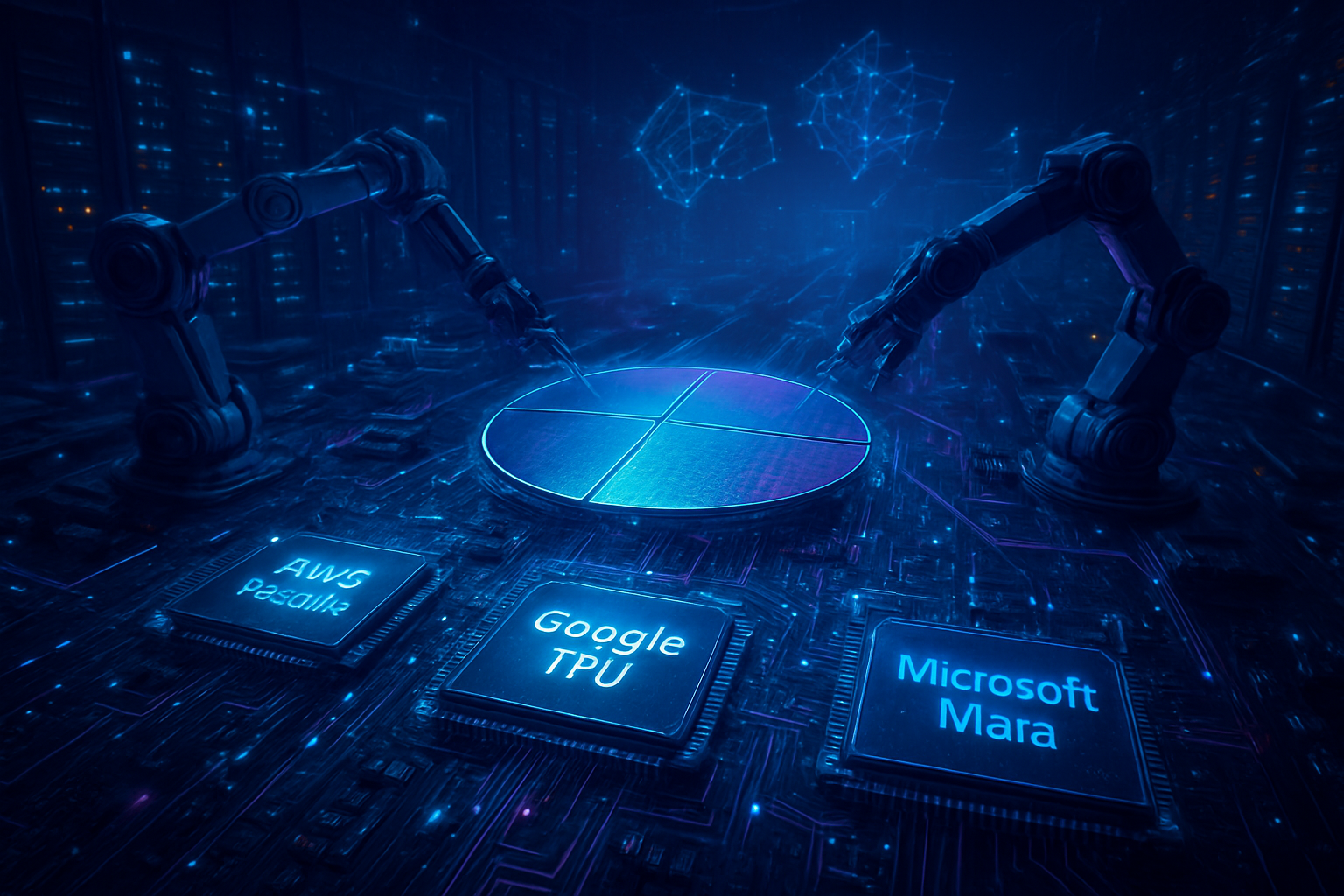
  • The Blackwell Era: Nvidia’s GB200 NVL72 Redefines the Trillion-Parameter Frontier

    The Blackwell Era: Nvidia’s GB200 NVL72 Redefines the Trillion-Parameter Frontier

    As of January 1, 2026, the artificial intelligence landscape has reached a pivotal inflection point, transitioning from the frantic "training race" of previous years to a sophisticated era of massive, real-time inference. At the heart of this shift is the full-scale deployment of Nvidia’s (NASDAQ:NVDA) Blackwell architecture, specifically the GB200 NVL72 liquid-cooled racks. These systems, now shipping at a rate of approximately 1,000 units per week, have effectively reset the benchmarks for what is possible in generative AI, enabling the seamless operation of trillion-parameter models that were once considered computationally prohibitive for widespread use.

    The arrival of the Blackwell era marks a fundamental change in the economics of intelligence. With a staggering 25x reduction in the total cost of ownership (TCO) for inference and a similar leap in energy efficiency, Nvidia has transformed the AI data center into a high-output "AI factory." However, this dominance is facing its most significant challenge yet as hyperscalers like Alphabet (NASDAQ:GOOGL) and Meta (NASDAQ:META) accelerate their own custom silicon programs. The battle for the future of AI compute is no longer just about raw power; it is about the efficiency of every token generated and the strategic autonomy of the world’s largest tech giants.

    The Technical Architecture of the Blackwell Superchip

    The GB200 NVL72 is not merely a collection of GPUs; it is a singular, massive compute engine. Each rack integrates 72 Blackwell GPUs and 36 Grace CPUs, interconnected via the fifth-generation NVLink, which provides a staggering 1.8 TB/s of bidirectional throughput per GPU. This allows the entire rack to act as a single GPU with 1.4 exaflops of AI performance and 30 TB of fast memory. The shift to the Blackwell Ultra (B300) variant in late 2025 further expanded this capability, introducing 288GB of HBM3E memory per chip to accommodate the massive context windows required by 2026’s "reasoning" models, such as OpenAI’s latest o-series and DeepSeek’s R-1 successors.

    Technically, the most significant advancement lies in the second-generation Transformer Engine, which utilizes micro-scaling formats including 4-bit floating point (FP4) precision. This allows Blackwell to deliver 30x the inference performance for 1.8-trillion parameter models compared to the previous H100 generation. Furthermore, the transition to liquid cooling has become a necessity rather than an option. With the TDP of individual B200 chips exceeding 1200W, the GB200 NVL72’s liquid-cooling manifold is the only way to maintain the thermal efficiency required for sustained high-load operations. This architectural shift has forced a massive global overhaul of data center infrastructure, as traditional air-cooled facilities are rapidly being retrofitted or replaced to support the high-density requirements of the Blackwell era.

    Industry experts have been quick to note that while the raw TFLOPS are impressive, the real breakthrough is the reduction in "communication tax." By utilizing the NVLink Switch System, Blackwell minimizes the latency typically associated with moving data between chips. Initial reactions from the research community emphasize that this allows for a "reasoning-at-scale" capability, where models can perform thousands of internal "thoughts" or steps before outputting a final answer to a user, all while maintaining a low-latency experience. This hardware breakthrough has effectively ended the era of "dumb" chatbots, ushering in an era of agentic AI that can solve complex multi-step problems in seconds.

    Competitive Pressure and the Rise of Custom Silicon

    While Nvidia (NASDAQ:NVDA) currently maintains an estimated 85-90% share of the merchant AI silicon market, the competitive landscape in 2026 is increasingly defined by "custom-built" alternatives. Alphabet (NASDAQ:GOOGL) has successfully deployed its seventh-generation TPU, codenamed "Ironwood" (TPU v7). These chips are designed specifically for the JAX and XLA software ecosystems, offering a compelling alternative for large-scale developers like Anthropic. Ironwood pods support up to 9,216 chips in a single synchronous configuration, matching Blackwell’s memory bandwidth and providing a more cost-effective solution for Google Cloud customers who don't require the broad compatibility of Nvidia’s CUDA platform.

    Meta (NASDAQ:META) has also made significant strides with its third-generation Meta Training and Inference Accelerator (MTIA 3). Unlike Nvidia’s general-purpose approach, MTIA 3 is surgically optimized for Meta’s internal recommendation and ranking algorithms. By January 2026, MTIA now handles over 50% of the internal workloads for Facebook and Instagram, significantly reducing Meta’s reliance on external silicon for its core business. This strategic move allows Meta to reserve its massive Blackwell clusters exclusively for the pre-training of its next-generation Llama frontier models, effectively creating a tiered hardware strategy that maximizes both performance and cost-efficiency.

    This surge in custom ASICs (Application-Specific Integrated Circuits) is creating a two-tier market. On one side, Nvidia remains the "gold standard" for frontier model training and general-purpose AI services used by startups and enterprises. On the other, hyperscalers like Amazon (NASDAQ:AMZN) and Microsoft (NASDAQ:MSFT) are aggressively pushing their own chips—Trainium/Inferentia and Maia, respectively—to lock in customers and lower their own operational overhead. The competitive implication is clear: Nvidia can no longer rely solely on being the fastest; it must now leverage its deep software moat, including the TensorRT-LLM libraries and the CUDA ecosystem, to prevent customers from migrating to these increasingly capable custom alternatives.

    The Global Impact of the 25x TCO Revolution

    The broader significance of the Blackwell deployment lies in the democratization of high-end inference. Nvidia’s claim of a 25x reduction in total cost of ownership has been largely validated by production data in early 2026. For a cloud provider, the cost of generating a million tokens has plummeted by nearly 20x compared to the Hopper (H100) generation. This economic shift has turned AI from an expensive experimental cost center into a high-margin utility. It has enabled the rise of "AI Factories"—massive data centers dedicated entirely to the production of intelligence—where the primary metric of success is no longer uptime, but "tokens per watt."

    However, this rapid advancement has also raised significant concerns regarding energy consumption and the "digital divide." While Blackwell is significantly more efficient per token, the sheer scale of deployment means that the total energy demand of the AI sector continues to climb. Companies like Oracle (NYSE:ORCL) have responded by co-locating Blackwell clusters with modular nuclear reactors (SMRs) to ensure a stable, carbon-neutral power supply. This trend highlights a new reality where AI hardware development is inextricably linked to national energy policy and global sustainability goals.

    Furthermore, the Blackwell era has redefined the "Memory Wall." As models grow to include trillions of parameters and context windows that span millions of tokens, the ability of hardware to keep that data "hot" in memory has become the primary bottleneck. Blackwell’s integration of high-bandwidth memory (HBM3E) and its massive NVLink fabric represent a successful, albeit expensive, solution to this problem. It sets a new standard for the industry, suggesting that future breakthroughs in AI will be as much about data movement and thermal management as they are about the underlying silicon logic.

    Looking Ahead: The Road to Rubin and AGI

    As we look toward the remainder of 2026, the industry is already anticipating Nvidia’s next move: the Rubin architecture (R100). Expected to enter mass production in the second half of the year, Rubin is rumored to feature HBM4 and an even more advanced 4×4 mesh interconnect. The near-term focus will be on further integrating AI hardware with "physical AI" applications, such as humanoid robotics and autonomous manufacturing, where the low-latency inference capabilities of Blackwell are already being put to the test.

    The primary challenge moving forward will be the transition from "static" models to "continuously learning" systems. Current hardware is optimized for fixed weights, but the next generation of AI will likely require chips that can update their knowledge in real-time without massive retraining costs. Experts predict that the hardware of 2027 and beyond will need to incorporate more neuromorphic or "brain-like" architectures to achieve the next order-of-magnitude leap in efficiency.

    In the long term, the success of Blackwell and its successors will be measured by their ability to support the pursuit of Artificial General Intelligence (AGI). As models move beyond simple text and image generation into complex reasoning and scientific discovery, the hardware must evolve to support non-linear thought processes. The GB200 NVL72 is the first step toward this "reasoning" infrastructure, providing the raw compute needed for models to simulate millions of potential outcomes before making a decision.

    Summary: A Landmark in AI History

    The deployment of Nvidia’s Blackwell GPUs and GB200 NVL72 racks stands as one of the most significant milestones in the history of computing. By delivering a 25x reduction in TCO and 30x gains in inference performance, Nvidia has effectively ended the era of "AI scarcity." Intelligence is now becoming a cheap, abundant commodity, fueling a new wave of innovation across every sector of the global economy. While custom silicon from Google and Meta provides a necessary competitive check, the Blackwell architecture remains the benchmark against which all other AI hardware is measured.

    As we move further into 2026, the key takeaways are clear: the "moat" in AI has shifted from training to inference efficiency, liquid cooling is the new standard for data center design, and the integration of hardware and software is more critical than ever. The industry has moved past the hype of the early 2020s and into a phase of industrial-scale execution. For investors and technologists alike, the coming months will be defined by how effectively these massive Blackwell clusters are utilized to solve real-world problems, from climate modeling to drug discovery.

    The "AI supercycle" is no longer a prediction—it is a reality, powered by the most complex and capable machines ever built. All eyes now remain on the production ramps of the late-2026 Rubin architecture and the continued evolution of custom silicon, as the race to build the foundation of the next intelligence age continues unabated.


    This content is intended for informational purposes only and represents analysis of current AI developments.

    TokenRing AI delivers enterprise-grade solutions for multi-agent AI workflow orchestration, AI-powered development tools, and seamless remote collaboration platforms.
    For more information, visit https://www.tokenring.ai/.