
Tag: GPT-5

  • The Summer of Agency: How OpenAI’s GPT-5 Redefined the Human-AI Interface in 2025

    The Summer of Agency: How OpenAI’s GPT-5 Redefined the Human-AI Interface in 2025

    As we close out 2025, the tech landscape looks fundamentally different than it did just twelve months ago. The primary catalyst for this shift was the August 7, 2025, release of GPT-5 by OpenAI. While previous iterations of the Generative Pre-trained Transformer were celebrated as world-class chatbots, GPT-5 marked a definitive transition from a conversational interface to a proactive, agentic system. By making this "orchestrator" model the default for all ChatGPT users, OpenAI effectively ended the era of "prompt engineering" and ushered in the era of "intent-based" computing.

    The immediate significance of GPT-5 lay in its ability to operate not just as a text generator, but as a digital project manager. For the first time, a consumer-grade AI could autonomously navigate complex, multi-step workflows—such as building a full-stack application or conducting a multi-source research deep-dive—with minimal human intervention. This release didn't just move the needle on intelligence; it changed the very nature of how humans interact with machines, shifting the user's role from a "writer of instructions" to a "reviewer of outcomes."

    The Orchestrator Architecture: Beyond the Chatbot

    Technically, GPT-5 is less a single model and more a sophisticated "orchestrator" system. At its core is a real-time router that analyzes user intent and automatically switches between different internal reasoning modes. This "auto-switching" capability means that for a simple query like "summarize this email," the system uses a high-speed, low-compute mode (often referred to as GPT-5 Nano). However, when faced with a complex logic puzzle or a request to "refactor this entire GitHub repository," the system engages "Thinking Mode." This mode is the public realization of the long-rumored "Project Strawberry" (formerly known as Q*), which allows the model to traverse multiple reasoning paths and "think" before it speaks.

    This differs from GPT-4o and its predecessors by moving away from a linear token-prediction model toward a "search-based" reasoning architecture. In benchmarks, GPT-5 Thinking achieved a staggering 94.6% score on the AIME 2025 mathematics competition, a feat that was previously thought to be years away. Furthermore, the model's tool-calling accuracy jumped to over 98%, virtually eliminating the "hallucinations" that plagued earlier agents when interacting with external APIs or local file systems. The AI research community has hailed this as a "Level 4" milestone on the path to AGI—semi-autonomous systems that can manage projects independently.

    The Competitive Fallout: A New Arms Race for Autonomy

    The release of GPT-5 sent shockwaves through the industry, forcing major competitors to accelerate their own agentic roadmaps. Microsoft (NASDAQ:MSFT), as OpenAI’s primary partner, immediately integrated these orchestrator capabilities into its Copilot ecosystem, giving it a massive strategic advantage in the enterprise sector. However, the competition has been fierce. Google (NASDAQ:GOOGL) responded in late 2025 with Gemini 3, which remains the leader in multimodal context, supporting up to 2 million tokens and excelling in "Video-to-Everything" understanding—a direct challenge to OpenAI's dominance in data-heavy analysis.

    Meanwhile, Anthropic has positioned its Claude 4.5 Opus as the "Safe & Accurate" alternative, focusing on nuanced writing and constitutional AI guardrails that appeal to highly regulated industries like law and healthcare. Meta (NASDAQ:META) has also made significant strides with Llama 4, the open-source giant that reached parity with GPT-4.5 levels of intelligence. The availability of Llama 4 has sparked a surge in "on-device AI," where smaller, distilled versions of these models power local agents on smartphones without requiring cloud access, potentially disrupting the cloud-only dominance of OpenAI and Microsoft.

    The Wider Significance: From 'Human-in-the-Loop' to 'Human-on-the-Loop'

    The wider significance of the GPT-5 era is the shift in the human labor paradigm. We have moved from "Human-in-the-loop," where every AI action required a manual prompt and verification, to "Human-on-the-loop," where the AI acts as an autonomous agent that humans supervise. This has had a profound impact on software development, where "vibe-coding"—describing a feature and letting the AI generate and test the pull request—has become the standard workflow for many startups.

    However, this transition has not been without concern. The agentic nature of GPT-5 has raised new questions about AI safety and accountability. When an AI can autonomously browse the web, make purchases, or modify codebases, the potential for unintended consequences increases. Comparisons are frequently made to the "Netscape moment" of the 1990s; just as the browser made the internet accessible to the masses, GPT-5 has made autonomous agency accessible to anyone with a smartphone. The debate has shifted from "can AI do this?" to "should we let AI do this autonomously?"

    The Horizon: Robotics and the Physical World

    Looking ahead to 2026, the next frontier for GPT-5’s architecture is the physical world. Experts predict that the reasoning capabilities of "Project Strawberry" will be the "brain" for the next generation of humanoid robotics. We are already seeing early pilots where GPT-5-powered agents are used to control robotic limbs in manufacturing settings, translating high-level natural language instructions into precise physical movements.

    Near-term developments are expected to focus on "persistent memory," where agents will have long-term "personalities" and histories with their users, effectively acting as digital twins. The challenge remains in compute costs and energy consumption; running "Thinking Mode" at scale is incredibly resource-intensive. As we move into 2026, the industry's focus will likely shift toward "inference efficiency"—finding ways to provide GPT-5-level reasoning at a fraction of the current energy cost, likely powered by the latest Blackwell chips from NVIDIA (NASDAQ:NVDA).

    Wrapping Up the Year of the Agent

    In summary, 2025 will be remembered as the year OpenAI’s GPT-5 turned the "chatbot" into a relic of the past. By introducing an auto-switching orchestrator that prioritizes reasoning over mere word prediction, OpenAI has set a new standard for what users expect from artificial intelligence. The transition to agentic AI is no longer a theoretical goal; it is a functional reality for millions of ChatGPT users who now delegate entire workflows to their digital assistants.

    As we look toward the coming months, the focus will be on how society adapts to these autonomous agents. From regulatory battles over AI "agency" to the continued integration of AI into physical hardware, the "Summer of Agency" was just the beginning. GPT-5 didn't just give us a smarter AI; it gave us a glimpse into a future where the boundary between human intent and machine execution is thinner than ever before.


    This content is intended for informational purposes only and represents analysis of current AI developments.

    TokenRing AI delivers enterprise-grade solutions for multi-agent AI workflow orchestration, AI-powered development tools, and seamless remote collaboration platforms.
    For more information, visit https://www.tokenring.ai/.
  • OpenAI and Walmart Launch Landmark AI Jobs Platform and Certifications to Transform Global Workforce

    OpenAI and Walmart Launch Landmark AI Jobs Platform and Certifications to Transform Global Workforce

    In a move that signals a tectonic shift in the relationship between artificial intelligence and the labor market, OpenAI and Walmart (NYSE: WMT) have officially launched a comprehensive AI Jobs Platform and a suite of industry-standard AI Certifications. Announced late in 2025, this partnership aims to bridge the widening "skills gap" by providing millions of workers with the tools and credentials necessary to thrive in an economy increasingly dominated by agentic workflows and automated systems.

    The initiative represents the most significant private-sector effort to date to address the potential for AI-driven job displacement. By combining OpenAI’s cutting-edge Large Language Models (LLMs) with Walmart’s massive workforce and logistical infrastructure, the two giants are attempting to create a "standardized currency" for labor in the AI era. For Walmart, it is a bid to modernize its 1.6 million-strong U.S. workforce; for OpenAI, it is a strategic step toward becoming the underlying infrastructure for the future of work itself.

    Technical Foundations: From Chatbots to Career Architects

    The centerpiece of this collaboration is the OpenAI Jobs Platform, an AI-native recruitment and talent management ecosystem. Unlike traditional platforms like LinkedIn, which rely on keyword matching and static resumes, the new platform utilizes OpenAI’s most advanced models—widely understood to be built upon the GPT-5 architecture—to analyze a candidate’s "verified competencies." The system evaluates users through a series of hands-on "sandbox" simulations where their ability to collaborate with AI agents, solve complex logistical problems, and refine prompts is measured in real-time.

    A key technical innovation is the introduction of "Study Mode" within the ChatGPT interface. This specialized environment acts as a personalized tutor, guiding workers through the new AI Certification tracks. These certifications range from "AI Foundations"—covering basic tool literacy—to advanced "Prompt Engineering" and "Retail Logic Automation." The training is adaptive, meaning the AI tutor identifies specific areas where a learner struggles and adjusts the curriculum dynamically to ensure mastery before a certification is granted.

    This approach differs fundamentally from previous e-learning models. Rather than watching videos and taking multiple-choice quizzes, employees are required to build functional AI workflows within a controlled environment. Industry experts have noted that this "performance-based" certification could eventually replace the traditional college degree for many technical and operational roles, as it provides a more accurate reflection of a worker's ability to operate in a high-tech environment.

    Market Disruptions: A New Front in the Tech Arms Race

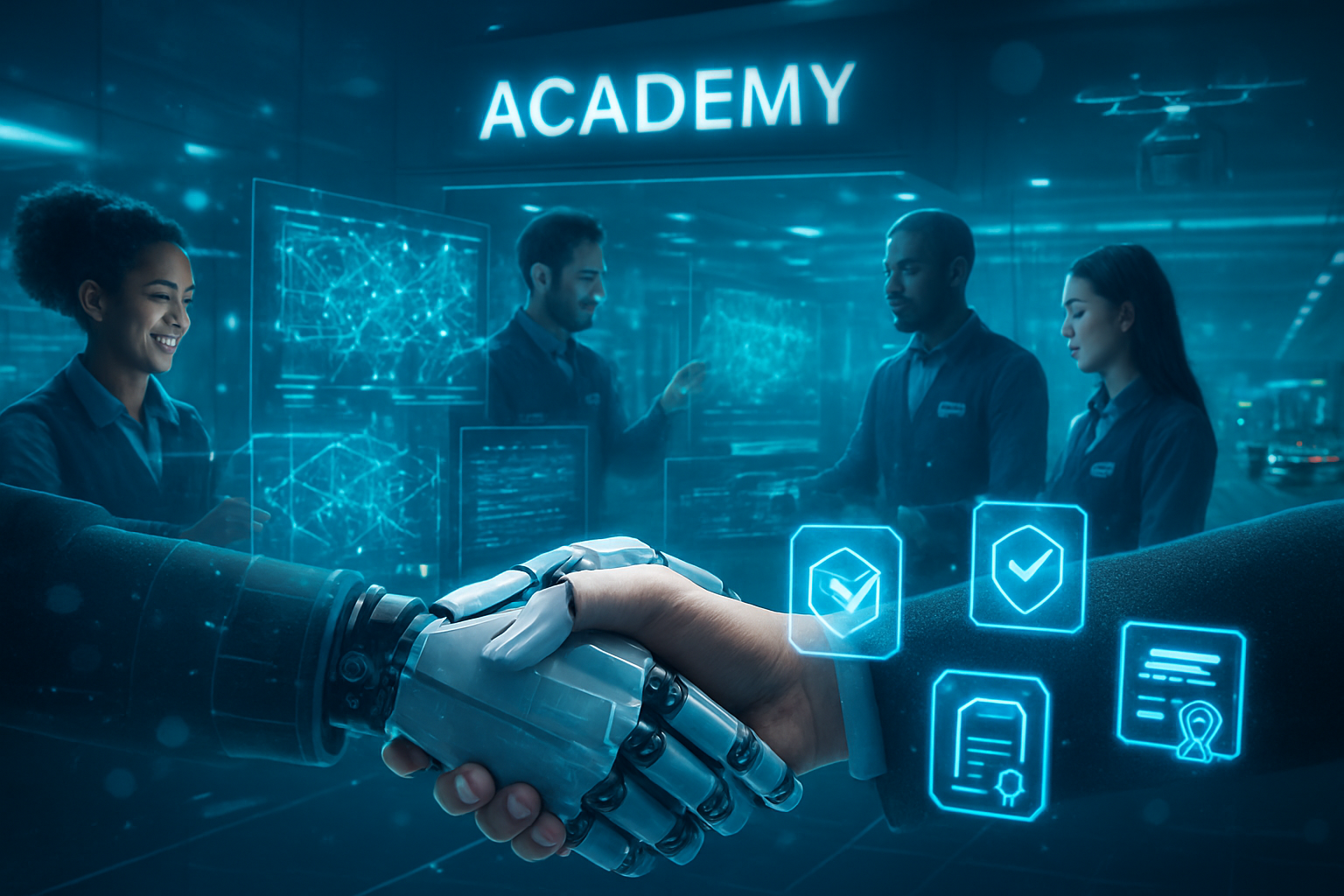
    The partnership has sent shockwaves through the tech and retail sectors, particularly affecting competitors like Amazon (NASDAQ: AMZN). By integrating AI training directly into the "Walmart Academy," Walmart is positioning itself as a high-tech employer of choice, potentially siphoning talent away from traditional tech hubs. Analysts at Morgan Stanley (NYSE: MS) have suggested that this move could close the digital efficiency gap between Walmart and its e-commerce rivals, as a "certified" workforce is expected to be 30-40% more productive in managing supply chains and customer interactions.

    For the broader AI industry, OpenAI’s move into the jobs and certification market marks a pivot from being a software provider to becoming a labor-market regulator. By setting the standards for what constitutes "AI literacy," OpenAI is effectively defining the skill sets that will be required for the next decade. This creates a powerful moat; companies that want to hire "AI-certified" workers will naturally gravitate toward the OpenAI ecosystem, further solidifying the company's dominance over rivals like Google or Anthropic.

    Startups in the HR-tech space are also feeling the heat. The vertical integration of training, certification, and job placement into a single platform threatens to disrupt a multi-billion dollar industry. Companies that previously focused on "upskilling" are now finding themselves competing with the very creators of the technology they are trying to teach, leading to a wave of consolidation as smaller players seek to find niche specializations not yet covered by the OpenAI-Walmart juggernaut.

    Societal Implications and the Labor Backlash

    While the tech community has largely lauded the move as a proactive solution to automation, labor advocacy groups have expressed deep-seated concerns. The AFL-CIO and other major unions have criticized the initiative as a "top-down" approach that lacks sufficient worker protections. Critics argue that by allowing a single corporation to define and certify skills, workers may become "vendor-locked" to specific AI tools, reducing their mobility and bargaining power in the long run.

    There are also significant concerns regarding the "black box" nature of AI-driven hiring. If the OpenAI Jobs Platform uses proprietary algorithms to match workers with roles, there are fears that existing biases could be baked into the system, leading to systemic exclusion under the guise of "objective" data. The California Federation of Labor Unions has already called for legislative oversight to ensure that these AI certifications are transparent and that the data collected during the "Study Mode" training is not used to penalize or surveil employees.

    Despite these concerns, the broader AI landscape is moving toward this model of "agentic commerce." The idea that a worker is not just a manual laborer but a "manager of agents" is becoming the new standard. This shift mirrors previous industrial milestones, such as the introduction of the assembly line or the personal computer, but at a velocity that is unprecedented. The success or failure of this partnership will likely serve as a blueprint for how other Fortune 500 companies handle the transition to an AI-first economy.

    The Horizon: What Lies Ahead for the AI Workforce

    Looking forward, OpenAI has set an ambitious goal to certify 10 million Americans by 2030. In the near term, we can expect the Jobs Platform to expand beyond Walmart to include other major retailers and eventually government agencies. There are already rumors of a "Public Sector Track" designed to help modernize local bureaucracies through AI-certified administrative staff. As the technology matures, we may see the emergence of "Micro-Certifications"—highly specific credentials for niche tasks that can be earned in hours rather than weeks.

    The long-term challenge will be the "half-life" of these skills. In an era where AI models are updated every few months, a certification earned today might be obsolete by next year. Experts predict that the future of work will involve "continuous certification," where workers are constantly in a state of learning, guided by their AI tutors. This will require a fundamental rethinking of the work-week, potentially leading to a model where a portion of every employee's day is dedicated solely to AI-led skill maintenance.

    Final Assessment: A Turning Point in Human-AI Collaboration

    The partnership between OpenAI and Walmart is more than just a corporate training program; it is a bold experiment in social engineering. By attempting to standardize AI education at scale, these companies are laying the groundwork for a new social contract in the age of automation. Whether this leads to a more empowered, highly-skilled workforce or a new form of corporate dependency remains to be seen, but the significance of this moment cannot be overstated.

    As we move into 2026, the industry will be watching the pilot results from Walmart’s 1.6 million associates with intense scrutiny. If the platform successfully transitions these workers into higher-value roles, it will be remembered as the moment the "AI revolution" finally became inclusive of the broader workforce. For now, the message is clear: the era of the "AI-augmented worker" has arrived, and the race to define that role is officially on.


    This content is intended for informational purposes only and represents analysis of current AI developments.

    TokenRing AI delivers enterprise-grade solutions for multi-agent AI workflow orchestration, AI-powered development tools, and seamless remote collaboration platforms.
    For more information, visit https://www.tokenring.ai/.
  • GPT-5 Widens the Gap: Proprietary AI Soars, Open-Source Faces Uphill Battle in Benchmarks

    GPT-5 Widens the Gap: Proprietary AI Soars, Open-Source Faces Uphill Battle in Benchmarks

    San Francisco, CA – October 10, 2025 – Recent AI benchmark results have sent ripples through the tech industry, revealing a significant and growing performance chasm between cutting-edge proprietary models like OpenAI's GPT-5 and their open-source counterparts. While the open-source community continues to innovate at a rapid pace, the latest evaluations underscore a widening lead for closed-source models in critical areas such as complex reasoning, mathematics, and coding, raising pertinent questions about the future of accessible AI and the democratization of advanced artificial intelligence.

    The findings highlight a pivotal moment in the AI arms race, where the immense resources and specialized data available to tech giants are translating into unparalleled capabilities. This divergence not only impacts the immediate accessibility of top-tier AI but also fuels discussions about the concentration of AI power and the potential for an increasingly stratified technological landscape, where the most advanced tools remain largely behind corporate walls.

    The Technical Chasm: Unpacking GPT-5's Dominance

    OpenAI's (NASDAQ: MSFT) GPT-5, officially launched and deeply integrated into Microsoft's (NASDAQ: MSFT) ecosystem by late 2025, represents a monumental leap in AI capabilities. Experts now describe GPT-5's performance as reaching a "PhD-level expert," a stark contrast to GPT-4's previously impressive "college student" level. This advancement is evident across a spectrum of benchmarks, where GPT-5 consistently sets new state-of-the-art records.

    In reasoning, GPT-5 Pro, when augmented with Python tools, achieved an astounding 89.4% on the GPQA Diamond benchmark, a set of PhD-level science questions, slightly surpassing its no-tools variant and leading competitors like Google's (NASDAQ: GOOGL) Gemini 2.5 Pro and xAI's Grok-4. Mathematics is another area of unprecedented success, with GPT-5 (without external tools) scoring 94.6% on the AIME 2025 benchmark, and GPT-5 Pro achieving a perfect 100% accuracy on the Harvard-MIT Mathematics Tournament (HMMT) with Python tools. This dramatically outpaces Gemini 2.5's 88% and Grok-4's 93% on AIME 2025. Furthermore, GPT-5 is hailed as OpenAI's "strongest coding model yet," scoring 74.9% on SWE-bench Verified for real-world software engineering challenges and 88% on multi-language code editing tasks. These technical specifications demonstrate a level of sophistication and reliability that significantly differentiates it from previous generations and many current open-source alternatives.

    The performance gap is not merely anecdotal; it's quantified across numerous metrics. While robust open-source models are closing in on focused tasks, often achieving GPT-3.5 level performance and even approaching GPT-4 parity in specific categories like code generation, the frontier models like GPT-5 maintain a clear lead in complex, multi-faceted tasks requiring deep reasoning and problem-solving. This disparity stems from several factors, including the immense computational resources, vast proprietary training datasets, and dedicated professional support that commercial entities can leverage—advantages largely unavailable to the open-source community. Security vulnerabilities, immature development practices, and the sheer complexity of modern LLMs also pose significant challenges for open-source projects, making it difficult for them to keep pace with the rapid advancements of well-funded, closed-source initiatives.

    Industry Implications: Shifting Sands for AI Titans and Startups

    The ascension of GPT-5 and similar proprietary models has profound implications for the competitive landscape of the AI industry. Tech giants like OpenAI, backed by Microsoft, stand to be the primary beneficiaries. Microsoft, having deeply integrated GPT-5 across its extensive product suite including Microsoft 365 Copilot and Azure AI Foundry, strengthens its position as a leading AI solutions provider, offering unparalleled capabilities to enterprise clients. Similarly, Google's integration of Gemini across its vast ecosystem, and xAI's Grok-4, underscore an intensified battle for market dominance in AI services.

    This development creates a significant competitive advantage for companies that can develop and deploy such advanced models. For major AI labs, it necessitates continuous, substantial investment in research, development, and infrastructure to remain at the forefront. The cost-efficiency and speed offered by GPT-5's API, with reduced pricing and fewer token calls for superior results, also give it an edge in attracting developers and businesses looking for high-performance, economical solutions. This could potentially disrupt existing products or services built on less capable models, forcing companies to upgrade or risk falling behind.

    Startups and smaller AI companies, while still able to leverage open-source models for specific applications, might find it increasingly challenging to compete directly with the raw performance of proprietary models without significant investment in licensing or infrastructure. This could lead to a bifurcation of the market: one segment dominated by high-performance, proprietary AI for complex tasks, and another where open-source models thrive on customization, cost-effectiveness for niche applications, and secure self-hosting, particularly for industries with stringent data privacy requirements. The strategic advantage lies with those who can either build or afford access to the most advanced AI capabilities, further solidifying the market positioning of tech titans.

    Wider Significance: Centralization, Innovation, and the AI Landscape

    The widening performance gap between proprietary and open-source AI models fits into a broader trend of centralization within the AI landscape. While the initial promise of open-source AI was to democratize access to powerful tools, the resource intensity required to train and maintain frontier models increasingly funnels advanced AI development into the hands of well-funded organizations. This raises concerns about unequal access to cutting-edge capabilities, potentially creating barriers for individuals, small businesses, and researchers with limited budgets who cannot afford the commercial APIs.

    Despite this, open-source models retain immense significance. They offer crucial benefits such as transparency, customizability, and the ability to deploy models securely on internal servers—a vital aspect for industries like healthcare where data privacy is paramount. This flexibility fosters innovation by allowing tailored solutions for diverse needs, including accessibility features, and lowers the barrier to entry for training and experimentation, enabling a broader developer ecosystem. However, the current trajectory suggests that the most revolutionary breakthroughs, particularly in general intelligence and complex problem-solving, may continue to emerge from closed-source labs.

    This situation echoes previous technological milestones where initial innovation was often centralized before broader accessibility through open standards or commoditization. The challenge for the AI community is to ensure that while proprietary models push the boundaries of what's possible, efforts continue to strengthen the open-source ecosystem to prevent a future where advanced AI becomes an exclusive domain. Regulatory concerns regarding data privacy, the use of copyrighted materials in training, and the ethical deployment of powerful AI tools are also becoming more pressing, highlighting the need for a balanced approach that fosters both innovation and responsible development.

    Future Developments: The Road Ahead for AI

    Looking ahead, the AI landscape is poised for continuous, rapid evolution. In the near term, experts predict an intensified focus on agentic AI, where models are designed to perform complex tasks autonomously, making decisions and executing actions with minimal human intervention. GPT-5's enhanced reasoning and coding capabilities make it a prime candidate for leading this charge, enabling more sophisticated AI-powered agents across various industries. We can expect to see further integration of these advanced models into enterprise solutions, driving efficiency and automation in core business functions, with cybersecurity and IT leading in demonstrating measurable ROI.

    Long-term developments will likely involve continued breakthroughs in multimodal AI, with models seamlessly processing and generating information across text, image, audio, and video. GPT-5's unprecedented strength in spatial intelligence, achieving human-level performance on some metric measurement and spatial relations tasks, hints at future applications in robotics, autonomous navigation, and advanced simulation. However, challenges remain, particularly in addressing the resource disparity that limits open-source models. Collaborative initiatives and increased funding for open-source AI research will be crucial to narrow the gap and ensure a more equitable distribution of AI capabilities.

    Experts predict that the "new AI rails" will be solidified by the end of 2025, with major tech companies continuing to invest heavily in data center infrastructure to power these advanced models. The focus will shift from initial hype to strategic deployment, with enterprises demanding clear value and return on investment from their AI initiatives. The ongoing debate around regulatory frameworks and ethical guidelines for AI will also intensify, shaping how these powerful technologies are developed and deployed responsibly.

    A New Era of AI: Power, Access, and Responsibility

    The benchmark results showcasing GPT-5's significant lead mark a defining moment in AI history, underscoring the extraordinary progress being made by well-resourced proprietary labs. This development solidifies the notion that we are entering a new era of AI, characterized by models capable of unprecedented levels of reasoning, problem-solving, and efficiency. The immediate significance lies in the heightened capabilities now available to businesses and developers through commercial APIs, promising transformative applications across virtually every sector.

    However, this triumph also casts a long shadow over the future of accessible AI. The performance gap raises critical questions about the democratization of advanced AI and the potential for a concentrated power structure in the hands of a few tech giants. While open-source models continue to serve a vital role in fostering innovation, customization, and secure deployments, the challenge for the community will be to find ways to compete or collaborate to bring frontier capabilities to a wider audience.

    In the coming weeks and months, the industry will be watching closely for further iterations of these benchmark results, the emergence of new open-source contenders, and the strategic responses from companies across the AI ecosystem. The ongoing conversation around ethical AI development, data privacy, and the responsible deployment of increasingly powerful models will also remain paramount. The balance between pushing the boundaries of AI capabilities and ensuring broad, equitable access will define the next chapter of artificial intelligence.


    This content is intended for informational purposes only and represents analysis of current AI developments.

    TokenRing AI delivers enterprise-grade solutions for multi-agent AI workflow orchestration, AI-powered development tools, and seamless remote collaboration platforms.
    For more information, visit https://www.tokenring.ai/.